Walter Morrison pushed open the glass door of Drove’s John Deere just after nine on a gray Tuesday morning, carrying a stained folder in one hand and his old green cap in the other. The showroom smelled of new rubber, polished floors, coffee, and expensive paint, with rows of green tractors lined beneath bright ceiling lights like machines waiting for applause. His boots left faint traces of dried mud across the tile, and two young salesmen looked up from the counter with the kind of smile men use when they think a customer has wandered into the wrong place. Walter did not look around with wonder, because he had seen enough shiny things in his life to know shine could hide a payment book.
At the far counter stood Preston Blake, the dealership manager who wore a dark green shirt with the Drove’s John Deere logo stitched over his chest. Preston was not the owner, but he acted like the building belonged to him, mostly because he had learned that arrogance sounded like confidence to people who did not listen closely. He looked down at the paper in Walter’s hand before he looked at Walter’s face. Then he smiled, and Walter already knew the morning was going to turn ugly.
“Well, look who finally decided to visit the future,” Preston said, loud enough for the salesmen to hear. Walter walked to the counter and set the folder down carefully, smoothing the corner with a thumb worn rough from seventy-four years of work. Behind Preston, a brand-new John Deere tractor sat under showroom lights with a price tag that looked like a mortgage. Walter glanced at it once, then looked back at the man blocking the counter with his folded arms.
“I came about the Farmall,” Walter said. “I need a part cross-check and a printed quote for the repair file.” Preston’s smile widened as if Walter had handed him a gift wrapped in humiliation. He reached for the paper and tapped it with one finger. “Walter, this Farmall is dead iron. The only thing older than that tractor is your pride.”
The words carried across the showroom, and the young salesmen laughed before they knew whether they should. A couple near the parts desk turned to watch, and an older farmer near the oil display slowly lowered a filter box from his hand. Walter held his cap against his leg and did not blink. “Careful, Preston,” he said coldly. “That dead iron has earned more honest money than your whole showroom of borrowed paint.”
Preston’s jaw tightened, but he recovered quickly because cruelty came easily to him in public. He leaned over the counter and pointed toward the tractors behind him. “You’re not loyal to that Farmall. You’re just too broke to buy progress.” The words landed harder than the laughter, because everyone in Johnson County knew Walter had nearly lost his farm years earlier after Eleanor’s medical bills swallowed everything he had saved. Preston knew it too, and that was why he said it.
Walter’s fingers tightened around his cap, but he did not raise his voice. “No, Preston,” he said, pushing the records forward. “I’m too smart to mortgage my land just to impress a salesman afraid of dirt.” The older farmer near the oil display looked up sharply, and one of the young salesmen stopped smiling. Preston’s face darkened because he could handle silence better than applause turning against him.
The folder on the counter held forty-four years of records for Walter’s 1952 Farmall M. Every oil change, every adjustment, every belt, blade, plug, gasket, and bearing was written down in neat pencil or ink. Walter had brought it because he needed proof that a small part could be matched through an old supplier, not because he expected respect. Still, Preston picked up the pages like they smelled bad and flipped through them with exaggerated boredom.
“This is exactly what I’m talking about,” Preston said. “A lifetime of patching junk when one modern tractor could do the work faster, cleaner, and smarter.” Walter looked past him at the rows of machines wearing yellow wheels and dealer polish. “Faster does not always mean better.” Preston laughed, but this time fewer people joined him. “That sounds like something men say when they cannot afford faster.”
Walter leaned both hands on the counter, and the room seemed to narrow around him. “Your John Deere sells power,” he said, voice sharp and steady. “My Farmall proves skill, patience, and a real farmer still beat your expensive mouth.” The sentence struck the room like a dropped wrench. Preston’s cheeks flushed, and the assistant manager near the office doorway slowly stepped back as if he wanted no part of what came next.
Preston grabbed one of the record sheets and held it up. “You really think anyone in here believes that old Farmall can outwork a modern tractor?” Walter did not answer immediately. He reached into the folder and removed another page, this one printed by the county extension office. It showed the results from Carl Johnson’s eighty-acre plowing test the previous summer, where Preston’s new demonstrator had finished faster but Walter’s Farmall had delivered better soil turnover, straighter rows, and far lower fuel use.
The showroom went quiet as Walter slid the report across the counter. Preston glanced at it, then pushed it back as if refusing the paper could erase the numbers. “That contest was a joke,” he snapped. “They changed the rules to make you look good.” Walter’s expression stayed calm, but his eyes sharpened. “No, Preston. They judged farming instead of theater.”
The older farmer by the oil display stepped closer now, drawn in by the report on the counter. His name was Carl Johnson, and it had been his field where the test happened. He took off his glasses, cleaned them on his shirt, and looked at Preston. “That was my soil,” Carl said. “Walter’s work was cleaner.” Preston glared at him, suddenly realizing the showroom had witnesses he could not control.
Preston pointed at Carl. “You old men always protect each other. You want everybody stuck in the past because that makes you feel useful.” Carl’s mouth tightened, but Walter lifted a hand, silently telling him not to answer. Walter had not come for a shouting match. He had come for a part, but Preston had turned the counter into a courtroom, and Walter was done being treated like evidence of failure.
“You used my name to sell debt,” Walter said. Preston went still. “For years, you told farmers they would end up like me if they didn’t buy something new from you. You pointed at my old tractor and called it shame. You never told them I kept farming because I refused to lose my land.” The air seemed to pull tight around the counter.
One of the young salesmen looked down at his shoes. He had heard Preston use Walter’s name in sales pitches many times, always as a warning, always with a laugh. Walter turned slightly so the others could hear him clearly. “You never told them my Farmall was paid for. You never told them I knew every inch of my field, every sound in that engine, every place the soil pulls hard and every place it turns easy.” His voice did not shake, and that made it stronger.
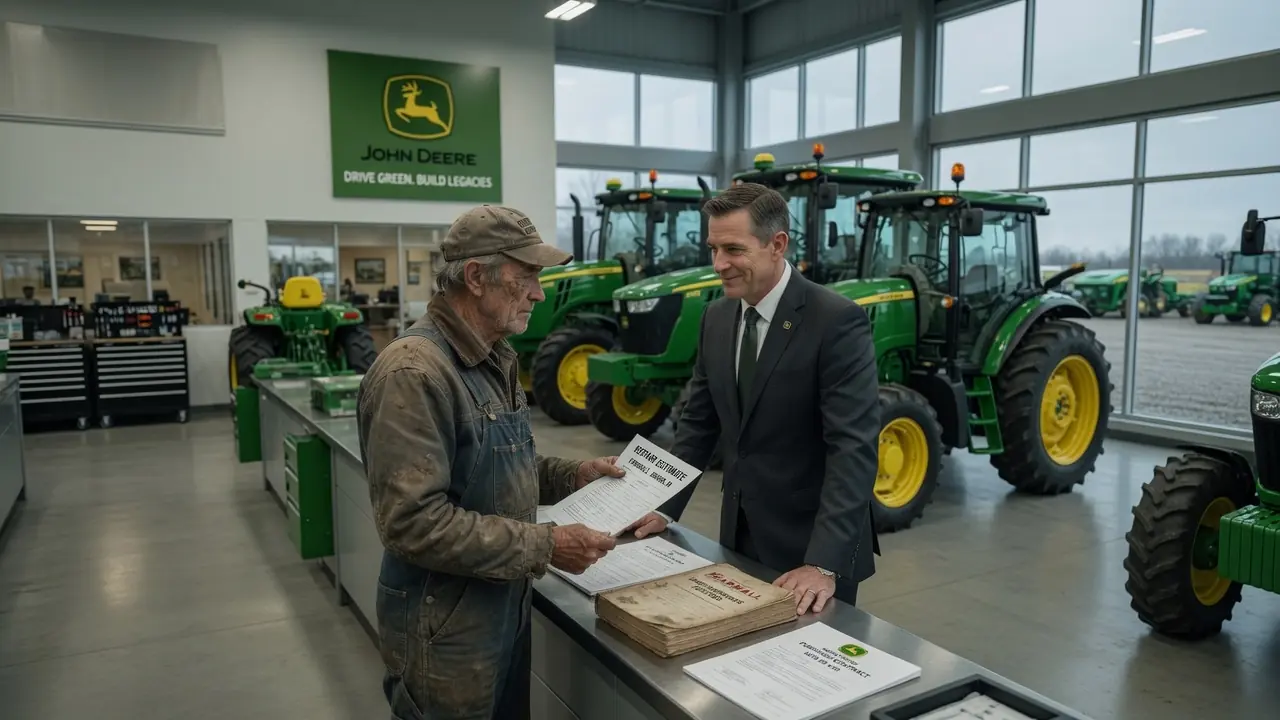
Preston slapped the report with his palm. “Nobody cares about your sentimental speech. Farmers need production.” Walter nodded once. “Then let us talk production.” He opened another page and placed it flat on the counter. It showed fuel costs, maintenance totals, equipment debt comparisons, and yield records over five years.
Preston glanced at the page and immediately looked away. Walter had spent the previous week gathering every number, not to brag, but to defend the truth. His Farmall did not have air conditioning, GPS, or a computer screen, but it also did not come with a six-figure loan. Walter had survived by understanding what every acre gave and what every machine took.
“My Farmall cost me eight hundred dollars in 1979,” Walter said. “I have maintained it for forty-four years. Over five seasons, my equipment cost per acre stayed lower than most farms running machines worth ten times more.” Preston forced a laugh. “You expect me to believe an antique beats modern equipment on economics?” Walter tapped the report. “You do not have to believe. You can read.”
A woman near the parts counter stepped forward. She was Jenna Miller, a young farmer who had inherited eighty acres from her father and had recently been pushed toward financing a new tractor she did not fully need. Preston had told her repairs were throwing money into a hole and that serious farmers upgraded before they got left behind. Now she looked at Walter’s numbers with a troubled face. “Mr. Blake told me older machines were costing me my future,” she said quietly.
Walter turned to her with softness in his tired eyes. “Sometimes they do. Sometimes they do not.” He looked back at Preston. “A good dealer helps you know the difference. A hungry salesman makes every problem look like a payment plan.” Jenna’s face hardened as she understood how fear had been used on her.
Preston’s confidence was slipping, and because it was slipping, he became meaner. “You think this makes you smart?” he asked Walter. “You walk in here covered in mud, carrying a folder like a schoolboy, acting like you know more than people who sell equipment every day.” Walter’s mouth tightened. “You sell equipment, Preston. You do not farm.” That line hit the showroom harder than any insult.
Preston stepped around the counter, face red now. “I know more about machines than you ever will.” Walter looked at the clean hands, the polished shoes, and the shirt with no sweat in the collar. “Then tell me why your operator burned nearly seven times the fuel on Carl Johnson’s field while producing lower-quality turnover.” Preston opened his mouth, but no answer came. Carl Johnson gave a low whistle from behind Walter.
The assistant manager finally moved closer, nervous now that customers were listening. “Preston, maybe we should take this to the office.” Preston snapped his head toward him. “Stay out of this.” Walter watched the exchange carefully. He had seen this kind of man before, one who treated subordinates like tools and customers like targets.
Walter reached into the folder again and pulled out one final sheet. This one was not about the Farmall. It was a copy of complaints farmers had made about aggressive financing, unnecessary upgrade pressure, and service quotes that doubled after customers signed loan papers. Walter placed it down with the same calm care as the others. “Since you like paperwork, I brought more.”
Preston stared at the sheet, and this time real fear moved through his eyes. “Where did you get that?” Walter did not smile. “From men who were too embarrassed to admit they had been cornered.” Jenna stepped closer and looked at the paper. Carl Johnson crossed his arms, his face turning hard as he recognized two names on the list.
The showroom doors opened behind them, and two more farmers walked in, then stopped when they sensed the tension. Preston tried to gather himself. “This is private business.” Walter shook his head slowly. “No, Preston. Private business happens in honest offices. Public shame happens when a man builds profit by making farmers feel poor, stupid, and afraid.”
A heavy silence followed. One of the new customers, a middle-aged man named Roy Ellison, looked from Walter to Preston. “He told me my combine repair was not worth doing,” Roy said. “Then another mechanic fixed it for less than half the quote.” Another farmer near the display tractors nodded. “He told my nephew he’d be laughed out of the county if he didn’t upgrade.” The young salesmen at the counter no longer looked amused.
Preston lifted both hands as if calming animals. “Everybody relax. This is getting ridiculous.” Walter pointed at the shiny tractor behind him. “That machine may be fine. I never said it was not.” Preston blinked, surprised. Walter continued, “What I said is that you are not fine, because you sell pride to men who need advice.”
For the first time all morning, Preston looked toward the showroom windows instead of the people in front of him. He had thought Walter’s dirty coat made him weak, but the old man had walked in with records, witnesses, and numbers. He had thought the Farmall was a joke, but it had become a symbol of everything Preston could not fake. Worse, the room was beginning to see the difference between a farmer and a dealer who only understood payment terms.
The general manager, Harland Drove, stepped out from the back office after hearing his dealership name dragged into the air like a warning. He was older than Preston, broad-shouldered, and usually quiet in the way owners become when they have survived more than one bad employee. His eyes moved from the papers to Walter, then to Preston’s flushed face. “What is going on in my showroom?”
Preston answered too quickly. “A customer is making accusations and disrupting business.” Walter picked up his folder but left the complaint sheet on the counter. “A customer asked for a part quote and got mocked for his clothes, his tractor, and his farm.” Harland’s face changed slightly. He looked at the young salesmen. Neither one denied it.
Harland turned to Preston. “Did you refuse to check his part request?” Preston swallowed. “I was trying to advise him toward a better equipment solution.” Walter looked at Harland. “He called my Farmall dead iron, my pride old, and my loyalty poverty.” The older farmer Carl added, “He said poor farmers worship junk because they can’t afford progress.”
Harland’s jaw tightened. For a moment, Preston looked less like a powerful dealer and more like a boy caught breaking something expensive. “Preston,” Harland said, “my father opened this place selling parts to farmers who could not always buy new.” Preston tried to speak, but Harland lifted one hand. “If you have forgotten that, then you have forgotten why this sign is on the wall.”
Walter looked up at the green sign above the showroom floor. The deer logo and the Drove’s name had been polished clean, but he wondered how many farmers had walked under it feeling smaller than when they entered. He had come in expecting disrespect, but he had not expected the room to turn. Now every face seemed to ask the same question: how many times had they been sold shame instead of service?
Harland picked up Walter’s repair request and read it carefully. “This part can be cross-matched,” he said. “Might take two days.” Preston’s eyes widened. “You’re actually going to help him repair that thing?” Harland looked at him with cold disappointment. “That thing is a customer’s tractor.”
Walter nodded once. “That is all I asked for.” Harland handed the paper to the parts manager and told him to make the call immediately. Then he turned back to Preston. “And you will apologize.” Preston’s face twisted as if the word had struck him physically.
Preston looked around the showroom and saw no escape. The young salesmen watched him. Jenna watched him. Carl watched him. Walter stood in front of him, muddy, tired, and unbent. Pride fought inside Preston like a trapped animal.
“I may have spoken too strongly,” Preston said. Walter’s eyes narrowed. Harland’s voice cut through the air. “That was not an apology.” Preston inhaled sharply, his face burning. “Walter, I apologize for mocking your tractor and your situation.”
Walter held his gaze. “And?” Preston’s lips thinned. “And for using you as an example in sales conversations.” Walter waited. Preston looked down at the complaint sheet and finally understood the room would not let him escape with half the truth. “And for making farmers feel ashamed when I should have been helping them make better decisions.”
No one clapped. That made the moment more powerful. It was not a performance, not a heroic speech, not a neat ending tied with ribbon. It was a man being forced to look at the damage he had called business. Walter slowly put his cap back on.
Harland turned to the customers in the showroom. “Anyone who feels they were pressured unfairly into financing or unnecessary equipment upgrades can schedule a review with my office starting today.” Preston stared at him, horrified. Harland did not look away. “This dealership will sell tractors, but it will not sell fear.”
Jenna Miller stepped forward first. “I want my quote reviewed.” Roy Ellison raised his hand. “Me too.” Another farmer added his name, then another. The young salesmen looked at each other, realizing their easy commissions might now have to face honesty.
Walter gathered his records, but Harland stopped him. “Mr. Morrison, would you be willing to come back next week?” Walter looked wary. “For what?” Harland glanced at the showroom tractors, then back at the old farmer. “To talk to my sales staff about equipment cost, maintenance, and what farmers actually need.” Preston looked like he had just been handed a second punishment.
Walter considered it. He was not a teacher by trade, and he had never enjoyed being stared at. But he thought of Tommy, of Jenna, of farmers carrying debt they did not understand until the first payment came due. He thought of his old Farmall sitting at home, still ready for work because care had outlasted fashion. “I will come,” he said. “But I will not polish the truth to make it easier.”
Harland nodded. “I would not ask you to.” Walter started toward the door, then paused beside the newest tractor on display. He placed one rough hand against the green hood, not with hatred, but with respect for a tool that could do good work in the right hands. “There is nothing wrong with a new machine,” he said quietly. “There is something wrong with selling one to a man who needs a gasket and telling him it is his only way to survive.”
That sentence stayed in the showroom after Walter left. Preston watched through the window as the old farmer crossed the parking lot to his rusted pickup. The mud on Walter’s boots, which had looked embarrassing to Preston minutes earlier, now seemed like proof of something Preston did not possess. Work. History. Soil under the nails.
A week later, Walter returned to Drove’s John Deere, and the showroom looked different. The sales staff sat in folding chairs near the parts counter, while farmers stood along the back wall, curious to hear what the old man would say. Preston sat in the front row because Harland made him. Walter stood beside a small table with his Farmall records, his fuel calculations, and a worn plow blade sharpened by his own hands.
He did not give a fancy speech. He talked about knowing a field before buying a machine to work it. He talked about debt, maintenance, repair skill, fuel, soil conditions, and the difference between convenience and necessity. He said new technology could be powerful, but power without judgment could waste money faster than an old tractor could burn fuel. Then he looked at Preston and said, “A machine should serve the farm. The farm should not become a servant to the machine.”
Some of the salesmen wrote that down. Preston did not, but he heard it anyway. Over the following months, Drove’s John Deere changed because Harland forced it to change. Repair quotes became clearer, financing conversations became less predatory, and the sales team had to document why a customer needed new equipment before pushing a deal. Preston stayed, but his voice lost the sharp edge that had once made farmers feel small.
Walter’s Farmall got the part it needed and went back to work before the next rain. Tommy helped him install it, asking more questions than usual, and Walter answered each one carefully. When the engine started, it gave the same steady sound it had given for decades. Walter rested one hand on the hood and smiled.
That fall, Jenna Miller used a repair plan instead of signing a loan she feared. Roy Ellison kept his combine running another season. Carl Johnson told the story at the diner until everyone in the county knew how Walter Morrison walked into Drove’s John Deere with mud on his boots and left with the truth spread across the showroom floor. Some people said Preston had been humiliated, but Walter did not see it that way.
Humiliation was what Preston had tried to sell. Correction was what he received. There was a difference, and Walter believed a man could survive correction if he had enough courage to learn from it. Whether Preston had that courage remained to be seen.
Years later, people in Johnson County still talked about the day an old farmer stood under the bright lights of Drove’s John Deere and defended a seventy-year-old Farmall against a showroom full of expensive machines. They remembered the sharp words, the papers on the counter, and the way Preston Blake’s arrogance cracked in front of everyone. But Walter remembered something simpler. He remembered walking in for a part and walking out having proven that dignity, like good iron, lasts longer when a man refuses to throw it away.