Charlie Morrison walked into Henderson’s John Deere in Ames, Iowa, wearing stained overalls, cracked leather boots, and a faded seed-company cap that had lost its shape years ago.
The dealership smelled of new rubber, polished metal, coffee, and fresh paint, the kind of place where every green tractor under the fluorescent lights looked like it had never touched dirt.
Farmers stood near the counter discussing financing rates, trade-in values, and the price of diesel, while salesmen moved through the showroom with practiced smiles.
Charlie carried a brown paper bag in both hands, folded at the top and heavy enough to make the paper crease around his fingers.
He did not look like a man who had come to buy much of anything.
His gray beard was uneven, his flannel shirt had a missing button, and one suspender on his overalls was repaired with wire.
Most people in the showroom noticed him only long enough to decide he was not important.
Charlie was used to that, and because he was used to it, he never felt the need to correct people too quickly.
Behind the counter stood Tom Henderson, owner of the dealership and a man who believed polished shoes proved intelligence.
Tom had silver hair, a smooth voice, and a tie the same green as the tractors behind him.
He had inherited the dealership from his father but liked to tell people he had built it with vision and discipline.
The truth, which he never mentioned, was that the showroom lights were brighter than his bank account.
Tom saw Charlie approach and forced a thin smile.
“Morning, Charlie,” he said, leaning one elbow on the counter.
“You finally come in to look at something that starts without prayer?”
A couple of salesmen chuckled behind him, and Charlie set the paper bag on the counter with a soft thud.
“I came about that Farmall out back,” Charlie said.
Tom blinked, then laughed as if Charlie had delivered the punchline he had been waiting for.
“The rusty red one by the fence?”
Charlie nodded.
“1962 Farmall 560. Gas engine. Wide front. Been sitting there since Wilbur Nash traded it in.”
Tom shook his head with exaggerated pity.
“Charlie, that machine is one rainstorm away from becoming a flower pot.”
A younger salesman named Brett leaned closer, grinning.
“Maybe Mr. Morrison wants something to scare crows.”
More laughter moved through the counter area.
Charlie did not answer right away.
He turned slightly and looked through the glass doors toward the back lot, where the old Farmall sat beneath a thin layer of dust and rust.
Its red paint had faded to a tired brown, one rear tire was low, and the seat looked like it had survived three generations of weather and bad decisions.
But Charlie’s eyes did not see junk.
He saw cast iron built before men learned to make everything disposable.
He saw a straight frame, original sheet metal, and a motor that had likely stopped from neglect rather than failure.
He saw possibility in the same place Tom saw embarrassment.
That difference had made Charlie a wealthy man long before anyone in Ames knew it.
“How much do you want for it?” Charlie asked.
Tom folded his arms and glanced at the other customers, enjoying the audience.
“For that thing? I ought to pay you to haul it away.”
Then his smile sharpened.
“But since you’re so attached to dead iron, let’s say two thousand dollars.”
Brett snorted.
“Two grand for that? Boss, you’re robbing him.”
Tom looked at Charlie’s paper bag.
“Don’t worry. Charlie probably brought nickels in there.”
Charlie opened the bag slowly.
Inside were wrapped stacks of hundred-dollar bills, neat and flat, held with bank bands.
The laughter stopped for half a second, then Tom leaned forward, his eyes narrowing.
“Where’d you get that kind of cash?”
Charlie looked at him calmly.
“From selling things people said were worthless.”
He counted out twenty hundred-dollar bills and placed them on the counter.
“I’ll take the Farmall.”
Tom’s smile returned, but now it had an edge.
“You know, Charlie, for a little more down, I could put you into a new John Deere. Something with air conditioning, electronics, real hydraulics.”
He gestured grandly toward the polished machines behind him.
“You don’t have to keep living like it’s 1962.”
Charlie looked at the new tractors, then back at Tom.
“I don’t owe money on 1962.”
A few farmers shifted uncomfortably, because that sentence hit closer to home than Tom liked.
Tom’s jaw tightened.
“That’s a poor man’s way of thinking,” Tom said.
“You don’t grow by clinging to scrap.”
Charlie smiled faintly.
“And you don’t stay rich by borrowing shine and calling it wealth.”
The words landed hard enough for the air around the counter to change.
Tom’s face flushed, but he laughed quickly to cover it.
“You hear that, boys? Charlie Morrison is giving financial advice now.”
Brett laughed again, though this time he looked less certain.
Charlie gathered the receipt after Tom printed it.
He tucked it carefully into his shirt pocket, then lifted the paper bag from the counter.
“I’ll have my trailer here in an hour.”
Tom leaned closer.
“Be careful it doesn’t fall apart on the way home.”
Charlie paused at the door.
He turned back, his weathered face unreadable.
“Machines don’t fall apart because they get old, Tom. They fall apart because people stop caring for them.”
Then he walked out into the Iowa sunlight.
The story traveled before Charlie even reached his truck.
By lunchtime, half the dealership was laughing about the old farmer who paid two thousand dollars for a rusty Farmall with cash in a grocery bag.
Tom told the story to every customer who came through the door, adding new details each time.
By evening, Charlie had become a joke at the coffee shop, the seed store, and even the bank lobby.
Charlie heard about the laughter, of course.
In a county that small, mockery had legs.
His neighbor, Earl Benson, stopped by the next morning and found him unloading the Farmall beside a long machine shed behind his farmhouse.
Earl leaned on the fence and shook his head.
“Tom’s running his mouth again,” Earl said.
Charlie wiped dust from the Farmall’s hood with a rag.
“Tom needs exercise.”
“He told folks you paid cash for scrap because you don’t understand modern farming.”
Charlie glanced at the machine shed.
“I understand enough.”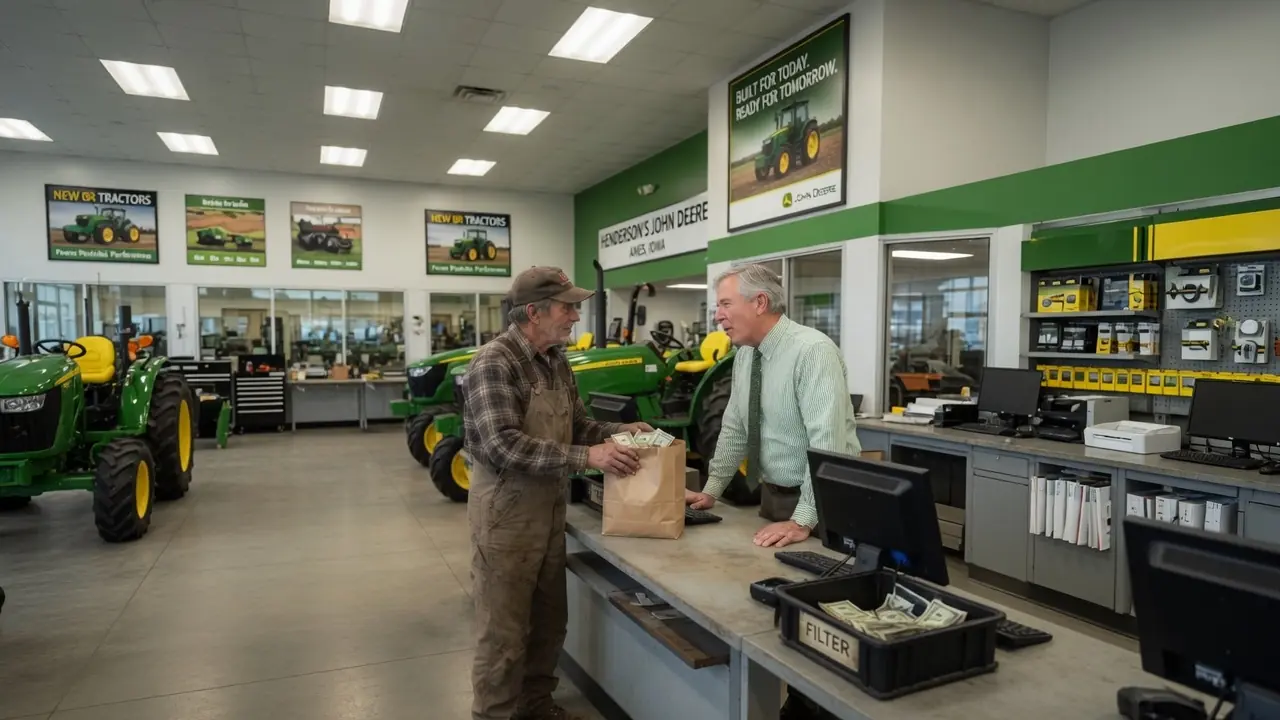
Earl followed his gaze through the open shed doors.
Inside stood tractors most men in Ames had never seen together outside a museum.
A restored 1939 Farmall H gleamed beside a 1951 Minneapolis-Moline, a rare Oliver Super 99, a row of antique Allis-Chalmers machines, and three early John Deere models restored so perfectly they looked better than new.
Each one had been bought cheap from fence lines, auctions, widows’ barns, and dealers too proud to see value under rust.
Earl shook his head.
“One day you ought to let people know what you’ve got in there.”
Charlie smiled.
“Why?”
“So they’ll stop laughing.”
Charlie ran his hand over the Farmall’s hood.
“Laughter is free. Let them enjoy it.”
Charlie’s farm did not look impressive from the road.
The house was plain, painted white, with a porch swing that creaked in the wind.
The barn needed new paint, the gravel drive had weeds along the edges, and Charlie still drove an old pickup with a cracked dashboard.
People saw those things and believed they understood his life.
They did not know about the farmland he owned outright across three counties.
They did not know about the machine parts business he had quietly built, selling restored components to collectors across the country.
They did not know that Charlie had invested carefully for forty years, bought land when others bought toys, and never borrowed unless the numbers favored him.
Most of all, they did not know that Charlie Morrison was worth more than every new tractor in Henderson’s showroom combined.
He did not hide his wealth out of shame.
He hid it because money changed the way people listened.
When folks thought he was poor, they revealed whether they had character.
Charlie considered that information more valuable than praise.
For the next six weeks, Charlie worked on the Farmall every morning before the heat rose.
He replaced the fuel lines, cleaned the carburetor, rebuilt the starter, flushed the tank, repaired the wiring, and carefully sanded away layers of neglect.
He did not hurry.
Restoration, he often said, was not fixing what was broken; it was remembering what something was built to be.
His granddaughter, Emma, visited after school and helped label parts in coffee cans.
At twelve years old, she had Charlie’s patient eyes and her grandmother’s stubborn chin.
She loved the smell of old metal, the sound of wrenches on concrete, and the way her grandfather spoke to tractors as if they understood him.
“Grandpa,” she asked one afternoon, “why do you let Mr. Henderson talk down to you?”
Charlie looked up from the workbench.
“Because a man who needs to talk down is already standing lower than he thinks.”
Emma considered that.
“So you’re not mad?”
“I was mad for about three minutes,” Charlie said.
“Then I remembered I owned the tractor and he owned the insult.”
By harvest season, the Farmall was running.
Not perfectly, not yet, but strong enough to move under its own power with a low, steady sound that made Charlie smile.
The faded red paint had been stripped, primed, and refinished in deep original color.
New decals sat straight along the hood, the seat was reupholstered, the wheels cleaned and painted, and every bolt that could be saved had been saved.
What had sat behind Henderson’s fence like shame now looked like history brought back from the dead.
Charlie entered it in the Iowa Antique Tractor and Farm Heritage Auction, a respected annual event that drew collectors, dealers, and wealthy hobbyists from across the Midwest.
Tom Henderson attended every year, mostly to be seen, shake hands, and remind older farmers that nostalgia was fine as long as they bought modern equipment afterward.
This year, he arrived with Brett and two salesmen, still joking about Charlie’s rusty Farmall as they walked through the fairgrounds.
Then they saw it.
The restored 1962 Farmall stood beneath a banner, polished red paint glowing in the afternoon light.
A small crowd gathered around it, speaking in low appreciative voices.
One man from Nebraska inspected the serial number plate and whistled.
Another collector from Illinois said, “You don’t see them restored this clean anymore.”
Tom stopped walking.
Brett nearly bumped into him.
“That’s not the same tractor,” Brett said.
Tom’s mouth tightened.
“It can’t be.”
Charlie stood nearby in the same faded cap, hands tucked into the pockets of clean overalls.
Emma stood beside him, holding a clipboard and smiling at the crowd like she knew a secret.
When Tom approached, Charlie greeted him with a nod.
“Afternoon, Tom.”
Tom stared at the Farmall.
“You did all this in six weeks?”
“Most of it.”
“It looked dead.”
Charlie shrugged.
“Lots of things look dead to people who don’t listen.”
Before Tom could answer, the auctioneer climbed onto the platform.
The Farmall was one of the featured restorations, and the bidding opened at fifteen thousand dollars.
Tom laughed under his breath, certain the number was theater.
Then a hand went up.
Twenty thousand.
Twenty-five.
Thirty.
The crowd pressed closer.
Tom’s face changed as the bids rose.
At forty thousand, Brett stopped smiling.
At fifty-five, the man from Illinois stepped out, but the Nebraska collector stayed in.
At sixty-eight thousand, a private collector on the phone entered the fight.
The final gavel fell at seventy-two thousand five hundred dollars.
Applause broke across the tent.
Charlie did not cheer.
He simply removed his cap, looked once at the Farmall, and nodded as if thanking an old friend.
Emma grabbed his arm, barely able to contain herself.
Tom stood frozen, his throat moving as he tried to swallow the humiliation.
“That was luck,” he said.
Charlie turned toward him.
“Luck helps men who prepare a place for it.”
Tom’s eyes moved from the tractor to Charlie.
“How many of these have you done?”
“Enough.”
That answer bothered Tom for days.
He began asking questions, first casually, then with increasing urgency.
He learned Charlie had sold a restored Minneapolis-Moline for ninety thousand dollars the previous year.
He learned a collector in Pennsylvania had paid six figures for a tractor Charlie rebuilt from three separate machines.
He learned Charlie owned storage barns full of rare parts that dealers across the country called about when they needed something impossible to find.
Then came the discovery that truly shook him.
Tom’s dealership was in trouble.
He had expanded too fast, renovated the showroom, borrowed against future sales, and counted on farmers taking loans for new machines every season.
But interest rates rose, crop prices softened, and several buyers backed out of large purchases.
Tom’s banker began visiting more often, speaking more quietly each time.
One Monday morning, Tom was called into First Prairie Bank for a meeting with Howard Bell, the bank president.
Tom arrived expecting another warning.
Instead, he found Charlie Morrison sitting in the conference room in clean overalls, drinking coffee from a paper cup.
Tom stopped in the doorway.
“What’s he doing here?” Tom asked.
Howard Bell cleared his throat.
“Mr. Morrison has purchased a significant portion of the note on your dealership.”
Tom’s face emptied.
“What?”
Charlie looked at him calmly.
“You were overleveraged, Tom. Bank wanted to reduce exposure. I bought the paper.”
Tom gripped the back of a chair.
“You bought my debt?”
“Part of it.”
“You can’t just do that.”
Howard Bell looked uncomfortable.
“Yes, actually, he can. It was a legal transfer.”
Tom stared at Charlie as if seeing him for the first time.
The stained overalls.
The faded cap.
The quiet hands.
Nothing had changed, and yet everything had changed.
“You’re telling me he has that kind of money?” Tom demanded.
Charlie set his coffee down.
“Money doesn’t get louder because you discover it late.”
Tom’s face reddened.
“You let me laugh at you.”
Charlie shook his head.
“No, Tom. You chose that part yourself.”
Howard excused himself to get another document, leaving the two men alone in the conference room.
For several seconds, the only sound was the hum of the air conditioner.
Tom looked older than he had in the showroom, his confidence wrinkled by fear.
When he finally spoke, his voice had lost its polish.
“What do you want?” Tom asked.
Charlie folded his hands on the table.
“I want the dealership to stay open.”
Tom blinked.
“You’re not foreclosing?”
“Not if you stop running it like a man selling mirrors instead of machines.”
Tom sat slowly.
Charlie continued, “Your father built that place by knowing farmers, not mocking them. He sold parts on credit when hail ruined crops. He knew which men needed financing and which men needed honesty. You replaced trust with shine.”
Tom looked away.
“I sell new equipment,” Tom muttered.
“You sell debt dressed as progress,” Charlie said.
“Sometimes a new tractor is the right tool. Sometimes an old machine with a patient mechanic is smarter. A good dealer should know the difference.”
Tom’s jaw worked, but no argument came.
For the first time in years, someone was saying aloud what many farmers had quietly felt.
Henderson’s John Deere had become a place where men were measured by financing approval instead of calloused hands.
Tom had mistaken sales volume for respect.
“What happens now?” Tom asked.
Charlie slid a folder across the table.
“You restructure. Sell off inventory that’s bleeding interest. Start a restoration and parts division. Hire two mechanics who understand older machines. Treat small farmers like customers, not museum pieces.”
Tom opened the folder and saw detailed projections, market research, collector sales, and a plan better than anything his consultants had given him.
“You wrote all this?” he asked.
“Emma typed it,” Charlie said.
“She’s better with computers.”
Despite himself, Tom almost smiled.
Then shame returned.
“I called you broke in front of half the showroom.”
Charlie nodded.
“You did.”
“I said you couldn’t afford tires on a real tractor.”
“You did.”
Tom looked up, his voice low.
“Why are you helping me?”
Charlie was quiet for a moment.
Then he looked through the conference room window toward the fields beyond the bank parking lot.
“Because your father helped me once.”
Tom frowned.
“My father?”
Charlie nodded.
“When I was twenty-two, my first crop failed. I came into Henderson’s with seventy dollars and a tractor that needed parts I couldn’t afford. Your father gave me the parts and told me to pay when the field paid me back.”
Tom’s expression changed.
“I never knew that.”
“No reason you would. Good men don’t invoice kindness for attention.”
Charlie leaned forward.
“I’m not helping you because you earned it, Tom. I’m helping that dealership because your father’s name is still on the sign, and there are farmers around here who need it to become honest again.”
Tom looked down at the folder.
For the first time, his pride did not protect him.
It only embarrassed him.
Two days later, Tom saw Charlie again at the dealership.
The atmosphere had changed because rumors had spread faster than corn dust in a harvest wind.
Everyone knew Charlie had sold the Farmall for more than seventy thousand dollars.
Everyone knew he had bought part of the dealership’s debt.
Everyone knew Tom Henderson had laughed at a millionaire holding cash in a paper bag.
When Charlie entered, the showroom went quiet.
Tom came out from behind the counter.
Brett and the other salesmen watched from the parts desk.
For a moment, Tom looked as if he might hide behind business language.
Then he did something nobody expected.
He removed his tie.
“Charlie,” Tom said, voice carrying through the showroom.
“I owe you an apology.”
Charlie stood still.
Tom swallowed.
“I mocked your clothes, your choices, and your tractor. I treated you like you were poor because you didn’t dress rich. That was small of me, and it was wrong.”
The silence deepened.
Charlie looked at him for a long moment.
Then he nodded once.
“Apology accepted.”
Tom exhaled, but Charlie lifted a hand.
“Now apologize to the farmers who heard you.”
Tom looked around the showroom at the men leaning on counters, the women standing near parts shelves, the customers who had all been judged by him in one way or another.
His face flushed, but he did not run from it.
“I’m sorry,” he said.
“To all of you. This dealership is going to change.”
It did change, though not all at once.
Tom hired an old mechanic named Russell Baird, who could diagnose a Farmall by ear and hated computers with religious intensity.
He opened a restoration bay in the back, moved the rusty trade-ins out of the weeds, and started treating them like future inventory instead of shame.
He lowered pressure on his salesmen to push financing and began offering repair options before replacement pitches.
Some customers did not believe it at first.
Trust, once dented, did not polish clean in a day.
But farmers noticed when Tom started listening more than talking.
They noticed when he stopped laughing at old equipment.
They noticed when Charlie Morrison sat once a week at the parts counter with coffee, advising on antique value and restoration potential like a quiet partner nobody had officially announced.
A year later, Henderson’s held its first annual Heritage Tractor Day.
The showroom doors were opened wide, and old machines lined the lot beside new John Deeres.
Families came from three counties.
Kids climbed carefully onto restored seats for pictures, old farmers told stories they had not told in years, and collectors made offers before lunch.
At the center of the event stood another Farmall, older than the first, restored by Charlie, Russell, Emma, and, surprisingly, Tom himself.
Tom had spent months learning how to sand, clean, and rebuild without rushing.
His hands, once soft from desk work, now carried small cuts and permanent traces of grease beneath the nails.
Charlie considered that a good beginning.
During the event, Tom found Charlie standing beside the restored tractor, watching Emma explain engine history to a group of children.
“She’s good,” Tom said.
“She listens,” Charlie replied.
Tom nodded.
“I’m trying to learn that.”
Charlie looked at him, and there was no mockery in his face.
“That’s the first expensive lesson most men avoid.”
Tom smiled faintly.
“Debt-free wisdom?”
“Paid for with mistakes,” Charlie said.
The two men stood together as the crowd moved around them.
Behind them, new tractors gleamed under banners.
In front of them, old machines shone with restored dignity.
For the first time in years, the dealership felt less like a showroom and more like a community.
Tom glanced at Charlie.
“You know, when you walked in with that paper bag, I thought you were just an old farmer stuck in the past.”
Charlie nodded.
“I know.”
“I was wrong.”
“I know that too.”
Tom laughed quietly, then grew serious.
“What are you, really, Charlie?”
Charlie watched Emma place one hand on the Farmall’s hood, proud and gentle.
“I’m a farmer,” he said.
“That’s still the richest thing I ever learned how to be.”
That evening, after the crowd left and the lot grew quiet, Tom stayed behind to sweep the showroom floor himself.
Charlie found him near the counter where the paper bag of cash had once sat.
Tom looked up and smiled without performance.
“I never asked you something. Why did you bring the money in a paper bag?”
Charlie shrugged.
“Bank envelope tore.”
Tom stared, then burst out laughing.
Charlie smiled too.
Outside, the Iowa sky turned orange over the fields, and the tractors sat in rows, old and new together, no longer enemies in Tom Henderson’s mind.
He had learned that wealth did not always arrive in a shiny truck or speak with a loud voice.
Sometimes it walked in wearing stained overalls, carrying cash in a paper bag, and choosing a rusty Farmall everyone else was too proud to understand.
Sometimes the richest man in the room was the one who had nothing to prove.
Charlie drove home in his old pickup as the last light faded.
The truck rattled, the seat squeaked, and the radio only worked when it felt generous.
He could have bought a new one that afternoon without noticing the cost.
But the old truck still started, still carried him where he needed to go, and still reminded him of every mile he had earned.
At the farm, Emma waited on the porch with two glasses of lemonade.
“How was Heritage Day?” she asked.
“Good,” Charlie said, taking one glass.
“Mr. Henderson still learning?”
Charlie looked toward the machine shed where restored tractors rested in the quiet.
“Aren’t we all?” he said.
Emma leaned against him, and Charlie watched the fireflies begin to rise over the fields.
The world had laughed at him many times, but laughter had never changed the truth.
Rust could hide value.
Old paint could hide history.
Plain clothes could hide a fortune.
And sometimes, if a man was patient enough, the people who laughed the loudest learned the lesson last.
Charlie Morrison had bought the Farmall because he understood machines.
He had saved the dealership because he understood debt.
But most of all, he had accepted Tom’s apology because he understood something richer than money.
A man’s worth is not measured by what shines under showroom lights, but by what he can restore after everyone else calls it worthless.