The warning appeared at 10:17 on a Thursday morning.
Hollis Eberhart was halfway through the southern section of her 480-acre cornfield when the John Deere S780 combine suddenly reduced engine power. Three yellow alerts flashed across the display, followed by one red message she had never seen before. The header stopped feeding, the unloading auger controls disappeared, and the machine rolled to a halt between two rows of dry corn.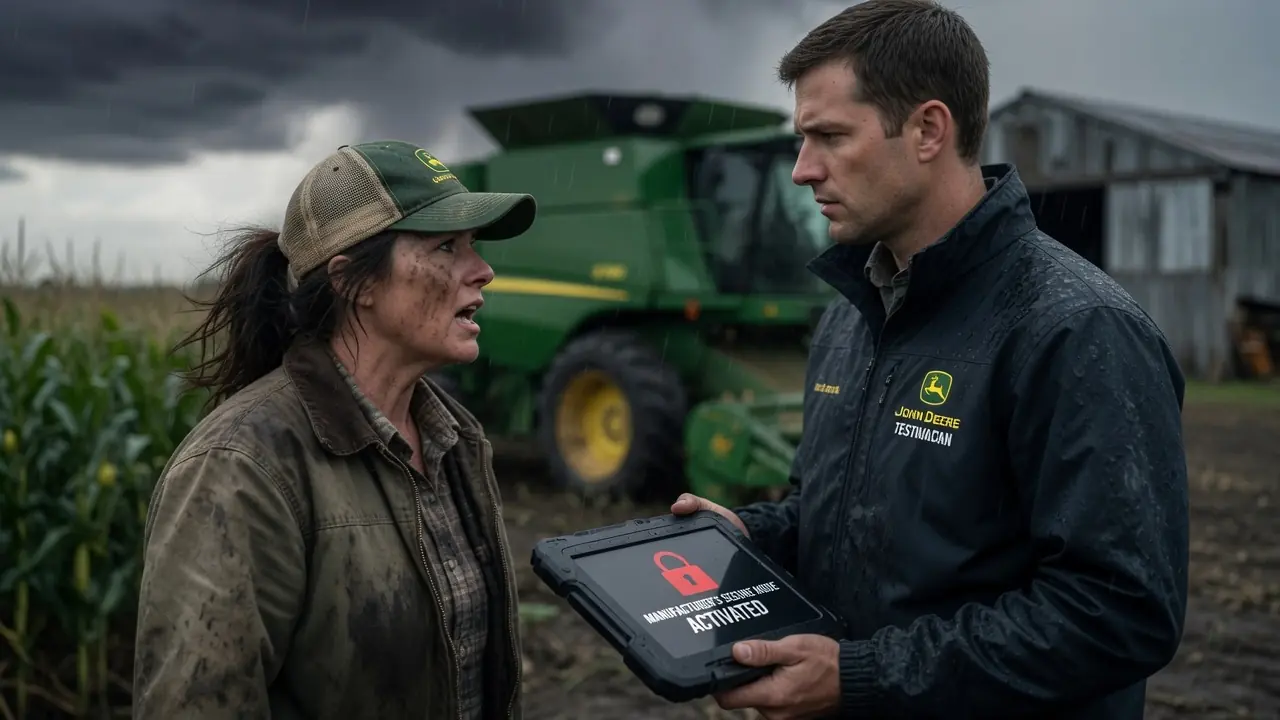
Hollis stared at the screen.
Outside the cab, the western Iowa sky had turned the color of steel. Rain was forecast to begin the following evening, but the dark line gathering above the horizon suggested the storm might arrive much sooner. Nearly three hundred acres remained unharvested.
She restarted the combine.
The engine came back to life, but the controls remained locked. She could raise and lower the cab fan, adjust the radio, and activate the hazard lights. She could not engage the separator, header, or propulsion system.
The $300,000 machine had become an air-conditioned building in the middle of her field.
Hollis called the dealership.
Prairie Crown Equipment had sold the combine to her father, Everett Eberhart, six years earlier. The final payment had been made eight months before Everett died, which meant the machine legally belonged to Hollis and the farm. At least, that was what every loan statement, insurance document, and tax record claimed.
The service dispatcher placed her on hold for eleven minutes.
When he returned, he said a technician was already nearby and could arrive before noon. Hollis asked what had caused the shutdown. He told her the system showed a “noncompliant electronic modification” and refused to explain further.
Technician Mason Reed arrived in a white dealership truck forty minutes later.
He was thirty-four, clean-shaven, and dressed in a green polo beneath a black work jacket. He carried a diagnostic tablet worth more than Hollis’s first pickup and climbed into the combine without asking permission. After connecting the tablet, he scrolled through several screens and gave a quiet laugh.
“What?” Hollis asked.
“Someone opened the primary control housing.”
“My father repaired it last fall.”
“That explains the lock.”
Hollis folded her arms. “Explain it to me.”
Mason pointed toward an electronic control module mounted behind the access panel. The original connector had failed during the previous harvest, less than two weeks before Everett entered the hospital for the final time. Rather than waiting nine days for dealership service, Everett purchased an equivalent sealed connector, transferred the pins, and returned the machine to operation.
The repair had worked for almost a year.
Mason examined the component as though Everett had replaced it with wire taken from a lamp. “This isn’t an authorized Deere repair.”
“It is a connector.”
“It is part of a protected control network.”
“My father replaced burned plastic.”
“He altered the original electrical system.”
“He repaired the machine he paid for.”
Mason looked toward Hollis. “Buying the combine doesn’t give you authority to modify controlled software hardware.”
Hollis thought she had misunderstood him.
“My name is on the ownership documents.”
“That doesn’t change the service terms.”
“Then what exactly do I own?”
Mason turned the tablet so she could see the diagnostic message. The system had recorded the connector housing being opened during the previous season. A recent software update compared the current component identification against the dealership service history and flagged the repair.
The machine did not fail mechanically.
It had been instructed to stop.
Hollis looked toward the darkening sky. “Unlock it.”
“I can’t do that until the combine passes an authorized electrical inspection.”
“Inspect it.”
“That requires transporting it to our main facility.”
“The combine cannot move.”
“We can send a lowboy Monday.”
“Monday?”
“That’s the earliest opening.”
“The rain starts tomorrow.”
Mason shrugged. “Weather doesn’t change the procedure.”
Hollis felt her anger sharpen. “How much?”
“The inspection begins at forty-eight hundred dollars. If the control harness needs factory replacement, parts and labor could reach seventeen thousand.”
“The harness is working.”
“That is not the issue.”
“What is the issue?”
“Compliance.”
Mason returned to the service truck and printed an estimate from a portable device. Beneath the inspection charge was an optional three-year service agreement costing twenty-six thousand dollars. Customers who signed received priority transport, reduced software-reset fees, and guaranteed harvest-season response.
Hollis read the document twice.
“You locked my combine and then offered to move me ahead in line if I bought your contract.”
“The system locked it.”
“You connected the tablet.”
“The violation already existed.”
“My father’s repair existed for eleven months without a problem.”
Mason’s expression became impatient. “Your father should have called an authorized technician.”
“My father was trying to bring in corn before a storm.”
“Then he made a short-term decision with long-term consequences.”
Hollis stepped closer. “He died believing this farm was secure.”
Mason lowered the estimate.
For one moment, she thought shame might reach him.
Instead, he said, “Farmers think purchasing expensive equipment means they can do whatever they want with it. Modern machines don’t work that way.”
Hollis looked at the corn surrounding them.
The farm had belonged to her family since 1948. Everett had survived drought, flooding, interest rates that nearly took the land, and a machinery fire that destroyed half the equipment shed. He trusted machines because he understood them and distrusted policies written by people who had never watched a crop darken beneath approaching rain.
“Unlock it,” Hollis repeated.
Mason shook his head. “Sign the service agreement, and I’ll request an emergency review.”
“How long?”
“Possibly twenty-four hours.”
“And without the contract?”
“Monday transport.”
Hollis handed the papers back.
“No.”
Mason stared at her. “You have almost five hundred acres standing.”
“I know.”
“The moisture is already higher than ideal.”
“I know that too.”
“You could lose a significant portion of the crop.”
“Then I lose it without paying the people who stopped my machine.”
Mason gave a short, dismissive smile. “That sounds principled until the bank calls.”
He climbed into his truck and drove away.
Hollis remained beside the silent combine.
Dust settled behind the dealership vehicle, leaving her alone between walls of corn. The hazard light continued flashing above the cab as though the machine were warning the field that its owner no longer controlled it. Hollis rested one hand against the enormous front tire.
She had defended the S780 when Everett purchased it.
At the time, she believed the modern machine would protect the farm. It harvested quickly, mapped yields, adjusted itself through changing field conditions, and provided information her father once gathered through notebooks and instinct. Everett admired its capacity but never trusted the electronics completely.
“A machine should answer to the person sitting in the seat,” he once said.
Hollis told him that was an old-fashioned way to think.
Now the seat answered to someone carrying a dealership tablet.
Her phone rang.
It was Owen Keller, the farmer whose property bordered the Eberhart land. He had seen Mason’s truck in the field and wanted to know what happened. Hollis explained the lock.
Owen remained silent for several seconds.
“Can they do that?”
“They already did.”
“Are you signing the contract?”
“No.”
“Hollis, that rain could flatten half the bottom ground.”
“I know.”
“What are you going to do?”
She looked toward the machine shed in the distance.
“I’m going to see what Dad left me.”
Everett’s 1978 John Deere 4440 stood beneath a canvas cover in the oldest section of the shed. The tractor’s paint had faded, the seat was cracked, and dust covered the hood. It had no touchscreen, no satellite receiver, and no electronic control module connected to a corporate server.
The key hung from a nail beside the door.
Hollis removed the cover.
She had learned to drive on the 4440 when she was nine. Everett sat beside her on the fender, keeping one hand near the steering wheel while she struggled to keep the tractor straight. Later, it pulled planters, wagons, disks, and grain carts until larger equipment replaced it.
Everett refused to sell it.
Beside the tractor stood an old pull-type corn picker-sheller, partially hidden beneath wooden pallets. Hollis remembered it working when she was a child, though her father retired it after purchasing his first self-propelled combine. Two narrow gathering rows extended from the front, and belts connected the snapping rolls to a PTO-driven shelling unit.
It was slow.
It was loud.
It might still work.
Owen arrived twenty minutes later and stared into the shed.
“You cannot be serious.”
“Dad maintained it.”
“Your dad maintained tools from the Civil War.”
“This is newer.”
“Barely.”
Hollis opened the tractor’s battery compartment. Everett had installed a maintainer and tagged the fuel filter with the date of its last service. The oil remained clean, coolant covered the tubes, and every grease fitting had been marked inside a handwritten maintenance notebook.
On the final page, Everett had written one sentence.
Keep the old machines ready. New equipment may forget who it belongs to.
Hollis ran her thumb beneath the words.
Owen read over her shoulder. “He always did enjoy being right.”
“He would hate the reason.”
They installed a fresh battery and checked the fuel system.
The engine turned slowly on the first attempt. On the second, it coughed. The third attempt brought the diesel to life with a deep mechanical roar that filled the shed and shook dust from the roof beams.
Hollis laughed despite the fear pressing against her chest.
The 4440 did not ask for a password.
It did not request permission.
It started because she turned the key.
The picker required more work.
Two belts had cracked, one chain had seized, and mice had built a nest inside the grain elevator housing. Hollis and Owen worked until darkness, using parts Everett stored in labeled boxes. Hollis found diagrams, adjustment notes, and a list of bearing numbers taped inside the cabinet door.
Everett had prepared for a return he probably never expected to see.
At midnight, the picker’s chains turned for the first time in seventeen years.
The machine rattled violently.
Owen shut it down. “That bearing won’t last an acre.”
Hollis checked Everett’s parts shelf and found a replacement wrapped in oily paper. They installed it beneath portable lights while wind moved against the shed walls.
At three in the morning, the picker ran smoothly.
Owen sat on an overturned bucket and looked at Hollis. “Even if this works, you cannot harvest four hundred acres two rows at a time.”
“I don’t need four hundred before the rain.”
“What do you need?”
“The creek bottom.”
The lowest ninety acres held the farm’s most productive soil, but it flooded quickly during heavy storms. If Hollis could harvest that section before the rain, she would protect enough revenue to make the winter payments. The remaining fields stood on higher ground and might survive several wet days.
Owen looked toward the old tractor.
“Ninety acres is still impossible.”
“Then we discover how close impossible is.”
They reached the creek-bottom field shortly before sunrise.
Hollis connected the picker, checked the PTO, and entered the first rows. The machine’s gathering points disappeared beneath dry stalks. A moment later, ears began moving through the snapping rolls, and shelled corn poured into the wagon trailing behind.
The old tractor was harvesting.
Not efficiently.
Not quietly.
But it was working.
Owen drove beside her using another tractor and grain wagon. When Hollis’s wagon filled, they switched without shutting down the picker. The first load went to the farm’s storage bin as pale daylight spread beneath the clouds.
By eight, three neighbors had arrived.
Someone had posted a photograph of the locked S780 beside the old 4440. The image traveled through the county faster than any official explanation. Farmers began calling to ask whether Hollis needed wagons, drivers, fuel, or help repairing the antique picker.
She accepted wagons and drivers.
She refused money.
By noon, seven people were working across the field. The 4440 continued pulling the picker while empty wagons rotated beside it. Every component remained exposed enough that Hollis could see, hear, and understand what was happening.
When a chain jumped, she stopped and replaced it in twelve minutes.
No diagnostic code appeared.
No technician needed to approve the repair.
At two, Mason Reed returned.
He parked beside the disabled S780 and walked toward the moving equipment. Hollis stopped the tractor only after finishing the row.
“What are you doing?” he asked.
“Harvesting.”
“That picker isn’t certified for modern grain-handling standards.”
Hollis climbed down. “Are you here to unlock my combine?”
“No.”
“Then stay out of the field.”
Mason looked at the neighbors watching from their tractors. “Prairie Crown has been contacted about the images circulating online.”
“That sounds like your problem.”
“People are claiming we disabled your combine without cause.”
“You disabled it over a connector my father repaired.”
“The repair violated the service agreement.”
Hollis removed a folded copy from her jacket. She had spent part of the morning reading every page while wagons changed. “Show me where.”
Mason hesitated.
“The agreement says unauthorized modifications may void coverage,” she continued. “My warranty expired fourteen months ago. It does not say you can immobilize equipment after the warranty ends.”
“The software license provides additional authority.”
“Give me a copy.”
“You received it during purchase.”
“My father received several hundred pages electronically.”
“Then review them.”
“I asked you to show me the section.”
Mason’s jaw tightened. “I am not an attorney.”
“You were certain enough yesterday.”
One of the neighbors raised his phone and began recording.
Mason noticed.
He lowered his voice. “You need to stop turning this into a public fight.”
“You stopped a combine during harvest.”
“The system detected a safety issue.”
“Which safety issue?”
“Unauthorized access.”
“That is not a safety condition.”
Mason looked toward the old picker. “That machine is far more dangerous than the combine.”
“Then it’s strange your company made the safer machine unavailable.”
He left without answering.
By sunset, Hollis had harvested twenty-eight acres.
Her shoulders hurt, her hands were blistered, and every muscle tightened when she climbed down from the tractor. The picker had broken twice, but each failure was repaired using tools carried on the wagon. Everett’s 4440 had consumed fuel steadily and never once stopped without explanation.
The rain was now expected before noon the next day.
They worked beneath portable lights.
At eleven, Hollis forced everyone to rest for three hours. She slept inside the farmhouse chair with Everett’s notebook across her lap. At two-thirty, she woke to a message from an unknown number.
Mason lied about the mandatory lock. Call me before you sign anything.
A photograph followed.
It showed an internal Prairie Crown service bulletin.
The bulletin instructed technicians to flag unauthorized repairs for inspection but specifically stated that equipment should not be immobilized unless an immediate operational hazard existed. Hollis’s service record contained no hazard finding.
Someone had manually selected the lock.
Hollis called the number.
A man named Caleb Morris answered. He had worked in Prairie Crown’s software-support department until being dismissed the previous month. According to Caleb, the dealership had begun using service locks to push customers toward multi-year maintenance contracts.
“The manufacturer gives dealers discretion during inspections,” he explained. “Prairie Crown is stretching that discretion far beyond what was intended.”
“Why tell me?”
“Because they locked my uncle’s tractor during planting and charged him eight thousand dollars to release it.”
“Do you have proof?”
“I have logs.”
The digital record showed Mason’s tablet activating the immobilization command at 11:06 the previous morning. The system did not lock automatically, as he claimed.
Service manager Clark Denning approved the action remotely.
Caleb sent everything to Hollis.
At sunrise, she forwarded the records to her attorney, the state agriculture department, and a local farm reporter named Natalie Shaw. Then she returned to the field.
The rain began as a mist at ten forty-five.
They had harvested sixty-three acres.
Hollis kept driving.
Drops collected across the tractor hood, and the old picker began pulling damp leaves through the snapping rolls. Owen called over the radio and warned that the machine might clog.
“We have one more dry section,” Hollis answered.
“Hollis, you proved the point.”
“I’m not proving anything. I’m bringing in corn.”
They completed another six acres before the rain became too heavy.
Hollis stopped the PTO and watched water move across the windshield. Sixty-nine acres of the creek bottom were harvested. It was not everything, but it was enough to protect the farm from immediate disaster.
Neighbors parked their tractors beside the 4440.
No one cheered.
They were too tired.
Owen climbed onto the step and handed Hollis a thermos.
“Your father would say you drove too fast.”
“He always said that.”
“He would also say the rows are crooked.”
“They are straight.”
“They are emotionally straight.”
Hollis laughed until tears filled her eyes.
The story reached regional news that afternoon.
Photographs showed the $300,000 combine sitting disabled while a forty-six-year-old tractor pulled a worn corn picker through the field. Reporters focused on the contrast, but Hollis kept directing attention toward the service records.
“This is not about old equipment being better than new equipment,” she told Natalie Shaw. “The new machine is faster, safer, and more efficient. The problem is that someone else could stop it after my family paid for it.”
Prairie Crown initially denied wrongdoing.
The dealership issued a statement saying Hollis’s combine contained unsafe modifications and that the lock protected both the operator and the machine. Caleb then released the diagnostic log showing no safety fault had been recorded.
Mason called Hollis privately that evening.
“I was following Clark’s instructions.”
“You told me the system locked automatically.”
“I was told to say that.”
“You also offered me a contract.”
“That is part of the service process.”
“You knew the lock was optional.”
Mason remained silent.
Hollis looked through the kitchen window toward Everett’s 4440, wet with rain beside the shed.
“Put everything in writing,” she said.
“They’ll fire me.”
“That decision belongs to you.”
He sent a signed statement before midnight.
Prairie Crown unlocked the combine remotely the following morning.
Hollis refused to start it until an independent technician inspected the repaired connector and confirmed there was no operational hazard. The technician found Everett’s work properly sealed, electrically sound, and equal to the manufacturer’s specification.
The inspection cost three hundred fifty dollars.
Prairie Crown had demanded up to seventeen thousand.
The state agriculture department opened an investigation into the dealership’s service-lock practices. Fourteen farmers came forward with similar experiences, including two who signed expensive contracts after machines were disabled during planting or harvest.
Prairie Crown fired service manager Clark Denning.
Mason received a suspension but kept his position after cooperating with investigators and admitting his role. Hollis did not object. He had lied and humiliated her, but his testimony helped expose a larger practice.
Consequences did not need to become destruction to remain real.
Prairie Crown reimbursed Hollis for lost operating time, independent inspection costs, and part of the crop damage. It also agreed that future service flags would not immobilize out-of-warranty farm equipment without a documented safety finding.
The settlement did not restore the twenty-one flooded acres.
It prevented the bank from taking the farm.
After the ground dried, Hollis finished the remaining harvest with the S780. The combine worked exactly as it had before the lock. It moved through twelve rows at a time while yield data appeared across the display and the cab protected her from dust.
She did not reject modern technology.
She rejected the idea that technology should erase ownership.
The 4440 returned to the shed only after Hollis washed the mud from its tires and changed every fluid. She parked the old picker beside it rather than burying it behind pallets again.
Everett’s notebook remained inside the tractor toolbox.
Months later, Hollis testified before a state agricultural committee examining equipment repair and software-control policies. Executives described intellectual property, safety standards, cybersecurity, and the complexity of modern machinery.
Hollis agreed that all those concerns mattered.
Then she placed Everett’s burned connector on the table.
“My father replaced this twenty-dollar component because the dealership could not reach us before the crop weather changed,” she said. “His repair did not damage the machine. The dealership’s response damaged the harvest.”
One committee member asked whether farmers should be allowed to rewrite protected software.
“That is not what happened,” Hollis replied. “We repaired a physical connection. They used software to punish us for doing it.”
Her statement appeared across agricultural publications.
Prairie Crown later changed ownership after losing several large accounts. A farmer-owned independent service cooperative opened in the county, employing certified technicians and publishing clear rates. Mason Reed eventually left the dealership and joined the cooperative after apologizing to Hollis in person.
She did not forgive him immediately.
Trust, like machinery, required more than a reset command.
The following October, Hollis began harvest under a clear blue sky. The S780 waited near the first field, inspected and ready. Beside the shed, the 4440 remained connected to the restored picker.
Owen looked at both machines.
“Which one are you taking?”
“The combine.”
He appeared disappointed. “After all that?”
Hollis smiled. “I’m not choosing old because it’s old. I’m choosing the machine that does the job.”
“And the 4440?”
She looked toward her father’s tractor.
“It stays ready.”
That afternoon, Hollis drove the S780 through the field while the old 4440 waited near the lane with the key inside her pocket. The modern combine harvested more corn in one hour than the picker could manage in an entire day.
But speed was no longer the only thing Hollis measured.
She measured whether a machine could be repaired, whether a policy respected the person paying the loan, and whether ownership remained real after software entered the cab.
Prairie Crown believed the lock would force her to surrender.
Instead, it forced her to remember what her father had protected.
The 1978 tractor did not save all 480 acres. It saved the bottom ground, the winter payment, and the time Hollis needed to uncover the truth.
More importantly, it reminded the entire county that progress should give farmers better tools, not quieter chains.
The expensive combine eventually returned to work.
The old tractor never forgot who turned the key.