Jake Morrison walked into Ed Garrison’s Massey Ferguson dealership in March of 2015 with his boots dusty, his jaw set, and a decision already made in his mind. He was twenty-eight years old, newly married, and farming 2,200 acres of wheat and milo on Kansas ground his family had worked since the 1950s. He did not come in to browse, negotiate slowly, or listen to an old salesman lecture him about patience. He came in to buy the biggest Massey Ferguson tractor on the lot and prove to everyone that Jake Morrison was not small-time.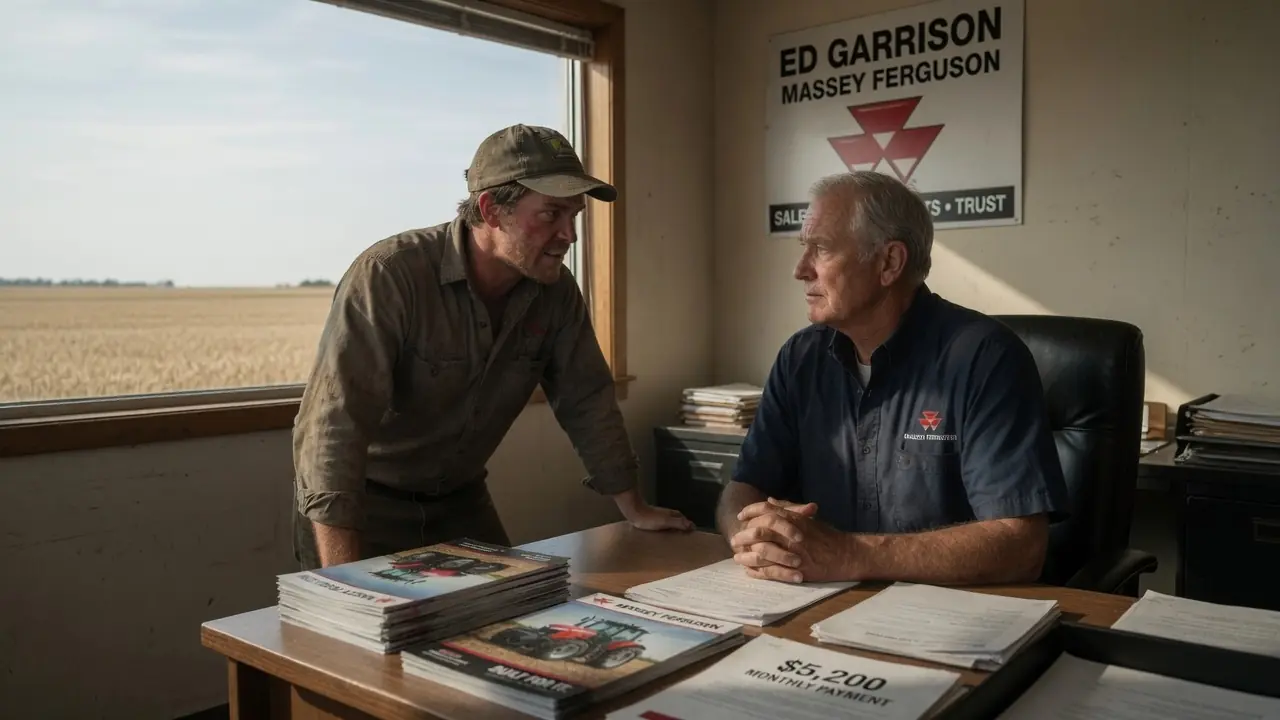
That phrase had been stuck in his chest for two years. Emily’s father, a Wichita businessman with clean hands and sharp suits, had used it once at dinner when talking about the Morrison farm. He did not say it cruelly, not exactly, but he said it like a man reading numbers from a page. Small-time operation, he called it, and Jake had smiled at the table while something hot and bitter settled behind his ribs.
Jake’s own father, Robert Morrison, never cared about looking impressive. Robert ran paid-off machines, fixed what he could, and treated debt like a storm cloud you did not invite over your fields. His older sons had learned that way too, expanding slowly, buying carefully, and measuring success by how much ground stayed in the family after a bad year. Jake respected them, but he was tired of living inside old caution.
He had studied agribusiness in college, read modern farm magazines, and listened to speakers who talked about scale, efficiency, leverage, and growth. Everywhere he looked in 2015, neighbors were buying bigger equipment, putting up new buildings, and acting like the good prices would last forever. Wheat was strong, lenders were friendly, and the machinery lots looked like proof that the future belonged to men bold enough to claim it. Jake wanted to be one of those men.
His old tractor still ran, but it had started needing repairs often enough for Jake to call it an opportunity. In his mind, he was not replacing a failing machine. He was stepping into the next version of himself. The Massey Ferguson 8670 had become the symbol of that next life, a 270-horsepower beast with enough size, technology, and presence to make every neighbor turn his head.
Ed Garrison was sitting behind his desk when Jake walked in. Ed was sixty-two, gray-haired, calm-eyed, and had been selling tractors since before Jake was born. His dealership had served central Kansas since 1972, and Ed had sold machines to Jake’s father more than once. He was known for showing up when equipment failed, not just when paperwork needed signing.
Jake did not care about Ed’s reputation that morning. He sat down across from him and said he wanted the 8670, fully loaded, with the best financing terms Ed could arrange. He expected Ed to smile, reach for a calculator, and start talking about payments like every salesman was supposed to do when a customer walked in ready to buy. Instead, Ed leaned back in his chair and studied him for a long moment.
“Why do you need 270 horsepower?” Ed asked.
Jake blinked, annoyed by the question. Then he explained his acreage, his soil, his future plans, the implements he wanted to upgrade, and the direction he intended to take the farm. Ed listened without interrupting, which made Jake even more irritated because silence can feel like judgment when a man already feels challenged. When Jake finished, Ed asked about debt load, operating margins, and how many bad years the farm could survive if commodity prices dropped.
Jake’s face grew hotter with every question. He felt less like a customer and more like a boy being tested before he could borrow the family truck. He answered, but his answers became sharper, shorter, and more defensive. Finally, Ed stood, walked to the window, looked out at the equipment lot, and said the sentence that made Jake’s pride flare like gasoline.
“I’m not selling you that tractor.”
Jake stared at him. “What?”
Ed turned back calmly. “You don’t need it, and it’ll put you out of business within three years.”
For a second, Jake could not speak. The words hit him harder than a flat refusal should have because they sounded too much like every doubt he had been trying to outrun. Too young. Too eager. Too small. Not ready for the big machines or the big operators’ table.
“So that’s it?” Jake said, his voice rising. “You think I’m too young and too stupid to run real horsepower?”
Ed did not blink. “No, Jake. I think your pride is trying to sign a loan your farm can’t survive.”
Jake pushed his chair back so hard it scraped the floor. “I came here to buy first-class equipment, not get treated like a scared little boy.”
Ed pointed at the financing sheet on his desk. “Then act like a farmer, not a man begging a tractor to prove he matters.”
The office went silent.
Jake’s hands curled into fists at his sides. Outside the window, the 8670 sat gleaming in the sun, tall and powerful and exactly what Jake wanted the world to see when it looked at him. Across the desk, Ed looked like a man who had no interest in winning an argument if winning meant helping someone lose a farm.
Ed explained the numbers without softening them. After the trade-in, the 8670 would still cost enough to put Jake under a payment of roughly $5,200 a month for seven years. Jake’s acreage did not justify that much horsepower, his current implements did not require it, and his operating margin could not absorb that payment if wheat prices dropped. If the market fell even twenty percent, Ed said, Jake would be using seed and fertilizer money to feed a tractor note.
Jake hated that Ed was saying it. He hated even more that part of him already knew it. He had run numbers at home, but only the numbers that made the dream possible. He had not spent much time with the numbers that made the dream dangerous.
“If wheat drops to four dollars next year,” Ed asked, “can you still make that payment and cover inputs?”
Jake opened his mouth.
Nothing came out.
The silence was more humiliating than the question. He could see the answer on paper in his own mind, and the answer was no. At four-dollar wheat, a $5,200 monthly payment would become a weight tied around his neck during floodwater.
Jake changed tactics, his voice thick with sarcasm. “Fine, Ed. Since you know my farm better than I do, what should I buy?”
Ed did not take the bait. He picked up his keys and walked Jake outside to the lot. The 8670 towered near the front, polished and proud, but Ed walked past it to a Massey Ferguson 7616. It was clean, capable, and solid, but beside the bigger machines it looked cautious, ordinary, and almost insulting.
“That one,” Ed said.
Jake stared at it. “That’s 160 horsepower.”
“Yes.”
“I asked for 270.”
“I know what you asked for.” Ed rested a hand on the tractor’s step. “This is what your farm needs.”
Jake looked at the 7616 like it had personally embarrassed him. It was the kind of machine his father would buy: practical, efficient, unflashy, and safe. It would pull his drill and planter. It would handle his current operation without waste. It would cost half what the 8670 cost and carry a monthly payment around $2,850, which sounded manageable even when Ed ran the bad-year numbers.
Jake did not thank him. He told Ed he would think about it, then walked to his truck with his ears burning. He sat there for a full minute gripping the steering wheel, staring at the dealership sign. In his mind, Ed had not protected him. Ed had humiliated him.
For two weeks, Jake shopped around. He called other dealers, including one sixty miles south that moved equipment fast and asked fewer questions. The salesman there did everything Jake had expected Ed to do. He ran financing, talked about power, praised Jake’s ambition, and had paperwork ready before the second call ended.
Jake almost signed. He wanted to sign just to prove Ed had no authority over him. He wanted to pull that 8670 into his yard and watch his father-in-law’s face when he saw it. He wanted the neighbors to stop seeing him as Robert Morrison’s youngest boy and start seeing him as a serious operator.
Then he made the mistake of telling Emily.
Emily listened quietly, then opened her laptop. She had grown up around business, and while she did not know much about diesel engines, she understood risk better than Jake wanted her to. She pulled up commodity price history and showed him what wheat had done in 2008. From strong to frightening in months.
“What happens to us if that happens again while you’re carrying a $5,200 payment?” she asked.
Jake tried to talk around it. He said the market was different, their operation was positioned well, the timing was right, and growth required risk. Emily listened, then asked the same question again. This time, he had no answer.
That night, Jake lay awake beside her, staring at the ceiling. He replayed Ed’s words until they stopped sounding like disrespect and started sounding like warning. By morning, he was angry in a different way. Not at Ed as much as at the fact that Ed had seen something Jake had tried not to see.
He drove back to Ed’s dealership the next day. Pride would not let him apologize, but it allowed him to say he had reconsidered and wanted to talk about the 7616. Ed did not smirk, gloat, or say “I told you so.” He simply pulled out the paperwork and ran the numbers honestly.
Then Ed did something Jake never forgot. He showed him the dealer cost on both machines. He showed Jake exactly how much commission he would lose by selling the 7616 instead of the 8670. The cheaper machine was not better for Ed’s pocket. It was better for Jake’s farm.
“I’d rather lose a little commission,” Ed said, “than watch Robert Morrison’s boy sign himself into trouble.”
Jake looked away because the sentence landed too close to the truth. He signed the paperwork that afternoon. When the Massey Ferguson 7616 arrived at his farm a week later, his father walked around it, kicked one tire, and nodded.
“Good choice,” Robert said.
Jake did not tell him Ed had made the choice for him.
The first season with the 7616 was difficult in a way Jake had not expected. The tractor performed perfectly. It pulled what needed pulling, handled the work without complaint, used less fuel than the larger machine would have, and never left him sitting in a field with a code flashing at him. By any practical measure, it was exactly right.
But it did not feel like victory.
When Jake planted wheat that spring, a neighbor pulled into the next field with a brand-new 300-horsepower machine from another brand. The tractor looked massive beside Jake’s Massey Ferguson, and the neighbor smiled as he climbed down. He made a joke about Jake running a cute little tractor.
Jake laughed like it did not bother him. It bothered him all day.
At the co-op, other farmers talked horsepower, technology packages, and big purchases. Jake mostly stayed quiet. The 7616 gave him nothing impressive to brag about, only acres completed, fuel saved, and payments he could actually make. He had made the responsible choice, but for a long time it felt like settling.
Still, the farm ran well. Jake kept his costs tight, managed inputs carefully, and avoided spending money that did not contribute directly to yield. Emily relaxed because the household budget was not stretched to the breaking point. Robert Morrison, who rarely praised anything, told Jake he was farming smart.
That should have satisfied him. It did not.
In quiet moments, Jake still imagined the 8670. He imagined sitting higher, pulling bigger, arriving at fields with a machine that made nobody joke. He wondered whether Ed had saved him or scared him into mediocrity. That question followed him through 2015 like dust behind a combine.
The answer began in 2016.
Wheat prices started sliding. At first, farmers called it a dip, then a correction, then something less comfortable. By fall, wheat had dropped from the comfortable range Jake had used in his best-case numbers. Revenue tightened. The farm still functioned, but there was less room for mistakes.
The 7616 payment, which had once felt boring, became a quiet mercy. It was not painless, but it was survivable. Jake could still cover inputs, make payments, and keep the operation steady. Every month he wrote the check, he thought about the number he would have owed on the 8670 and felt a cold shiver of understanding.
Then 2017 came harder.
By spring, wheat prices were low enough that every report felt like a sentencing hearing. Margins thinned until they nearly disappeared. Jake worked more, worried more, slept less, and learned that financial pressure has a sound: the silence at the kitchen table when two people are calculating the same bills and neither wants to speak first.
Neighbors began struggling. The same farmers who had laughed about horsepower in 2015 were meeting with lenders in 2017. Big payments that had seemed reasonable during strong prices became brutal when the market turned. Equipment began showing up for sale with fewer hours than it should have had and more desperation than sellers wanted to admit.
The neighbor who had mocked Jake’s “cute little tractor” sold his big machine for far less than he owed. The loss was painful, but the payment had become impossible. Jake watched the trailer haul the tractor away and felt no satisfaction. He only felt the terrible closeness of a disaster he had almost chosen for himself.
The high-volume dealership that had been ready to sell Jake the 8670 without asking questions closed in 2018. Its customers were left sorting out service problems, warranty confusion, and distance from support. Ed Garrison’s dealership remained open. Quietly, steadily, stubbornly, Ed kept taking care of farmers who had listened when he told them the truth.
By 2019, Jake no longer saw the 7616 as a compromise. He saw it as the foundation beneath his feet. It had never missed a harvest day, never buried him in repairs, and never demanded a payment the farm could not make. The tractor that once felt too small had become the reason the farm was still his.
The respect Jake had chased through horsepower began arriving another way. People noticed he was still farming. They noticed he was current with his lender, still making smart input decisions, still building equity instead of bleeding it out through bad debt. Younger farmers began asking him how he made it through the downturn.
Jake gave them the answer Ed had given him, though it took him years to earn the right to say it. Buy what does the work, not what feeds your pride. Payments do not care who you were trying to impress. A tractor cannot prove you are a farmer if the loan behind it takes your farm.
In December of 2019, Jake drove to Ed’s dealership without needing a part, service, or paperwork. The 7616 was running fine. The farm was stable. Emily had told him, gently but firmly, that some conversations only get heavier the longer a man avoids them.
Ed was in the same office, behind the same desk. He looked up and smiled as if Jake had only been gone a week instead of carrying resentment for years. Jake sat across from him, took off his cap, and turned it slowly in his hands.
“You were right,” Jake said.
Ed said nothing.
“I didn’t need the 8670. If I’d bought it, I’d be gone right now.”
Ed leaned back, his eyes calm. “I’m glad you’re still farming.”
That was all. No victory lap. No reminder. No old man’s satisfaction at being proven right. Jake had expected that restraint from Ed, and somehow it made the apology harder.
“How did you know?” Jake asked.
Ed looked through the office window toward the lot. “I’ve been doing this forty years. I’ve sold tractors to farmers who succeeded and farmers who failed. The ones who failed usually had one thing in common.”
“What?”
“They bought based on what they wanted people to think, not what their farm needed to do.”
Jake looked down at his cap.
“You wanted that 8670 to prove something,” Ed said. “Maybe to your neighbors, maybe to your father-in-law, maybe to yourself. But proving something doesn’t pay bills. Doing the work pays bills.”
Jake nodded slowly.
“The 7616 did your work,” Ed added. “That’s what mattered.”
Jake sat with that for a while. He thought about the first year of resentment, the neighbor’s joke, the co-op conversations that made him feel small, and the pride he had mistaken for ambition. Then he thought about Emily sleeping better, his father’s quiet approval, the bills paid on time, and the ground still under his name.
“Did you lose sales over the years by telling people no?” Jake asked.
Ed smiled faintly. “All the time.”
“Doesn’t that bother you?”
“No. I’d rather lose a sale than watch a farm go under because I helped a man make a bad decision.”
In that moment, Jake finally understood Ed was not merely a salesman. He was a neighbor with a desk. A mentor with invoice forms. A man who knew that the most valuable word in equipment sales could sometimes be no.
Years later, when prices recovered and Jake’s operation grew, he returned to Ed’s dealership with Emily beside him. His acreage had expanded, his debt was low, the 7616 was nearly paid off, and the farm’s numbers finally supported more horsepower. This time, Ed asked the same hard questions as before. This time, Jake had better answers.
Ed walked him out to a Massey Ferguson 8727, a machine in the same power class as the one Jake had wanted seven years earlier. He ran the numbers carefully, quietly, honestly. Then he looked Jake in the eye.
“Now you’re ready for this.”
Jake bought it that afternoon.
When the new tractor arrived, he kept the 7616. Trading it in would have felt like sending away the machine that had carried him through the years when pride would have sunk him. It stayed in the shed, used for lighter work and emergencies, still starting when asked, still running like the steady old lesson it had become.
Ed retired in 2023 and wrote letters to a handful of farmers he had helped over the decades. Jake received one in the mail on a quiet afternoon. It was short, handwritten, and plain in the way only honest words can be plain. Ed wrote that a good dealer sells what a farmer needs, not merely what he wants, and that the only commission that had ever mattered was knowing Jake was still farming.
Jake framed the letter and hung it in the shop.
Sometimes his young son asked why they kept the older Massey Ferguson when newer tractors sat nearby. Jake would lift him into the 7616 cab and tell him part of the story. Not all of it, not yet. A boy cannot understand the full weight of debt, pride, fear, and survival until life puts a few hard numbers in front of him.
But Jake told him enough. He told him about a young farmer who wanted the biggest tractor because he thought horsepower was respect. He told him about an old dealer who refused to sell it because he cared more about the farm than the commission. He told him about a machine that was not impressive, but was exactly right.
The boy would pat the steering wheel and ask if the tractor saved the farm.
Jake always smiled at that.
“Yes,” he would say. “But first, it had to save me from myself.”
And every time the 7616 started on the first crank, Jake heard the truth again. Not loud, not flashy, not impressive to strangers driving by. Just steady. Just alive. Just the sound of a decision that had once felt like humiliation and turned out to be mercy.