For almost thirty years, Eli Turner’s John Deere 4020 started every morning like it still had something to prove. Rain, frost, harvest dust, late summer heat, and bitter February mornings had never stopped it. The tractor was older than some of the men now selling machines at the dealership, but Eli trusted it more than anything new parked beneath showroom lights. It did not need a laptop to understand its own engine, and it did not ask permission from a computer before doing honest work.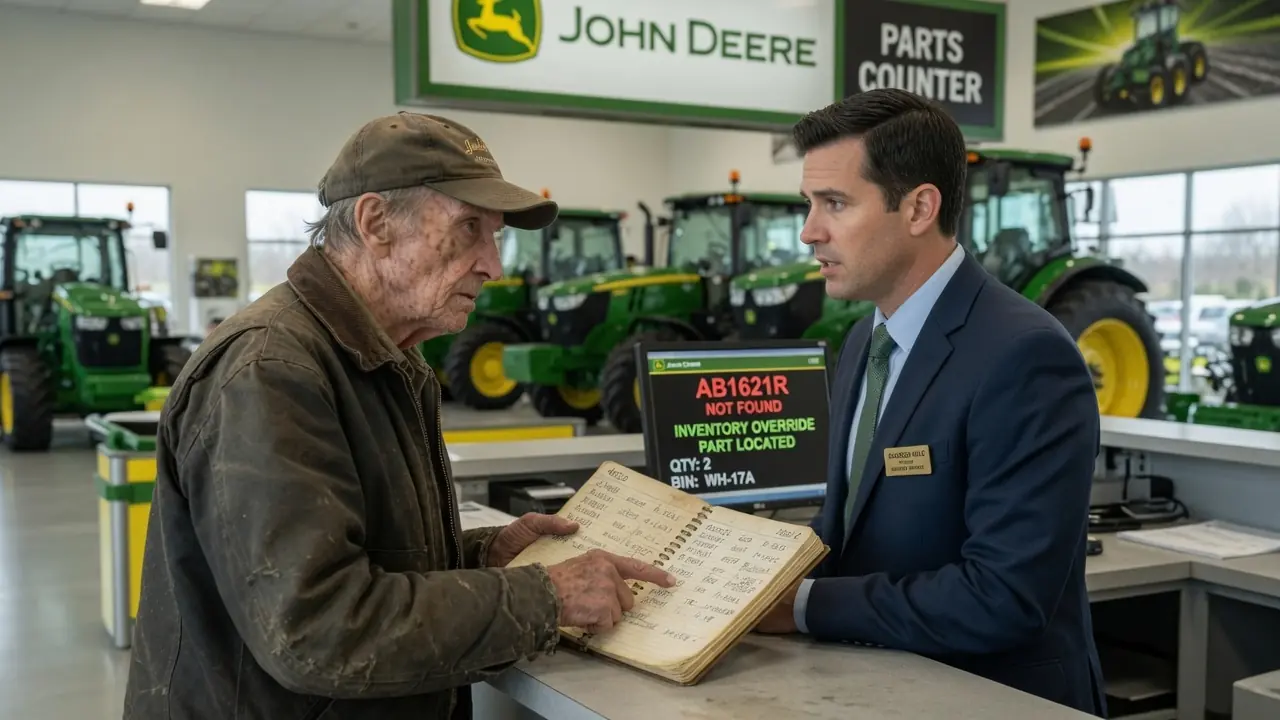
Then one cold morning, the engine stumbled. Not badly, not enough to frighten a young farmer who did not know better, but Eli knew that tractor the way some men knew a song. The idle had a slight cough, and a puff of dark smoke lifted when he brought the throttle up. He shut it down, opened the hood, and listened to the silence like it owed him an answer.
The problem was not the engine. It was not the transmission, not the fuel pump, not the kind of failure that could ruin a planting season. It was one injector nozzle, a little piece of metal smaller than a man’s thumb. Eli found the part number in his old service manual, wiped his hands on a rag, and smiled because he thought the fight was already over.
AB1621R.
He wrote it on a scrap of cardboard and drove to the dealership before lunch. The building still wore the same green signs, but everything inside looked brighter, cleaner, and less familiar. New machines sat under lights like expensive statues, each one carrying a price tag large enough to make a farmer’s stomach tighten. Eli ignored them and walked straight to the parts counter.
Brandon Hale stood behind the computer in a pressed shirt with the dealership logo stitched over his chest. He was younger than Eli expected, maybe early forties, with smooth hands and a confident smile that belonged more to financing than farming. Eli slid the cardboard across the counter.
“Need one of these,” Eli said.
Brandon typed the number without looking up at first. Then he paused. His eyebrows lifted slightly, and he leaned back in his chair like the computer had given him permission to stop caring.
“That’s for a 4020, right?”
“Yes.”
Brandon tapped a few more keys, then shook his head. “That part’s discontinued.”
Eli frowned. “Discontinued?”
“Too old,” Brandon said casually.
Eli did not move. He had spent enough years fixing equipment to know when a sentence sounded wrong. Parts did not just vanish when thousands of tractors still used them. Machines wore out, dealers changed, catalogs shifted, but metal had a way of existing somewhere if a man knew how to ask.
“You sure about that?” Eli asked.
Brandon turned the monitor slightly away. “That’s what the system says.”
“I don’t need the whole injector. Just the nozzle.”
“I understand.” Brandon’s smile returned, smoother now. “But honestly, Eli, you’d probably be better off upgrading anyway.”
He pointed across the showroom to a brand-new John Deere 6M shining under bright lights. The paint looked flawless, the cab looked quiet, and the digital display inside looked more like an airplane than a tractor. Eli followed Brandon’s gesture and saw the price tag.
$185,000.
Brandon leaned forward. “Payments wouldn’t be bad. Around seven hundred and forty a month, depending on terms. Seven years, interest included.”
Eli stared at him. “I need a nozzle.”
“I’m trying to save you trouble.”
“No,” Eli said slowly. “You’re trying to sell me a tractor.”
Brandon’s polite smile thinned. “I’m telling you the truth. That part doesn’t exist anymore.”
Eli picked up the cardboard and walked out before anger could make him say something he would regret. Outside, cold air hit his face, but it did not cool him. He sat in his truck for a full minute, both hands on the wheel, staring at the dealership doors. A $47 repair had somehow turned into a $185,000 suggestion.
That afternoon, Eli stopped at the co-op. Farmers were gathered near the coffee machine, talking about weather, fertilizer prices, and the kind of repairs that never waited until a convenient week. Eli mentioned what happened while paying for a bag of seed.
“They said the injector nozzle doesn’t exist anymore.”
Old Ray Dunlap laughed so hard he nearly spilled his coffee. “Discontinued?”
“That’s what they said.”
Ray shook his head. “My uncle Frank worked at Waterloo for nearly forty years. Built those engines back when Deere still expected a machine to outlive a man’s mortgage.”
Eli looked up. “You think he’d know?”
Ray smiled. “Frank knows things computers forgot.”
Three days later, a faded blue pickup rolled into Eli’s driveway. It had rust along the wheel wells, toolboxes rattling in the bed, and a cracked windshield that had probably been cracked for years. Frank Miller stepped out slowly, but not weakly. He was seventy-four, with grease stains on his cap and hands that looked like they had spent a lifetime arguing with bolts and winning.
He did not waste words. He walked straight to the 4020, ran his fingers along the injector housing, and listened while Eli explained the rough idle and dark smoke. Frank nodded once.
“Injector nozzle,” he said.
“That’s what I thought.”
“What number?”
“AB1621R.”
Frank froze for half a second. Then he smiled, but it was not a happy smile. It was the kind of smile a man wears when a lie has just introduced itself.
“Show me what the dealership gave you.”
Eli handed him the paperwork. Frank read it, then pulled a small leather notebook from his jacket. The pages were yellowed, packed with handwritten numbers, casting codes, factory references, and notes only a man who had spent decades inside engines could understand. He flipped through until his finger stopped on a line.
“That nozzle,” Frank said calmly, “never stopped being made.”
Eli stared at him. “What do you mean?”
Frank closed the notebook. “They just stopped selling it to farmers.”
The sentence landed heavier than Eli expected. He looked at the tractor, then back at Frank. “How can they do that?”
Frank shrugged. “They change the catalog.”
“That’s legal?”
“Depends how they explain it.” Frank looked toward the horizon. “But the truth is simple. That old 4020 is worth more to them broken than running.”
Eli felt his stomach tighten. He had known something was wrong at the dealership, but hearing it from Frank made the wrongness feel bigger than one part. It was not just Brandon being lazy. It was a system with a polished counter and a financing desk behind it.
Frank inspected the tractor for half an hour. He checked the injector body, fuel lines, pump timing, and the worn nozzle. Finally, he stood and wiped his hands with a rag.
“You were right. Just the nozzle.”
“Which should cost around fifty dollars.”
“About that.”
Eli crossed his arms. “So what do we do?”
Frank put the notebook back in his pocket. “We go back.”
“They already told me no.”
Frank’s eyes sharpened. “That’s because you asked like a customer. I’m going to ask like a man who helped build the thing they’re lying about.”
The dealership was busy when they returned. Mechanics moved through the shop, customers waited near the service desk, and the same new tractors gleamed under the lights like quiet threats. Brandon Hale was behind the parts counter, laughing with a salesman until he saw Eli walk in.
“Back again?” Brandon asked.
Eli said nothing.
Frank stepped forward.
Brandon glanced at him, dismissing him in one quick look. To Brandon, Frank was just another old man in a worn jacket. Another farmer’s friend. Another relic from a time before software subscriptions and seven-year financing plans.
“Still looking for that injector?” Brandon asked.
“Yes,” Frank said.
Brandon sighed. “Like I told him, that part’s discontinued.”
Frank leaned one elbow on the counter. “Show me the system.”
Brandon blinked. “Excuse me?”
“The parts lookup.”
“That’s internal.”
“I figured.”
Brandon’s smile faded slightly. “Then you know I can’t show it to you.”
Frank’s voice remained calm. “I also know it has an inventory override.”
The air changed around the counter.
Brandon stared at him. “How would you know that?”
Frank opened his notebook. “I spent thirty-eight years at Waterloo Works. I helped design injector tooling for the 4000 series engines.”
The parts counter went quiet. A customer waiting for hydraulic fittings turned his head. One of the mechanics stopped near the shop door.
Frank tapped the counter once. “So if you don’t mind, I’d like to see the real inventory.”
Brandon’s jaw tightened. “I’ll need the manager.”
Frank nodded. “That would be best.”
Five minutes later, the dealership manager walked out from the office. His name was Brandon Hale too, though most employees called him Mr. Hale when customers were listening. He had the polished confidence of a man who trusted policy more than truth. He looked at Eli first, then Frank.
“What seems to be the issue?”
Brandon from parts explained quickly. “Old tractor, discontinued nozzle, customer refuses upgrade.”
Frank smiled without warmth. “That is not the issue.”
The manager turned to him. “And you are?”
“Frank Miller. Retired Waterloo engineer.”
The manager’s face tightened just a little. “Mr. Miller, I understand old machines matter to people, but unfortunately, some parts are no longer supported.”
Frank opened his notebook. “AB1621R. Injector nozzle. Waterloo internal reference 4172B. Same casting, same tolerances, same material spec.”
The manager crossed his arms. “That agricultural part is discontinued.”
“No,” Frank said. “The agricultural catalog number is filtered.”
The manager did not answer.
Frank stepped closer to the counter. “That casting is still being produced and sold through the industrial engine division.”
“That’s not something we can confirm.”
“You can.” Frank pointed toward the computer. “Use the all-region inventory override.”
The manager’s eyes hardened. “That is not standard procedure.”
Frank’s voice sharpened. “Neither is telling a farmer a part doesn’t exist while trying to sell him debt.”
The words carried across the showroom.
A salesman near the new tractors stopped talking. Customers waiting at service turned fully now. Eli felt his pulse climb, but Frank looked as calm as winter iron.
The manager lowered his voice. “Sir, this is a dealership, not a courtroom.”
Frank leaned in. “Then stop acting like a defendant.”
The manager flushed.
Brandon from parts looked at the keyboard, then at his manager. The computer screen glowed between them like an accusation. Eli could see the hesitation now. Not confusion. Fear.
The manager tried one last smile. “Even if something appears in another division, we may not be allowed to sell it for emissions reasons.”
Frank pulled out his phone and opened a saved document. “Federal guidance says manufacturers may not restrict access to repair parts under emissions compliance claims when the part restores original function.”
The manager’s smile disappeared completely.
Frank held up one finger. “The part exists.” Another finger. “It is legal to sell.” A third. “And it is currently sitting somewhere in your inventory.” His voice dropped. “So the only remaining reason not to sell it is because you would rather he buy a new tractor.”
Silence settled heavy over the dealership.
The manager looked around and realized the room had become an audience. Mechanics. Farmers. Service customers. Salesmen pretending not to listen. A dealership could survive one angry farmer, but it could not easily survive an entire showroom hearing the wrong truth.
“Type it,” Frank said.
The manager did not move.
Frank’s eyes narrowed. “Brandon, you told this farmer the nozzle was dead. If that is true, the screen will protect you. If it is not true, every man in this room deserves to see how close a lie came to costing him one hundred and eighty-five thousand dollars.”
The manager exhaled through his nose. Then he turned to the computer.
His fingers moved across the keyboard.
The screen refreshed.
For a moment, nobody spoke.
Frank tilted his head. “Read it.”
The manager stared at the monitor.
“Read it,” Frank repeated, louder this time.
Brandon from parts swallowed.
The manager’s voice came out tight. “Four units in warehouse stock.”
A low murmur rolled across the showroom.
Eli felt anger rise so fast it nearly stole his breath. Four units. The part had been there the entire time. His tractor had been one inventory screen away from running, and Brandon had looked him in the eye like the truth was obsolete.
Frank nodded once. “Price?”
The manager did not answer.
Frank’s voice went cold. “Read that too.”
“Forty-seven dollars.”
Someone in the service line swore under his breath.
Eli looked toward the brand-new tractor under the lights, then back at the screen. Forty-seven dollars. Seven years of payments had been sitting beside a hidden part number.
The manager tried to recover. “We still have policy limitations.”
Frank slammed his notebook shut. The sound cracked across the counter.
“No. Policy is not a holy word. Policy does not get to turn a working tractor into a loan document. Policy does not get to lie to a man who knows his machine.”
The manager’s face hardened. “You need to lower your voice.”
Frank leaned closer. “No, son. You need to raise your standards.”
The room went silent again.
Eli had expected Frank to be calm. He had not expected him to be dangerous in such a quiet way. The old engineer was not shouting, not threatening, not performing. He was simply stripping away every place the manager tried to hide.
Brandon from parts finally spoke. “Should I order it?”
The manager turned on him. “Wait.”
Frank looked at Brandon. “Order it.”
The young parts clerk hesitated.
Eli stepped forward then. “I’m the customer. I’m paying. Order the part.”
The manager’s mouth opened, but no words came.
Brandon typed, hands shaking slightly. The printer behind the counter spat out a slip. He walked into the back and returned with a small cardboard box, plain and unimpressive. He placed it on the counter like it weighed a hundred pounds.
AB1621R.
Waterloo casting.
$47.
Eli picked it up slowly. He had held heavier parts, more expensive parts, more urgent parts. But he had never held a piece of metal that felt so much like proof.
Frank looked at the manager. “Now you understand something.”
The manager’s jaw flexed. “What’s that?”
“You didn’t lose a sale today because this farmer is stubborn.” Frank’s eyes cut toward the new tractor. “You lost trust because you thought he was ignorant.”
Nobody moved.
Frank turned and walked toward the door.
Eli followed, still holding the box.
Outside, the cold air felt cleaner than it had that morning. Eli stopped beside the truck and looked back through the dealership windows. Men inside were still talking, gesturing toward the counter, toward the showroom tractors, toward the parts department where the lie had finally been forced into daylight.
Frank opened the passenger door.
“You coming?” he asked.
Eli looked at the box in his hand. “Forty-seven dollars.”
Frank nodded. “Expensive lesson.”
“That’s not expensive.”
Frank gave him a sharp look. “It almost was.”
They drove back to the farm in silence. At the shop, Frank helped install the nozzle, talking Eli through torque specs and alignment like he was teaching a class only one man had paid attention enough to deserve. The job took less than an hour.
Eli climbed into the tractor seat and turned the key.
The diesel rolled once, twice, then caught. The rough idle was gone. No dark smoke. No stumble. Just the steady, deep rhythm of old iron doing exactly what it had been built to do.
Frank stood beside the tractor with his arms folded, listening.
“That,” he said, “is how it’s supposed to sound.”
Eli shut it down and climbed off. “I appreciate this.”
Frank shrugged. “Wasn’t about the nozzle.”
“What was it about?”
Frank looked at the 4020. Its green paint was faded, the hood scratched, the tires worn but solid. “That machine was built to last fifty years. The business model wasn’t.”
Eli understood.
The fight had never been about one injector nozzle. It was about who controlled a machine after a farmer bought it. The company that built it, the dealership that sold it, or the man whose hands kept it running through frost, dust, and harvest.
Frank climbed into his pickup, then paused with the door open. “Learn your machines.”
Eli nodded.
Frank smiled faintly. “Because once you know how they really work, nobody can sell you a lie again.”
The story spread before the week ended. Farmers talk in co-ops, at grain elevators, in machine sheds, and over coffee before sunrise. By Saturday, three different men had asked Eli if it was true that the dealership had claimed the part did not exist while four units sat in warehouse stock. Eli told them exactly what happened.
Some laughed bitterly. Some shook their heads. One man stared into his coffee and said, “Then it’s not just your tractor.”
That sentence stuck.
Two weeks later, Eli found Frank at the co-op, sitting with his leather notebook open beside a cup of coffee. Eli sat across from him.
“You started something.”
Frank looked up. “What do you mean?”
“Three guys told me the dealership said the same thing to them. Different parts. Different machines.”
Frank nodded slowly. “Same pattern.”
“What pattern?”
“Corporate pressure.” Frank closed the notebook. “Dealerships don’t make real money selling fifty-dollar parts anymore. They make money selling financing, service contracts, software access, and new machines that keep owners tied to the dealer.”
Eli leaned back. “So the old 4020 is a bad customer.”
Frank smiled. “Terrible customer. Doesn’t borrow money. Doesn’t need dealer diagnostics. Doesn’t phone home. Doesn’t ask permission to start.”
Eli laughed once, then stopped because the truth underneath was not funny.
Frank tapped the notebook. “That’s why knowledge matters. Part numbers. Casting numbers. Manuals. Maintenance logs. The more a farmer knows, the harder it is to trap him with a screen.”
That night, Eli’s fifteen-year-old son Caleb came into the shop while Eli was changing oil on the 4020. The boy watched quietly for a while, hands in his hoodie pocket.
“Dad?”
“Yeah?”
“Is it true the dealership tried to make you buy a new tractor?”
Eli tightened the drain plug slowly. “They tried.”
“Because of that tiny part?”
“Because they hoped I didn’t know better.”
Caleb frowned. “But the tractor works.”
“Exactly.”
Eli handed him a wrench and pointed toward the injector housing. “Come here. See that piece?”
Caleb leaned in.
“That nozzle caused the whole fight.”
“That little thing?”
“Yep.”
“That’s crazy.”
“It is.” Eli looked at his son. “That’s why you’re going to learn this machine.”
Caleb looked unsure. “Why?”
“Because if you know how something works, nobody can convince you it’s broken when it isn’t.”
The boy nodded slowly.
In that moment, something bigger than repair passed between them. Not just maintenance. Not just mechanical knowledge. Independence. The kind of independence that had kept small farms alive through bad prices, bad weather, and bad advice from men behind counters.
Months passed. Planting came. Then summer. Then harvest. The 4020 started every morning, steady as ever. Sometimes Eli stood outside before sunrise and listened to the engine idle, remembering how close he had come to letting a hidden inventory screen push him toward debt.
At the dealership, things changed too. Not quickly, and not because Brandon Hale had suddenly grown a conscience. They changed because farmers began asking different questions. Show me the real inventory. Check the industrial catalog. Use the override. What is the casting number?
The parts counter no longer felt so untouchable.
One morning, Brandon saw Eli walk in with another farmer beside him. His face tightened immediately.
Eli smiled politely. “Morning, Brandon.”
Brandon said nothing.
The farmer beside Eli placed a part number on the counter. “Need one of these. And before you say discontinued, check every catalog.”
Behind them, three men in line chuckled.
Frank’s lesson had spread.
The retired engineer did not become famous. He did not want to. He kept drinking coffee at the co-op, fixing old engines in his garage, and adding notes to the little leather book that had defeated a polished lie. But farmers started bringing him questions. Hydraulic valves. Pump housings. Sensors. Old manuals with pages missing.
Frank always told them the same thing.
“Don’t accept disappeared as an answer. Parts almost never disappear. They just get hidden where you were not supposed to look.”
Years later, Caleb would remember the sound of that tractor starting after the nozzle was replaced. He would remember his father’s hand placing the wrench in his palm. He would remember Frank Miller standing at the dealership counter, facing Brandon Hale without raising his voice, and forcing the screen to tell the truth.
And when Caleb took over more of the farm, he kept his own notebook.
Part numbers.
Casting codes.
Service dates.
Torque specs.
Cross-reference notes.
Not because he distrusted every dealer. Some were honest. Some still cared. But because trust without knowledge was just hope wearing a work shirt.
The 4020 kept running.
Its paint kept fading. Its seat cracked more at the edges. Its engine still turned cold mornings into motion. And every time it started, it carried a lesson louder than diesel.
A machine paid for belongs to the person who owns it.
A repair denied should be questioned.
And sometimes the difference between a $47 part and a $185,000 purchase is one old engineer willing to say, “Show me the real inventory.”