“Hey, get your hand off that truck.”
The words cut across the bright Ford Super Duty showroom before Elias Thorne had even turned his head. He was standing beside a black F-350, one rough hand resting lightly on the hood, his old cowboy hat tilted low over his white hair. Dust clung to the cuffs of his overalls, and the heels of his boots had carried half the Texas panhandle into the polished dealership. Behind the truck, salesmen in clean shirts turned toward him with amused faces, already deciding what kind of man he was before he had spoken a single word.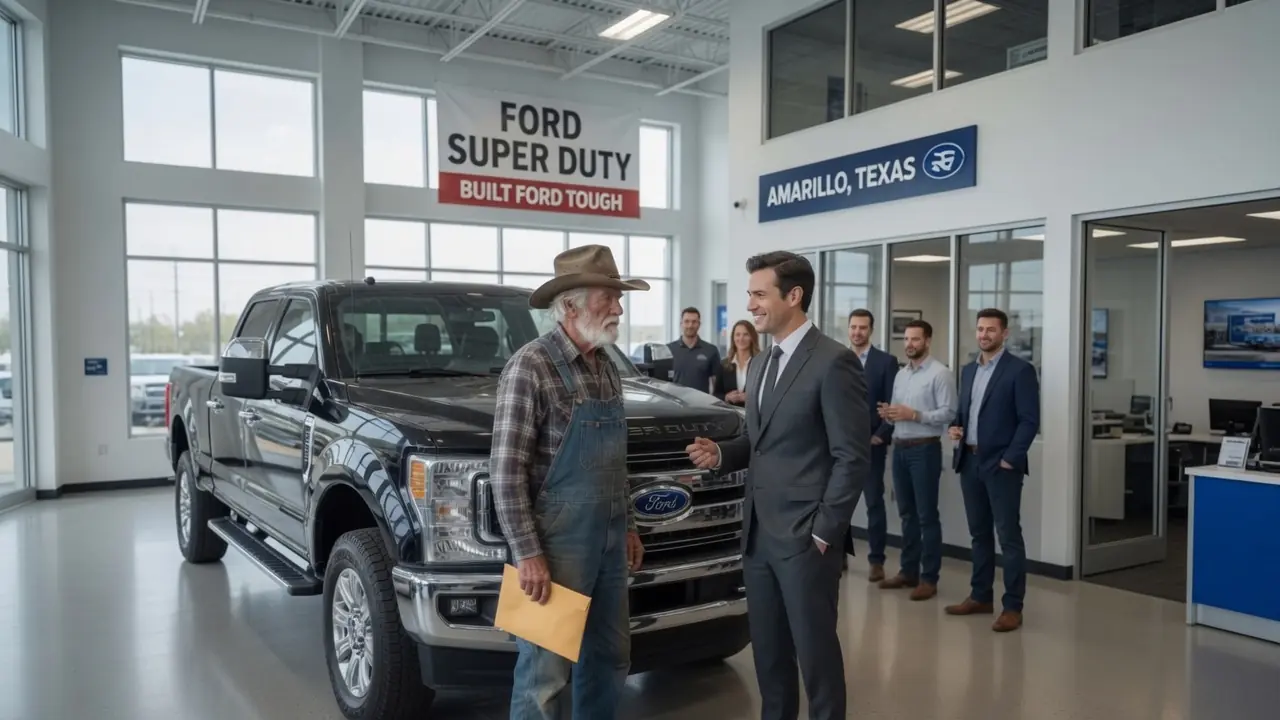
The man who had shouted was Grant Mercer, the youngest sales manager at Amarillo Plains Ford, dressed in a gray suit that looked too sharp for the room and a smile that never reached his eyes. He stepped around the front bumper slowly, like Elias had touched something sacred. Two younger salesmen stood behind him, half laughing, half waiting to see how far Grant would take it. A young couple near the service desk turned to watch, their phones still in their hands.
Elias lifted his palm from the hood.
“I said,” Grant repeated, louder this time, “get your hand off that truck. These are not display toys for anybody who wanders in from the road.”
Elias looked at him for a long, quiet second. He did not look angry yet, and that seemed to bother Grant more than if he had shouted. In Elias’s left hand was a large yellow envelope, sealed, clean, and held carefully against the leg of his overalls. He had carried that envelope across his ranch office that morning, across two hundred miles of highway, and through the front doors of a dealership where he had expected professionalism.
Instead, he had found a room full of grins.
“I came to look at the truck,” Elias said.
Grant glanced down at Elias’s boots. “You can look from over there.”
A few people laughed under their breath.
Elias’s eyes moved across the showroom. The place was bright, new, and full of polished glass. A red-and-white banner hanging from the ceiling read Built Ford Tough, and beside it a blue sign said Amarillo, Texas in bold white letters. The black Super Duty behind him gleamed under the overhead lights, spotless and enormous, the kind of truck built for oil fields, cattle ranches, construction crews, and long roads where a weak machine could cost a man more than money.
“I like to look close,” Elias said.
Grant gave him a thin smile. “Then maybe look close at the floor. You’re tracking dirt all over it.”
The laughter came again, sharper now.
Elias looked down at the floor. There was dust around his boots, yes, and a little mud dried along one heel from the cattle pens that morning. He thought of the three men he had left repairing fence on the north pasture, of the two drivers waiting for new trucks before the next hay run, and of the contract in his envelope that had taken four months to prepare. He had dressed as he always dressed on a workday because he had never believed money required a costume.
Grant believed otherwise.
“We’re not hiring,” Grant said. “If that’s why you came in.”
Something in the showroom shifted. The words were not shouted, but they were loud enough. A man near the parts counter looked away. One of the salesmen smiled, then quickly hid it when Elias turned his eyes toward him. The young couple stopped pretending they were not listening.
Elias adjusted the envelope under his arm.
“I did not come looking for work,” he said.
Grant nodded slowly, as if humoring him. “Then what did you come for?”
“To see how your people treat a man before they know his name.”
Grant laughed once. “Your name won’t change the price of that truck.”
“No,” Elias said quietly. “But it might change what happens in this building.”
Grant’s smile hardened. “Old man, let me make this easy. That truck starts at more than most people make in a year. If you need used inventory, someone can show you the back lot. If you need directions, the front desk can help.”
Elias looked at the truck again.
“My father bought his first Ford pickup in 1951,” he said. “Blue one. Three-on-the-tree. He drove it until the floor rusted out and still said it had one more year in it.”
Grant blinked, thrown by the quiet memory.
“My son bought two trucks from this dealership before he died,” Elias continued. “Back when Mr. Holloway ran it. He knew every rancher’s name.”
Grant folded his arms. “Mr. Holloway retired ten years ago.”
“I know.”
“This is not the same dealership.”
Elias looked back at him. “I can see that.”
Grant’s jaw tightened. “Do you have an appointment?”
“Yes.”
“With who?”
“With the fleet director.”
Grant’s expression flickered.
Behind him, one of the salesmen straightened slightly.
“What fleet director?” Grant asked.
“Rebecca Sloan.”
Grant’s confidence returned almost immediately. “Rebecca is in a meeting.”
“She is expecting me at ten.”
Grant glanced at the clock on the wall. It was 9:52.
He looked back at Elias’s clothes, then at the yellow envelope. “You’re Elias Thorne?”
The way he said the name told Elias everything. Grant had heard it before, but he had not expected it to belong to the man standing in front of him. He had expected someone in a pressed shirt, maybe a lawyer, maybe a ranch manager with a company badge. He had not expected an elderly Black rancher in overalls with dirt on his boots and a face carved by seventy years of sun.
“Yes,” Elias said.
Grant’s smile returned, but it was no longer comfortable. “Well, Mr. Thorne, you should have checked in at the front desk instead of putting your hands on a sold unit.”
“Is it sold?”
Grant paused.
“No,” one of the younger salesmen said before he could stop himself.
Grant shot him a look.
Elias turned toward the younger man. “Thank you.”
The salesman’s face reddened.
Grant stepped closer, lowering his voice. “Listen carefully. We have customers in here today who actually came to buy. I do not need a scene.”
Elias’s eyes narrowed slightly. “You made the scene.”
Grant’s face changed. For the first time, irritation overpowered his showroom smile. He looked toward the front desk, where the receptionist was pretending to type. Then he looked back at Elias.
“Security can help you wait outside until Rebecca is available.”
The words settled coldly into the bright room.
Elias stood very still.
He had been spoken down to before. A man did not live as long as he had in Texas, build land from nothing, survive bank refusals, drought years, cattle losses, and quiet insults without learning the shape of contempt. But there was a difference between ignorance and arrogance. Ignorance could be taught. Arrogance had to be exposed.
Elias nodded once.
“Call them,” he said.
Grant blinked. “Excuse me?”
“Call security.”
One of the customers murmured something.
Grant’s smile faltered. “That will not be necessary if you cooperate.”
Elias lifted the yellow envelope. “I am cooperating. I am standing right here, waiting for you to show the room exactly who you are.”
Before Grant could answer, a glass office door opened above the showroom floor. A woman in a navy blazer stepped out, followed by two men with folders. She looked down over the railing, saw Elias, then saw Grant standing too close to him. Her face went pale.
“Mr. Thorne?” she called.
Everyone turned.
Rebecca Sloan hurried down the stairs, her heels clicking fast against the steps. She was in her early forties, sharp-eyed, composed, and suddenly very aware that something had gone wrong before her meeting had even begun. Grant straightened his jacket as she approached.
“Rebecca,” he said quickly, “I was just helping Mr. Thorne—”
“No, you were not,” Elias said.
The room fell silent.
Rebecca stopped beside them. “Mr. Thorne, I’m sorry. I came down as soon as my assistant said you arrived.”
Elias looked at her. “I arrived early. I had time to learn a few things.”
Rebecca’s eyes moved from Elias to Grant. “What happened?”
Grant laughed lightly. “Just a misunderstanding. Mr. Thorne came in and started touching one of the trucks, and I asked him to—”
“You told me to get my hand off it,” Elias said.
Grant’s face tightened.
“You told me not to track dirt in here,” Elias continued. “You told me you were not hiring. You told me to look at the back lot. Then you said security could help me wait outside.”
The showroom became so quiet that the hum of the lights seemed loud.
Rebecca’s mouth opened slightly, then closed. She looked at Grant, and whatever professional calm she had brought down the stairs began to disappear.
“Is that true?” she asked.
Grant glanced around, realizing too late that too many people had heard too much. “I was managing the showroom.”
Rebecca’s voice dropped. “Is it true?”
He looked away. “It may have been poorly phrased.”
Elias gave a small, tired laugh. “It was phrased clearly.”
Rebecca turned back to him. “Mr. Thorne, I am deeply sorry.”
Elias did not answer immediately. He looked at the black Super Duty again, then at the staff gathered near the counter. He thought of his son Marcus, who had walked into this same building years ago and come home talking about how old Mr. Holloway had shaken his hand before asking what he needed. Marcus had believed loyalty mattered. Elias had come today partly because of that memory.
Now the memory felt insulted.
Rebecca gestured toward the office. “Please, let’s go upstairs. We can discuss this privately.”
“No,” Elias said.
Rebecca froze.
Grant glanced up, almost relieved, thinking perhaps the old man was being difficult enough to weaken his own position.
Elias placed the yellow envelope on the hood of the black truck. He opened it slowly and took out a stack of papers clipped together with a blue binder clip. The top page carried the name Thorne Land & Cattle Logistics, the company Elias had built from one leased pasture and two used trailers into one of the largest ranch transport operations in the region.
Grant stared at the papers.
Elias turned the top page so Rebecca could see it. “This is the purchase authorization for forty-two Ford Super Duty trucks, phased over six months. Twenty-six F-350s. Ten F-450 chassis cabs. Six service-body units. Total value just over four million dollars before maintenance contracts.”
A man near the service desk whispered, “Forty-two?”
Grant’s face drained of color.
Rebecca’s hand moved toward the papers, but she stopped short of touching them. “Mr. Thorne…”
“I came here because my son bought from this dealership,” Elias said. “I came because your fleet office gave a fair proposal. I came because these trucks would serve ranches, feed routes, veterinary crews, equipment haulers, and emergency water deliveries across five counties.”
He looked at Grant.
“And before ten o’clock, I learned exactly how this dealership treats a working man with dust on his boots.”
Grant swallowed. “Mr. Thorne, I had no idea—”
“That is the point,” Elias said.
The words struck harder than shouting would have.
“You had no idea who I was,” Elias continued. “No idea what I owned. No idea what I came to buy. And because you did not know, you treated me like I was beneath your floor.”
Grant opened his mouth, but nothing came out.
Elias looked across the showroom. “How many men have walked in here with less money than me and been treated the same way? How many farmers, drivers, mechanics, widows, young families, and ranch hands did you shame because they did not look profitable fast enough?”
No one answered.
Rebecca’s eyes had gone bright with anger, but she kept her voice controlled. “Mr. Thorne, this is unacceptable. Grant will be removed from this account immediately.”
Grant turned toward her. “Rebecca—”
“Do not speak,” she said.
Elias gathered the papers back into a neat stack. “This is no longer an account.”
Rebecca looked at him.
He slipped the papers back into the envelope.
“I have another meeting in forty minutes,” he said. “Lubbock dealership. They know I am coming. They know what I am buying. Maybe they will remember to treat me like a man before they treat me like a contract.”
Rebecca stepped closer. “Please give me ten minutes. Just ten minutes to call ownership.”
Elias looked at the clock.
It was 10:02.
“Ten minutes,” he said. “That is all.”
Rebecca moved fast. She turned to the receptionist. “Get Mr. Whitcomb on the phone now. Tell him it is urgent.” Then she pointed to Grant. “My office. Do not leave.”
Grant did not move.
“Now,” Rebecca said.
He walked toward the office with the stiff steps of a man watching his future disappear in front of customers.
The next ten minutes felt longer than the whole morning. Elias stood beside the black truck, hands folded over the envelope, while the showroom pretended not to stare. The young salesman who had accidentally admitted the truck was not sold approached him slowly.
“Mr. Thorne,” he said, voice low, “I’m sorry I laughed.”
Elias studied him. The young man looked barely twenty-three, with nervous eyes and a face that had not yet learned how expensive cowardice could be.
“What is your name?” Elias asked.
“Caleb, sir. Caleb Morris.”
“Why did you laugh?”
Caleb looked down. “Because Grant did.”
Elias nodded. “That is how bad rooms stay bad.”
Caleb’s face reddened. “Yes, sir.”
Elias looked toward the truck. “Do you know what payload this model carries with the proper package?”
Caleb blinked, then answered quickly. “Depending on configuration, over seven thousand pounds, sir. More with chassis cab options.”
“Do you know ranch use?”
“My grandfather runs cattle outside Pampa.”
“Then you knew I belonged around this truck.”
Caleb’s eyes lifted. “Yes, sir.”
“But you let another man decide I did not.”
The young salesman swallowed. “Yes, sir.”
Elias let the silence sit between them, not to humiliate him, but to make sure the lesson had somewhere to land.
At 10:12, Rebecca came down the stairs with an older man in a dark blazer. He had silver hair, a hard mouth, and the look of someone who had been pulled from a comfortable office into a crisis. This was Martin Whitcomb, one of the dealership owners. Grant followed behind them, pale and silent.
Martin crossed the floor with his hand extended. “Mr. Thorne, I’m Martin Whitcomb. What happened here today is inexcusable.”
Elias did not take his hand.
Martin lowered it slowly.
“I won’t dress this up,” Martin said. “I heard the account from Rebecca, from two staff members, and from a customer who recorded part of it. Grant Mercer is no longer employed by this dealership.”
Grant’s head snapped up. “Martin—”
“You are done,” Martin said without looking at him.
A quiet shock moved through the room. Grant looked around as if someone might object, but no one did. The same employees who had laughed behind him now stood silent, suddenly fascinated by the floor.
Elias looked at Martin. “Firing one man does not fix a showroom.”
“No,” Martin said. “It does not.”
“Then what does?”
Martin breathed in. “Training. Policy. Accountability. A customer treatment review. Direct oversight from ownership.”
Elias shook his head. “Those are office words.”
Martin flinched slightly.
Elias pointed toward the black truck. “This showroom sells work trucks to people who work. Dirt should not frighten your floor. Overalls should not confuse your sales staff. An old Black man in boots should not have to prove he is rich before he is treated with ordinary respect.”
Martin’s face tightened with shame.
Rebecca looked down.
Elias picked up the envelope again. “You want this contract?”
“Yes,” Martin said. “Very much.”
“Then the first truck in this order will not be mine.”
Martin hesitated. “What do you mean?”
Elias turned toward Caleb. “It will be a service truck donated in Marcus Thorne’s name to the Panhandle Rural Relief Network. You will sell it at cost, outfit it properly, and your dealership will service it free for five years. It will carry water, feed, generators, and medicine to small ranches during drought, flood, and breakdowns.”
Rebecca nodded quickly. “We can do that.”
Elias kept his eyes on Martin. “Second, Caleb here will handle the fleet account with Rebecca supervising him. Not because he was perfect. Because he admitted the truth when it cost him pride.”
Caleb looked stunned.
“Third,” Elias continued, “every person in this building will spend one day on a working ranch before they sell another ranch truck. Not a charity photo. A full day. Fence, feed, mud, heat, dust, and all.”
For the first time, Martin almost smiled, but he wisely stopped himself. “That can be arranged.”
“Fourth, when a farmer, driver, mechanic, or ranch hand walks in wearing work clothes, your staff will stand up and greet them before judging whether they can pay.”
Martin nodded. “Agreed.”
Elias looked around the room one last time. “And fifth, Grant Mercer will apologize before he leaves.”
Grant’s face twisted. “I was fired. Isn’t that enough?”
Elias turned toward him. “No.”
The silence pressed down.
Grant looked at Martin, but Martin gave him nothing. He looked at Rebecca, but her expression was colder than the chrome grille behind them. Finally, Grant faced Elias.
“I’m sorry,” he said.
Elias waited.
Grant swallowed. “I’m sorry I judged you by how you looked. I’m sorry I told you to get your hand off the truck and treated you like you didn’t belong here.”
Elias held his gaze. “You did not just treat me like I did not belong. You enjoyed making sure everyone else saw it.”
Grant’s eyes dropped.
“Say that part,” Elias said.
Grant’s voice weakened. “I enjoyed embarrassing you.”
Elias nodded once. “Now you have told the truth.”
Grant left through the side door with no applause, no defense, and no one walking beside him.
The showroom stayed quiet long after he was gone. Elias finally placed the envelope in Rebecca’s hands. She accepted it like it weighed more than paper.
“You still want to do business with us?” she asked.
“I want to see whether you can become the kind of dealership my son remembered,” Elias said. “You have six months to prove it.”
Rebecca nodded. “We will.”
Elias looked at Caleb. “Show me the truck.”
Caleb straightened. “Yes, sir.”
This time, when Elias placed his hand on the hood of the black Super Duty, no one told him to move it. Caleb opened the driver’s door, explained the towing package, payload ratings, engine options, axle ratios, and service configurations. He spoke carefully at first, then with more confidence as Elias asked questions that proved he knew trucks better than half the men in the building.
By noon, the first phase of the order was signed.
By the end of the week, the story had spread across Amarillo. Some told it as a business lesson. Some told it as a humiliation. Some told it as the day an old rancher walked into a showroom with dust on his boots and walked out with the dealership in his hand.
Elias did not care how they told it.
He cared what changed.
Two weeks later, the first ranch workday took place at Thorne Land & Cattle. Salesmen arrived in clean boots and left with sore backs, sunburned necks, and a new understanding of what their customers meant when they said a truck had to work. Caleb stayed late helping repair a gate even after the others had gone. Elias noticed but said nothing until the boy was washing dust from his hands at the pump.
“You did better today,” Elias said.
Caleb looked up, surprised. “Thank you, sir.”
“Do not thank me yet. Doing better once is easy. Becoming better takes longer.”
Caleb nodded. “I understand.”
Elias looked toward the pasture where cattle moved slowly under the wide Texas sky. “My son used to say a truck salesman ought to know what a truck is carrying before he talks about price.”
“He was right,” Caleb said.
“Yes,” Elias replied softly. “He usually was.”
The Marcus Thorne service truck was delivered a month later. It was white, strong, and fitted with toolboxes, water tanks, a generator rack, medical storage, and heavy-duty tires. On the door, beneath the relief network logo, were the words: Respect the work. Respect the worker.
Elias stood beside it at the dedication while Rebecca, Caleb, Martin, ranchers, reporters, and dealership staff gathered around. No one mentioned Grant Mercer. No one needed to. The empty space where his arrogance had once stood was lesson enough.
When Elias was asked to speak, he kept it short.
“A truck is just steel until it serves somebody,” he said. “A business is just glass and lights until it remembers people come first. Today, this truck goes where it is needed. I hope this dealership learns to do the same.”
People clapped, but Elias did not smile for the applause.
He placed one hand on the truck door, right over his son’s name.
Six months later, Amarillo Plains Ford had changed enough that people noticed. Ranchers came in wearing dusty boots and were greeted by name. Service staff asked what was down, how urgent it was, and what the weather looked like before they asked about account history. Caleb became the youngest fleet specialist in the dealership’s history, not because Elias had saved him, but because he had chosen to learn from the day he nearly became another silent coward in a bad room.
The forty-two trucks were delivered on schedule.
Every one of them went to work.
Some hauled cattle trailers. Some carried feed. Some pulled equipment through red dirt roads. One carried emergency water during a brutal dry spell, and another brought a stranded family home after their old pickup failed outside Dalhart.
Elias saw them across the panhandle for years, black, white, silver, and blue, each one marked with the Thorne brand near the rear window. He never looked at them as proof of money. He looked at them as proof that dignity, once defended, could travel farther than a man ever expected.
And whenever someone asked why he had not simply walked out that morning, Elias gave the same answer.
“Because walking out would have taught them they lost a sale,” he said. “Staying taught them they had nearly lost their soul.”