The morning Walter Briggs drove into Mercer Farm Equipment, the sky over rural Iowa was low and gray, the kind of sky that made every field look older than it was. His faded green 4955 tractor sat on the trailer behind his pickup, its paint dull, its tires worn, and its engine still carrying the deep cough of a machine that had worked more acres than most men could imagine. Walter was sixty-eight years old then, with a weathered face, stiff knees, and hands that looked as if they had been shaped by wrenches, soil, and weather. In his shirt pocket, he carried a bank envelope with every dollar he could spare.
He had not come asking for charity. He came hoping to trade the old tractor toward a used combine sitting at the back of the dealership lot. Harvest was coming, his own combine was nearly finished, and the bank had made it clear there would be no second chance if he missed another payment. Walter knew the 4955 was not pretty anymore, but it was strong, honest, and paid for. To him, that still meant something.
Cole Mercer did not see it that way. Cole was the owner’s son, thirty-four years old, clean-shaven, sharp-shirted, and proud in the way men are proud when they inherit what other people built. He stood near the dealership doors with two younger salesmen beside him, holding coffee cups and laughing before Walter even stepped out of the truck. They looked at the tractor on the trailer the way some people look at roadkill. Walter felt the laughter before he heard the first word.
“What are you hauling, Walter?” Cole called out, walking closer with a grin. “A tractor or a museum donation?” The young salesmen laughed too loudly, eager to show they belonged on Cole’s side. Walter climbed down slowly from the pickup, one hand braced against the door because his knee had been aching since sunrise. He looked at Cole and said, “I came to talk trade.”
Cole walked around the trailer, pretending to inspect the tractor. He kicked one tire, wiped imaginary dirt from his shoe, and shook his head like a doctor delivering bad news. “Trade?” he said. “Walter, that thing belongs behind a barn with weeds growing through it.” Walter kept his voice steady. “It still pulls. Still starts. Still earns.”
Cole laughed and looked back at his salesmen. “Hear that? The old man thinks rust earns money.” Walter’s ears burned, but he kept his eyes on the dealership sign behind Cole. His father used to bring him here when it was still Briggs County Implement, before Mercer bought it and turned it into something shinier and colder. Back then, the men behind the counter knew every farmer by name and never laughed at a machine that had fed families.
Walter reached into his pocket and pulled out the envelope. “I’ve got cash with it,” he said. “Not enough for new, but maybe enough to work something fair.” Cole glanced at the envelope, then at Walter’s boots, which were cracked, muddy, and patched with old leather near the toe. Something cruel moved across his face.
He spat into the gravel near Walter’s boots. Not on them, but close enough to make the meaning clear. “Go home, old man,” Cole said coldly. “Nobody here is wasting time on you or that dead machine.” The salesmen stopped laughing for half a second, shocked by the sharpness of it, then one of them smirked because Cole was still smiling.
Walter looked down at the dark spot in the gravel. His fingers tightened around the envelope, and for a moment, he thought about saying every word that had risen in his throat. He thought about his father, who had taught him that a man could be poor and still stand straight. He thought about the acres waiting for harvest and the bills stacked on his kitchen table.
Then he put the envelope back in his pocket. “This old iron has worked harder than every salesman on this lot,” he said quietly. Cole’s smile faded for just a second, but Walter did not wait for a reply. He climbed back into his truck, started the engine, and pulled away while the old tractor rattled behind him.
That night, Walter sat at his kitchen table with the bank envelope in front of him and the house silent around him. His wife, June, had died three winters earlier, and the chair across from him had never stopped feeling empty. He poured coffee he did not want and stared at the envelope until the numbers stopped making sense. Outside, the old 4955 sat under the yard light, looking tired but not beaten.
Walter did not sleep much. Before dawn, he walked outside with a flashlight and lifted the tractor’s hood. The engine smelled of diesel, dust, and years of use. He ran one hand over the frame and remembered his father standing beside him when they bought it, saying, “Take care of old iron, son, and it’ll take care of you longer than proud men will.” Walter had laughed back then, but that morning the words felt like a warning.
He did not buy the used combine from Mercer. Instead, he patched his own machine with parts pulled from a salvage yard, welded the cracked bracket himself, and harvested slowly enough to make a patient man angry. He lost some crop to weather, but not enough to lose the farm. When the final wagon came in, Walter stood in the field under a cold October moon and made himself a promise. Cole Mercer would not be the last word on him.
The next spring, his neighbor Earl Dawson broke a clutch on an old tractor two days before planting. The dealership told Earl the parts were backordered and suggested financing a newer machine. Earl came to Walter’s place mostly to complain, but Walter walked out to the shed, pulled open a drawer, and found a used part he had saved for years. By supper, Earl’s tractor was running.
Word traveled fast because farmers remember who helps when the clock is cruel. Soon, another neighbor came with a broken hydraulic pump, then a widow brought her late husband’s utility tractor, then a young farmer asked if Walter could look at a planter motor. Walter charged fair, sometimes too fair, and often accepted payment after harvest. He did not call it a business at first. He just called it helping.
But old iron had a way of gathering around him. Walter began buying broken tractors from auctions, fence rows, estate sales, and failed farms. He bought machines nobody wanted because he knew where the life still hid inside them. Some he repaired and sold. Some he stripped for parts. Some he kept because a farmer somewhere would need exactly that piece on exactly the wrong day.
By the third year, Walter’s machine shed had become a small equipment yard. Rusted hoods leaned against the wall, tires stood stacked like black towers, and shelves of cleaned, labeled parts filled the back room. He hand-painted a sign and hung it near the road: Briggs Used Iron & Repair. It was crooked, but people noticed it.
Cole Mercer noticed too. At first, he joked about it at the dealership, calling Walter’s place “the graveyard.” He told customers they could risk old junk with Briggs or buy real equipment from him. Some listened. But others had learned that Walter answered his phone at midnight, drove out in snow, and fixed machines Cole’s shop refused to touch.
Years passed, and the world changed in ways Cole did not understand. New equipment grew more expensive, computer systems became harder to repair, and farmers who once bought new every few years started keeping old machines alive longer. Walter’s yard became valuable not because it was polished, but because it was practical. A man with a broken tractor did not need a showroom smile. He needed the right part and someone who knew how to make it fit.
Walter hired his first employee in year four, a quiet young mechanic named Lucas Reed who had dropped out of college and needed a chance. Lucas knew modern electronics, and Walter knew old engines. Together, they became dangerous in the best way. They could fix nearly anything that rolled into the yard.
By year six, Walter had three mechanics, two service trucks, and a parts inventory that stretched across two barns and a gravel lot. Farmers drove from three counties over to ask whether he had an axle, a pump, a hood panel, or an engine block. Walter still wore the same old cap and kept a coffee pot on for anyone who walked in. He never forgot what it felt like to be laughed off a lot.
Meanwhile, Cole Mercer’s dealership looked successful from the road but weaker inside. He had borrowed too much to expand the showroom, pushed customers into equipment they could not afford, and treated loyalty like something he was owed instead of something he had to earn. When farmers struggled, Cole threatened repossession faster than he offered repair. When machines broke out of warranty, he blamed operators. Slowly, the county stopped trusting him.
The breaking point came after a wet spring and a bad equipment season. Cole had sold a line of expensive tractors with software issues he refused to acknowledge. Farmers lost planting days waiting for service calls that never came. Walter and Lucas found workarounds, repaired what they could, and kept men in the field while Cole argued with corporate representatives. By harvest, people knew who had stood with them.
In year eight, Walter bought the old feed mill property near the highway and turned it into a larger parts yard. The bank that once doubted him now called him Mr. Briggs and offered coffee in clean mugs. Walter accepted the loan only after reading every line twice. He had learned the hard way that respect from banks could turn careful when trouble arrived.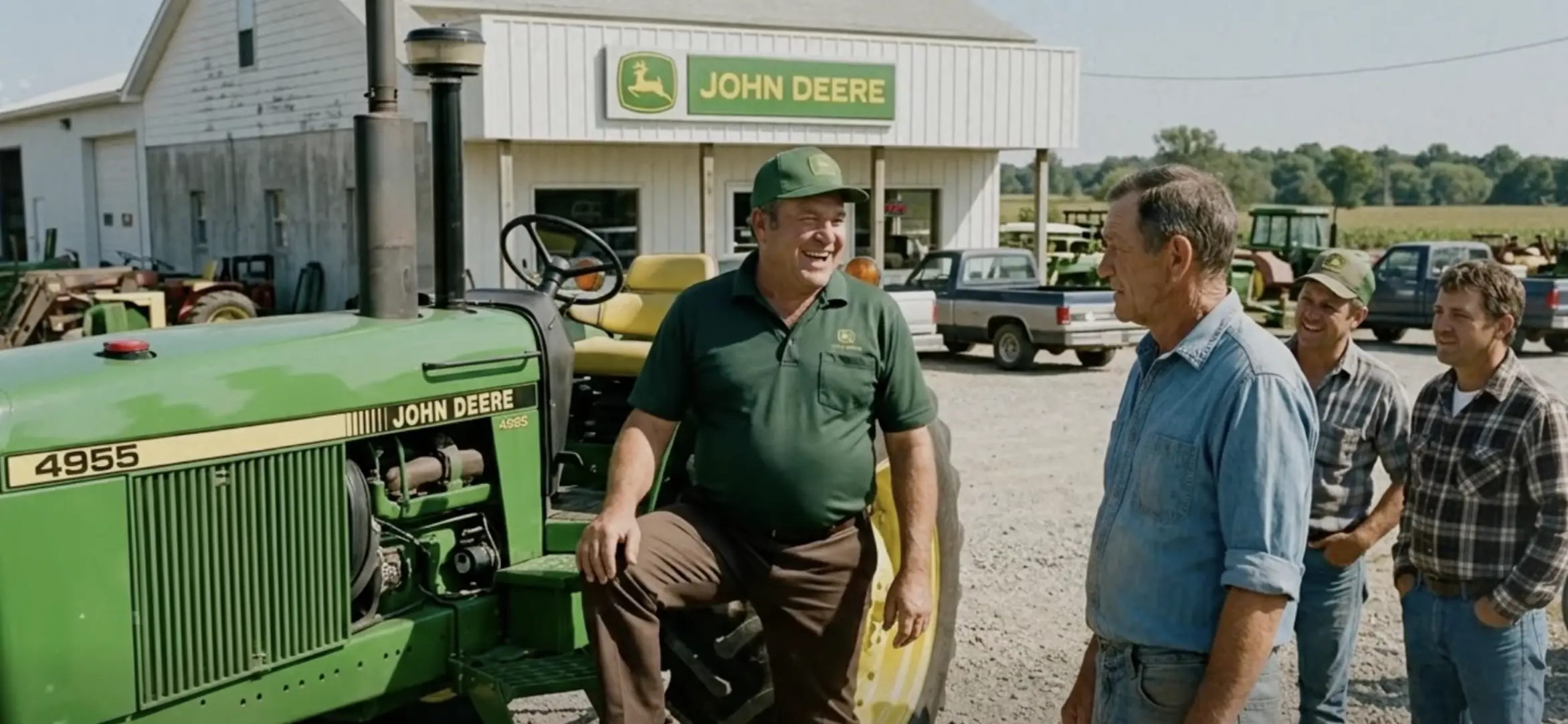
He also started something June had wanted years earlier. Every winter, Walter held free repair classes for young farmers, high school kids, and anyone willing to learn. He taught them how to listen to engines, how to read wear patterns, how not to panic when a machine quit in the middle of a field. He always ended the first lesson the same way. “A machine breaks loud, but it warns quiet first. Same as people.”
By year nine, Cole’s dealership was drowning. The shiny expansion became a burden, the service department lost good mechanics, and customers who once financed through him now bought rebuilt equipment from Walter. Cole tried discounts, radio ads, and angry phone calls. Nothing worked. You can cut a price, but you cannot discount away contempt.
One autumn afternoon, Cole came to Walter’s yard for the first time in nearly a decade. He stepped out of a clean pickup wearing the same kind of polo shirt, though his hair had thinned and the confidence around his mouth had cracked. Walter was standing beside a restored 4955 tractor, the same model Cole had mocked years before. Its green paint shone now, its engine rebuilt, its tires new, its frame straight and proud.
Cole looked at the tractor, then at Walter. “You’ve done well,” he said, trying to sound casual. Walter wiped his hands on a rag. “Kept busy.” Cole glanced around the yard, at the service trucks, the parts barns, the farmers waiting near the counter. “I need some parts,” he said.
Walter nodded toward the office. “Lucas can help you.” Cole’s face tightened at being directed to someone else, but he went. Walter watched him walk across the gravel, remembering the spit near his boots and the laughter from younger men. He felt no joy in Cole’s decline. But he did feel the solid quiet of having outlasted him.
The dealership filed for bankruptcy in year ten. By then, everyone knew it was coming, though Cole pretended otherwise until the papers became public. The building, lot, shop equipment, remaining inventory, and signage were scheduled for auction the following spring. Farmers talked about it at the diner, at church, at the grain elevator, and in Walter’s yard. Some spoke with satisfaction, some with pity, but no one sounded surprised.
Walter did not plan to bid at first. He already had enough work, enough land, enough headaches. But Lucas and the other mechanics kept bringing it up, not because they wanted revenge, but because the county still needed a full-service equipment shop. The Mercer building had good lifts, wide doors, and a location every farmer knew. In the right hands, it could matter again.
The night before the auction, Walter sat at the kitchen table where June’s chair still remained across from him. He placed his bid papers beside an old photograph of his father standing next to a tractor in 1978. Then he took his wedding ring from the small dish near the window and turned it between his fingers. “What do you think, June?” he whispered into the empty kitchen.
The house gave no answer, but he imagined her voice anyway. June had always believed dignity was not something a person kept by hiding from old wounds. Sometimes, she said, you had to walk back into the place that hurt you and stand there whole. Walter folded the papers, put them in his jacket, and slept better than he expected.
The auction drew half the county. Farmers leaned against trucks, bankers stood near the front, and equipment men from other towns circled the property like hawks. Cole Mercer stood near the office door with his arms crossed, his face gray from humiliation and lack of sleep. He did not look at Walter when Walter drove in. Not at first.
Walter arrived in the restored 4955. He drove it slowly up the gravel lane, the engine running smooth and deep, the paint shining under a pale spring sun. Conversations quieted as he parked near the same spot where Cole had once spat by his boots. Walter climbed down carefully, older now but straighter than he had stood that day.
The bidding began with the shop equipment, then parts inventory, then trucks, then the land and building. Walter waited through each round, speaking only when necessary. He did not bid angrily. He did not bid to perform. He bid like a man who had already done the hard work and now simply had to finish the row.
When the final property bid came, the auctioneer looked over the crowd and called for any advance. The wind moved dust across the lot. No one answered. The gavel came down, and Briggs Used Iron & Repair became the new owner of Mercer Farm Equipment.
Cole stared as if he had misunderstood the language. Walter walked to the auction table, signed the papers, and accepted the folder from the clerk. Then he turned and found Cole standing a few yards away, his hands hanging at his sides. The younger salesmen from eleven years earlier were nowhere to be seen.
“You bought the dealership?” Cole asked. His voice sounded smaller than Walter remembered. Walter looked at the building, then at the gravel near his boots. “No, Cole,” he said. “I bought back the dignity you spat on.”
Cole lowered his eyes. For a moment, Walter thought he might make an excuse, blame the market, blame customers, blame weather, blame anyone but himself. Instead, Cole said nothing. Maybe silence was the first honest thing he had given Walter in eleven years.
Walter looked toward the restored tractor. “This place used to help farmers,” he said. “Before your family bought it. Before you forgot what a farmer standing on this lot was worth.” Cole’s jaw tightened, but he did not argue. “I’m going to make it that kind of place again.”
That summer, the sign changed. Mercer Farm Equipment came down, and Briggs County Implement went up, using the old name Walter remembered from childhood. He kept some former employees, hired young mechanics, expanded the repair bays, and put a coffee pot near the front counter. The first rule he wrote for the staff was simple: No farmer leaves this lot feeling smaller than when he came in.
The restored 4955 stayed near the entrance for the first year. Not as decoration, but as a reminder. Men stopped to look at it, touch the fender, and ask if it was for sale. Walter always shook his head. “That one already paid for itself,” he said.
Cole left town for a while, then came back quietly and took a job selling insurance two counties away. Walter heard about it but did not repeat the gossip. Revenge loses its flavor when a man has better work to do. He had fields to serve, machines to fix, and young people to train.
Years later, when Walter’s hair had gone fully white and his steps had slowed, his grandchildren would ask why that old green tractor sat in the front of the shop. He would tell them the story around the kitchen table, just the way old men tell stories when they want children to learn without sounding like they are teaching. He would tell them about the dealer, the spit in the gravel, and the long ride home.
Then he would tell them the part that mattered most. “Don’t let one proud fool decide what you’re worth,” he would say, tapping the table with one thick finger. “And don’t throw away old iron just because shiny men laugh at it.” His grandchildren would smile, not fully understanding yet. That was all right.
Some lessons wait until life makes room for them. Walter Briggs had learned his lesson in gravel, humiliation, diesel smoke, and eleven years of steady work. Quiet men with old machines do not always answer in the moment. Sometimes they drive home, rebuild what others mocked, and return years later with the winning papers in their hand.