The boots were two sizes too large for Eli Greer, but he wore them anyway.
They had belonged to his father, Daniel, and still carried pale lines of dried Iowa soil around the heels. Eli had stuffed folded newspaper into the toes so his feet would not slide whenever he walked. Each heavy step reminded him that he was trying to fill a place nobody expected a fourteen-year-old boy to understand.
That morning, the John Deere 4440 had stopped halfway across the south field.
The engine still ran, but the tractor would not pull. When Eli pressed the clutch pedal, he heard a grinding sound beneath the cab, followed by a sharp metallic snap. He shut the engine down immediately because his father had taught him that forcing a machine after it warned you was the fastest way to turn one broken part into five.
The Greer family had 160 acres of corn ready for harvest.
Their old six-row picker-sheller could not move without the tractor, and a powerful storm was expected to reach Cedar County within thirty-six hours. Weather reports warned of heavy rain, strong wind, and possible hail. If the corn went down before they harvested it, the Greers could lose the farm payment due at the end of the month.
Eli crawled beneath the tractor with a flashlight and his father’s repair manual.
The inspection plate revealed pieces of damaged clutch facing and a broken release bearing. The pressure plate fingers were worn unevenly, and the clutch would no longer disengage properly. It was not a repair that could be completed with wire, hope, or a borrowed hammer.
They needed a complete clutch assembly.
His mother, Sarah Greer, stood beside the tractor with one hand pressed against her mouth. She had learned to handle most farm emergencies after Daniel became ill, but machinery had always been the part of their life he understood best. Since his death eight months earlier, every new mechanical problem felt like another door closing.
“How much will it cost?” she asked.
“Probably twelve hundred dollars,” Eli answered.
Sarah looked toward the farmhouse.
Their checking account held less than eight hundred. The farm operating loan was already at its limit, and the bank had refused another extension. Sarah had paid the property insurance two days earlier, leaving almost nothing for unexpected repairs.
“We could call the auction company,” she said quietly.
Eli climbed from beneath the tractor.
“No.”
“Eli, if the crop is lost, we cannot make the payment.”
“We are not selling Dad’s equipment before I try.”
Sarah looked at the boots on his feet. Daniel had worn them during his final planting season, even after illness made climbing the tractor steps difficult. The boots were cracked, heavy, and shaped around another man’s stride.
“You are fourteen,” she said.
“I know.”
“You cannot carry this farm by yourself.”
“I’m not asking to carry everything. I’m asking to fix one clutch.”
Sarah closed her eyes for a moment.
When she opened them, she handed him the keys to Daniel’s old pickup.
“You are not driving to town alone.”
Eli’s sixteen-year-old cousin, Hannah, drove while he sat beside her holding the handwritten parts list. Sarah remained home to call neighbors and search for anyone with a compatible tractor. Every farmer she reached was already harvesting his own crop before the storm.
Bickford’s John Deere dealership stood twelve miles away beside the county highway.
Daniel Greer had bought filters, bearings, belts, seals, and hydraulic parts there for more than twenty years. Eli remembered walking through its doors as a small child while his father discussed equipment with men who seemed to speak an entirely different language. Back then, Monroe Bickford always greeted Daniel by name.
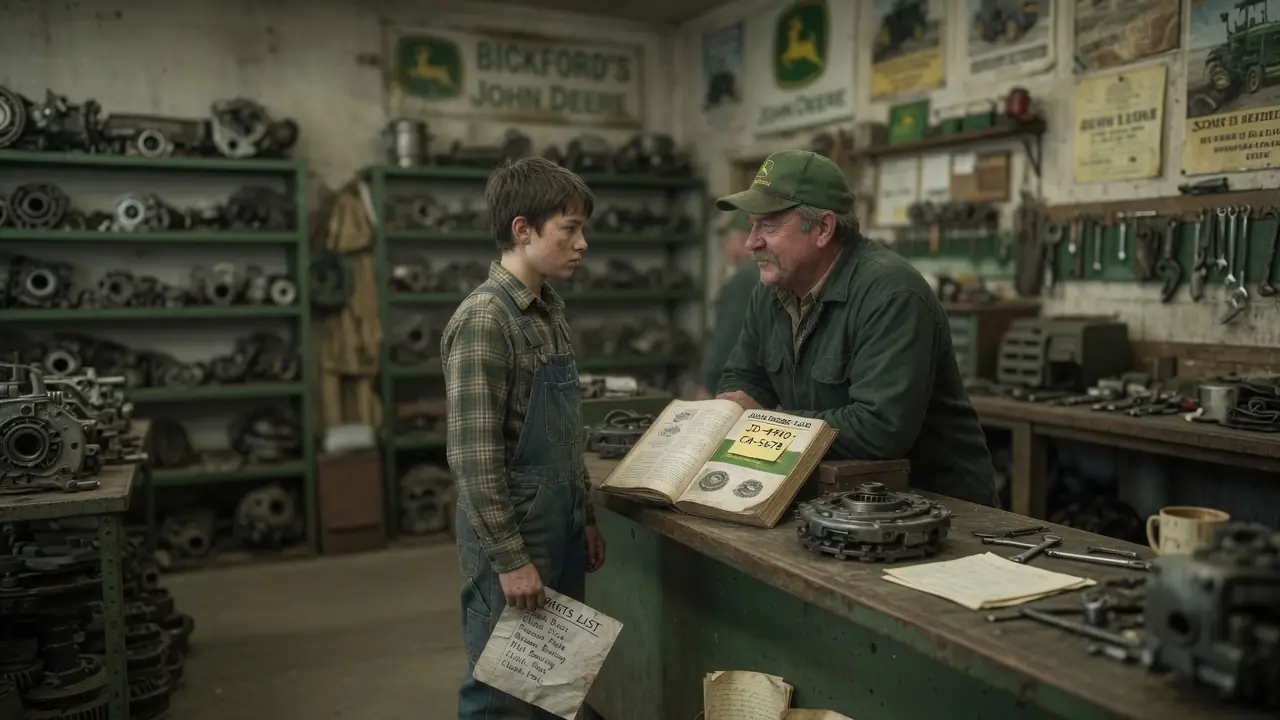
That morning, Monroe stood behind the parts counter surrounded by four farmers.
He was sixty-seven, silver-haired, and broad through the chest despite spending most of his time inside an office. His dark green work shirt carried the dealership logo above the pocket. He saw Eli enter and looked first at the oversized boots.
“Well,” Monroe said, “Daniel Greer’s boy.”
Eli placed the list on the counter.
“I need a clutch assembly for a 1982 John Deere 4440. Pressure plate, driven disc, pilot bearing, release bearing, and alignment tool if the kit has one.”
The farmers stopped talking.
Monroe picked up the paper and examined it.
“Who wrote these numbers?”
“I did.”
“You sure about the serial split?”
Eli recited the tractor’s serial number without looking down.
Monroe entered it into the computer. A complete kit was available in the warehouse behind the showroom. The price, including tax, was $1,347.62.
Eli removed an envelope from inside his jacket.
It contained $718 from the family account, ninety dollars he had earned repairing lawnmowers, and forty-three dollars Hannah collected from her purse. He placed the money on the counter and asked Monroe to charge the remainder to Daniel’s parts account.
Monroe pushed the envelope back.
“Your father’s account closed when he died.”
“He bought here for twenty years.”
“That does not make you responsible for his account.”
“We will pay the rest after harvest.”
Monroe looked past Eli toward Hannah, then toward the farmers watching.
“Go home, kid.”
Eli remained still.
“We have 160 acres ready, and the storm arrives tomorrow night.”
“That is your mother’s problem.”
“It is my family’s problem.”
Monroe leaned across the counter.
“Why are you pretending a child can repair that tractor and harvest 160 acres alone?”
“Because my father taught me the repair before he died.”
The owner gave a short laugh.
“Quit this foolish nonsense, kid. Those boots don’t make you a farmer.”
Eli felt heat rise into his face, but he did not look away.
“Maybe not, but the men behind you remember the man who wore them.”
The room became quiet.
Hank Wallace, a farmer from the eastern side of the county, shifted beside the parts shelves. Daniel had repaired Hank’s combine during a Sunday harvest when every dealership technician was unavailable. Another man, Peter Sloan, remembered Daniel welding a broken planter hitch without accepting payment.
Monroe noticed their expressions and straightened.
“Daniel was a capable mechanic,” he said. “That does not mean his boy can split a tractor.”
“I have the stands he built.”
“You have no trained technician.”
“I helped him replace the clutch in Mr. Wallace’s 4020.”
Hank nodded.
“The boy was there.”
Monroe looked irritated.
“Watching someone perform a repair is not the same as doing it.”
Eli placed his father’s manual on the counter.
The margins were filled with Daniel’s handwriting. He had recorded bolt sizes, torque values, alignment instructions, and warnings about supporting the cab correctly. A folded diagram showed the rolling stands Daniel had constructed from heavy steel.
Monroe barely glanced at it.
“You do not have enough money.”
Eli gathered the envelope slowly.
He had expected the price to be difficult, but he had not expected the man who shook his father’s hand for decades to dismiss him without even examining the account. The humiliation hurt more because the other farmers were watching. Eli turned toward the door.
Something inside his right boot shifted.
A sharp paper edge pressed against his ankle.
Eli stopped, leaned against a display, and pulled the boot from his foot. The newspaper packed into the toe had loosened, revealing an old folded envelope wedged beneath the inner sole. His mother must not have noticed it when she gave him the boots.
Across the front, Daniel had written one sentence.
For parts when the farm needs them most.
Eli opened the envelope.
Inside was a handwritten dealership receipt dated two years earlier. It stated that Monroe Bickford owed Daniel Greer a $1,500 parts credit for repairing the dealership’s loading tractor after its transmission failed during a winter delivery. Daniel’s signature appeared beneath the agreement.
Monroe’s signature appeared beside it.
Hank Wallace stepped closer.
“I remember that night.”
Monroe’s face changed.
The dealership loader had failed during an ice storm while two new tractors remained trapped on a transport trailer. Daniel worked until nearly sunrise rebuilding the hydraulic shuttle. Monroe had no technician available and promised him store credit instead of immediate payment.
Eli placed the receipt on the counter.
“My father never used this.”
Monroe did not touch it.
“That paper is old.”
“It does not have an expiration date.”
“The account closed.”
“The credit was payment for work already completed,” Hank said. “That is not the same as an open account.”
Monroe looked toward him.
“This is dealership business.”
Peter Sloan walked closer as well.
“Daniel saved you thousands that night.”
Monroe’s mouth tightened.
He had expected the boy to leave quietly. Instead, the farmers were remembering favors that had never appeared in any dealership ledger. Daniel Greer had spent years helping people because machines did not wait for convenient hours.
Eli pushed the receipt another inch forward.
“I am not asking for charity.”
Monroe picked up the document and studied his own signature.
For several seconds, nobody spoke. Then he entered a number into the computer, printed a new invoice, and stamped it paid from existing credit. He told a warehouse employee to bring the clutch kit forward.
The remaining credit came to $152.38.
Monroe slid the invoice across the counter.
“There. Your father’s debt is settled.”
“Your debt,” Eli corrected.
The farmers looked down to hide their smiles.
Monroe’s face reddened, but he said nothing.
The clutch kit arrived in a heavy cardboard box containing the disc, pressure plate, bearings, alignment tool, and hardware. Eli tried lifting it from the counter, but Hank reached for the opposite side. Together, they carried it toward the pickup.
Outside, Hank placed the box in the truck bed.
“You truly intend to split that 4440?”
“Yes.”
“Who is helping you?”
“My mother can handle the jacks.”
“That was not what I asked.”
Eli closed the tailgate.
“We cannot pay anyone.”
Hank looked toward the dealership window where Monroe still stood behind the counter.
“Your father never charged me when my combine failed.”
“I’m not Dad.”
“No. You are the boy he taught.”
Peter and one other farmer stepped outside behind him. They had crops of their own waiting, but all three remembered Daniel arriving during breakdowns without asking whether a man could pay first.
Hank pointed toward the road.
“We will give you four hours.”
Eli shook his head.
“You need to harvest.”
“So do you.”
They reached the Greer farm shortly before noon.
Sarah stared when three pickups followed Hannah into the yard. Hank explained that they had not come to save the farm. They had come to make certain a fourteen-year-old did not get crushed beneath a tractor while proving Monroe wrong.
Eli accepted the distinction.
They rolled the 4440 into the machine shed and removed the picker hitch. Daniel’s splitting stands stood against the rear wall beneath a canvas cover. Eli had helped build them from steel beams, heavy casters, and threaded supports.
The work began with the battery disconnected and the wheels blocked.
They removed the hood panels, steering linkage, hydraulic lines, electrical connections, fuel line, and control rods crossing between the engine and transmission sections. Every disconnected hose received a labeled plug because Daniel had taught Eli that memory became unreliable when a repair lasted through the night.
Hank watched the boy work.
Eli did not rush.
He checked the manual before removing each major bolt and used chalk marks to record alignment. When Peter suggested pulling a line from the wrong fitting, Eli stopped him and pointed to his father’s note warning that the connection remained under residual pressure.
By four o’clock, the tractor was ready to separate.
They supported the engine on one rolling stand and the transmission beneath the cab on another. Sarah stood near the jack while Eli loosened the final housing bolts. The enormous machine seemed to hold its breath.
“Do not stand between the halves,” Eli said.
Hank nodded.
“You sound like Daniel.”
“Those were his words.”
They rolled the front section forward slowly.
The input shaft resisted.
One farmer suggested using a pry bar, but Eli stopped him immediately. Inside the manual, Daniel had written in capital letters: NEVER FORCE THE SPLIT. CHECK THE HIDDEN BOLT ABOVE THE HYDRAULIC LINE.
Eli reached beneath the cab.
The hidden bolt remained in place.
After removing it, the tractor separated smoothly.
The damaged clutch became visible between the engine and transmission. Half the friction material had broken away from the disc, while the release bearing had collapsed and scored the pressure plate fingers. The failure was worse than Eli expected.
Hank examined the parts.
“You were right to shut it down.”
“Dad said grinding is a machine asking you not to make it expensive.”
Peter laughed.
“That sounds like him.”
They removed the old assembly and replaced the pilot bearing inside the flywheel. Eli cleaned the mounting surface, inspected for heat cracks, and checked the flywheel runout with Daniel’s old dial indicator. The reading remained within tolerance.
The new disc had to face the correct direction.
Eli checked it three times.
When the pressure plate was installed, he tightened the bolts gradually in a crossing pattern. He used the alignment tool to center the disc, then measured the release fingers according to the notes in the manual.
By sunset, Hank and the others needed to return to their own fields.
They had already given more time than promised.
Hank placed one hand on Eli’s shoulder.
“Do not rush the halves together.”
“I won’t.”
“If the shaft does not slide, rotate the engine slightly.”
“I know.”
Hank looked toward Daniel’s boots.
“Yes,” he said quietly. “I believe you do.”
After the farmers left, Sarah heated soup and carried bowls into the machine shed. Eli ate sitting on an overturned bucket while reading the next steps. His little sister, Lucy, slept inside the pickup with a blanket around her shoulders.
Sarah sat beside him.
“You do not have to finish tonight.”
“The rain starts tomorrow evening.”
“You have been working since sunrise.”
“So have you.”
“I’m not fourteen.”
Eli looked toward the split tractor.
“Dad was already helping Grandpa at fourteen.”
“Your father also had the bad habit of turning suffering into proof that he was strong.”
The words surprised Eli.
Sarah touched the worn leather of Daniel’s left boot.
“You do not have to become him by hurting yourself.”
“I’m not trying to become him.”
“Then who are you trying to become?”
Eli thought for a moment.
“Someone who doesn’t leave when the farm needs him.”
Sarah looked away, wiping her eyes before he could see clearly.
“Your father would be proud of that answer.”
They resumed work after eating.
The tractor halves had to come together with the input shaft aligned through the clutch disc and pilot bearing. Eli rolled the engine section backward while Sarah controlled the jack.
The housings stopped three inches apart.
Eli checked the height.
The engine sat slightly low.
They adjusted the stand and tried again. This time, the gap narrowed to one inch before stopping.
Sarah reached toward a housing bolt.
“We could pull it together.”
“No.”
“Only gently.”
“Dad wrote never to use the bolts to force alignment. It can bend the clutch disc.”
Eli lay beneath the housing with a flashlight.
The shaft splines were close but not fully engaged. He placed the transmission in gear, rotated the rear wheel slightly, and asked Sarah to move the engine again.
The housings slid together.
Neither spoke for several seconds.
Then Sarah laughed.
It was the first happy sound Eli had heard from her in weeks.
They installed the bolts, reconnected the lines, adjusted the clutch linkage, and filled the hydraulic reservoir. The work continued until nearly three in the morning. When everything was ready, Eli climbed into the cab wearing his father’s boots.
He turned the key.
The engine started.
Eli pressed the clutch, selected a low gear, and released the pedal slowly. The tractor moved forward across the shed floor without grinding.
Sarah covered her face with both hands.
Eli drove into the yard and made one slow circle beneath the work lights. The clutch engaged smoothly, the transmission shifted correctly, and no fluid leaked from the reconnected lines.
They had repaired the tractor.
They had not yet saved the harvest.
At six that morning, Hank Wallace returned with an empty grain wagon. Peter Sloan arrived with a truck, while another neighbor brought fuel and sandwiches. None of them offered speeches.
They simply went to work.
Eli connected the 4440 to the picker-sheller.
Sarah drove the grain truck, and Hank handled wagons between the field and storage bin. Peter repaired a weak chain on the elevator while Eli greased every bearing and checked the gathering units.
The first rows entered the machine shortly after sunrise.
Dry corn moved through the snapping rolls, sheller, and cleaning system before pouring into the wagon. Dust rose behind the tractor in a long brown cloud. Eli gripped the steering wheel while the oversized boots worked the clutch and brakes.
The machine was slow.
Six rows at a time could not compare with the large modern combines operating across neighboring fields. Yet each round placed more corn safely inside the bin.
By noon, twenty-eight acres were finished.
By sunset, they had harvested seventy-three.
Lightning flickered along the western horizon.
The storm had accelerated.
Weather reports predicted rain before dawn rather than the following evening. Hail remained possible, and wind speeds could exceed fifty miles per hour.
The men installed temporary lights on the tractor and continued after dark.
Eli’s body ached, but he remembered what Sarah had said. He stopped every two hours, drank water, and allowed someone else to drive short sections while he inspected the machine.
At midnight, the picker chain broke.
The delay cost forty minutes.
At two in the morning, a wagon tire failed near the field entrance. Peter replaced it while Sarah hauled another load.
At three twenty, cold wind moved across the corn.
One hundred and forty-six acres had been completed.
Fourteen remained.
Eli returned to the tractor seat.
Rain began as small drops striking the windshield. The first gust bent the outer rows but did not break them.
Hank climbed onto the step.
“We can stop. Most of it is safe.”
Eli looked toward the final section.
“That fourteen acres pays the property tax.”
“You have already done more than anyone expected.”
“That does not change what the bank expects.”
Hank studied him.
Then he stepped down.
“Finish it.”
The final rows disappeared beneath the machine as rain strengthened. Mud began forming in the low areas, forcing Eli to adjust his route. The 4440 pulled steadily, its new clutch carrying the load without slipping.
At 4:17 in the morning, the last corn entered the wagon.
Sarah parked the truck near the bin and ran across the yard through the rain. She reached the tractor as Eli shut down the engine.
For a moment, neither moved.
Then she opened the cab door and held her son while wind drove rain against the machine shed.
The storm flattened nearly a third of the unharvested corn across Cedar County.
The Greers lost less than two acres.
Their crop payment cleared the bank deadline, covered the clutch repair, and left enough money to carry the farm through winter. The harvest did not make them wealthy.
It kept the land in the family.
Two weeks later, Eli returned to Bickford’s dealership.
He carried the unused portion of Daniel’s parts credit and the broken release bearing from the tractor. Monroe saw him approach and became suddenly interested in the computer screen.
Eli placed the bearing on the counter.
“The 4440 finished all 160 acres.”
Monroe looked up.
“I heard.”
“The clutch worked.”
“That is what the part was designed to do.”
Eli slid the credit receipt toward him.
“There should be $152.38 left.”
Monroe opened the account.
He entered the amount without arguing.
Several farmers stood near the same shelves where they had watched Eli leave with the clutch. This time, nobody laughed at the boots.
Monroe printed the updated statement.
“You had help,” he said.
“Yes.”
“Then you did not save the farm alone.”
Eli folded the paper.
“I never said I should have to.”
The answer silenced him.
Outside, Hank waited beside his truck. He asked whether Monroe had apologized.
“No.”
“Some men would rather rebuild a transmission than admit they were wrong.”
Eli looked down at the boots.
“They still don’t fit.”
Hank smiled.
“They aren’t supposed to.”
Eli glanced toward him.
“Your father’s boots carried his life,” Hank said. “Yours will shape themselves around yours.”
That winter, Eli placed Daniel’s boots beside the farmhouse door instead of wearing them every day. He continued using them for difficult repairs and important fieldwork, but he stopped stuffing extra newspaper into the toes.
He bought a pair that fit.
The old boots remained close.
Inside the right one, Eli kept the final note his father had written beneath the dealership receipt.
A machine does not care how old you are. It cares whether you listen, learn, and refuse to force what is not ready.
Eli read those words whenever fear told him he was too young.
By spring, he had repaired tractors for six neighboring farms and earned enough to open a small parts account in his own name. Monroe approved it without mentioning the day he told the boy to go home.
Eli noticed.
He said nothing.
The dealership owner had believed the oversized boots proved a child was pretending to be a man. Eli eventually understood that becoming the person his family needed had never required pretending.
He had asked for help when the work became dangerous.
He had followed the instructions left by someone wiser.
He had refused to confuse pride with strength.
Daniel Greer’s boots did not save the farm because they magically turned a fourteen-year-old into his father.
They saved it because they carried one final promise, one unpaid debt, and the knowledge Daniel had taken time to pass down.
The boots never fit Eli perfectly.
The future did.