On a cold Thursday morning in October of 1963, fourteen-year-old Eli Greer pushed open the glass door of Bickford’s John Deere dealership in Lewisburg, Tennessee, wearing his dead father’s boots. They were two sizes too big, stuffed with newspaper at the toes so they would not slide off his feet whenever he took a step. His father’s work jacket hung from his narrow shoulders, the sleeves rolled three times, the cuffs still stained with old grease from James Greer’s hands. In one trembling hand, Eli held a parts order for a clutch assembly, the one thing standing between his family and a harvest that could be lost in the field.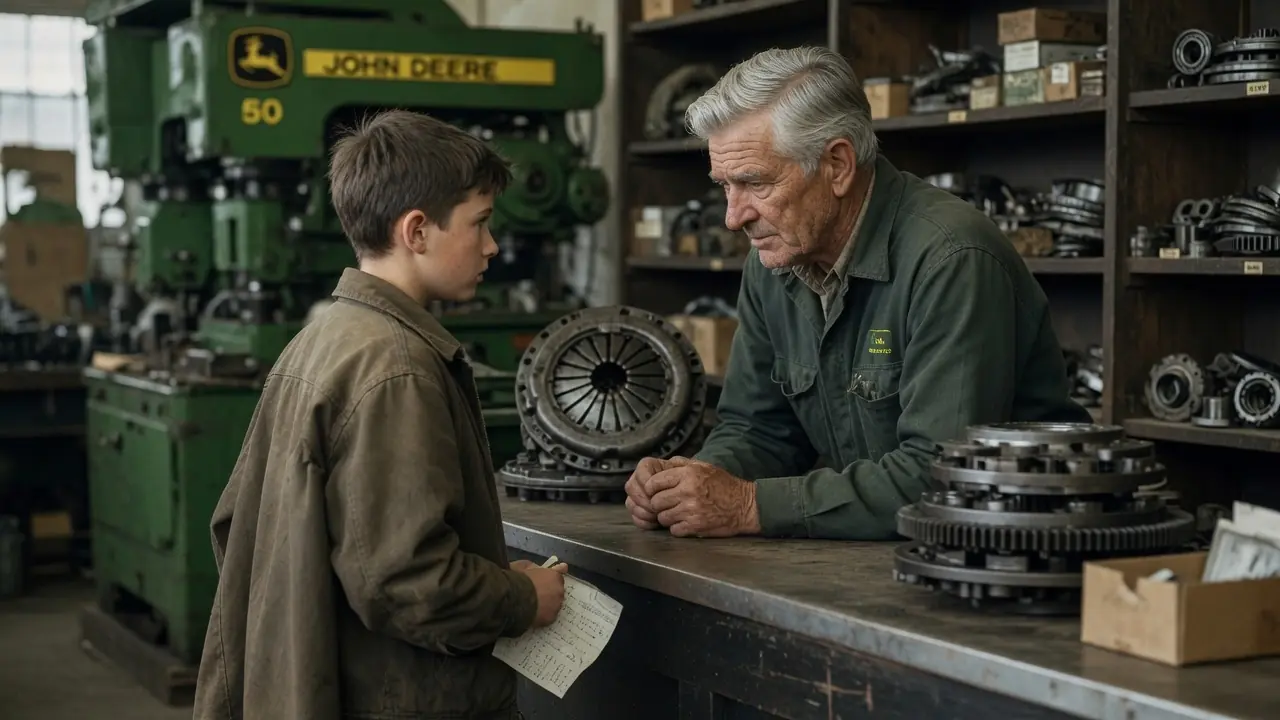
The dealership smelled of machine oil, rubber tires, coffee, and dust carried in by farmers’ boots. New green tractors sat under the bright showroom lights, polished and powerful, looking nothing like the old John Deere 60 waiting dead in Eli’s barn. Behind the parts counter stood Monroe Bickford, tall and silver-haired, with reading glasses hanging from a chain around his neck. Monroe had known Eli since he was a baby, and now he looked at him like he was seeing both a child and a ghost.
“Eli,” Monroe said softly, setting down his pencil. “Come in, son. I was at the funeral. Your daddy was one of the finest men I ever knew.”
Eli swallowed hard because every kind word about his father still hit him like a hand against the chest. James Greer had been gone nine days, but the farm had not waited for grief to finish. There were 160 acres of corn, soybeans, and tobacco still needing work, a mother who had never driven a tractor, three younger siblings watching every move Eli made, and a tractor with a blown clutch. Eli placed the parts order on the counter because if he spoke too soon, his voice might break.
“I’m here to pick up the clutch assembly my daddy ordered,” he said.
Monroe lifted the paper and read the familiar handwriting. James Greer had written the order ten days earlier, one day before his heart stopped in the barn beside the machine he had meant to repair. Eli’s throat tightened as Monroe stared at the page, then at him. Around the counter, two farmers stopped talking, sensing the kind of moment men remembered later.
“I’ve got the part,” Monroe said. “It came in Tuesday.”
Eli nodded once. “I’ll take it.”
Monroe did not move toward the shelf. He removed his glasses, rubbed the bridge of his nose, and looked at the boy with an expression that was almost pity. “Eli, who is going to install it?”
“I am.”
The words left Eli’s mouth before fear could catch them. One farmer across the counter shifted his weight, and another looked down at his boots. Monroe’s face tightened with the concern of a man who thought he was about to save a child from himself. Eli hated that look more than he hated the oversized boots.
“Son,” Monroe said, “you’re fourteen years old.”
“I’ve worked on that tractor with my daddy since I was nine.” Eli pressed both palms against the counter to steady them. “I know how to split it. I know where the clutch sits. I know what tools he uses. He taught me.”
Monroe glanced toward the clutch assembly on the shelf behind him, then back to Eli. “Knowing the steps and doing the work alone are not the same thing.” His voice stayed gentle, but every word landed like a door closing. “Your daddy is gone. Go home. Tell your mama to call Harold Ketchum about leasing the ground.”
Eli stared at him.
“He’ll pay fair,” Monroe continued. “You kids can stay in the house. Your mama can find work in town. There is no shame in it. A lot of families do the same when they lose the man who ran the farm.”
Curtis Polk, an older farmer standing nearby, crossed his arms and nodded. “Monroe’s right, son. Leasing the land isn’t giving up. Your daddy would understand.”
Something in Eli went very still. For nine days, grown men had spoken around him in low voices, as though he were too young to understand the weight of debt, seed, weather, machinery, and hunger. They talked about what his mother should do, what his father would have wanted, what a boy could not handle. Not one of them had been standing in the barn the night James Greer put a hand on Eli’s shoulder and told him the words he could not stop hearing.
“My daddy told me something the night before he died,” Eli said.
The room fell quiet.
“He said, ‘Eli, if anything ever happens to me, you keep this farm. Don’t let anyone take it. Don’t let anyone tell you it’s too much. You keep it.’” Eli’s eyes burned, but he would not look away from Monroe. “He said it to me nine days ago, Mr. Bickford. So I’m going to do what he told me.”
Monroe’s jaw worked once, but he said nothing.
Eli pointed toward the shelf behind the counter. “Now, are you going to sell me that clutch assembly, or do I need to drive to the next county?”
The question was too bold for a child and too brokenhearted for any decent man to punish. Monroe looked at the boy’s oversized boots, the rolled sleeves, the father’s handwriting on the order slip, and the straightness in Eli’s trembling shoulders. Then he turned, lifted the clutch assembly from the shelf, and placed it on the counter. “Twenty-eight dollars,” he said quietly.
Eli reached into the inside pocket of James Greer’s jacket and pulled out an envelope. The money inside had been folded neatly, counted by hands that would never hold a wrench again. Eli laid the bills down one by one, forcing himself not to rush. Monroe did not count them twice.
When Eli lifted the part, it was heavier than he expected. He tightened his grip, refusing to let the weight show on his face. Monroe watched him carry it toward the door, and for a moment, Eli thought the old man might call him back. But nobody stopped him.
Outside, the Ford F-100 waited with its cracked windshield and stubborn engine. Eli loaded the clutch assembly into the bed, climbed behind the wheel, and pulled himself close enough to see over the dash. He drove home on back roads because the highway felt too exposed, and because every mile of that road seemed to ask whether he was brave or only foolish. He had no answer yet.
The Greer farm sat quiet under a pale October sky when Eli returned. His mother, Ruth, stood on the porch with her arms folded across her middle, watching him climb out of the truck. She looked older than she had ten days ago. Grief had not made her weak, but it had taken something from her face that sleep could not return.
“Did he sell it to you?” she asked.
Eli nodded. “Yes, ma’am.”
Ruth looked toward the barn, then back at him. “Eli, you do not have to become your father in one week.”
“I’m not trying to.” He lifted the clutch assembly from the truck bed and held it against his chest. “I’m trying to keep what he left.”
His mother closed her eyes, and for a moment he thought she might order him to stop. Instead, she opened them again and stepped off the porch. “Then I’ll bring supper to the barn.”
Eli began before sunset. The John Deere 60 sat in the center of the barn with its hood open, still exactly where his father had left it. Tools lay arranged on the bench in James Greer’s order: wrenches by size, bolts in coffee cans, rags folded beside the oil bucket. Eli stood beside the tractor for a long time before touching anything.
He could still see his father there, sleeves rolled, head bent, explaining not just what a part did, but why it mattered. James had never treated Eli like a nuisance in the barn. He gave him tools, asked questions, made him think through problems, and corrected him without mockery. Eli had not known those lessons were becoming an inheritance.
The hardest part was that splitting the tractor was not meant for one person. Eli knew that. Monroe knew it. Curtis Polk knew it. His father had done it with help, and Eli had been the boy handing tools, not the man making every decision.
So Eli built a cradle. He dragged boards from the back of the barn, measured twice, cut once, cursed softly when the first frame sat uneven, and rebuilt it again. He tested it with weight before trusting it to hold the front half of the tractor. His father had taught him that impatience could break machines faster than force.
For three days, the barn became Eli’s whole world. He ate biscuits and cold ham with grease on his hands, slept a few hours on a cot near the wall, and woke before dawn with the shape of the next step already in his mind. Ruth came and went quietly, leaving food, coffee, and sometimes standing in the doorway without speaking. His younger brother Daniel watched from outside, too young to help much but old enough to understand something important was happening.
On the second night, Eli nearly quit. A bolt refused to move, his hands were raw, and the clutch assembly seemed too heavy to position properly. He sat on the barn floor, back against the tractor tire, and stared at his father’s boots on his feet. The newspaper inside had shifted, and his toes ached.
“You don’t have to fit them today,” Ruth said from the doorway.
Eli looked up.
She stepped into the barn, holding a lantern. “Your daddy’s boots. You keep looking down at them like they’re asking more than feet can give.” Her voice trembled, but it did not break. “Maybe they don’t have to fit yet. Maybe you just have to keep walking in them.”
Eli wiped his eyes with the back of his wrist and stood.
By Sunday afternoon, the tractor was whole again. Eli checked everything twice, then a third time because fear made him careful. Ruth stood outside the barn with Daniel and his sisters. The yard seemed too quiet.
Eli climbed onto the tractor seat and turned the key. The engine coughed, hesitated, then caught. The sound filled the barn, deep and alive, rolling through the rafters like a voice returning.
Eli pressed the clutch. It engaged cleanly.
For one second, nobody moved. Then Daniel shouted, Ruth covered her mouth, and Eli drove the John Deere slowly out of the barn into the October light. He made one circle of the yard, not fast, not showing off, just proving that the machine had breath again. When he stopped, his hands were shaking harder than they had in the dealership.
Harvest began the next morning before sunrise. Eli folded a blanket on the seat so he could see better over the hood, stretched his legs to reach the pedals, and drove into the corn with a focus that made him seem older from a distance and painfully young up close. The two-row picker demanded constant attention. Rows had to be held straight, loads moved, wagons hauled, and every strange sound from the tractor judged quickly.
He worked until dark, then worked past dark when the moon was bright enough. At school, he sat through lessons with dirt under his fingernails and exhaustion pressing behind his eyes. Teachers saw him nod off and pretended not to notice unless they had to. Everyone in Lewisburg knew something about what was happening on the Greer farm.
Neighbors helped in quiet ways. Earl Dawkins brought his truck twice and hauled loads without asking for payment. A church woman left covered dishes on the porch. Curtis Polk, who had told Eli to lease the land, came by one evening and found him asleep on the tractor seat in the middle of a field, too tired to drive back to the barn.
Curtis carried him inside like he weighed no more than a sack of feed. Ruth met him in the kitchen, her face pale with fear and pride. Curtis laid Eli on the couch and stood there with his hat in his hands. “That boy is going to wear himself down, Ruth.”
“What do you want me to do?” Ruth asked. “I’ve tried to stop him.”
“He’s fourteen.”
“I know how old my son is.”
Curtis had no answer for that. He looked toward the couch, where Eli slept in his father’s jacket, boots still on, one hand curled like it was holding an invisible steering wheel. Then he left quietly.
Three weeks later, the corn was in. Not perfect, not record-breaking, not the clean harvest James Greer would have managed, but in. Eli drove to the elevator and stood at the counter while the manager wrote the check to the Greer farm. The man did not make a speech, and Eli was grateful for that.
At home, he and Ruth spread the bills across the kitchen table. Property tax, fuel, seed loan, electric, feed, parts, everything his father had carried as if there would always be another season. They paid them one by one. When the last bill was set aside, there were three hundred forty dollars left.
Ruth stared at the number for a long time. “That isn’t enough to get us to spring.”
“I’ll find winter work,” Eli said. “Hauling hay, cutting tobacco, whatever someone will pay for.”
“You’re supposed to be a child.”
Eli did not know what to say because she was right and it changed nothing. Ruth lowered her head to the table and began to cry. Not loud, not dramatically, but with the deep exhaustion of a mother proud of her son and broken by what he had been forced to become. Eli stood beside her and placed one hand on her back.
In town, Monroe Bickford heard about the harvest. He heard the corn came in. He heard the bills were paid. He heard the boy was back in school by day and working by afternoon, as though proving one man wrong had only opened the door to proving the whole county wrong.
Monroe drove past the Greer farm twice before he had the courage to turn in. In December, he loaded a box of filters, belts, spark plugs, and small maintenance parts into his truck. He found Eli in the barn changing oil on the John Deere, sleeves rolled, face streaked with dirt, moving with the careful rhythm of someone who had stopped waiting for permission.
Monroe set the box on the bench. “Brought you some supplies.”
Eli looked at the box, then at him. “I can’t afford parts right now, Mr. Bickford.”
“They’re not for sale.”
Eli’s eyes narrowed, not with disrespect, but with the guarded pride of a boy who had learned charity could sometimes feel like insult. “Why?”
Monroe removed his glasses and cleaned them with his shirt, though they were not dirty. “Because I told you to go home.”
The barn went still.
Eli set down the wrench. “You told me I couldn’t run this farm.”
“I did.”
“You told me to lease the land.”
“I did.”
“I harvested eighty acres of corn.”
Monroe nodded slowly. “Yes, you did.”
“So were you wrong?”
The question stood between them sharper than any tool in the barn. Monroe looked at the tractor, at the boy, at the father’s jacket still hanging from Eli’s shoulders. He had sold machines to farmers for nearly twenty years, but he had never felt smaller behind a counter than he did now in that barn.
“I was wrong about what you were capable of,” Monroe said. “I was not wrong to worry. You are still fourteen, and this work is still too heavy for a boy alone.” His voice thickened. “But I should have offered to help instead of telling you to give up.”
Eli looked away first. Not because he had lost, but because the apology found a place in him he had been trying to harden. “I don’t need pity.”
“No,” Monroe said. “You need parts, knowledge, and someone who shows up before the machine breaks.”
That was how Monroe Bickford became Eli Greer’s mentor. Not all at once, not with any grand announcement, but Saturday by Saturday. He taught Eli how to read soil tests, how to plan crop rotation, how to talk to bankers, how to judge used equipment, and how to repair what other men would replace. He never took over the farm. He simply stood close enough that Eli no longer had to learn every hard lesson alone.
Years passed, and Eli grew into the boots. Daniel grew old enough to run equipment beside him. His sisters helped with records, errands, and summer work. Ruth watched her children hold the farm together, proud and heartbroken in equal measure, because the price of keeping it had been paid in childhood.
Eli graduated high school tired but standing. He bought more land when he could, never more than he could pay for, never fast enough to impress reckless men. Monroe found him a used tractor at auction when he turned sixteen and taught him how to bid without letting hope empty his pockets. Every lesson became part of the farm.
By the time Eli was grown, people no longer spoke of him as the poor boy in his father’s boots. They spoke of him as a careful farmer, a man who paid his debts, kept his machines running, and knew every acre by feel. The John Deere 60 remained in the shed, clean and oiled, started every spring like a memory with an engine.
Decades later, when Monroe retired from the dealership, Eli walked through the same glass door he had entered at fourteen. The shelves were half-empty now, the counter worn smooth by years of elbows and invoices. Monroe sat behind it one last time, older and thinner, his glasses still hanging from a chain.
“You told me to go home,” Eli said.
Monroe smiled faintly. “Worst advice I ever gave.”
“No, sir.” Eli reached across the counter and shook his hand. “It made me prove I could stay. Then you came back and taught me how to stay well.”
Monroe’s eyes filled, and he removed his glasses the way he always did when his heart needed a moment. “Your daddy taught you to farm, Eli.”
“You taught me asking for help wasn’t giving up.”
Monroe died years later, and Eli carried him to the grave as a pallbearer. He carried the man who had doubted him, then helped him, then loved him like a second father. Grief felt different that day than it had when James died. It did not crush him; it completed a circle.
When Eli was older, he started a program for farm children who had lost a parent. He did not want them standing alone at counters while grown men explained surrender as kindness. He paired them with farmers who could teach, guide, and show up before desperation became disaster. He always said a child needed two things: a reason to stay and someone willing to help them stay wisely.
The old boots remained on a shelf in the barn. The newspaper was gone from the toes, but Eli never threw the boots away. When people asked why, he gave the same answer every time. “That’s where I started. You don’t throw away where you started.”
And the John Deere 60 still ran.
Every spring, Eli would climb onto the seat, turn the key, and listen as the engine caught. For a moment, he was fourteen again, sitting too low, reaching too far, carrying too much, with a dead man’s boots on his feet and a farm waiting to see whether a boy could become enough. Then the engine would settle, the field would open ahead, and Eli Greer would remember the truth that saved him.
The boots do not have to fit.
You just have to put them on and go to work anyway.