Hattie Vance walked into Redfern’s John Deere parts department with her father’s handwritten order folded inside his canvas jacket and his boots sliding loose around her feet. The dealership looked brighter and newer than the one her father had known, with clean concrete floors, green-and-yellow parts boxes stacked behind the counter, and a massive John Deere tractor visible through the glass windows. But Hattie did not feel bright or new. She felt fourteen years old, fatherless, and surrounded by grown men who had already decided she was too small for the work waiting at home.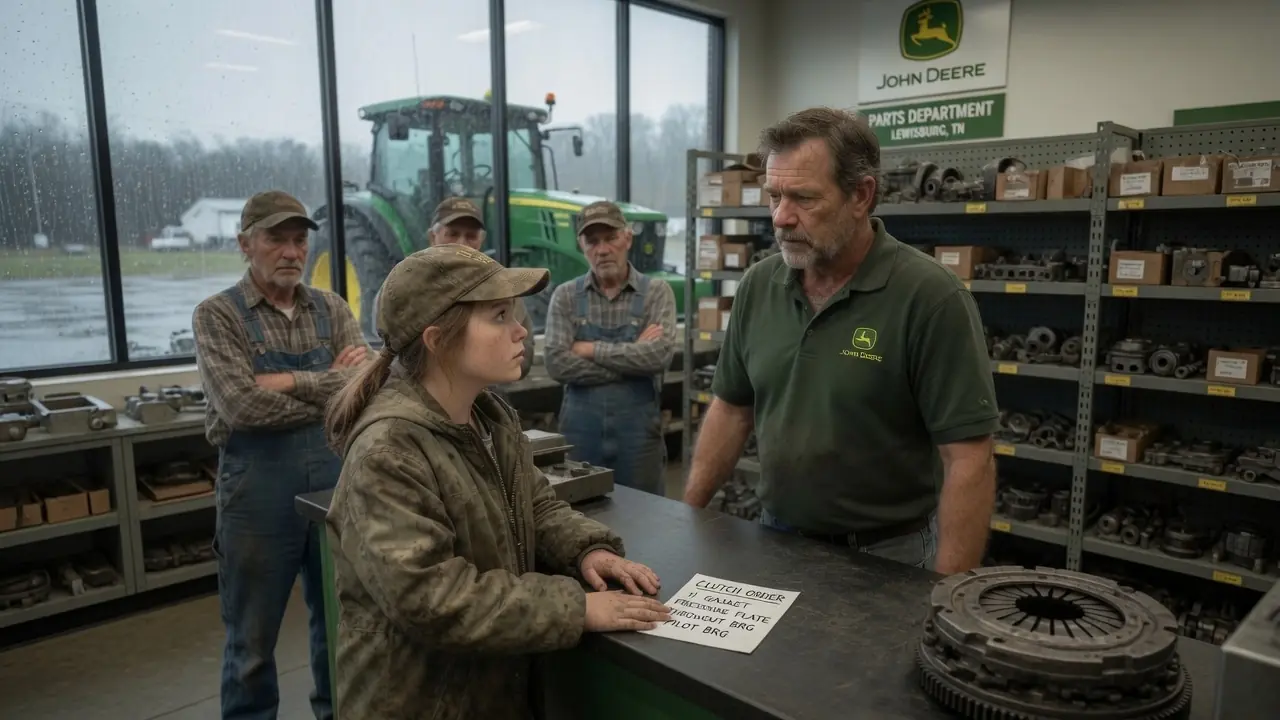
The bell above the door had barely stopped ringing when the three farmers by the counter turned to stare. They saw the muddy jacket, the rolled sleeves, the cap pulled low over her braid, and the boots stuffed with newspaper so they would not slip off. They did not see 160 acres of corn standing in the field, the tobacco barn waiting, the younger children at the kitchen table, or the mother who could barely stand without crying. They saw a child wearing a dead man’s clothes, and pity settled over their faces like dust.
Behind the counter, Silas Redfern looked up from an invoice. He was older than Hattie’s father had been, with gray hair and a green John Deere shirt stretched across his broad shoulders. His eyes softened when he recognized her, and that softness made Hattie’s stomach twist. People had been speaking gently to her for nine days, as if gentleness could replace the man lying under fresh earth behind the Methodist church.
“Hattie,” Silas said, lowering his voice. “Come in, child. I was sorry to hear about Thomas.”
“Thank you, Mr. Redfern.” Her voice sounded smaller than she wanted, so she placed the order paper on the counter and pressed her palm flat over it. “I’m here to pick up the clutch assembly my daddy ordered.”
Silas looked at the paper, then at her. The order had been written in Thomas Vance’s neat hand ten days earlier, before his heart stopped in the equipment shed beside the torn-apart John Deere 60. Hattie could not look at the handwriting without feeling the floor tilt beneath her. She kept her eyes on Silas instead, forcing herself to stand still.
“I have the part,” Silas said slowly. “It came in Tuesday.”
“Then I’ll take it.”
He did not move toward the shelf. His hand stayed on the counter, thick fingers resting near the order like he could hold back her whole future by keeping that paper under his palm. The farmers behind her grew quieter. Even the cashier at the side register stopped tapping keys.
Silas leaned forward. “Hattie, who’s going to install it?”
“I am.”
One of the farmers breathed out through his nose. Another shifted his weight and looked toward the ceiling. Hattie heard the judgment in those small sounds before anyone spoke it aloud.
Silas’s face tightened with worry. “You are fourteen years old.”
“I know how old I am.”
“You cannot split that tractor alone.”
“My daddy taught me.”
“Hattie, listen to me.” His voice became firmer now, less like a neighbor and more like a man used to being obeyed in his own store. “Go home. Tell your mama to call Wendell Ashcroft. He can lease the ground, pay fair, and keep you children in the house.”
For a moment, the words did not feel real. Hattie stared at him, hearing her father’s voice on the porch the night before he died. Wendell Ashcroft is not your friend. Say it back, baby girl. Wendell Ashcroft is not my friend.
Silas kept talking, unaware that every word was pushing him closer to the one wound Hattie would not let anyone touch. “There is no shame in it. A dozen widows in this county have done the same. Your mama can find work in town, and you children can have a chance at a life that doesn’t break you.”
“Ashcroft is not our chance,” Hattie said.
Silas paused.
Hattie reached inside the jacket, where her father’s envelope rested against her heart. Her fingers found the folded letter, soft now from being opened and closed too many times in the last day. She pulled it out and laid it on top of the parts order.
“My daddy gave me this the night before he died.”
The farmers behind her stopped shifting. Silas looked at the envelope as if it had become dangerous.
Hattie unfolded the second page and began reading, not loudly, but clearly enough for every man in the parts department to hear. “Wendell Ashcroft has been trying to buy our farm for twelve years. Three times he has made offers. Three times I have refused. Last month, he told me I would not live forever, and when I was gone, my widow would have to make a decision.”
Silas’s face changed.
Hattie kept reading. “Two weeks later, I learned Ashcroft had bought my seed loan from First National Bank through a shell company in Nashville. If I do not live, he will come to your mother and offer to forgive the debt in exchange for the farm.”
The dealership was completely silent now. The polished parts department, the green boxes, the bright tractor outside, all of it seemed to pull back from that one handwritten page. Hattie folded the letter carefully. Her hands were shaking, but her voice was not.
“My daddy told me Wendell Ashcroft would come smiling for our land,” she said. “And you just told me to hand that man the keys.”
Silas looked like the sentence had struck him in the chest. “Hattie, I didn’t know.”
“No, sir. You didn’t ask.”
One of the farmers behind her, Curtis Holloway, removed his cap. “Girl, Silas is only trying to keep you from getting hurt.”
Hattie turned halfway toward him. “Then every man in this room can stop calling surrender kindness.”
Curtis’s mouth closed.
Silas swallowed. “Child, a tractor can crush you. A farm can bury you in debt. I knew your father, and even Thomas had hard years with that ground.”
“My father died trying to keep that ground.” Hattie placed both hands on the counter now, leaning forward just enough to make Silas meet her eyes. “I am not asking you to believe I can do it. I am asking you to sell me the part he already ordered.”
Silas’s jaw worked as he looked past her toward the window. The big green tractor outside gleamed in the pale morning light, new and powerful, a machine that looked impossible for a girl her size. Hattie could see what he was thinking. He was seeing danger, a funeral, another coffin, another family broken.
But Hattie was seeing Ashcroft’s Cadillac in her yard.
She was seeing her mother’s hands shaking over unpaid bills.
She was seeing her father’s last line: You are the one.
Silas removed his reading glasses and rubbed the bridge of his nose. When he spoke again, his voice was rough. “I had a son once.”
Hattie did not move.
“Fifteen years old,” he said. “Got hurt bad on a tractor. I have not been able to look at a child around machinery since without seeing him.”
The anger inside Hattie shifted, but it did not disappear. “I’m sorry, Mr. Redfern.”
“So am I.” He looked down at the letter. “But that fear made me give you advice that would have handed your farm to the wrong man.”
“Yes, sir.”
Silas drew a long breath, then turned toward the back shelves. He walked slowly, like a man moving through a memory instead of a store. When he returned, he carried the clutch assembly wrapped in brown paper. He set it on the counter between them.
“Twenty-eight dollars.”
Hattie reached into the jacket pocket and took out the money her father had left. She counted it bill by bill, the way Thomas had taught her to count at the feed store. Her fingers brushed the counter with every note, and she thought of how many times her father must have stood in this exact place, trusting the world to stay solid beneath his boots.
Silas did not count the money again. He slid a receipt toward her, then placed one hand on the brown-wrapped part.
“Hattie.”
She looked up.
“I was wrong to tell you to go home.”
The apology filled the space between them, but Hattie did not know what to do with it yet. She nodded once because anything more would have cracked her open in front of men who had already seen too much. Then she lifted the clutch assembly with both arms.
It was heavier than she expected.
Curtis stepped forward automatically. “Let me carry that.”
Hattie tightened her grip. “No.”
Curtis stopped.
She carried it herself across the parts department, past the farmers, past the displays, past the polished tractor outside the glass. The weight pulled at her arms, but she would not show it. Outside, her father’s old Ford waited in the lot, faded and rattling, the driver’s seat pushed forward with two folded sacks behind her back so she could see over the wheel.
She placed the clutch assembly in the truck bed and wrapped it in an old feed sack so it would not slide. For a moment, she stood there with both hands on the tailgate, breathing hard. Through the dealership window, she could see Silas still standing behind the counter, watching her.
Hattie climbed into the cab and drove home on back roads.
When she reached the Vance farm, the house looked smaller than it had before her father died. The barn leaned against the gray October sky, the equipment shed waited open, and the cornfields stretched beyond the lane like a challenge. Hattie parked beside the shed and carried the clutch assembly inside.
The John Deere 60 sat where Thomas had left it, opened in the middle like a wounded thing. Tools lay on the bench in the order he preferred. A coffee cup still sat near the corner, the dark liquid inside cold and skinned over. Hattie picked it up, carried it outside, poured it onto the gravel, then rinsed the cup at the pump.
She set it on a shelf in the shed.
Then she got to work.
Not because she felt brave. She did not. Not because she felt ready. She was not. She got to work because there was nothing else between her family and Wendell Ashcroft except a clutch assembly, her father’s tools, and a promise made on a porch in October light.
She measured before moving anything. She wrote down each bolt location in Thomas’s black notebook. She labeled coffee cans with grease pencil. When the work became too heavy for her arms, she stared at the rafters until she remembered the block and tackle hanging from the wall.
By midnight, her hands were black and her back ached from her neck to her hips. She had made two mistakes, corrected both, and learned that fear was loudest when the barn went quiet. Every creak of wood sounded like her father stepping back into the shed. Every time she looked at the empty stool by the bench, she had to swallow hard.
At two in the morning, she slept on the cot with her boots still on.
The next day, Silas Redfern arrived just after lunch.
Hattie heard the truck before she saw him. She stepped out of the shed wiping her hands on a rag, ready to tell him she did not need supervision. But Silas did not come with pity on his face. He came carrying a crate of supplies.
“Brought filters, belts, and a manual,” he said.
“I cannot pay for those.”
“They are not for sale today.”
“I don’t take charity.”
“It is not charity.” Silas set the crate near the shed door. “Your father was a customer of mine. He paid on time for eight years. Think of this as my account finally settling properly.”
Hattie studied him. He did not step into the shed. He did not take over. He did not tell her to move aside. That mattered.
“I need one thing from you,” Silas said.
“What?”
“If you are lifting anything heavier than sense, you let me stand close enough to keep you alive.”
Hattie almost smiled. Almost.
“You can stand by the door,” she said.
He nodded. “That will do.”
For the next two days, Silas returned. Sometimes he held a lantern. Sometimes he explained a part when Hattie asked. Sometimes he said nothing at all. He never touched the tractor unless she asked him to. That was how trust began between them: not with rescue, but restraint.
On Sunday afternoon, the John Deere started.
The engine coughed, smoked, then settled into a rough sound that filled the shed and seemed to shake the grief loose from the rafters. Hattie sat on the seat, both hands locked around the steering wheel. The folded blanket beneath her lifted her just high enough to see properly.
Silas stood at the doorway, one hand over his mouth.
Hattie pressed the clutch. It held.
She eased the tractor forward into the yard. Her mother came onto the porch, apron pressed to her mouth. Caleb ran from the woodpile. Verna and Clara stood in the doorway, wide-eyed and silent.
Hattie drove one slow circle around the yard, then stopped beside the shed. When she climbed down, her legs nearly gave out, but she caught herself against the tire.
Cordelia crossed the yard and touched her daughter’s face with both hands. “Your daddy would have seen you.”
Hattie finally cried then. Not loudly. Not long. Just enough for her mother to pull her close and let the child inside the borrowed boots breathe for one small moment.
The next morning, she went to the field.
The harvest was not beautiful. It was hard, slow, uneven work. Hattie’s feet barely reached the pedals, and the tractor demanded more strength than she had. The corn rows did not care about grief. The machinery did not care she was fourteen.
But Hattie learned.
She learned the sound of a belt before it slipped. She learned when to stop before a clog became a broken part. She learned to eat cold biscuits while sitting on the tractor because walking back to the house cost time she did not have. She learned that doubt did not mean defeat; it only meant another row was waiting.
Curtis Holloway came on the fourth day with his grain truck.
He did not apologize for what he had said in the dealership. He simply pulled up beside the field and started hauling loads. Earl Dawson gave her four cents above market at the elevator and never mentioned it. Silas kept spare parts ready and wrote nothing down on the store account until Hattie could pay.
One by one, the county changed from watching her fail to helping her continue.
Wendell Ashcroft came late one night after the first week of harvest. His black car rolled into the yard, headlights cutting across the barn. He stepped out in a clean coat with a paper envelope in his hand and a smile Hattie already hated.
“I came to help your mother,” he said.
Hattie stood at the equipment shed door, grease on her face, her father’s jacket hanging from her shoulders. “No, sir. You came to collect.”
His smile tightened. “That loan comes due soon. A child cannot outrun debt.”
“A grown man who buys a widow’s loan in secret should not lecture a child about honor.”
The smile disappeared.
Ashcroft stepped closer. “You are going to lose, little girl.”
Hattie looked him dead in the eye. “Then you better hurry, Mr. Ashcroft. Because every day I stay in that field, your chance gets smaller.”
He left angry.
The harvest finished with the weather turning cold. Hattie brought in less than her father would have, but enough to keep the farm breathing. When the final check came from the elevator, Cordelia and Hattie sat at the kitchen table and paid bills until the money was gone.
Then they opened the bank letter.
The $3,200 note was due December 15.
Hattie read it once, then again. She looked at her mother, whose face had gone gray with fear. For the first time since the dealership, Hattie felt the ground beneath her shift.
The tractor had not been the whole battle.
It had only been the first gate.
The next day, she walked into First National Bank wearing her father’s jacket and carrying his letter. Randall Pierce, the banker, kept her waiting forty-five minutes before allowing her upstairs. His office smelled of polished wood and money that had never been counted by hungry hands.
“Miss Vance,” he said, not standing. “I understand you wish to discuss your father’s note.”
“Yes, sir.”
“The note is due in thirty-three days. Without payment, foreclosure proceedings will begin on the bottom land.”
Hattie placed her father’s letter on her lap but did not open it yet. “Is it true that note was sold to Wendell Ashcroft through a Nashville company?”
Pierce’s face went still. “Bank transactions are confidential.”
“So it is true.”
“This meeting is over.”
Hattie stood. “My father wrote everything down before he died. If one acre of our farm is taken through a hidden deal, I will send his letter to every state office I can find in Nashville.”
Pierce’s hand twitched toward the phone.
Hattie knew she was bluffing. She did not know which office handled banks. She did not know if anyone in Nashville would read a letter from a fourteen-year-old girl. But Randall Pierce did not know what she knew, and fear made a useful shadow.
She walked out before he could answer.
That night, Silas called a meeting.
He called farmers, elevator men, neighbors, a widow who had kept her own land after her husband died, and the pastor who had buried Thomas Vance. Two nights later, they gathered at the Grange Hall with coffee, folding chairs, and checkbooks.
Hattie sat in the front row beside Cordelia, hands folded so tightly her knuckles hurt.
Silas stood at the front. “Thomas Vance’s farm is not going to Wendell Ashcroft because decent people looked away.”
No one spoke.
He told them about the loan, the shell company, the fire threat Hattie believed was coming, and the harvest she had brought in alone. He did not make her sound helpless. He made her sound exactly as she was: fourteen, stubborn, exhausted, and standing between her family and a man waiting to take everything.
Curtis was the first to pledge money.
Then Earl.
Then Lorraine Pettigrew, the widow farmer, stood and said, “I know what it is to be told land is too much for a woman. Put me down for seventy-five.”
By the end of the night, they had more than enough to pay the note.
Hattie stood up slowly. “I cannot accept a gift.”
Silas looked at her. “Then accept a loan from the Marshall County Farmers Fund, which we just invented.”
A few men laughed softly.
Hattie did not. “I will pay every dollar back.”
“I believe you,” Silas said.
On December 2, Hattie walked into First National Bank with Silas, Curtis, Earl, Lorraine, and a line of farmers behind her. Randall Pierce’s face changed when he saw them. By noon, the Vance note was marked paid in full, and the lien on the bottom land was released.
Hattie folded the stamped note and placed it inside her father’s jacket beside his letter.
Ashcroft did not get the farm.
Years passed after that, but Hattie never forgot the parts counter. She paid back the Farmers Fund with interest. She finished school. She expanded the farm slowly, never borrowing more than she could pay. She learned soil, weather, repairs, markets, and the harsh difference between pride and discipline.
Silas became her mentor. He never called her “child” again after the bank note was paid. He called her Miss Vance, then Hattie, and eventually, when she was grown, “the best farmer this county ever tried to underestimate.”
Decades later, when Hattie accepted Tennessee’s highest farming honor, the presenter told the room she had begun farming alone at fourteen. People clapped, but Silas Redfern’s son sat in the back with tears in his eyes, remembering the story his father had told him a hundred times. The dealer had told her to go home.
The girl had stayed.
And the part he almost refused to sell became the first piece of a life nobody in that dealership had believed she could build.
The old boots remained on a shelf in Hattie’s equipment shed, newspaper still stuffed in the toes. When children from her farm mentorship program asked why she kept them, she always gave the same answer.
“Because they did not fit when I put them on,” she said. “But the work made me grow.”