Nine days after his father died, fourteen-year-old Eli Greer walked into Harlan John Deere Supply wearing boots two sizes too big and carrying a folded order slip in his hand. The boots had belonged to his father, Mason Greer, and every step made the leather crease wrong around Eli’s thin ankles. His hair was wind-tangled, his shirt was dusty from the morning chores, and his eyes held the exhausted stare of a boy who had not slept properly since the funeral. Outside the open shop door, a green tractor sat under the Iowa sun, reminding him of the machine waiting dead in his own barn.
The dealership smelled of grease, rubber belts, old coffee, and metal shelves full of parts arranged by men who trusted numbers more than grief. Two mechanics looked up from the back counter when Eli stepped inside, then looked down again when they saw his age. A 1963 John Deere calendar hung crooked above a wall of filters, and another faded poster showed a combine crossing a perfect field no real farmer ever saw. Eli kept his eyes on the parts counter because if he looked at too many things, he might remember walking in there beside his father.
Russell Harlan stood behind the counter in a cream John Deere shirt, suspenders, and the hard expression of a man who believed age gave him ownership over truth. He had known Mason Greer for years, but not kindly enough to soften when he saw Mason’s son alone. Russell looked at the paper in Eli’s hand, then at the boy’s boots, then at the dried mud on his cuffs. His mouth tightened before Eli even spoke.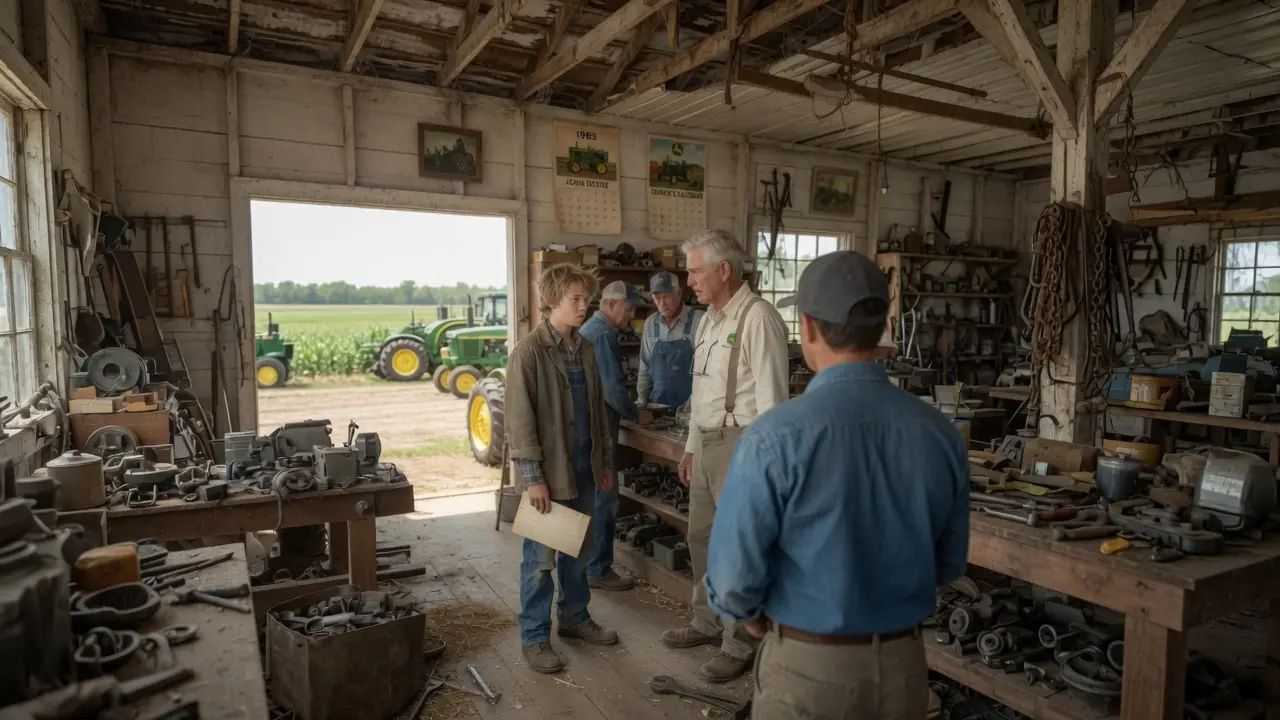
“I’m here for the hydraulic pump kit my father ordered,” Eli said, placing the paper on the counter. His voice cracked once on the word father, but he forced himself not to look away. “Mason Greer. He called it in two weeks ago.” Russell did not reach for the paper at first. He only leaned both hands on the counter and studied Eli like the boy had walked in carrying a fantasy instead of an order slip.
“Your father’s gone, boy,” Russell said coldly. “One tractor part won’t save a dead man’s farm.” The words hit Eli hard enough that his fingers curled against the counter. Behind Russell, one mechanic stopped sorting bolts, while the other stared at the floor. Eli could feel heat rising in his face, but he remembered his father’s voice: Don’t spend strength proving you’re angry. Spend it finishing the job.
“Then sell me the part,” Eli said, his voice shaking but steadying, “and watch what his son does with it.” Russell gave a sharp breath through his nose, almost a laugh. “You don’t understand what you’re asking for. That pump kit won’t install itself, and neither will a crop harvest itself because a boy makes promises in boots he can’t fill.” Eli looked down at the boots, then back at Russell.
The farm was one hundred sixty acres outside Calhoun, Iowa, with corn standing high and stubborn under the late-summer sky. Mason Greer had planted that corn in spring while hiding how tired he was from Eli, smiling through pain and saying farmers did not get to negotiate with weather. Then he grew worse, then quiet, then gone. The funeral came before the crop was ready, leaving Eli, his mother’s old recipe box, his father’s tools, and a tractor that would not lift the implement needed to finish the work.
Russell picked up the order paper at last and glanced at it. “Your father ordered it, not you.” Eli’s jaw tightened. “He ordered it for the tractor. The tractor is still mine.” Russell’s eyes narrowed. “Farm belongs to your father’s estate until a court says otherwise.” Eli leaned closer, small but fierce. “The corn doesn’t care what the court says. It’s standing now.”
That made one of the old mechanics look up again. His name was Clem Porter, and he had gray stubble, oil-dark fingernails, and the tired eyes of a man who had spent his whole life fixing machines other men blamed. Clem knew the Greer farm. He had worked on Mason’s planter twice and once watched Eli, then eleven years old, diagnose a clogged fuel line before the adults finished arguing about bad diesel.
Russell ignored Clem’s look. “Go home before that land buries you beside him,” he said, stepping closer to the counter. The room went still. Eli’s grief flared into something hotter, something that made his chest hurt and his eyes sharpen. He lifted the order paper with both hands, smoothing it flat like a document in court.
“My father left me boots, fields, and a promise,” Eli said, staring Russell down. “Not permission to quit.” For one second, nobody moved. Then Clem cleared his throat from the back. “Part’s on shelf C-four, Russell.” Russell turned toward him with irritation. Clem held his gaze. “Mason paid half already. Boy’s got the slip.”
Russell looked like he wanted to refuse anyway, but business and reputation stood behind him like witnesses. He took the paper, walked to the shelf, and pulled down a dusty green box with yellow lettering. He dropped it onto the counter harder than necessary. “Balance is forty-six dollars and seventy cents.”
Eli opened the cloth pouch in his jacket pocket. Inside were folded bills from selling two calves Mason had planned to keep, along with coins from a coffee can above the stove. He counted the money carefully, feeling Russell watch every small bill. When he slid the payment across the counter, he had three dollars and twelve cents left.
Russell printed the receipt and shoved it forward. “You’ll be back in a week asking someone to haul your tractor in.” Eli tucked the receipt beside the order paper. “No, sir.” He lifted the box with both arms because it was heavier than he expected. “Next time I come back, I’ll be buying parts for the combine.”
The mechanic Clem stepped forward before Eli reached the door. “Boy.” Eli turned, guarded. Clem pulled a folded diagram from a drawer and slipped it on top of the box. “Pump housing bolts need even pressure. Don’t force the seal, and bleed the line before you curse the whole system.” Russell’s face hardened, but Clem looked only at Eli. “Your father knew machines. If he taught you half of what he knew, you’ll manage.”
Eli swallowed around the ache in his throat. “Thank you, Mr. Porter.” Clem nodded once, then looked away because old men sometimes hid kindness like contraband. Eli carried the part outside, loaded it into the bed of his father’s pickup, and sat behind the wheel for a full minute before starting the engine. The truck smelled like dust, twine, and Mason’s old peppermint gum.
Back at the farm, the barn stood open, and the broken tractor waited inside like a wounded animal. It was a John Deere 4020, older than half the men who laughed at it, but Mason had kept it alive with maintenance, patience, and threats muttered under his breath. Eli set the pump kit on the workbench, unfolded Clem’s diagram, and opened his father’s grease-stained repair notebook. On the first page, Mason had written: If it quits, listen before you fix. A machine usually tells the truth before a man does.
Eli worked until his hands cramped. He removed the old housing, cleaned the fittings, checked the lines, and cursed only twice, both times softly because his father would have laughed. By sunset, he was covered in grease from his wrists to his elbows, with sweat drying at the back of his neck and dust sticking to his face. The first attempt leaked badly, and for ten terrible minutes Eli sat on the barn floor with his head in his hands.
Then he remembered Clem’s warning. Even pressure. Don’t force the seal. Eli took the assembly apart again, cleaned the gasket surface, realigned the seal, and tightened the bolts slowly in sequence. It took another hour, and by then the barn was fading into evening.
When he climbed into the tractor seat and turned the key, the engine coughed, rattled, then caught. Eli held his breath. He moved the hydraulic lever, and the implement arm lifted with a slow, stubborn rise that looked to him like a miracle. The boy laughed once, then cried so suddenly he had to shut the engine off and lean his forehead against the steering wheel.
The next morning, he started before dawn. The corn rows were wet with dew, and the sky over the Greer farm turned pale as Eli checked fuel, oil, belts, and the repair one more time. He had school waiting in town, bills waiting on the kitchen table, and neighbors waiting to see if the boy would fail. He ignored all of it and drove the tractor into the field.
The first day was rough. He worked too slowly, missed a turn, nearly bogged down near the low end of the field, and forgot to bring lunch. At noon, he ate crackers from the glove box and drank warm water from a jar. By evening, his shoulders ached so badly that lifting his arms felt like punishment.
But the crop moved. Row by row, acre by acre, the Greer farm began to answer him. Eli learned to feel the soil through the tires, to hear strain before the engine complained, to stop before small problems became expensive ones. Each night, he came home, washed in the sink, ate whatever he could heat quickly, and fell asleep over his father’s notebook.
Word traveled fast in Calhoun. By the third day, men at the diner were talking about Mason Greer’s boy running equipment alone. Some said it with admiration, others with doubt, and a few with the strange resentment grown men feel when a child refuses to prove their low opinion correct. Russell Harlan heard every version and dismissed them all.
“He’ll break something bigger by Friday,” Russell said over coffee. “Grief makes boys stubborn, not capable.” Clem Porter sat two stools down and did not answer. He had driven past the Greer place that morning and seen straight rows, fresh tracks, and a boy checking a hydraulic line with a rag in his hand. Clem knew the difference between stubbornness and work.
On the fifth day, trouble came in the form of a banker. Mr. Alden Pike drove out in a black sedan and stood beside the field wearing clean shoes and a patient smile. Eli shut down the tractor and climbed down, wiping sweat from his face with one sleeve. Pike held a folder against his chest as if it contained sympathy instead of numbers.
“Eli,” he said, “I am sorry about your father.” Eli nodded. “Thank you.” Pike looked toward the corn. “You understand the farm has obligations.” Eli’s hand tightened around the rag. “I know what we owe.” Pike smiled gently. “A boy should not have to carry all this. There are buyers interested in this land. If you sell now, you could walk away with something, perhaps finish school without this burden.”
Eli looked at the field behind him. The word burden sounded like an insult to every hour Mason had spent there. “My father didn’t call it a burden.” Pike sighed. “Your father was a grown man.” Eli stepped closer, anger making him stand taller than his years. “And I’m the son he raised on this ground.”
Pike’s smile faded. “Sentiment will not stop foreclosure if payments are missed.” Eli felt fear then, cold and real, but he refused to let it show. “Give me until harvest settlement.” Pike studied him, surprised by the firmness. “You have thirty days,” he said. “After that, the bank acts.”
Thirty days. Eli watched the sedan leave in a trail of dust, then climbed back onto the tractor. He worked until the moon rose because fear, if turned properly, could become fuel.
The hardest night came a week later when rain swept in early. Eli had been trying to get the last section ready before the field turned soft, but the sky closed faster than expected. The tractor slipped near the ditch, the rear tire sank, and mud sucked at the wheel with a sound that made his stomach drop. He shut down the engine, climbed into the rain, and stood there soaked, exhausted, and alone.
For a moment, he wanted to quit. Not forever, maybe not even for long, but long enough to stop hurting. His father’s boots were full of mud, his hands were blistered raw, and the field seemed too large for a boy with no one waiting at the house. Eli leaned against the tractor and whispered, “I can’t do it, Dad.”
The wind answered with rain. Then headlights appeared at the edge of the field. Eli straightened, wiping water from his eyes as an old pickup rolled to a stop. Clem Porter stepped out wearing a raincoat and carrying a chain. Behind him came Mrs. Halley from the next farm, her son Noah, and old Mr. Briggs with his bigger tractor.
Clem looked at Eli, then at the stuck wheel. “You planning to sleep out here or pull this thing free?” Eli’s throat closed so tightly he could barely answer. “I didn’t ask for help.” Clem walked past him with the chain. “Good. Saves us from saying no.”
They pulled the tractor free in twenty minutes. Mrs. Halley brought a basket from her truck with sandwiches, boiled eggs, and a thermos of coffee. “Your father helped us through the drought of ’88,” she said when Eli tried to protest. “You think kindness dies with a man? Eat.”
After that night, people began showing up quietly. Noah Halley came after school to help with fence and fuel. Mr. Briggs lent a wagon when Eli’s old one cracked a sideboard. Clem stopped by twice to check the pump repair and pretended he happened to be passing. No one took over, and that mattered. They helped the boy keep his promise without stealing it from him.
By harvest time, the Greer farm had become a test the whole town was watching. The corn stood ready, tall and dry, rustling under October wind. Eli had repaired the tractor, patched the wagon, negotiated with the elevator, and kept a notebook of every expense in his father’s blocky style. He was thinner, harder, and older in the eyes than he had been walking into Harlan’s dealership, but the boots fit better now.
The combine was another battle. It coughed, jammed, and broke a belt on the second day. Eli drove to Harlan John Deere Supply with grease on his cheek and the broken belt in his hand. This time, when he stepped inside, the mechanics looked up and stayed looking.
Russell stood behind the counter, expression guarded. “What do you need?” Eli placed the belt down. “Replacement for a 4400 combine. And two filters.” Russell glanced at the belt, then at Eli. “Still standing, then.” Eli’s eyes did not move from his face. “So is the corn. I’m changing that.”
Clem smiled faintly from the back. Russell pulled the parts without another insult, but his pride would not let the moment pass cleanly. “Luck doesn’t make a farmer.” Eli took out his money. “No. Work does.” He slid the bills across the counter. “You sell parts, Mr. Harlan. Don’t mistake that for knowing what a farm can survive.”
The words landed hard enough that even Clem stopped smiling. Russell’s face flushed, but he said nothing. Eli picked up the parts and walked out. Outside, two farmers who had heard through the open door tipped their hats as he passed.
The harvest took eleven days. Eleven long, brutal days of dust, noise, breakdowns, cold mornings, late nights, and counting every wagon load like a prayer. Eli drove until his hands buzzed from vibration and his eyes burned from chaff. When the last row came down, he shut off the combine at the edge of the field and sat in the sudden quiet with the land stripped clean behind him.
He did not cheer. He only took off his father’s hat, pressed it against his chest, and looked across the acres Mason Greer had left him. The promise was not finished forever, but it was finished for that season. Sometimes that was all a person could win.
At the grain elevator, the numbers surprised everyone. The yield was not perfect, but it was good enough. Good enough to pay the immediate bank note. Good enough to keep seed money. Good enough to keep the farm from becoming another story old men told about land lost after a funeral.
Mr. Pike shook Eli’s hand with a different expression than before. “Your father would be proud,” he said. Eli looked at him carefully. “He’d be relieved.” Pike nodded, chastened. “That too.”
News of the settlement reached town before Eli got home. At the diner, the talk changed from doubt to praise, though some of the same mouths shaped both. By the end of the week, folks were calling him “Mason’s boy” with pride instead of pity. By the end of the month, someone at the feed store called him “young Greer” as if the name itself had earned weight.
Russell Harlan did not apologize quickly. Men like him often needed shame to age before they could swallow it. But one cold morning in November, he drove out to the Greer farm with a box of parts, a service manual, and Clem Porter in the passenger seat. Eli was repairing a gate when the truck came up the lane.
Russell climbed out slowly. “Brought something.” Eli wiped his hands on his coat and waited. Russell opened the truck bed. Inside lay filters, belts, spare fittings, a used torque wrench, and a thick John Deere manual with worn pages. “Your father had credit here,” Russell said. “Some of this should have gone with his order.”
Eli looked at the box, then at Russell. “That true?” Clem coughed into one hand. Russell’s jaw tightened. “It’s true enough.” Eli understood then that this was the closest Russell could come to admitting he had been wrong while standing upright.
The boy walked to the truck and lifted the manual. Inside the front cover, someone had written Mason Greer in faded pencil. Eli ran his thumb over the letters. “This was Dad’s?” Clem nodded. “He lent it to the shop years ago. Figured it ought to come home.”
Eli’s eyes burned, but he did not cry in front of them. Russell shifted his weight. “You did a hard thing,” he said finally. Eli closed the manual. “I did the thing that needed doing.”
Russell looked across the harvested field. “I told you to give up.” Eli met his eyes. “Yes, sir. You did.” Russell swallowed. “I was wrong.” The words were rough and uncomfortable, but they were real enough.
Eli nodded once. “Then don’t say it to the next boy who walks in wearing dead man’s boots.” Russell flinched, and Clem looked away to hide the emotion in his face. Russell took off his cap. “Fair enough.”
Winter settled over the Greer farm, but it did not feel like surrender. Eli returned to school part-time, worked the farm before and after classes, and hired Noah Halley on weekends when money allowed. Mrs. Halley kept leaving casseroles on the porch until Eli stopped pretending he did not need them. Clem became a regular presence in the barn, teaching Eli the deeper language of machines: pressure, timing, wear, patience.
Years passed, though the town would always remember that first harvest. Eli grew taller, filled out his father’s boots, and bought his first new piece of equipment at twenty-three with a down payment earned from crops no one thought he could save. He expanded slowly, never gambling land for pride. He kept Mason’s notebook in the tractor cab, wrapped in oilcloth, and added his own notes beneath his father’s handwriting.
By thirty, Eli Greer was known across three counties as the farmer who could coax life from tired ground and fix almost anything with calm hands. By forty, he ran one of the most respected operations in the region, not the biggest, but the steadiest. Young farmers came to him for advice, widows came when dealers tried to cheat them, and boys who had lost fathers found work on his land before they found trouble elsewhere.
Harlan John Deere Supply changed too. Russell retired, and Clem’s nephew took over the service desk. Above the parts counter, beside the old 1963 calendar, hung a framed copy of the order slip Mason Greer had left behind and Eli had carried in with shaking hands. Under it was a small brass plate that read: Sell the part. Never bury the promise.
Eli visited the shop once a year on the anniversary of his father’s funeral. Not because he enjoyed old pain, but because memory kept a man honest. One year, he arrived to find Russell Harlan sitting in a chair near the counter, older, thinner, and leaning on a cane. Russell looked up when Eli entered.
“Greer,” he said.
“Harlan.”
Russell pointed toward the framed slip. “They made a shrine out of my worst day.” Eli looked at it and smiled faintly. “Maybe your most useful one.” Russell gave a dry laugh that turned into a cough. “You became something, boy.” Eli walked closer. “I was something when I walked in. You just couldn’t see it.”
Russell nodded slowly. There was no argument left in him. “No,” he said. “I couldn’t.”
Eli looked through the open shop door at a green tractor parked outside in the light. He thought of the broken pump, the rain, the mud, the bank, the harvest, and a father whose hands had taught him everything except how to say goodbye. Then he looked back at Russell, not with hate, but with the hard peace of someone who had outgrown the insult.
“My father used to say a machine tells the truth before a man does,” Eli said. “That old tractor told me it could still work. You told me I couldn’t.” Russell lowered his eyes. Eli picked up the part he had come to buy and added, “Good thing I listened to the tractor.”
The men at the counter laughed softly, but Russell smiled too.
Outside, the fields beyond town rolled green beneath the Iowa sky. Eli loaded the part into his truck, the same truck Mason had once driven, restored now but still smelling faintly of dust and peppermint gum on hot days. He rested one hand on the door and looked toward the road home.
Fourteen-year-old Eli Greer had walked into the dealership carrying an order slip and grief. He had walked out carrying a part, an insult, and a promise heavier than both. The town had watched to see whether a boy could save a farm in boots too large for him.
They learned that boots are not filled all at once.
They are filled step by step, row by row, season by season, until the boy wearing them becomes the man everyone else remembers.