Nine days after his father died, fourteen-year-old Eli Greer walked into Harlan Farm Equipment carrying a paid invoice in one hand and a grease-stained repair diagram in the other. His sandy-brown hair had not been properly combed since the funeral, and the oversized canvas jacket hanging from his narrow shoulders still smelled faintly of the machine shed. Outside the dealership’s open repair bay, bright green tractors stood in a perfect line beneath the Iowa morning sun. Eli ignored them and went directly to the parts counter.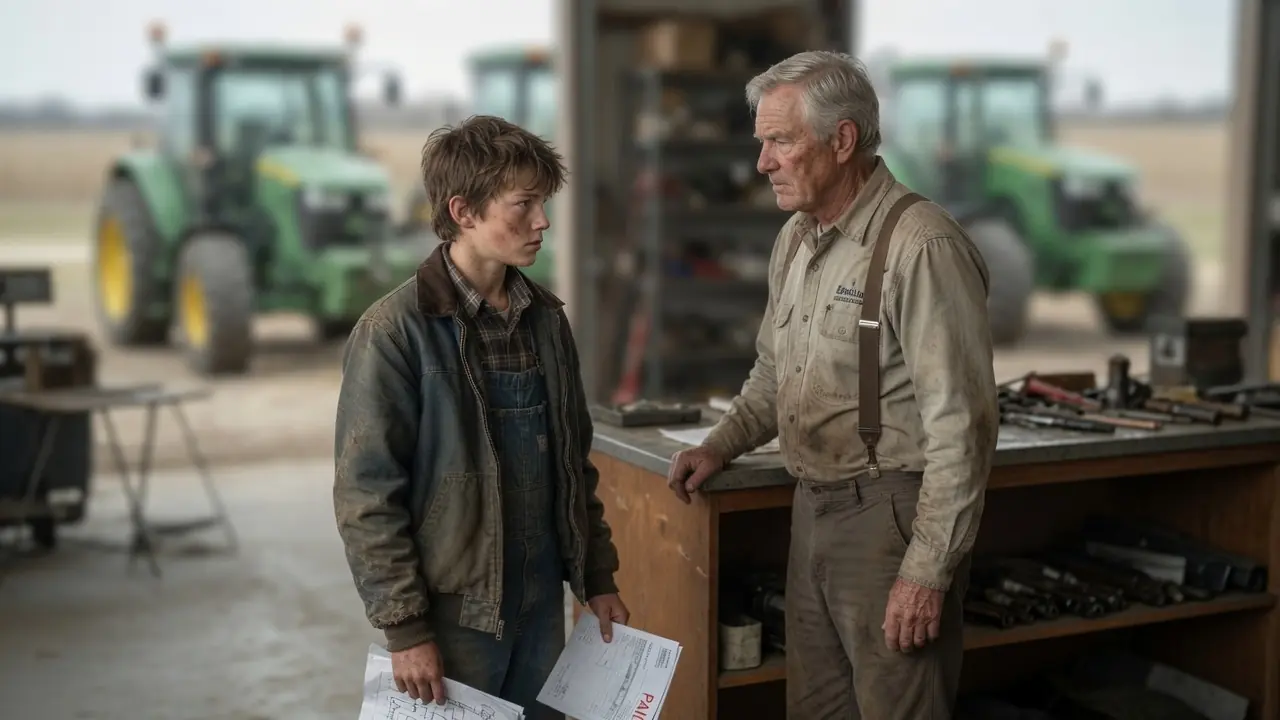
Russell Harlan looked up from a stack of service orders and immediately recognized the Greer name written on the invoice. He was sixty-three, silver-haired, broad through the chest, and dressed in the beige company shirt he wore like a uniform of authority. For thirty years, farmers throughout Jasper County had trusted him to sell them machinery, parts, and advice. Russell examined Eli’s mud-stained boots and tired face before asking where his mother was.
“She’s at home talking to the bank,” Eli answered. “I came for the hydraulic control valve my father ordered.”
Russell placed the invoice on the counter but did not turn toward the shelves. “Your father’s account is closed.”
“He paid before he died.”
“The part arrived after the account was reviewed.”
Eli pushed the invoice forward. A red stamp across the bottom read PAID IN FULL, and beneath it appeared the signature of his father, Thomas Greer. “Then it belongs to us.”
Several mechanics working behind the counter had stopped pretending not to listen. One of them, a heavyset man named Warren, knew Thomas and had attended the funeral. He lowered the wrench in his hand, but Russell’s expression warned him not to interfere.
“One valve will not save that farm,” Russell said. “Your tractor has more problems than your father admitted.”
“The pump is strong. The rear control block is sticking because the valve spring broke.”
Russell gave a short laugh. “Did you diagnose that yourself?”
“My father did. I confirmed it.”
“You confirmed it.” Russell repeated the words as though they were part of a joke. “Son, you are fourteen years old.”
Eli’s fingers tightened around the repair diagram. “I’m old enough to know when someone is trying to keep a part we paid for.”
Russell walked from behind the counter and stopped directly in front of him. “Your father is dead, the account is finished, and one part won’t save a farm run by a scared little boy.”
The repair bay became completely silent.
Eli felt the words land inside him, not because Russell had mentioned his father’s death, but because he spoke as though Thomas Greer’s work had vanished with him. For six years, Eli had followed his father through every field, listening to him explain soil moisture, seed depth, belt tension, hydraulic pressure, and the different sounds an engine made before something failed. Thomas had never treated him like a child when there was real work to be done. Russell Harlan had decided his age erased everything he knew.
Eli raised the paid invoice between them. “He taught me more about that tractor than you ever bothered to learn.”
Russell’s face reddened. He turned, pulled a cardboard box from a locked shelf, and dropped it hard onto the counter. “Take it, then. When you destroy that tractor, don’t crawl back here begging real men to fix it.”
Eli picked up the box. “Be at our field by sunset.”
Russell narrowed his eyes. “Why?”
“You’ll watch his tractor start.” Eli tucked the invoice into his jacket. “Or you’ll watch me bury this dealership’s reputation with it.”
He walked out before his grief could turn into tears.
The Greer farm lay seven miles east of town, where one hundred sixty acres of corn and soybeans stretched around a weathered white farmhouse, a leaning red barn, and the machine shed Thomas had built with his own hands. The corn was nearly ready for harvest, but heavy rain was forecast within five days. If the fields became saturated before the crop came out, the Greers could lose enough grain to miss the mortgage payment due in November. Their only working tractor had stopped three days before Thomas collapsed.
Thomas suffered a massive heart attack while repairing a broken fence near the creek. Eli had been the one who found him lying in the grass beside the post driver. He called for help, performed chest compressions until the ambulance arrived, and spent the next forty minutes believing effort could force death to change its mind. It could not.
Since the funeral, every adult who entered the Greer house brought food, condolences, and suggestions about selling. The bank manager said the family could avoid foreclosure by listing the northern eighty acres quickly. A neighboring farmer offered to buy their equipment at what he called a compassionate price. Even Eli’s uncle advised his mother, Sarah, that holding the farm without Thomas was unrealistic.
Eli heard all of it from the hallway.
Sarah had not surrendered, but grief and fear followed her through every room. She was forty-one, exhausted, and responsible for a farm loan, medical bills, two children, and a harvest that could not wait for mourning to end. Eli’s younger sister, Annie, was ten and still expected their father’s truck to return whenever she heard gravel outside. Neither of them needed another man explaining why the Greer family could not survive.
When Eli returned from the dealership, Sarah stood at the kitchen table with bank documents spread around her. “Where did you go?”
“To get Dad’s valve.”
Her eyes moved toward the box. “Eli, I told you not to work on that tractor alone.”
“I won’t be alone. Warren said he might come after his shift.”
“Did he promise?”
“No.”
Sarah closed her eyes. “We cannot afford to damage anything else.”
“We cannot afford to leave the tractor dead.”
“The bank will give us time.”
“The rain won’t.”
His mother looked toward the window where the corn moved beneath a steady western wind. She knew he was right about the weather, but that did not make trusting a grieving fourteen-year-old with a six-ton machine any easier. “Your father had thirty years of experience.”
“He also wrote down everything.”
Eli placed the stained repair diagram on the table. Thomas had drawn the hydraulic assembly by hand and circled the defective valve. Beside it, he had written pressure readings, tool sizes, and the order in which each line needed to be disconnected.
Sarah touched the handwriting with one finger. “When did he make this?”
“The night before he died.”
She looked at her son for a long moment. “If anything feels wrong, you stop.”
“I will.”
“You do not crawl beneath it unless the wheels are blocked and the pressure is released.”
“I know.”
“I need to hear you say it.”
“I’ll block the wheels, lower the hitch, shut down the engine, and release the hydraulic pressure before touching the control block.”
Sarah nodded slowly. “Then I’ll help.”
The tractor sat inside the machine shed beneath a layer of dust and grief. It was an aging green machine Thomas had purchased used twelve years earlier, with faded paint, a cracked seat, and an engine that started reluctantly on cold mornings. To outsiders, it looked like equipment nearing the end of its life. To Eli, every dent carried a memory.
He remembered sitting on his father’s knee while steering between soybean rows. He remembered Thomas teaching him never to force a bolt simply because anger demanded movement. Most clearly, he remembered his father placing a wrench in his hand and saying, “A machine always tells you what hurts. Your job is to listen before you start swinging.”
Eli cleaned the workbench and arranged the tools in order. Sarah blocked the rear wheels while Annie held a flashlight despite the daylight streaming through the open shed doors. Eli lowered the hydraulic hitch, turned off the engine, and moved the control lever repeatedly until the trapped pressure eased. Only then did he begin removing the metal lines.
The first fitting would not move.
Eli braced the wrench and pulled until his arms shook. Nothing happened. He tried again, harder, and felt the tool begin slipping against the metal.
“Stop,” Sarah said.
“I almost have it.”
“You’re rounding the fitting.”
Eli released the wrench and stared at the damaged edge. His first instinct was to keep forcing it until something obeyed. Then he heard his father’s voice: Listen before you start swinging.
He cleaned the threads, applied penetrating oil, and waited.
Waiting felt unbearable with rain approaching and the harvest standing outside. Yet after fifteen minutes, the fitting turned with steady pressure. Eli removed the line without further damage and set it carefully on the bench.
By noon, the control block was exposed. The replacement valve looked simple inside its box—a compact metal piece containing a spring, seals, and precisely machined openings. Russell had treated it as proof that Eli could not understand the machine. Eli treated it as one part of a system his father had taught him to respect.
Warren arrived shortly after one o’clock, still wearing his dealership overalls. He parked his old pickup behind the barn so no passing customer would recognize it from the road. “Russell told everyone you threatened him.”
“I told him to come watch.”
“That counts as a threat when a man’s pride is fragile.”
Eli looked toward the half-disassembled tractor. “Are you here to stop me?”
“I’m here because your father once repaired my baler at midnight and refused payment.”
Warren examined the removed lines and nodded with quiet approval. He did not take over. Instead, he asked Eli why the system had failed, what pressure readings Thomas recorded, and which direction the valve needed to face.
Eli answered every question.
“The boy knows the system,” Warren told Sarah. “That doesn’t mean nothing can go wrong.”
“We know.”
Warren showed Eli how to inspect the valve seat for scoring. They found small metal fragments inside the chamber, evidence that the spring had broken and circulated through the control block. If they installed the replacement without cleaning everything, those fragments could damage the new valve within minutes.
Russell had been partly right.
One part alone would not save the tractor.
Eli removed the block completely and cleaned every passage with solvent and compressed air. Warren checked the pump filter and discovered additional debris. Sarah drove to town for hydraulic fluid while Annie used magnets wrapped in cloth to collect the smallest particles from the drain pan.
The work continued through the afternoon.
At three thirty, dark clouds appeared beyond the western tree line. The forecast had changed, bringing the first storm earlier than expected. If rain reached the county that night, the fields might remain too soft for heavy machinery for several days.
Warren glanced toward the sky. “You need this running before dark.”
Eli installed the new valve and tightened each fitting to the specifications in Thomas’s notes. He replaced the filter, filled the reservoir, and checked every line twice. Then he climbed into the seat while Sarah, Annie, and Warren moved away.
The engine turned once.
Then nothing.
Eli tried again. The starter clicked, but the engine did not fire. His chest tightened as the silence inside the shed filled with everything Russell had said.
A scared little boy.
A dead man’s farm.
A machine real men would need to repair.
“Battery may be weak,” Warren said.
“We charged it yesterday.”
“Connections?”
Eli climbed down and checked both terminals. They were tight. He followed the ground cable toward the frame and found corrosion beneath the lower bolt, hidden where the cable bent against the metal.
Thomas had mentioned occasional starting trouble but never repaired it before his death.
Eli removed the connection, cleaned the frame to bare metal, and fastened it again. When he returned to the seat, his hands were shaking. Sarah placed one palm against the tractor’s side as though touching the machine could connect her to the husband who once operated it.
“Try,” she said.
Eli turned the key.
The engine fired.
Black smoke rolled from the exhaust before clearing into a steady rhythm. Annie shouted and jumped into her mother’s arms. Warren grinned, but Eli barely heard them because he was listening to the hydraulic pump.
A faint whine rose near the control block.
He moved the lever.
The rear hitch lifted six inches, jerked, and stopped.
Warren’s smile disappeared. “Shut it down.”
Eli killed the engine immediately.
The new valve worked, but pressure was not reaching the cylinders evenly. They searched for leaks and found none. Warren suggested the pump might be damaged after all, which would require parts the dealership did not have in stock.
Eli sat on the tractor step and opened his father’s notebook.
Thomas had recorded the hitch lifting slowly during cold mornings but functioning once the fluid warmed. The final note mentioned pressure dropping after the control lever returned to center. Eli read the line repeatedly until he understood what his father had been trying to diagnose.
“The return line is blocked.”
Warren shook his head. “The filter is new.”
“Not the filter. The hose.”
They disconnected the return hose and found its inner lining partially collapsed. From the outside, the rubber appeared intact. Inside, the damaged layer folded inward whenever pressure increased, restricting flow and starving the hydraulic system.
No replacement hose waited in the shed.
Warren looked at the clouds. “Dealership has one.”
“Russell won’t give it to us.”
“He might sell it.”
Sarah reached for her purse. “How much?”
“More than it should cost.”
Eli looked toward a retired cultivator parked behind the barn. Its hydraulic system had not been used in four years, but one hose appeared close to the correct length. He removed it, inspected the fittings, and compared its pressure rating to Thomas’s notes.
“It will work temporarily,” he said.
Warren examined the hose. “It might.”
“That isn’t the same as safe.”
“No.” Warren looked directly at him. “You need to decide whether ‘might’ is enough.”
Eli considered the weather, the crop, and the cost of failure. His father had taught him that courage was not ignoring risk. It was understanding exactly what could go wrong and deciding whether the work still needed doing.
They installed the used hose.
The engine started again. Eli moved the control lever slowly, ready to stop at the first abnormal sound. The hitch rose smoothly to full height and remained there.
No jerking.
No pressure drop.
No whine.
Warren checked the connections while the system ran. “You fixed it.”
Eli stared at the hydraulic arms holding steady behind the tractor. “Dad fixed it.”
“No,” Sarah said softly. “He left you the first steps. You finished them.”
A pickup entered the driveway.
Russell Harlan had come after all.
He stepped from the vehicle wearing clean trousers and the same beige dealership shirt. Two local farmers arrived behind him, apparently invited to witness the Greer boy’s failure. Russell looked toward the running tractor and then toward the discarded broken valve on the workbench.
“Starting is not harvesting,” he said.
Eli climbed down. “You said the tractor would be destroyed.”
“I said one part wouldn’t save the farm.”
“You were right about that. We also cleaned the control block, replaced the filter, repaired the ground, and found a collapsed return hose.”
Russell glanced toward Warren. “You did this.”
“I watched him do it.”
“You supplied dealership knowledge.”
“Thomas Greer supplied most of it years ago.”
Russell walked around the tractor, inspecting it for evidence that could return control of the moment to him. He found the used hydraulic hose and pointed toward it immediately. “That is not an approved permanent replacement.”
“It’s rated for the pressure,” Eli said. “We’ll replace it before next season.”
“You are placing the machine at risk.”
“The machine was already dying while your dealership held a part we paid for.”
One of the farmers behind Russell lowered his eyes.
Eli removed his father’s invoice and handed it to Russell. “You told me the account ended because my father died. You tried to keep what belonged to us because you thought a widow and a boy couldn’t challenge you.”
Russell folded the paper. “Careful.”
“No.” Eli’s voice became stronger. “You be careful. Every farmer here needs parts eventually. They deserve to know what happens when someone dies before collecting one.”
The other men looked toward Russell.
For decades, he had built his authority on the belief that farmers could not afford to anger the only major dealership within forty miles. Eli’s threat mattered because it was not loud or empty. If the story spread, every grieving family would wonder whether Harlan Farm Equipment would honor their payments.
Russell handed the invoice back.
“The hose will fail if you leave it there too long,” he said.
“Then sell us the correct one at the price my father would have paid.”
Russell hesitated.
Warren crossed his arms. “That sounds fair.”
One of the farmers behind him nodded. “More than fair.”
Russell agreed.
He did not apologize, but the agreement happened in front of witnesses. For the first time, Eli saw the man’s confidence bend beneath the judgment of people whose respect he had assumed permanent.
The Greers attached the grain wagon before sunset.
Their tractor could not harvest the corn alone, but it could pull wagons, operate the auger, and handle the work required to support the neighbor’s combine Sarah had arranged to rent. Samuel Greer’s machine moved into the field beneath a sky darkening with rain.
Eli drove.
The first wagon filled shortly after seven. By midnight, three neighboring farmers had brought additional equipment, not because Sarah begged, but because Warren told them what happened at the dealership. Men who had arrived expecting to help a helpless family instead took instructions from the fourteen-year-old who knew every corner of the field.
Rain began at four in the morning.
By then, the northern corn was harvested and safely stored. They lost part of the western field to mud, but enough grain had been collected to cover the November payment and most of the medical debt.
At sunrise, Eli parked the tractor inside the shed.
He placed one hand on the steering wheel and finally allowed himself to cry. Not because the machine ran or the farm was saved, but because his father should have been there to see it.
Sarah climbed onto the step beside him.
“He knew,” she said.
“How?”
“Because he taught you.”
The story spread through Jasper County within days.
Customers began asking Russell why the dealership had refused to release a paid part to a grieving family. Several requested written guarantees that prepaid orders would remain valid after death or illness. Harlan Farm Equipment adopted a new policy before the month ended.
Russell personally delivered the correct hydraulic hose.
He found Eli in the machine shed cleaning mud from the tractor. For several seconds, neither spoke.
“I was wrong,” Russell finally said.
“About the tractor?”
“About you.”
Eli waited.
Russell placed the box on the workbench. “I saw a child standing where his father should have been. I assumed grief had made you reckless.”
“It made me afraid.”
“You didn’t look afraid.”
“I was.”
Russell nodded slowly. “Your father would have been proud.”
Eli’s expression hardened. “Don’t use him to make this easier.”
The older man accepted the rebuke.
“You told me his account ended when he died,” Eli continued. “You made him sound like he was worth nothing once he couldn’t buy from you again.”
Russell looked toward the tractor. “I’m sorry.”
This time, the apology was complete enough to matter.
Years later, Eli would remember that harvest as the season everything changed. The Greer farm survived, Sarah took over the accounts, and Annie learned to drive the tractor before her thirteenth birthday. Eli continued attending school while working mornings, evenings, and weekends beside his mother.
He never became the frightened boy Russell expected.
He also never pretended he saved the farm alone.
His father left knowledge. His mother trusted him. His sister worked beside him, Warren shared experience without taking control, and neighbors arrived before the rain because one person’s courage gave others permission to help.
Above the workbench, Eli framed the paid invoice beside his father’s repair diagram.
The original broken valve rested on the shelf beneath them.
Visitors often asked why he kept a useless piece of metal.
Eli always gave the same answer.
“Because one broken part stopped a tractor, but one cruel man nearly convinced a family to stop trying.”
The tractor continued working for another eleven years.
By then, Eli Greer was no longer the fourteen-year-old boy carrying a cardboard box through a dealership full of men waiting for him to fail. He had become a farm-equipment engineer specializing in affordable repair systems for small family farms.
Yet whenever harvest approached, he returned to Iowa.
He climbed into his father’s old tractor, turned the key, and listened as the engine settled into the steady rhythm that had once carried the Greer family through the darkest season of their lives.
Russell Harlan had told him one part could not save a dead man’s farm.
He had been right about one thing.
The valve did not save it.
A father’s lessons, a widow’s courage, a community’s help, and a grieving boy’s refusal to quit did.