Hollis Eberhart heard the combine die before she fully understood what had happened. The sound began as a low mechanical surrender, a slow drop in pressure, a fading hum from a machine that had been cutting corn only seconds earlier. Then the header sagged, the reel stopped turning, and the monitor inside the cab gave one small electronic chirp. On the screen, in clean white letters, the message appeared: Compliance hold status. Harvest functions disabled. Contact your authorized dealer.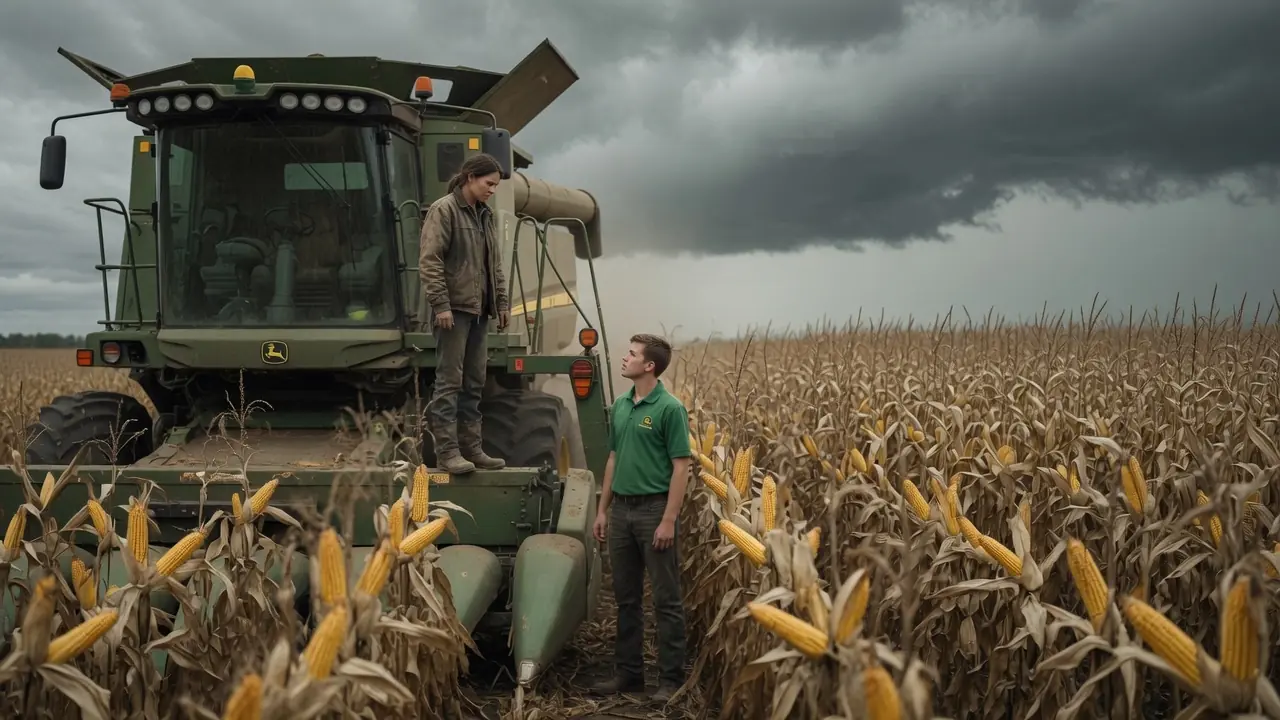
For a moment, Hollis sat frozen in the cab of the John Deere S780 with both hands still on the steering wheel. Outside, 480 acres of October corn stood ready in the cold Iowa wind, each row waiting for a machine that no longer had permission to work. The diesel engine still idled beneath her, expensive, powerful, and useless. Rain was forecast before the end of the week, and every hour that combine sat still pushed her closer to losing the harvest her father had planted before illness took him from the farm.
At the edge of the field, Garnett Voss stood beside his dealership service truck, coiling the cable he had just unplugged from the machine. He was twenty-eight, clean-cut, polite, and wearing a green polo with the dealership logo stitched over his chest. Forty minutes earlier, he had driven into her field and told her the compliance team had issued a hold order. Now he stood in the stubble like a messenger who hated the message but had delivered it anyway.
Hollis climbed down from the cab slowly. Her boots hit the ground hard, and the dry corn leaves whispered around her as she walked toward him. Garnett would not quite meet her eyes. The service tablet in his hand looked small compared to the dead machine behind him, but that tablet had just done what storms, breakdowns, and debt had not done yet. It had stopped an entire farm with a few keystrokes.
“How much?” Hollis asked.
Garnett swallowed. “Fourteen thousand eight hundred and forty dollars.”
“For what?”
“Outstanding service balance,” he said. “And the unauthorized modification fee on the sensor harness.”
Hollis stared at him. “My father fixed that harness because your dealer left him waiting four days.”
“I know,” Garnett said quietly.
“The planter was dead. Seed was sitting in the shed. Rain was coming. He repaired one wire so he could keep farming.”
Garnett looked down at the tablet. “The warranty terms required dealer-only service.”
“My father is dead.”
His face tightened. “I’m sorry.”
The apology was real, and that made it worse. Hollis wanted him to be cruel, smug, or careless, because anger would have been easier if the person in front of her looked like the enemy. Instead, Garnett looked tired and ashamed, a young man with a mortgage, a child, and a company truck he probably could not afford to lose. But his shame did not unlock her combine.
“So that’s it?” she asked. “You come into my field, shut down my harvest, and leave?”
Garnett’s jaw worked. “Policy doesn’t give me a choice.”
Hollis took one step closer. “Policy didn’t plant this corn.”
“No, ma’am.”
“Policy didn’t bury my father.”
“No.”
“Policy won’t face the bank in November if this field goes down in the rain.”
Garnett’s eyes finally lifted. “No, ma’am.”
Hollis looked back at the S780. Her father, Roland Eberhart, had bought it new in 2018, back when her mother Margaret was still alive to read contracts and underline clauses. After Margaret died, Roland had kept paying, kept clicking through updates, kept trusting that a machine he bought belonged to him. Nineteen months after his funeral, Hollis was standing in his field learning that ownership had become a word with hidden conditions.
Garnett cleared his throat. “Off the record, I’m sorry. I have a kid. I drove out here because I have a kid.”
Hollis looked at him for a long moment. She could hear the fear beneath the apology, and because she was her father’s daughter, she understood debts a person carried for reasons other people never saw. “I know,” she said. “But knowing why you did it doesn’t make the corn any less ready.”
Garnett nodded once, then turned toward his truck.
“Garnett,” she called.
He stopped.
Hollis pointed toward the locked combine. “Tell your company something for me.”
He waited.
“My father left me one tractor they can’t lock. By sunrise, this field is going to learn the difference between ownership and permission.”
Garnett did not answer. He climbed into the service truck, started the engine, and drove away between the rows. Hollis watched until the truck disappeared over the hill. Then she stood alone beside the dead S780 while the corn rustled around her like a crowd that had gone silent after hearing a verdict.
She drove home without touching the combine again. In the farm office, she opened the bottom drawer of her father’s old desk and pulled out the manila folder labeled KEEP in Roland’s careful pencil handwriting. Inside were contracts, financing papers, service agreements, and update notices he had filed but never fully understood after Margaret was gone. Hollis spread them across the desk where her mother had once sat with reading glasses and a red pen.
It took forty-five minutes to find the clause. Page sixty-seven, small print, buried under service compliance terms. The dealership had authority to disable harvest functions in the event of an outstanding service balance. But the part that made Hollis go still was not the clause itself. It was the date.
The lockout language had not been in the agreement Roland signed in 2018. It had been added through a firmware update in 2021, accepted automatically on the monitor during a season when Roland was already grieving and exhausted. Margaret would have read every line. Margaret would have called the dealer, asked nine questions, and kept asking until someone explained who truly controlled the machine.
But Margaret had been gone.
Hollis sat at the desk, the papers spread beneath her hands, and understood something her father had learned too late. A farm could lose more than a person when a spouse died. It could lose the one who read the fine print, the one who caught the trap before it snapped shut.
She looked out the office window toward the east equipment shed. There, under dust and old memories, sat Roland’s 1978 John Deere 4440. He had told her three weeks before he died, his voice thin but certain, “Whatever they sell you, don’t sell the old tractor.” At the time, she thought he meant it sentimentally. Now she understood it as an instruction.
The 4440 had no monitor to accept hidden terms. No remote system to disable its heart. No dealership compliance team waiting behind a screen. It had an engine, gears, hydraulics, worn paint, and the shape of her father worn into the seat after decades of work.
Hollis drove to the east shed before dark. She pulled the big sliding door open, and dust rose in the cold air. The tractor sat where Roland had left it, green paint dulled by years, tires low but sound, the cab glass filmed with dirt. Hollis placed one hand on the hood and felt the cold metal beneath her palm.
For the first time all day, she breathed.
At dawn, she called Alvin Osterman.
Alvin was seventy-eight and lived twenty-six miles south, near Belle Plaine. He had known Roland since both men were young, and at Roland’s funeral he had held Hollis’s hand with both of his and said, “Whatever you need, ever, don’t hesitate.” Hollis had not used the promise because pride is often what grief wears when it has no other coat. But the locked combine had burned the pride clean out of her.
“Mr. Osterman,” she said when he answered, “I need help.”
“Tell me.”
She told him everything. The lockout, the service fee, the old repair, the rain, the 480 acres, and the 4440 sitting in the shed. She told him she could maybe pull wagons, maybe move grain, maybe do something, but she had no way to cut the field without the S780. When she finished, the line was quiet.
Then Alvin said, “Bring the 4440 to my place at six tomorrow morning.”
“Why?”
“Because I have a 1947 Massey-Harris pull-type combine in my back shed, and I’m going to make some calls tonight.”
Hollis closed her eyes. “Mr. Osterman, that machine hasn’t run in years.”
“Neither have some of the men I’m calling, but they’ll remember.”
“I can’t ask you for that.”
“You didn’t ask,” Alvin said. “Roland did, thirty-six years ago, when he saved my farm and never told you about it.”
Hollis went silent.
Alvin’s voice softened. “Your father wrote me a check in 1989 when the bank was ready to take everything. Fifty thousand dollars, no interest, no deadline. I paid him back over eleven years, but money wasn’t the whole debt. Tomorrow, I settle the rest.”
Hollis pressed her hand over her mouth.
“This is not charity,” Alvin said. “It is settlement. Bring the tractor.”
The next morning, the 4440 started on the second crank. The engine turned rough at first, then settled into a deep, steady rhythm that seemed to wake the whole shed. Hollis sat in the cab gripping the wheel, and for one brief moment, she felt Roland beside her so strongly that she almost turned her head. The tractor smelled of dust, diesel, old vinyl, and every harvest her father had ever carried home.
When she rolled into Alvin’s yard at 6:02, six men were waiting. Some were old enough to have worked with Roland in the seventies. Others were sons and grandsons who had learned mechanical skills modern equipment had tried to make unnecessary. Alvin stood in the center of them with his cap low, his hands already stained with grease. Behind him, the back shed door stood open.
Inside sat the Massey-Harris, covered in decades of dust.
They worked all day.
Belts came off, chains were cleaned, tires were patched, bearings were checked, and old grease was scraped from places no one had touched in years. Hollis held lights, passed wrenches, pumped grease, and refused to sit even when her hands cramped. Alvin told her to drink water twice, and the second time she obeyed because his voice sounded too much like Roland’s to ignore. By late afternoon, the old combine no longer looked abandoned.
It looked awake.
At 7:41 that evening, the Massey-Harris coughed, shook, and came alive behind the 4440. The men cheered once, not loudly, but with the rough joy of people who had forced old iron back into service. Hollis stood beside the rig with grease on her cheek and tears she would not let fall. Alvin put one hand on the fender and nodded toward the darkening road.
“Now,” he said, “we go get your corn.”
The convoy reached Hollis’s farm after nine. Trucks followed with fuel, chain links, tools, lights, and men who did not need to be asked twice. A well driller from Cedar Rapids arrived because Roland had once helped him in a drought year. An extension agent came because his own family had been hurt by a service lockout years before. One by one, the invisible life Roland had built began arriving in headlights.
Hollis watched them park beside her shed and felt something inside her loosen. She had thought she was alone because her father was gone, her mother was gone, and the field was hers to save. But Roland had left more than land and machinery. He had left a chain of kindness that had been lying quiet across Iowa for decades, waiting for the day his daughter needed it.
They started cutting at first light.
The Massey-Harris only took six feet at a time, painfully narrow compared to the wide header on the locked S780. But it moved. The 4440 pulled steadily, its engine deep and stubborn, the old combine rattling behind it like a survivor telling the field to wait its turn. Corn flowed into wagons, wagons rolled to the bins, and men who had not worked together in years fell into rhythm as if Roland himself had assigned each place.
At 8:14, Hollis’s phone buzzed.
The compliance hold on the S780 had been lifted.
For a full minute, she looked at the message. The expensive machine was available again. The state, the dealer, or fear of exposure had forced someone to reverse what had been done. She could climb back into the S780 and cut four times as fast.
Instead, she put the phone in her jacket pocket and kept driving the 4440.
By noon, Garnett Voss returned.
His service truck stopped at the edge of the field, and he stood there in the same green polo, watching the old rig crawl through the corn. Hollis saw him but did not stop until the wagon was full. Then she pulled to the field edge, climbed down, and walked across the stubble toward him.
His eyes were red.
“I quit this morning,” Garnett said.
Hollis stopped a few feet away.
“I put the keys on my manager’s desk at six,” he continued. “I drove home. My wife asked what I was going to do now. I told her I didn’t know. Then I drove here.”
“Why?”
He looked past her at the old tractor. “To apologize as myself. Not as a technician. Not off the record. As the man who locked your combine and drove away.”
Hollis studied him. The logo on his shirt no longer looked powerful. It looked like a weight he had not yet removed.
“What you did nearly cost me the harvest,” she said.
“I know.”
“You knew it was wrong when you did it.”
“I did.”
“And you still did it.”
His voice broke. “Yes.”
Hollis let the silence sit between them. She thought of her father, who had helped men without demanding they deserve it first. She thought of Garnett’s child, his wife, his fear, and the hard truth that decent people sometimes become tools in cruel systems until something finally breaks them.
“I forgive you,” she said. “Not because it was acceptable. Because you came back.”
Garnett wiped his face quickly. “Can I work?”
Hollis nodded toward the wagons. “Carl will show you where to start.”
Garnett worked for thirty-one hours.
He drove wagons, hauled fuel, lifted chains, and never once asked to be thanked. The green polo was ruined by the second day, stained with oil, dust, and honest labor. When his phone rang, he ignored it. When another man asked if he regretted quitting, he looked at the old 4440 moving through the corn and said, “No. I regret waiting until now.”
They finished the final row on Wednesday afternoon at 2:47.
The same time the S780 had died days earlier.
Hollis shut down the 4440 at the edge of the field and listened to the sudden quiet. Behind her, every acre was cut. Ahead of her, gray clouds gathered in the west, and the first cold wind of the storm moved over the stubble. The men stood together without speaking, their caps in their hands or their arms folded against the chill.
Then the first raindrop hit the hood of the tractor.
Alvin looked at the field and said, “Roland would have liked this.”
Hollis placed her hand on the warm metal of the 4440. For the first time since her father’s funeral, she did not feel him as an absence. She felt him as a continuation. In the men who came. In the tractor that ran. In the debts nobody had forgotten. In the harvest that was saved.
That night, eight men crowded around her kitchen table eating soup and sandwiches. Hollis served them until they protested, then served them more because gratitude needed somewhere to go. Garnett tried to leave early, but she handed him a sealed envelope with thirty-one hours of pay inside and told him not to argue. He argued anyway from the driveway, and she shut the door on him.
After the last truck disappeared down the lane, Hollis finally cried.
Six months later, while cleaning the back of the equipment shed, she found the wooden box. It had been tucked behind the 4440’s rear tire, where Roland must have placed it near the end of his life. Inside were forty-two envelopes, each labeled with a name. Each contained a note about someone Roland had helped: a check written, a tractor loaned, a bank call made, a medical bill quietly paid.
At the bottom was one sheet of paper in Roland’s handwriting.
Hollis, if you are reading this, the time has come. You are going to need them now. They will come. Don’t be too proud to let them. Love, Dad.
Hollis sat on the shed floor for nearly two hours holding that note.
The S780 still worked after that. She used it when it made sense, but she never again mistook access for ownership. The 4440 remained in the equipment shed, washed, maintained, and started every month. It was no longer just a tractor. It was the proof that some things built by hands and loyalty could not be disabled from an office.
On the wall of the farm office, Hollis hung her father’s note beside an old photograph of the final row. In the picture, the 4440 pulled the Massey-Harris under a darkening sky, rain waiting just beyond the field. The image was slightly blurred, but Hollis loved it that way. It looked like motion, like memory, like a chain still holding.
Years later, when farmers asked her what saved the harvest, she never said technology, luck, or law.
She said, “My father did.”
And when they looked confused, she told them the truth.
Sometimes the most expensive machine in the field is the one that cannot work without permission. Sometimes the oldest tractor in the shed is the only thing free enough to save you. And sometimes a father’s quiet goodness, scattered across forty years of neighbors, comes back in trucks, tools, old iron, and tired hands exactly when his daughter needs it most.