Harriet Gable had spent forty-six years walking the same rows of apple trees every morning. At seventy-two, her knees were slower than they used to be, but her hands still knew where to prune, where to tie a graft, and where to test the bark for winter damage. The orchard sat in Oregon’s Willamette Valley, forty acres of green patience surrounded by land that developers had already begun swallowing piece by piece. To most people driving past, it looked like an old widow’s farm holding out against progress, but to Harriet, every tree carried a memory.
Her late husband, Walter Gable, had not simply planted apples. He had studied them, bred them, cataloged them, and treated each rare variety like a living chapter of history. Some trees were old Arkansas Black, their fruit dark and polished. Others were Hewe’s Crab, small and bitter, prized by cider makers who understood old flavors. But the heart of the orchard was the twelve-acre heritage block, where Walter had spent decades developing the Gable’s Crimson, a deep red cider apple that could survive late frost and produce a richness boutique distilleries were beginning to chase.
Walter had been gone for six years, but Harriet still spoke to him when she walked the southern rows. She would touch a trunk and tell him which branches needed trimming, which blossoms were early, which buyers had called. Near the creek stood the grand oak where his ashes had been scattered, and from there she could see the slope where his life’s work grew. She often told people she did not own the orchard as much as she was entrusted with it.
That trust became a problem for Croft and Langdon Holdings. The real estate firm had bought most of the surrounding acreage and planned a luxury subdivision called The Estates at Oakhills. Their brochures showed faux farmhouse mansions, paved trails, a golf course, and smiling families who looked like they had never stepped in mud. But their phase-three map had one ugly obstacle in the middle of all that expensive fantasy: Harriet Gable’s forty acres.
At first, the company tried politeness. Associates called to ask whether Harriet was ready to “downsize.” Glossy brochures arrived in the mail promising a comfortable future, property valuation, relocation support, and a life without farm responsibilities. Harriet used the brochures to start her wood stove. When the phone calls became annoying, she simply said, “Not for sale,” and hung up.
Then Preston Croft drove up her gravel lane in a black luxury SUV. He wore an expensive navy suit and polished shoes, the kind of man who dressed like money could keep dirt from touching him. Harriet met him on the porch with a mug of black coffee and a face that had survived weather worse than him. Preston smiled too brightly and told her he would get right to the point.
“Mrs. Gable, stubborn old widows shouldn’t stand in front of progress,” Preston said, looking past her toward the orchard. “That land is worth more under homes than under dying apple trees.”
Harriet did not blink. “Those trees are not dying.”
“They will be eventually,” he said smoothly. “You are seventy-two. Farming is difficult. Property taxes rise. Maintenance becomes impossible. We are prepared to offer you two and a half million dollars, which is generous for agricultural zoning.”
His smile tightened. “Everyone sells eventually.”
“Not everyone.”
Preston’s eyes cooled. “Croft and Langdon always gets the land it needs. We prefer to pay for it, but stubborn obstacles have a way of becoming expensive.”
Harriet set her coffee cup on the porch rail. “Are you threatening me?”
“Friendly advice,” he said, turning back toward his SUV. “Take the money before this becomes harder than it needs to be.”
After that visit, the pressure changed shape. A drainage canal was rerouted near Harriet’s northern pasture, and water began pooling where it never had before. Anonymous noise complaints went to the county, accusing her of running farm equipment too early despite agricultural exemptions that had existed long before the subdivision map. Chain-link fences rose along her property line, wrapped in green privacy screens that blocked the view and trapped dust from construction equipment.
Harriet did not break. She hired a surveyor, marked her boundaries clearly, kept copies of every complaint, and continued tending the heritage block. That year, the Gable’s Crimson trees were producing beautifully. A Seattle cidery had signed a preliminary agreement to buy the full harvest, and the payout would secure Harriet’s finances for years. Preston Croft saw the numbers, saw the delay to his utility route, and began to understand that the widow was not only emotionally stubborn; she was financially strong enough to keep saying no.
That made him reckless.
The development needed sewer and utility lines across the southern section of Harriet’s property. Rerouting around the heritage block meant cutting through difficult ground, delaying construction, and adding millions in costs. Preston decided the cheaper option was not to negotiate, but to erase the problem. If an “independent” clearing crew accidentally crossed the boundary, Croft and Langdon could blame a mapping error, pay a small fine, and move forward once the trees were gone.
It happened on a Tuesday in late October. Harriet had a cardiology appointment in Portland, routine but unavoidable, and she left the farm for several hours. Twenty minutes after her pickup disappeared over the ridge, three yellow bulldozers rolled from the construction side toward the southern fence line. Boyd Gregson, the subcontractor leading the crew, had been handed a revised map that morning.
He had questioned it once. Preston told him to clear the whole marked section, remove the stumps, flatten the grade, and push the wood into piles. Boyd did not like the look of the old survey stakes, but he liked getting paid on time. The machines moved forward, broke through the boundary fence, and entered the heritage block.
For four hours, steel tore through seventy years of botanical history. The old trees resisted as much as trees could, their thick trunks bending before giving way. Branches heavy with dark red apples fell into the dirt. Graft tags that Walter had tied by hand were torn loose and buried beneath crushed fruit, leaves, and soil. By early afternoon, the twelve-acre heritage block was no longer an orchard; it was a flat scar of churned earth and broken wood.
Harriet got the call from her neighbor Brenda Higgins as she was driving home. Brenda’s voice shook so badly Harriet could barely understand her. “They’re on your land,” Brenda cried. “The machines are on the southern slope.”
Harriet dropped the phone onto the passenger seat and pressed harder on the gas. When she reached the driveway, she did not even shut off the engine properly. She ran toward the ridge, boots slipping on damp ground, heart pounding for reasons no doctor could measure. At the top of the slope, she stopped.
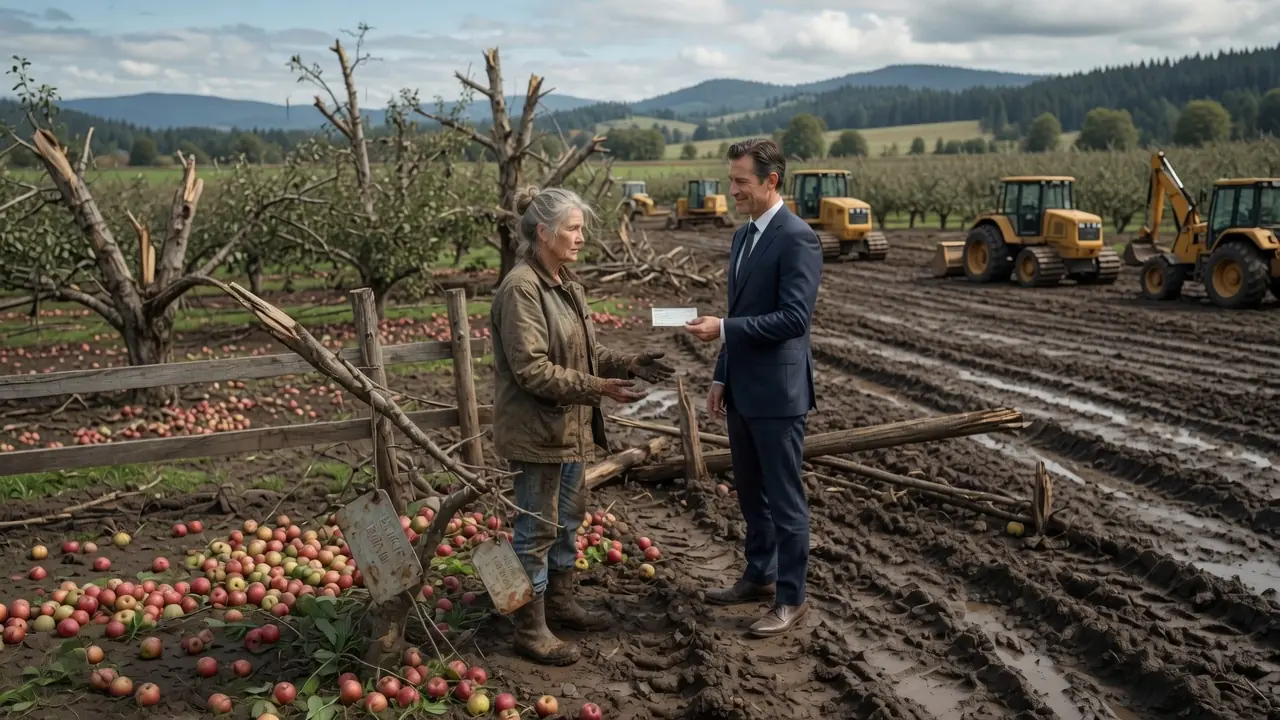
The orchard was gone.
For a moment, Harriet could not breathe. Where the green canopy had stood that morning, there were only tread marks, torn roots, broken irrigation lines, and piles of shattered branches waiting to be burned. Dark red apples lay crushed into the mud like wasted years. She stepped forward slowly, then sank to her knees, both hands pressing into the ruined soil.
It felt like losing Walter again.
She picked up a broken branch and saw one of his old metal tags still tied to it. The tag was bent, scratched, and caked with soil, but the registry number was visible. Harriet stared at it until the blur in her eyes cleared. Grief was still there, heavy and deep, but beneath it something colder began to form.
A black SUV rolled across the flattened ground and stopped several yards away. Preston Croft stepped out with Boyd Gregson behind him. Preston wore the expression of a man practicing concern without feeling it. He approached with both hands slightly raised, as if the devastation around him were an unfortunate inconvenience.
“Mrs. Gable,” he said, “this is a terrible misunderstanding.”
Harriet stood slowly. Her hands were covered in dark soil. “You destroyed it.”
Preston sighed, performing regret. “A catastrophic survey error. My subcontractor crossed the boundary by mistake. I am sick about it, truly.”
Boyd looked away.
Preston reached into his coat and pulled out a check. “I know these trees had sentimental value, but legally speaking, old fruitwood is valued by timber standards. We had an assessor run the numbers. Fifteen thousand dollars, plus reseeding costs. A generous apology for an honest mistake.”
Harriet looked at the check, then at the smashed branch in her hand. “You think this is timber?”
Preston frowned. “Old apple wood, yes. Good for smoking meats, I suppose.”
The last trace of trembling left Harriet’s body. She wiped soil from her palms onto her jeans and straightened her spine. The woman who had fallen to her knees was gone. In her place stood the keeper of Walter Gable’s life’s work.
“Keep your check, Preston.”
His fake concern cracked. “Be reasonable. If you sue us, my lawyers can drag this through court longer than you have the energy to fight. Take the money.”
Harriet looked him dead in the eye. “You did not cut down firewood. You trespassed on private property and destroyed a federally registered proprietary botanical genetics bank.”
Preston’s face twitched.
Harriet turned toward her truck. “You are going to wish you had never heard the name Gable.”
She drove back to the farmhouse without looking behind her. Preston stood in the ruined field holding a useless check while the wind lifted dust around his polished shoes. He still believed this was a property dispute. He had no idea it had just become the worst mistake of his career.
Inside the farmhouse, Harriet did not collapse. She went to the study, pulled back the braided rug, opened the old iron floor safe, and took out Walter’s records. There were ledgers, registry certificates, cidery contracts, graft maps, old correspondence, photographs, and botanical documentation. Walter had been sentimental, yes, but he had also been meticulous. Every tree in the heritage block had a history, and every history had proof.
The next morning, Harriet drove to Portland and walked into the office of Mitchell Harrison. Mitchell was a silver-haired agricultural litigator who knew timber law, water rights, and the quiet violence of land disputes better than most judges. Harriet dropped the folder on his desk, followed by three bruised Gable’s Crimson apples she had recovered from the mud. “Croft and Langdon bulldozed twelve acres,” she said. “They offered me fifteen thousand dollars. I want them stopped.”
Mitchell opened the folder. At first, he read with professional attention. Then he sat straighter. He flipped through the registry papers, the genetic records, Walter’s maps, and the cidery agreements. By the time he reached the National Clonal Germplasm correspondence, his expression had changed completely.
“Harriet,” he said quietly, “did they admit they crossed the property line?”
“Preston stood on my land and called it a mapping error.”
Mitchell leaned back. “Then he has made a fatal mistake.”
Over the next weeks, Mitchell built the case carefully. He brought in Dr. Gregory Miller, a forensic pomologist from Cornell, to evaluate the destroyed heritage block. Dr. Miller walked the scarred rows, cataloged stumps, inspected broken root systems, and matched surviving tags to Walter’s records. His report made it clear that the destroyed trees were not replaceable nursery stock. They were mature, proprietary, registered agricultural genetics tied to rare cider production and decades of specialized breeding.
The value was not fifteen thousand dollars. It was not even close.
The direct damages reached $4.8 million when the experts included mature tree replacement, lost cidery contracts, genetic loss, soil remediation, destroyed irrigation, and long-term revenue. Under Oregon’s timber trespass statute, willful cutting of another person’s trees could trigger treble damages. That meant Preston’s attempt to save money could cost Croft and Langdon $14.4 million, plus legal fees.
Three weeks later, a process server walked into Preston Croft’s glass office and placed a thick legal filing on his desk. Preston opened it with irritation, expecting a nuisance claim. When he reached the damages section, the color left his face. He stared at the number as if the zeros might rearrange themselves.
He called his corporate attorney, Cameron Hayes, in a panic. Cameron read the filing and did not comfort him. The registry documents were real. The expert report was real. The statute was real. The only question was whether Harriet’s team could prove the clearing had been intentional.
Preston insisted it was an accident. He said Boyd Gregson had misread the map. He said the company relied on subcontractors. He said Harriet was emotional, unreasonable, and trying to exploit a mistake. For a while, the defense had just enough structure to sound plausible.
Then Boyd Gregson realized Preston planned to blame him completely.
Boyd had a small company, heavy equipment payments, and a family that depended on him. He was not innocent, but he was not willing to be destroyed alone while Preston hid behind paperwork. When Mitchell Harrison’s investigator found him, Boyd had already saved text messages, payment records, and the original survey map. He knew exactly what Preston had told him.
The trial began the following spring in Marion County. The courtroom was packed with farmers, cider makers, reporters, local officials, and nervous executives from Croft and Langdon. Harriet sat at the plaintiff’s table in a plain gray suit, her hands folded, her posture straight. Preston sat across the aisle looking thinner than before, his confidence worn down by months of headlines and investor fear.
The defense argued accident. Cameron Hayes told the jury that a tragic survey error had occurred, that Preston had offered fair compensation, and that treble damages should not punish a company for a subcontractor’s mistake. It was polished and professional. Some jurors took notes. Preston looked almost relieved.
Then Mitchell called Boyd Gregson.
Boyd walked to the stand with a stiff jaw and tired eyes. Mitchell asked whether the clearing was accidental. Boyd looked at Preston, then at the jury. “No, sir,” he said. “It wasn’t.”
The courtroom went silent.
Mitchell handed him a map. Boyd identified it as the altered grading map Preston had given him the morning of the clearing. He testified that he had warned Preston the survey stakes marked Harriet’s orchard. He said Preston told him to ignore the stakes, clear the trees, and let lawyers deal with the widow. Then Boyd confirmed he had text messages and a bonus wire transfer to prove it.
Preston lowered his face into his hands.
Harriet did not smile. The truth did not bring the orchard back. It only named the people who had chosen to destroy it.
The jury deliberated for less than four hours. They found Croft and Langdon liable for willful timber trespass. They accepted the expert valuation of $4.8 million. Judge Penelope Farnsworth adjusted her glasses, looked at Preston with open contempt, and applied the statutory multiplier.
Judgment entered: $14.4 million, plus legal fees.
The company did not survive it. Investors pulled out. Lenders called in loans. Phase three collapsed first, then the rest of the development. Half-built luxury homes sat wrapped in weatherproofing, empty and useless in the rain. Croft and Langdon filed for bankruptcy within weeks, and Preston Croft was removed from the company he had tried to enrich by bullying an old widow.
Harriet received a fortune, but she did not move to Carmel. She did not buy a beach house. She did not travel the world. Instead, she bought the surrounding development acreage out of bankruptcy at a fraction of its former price.
Then she began restoring the land.
She hired crews to remove abandoned construction materials, break up unnecessary asphalt, and return the grade to something the soil could forgive. She partnered with a university, donated Walter’s records, and established the Walter Gable Agricultural Trust. In her greenhouse, from surviving root fragments and saved genetic material, she began the long work of bringing back what Preston thought he had erased.
The first new trees were small, fragile, and unimpressive to anyone who did not understand patience. Harriet planted them herself, one by one, pressing soil around each root with hands that still remembered the old orchard. Reporters came to photograph her, but she ignored them whenever possible. She cared more about whether the trees took hold.
Years later, the land where luxury houses were supposed to stand had become a protected botanical sanctuary. Ten thousand rare apple trees grew across the expanded acreage. Students came to study grafting, cider makers came to learn history, and farmers came to see what resilience looked like when planted deep enough.
Harriet still walked the rows every morning. She was slower now, but not weaker. Near the grand oak by the creek, she kept one bent metal registry tag nailed to a wooden post. It was the tag she had found on the day Preston offered her fifteen thousand dollars and called Walter’s life’s work firewood.
Sometimes visitors asked about it.
Harriet would touch the tag gently and say, “That was the day a man looked at roots and saw timber.”
Then she would look out over the new orchard, where thousands of young branches lifted toward the Oregon sky.
“And this,” she would say, “is what roots remembered.”