Helen Carter knew something was wrong before she reached her own front door. The brass wind chime Robert had hung beneath the porch roof was gone, the flowerpots had been pushed against the garage, and an unfamiliar black SUV occupied her side of the driveway. She had spent six exhausting weeks caring for her younger sister after emergency heart surgery, and all she wanted was a shower, a cup of tea, and one night in the bed she had shared with her husband for thirty-seven years. Instead, she found her suitcase blocked by two black garbage bags filled with clothes she recognized as her own.
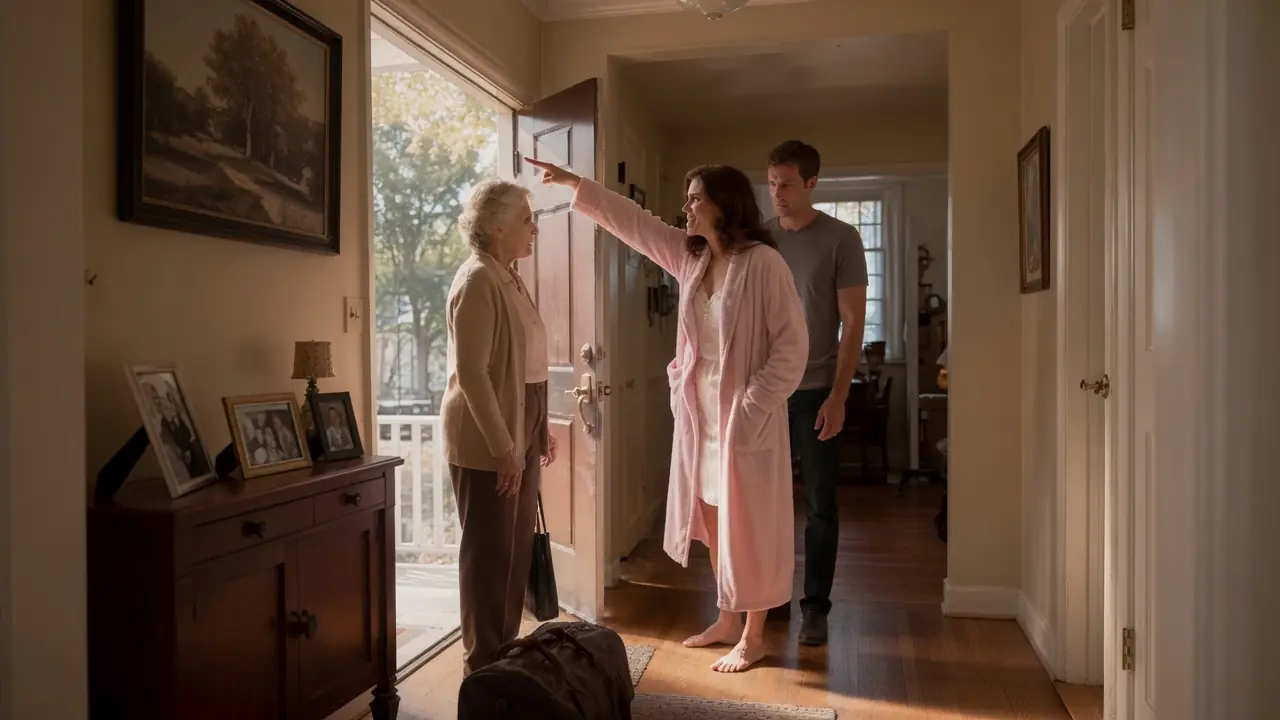
The door opened before Helen could reach for her key. Olivia Carter stood in the entrance wearing Helen’s pale-blue robe, the soft cotton one Robert had bought her on their final anniversary before cancer took him. Olivia’s long dark hair was loose around her shoulders, and her bare feet rested comfortably on the polished floor as though she had lived there for decades. Behind her stood Helen’s son, Ethan, pale and rigid in a gray T-shirt, his eyes fixed somewhere near the staircase.
“GET OUT OF MY HOUSE!” Olivia shouted, pointing toward the sidewalk. “You abandoned this place, and Ethan and I have already taken possession.”
For a moment Helen heard nothing except the blood beating inside her ears. She looked at the robe, then at Ethan, waiting for him to laugh, apologize, or step forward and explain that his wife had lost her mind. He did none of those things. His silence hurt more than Olivia’s words because Helen had once carried that silent man through a winter storm when he was a feverish child.
“My house?” Helen repeated quietly. “You are standing in my doorway, wearing my robe, while my son hides behind you.”
“You left for more than a month,” Olivia said. “We paid the utilities, handled the repairs, and kept this place running. Ethan is Robert’s only child, so this house belongs to him eventually anyway.”
“Eventually is not today,” Helen replied.
Olivia smiled with the confidence of someone who believed the battle had already ended. She explained that papers had been filed, ownership had been transferred, and Helen’s bedroom was now the marital suite. According to Olivia, an aging widow who disappeared without warning could not expect two responsible adults to wait forever while a valuable house sat “underused.” Ethan flinched at the word transferred, but he still did not speak.
Helen bent down and lifted the brown leather document case she had placed beside her suitcase. Inside it were her birth certificate, Robert’s death certificate, his will, several bank records, and a certified copy of the property deed. Her attorney had suggested carrying the folder while she was away because Helen had recently received two suspicious calls from people asking whether she intended to sell. At the time she had dismissed them as aggressive real-estate agents.
Now those calls made sense.
“I would like to enter my home,” Helen said.
Olivia stepped sideways and blocked the doorway. “You’re confused, Helen. This kind of stress is exactly why Ethan and I had to take control.”
The insult was deliberate. Olivia did not call her old; she used a softer, more dangerous word that could later be repeated to doctors, lawyers, judges, or anyone who needed convincing. Helen saw the strategy clearly. If Olivia could make her seem confused, then every objection would become evidence supporting the accusation.
Ethan finally raised his head. “Mom, maybe you should stay with Aunt Margaret tonight.”
“Aunt Margaret lives seventy miles away,” Helen replied. “And you know perfectly well that she is recovering from surgery.”
“We can arrange a hotel,” he said.
“You can arrange to move your wife out of my bedroom.”
Olivia gave a short laugh. “Your bedroom has already been cleared.”
Helen’s composure nearly broke. She stepped past Olivia before either of them could stop her and entered the hallway. The framed photograph of Robert in his navy suit had disappeared from the console table, replaced by a silver sculpture Olivia had once described as “minimalist.” Helen’s collection of family photographs had been stacked facedown beneath the staircase, and the old walnut clock Robert repaired every winter was sitting inside an open cardboard box.
Her home did not merely look rearranged. It looked erased.
Helen climbed the stairs slowly while Ethan followed several steps behind. In the master bedroom, Olivia’s perfume filled the air. Designer dresses occupied the closet, unfamiliar shoes lined the shelves, and Helen’s jewelry box sat open on the dresser with several empty compartments. The quilt Helen’s mother had sewn was folded on the floor beside two bags marked DONATION.
“Where are my things?” Helen asked.
Olivia entered behind them and folded her arms. “We kept what was usable.”
Helen turned toward Ethan. “Where is your father’s watch?”
His face changed.
“I asked you a question.”
“Olivia put some things in storage,” he muttered.
“I sold the watch,” Olivia corrected. “It was sitting in a drawer, and we needed money for improvements.”
The room seemed to tilt. Robert had worn that watch every day for twenty-two years. Helen had placed it in the jewelry box after his funeral because hearing it tick had been too painful, yet she had always intended to give it to Ethan when he was ready to understand what it meant.
“You sold your father’s watch?” she whispered.
Ethan looked sick. “I didn’t know she had done it.”
“You knew she was wearing my robe.”
“That is not the same thing.”
“No,” Helen said. “It is only where you decided to stop noticing.”
She returned downstairs, picked up her suitcase, and walked back onto the porch. Olivia mistook the movement for surrender and immediately began discussing how they could arrange a weekly allowance from the eventual sale. Helen did not answer. She carried her belongings across the lawn to Margaret Shaw’s house, where her seventy-three-year-old neighbor was already standing behind the screen door with a telephone in her hand.
“I heard her shouting,” Margaret said. “I was about to call the police.”
“Call them,” Helen replied. “Then make coffee. We have paperwork to read.”
Margaret had lived beside the Carters for twenty-eight years and remembered the day Robert and Helen bought the house. She remembered Ethan learning to ride a bicycle in the driveway, Robert building the porch swing, and Helen planting roses along the fence. As they spread the documents across Margaret’s kitchen table, her outrage grew with every page.
The deed was clear. Helen Carter was the sole legal owner through a survivorship clause added when Robert refinanced the mortgage twelve years earlier. Ethan’s name appeared nowhere, and Robert’s will did not grant him the property while Helen lived. He would inherit only if she still owned it at her death.
Helen called her attorney, Rachel Greene, who answered on the second ring. Rachel listened without interrupting, then asked Helen to read the recording number printed on the most recent title-alert notice. Helen had signed up for county property monitoring after Robert died, but the mailed notice had arrived while she was caring for her sister.
Rachel searched the county database and became silent.
“Someone attempted to file a quitclaim deed three weeks ago,” she said. “It claims that you transferred the property to Ethan for ten dollars.”
“I signed no such document.”
“I know. The signature doesn’t match anything in your estate file.”
“Was it accepted?”
“It was recorded provisionally, but the title-alert system flagged the notarization. The notary’s commission expired eight months ago.”
Helen closed her eyes. “Who submitted it?”
“The filing lists Ethan as the recipient and Olivia as the document preparer.”
Margaret muttered something sharp beneath her breath.
Rachel continued. “There is more. A mortgage application was submitted against the house four days later. They tried to borrow three hundred and twenty thousand dollars against the equity.”
Helen stared across the yard at her illuminated bedroom window. Olivia moved behind the curtains wearing Robert’s anniversary gift as though every object in the house had become a costume in her performance. The attempted theft was no longer about convenience or grief. Her son and daughter-in-law had tried to turn Helen’s entire life into collateral.
“Can they take the money?” Helen asked.
“Not now. The lender requested title verification, and the questionable notarization stalled the process. We need to file an emergency affidavit of fraud tomorrow morning.”
“And tonight?”
“Do not enter the house alone. Do not argue with them. Let the police document that you were denied access to property legally titled in your name.”
Two officers arrived twenty minutes later. Olivia met them at the door in Helen’s robe and confidently presented a photocopy of the fraudulent deed. She spoke slowly, explaining that Helen had become forgetful since Robert’s death and had voluntarily transferred the home before leaving town. Ethan stood beside her, his face drained of color.
Officer Daniels examined Helen’s certified deed, Rachel’s emailed statement, and the title-alert notice. He explained that ownership disputes often required a court order, but Helen could not be permanently removed without lawful eviction. Olivia protested until the officer warned her that interfering with Helen’s access could create additional legal problems.
Helen chose not to sleep inside. She could have forced the issue, but she no longer trusted the people occupying her home. She returned to Margaret’s house, where she spent the night staring at the ceiling and remembering Ethan at seven years old, carrying dandelions into the kitchen and declaring them more beautiful than roses.
She wondered when fear had replaced his conscience.
The next morning Rachel filed the fraud affidavit and obtained an emergency hearing for Monday. The lender froze the mortgage application, and the county recorder marked the quitclaim deed as disputed. Olivia responded by calling relatives and claiming Helen was trying to steal Ethan’s inheritance.
By Saturday afternoon, three family members had called Helen to suggest compromise. Each repeated some version of Olivia’s argument: the house would belong to Ethan someday, so why create a public scandal now? Helen listened until her patience disappeared.
“My husband did not work forty years so his son could forge my name while I was caring for a sick woman,” she told Ethan’s uncle. “Inheritance begins after death. I am still alive.”
On Sunday morning, Margaret noticed a real-estate agent placing a sign in Helen’s front yard. Olivia had scheduled a private showing for prospective buyers, apparently hoping to create pressure before the hearing. The asking price was nearly nine hundred thousand dollars.
Helen crossed the lawn carrying the brown folder. She removed the sign and placed it inside the agent’s trunk.
The agent looked confused. “Mrs. Carter authorized this listing.”
“I am Mrs. Carter.”
“Olivia Carter said she owned the property with her husband.”
“She lied.”
Helen opened the folder and showed him the certified deed, the fraud affidavit, and the lender’s title warning. The agent’s face changed from confusion to horror. Two couples waiting near the driveway overheard enough to understand that the elegant woman conducting the showing did not own the house she was trying to sell.
Olivia rushed outside, still wearing Helen’s robe over expensive pajamas. “You are humiliating us!”
“You listed my home without permission,” Helen replied. “Embarrassment is the smallest consequence you should expect.”
The agent removed the listing from his tablet while the prospective buyers returned to their cars. Margaret watched from her porch with undisguised satisfaction. Ethan remained inside, visible through the window but unwilling to face anyone.
That evening he came to Margaret’s house alone.
He looked older than he had one week earlier. His shoulders sagged, and dark circles surrounded his eyes. Helen let him stand on the porch for several seconds before opening the door.
“Did you sign the mortgage application?” she asked.
“Yes.”
“Did you know my signature on the deed was false?”
He looked down. “Olivia said it was only temporary. She said we could correct it after the loan was approved.”
“Forgery does not become legal because you plan to correct it later.”
“I know.”
“No, Ethan. You knew before.”
He covered his face with both hands. Months earlier he had lost thirty thousand dollars investing in a restaurant project Olivia promised would double their savings. Then he discovered that Olivia had accumulated more than one hundred thousand dollars in credit-card debt while maintaining the appearance of a successful lifestyle. They had moved into Helen’s guest room after claiming they were saving for a house, but in reality creditors were already pursuing them.
While Helen was away, Olivia convinced Ethan that borrowing against the property was the only solution. She said the house would eventually be his and that Helen had more space than she needed. Ethan resisted at first, then signed documents, ignored missing possessions, and allowed his wife to replace facts with entitlement.
“Why didn’t you call me?” Helen asked.
“I was ashamed.”
“So you chose something more shameful.”
Tears filled his eyes. “I kept thinking I could fix it before you came home.”
“You let her order me out.”
“I froze.”
“You were not frozen when you signed the loan papers.”
He had no answer.
Helen did not invite him inside. She told him to appear at Monday’s hearing, tell the truth, and return every item removed from the house. Ethan asked whether she would ever forgive him.
“I do not know,” Helen said. “Forgiveness is not another thing you inherit automatically.”
The courthouse hearing lasted less than forty minutes. Olivia arrived in a cream suit accompanied by an attorney who looked increasingly unhappy as Rachel presented the evidence. The original deed established Helen as the sole owner, handwriting analysis showed obvious differences between Helen’s genuine signature and the forged one, and the invalid notary seal made the attempted transfer impossible to defend.
The lender’s representative confirmed that Olivia and Ethan had applied for a large equity loan using the disputed deed. The county recorder testified that Olivia personally delivered the quitclaim document and insisted it be filed quickly. Finally, Ethan stood before the judge and admitted that Helen had never agreed to transfer the house.
Olivia’s composure collapsed.
“He told me it was basically his property!” she shouted. “His father wanted him to have it.”
The judge looked over his glasses. “His father’s intentions are stated in a legal will. That document grants Mrs. Carter full ownership during her lifetime.”
“She was gone for six weeks!”
“Visiting a sick relative does not constitute abandonment of real property.”
Olivia pointed at Helen. “She has more house than she needs.”
“That is not a legal argument.”
Laughter rippled from the rear benches before the judge demanded silence. Several neighbors had attended after learning about the fraudulent listing, along with the real-estate agent and two relatives Olivia had contacted. Every person she had tried to impress now watched her explanation disintegrate.
The judge declared the quitclaim deed fraudulent, voided any claim Ethan and Olivia asserted, and prohibited them from selling, borrowing against, or removing property from the house. He also ordered them to vacate within seventy-two hours and referred the documents to the district attorney for review. Olivia’s attorney immediately requested a private conversation with his client.
Outside the courtroom, a local reporter asked Olivia why she had attempted to sell a widow’s home while wearing the widow’s clothing. Olivia pushed past him without answering. Ethan remained near the courthouse steps, looking as though he deserved every stare directed toward him.
By Thursday evening, a moving truck stood outside Helen’s house. Olivia’s designer furniture, silver sculpture, clothes, and boxes were carried out beneath the watch of a court-appointed officer. Margaret sat on her porch drinking lemonade despite the cold.
Helen supervised from the hallway. She found Robert’s photographs in the garage, her mother’s quilt in a donation bin, and most of her jewelry hidden inside Olivia’s luggage. Robert’s watch could not be recovered because it had already been sold to an online collector, but Ethan promised to find it.
Olivia stopped beside Helen before leaving. “You destroyed our future over a house.”
“No,” Helen replied. “You tried to build your future by erasing mine.”
“You could have shared.”
“I shared my guest room, my food, and six months of my life. You answered by forging my signature.”
Olivia looked toward Ethan, expecting him to defend her. This time he remained silent for a different reason. He had already told her he would not move with her and had given the district attorney a full statement.
When the truck departed, Helen entered her bedroom alone. The robe lay crumpled across the bed. She picked it up, remembered Robert placing the wrapped box in her hands, and realized Olivia’s wearing it had not destroyed the memory attached to it.
Helen washed the robe twice and hung it beneath the open window. Then she returned every photograph to its place, unpacked her suitcase, and placed the certified deed inside a new fireproof safe. The house slowly began to feel like hers again, not because the furniture had returned but because no one inside it was demanding that she disappear.
Three months later, Ethan recovered Robert’s watch from a collector in Vermont. He had sold his truck to pay for it and arrived at Helen’s door carrying the small wooden box in both hands. He was living in a modest apartment, attending counseling, and cooperating with the investigation into the forged deed.
Helen opened the box and listened to the familiar ticking.
“I thought bringing it back might fix something,” Ethan said.
“It helps,” she replied. “But people are not watches. You cannot replace one missing part and expect everything to run normally.”
“I know.”
For the first time, she believed he might.
Helen did not invite him to move home, and she did not promise that trust would return quickly. She allowed him to visit on Sundays, help repair the porch, and sit beside her while they sorted through Robert’s old photographs. Ethan learned that remorse was not an emotion performed once but a responsibility carried repeatedly.
The following spring, Helen’s sister came to stay during her final weeks of recovery. They drank tea on the porch beneath a new wind chime and laughed about the relatives who had once suggested Helen surrender quietly. Margaret often joined them, usually bringing pastries and an exaggerated retelling of Olivia’s courtroom argument that six weeks away somehow transferred property ownership.
Helen eventually placed Robert’s watch inside a glass case beneath their wedding photograph. Beside it she kept a copy of the deed—not because she feared forgetting who owned the house, but because she wanted to remember the moment she refused to be erased inside it.
The pale-blue robe remained hers as well. On cool mornings, Helen wore it while walking through the rooms Olivia had tried to claim. Each step reminded her that age had not made her weak, grief had not made her confused, and kindness had never meant surrender.
The house was more than wood, equity, or an inheritance waiting to happen. It contained a marriage, a childhood, years of work, and the right of a living woman to decide what happened to her own life. The deed had exposed whose name belonged on the property, but Helen’s courage revealed something even more important.
She belonged there because she had never stopped being the owner of her home—or of herself.