Ava Sterling did not usually shop alone.
As the chief executive officer of Sterling Meridian Group, she normally traveled with an executive assistant, a driver, and at least one person who worried about schedules more than she did. Her company owned luxury retail properties across New York, Chicago, Miami, and Los Angeles, including the Madison Avenue building where one of Manhattan’s most prestigious Dior boutiques operated. On most days, employees recognized her before she reached the door.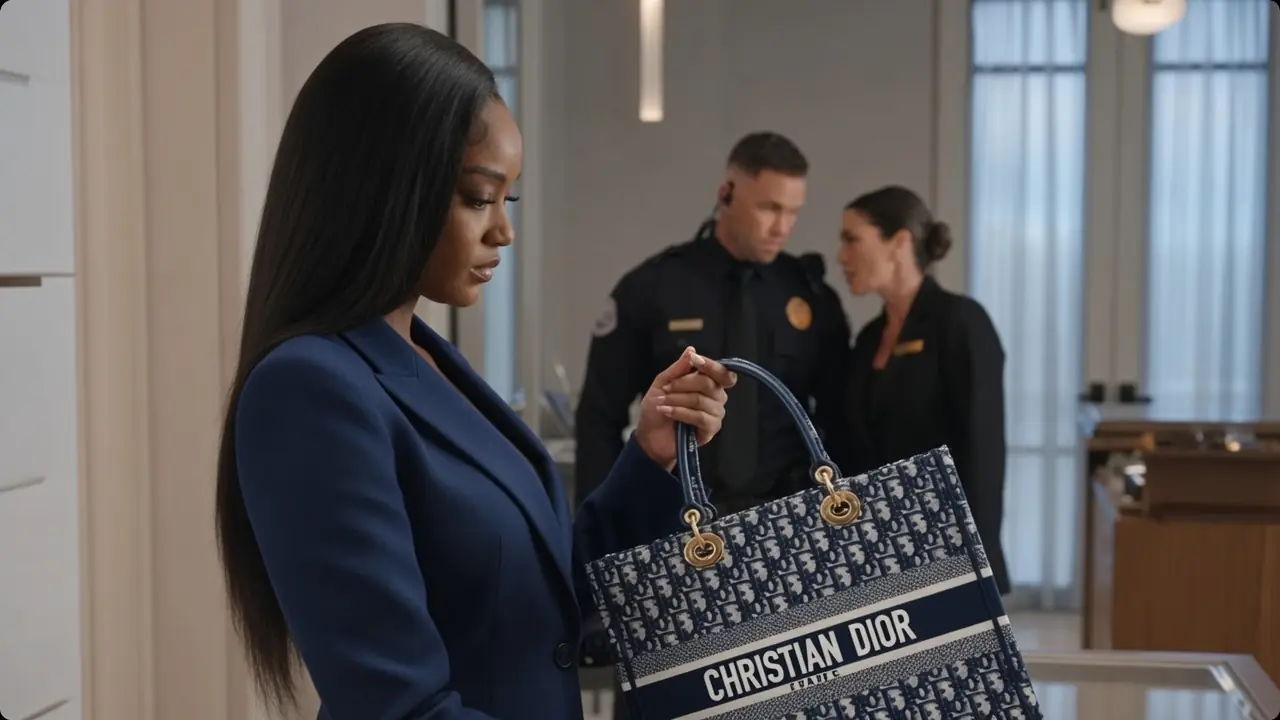
That Thursday morning, however, Ava wanted silence.
Her mother, Evelyn Sterling, was turning seventy the following week, and Ava had promised herself she would choose the birthday gift personally. Evelyn had spent most of Ava’s childhood working two jobs, sewing church dresses at night and answering telephones at a medical office during the day. Even after Ava became wealthy, her mother still carried the same brown leather handbag she had purchased nearly twenty years earlier.
Evelyn refused expensive gifts whenever she suspected Ava had delegated the purchase to someone else. She did not care about labels, price tags, or exclusivity. She cared whether her daughter had stopped long enough to think about her. That was why Ava dismissed her driver two blocks away and entered the Dior boutique carrying no assistant’s tablet, no security detail, and no visible symbol of her position.
She wore a tailored cream suit, a simple white blouse, and low black heels.
Her long dark hair fell straight over her shoulders, and her only jewelry was a small pair of diamond earrings her mother had given her after Ava graduated from business school. The outfit was elegant but intentionally restrained. Ava wanted to experience the boutique the way an ordinary customer might experience it.
She also had a second reason for coming unannounced.
During the previous six months, Sterling Meridian’s customer relations office had received four complaints connected to the Dior location. Three customers said they had been followed by security after entering the boutique. A fourth claimed a manager refused to show her a handbag until she provided proof that she could afford it.
The complaints had been forwarded to Dior’s regional management team.
Each time, the boutique reported that the incident had resulted from a misunderstanding. The store manager, Celeste Moreau, described her staff as attentive and security-conscious. Because no clear evidence had been submitted, the cases were quietly closed.
Ava disliked quiet closures.
She believed that repeated complaints were rarely isolated misunderstandings, especially when each person described nearly identical treatment. The building’s lease renewal meeting was scheduled for three that afternoon. Ava intended to observe the store before deciding whether Sterling Meridian would support Dior’s request for another ten-year term.
The boutique doors opened without resistance.
Inside, polished cream walls reflected clean light from sculpted ceiling fixtures. Handbags rested on glass shelves like museum pieces, arranged with exact spacing and guarded by employees in black tailored suits. The air carried a faint floral fragrance, and every surface appeared too perfect to touch.
A young sales associate looked toward Ava from across the room.
Her name tag read Maya Ellis. She appeared to be in her mid-twenties, with tightly curled hair pulled into a low bun and nervous eyes that moved quickly toward the manager’s desk. Maya started walking toward Ava, but another voice stopped her.
“I’ll handle this one.”
Celeste Moreau stepped from behind the central counter.
She was forty-six, impeccably dressed, and known throughout the company for protecting the boutique’s exclusivity. Her black suit fit perfectly, her dark hair was secured in a smooth knot, and a narrow gold nameplate rested above her pocket. She offered Ava the kind of smile that appeared polite until someone looked closely.
“Good morning,” Ava said.
Celeste’s gaze moved from Ava’s face to her cream suit, then to her empty hands. She appeared to search for a recognizable handbag, a personal shopper, or some signal explaining why Ava had entered alone. When she found none, her expression cooled.
“Good morning,” Celeste replied. “Were you meeting someone?”
“No. I’m shopping for a birthday gift.”
“For whom?”
“My mother.”
Celeste looked toward the entrance as though expecting another person to appear. “Do you have an appointment?”
“I didn’t realize one was required.”
“It is not technically required,” Celeste said. “However, our established clients generally schedule private consultations.”
Ava glanced around the nearly empty boutique. “You don’t appear busy.”
Celeste’s smile tightened. “Appearances can be misleading.”
Ava noticed Maya still standing a short distance away. The young associate held a pair of white gloves, ready to assist, but Celeste gave her a subtle shake of the head. Maya lowered her hands.
“I would like to see a classic black handbag,” Ava said. “Something elegant but practical.”
Celeste gestured vaguely toward a display wall. “Our entry-level pieces are located near the rear.”
“I didn’t ask for an entry-level piece.”
“You said practical.”
“Practical and inexpensive are not the same thing.”
For the first time, Celeste looked directly into Ava’s eyes.
The manager seemed irritated that the customer had noticed the insult hidden inside her suggestion. She turned toward a male security officer stationed beside the doorway. His name was Daniel Ruiz, and he had worked at the location for less than three months.
Celeste leaned toward him and whispered, “Keep eyes on her.”
She spoke quietly, but the boutique was silent enough for Ava to hear every word.
Daniel hesitated. “She hasn’t done anything.”
“I did not ask for commentary.”
Ava showed no reaction.
She walked toward the handbag display while Daniel remained several steps behind her. The officer looked uncomfortable, but he followed the manager’s direction. Celeste watched from the counter, pretending to review paperwork.
Ava stopped beside a black Lady Dior handbag.
The design was structured, graceful, and understated enough for Evelyn. Ava imagined her mother protesting that it cost too much, then secretly touching the stitching when she thought no one was watching. A small smile crossed Ava’s face.
She reached toward the handle.
Celeste’s voice cut across the room. “Please do not touch that without assistance.”
Ava withdrew her hand slowly. “Then assist me.”
“That particular piece is reserved.”
“There is no reservation card.”
“Our internal reservations are not displayed publicly.”
Ava looked toward Maya. “Can you show me another one?”
Maya stepped forward. “Of course. We have the same design in—”
“Return to your station,” Celeste interrupted.
Maya stopped. “Ms. Moreau, I can help her.”
“I said return to your station.”
The young associate lowered her eyes and walked away.
Two other customers entered the boutique, an older white couple carrying shopping bags from nearby luxury stores. Celeste’s entire manner changed the moment she saw them. She hurried to greet them with a wide smile, addressed the woman by name, and offered champagne before they had requested assistance.
Ava continued examining the display.
Daniel stood close enough that she could hear his radio. He avoided looking directly at her. His embarrassment seemed almost as strong as hers, though only one of them was being treated like a threat.
After several minutes, Celeste returned.
“Ma’am, are you waiting for someone to complete a purchase for you?”
Ava turned. “I am completing my own purchase.”
“Then perhaps you should begin with a clear budget.”
“My budget is not your concern.”
“It becomes my concern when a customer handles merchandise without demonstrating serious intent.”
Ava’s expression remained calm. “How does a customer demonstrate serious intent?”
Celeste folded her arms. “Our regular clients understand the process.”
“I am asking you to explain it.”
The older couple had stopped speaking. Both were watching from across the room, along with three sales associates and Daniel. Celeste seemed aware of the audience, but instead of stepping back, she became more determined to assert control.
“Luxury boutiques are not department stores,” Celeste said. “People cannot simply enter, touch expensive pieces, and expect us to ignore obvious risks.”
“What risk have I created?”
“You entered without an appointment, avoided the client desk, and immediately approached one of our premium handbags.”
“I walked into a store and looked at something for sale.”
Celeste lowered her voice. “We both understand what is happening.”
“I don’t believe we do.”
The manager looked toward Daniel. “Would you please remain beside her until she decides whether she is purchasing anything?”
Daniel shifted uneasily. “Ms. Moreau, she hasn’t violated store policy.”
Celeste’s eyes hardened. “Are you refusing an instruction?”
“No, ma’am.”
Ava studied the manager carefully.
There it was: the same pattern described in the complaints. A customer entered alone. Celeste decided she did not belong. Security was summoned before any misconduct occurred, and the person was pressured until humiliation drove her from the store.
Ava had already learned enough to influence the lease meeting.
But Celeste was not finished.
She stepped closer and looked at the black handbag Ava had selected. “That Dior piece is not for casual browsing. After what I told security, I suggest you stop touching merchandise you clearly do not intend to buy.”
Ava’s voice remained quiet. “Interesting. Most managers greet customers before accusing them of not belonging.”
“I greet clients,” Celeste replied.
“And what am I?”
“A woman who walked in alone, avoided the VIP desk, and expected us to pretend we didn’t see the difference.”
The room became completely silent.
Maya looked horrified. Daniel lowered his chin, and the older couple exchanged an uncomfortable glance. Celeste appeared satisfied, convinced that she had finally forced the customer into her proper place.
Ava lifted the handbag from its stand.
She held it gently by the handles and examined the stitching. The movement made Celeste’s face tighten.
“Put that down immediately,” the manager ordered.
“I intend to purchase it.”
Celeste gave a short, humorless laugh. “The price is eleven thousand dollars before tax.”
“I know.”
“Then you understand why I cannot allow this performance to continue.”
Ava turned to face her fully. “Call your regional director, Celeste.”
The manager blinked. “Excuse me?”
“Call Gabrielle Laurent.”
Celeste’s expression changed slightly at the mention of the Dior regional director’s name. “Ms. Laurent does not speak to walk-in customers.”
“She will speak to me.”
“I don’t know what kind of impression you are trying to create, but name-dropping an executive will not help you.”
Ava reached into the inner pocket of her cream jacket.
Daniel’s posture became alert, but she removed only a black business card. She placed it on the glass display table between them.
Celeste looked down.
AVA STERLING
CHIEF EXECUTIVE OFFICER
STERLING MERIDIAN GROUP
The manager stared at the card for several seconds. Then she looked back at Ava’s face and forced a smile.
“Anyone can print a business card.”
“That is true.”
“Sterling Meridian’s CEO would not enter through the public door without an appointment.”
“Why not?”
“She would have an assistant, security, and advance arrangements.”
“Perhaps she wanted to discover how customers are treated when no one knows who they are.”
The color began draining from Celeste’s face.
The older man across the boutique quietly took out his phone. One of the sales associates turned away, pretending to rearrange a display while listening to every word. Maya stood motionless beside the client desk.
Celeste recovered quickly.
“If you truly are Ava Sterling, I apologize for the confusion.”
Ava’s gaze sharpened. “Which part was confusing?”
Celeste opened her hands. “We have experienced several theft attempts recently. My caution was not personal.”
“You did not ask my name before placing me under surveillance.”
“I followed standard loss-prevention procedure.”
Daniel finally spoke. “No, ma’am.”
Celeste turned toward him. “What did you say?”
Daniel swallowed. “There was no standard reason to monitor her. You instructed me before she touched anything.”
The manager stared at him with open fury. “You are security, not management.”
“I am also required to document instructions that may violate company policy.”
Celeste’s voice rose. “You will not have a position here by the end of the day.”
Ava looked at Daniel. “Do not leave the floor.”
The security officer nodded.
Celeste reached for the business card. Her hand trembled slightly as she picked it up. “Ms. Sterling, perhaps we should continue this privately.”
“No.”
“There is no reason to involve customers or junior staff in a misunderstanding.”
“They were involved when you decided to humiliate me in front of them.”
Celeste looked toward the entrance, calculating whether she could contain the situation. Then the boutique doors opened again.
Gabrielle Laurent entered with two Dior executives and Marcus Bell, Sterling Meridian’s general counsel. Gabrielle was a tall French American woman in her early fifties, dressed in a navy suit with a silk scarf at her neck. She had arrived early for the lease meeting after receiving a one-line message from Ava.
Come to the boutique. Do not announce yourself.
Gabrielle saw Ava holding the handbag and smiled.
“Ava, I thought our meeting was at three.”
Celeste’s last trace of confidence disappeared.
Gabrielle looked from Ava to the security officer, then to the silent staff. “What happened?”
Ava placed the handbag back on the display. “I came to purchase a gift for my mother.”
“And?”
“Your manager instructed security to watch me before offering assistance. She refused to show me merchandise, questioned whether I could afford it, and told me she serves clients rather than women like me.”
Gabrielle’s face became still. “Celeste?”
The manager immediately stepped forward. “That is not an accurate description.”
Maya looked at the floor.
Daniel’s hands tightened at his sides. The other employees avoided Gabrielle’s eyes, each appearing trapped between fear and relief.
Ava turned toward them. “No one will be punished for telling the truth.”
Celeste laughed nervously. “This is unnecessary. The security footage will show that I was simply protecting the merchandise.”
Marcus Bell opened the tablet he carried. “We have already requested the footage.”
The manager stared at him. “You cannot access our private security system.”
“The cameras belong to the building,” Marcus replied. “Your lease grants Sterling Meridian access when misconduct or safety concerns are alleged.”
Within minutes, the group moved into the boutique’s private consultation room. The staff remained on the sales floor, while Celeste sat opposite Ava, Gabrielle, and Marcus. A monitor on the wall displayed footage from the previous hour.
They watched Ava enter.
They watched Maya begin approaching her and Celeste stop the associate. They watched Celeste whisper to Daniel before Ava had touched any merchandise. The camera did not record clear audio from every angle, but Daniel’s written security log contained the exact instruction.
10:14 a.m. Manager requested visual monitoring of unidentified female customer. No suspicious behavior observed.
Celeste shifted in her seat. “The camera does not capture context.”
“It captures sequence,” Ava said.
Gabrielle asked Marcus to play the footage again.
This time, she focused on Maya. The young associate had repeatedly attempted to help Ava, but Celeste blocked her every time. Gabrielle then reviewed footage from the previous month and found the manager performing the same intervention with two other Black customers and one Latina customer.
“Why was this footage never included in the complaint reviews?” Gabrielle asked.
Celeste crossed her arms. “Because those customers misunderstood attentive service.”
Marcus opened another document. “Six employees submitted internal concerns about your management.”
Celeste looked toward him sharply.
“Four complaints describe discriminatory customer screening,” he continued. “Two describe retaliation after employees objected.”
“Those employees were underperformers.”
“One is still employed here,” Ava said. “Maya Ellis.”
Celeste’s jaw tightened.
Gabrielle asked for Maya to join them.
The young associate entered the room looking terrified. She sat near the door and kept both hands folded tightly in her lap. Celeste stared at her with a warning that required no words.
Ava noticed.
“Maya,” she said gently, “your manager cannot affect your employment after this meeting. Tell us what you have seen.”
Maya’s eyes filled with tears.
She explained that Celeste used coded phrases for customers she considered undesirable. “Needs guidance” meant security should follow someone. “Browsing without profile” meant employees should avoid displaying expensive items. “Protect the premium wall” meant a customer should be encouraged to leave.
Gabrielle looked sickened. “How long has this been happening?”
“Since before I started,” Maya whispered. “At least two years.”
“Why did no one report it?”
“We did.”
The answer landed harder than any accusation.
Maya explained that employees had contacted human resources, but each complaint was redirected to the store manager for local resolution. Celeste then reduced hours, changed schedules, or denied commissions to anyone she believed had spoken against her.
One associate resigned after being assigned closing shifts for six consecutive weeks.
Another transferred to New Jersey. Maya stayed because she was helping support her younger brother through college and could not afford to lose the position. She had learned to remain silent while quietly helping customers whenever Celeste was occupied.
Celeste leaned forward. “She is lying to protect herself.”
Maya flinched.
Ava’s voice became cold. “Do not speak to her again.”
The manager turned toward Gabrielle. “Surely you can see what this is. Ms. Sterling entered without identifying herself, created a confrontation, and is now using her position to threaten the boutique.”
“I did not create your words,” Ava replied. “I only allowed you enough time to say them.”
Celeste’s face hardened. “I have managed this store for eight years. Sales have increased every year under my leadership.”
Gabrielle looked at the records Marcus had provided. “So has employee turnover.”
“This is luxury retail. Pressure is part of the work.”
“Humiliation is not pressure,” Ava said.
Celeste stood abruptly. “I will not sit here while someone who knows nothing about my clients destroys my career over one uncomfortable interaction.”
Gabrielle’s eyes narrowed. “Sit down.”
The manager remained standing.
She looked toward Ava with the resentment of someone who had stopped pretending to be afraid. “You came here dressed like you belonged, but gave us no reason to know who you were.”
Ava held her gaze. “I gave you the only reason you should have needed. I walked through the door as a customer.”
“You know how these stores work.”
“I know exactly how they should work.”
Celeste shook her head. “People expect exclusivity.”
“Exclusivity means careful design, exceptional service, and limited craftsmanship. It does not mean deciding which customer deserves dignity.”
Celeste looked toward Gabrielle. “Are you really going to let a landlord dictate Dior’s personnel decisions?”
Gabrielle closed the complaint file.
“No,” she said. “I am going to make my own decision based on the evidence your landlord forced us to examine.”
For the first time, Celeste appeared genuinely frightened.
Gabrielle removed her glasses and placed them on the table. “Celeste Moreau, your employment is terminated for discriminatory conduct, retaliation, falsification of complaint reviews, and creating legal and reputational risk for the company.”
Celeste’s mouth opened, but no sound came out.
“This decision is effective immediately,” Gabrielle continued. “You will surrender your keys, company devices, and client records before leaving the property. Security will accompany you while you collect your personal belongings.”
“You cannot do this.”
“I just did.”
Celeste turned toward Ava. “You wanted this from the moment you entered.”
Ava shook her head. “I wanted to buy my mother a handbag.”
“You destroyed my career over a bag.”
“No. You destroyed it every time you treated a person as suspicious because they did not match the image in your mind.”
Celeste looked around the room for support.
No one offered it.
Daniel waited outside the door with another security officer. The man Celeste had threatened with unemployment would now escort her from the store. The reversal seemed to strike her all at once.
She removed her gold nameplate and placed it on the table.
Before leaving, she looked at Maya. “You will regret this.”
Gabrielle stood. “That threat will be included in the termination report.”
Celeste’s shoulders dropped.
She walked out of the room without another word.
The boutique remained closed for the rest of the afternoon. Gabrielle met individually with every employee, while Marcus collected documentation connected to the previous complaints. Sterling Meridian postponed the lease decision until Dior completed an independent review of the store’s management culture.
Ava stayed.
She listened to associates describe years of fear, coded discrimination, and pressure to prioritize appearances over service. Several admitted they had participated because they feared losing commissions or shifts. Others cried as they apologized for remaining silent.
Ava did not excuse them, but she understood the difference between authority and survival.
“You are still responsible for what you did,” she told them. “But responsibility is where correction begins, not where human worth ends.”
Maya was appointed acting floor supervisor.
She initially refused, insisting she lacked management experience. Gabrielle reminded her that leadership had begun the moment she tried to assist a customer while her manager ordered her not to. Ava agreed.
“You noticed the person before the price tag,” Ava said. “That is more than your previous manager understood after eight years.”
The boutique reopened three days later.
Every employee completed new training on customer dignity, discriminatory profiling, and ethical reporting. Dior created an external complaint channel that bypassed store management. Sterling Meridian added anti-retaliation requirements to the proposed lease renewal.
The four customers whose complaints had been dismissed received personal apologies.
Two agreed to return to the boutique for private meetings. One declined and asked that the cost of any offered gift be donated to a youth employment program instead. Ava ensured the request was honored.
A month later, she returned with Evelyn.
Her mother wore a navy dress, comfortable shoes, and the old brown handbag with worn handles. She stopped outside the Dior entrance and looked suspiciously at the elegant displays.
“This is where you bought it?” Evelyn asked.
“This is where I tried to buy it.”
“That sounds like a longer story.”
“It is.”
Inside, Maya greeted them with a genuine smile.
She did not recognize Evelyn as Ava’s mother until Ava introduced them. Even then, her service did not suddenly become more attentive. She had already offered them both water, invited Evelyn to describe what she liked, and asked before touching the old handbag to compare its size.
Evelyn noticed.
She examined several designs before returning to the black Lady Dior handbag Ava had selected on the first visit. She lifted it carefully and looked at the price.
“No.”
Ava laughed. “Mama.”
“Absolutely not.”
“It is your seventieth birthday.”
“I did not survive seventy years to let my daughter spend that much money on a container for tissues and peppermints.”
Maya covered a smile.
Ava touched her mother’s shoulder. “You spent your life making sure I had what I needed.”
“That does not mean you must become foolish.”
“It means I finally get to choose something beautiful for you.”
Evelyn looked at the handbag again.
Her fingers traced the stitching. Then she glanced toward Ava’s cream suit, remembering perhaps the child who had once studied at the kitchen table while her mother sewed dresses nearby.
“You really chose it yourself?” Evelyn asked.
“Yes.”
“No assistant?”
“No assistant.”
Evelyn’s expression softened. “Then I suppose refusing it would waste your effort.”
“That is exactly right.”
“But I am carrying it.”
“That is generally how handbags work.”
“And you are not putting it on a shelf like decoration.”
“I promise.”
Maya completed the purchase and wrapped the handbag carefully. There was no whisper to security, no demand for proof, and no calculation about whether Evelyn appeared wealthy enough to deserve attention. She was simply treated as a woman choosing something meaningful with her daughter.
Before leaving, Evelyn stopped beside Maya.
“My daughter told me what happened here.”
Maya’s smile faded slightly. “I wish I had spoken sooner.”
“You tried to help her.”
“I should have done more.”
Evelyn reached for the young woman’s hand. “Fear makes silence easy. What matters is what you do when the door opens again.”
Maya nodded, her eyes shining.
Outside the boutique, Ava and Evelyn walked slowly along Madison Avenue. The new Dior bag rested inside a cream shopping box, while Evelyn’s old brown handbag remained over her shoulder.
“You are not replacing it today?” Ava asked.
Evelyn patted the worn leather. “This one has earned a respectful retirement.”
Ava smiled. “That sounds like something a chief executive would say.”
“No. A chief executive would have replaced it ten years ago.”
They continued toward the waiting car.
Behind them, the boutique doors opened for another customer, a young woman wearing jeans and carrying a canvas backpack. Maya approached her before anyone could decide whether she belonged.
“Welcome to Dior,” Maya said. “What would you like to see today?”
The woman looked surprised by the warmth of the greeting.
She smiled and stepped farther inside.
That small moment was not recorded in any executive report. It did not appear in the lease agreement, the termination file, or the company’s new training materials. Yet it represented the change Ava had wanted from the beginning.
Luxury had once been used inside that boutique as a wall.
Now, for the first time in years, it began with an open door.