“You endangered my patients. Get off this floor before I personally end your career.”
Dr. Marcus Hale stood inches from Zara Quinn in the main corridor of Riverside General Hospital, one finger aimed at her face as though the accusation itself were already a verdict. His white coat remained perfectly pressed despite the chaos that had consumed the emergency department less than an hour earlier. Around them, nurses, residents, and technicians slowed without openly stopping, each pretending not to witness the confrontation.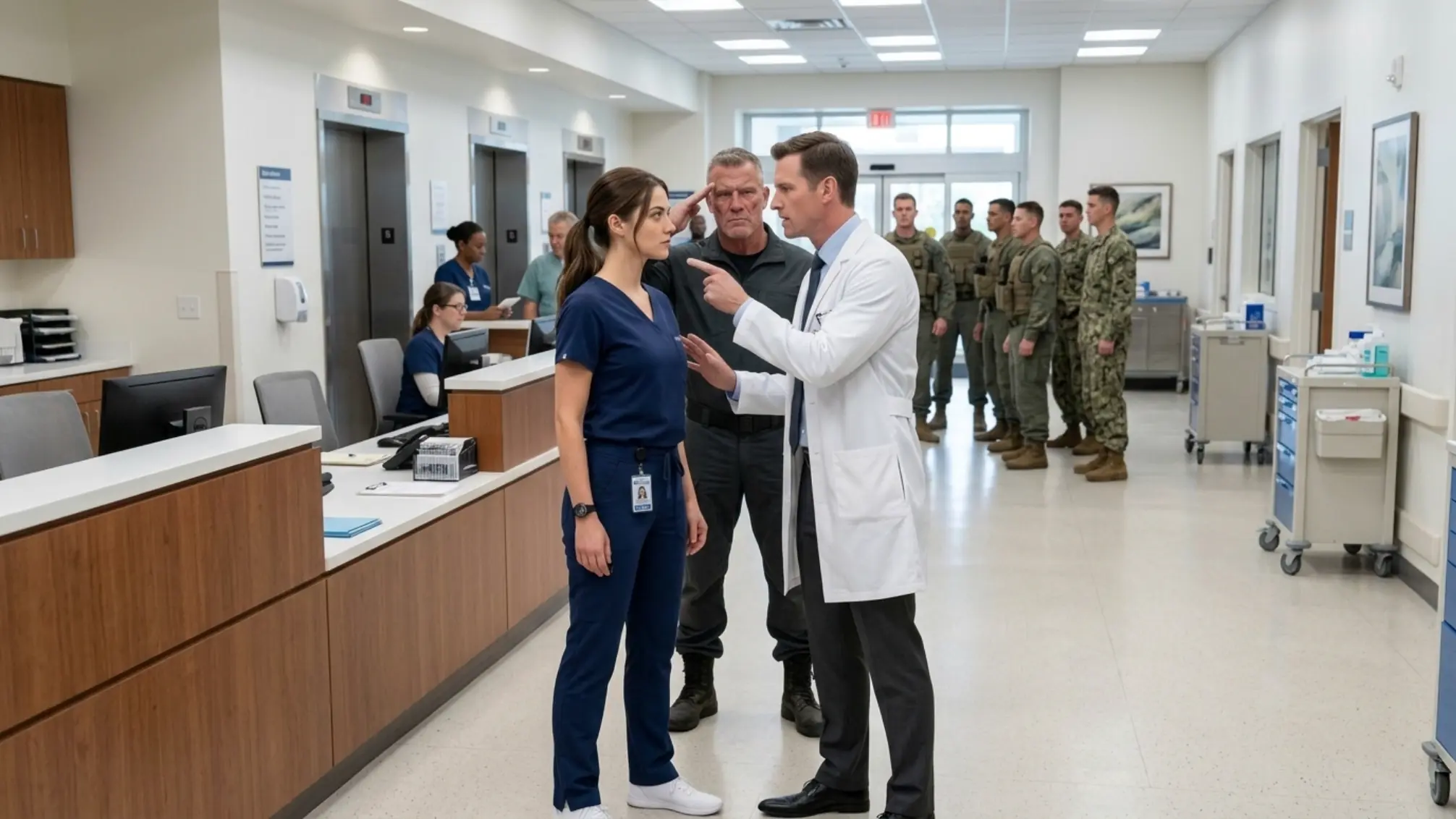
Zara remained in her navy-blue scrubs, her dark hair secured in a practical low ponytail and her hands relaxed beside her. “Touch me or lie about my work again, and we settle this without your title protecting you.”
Marcus raised one hand as if he might shove her away from the nurses’ station. “You’re a community-college nobody. I’ll have security drag you out screaming.”
Before his arm moved any farther, a broad hand caught it in midair.
A powerful man wearing dark tactical clothing had stepped between them. Behind him stood seven disciplined soldiers, all silent, watchful, and built with the contained stillness of people trained to move only when movement mattered.
“Put that hand down,” the commander said. “This ‘nobody’ saved my entire unit, and eight witnesses just heard your threat.”
Three days later, everyone at Riverside would remember those words.
But the confrontation had begun long before the soldiers entered the hospital.
Zara Quinn had worked at Riverside General for only six weeks. She arrived eight minutes early for every shift, checked equipment without waiting to be told, and greeted the exhausted night staff by name before they disappeared toward the elevators. She never announced what she had fixed, never claimed credit for what she prevented, and never reminded anyone when her preparation made another person’s job easier.
At twenty-eight, Zara looked younger than most people expected from the quiet authority in her movements. She had earned her nursing credentials through a community program after completing a GED, and her résumé contained a ten-year gap explained by only two words: military service. Whenever anyone asked what she had done during that decade, she answered that she had been a medic.
That was true.
It was also so incomplete that it concealed nearly everything.
Most of Zara’s colleagues had already formed opinions about her. She had not attended an elite university, did not join the after-shift gatherings, and rarely volunteered stories about her personal life. Her silence was interpreted as arrogance by some, insecurity by others, and lack of intelligence by those who believed confidence had to be loud.
Charge Nurse Sandra Ochoa saw something different.
Sandra had worked at Riverside for twenty-six years and could recognize a dangerous nurse, a lazy nurse, and an extraordinary nurse before most administrators finished reviewing a résumé. She watched Zara for six shifts before pulling her aside beside the medication room.
“You’re good at this,” Sandra said.
Zara nodded once. “Thank you.”
Then she returned to work.
Sandra had expected a smile, a question, or at least the small excitement of a new employee receiving approval from the most respected charge nurse on the floor. Zara reacted as though Sandra had merely confirmed the time.
That response stayed with her.
Dr. Marcus Hale noticed Zara for a different reason.
Marcus was an accomplished internal-medicine physician with excellent exam scores, strong technical knowledge, and enough experience to know that he was often the smartest person in the room. Over the years, “often” had gradually become “always” in his mind. Riverside rewarded his confidence because patients generally survived, junior doctors listened, and administrators preferred certainty to doubt.
His teaching moments happened publicly.
Marcus liked asking residents difficult questions in crowded corridors, correcting nurses within earshot of patients, and turning ordinary discussions into demonstrations of hierarchy. He believed pressure revealed weakness, though the pressure was almost always directed at someone unable to answer him without risking a career.
His dislike of Zara began in the pediatric unit.
A seven-year-old boy had arrived with severe respiratory distress, and Marcus entered a medication dosage that was too high for the child’s weight. The mistake would probably not have killed him, but it could have caused complications during an already unstable emergency.
Zara noticed the dosage while checking the chart.
She did not announce the error or challenge Marcus in front of the team. She flagged it through the pharmacy verification system, added the child’s current weight, and requested confirmation. The pharmacist contacted Marcus, the order was corrected, and the boy received the proper dose.
Zara moved on.
Marcus discovered two days later that she had initiated the review.
He never thanked her.
Instead, he began watching her.
Four weeks later, Zara entered the main corridor carrying a tablet when Marcus stopped near the nurses’ station. Several residents stood nearby, including Dr. Priya Mehta, a second-year physician known for careful thinking and quiet observation.
“Quinn,” Marcus called. “Walk me through the emergency management of a tension pneumothorax. Full sequence.”
The question was not inappropriate by itself. The intention behind it was.
Marcus had selected a medical emergency dramatic enough to expose hesitation and asked in front of an audience already aware of his opinion about Zara’s training. He expected her to remember fragments from a textbook, confuse the anatomical landmarks, or become nervous beneath his stare.
Zara placed the tablet on the counter.
“Confirm the clinical presentation without delaying treatment for imaging,” she began. “Severe respiratory distress, unilateral absent breath sounds, hypotension, distended neck veins if visible, tracheal deviation as a late sign. Immediate needle decompression, followed by definitive chest-tube placement.”
Marcus said nothing.
Zara identified the anatomical landmarks, insertion angle, catheter considerations, and signs of successful decompression. She explained how to monitor for reaccumulation, what changes in oxygenation to expect, and what to do if the first attempt did not release pressure.
Her answer contained none of the rhythm of memorization.
She sounded like someone describing a room she had entered many times.
When Zara finished, the corridor was silent.
Priya had stopped pretending to review her chart.
Marcus smiled faintly. “Textbook.”
Zara picked up the tablet.
“That’s what that was,” he continued. “Textbook knowledge from someone who has never been in the room when it matters. There is a difference between knowing and doing.”
He looked toward the residents as though delivering a lesson.
Then he walked away.
Priya watched Zara return to her patients without reacting. She wanted to say that the answer had been flawless, that Marcus’s remark was unfair, and that she had noticed how personal the exchange had become.
She said nothing.
At 11:47 that morning, Riverside received a mass-casualty warning.
Six vehicles and a delivery truck had collided on the interstate during heavy rain. First responders reported multiple trapped passengers, crush injuries, severe blood loss, and limited transport capacity. Every available emergency bed was cleared, surgery teams were alerted, and staff from other departments were reassigned.
Sandra sent Zara to the emergency department.
The first ambulance arrived twelve minutes later.
Chaos entered with it.
A young man with a flail chest struggled to breathe while another patient bled through layers of compression dressings. A pregnant woman cried for her husband from one bay as paramedics rushed the unconscious man toward another. Monitors sounded, stretchers blocked corridors, and soaked responders shouted fragments of information above the noise.
Zara changed.
She did not become faster in a frantic way. She became quieter.
Her movements narrowed into a precision that made everyone around her feel less chaotic. She prepared intubation equipment before the attending physician requested it, established a second large-bore intravenous line while a resident was still reading the initial assessment, and corrected a misplaced oxygen connection without interrupting the respiratory therapist.
When the twenty-three-year-old man’s oxygen saturation collapsed, Zara was beside him.
She stabilized the injured section of his chest, adjusted his position, called out the rhythm change appearing on the monitor, and placed the exact equipment the physician needed within reach. Her voice remained calm enough that the terrified patient followed her breathing instructions despite the pain.
“Look at me,” she told him. “Not the monitor. Stay with my voice.”
His eyes locked onto hers.
“Slow breath. Good. Again.”
Two beds away, Priya watched.
She had completed medical school, passed exhausting examinations, and spent years learning emergency protocols. Yet what Zara demonstrated seemed older than education. She did not merely know what actions belonged in the sequence; she recognized the next problem before anyone else saw it forming.
A paramedic stumbled into the trauma bay carrying a child whose mother had been transported separately. Zara received the girl, checked her airway, identified hidden bleeding beneath her jacket, and directed an orderly to the correct surgical team.
She never raised her voice.
People listened anyway.
For ninety minutes, Zara moved through the emergency department as if every alarm, injury, and frightened voice belonged to one larger pattern she alone could see clearly. The attending physician, Dr. Wallace, began looking toward her before making certain decisions—not because she outranked him, but because her observations kept proving correct.
By 1:30, the worst had passed.
Every patient was alive.
Two had been taken into surgery, four remained critical, and the department looked like the aftermath of a storm. Used packaging covered carts, blood marked the floors, and exhausted staff leaned against walls while trying to understand how much they had accomplished.
Dr. Wallace addressed the room.
“That was exceptional work,” he said. “Every one of you.”
His gaze paused on Zara.
She was cleaning blood from the side of a monitor.
Marcus entered just in time to see the aftermath.
He had not witnessed the decisions, the timing, or the way the team had unconsciously relied on Zara. What he saw was a probationary nurse standing at the center of a trauma response while other professionals looked toward her with respect.
His expression hardened.
“Before anyone celebrates,” Marcus announced, “we should discuss scope of practice.”
The room quieted.
He spoke about liability, chain of command, and the danger of allowing enthusiasm to replace qualification. He never named Zara at first, but every person understood whom he meant.
Then he looked directly at her.
“Someone with your particular background needs to be especially careful about crossing lines she may not understand.”
Priya felt the words strike harder than his earlier humiliation.
Zara finished wiping the monitor.
“Which action endangered a patient?” she asked.
Marcus folded his arms. “That is not a discussion for the middle of the emergency department.”
“You started it here.”
A few heads turned.
He stepped closer. “Your problem is that you mistake confidence for competence.”
Zara looked at him without blinking. “And your problem is that you mistake a title for proof.”
The air changed.
Marcus’s face tightened, but Dr. Wallace intervened before the confrontation escalated. He told everyone to complete documentation and ordered both of them to return to their assigned floors.
Zara walked to the staff restroom.
Inside, she locked the door, turned on the cold tap, and held her wrists beneath the water. Her hands were steady, but her breathing had shortened.
She counted silently.
Four seconds in.
Four seconds out.
The technique came from another life, one in which panic could expose a position, bad breathing could destroy accuracy, and emotion had to wait until survival no longer depended on control.
Zara studied herself in the mirror.
She had spent ten years becoming excellent at things most people would never know existed. She had operated in places absent from maps, treated injuries under conditions no hospital administrator could imagine, and made decisions that still visited her at night.
When she returned, she had chosen nursing because she wanted a simpler arithmetic.
One patient.
One wound.
One person leaving better than they arrived.
Marcus Hale was not going to take that from her.
The formal complaint reached the nursing director the following morning.
It was three pages long, carefully written, and vague in strategic places. Marcus accused Zara of performing unsanctioned interventions, disregarding the chain of command, creating liability, and demonstrating a “pattern of behavior inconsistent with safe nursing practice.”
There was no previous pattern.
The phrase made it sound as though one existed.
He copied the chief of medicine and risk-management department, ensuring that the complaint would become too visible to dismiss quietly. Zara’s probationary employment status left her vulnerable. A single serious accusation from a respected physician could end her career at Riverside before anyone formally reviewed what had happened.
Sandra read the document twice.
Then she opened Zara’s personnel file.
Perfect attendance.
No complaints.
Commendations from two attending physicians.
A note from Sandra herself describing exceptional situational awareness and clinical instinct.
She called the nursing director.
“I was in the emergency department,” Sandra said. “Hale was not.”
“His complaint concerns procedure.”
“His complaint concerns his ego.”
“We cannot write that into the review.”
“You can write that every intervention was witnessed and supported.”
The director promised an investigation.
Sandra knew what that meant.
Meetings, statements, cautious language, and a strong possibility that the newest employee would be sacrificed because institutions often found that safer than confronting an established physician.
By noon, the entire floor knew.
Some nurses became distant from Zara, afraid that defending her would place them inside the dispute. Others studied her as though searching for signs of recklessness they had somehow missed. A few, including Sandra and Dr. Wallace, remained openly supportive.
Priya said nothing.
Again.
That silence followed her home.
She remembered Marcus testing Zara in the corridor. She remembered the mass-casualty response and the twenty-three-year-old trauma patient following Zara’s voice while the rest of the room shook around them.
Marcus had not been there.
Priya had.
Yet the complaint now carried his authority while the truth carried her silence.
At 8:41 the next morning, hospital security received an unusual call.
The man identified himself by name, federal agency, and badge number. He stated that a group of eight people would arrive to speak with Zara Quinn about a personal matter. Security verified his credentials within minutes.
The information spread through Riverside before nine fifteen.
By the time it reached the medical floors, “federal contact” had become “federal investigators.” Someone suggested Zara was being questioned over her military record. Another person assumed Marcus’s complaint had uncovered something serious.
Marcus heard the rumor and positioned himself near the administration desk.
He believed the visitors were coming because of his complaint.
At 10:23, the hospital’s glass doors opened.
Eight people entered.
They wore subdued tactical clothing without visible insignia. None carried the restless energy of investigators or the obvious presentation of a ceremonial unit. They moved with controlled purpose, scanning exits and angles instinctively before approaching the desk.
The lobby fell silent.
A receptionist named Carol looked up. “May I help you?”
“We’re here for Zara Quinn.”
Marcus stood nearby with his arms crossed.
Sandra received the call and paged Zara.
“There are eight people in the lobby asking for you,” she said. “I think you should come down.”
Zara was silent for one breath.
“I’ll be there.”
The elevator doors opened ninety seconds later.
She emerged in fitted navy scrubs and white nursing shoes, her identification badge clipped near her pocket. She looked exactly as she had every other day—beautiful but unadorned, composed, and impossible to read.
The eight visitors turned together.
Their leader was a broad-shouldered man in his late forties with graying hair and a scar near his jaw. His face carried the weathered restraint of someone accustomed to making decisions no one celebrated.
Zara stopped several feet from him.
“Commander.”
“Quinn.”
Marcus’s certainty wavered.
The commander straightened.
His right hand rose to his temple in a precise military salute.
Behind him, seven others came to attention and saluted in perfect unison.
No one in the lobby moved.
Marcus stood four feet away, his arms slowly dropping to his sides.
The commander lowered his hand.
“Three weeks ago, someone provided information that prevented an attack on American soil,” he said. “Estimated casualties were in the hundreds.”
Staff members exchanged stunned looks.
“The source refused recognition,” he continued. “It took us until yesterday to confirm who supplied the intelligence.”
His eyes remained on Zara.
“We came because gratitude should be delivered properly.”
He addressed her by a designation no one at Riverside recognized.
Zara’s posture changed almost imperceptibly.
The designation belonged to a part of her life sealed behind classified records and memories she had worked hard to contain. During her military service, she had not been only a medic. She had supported operations requiring medical skill, intelligence assessment, field coordination, and decisions made far outside conventional assignments.
She had left that life behind.
But three weeks earlier, while volunteering with a veterans’ organization, Zara overheard details from a former service member who did not understand the significance of what he had witnessed. The description involved unusual materials, transportation patterns, and a location near a major public event.
Zara recognized the pattern.
She passed the information through a secure contact, refused credit, and returned to work.
The commander stepped closer.
“My people are alive because you noticed what everyone else dismissed.”
Zara’s eyes shifted briefly toward the floor. “I passed along information.”
“You prevented a mass casualty.”
“I did what anyone should have done.”
“No,” he replied. “You did what very few people were capable of understanding.”
One of the soldiers behind him carried a small case.
The commander opened it and removed a challenge coin engraved with the unit’s emblem. He placed it in Zara’s hand, then clasped her fingers around it.
“This does not repay the debt,” he said. “It acknowledges it.”
The eight soldiers saluted again.
Marcus Hale said nothing.
For three days, he had described Zara as reckless, underqualified, and incapable of functioning when stakes became serious. Now eight people who had lived within those stakes stood before her with a respect no title at Riverside could command.
The group remained for only twenty minutes.
They spoke privately with Zara, shook her hand, and left without reporters or ceremony. Their departure was as controlled as their arrival.
The lobby remained changed after the doors closed.
People looked at Zara differently.
She did not enjoy it.
Zara went upstairs to the staff break room and closed the door. She sat beside the window, placed both hands flat on the table, and stared toward the concrete parking structure.
She had wanted to become ordinary.
Not invisible, and not ashamed.
Ordinary.
She wanted colleagues to know her by how she cared for patients, not by missions she could not discuss. She wanted her competence to stand on what happened at Riverside rather than what had happened somewhere else under another name.
Now the hidden part of her had followed her into the hospital.
Sandra entered several minutes later.
“You all right?”
“I didn’t want it to happen like that.”
“I know.”
Zara looked toward her.
Sandra leaned against the wall. “For what it’s worth, I didn’t need eight soldiers to tell me what I was looking at.”
The words reached somewhere the salute had not.
“That matters more,” Zara said.
Sandra nodded and left.
Zara returned to work.
Marcus found her near the end of the corridor shortly after four. He no longer carried the posture of a man arriving to instruct someone.
“Quinn.”
She finished entering a note before looking at him.
“I need a minute.”
“You have one.”
Marcus had rehearsed an apology, but the sentences collapsed when he faced her. “I didn’t know.”
“I know.”
“I judged too quickly.”
“Yes.”
“The complaint was excessive.”
“The complaint was dishonest.”
He flinched.
“I believed you had exceeded your scope.”
“You were not in the room.”
“I understand that now.”
“You understood it then. You chose not to care because respecting my work threatened the opinion you had already formed.”
Marcus looked toward the empty corridor.
Zara continued before he could defend himself.
“You did not need classified records to treat me fairly. You needed witnesses, charts, patient outcomes, and the judgment of people who were actually present.”
His voice dropped. “I’m withdrawing the complaint.”
“That is the minimum.”
“What else do you want?”
“I want you to apologize to Sandra. She defended me before anyone important walked through the door.”
Marcus nodded slowly.
“And Priya,” Zara added. “She watched what you were teaching every time you humiliated someone publicly.”
“I never intended—”
“Intent does not erase what everyone learns from watching you.”
Marcus had no answer.
Sandra received his apology twenty minutes later. She accepted it with neither warmth nor cruelty. She had spent too many years around powerful men to confuse embarrassment with transformation.
The nursing director officially withdrew the complaint before the end of Zara’s shift.
Dr. Wallace submitted a written account of the mass-casualty response, documenting every intervention and confirming that Zara remained within appropriate emergency practice. Risk management quietly began reviewing how physician complaints against probationary nurses were evaluated.
Priya found Zara at five fifteen.
“I was there,” she said.
Zara looked up from her notes.
“Both times,” Priya continued. “When he questioned you in the corridor and during the emergency response. I saw what happened, and I said nothing.”
Zara waited.
“I told myself speaking would not help. I told myself I had to protect my residency. But I was afraid.”
“You’re here now.”
Priya understood that the words were not forgiveness.
They were acknowledgment.
“I learned something from watching you,” Priya said. “Not in the lobby. In the emergency department.”
Zara closed the chart.
“You’re a good doctor, Mehta,” she replied. “Do not let anyone teach you to stop seeing the person in front of you.”
Priya nodded.
The final hour of Zara’s shift contained nothing dramatic.
She refilled water for an elderly man recovering from hip surgery and listened while he described a fishing trip from 1988. She repositioned another patient’s call button, corrected a mislabeled specimen before it left the floor, and helped a nervous student nurse understand why a patient’s blood pressure required closer monitoring.
At 6:42, Zara clocked out.
She passed through the same lobby where eight soldiers had saluted her earlier. The administration desk was busy again, patients sat in plastic chairs, and the elevators opened and closed with ordinary impatience.
Marcus was nowhere in sight.
Zara entered the parking structure and sat in her car without starting the engine. The challenge coin rested inside her pocket, heavier than its size should have allowed.
She had spent ten years in a world where success often meant the worst outcome had been prevented and nobody could ever know. She had become skilled at violence, survival, trauma care, and interpreting details that might decide whether people returned home.
Eventually, she became tired of the arithmetic of harm.
Nursing offered something simpler.
When she did the job correctly, a frightened person breathed easier. A family received more time. A patient felt less alone.
That was enough.
The eight soldiers had not transformed Zara Quinn from an incompetent nurse into a hero. She had been the same woman before the front doors opened, during the salute, and after everyone left.
Sandra had recognized that.
Marcus had not.
He believed credentials were visible, competence belonged to institutions, and people without prestigious backgrounds needed to prove themselves repeatedly before receiving basic respect. He called Zara a community-college nobody because he assumed the parts of her life he could see were the only parts that existed.
The soldiers exposed how little he knew.
But the deeper lesson was not that every quiet nurse might secretly be a decorated operative. It was that no hidden history should have been required for Zara to receive fairness.
Her actions during the emergency were enough.
The witnesses were enough.
The surviving patients were enough.
Marcus Hale called her incompetent and tried to end her career from a crisis he never witnessed.
Three days later, eight soldiers entered Riverside General, stood at attention, and saluted the woman he had attempted to destroy.
Yet Zara’s real victory did not happen in the lobby.
It happened when she returned upstairs, put the challenge coin in her pocket, and continued caring for patients with the same quiet precision she had shown before anyone understood who she was.