The autumn of 1817 arrived at Farnol not as a season of mellow fruitfulness, but as a creditor. It seeped through the ill-fitting window frames with a damp chill and painted the surrounding woods in shades of rust and decay.
The house itself seemed to be shrinking from the cold, its gray stone darkened by perpetual moisture, its chimneys breathing only thin, hesitant plumes of smoke.
Farnol had once been a proud, solid home. Now it was a house of economies, of mended linens and watered wine, a house holding its breath against the inevitable.
Inside its walls, life was measured in subtractions, fewer logs for the fire, fewer candles in the sconces, fewer pleasantries at the dinner table.
For Louisa Halt, it was a state of being she had long grown accustomed to. At 24, she was the elder daughter, the practical one, the one who knew precisely how many days the remaining flower would last, and which floorboards to avoid on the main stair.
She moved through the house, not as its mistress, but as its quiet caretaker, its silent witness.
Her beauty, like the house, was of a subdued and unfashionable sort. Where her younger sister, Henriette, was all vibrant color and dazzling light, a confection of blonde curls and brilliant blue eyes, Louisa was muted tones.
Her hair was the deep brown of wet earth. Her eyes a shifting hazel green, and her gowns were the soft grays and lavenders of twilight.
They were gowns that had once belonged to her mother, cleverly refitted by her own hand. Henriette called them mouse colors. Louisa thought of them as the colors of survival.
The morning the letter arrived was no different from any other. A sharp wind rattled the pains of the breakfast room. Her father, Sir Alistair Halt, sat staring into his empty teacup as if searching for a future in the dregs.
Her mother fluttered nervously, rearranging the few pieces of toast on the platter, while Henriette, radiant even in a state of peevish boredom, tapped a perfectly manicured finger against the damask tablecloth.
“It is simply too dreary,” Henriette announced to no one in particular. “Another day of this endless rain. If we do not get to London for the season, I shall positively wither away.”
Sir Alistair flinched. The London season was a fantasy, a ghost of a life they could no longer afford. Every mention of it was another turn of the screw.
It was then that the butler, old Thomas, entered, his gait slower than ever. He carried a single letter on a silver tray that had not been polished in a month.
He presented it to Sir Alistair. The breaking of the seal was a sound unnaturally loud in the tense quiet.
Sir Alistair’s eyes scanned the page. His face, usually a mask of weary defeat, underwent a strange transformation, a flicker of disbelief. A flush of high color, then a look so close to hope it was terrifying.
“My word,” he breathed. He looked up, his gaze unfocused, as if seeing them all for the first time.
“My father, what is it?” his wife asked, her voice trembling.
“Velmore,” he said, the name a strange foreign object in the room. “The Duke of Velmore.”
Henriette sat up straight. The boredom fell away from her like a dropped cloak. The Duke of Velmore was a name of almost mythical power.
Unmarried, impossibly wealthy, and reclusive to the point of legend. He owned vast tracts of the north, mines that bled silver, and a title that dripped history.
“What about him?” Henriette demanded, her voice sharp with sudden keen interest.
Sir Alistair read from the letter, his voice shaking. “His Grace’s man of business proposes a contract to settle all outstanding debts…”
He swallowed hard. “In exchange for a marriage to my daughter.”
The room fell silent. Louisa felt the air grow thin. A marriage, a transaction, a daughter for a pile of gold.
Henriette let out a little laugh, a sound of pure, unadulterated triumph.
“Well,” she said, smoothing her gown. “It seems my prayers have been answered. A duke.”
She looked at her reflection in the back of a silver spoon, tilting her head.
“The Duchess of Velmore. It has a certain ring to it, does it not?”
It was so completely assumed, so utterly taken for granted that the Duke’s offer could be for anyone but her.
Louisa felt nothing. A strange cold calm settled over her. Of course it was for Henriette. It was always for Henriette.
The world was arranged for girls like Henriette. Louisa was merely part of the scenery.
“He will arrive in two days’ time,” Sir Alistair said, his voice giddy. “We must prepare. We must make the house presentable.”
The next 48 hours were a flurry of panicked activity. Servants scurried to beat rugs and polish silver that had not seen the light in years.
Louisa found herself directing it all. Her quiet competence the only thing standing between the family’s aspirations and utter chaos.
She organized the menus, aired the linens for the guest suite, and instructed the gardener on which of the wilting flowers to cut for the vases.
Through it all, Henriette drifted about, issuing contradictory orders and complaining about the shabbiness of everything, already practicing the airs of a duchess.
Louisa did not begrudge her. She did not feel envy. What she felt was a profound weariness, the weight of a life spent being useful but never seen.
She was the sturdy scaffolding that allowed the beautiful facade to stand. Soon the scaffolding would no longer be needed.
And what would become of her then? A spinster aunt living on the charity of her sister’s ducal husband.
It was a bleak picture. She pushed it away. There was work to be done.
200 m away, Jonathan, the sixth Duke of Velmore, stood in his solicitor’s office in London and felt the walls closing in.
The letter from Sir Alistair Halt, a near hysterical acceptance, lay on the desk between them.
“It is done, Your Grace,” Mr. Atherton said, his tone carefully neutral. “The preliminary contract is accepted.”
Sir Alistair will be a solvent man, and you will have your dowry.
Jonathan did not look at him. He stared out the window at the gray London street.
The dowry—£20,000—a fortune, and yet a mere drop in the bucket. Enough to keep the mines running a little longer.
Enough to delay collapse.
His father had left him inheritance, title, lands… and rot beneath it all.
Jonathan had spent five years fighting to hold everything together. Selling property, cutting costs, working like a clerk.
He was known as cold, severe, reclusive. He did not care.
All he cared about was survival of his estate and those who depended on it.
This marriage was the final gamble.
A baronet’s daughter. A dowry locked by inheritance. A contract of necessity.
And in his mind, she already existed as a calculation: grasping, ambitious, opportunistic.
They will be expecting me Friday, he said flatly.
“You will travel by carriage,” the solicitor said.
“Cancel it,” Jonathan replied.
Mr. Atherton blinked.
“I will travel alone. On horseback. I will arrive early.”
“I want to see them as they are—not as they wish to appear.”
And so, late on a drizzly Thursday afternoon, a lone rider arrived at Farnol…
He was dressed not in the fine wools of a duke, but in the sturdy, plain garb of a traveling man. His coat was splattered with mud, his boots worn. He looked more like a groom looking for work than a peer of the realm come to claim a bride.
He did not approach the front door. He circled around to the back towards the stables, leading his horse. The air smelled of wet leaves and horse manure.
A boy ran out, eyes wide at the sight of the magnificent animal.
“Take him,” Jonathan said, his voice a low command. “Rub him down and give him a good feed. I am here on business for the Duke.”
The boy nodded, intimidated. Jonathan moved away from the stables, keeping to the shadows of a hedge. He had no clear plan. He meant only to observe, to listen.
The house was a flurry of activity, lights moving in the windows. He could hear raised voices, the clatter of pans. They were clearly preparing for his formal arrival tomorrow.
He found himself near a small walled garden, overgrown, but for a few hardy rose bushes that still clung to their last fading blooms. Through the tangled branches, he could see a stone bench, and on it two figures.
The Halt sisters, he presumed. He drew closer, melting into the deep shadow of an old oak.
The light was failing, but he could make them out. One was a vision, a golden-haired girl gesturing dramatically, her voice carrying on the damp air. The other was a still quiet shape beside her.
“It is an outrage,” Henriette said sharply. “He should have been here today. I’ve been ready for hours.”
“Do you have any idea how difficult it is to hold a state of perfect radiance for an entire afternoon?”
The other girl said nothing.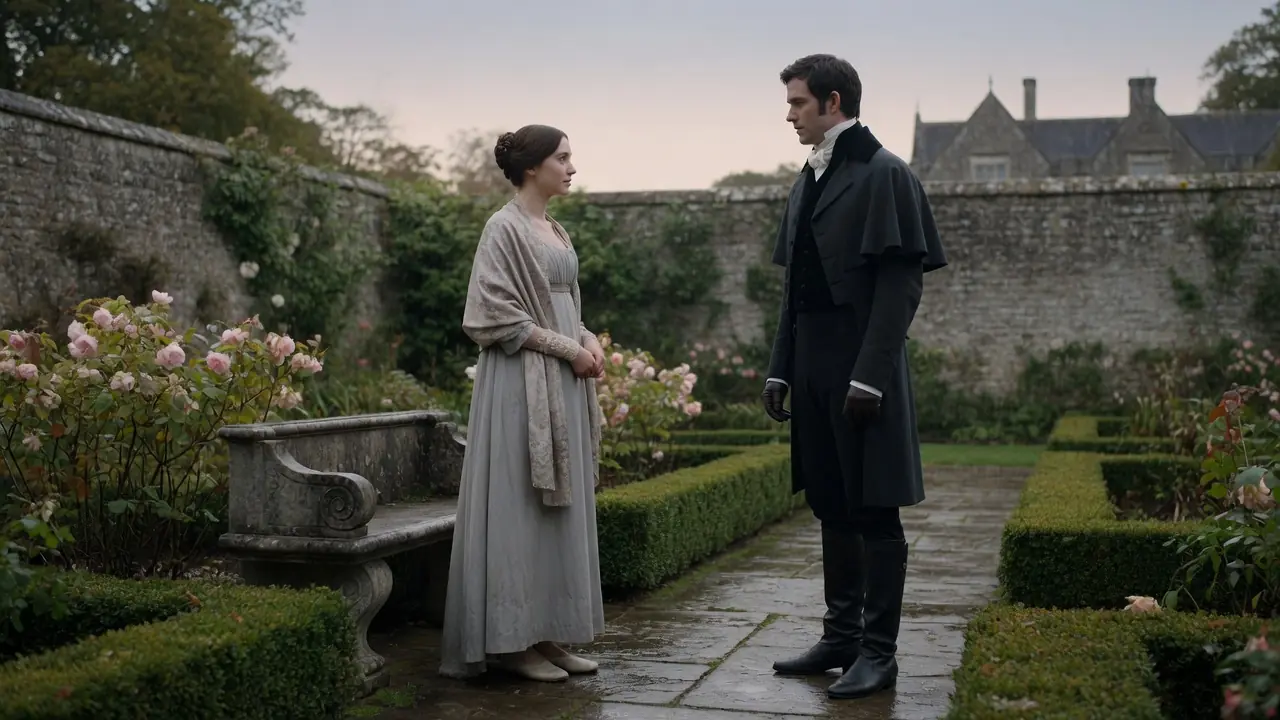
“And this dress?” Henriette plucked at her sleeve. “Mama says I must wear it tonight. It is three years out of fashion. The Duke will think us paupers.”
“We are paupers, Henriette,” the other girl said quietly.
It was a simple statement of fact.
Henriette scoffed. “We will not be for long. Once I am Duchess, I shall have everything.”
Jonathan felt a grim satisfaction. This was exactly what he had expected: ambition without restraint.
“You should be happy for me, Louisa,” Henriette went on. “You have no idea the sacrifice I am making.”
Then she leaned in, voice lowering. “But I will tell you a secret. Once I am settled, there is always Lord Ashworth…”
Jonathan’s jaw tightened.
Before the bargain was even struck, betrayal already existed.
He had heard enough. He was about to leave—until the quieter sister finally spoke.
“You should not speak so,” Louisa said softly. “You are building a house on sand, Henriette. A title and fortune are not a home. Kindness is a home. Honesty is a home.”
Henriette laughed. “That is why you are the one in gray, and I am the one who will be a duchess.”
She stood. “Do not follow. You are needed to help me dress.”
She left in a swirl of silk, leaving Louisa alone.
Jonathan remained frozen.
Louisa did not cry. She did not rage. She simply sat still, her hand brushing a fading rose.
And something inside Jonathan shifted.
He had come expecting calculation—and found cruelty.
But he had also found something else.
Dignity.
A stillness that did not bend.
He made a decision.
The contract did not specify which daughter.
There were two Miss Halts.
And he would choose the one the world overlooked.
He was dressed not in the fine wools of a duke, but in the sturdy, plain garb of a traveling man. His coat was splattered with mud, his boots worn. He looked more like a groom looking for work than a peer of the realm come to claim a bride.
He did not approach the front door but circled around to the back toward the stables, leading his horse. The air smelled of wet leaves and horse manure, and a boy rushed out, eyes widening at the magnificent animal.
Jonathan handed over the reins with a calm command and told the boy to tend to the horse well, speaking as if he were simply another man on business. He moved away into the shadows, observing rather than announcing himself, while the house bustled with preparations for the duke’s formal arrival.
Drawn by instinct more than intention, he found himself near a neglected walled garden where two figures sat on a stone bench beneath fading roses. Through the branches, he recognized the Halt sisters immediately.
Henriette’s voice cut through the damp air, sharp with entitlement and frustration as she complained about the delay of the duke’s arrival and the burden of maintaining her appearance, while Louisa sat beside her in silence, composed and still as though she belonged to the earth itself.
Henriette fumed about her dress, about being expected to endure another night of waiting, about how unbearable it was to maintain “radiance” for so long, and then shifted quickly into her certainty that she would become duchess, that everything would finally belong to her.
Jonathan listened, each word confirming the calculation he had already made in his mind, yet when Henriette leaned closer to whisper about future affairs and other admirers she intended to keep even after marriage, something cold and final settled within him.
It was not surprise but confirmation of distrust.
Then Louisa spoke, her voice low but steady, telling her sister she was building a life on unstable ground, that titles and wealth could not replace honesty or kindness, and for a moment there was no bitterness in her words, only quiet clarity.
Henriette dismissed her easily, mocking her softness, her gray dresses, her practicality, before leaving in a swirl of irritation and silk, leaving Louisa alone beneath the fading light.
Jonathan stayed hidden, watching as Louisa remained still, not crying, not reacting, simply existing with a quiet endurance that seemed almost unnatural in its strength.
She touched one of the dying roses lightly, as if acknowledging something in it that mirrored herself, and in that small gesture something inside him shifted.
He had come expecting to confirm a fraud, but instead he found something he had not accounted for at all, a kind of integrity that did not demand attention.
He realized then that the contract did not specify which daughter, only Miss Halt, and for the first time in years he made a decision not based purely on necessity but on conviction.
The next morning the house trembled with anticipation as the duke was expected at noon, and when the carriage finally arrived, Sir Alistair rushed forward with relief while Henriette positioned herself like a crowned prize, certain the moment belonged to her.
Jonathan entered the house with quiet authority, his presence immediately silencing the room, his gaze moving over everyone without warmth or hesitation until it briefly settled on Henriette and then passed her entirely.
He looked instead at Louisa standing near the doorway in muted gray, half in shadow, and something in his expression changed almost imperceptibly as he stepped forward past everyone else and stopped directly in front of her.
The silence in the hall became absolute as he addressed her by name, confirming she was Miss Louisa Halt, and without raising his voice he declared that the contract referred to her hand in marriage.
Shock fractured the room instantly, Henriette’s protest sharp and disbelieving, her parents stumbling over objections, but Jonathan remained unmoved, explaining calmly that the agreement specified Miss Halt and he had chosen the elder daughter.
He extended his hand and waited without pressure, offering not persuasion but certainty, and Louisa, after a long moment of stillness in which she seemed to understand everything she had always been and everything she might become, placed her hand in his.
The moment her fingers touched his, the world seemed to shift into something irreversible, and the household collapsed into confusion as Henriette broke down in disbelief while preparations for marriage began almost immediately.
Papers were signed, debts quietly resolved, arrangements made with clinical speed, and within days the engagement became an unavoidable fact of life.
Louisa moved through it all with a strange calm, neither resisting nor celebrating, while Jonathan observed her with increasing attention, noting not ambition or calculation but steadiness, a quality he had long forgotten existed in people.
When he was not occupied with estate matters, he walked with her in the gardens or sat with her in rooms that slowly began to feel less like chambers and more like shared space, though neither of them spoke openly of the decision that had bound them together.
On the morning of the wedding, the church was small and simple, the air heavy with expectation, and Louisa walked down the aisle in a plain gray gown that felt less like decoration and more like armor, while Jonathan watched her approach as though seeing something he had not known he was waiting for.
The vows were exchanged without spectacle, the ring placed with steady hands, and when they left Farnol together afterward, Louisa did not look back at the place that had defined her life, and Jonathan did not look back at anything at all.
The journey to Blackwood Manor was silent, the estate itself rising from the landscape like something carved from stone and memory, vast and unwelcoming, more fortress than home.
That first evening they sat at opposite ends of a long dining table, distance stretching between them like a physical barrier, until Jonathan finally broke formality by asking if she preferred to be called Louisa rather than “your grace,” and when she agreed, she in turn asked him to be called Jonathan, creating the first fragile bridge between them.
In the days that followed, Louisa began to move through the manor not as a guest but as someone trying to understand it, quietly observing staff, learning rhythms, noticing what had been neglected rather than demanding change, and without announcement she began to restore small pieces of life to the house.
Jonathan noticed without comment: a fresh arrangement of flowers, lighter air in the halls, books being dusted and opened in the library that had long been forgotten. He did not interfere, but he also did not look away.
Slowly, without either of them naming it, the house began to change, and so did the space between them.
One evening, Jonathan finally spoke to her about the truth he had been carrying alone, the failing mines, the debts, the collapsing estate, and the marriage contract that had been less choice than necessity, expecting judgment or resentment, but instead receiving only quiet attention.
When he finished, Louisa told him he was not alone anymore and that they were husband and wife now, and in that moment something in him loosened for the first time in years, as if a weight he had accepted as permanent had finally been shared.
From that point onward, they stopped being strangers bound by contract and began, slowly and cautiously, becoming partners in survival, then in understanding, and eventually in something neither of them had expected to find when the arrangement began.