Duke Arthur Whittaker had spent fifteen years perfecting the art of being untouchable.
Untouchable by emotion, by the past, by anything that might remind him of the starving orphan boy he once was.
His Mayfair mansion was a fortress of marble and mahogany.
His social calendar was a carefully orchestrated dance of power and privilege.
But as he descended the grand staircase that December morning in 1823, adjusting his pristine cravat and mentally reviewing the day’s appointments, he never imagined that a simple silver ring on a servant’s finger would shatter his composure entirely.
The ring was nothing extraordinary.
A modest band with a small engraved rose.
But it carried the weight of a promise made by two desperate children in a workhouse dormitory sixteen years ago.
A promise that had sustained him through hunger, humiliation, and heartbreak.
A promise he had convinced himself was buried with his past.
Yet there it was, gleaming on the hand of the new scullery maid as she curtsied before him.
And in that moment, Arthur Whittaker, Duke of Ravens Hollow, master of vast estates, confidant of kings, became once again the terrified boy who had sworn to a girl named Lily that someday, somehow, he would come back for her.
The morning had begun like any other in the opulent halls of Whittaker House.
Duke Arthur Whittaker descended the marble staircase with the measured precision that had become second nature to him.
Each step was calculated.
Each movement reflected the absolute control he maintained over every aspect of his existence.
At thirty-two, he was the embodiment of aristocratic perfection.
Tall and commanding, with dark hair that never dared fall out of place, and steel-blue eyes that could freeze a man’s blood or charm a woman’s heart, depending on his purpose.
“Good morning, Your Grace,” his butler, Harrison, intoned with the reverence due to one of England’s most powerful dukes.
“The morning correspondence awaits your attention in the study, and Lady Pemberton has sent another invitation for her Christmas ball.”
“Declined, as usual,” Arthur replied without breaking stride.
“I have no interest in Lady Pemberton’s matchmaking schemes.”
“Very good, Your Grace. Also, the new servants have arrived for your inspection. Cook requested that you approve the additional kitchen staff before the holiday entertaining begins.”
Arthur paused, one hand on the banister.
He rarely bothered with such mundane household matters, but his Christmas house party would host some of the most influential people in England.
Every detail had to be perfect.
“Very well,” he said with resignation.
“Have them assembled in the servants’ hall.”
As he made his way through the corridors lined with priceless paintings and gleaming with fresh beeswax, Arthur reflected on how far he had come from his humble beginnings.
Not that anyone in his current circle knew about those beginnings.
He had crafted his public persona so carefully that even he sometimes forgot the truth of his origins.
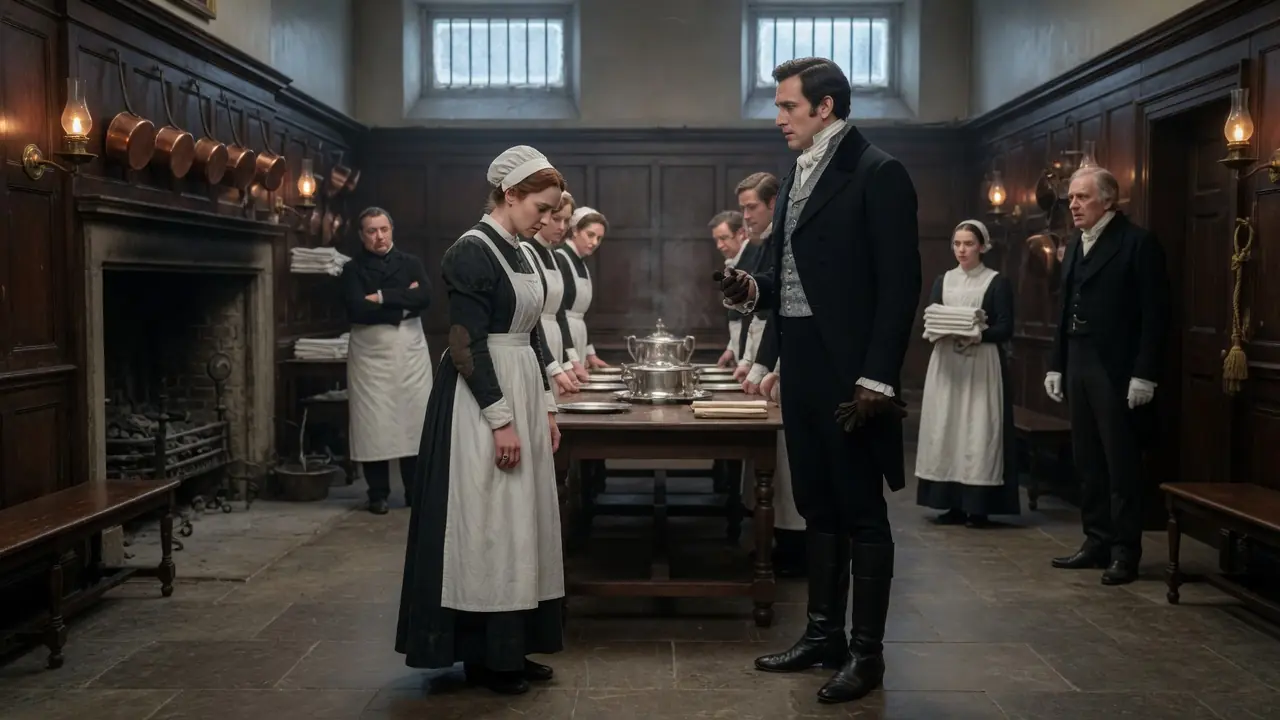
The servants’ hall buzzed with nervous energy as a dozen new staff members stood in a perfectly straight line, their uniforms pressed and their faces carefully blank.
Arthur’s gaze swept over them with practiced indifference.
A footman who looked strong enough for the heavy work.
Two housemaids who appeared competent.
A stable boy who looked nervous but eager.
His thought stopped abruptly as his eyes fell upon the last figure in the line.
A young woman, perhaps twenty-eight, stood with her head bowed in the traditional pose of deference.
Her auburn hair was neatly pinned beneath a simple white cap, and her black dress and white apron marked her as one of the lower servants.
A scullery maid, most likely.
There was nothing remarkable about her appearance, nothing that should have caught his attention.
Except for the ring.
Arthur’s breath caught in his throat as his gaze fixed on her left hand, clasped respectfully in front of her.
On her ring finger was a simple silver band, tarnished with age, bearing the faint outline of an engraved rose.
It was a ring he had seen every day for three years of his childhood.
A ring that had been the only beautiful thing in a world of unrelenting ugliness.
The world seemed to tilt on its axis as memories came flooding back.
Memories he had spent years burying beneath layers of wealth, power, and carefully constructed indifference.
“Promise me, Arthur,” a small voice whispered in his memory.
“Promise me that when you’re rich and famous, like you always say you’ll be, you won’t forget about me.”
“I promise, Lily,” his younger self had replied, his voice cracking with emotion and determination.
“I promise I’ll come back for you. I promise I’ll marry you when we’re grown up, and we’ll never be hungry or cold or scared again.”
“Your Grace.”
Harrison’s voice seemed to come from very far away.
“Your Grace, are you quite well?”
Arthur realized he had been staring at the young woman for an uncomfortably long time.
She had raised her head slightly, and he caught a glimpse of familiar green eyes before she quickly lowered her gaze again.
“I…”
Arthur began, then stopped.
His throat felt dry, and his hands were trembling slightly.
A physical reaction he had not experienced in years.
“What is your name?” he asked the woman, his voice coming out rougher than intended.
“Lily Carter, Your Grace,” she replied softly.
The sound of her voice, older now but unmistakably the same, sent another shock through his system.
“Lily,” he repeated.
He saw her shoulders tense at the way he said her name.
“Lily Carter.”
“Yes, Your Grace.”
Arthur was dimly aware that everyone in the room was watching this unusual exchange with growing curiosity.
He never engaged with servants beyond the most basic necessities.
He certainly never did so with such obvious emotion.
“Where did you work previously?” he managed to ask.
“Various households in Yorkshire, Your Grace,” Lily replied, her voice carefully neutral.
“Most recently with the Thornton family.”
“Yorkshire.”
Of course.
That was where the workhouse had been, where they had spent those three terrible years together before his life had changed forever.
“I see.”
Arthur struggled to regain his composure, to slip back into the role of the aloof duke, but his eyes kept returning to that ring.
To the face that had haunted his dreams for years after he left the workhouse behind.
“Harrison,” he said finally, his voice strained, “see that the new staff are properly settled. I will review their positions later.”
Without another word, Arthur turned and strode from the room, leaving behind a wake of confused servants and a butler who had never seen his master so visibly shaken.
In the privacy of his study, Arthur collapsed into his leather chair and buried his face in his hands.
Lily.
After all these years, Lily was here.
In his house.
Wearing the ring he had given her as a token of his promise.
The ring he had saved for months to buy from a peddler who visited the workhouse, spending every penny he could earn from odd jobs and small favors.
He had been sixteen when his life changed overnight.
A distant relative he had never known existed died and left him a title and vast estates.
Suddenly, the orphan boy who had scrubbed floors and emptied chamber pots was the Duke of Ravens Hollow, one of the wealthiest men in England.
He had tried to return for Lily.
He had sent letters and made inquiries.
But the workhouse had closed, and she had vanished without a trace.
For years, he had searched for her while simultaneously trying to bury the memories of his past.
Eventually, he had convinced himself that she was probably dead.
That the harsh realities of life for a workhouse girl had claimed her, as they claimed so many others.
He had built walls around his heart.
He had become the cold, calculating duke society expected him to be.
But she was alive.
She was here.
A soft knock at the door interrupted his tumultuous thoughts.
“Enter,” he called, hastily composing himself.
Harrison appeared, his expression carefully neutral.
“Your Grace, I have taken the liberty of assigning the new maid, Carter, to the scullery as planned. However, if you have any concerns about her suitability—”
“No,” Arthur said quickly, then caught himself.
“That is, I am sure she will be adequate. Carry on with the arrangements.”
“Very good, Your Grace.”
Harrison paused.
“If I may say so, sir, you seem somewhat unsettled. Perhaps you are coming down with something. Shall I send for the physician?”
“I am perfectly fine,” Arthur replied curtly.
“Just tired. The preparations for the house party have been demanding.”
“Of course, Your Grace.”
After Harrison left, Arthur sat in silence, staring out the window at the perfectly manicured gardens that surrounded his estate.
Everything in his life was ordered, controlled, predictable.
He had spent years creating this existence, this persona of the untouchable duke who needed nothing and no one.
And now Lily was here, threatening to unravel everything he had built.
The question that tormented him was simple, yet impossible to answer.
What was he going to do about it?
Echoes of the Past
For three days, Arthur managed to avoid any direct contact with Lily, though he found himself constantly aware of her presence in the house.
He caught glimpses of her in the corridors, always with her head down, always moving with the efficient invisibility that marked the best servants.
But every time he saw her, his carefully constructed composure threatened to crumble.
On the fourth morning, his resolve finally broke.
“Harrison,” he said as his butler brought the morning tea, “I need to speak with the new scullery maid. Have her come to my study in an hour.”
Harrison’s eyebrows rose slightly.
Such a request was highly irregular, but his training was too thorough to allow him to question his master’s orders.
“Of course, Your Grace. Shall I remain present during the interview?”
“No,” Arthur said quickly.
“That will not be necessary.”
The hour that followed was the longest of Arthur’s life.
He paced his study like a caged animal, rehearsing what he would say, how he would approach the impossible situation they found themselves in.
How did one address a childhood promise made in desperation?
How did one bridge the vast chasm that now separated a duke from a scullery maid?
When the soft knock came at his door, his heart began racing in a way it had not since he was a boy.
“Enter,” he called, his voice carefully controlled.
Lily stepped into the room and immediately dropped into a deep curtsy, her eyes fixed on the floor.
“You wish to see me, Your Grace?”
“Yes,” Arthur said.
Then he found himself at a loss for words.
She looked so small in the vast study, so fragile in her simple black dress and white apron.
But there was something in her bearing.
A quiet strength that he remembered from their childhood.
“Please,” he said finally, “sit down.”
Lily’s head snapped up in surprise, her green eyes meeting his for the first time since that moment in the servants’ hall.
“Your Grace, I could not possibly—”
“Sit down, Lily,” Arthur repeated, using her given name deliberately.
“We need to talk.”
She hesitated for a moment, then perched on the very edge of a chair, her back straight and her hands folded in her lap.
Arthur noticed that she had turned the ring so that the engraved rose faced inward, hiding it from view.
“You recognize me?” Arthur said.
It was not a question.
Lily was quiet for a long moment.
“Yes, Your Grace,” she said finally.
“I recognized you the moment I saw you, though you have changed considerably.”
“As have you.”
Arthur studied her face, noting the lines of hardship around her eyes, the way her hands bore the calluses of years of hard work.
“I searched for you, Lily, when I inherited the title. When I had the means to help you. I tried to find you, but the workhouse had closed, and no one knew where you had gone.”
“I know,” Lily said softly.
“I heard about your elevation. Everyone in the workhouse talked about it for months after you left. Little Arthur Whittaker, who used to share his bread with the younger children, had become a duke.”
“Then why did you not contact me? Why did you not let me know you were alive?”
Lily’s laugh was bitter.
“Contact you? A duke?”
“Your Grace, I may have been a child when you left, but I was not naive. I knew your new life would have no place for reminders of your old one.”
“That is not true,” Arthur said fiercely.
“I made you a promise, Lily. I gave you that ring as a symbol of that promise.”
“You were a boy,” Lily replied, her voice gentle but firm.
“A desperate, frightened boy who thought he could change the world with good intentions. We both were children, Your Grace. Children who said things we could not possibly understand the meaning of.”
“Do not call me Your Grace,” Arthur said suddenly.
“Not you. Never you.”
Lily looked at him with something like pity.
“But that is what you are now, is it not? You are not the Arthur I knew. You are the Duke of Ravens Hollow, one of the most powerful men in England. And I am a scullery maid who scrubs pots and empties chamber pots. The distance between us is insurmountable.”
“Is it?” Arthur asked, moving closer to her chair.
“Is it really?”
“Yes,” Lily said firmly, though he noticed her hands were trembling slightly.
“It is. And even if it were not, even if by some miracle we could bridge that gap, what then?”
“You think society would accept a duke marrying a servant? You think your peers would welcome me into their drawing rooms? You think I could ever fit into your world?”
Arthur was quiet for a moment, forced to confront the harsh realities she was presenting.
“I do not care about society,” he said finally.
“Do you not?” Lily challenged.
“Then why have you not married? You are thirty-two years old, wealthy, titled, handsome. You could have your pick of any woman in England, yet you remain a bachelor. Why?”
The question hit him like a physical blow, because he knew the answer, even if he had never admitted it to himself.
He had remained unmarried because no woman had ever measured up to the memory of a girl who had shown him kindness when the world was cruel.
A girl who had shared her meager rations when he was hungry.
A girl who had held him when nightmares made him cry out in the dark.
“Because,” he said quietly, “I was waiting for you.”
Lily’s composure finally cracked, and tears began to flow down her cheeks.
“Arthur,” she whispered, using his name for the first time since entering the room.
“You cannot say things like that. You cannot mean them.”
“But I do mean them,” Arthur said, kneeling beside her chair and taking her work-roughened hands in his.
“I have meant them every day for the past sixteen years.”
“This is madness,” Lily said, though she did not pull her hands away.
“You are a duke. You have responsibilities, obligations.”
“My only obligation is to the promise I made to you,” Arthur interrupted.
“Everything else is just noise.”
“And what about love?” Lily asked quietly.
“You speak of promises and obligations, but what about love? Do you love me, Arthur? Or do you just love the memory of what we once were?”
The question hung in the air between them.
Arthur realized that he did not know the answer.
Did he love the woman sitting before him?
Or was he in love with a ghost from his past?
“I do not know,” he admitted honestly.
“I know that I have thought about you every day since I left the workhouse. I know that no other woman has ever made me feel the way you did. But you are right. We are not the same people we were then. We are strangers now, are we not?”
“Yes,” Lily said sadly.
“We are.”
“Then let us get to know each other again,” Arthur said impulsively.
“Let us see if what we had as children can grow into something real as adults.”
“How?” Lily asked.
“I am a servant in your house. We cannot exactly court in the traditional manner.”
Arthur was quiet for a moment, thinking.
“Meet me,” he said finally.
“Tonight, after the household is asleep. Meet me in the conservatory. We will talk, really talk, like we used to when we were children.”
“Arthur, if we are caught—”
“We will not be,” Arthur assured her.
“I know every inch of this house, every servant’s schedule. We will be safe.”
Lily looked at him for a long moment, and he could see the war being fought in her green eyes.
Finally, she nodded.
“All right,” she said.
“One conversation. But after that, you have to let this go. You have to let me go.”
“If that is what you want after we talk,” Arthur agreed, though privately he had no intention of letting her go ever again.
After Lily left his study, Arthur found himself unable to concentrate on anything.
He went through the motions of his daily routine, reviewing correspondence, meeting with his steward, approving menus for the upcoming house party.
But his mind was entirely focused on the evening ahead.
As night fell and the house settled into quiet, Arthur made his way to the conservatory, his heart pounding with anticipation and nervousness.
The room was filled with exotic plants and flowers, creating a tropical oasis in the heart of his English estate.
Moonlight streamed through the glass walls, casting everything in silver.
He did not have to wait long.
Lily appeared in the doorway like a ghost, having changed from her servant’s uniform into a simple gray dress that somehow made her look more like the girl he remembered.
“Hello, Arthur,” she said softly.
“Hello, Lily,” he replied.
For a moment, they were children again, finding comfort in each other’s presence in a world that had shown them little kindness.
“Tell me,” Arthur said as they settled on a bench surrounded by blooming jasmine.
“Tell me what happened to you after I left. Tell me how you survived.”
And in the moonlit conservatory, with the scent of flowers surrounding them and sixteen years of separation between them, Lily began to tell him the story of her life.
A story of hardship and resilience.
Of small kindnesses and great cruelties.
Of a woman who had never stopped believing in the promise of a better tomorrow, even when that promise seemed impossibly far away.
As Arthur listened, he began to understand that the girl he had loved was gone.
In her place was a woman who was stronger, wiser, and more beautiful than he had ever imagined.
And slowly, carefully, he began to fall in love all over again.
The Woman She Became
“After you left,” Lily began, her voice soft in the moonlit conservatory, “everything changed at the workhouse. The other children looked at me differently. I was the one who had known the boy who became a duke. Some were jealous. Some were hopeful that you might remember them too. And some were cruel about it.”
Arthur felt a pang of guilt.
“I am sorry. I never thought—”
“You could not have known,” Lily interrupted gently.
“You were dealing with your own transformation. I cannot imagine how overwhelming it must have been for you.”
“Tell me what happened,” Arthur said, settling beside her on the bench.
“I need to know.”
Lily was quiet for a moment, her fingers unconsciously turning the silver ring on her finger.
“I stayed at the workhouse until I was eighteen. The conditions got worse after you left. Less funding, harsher overseers, but I survived.”
“I learned to read and write better. I helped care for the younger children, and I tried to keep your memory alive by telling them stories about the boy who was going to come back and save us all.”
“But I did not come back,” Arthur said heavily.
“Not then,” Lily agreed.
“When I turned eighteen, I was turned out with nothing but the clothes on my back and this ring. I found work as a scullery maid in a tavern in York. Terrible work, terrible conditions, but it was better than the streets.”
Arthur’s hands clenched into fists as he imagined the hardships she must have endured.
“Go on.”
“I worked there for two years, saving every penny I could. Then I heard about a position with a family in Leeds, the Thorntons. They were merchants, newly wealthy, and they needed a maid who could read and write to help with household correspondence.”
“It was better. Mrs. Thornton was kind in her way, and I learned about running a proper household.”
“You were there for eight years?”
“Yes,” Lily confirmed.
“I worked my way up from scullery maid to lady’s maid. Mrs. Thornton taught me about fashion, about society, about the things that matter to wealthy families. I thought perhaps I could make something of myself. Perhaps even save enough to open a small shop someday.”
“What changed?” Arthur asked, though he suspected he knew the answer.
Lily’s expression darkened.
“Mr. Thornton’s son came home from university. He was persistent in his attentions. When I refused him, he told his parents I had been stealing from them. I was dismissed without references, without pay for my final month’s work.”
Arthur’s jaw tightened with anger.
“The bastard.”
“Language, Your Grace,” Lily said with a small smile that reminded him of the girl who used to scold him for cursing in the workhouse.
“Do not,” Arthur said softly.
“Do not retreat behind formality, not with me.”
Lily looked at him for a long moment.
“It is a habit,” she said finally.
“Sixteen years of knowing my place, of keeping my head down and my thoughts to myself. It is not easy to set aside.”
“I know,” Arthur said.
“I have spent sixteen years doing the same thing in a way. Building walls, keeping people at a distance, never letting anyone see the real me.”
“And who is the real you?” Lily asked curiously.
Arthur considered the question.
“I do not know anymore,” he admitted.
“I have been the Duke of Ravens Hollow for so long that I have forgotten who Arthur Whittaker really is. But when I am with you, when I look at you, I remember the pieces of him.”
“Tell me about your life,” Lily said.
“What was it like, suddenly becoming a duke?”
Arthur laughed, but there was no humor in it.
“Terrifying. Overwhelming. Lonely.”
“One day, I was scrubbing floors and eating gruel. The next, I was living in a mansion with servants waiting on me hand and foot. I had tutors, lawyers, advisers, all trying to teach me how to be a proper duke, but no one could teach me how to belong.”
“You never felt like you belonged?”
“Never,” Arthur said emphatically.
“I was always waiting for someone to discover I was a fraud, that I did not deserve any of it. I learned to mimic the mannerisms of the aristocracy, to speak like them, to think like them. But inside, I was still that frightened boy from the workhouse.”
“And now?” Lily asked softly.
“Now I am a man who has forgotten how to feel anything real,” Arthur said.
“Until I saw you again. Until I remembered what it was like to care about someone more than myself.”
They sat in comfortable silence for a while, both lost in their own thoughts.
Finally, Lily spoke again.
“Arthur, what do you want from me, really?”
“I want to keep the promise I made to you,” Arthur said without hesitation.
“I want to marry you, to take care of you, to give you the life you deserve.”
“But do you want me?” Lily pressed.
“Not the memory of me, not the obligation you feel toward me, but me as I am now.”
Arthur turned to face her fully, studying her face in the moonlight.
She was beautiful, but it was a different beauty than she had possessed as a child.
There were lines around her eyes from years of hard work and worry, calluses on her hands from scrubbing and cleaning, a weariness in her expression that spoke of disappointments and betrayals.
But there was also strength there.
Resilience.
A quiet dignity that took his breath away.
“Yes,” he said simply.
“I want you. The woman you have become, not just the girl you were.”
“Even though I am a servant? Even though I have no dowry, no family, no social standing?”
“Especially because of those things,” Arthur said.
“You have earned everything you have through your own efforts. You have survived things that would have broken weaker people. You are more admirable than any pampered society miss I have ever met.”
Lily’s eyes filled with tears.
“Arthur, you cannot mean that. You cannot throw away everything you have built for a childhood promise.”
“I am not throwing anything away,” Arthur said firmly.
“I am finally claiming what is mine. What has always been mine.”
“And if society rejects us? If your peers turn their backs on you? If you lose your position, your influence, your friends?”
“Then I will have you,” Arthur said simply.
“And that will be enough.”
Lily stared at him for a long moment, and he could see the battle being fought in her green eyes.
Finally, she shook her head.
“You are not thinking clearly,” she said.
“You are caught up in nostalgia, in guilt, in some romantic notion of keeping a promise made by children. But marriage is not a fairy tale, Arthur. It is a practical arrangement, especially for people in your position.”
“You need a wife who can help you, who can be an asset to your career and your standing. You need someone who understands your world.”
“I need someone who understands me,” Arthur countered.
“And you are the only person who ever has.”
“I knew you when you were a boy,” Lily said sadly.
“I do not know the man you have become, and you do not know the woman I am now.”
“Then let us learn,” Arthur said urgently.
“Give us a chance, Lily. Give me a chance to prove that this is not just nostalgia or guilt. Give me a chance to show you that what we had as children can grow into something real and lasting as adults.”
“How?” Lily asked.
“How can we possibly make this work?”
“I do not know,” Arthur admitted.
“But I know I have to try. I have spent sixteen years being the perfect duke, doing what was expected of me, living up to everyone else’s standards. For once in my life, I want to do something for myself. I want to choose love over duty, heart over head.”
“And if you are wrong? If this destroys both our lives?”
“Then at least we will have tried,” Arthur said.
“At least we will know we did not let fear make our choices for us.”
Lily was quiet for a long time, staring out at the moonlit garden beyond the conservatory walls.
Finally, she turned back to him.
“If we do this,” she said slowly, “if we try to make this work, it has to be real. Not a charity case. Not you rescuing the poor servant girl out of guilt. It has to be between equals. Between two people who choose each other freely.”
“Yes,” Arthur agreed immediately.
“And it has to be gradual,” Lily continued.
“We need time to get to know each other again, to see if what we feel is real or just the echo of childhood affection.”
“How much time?” Arthur asked.
“I do not know,” Lily said.
“Months, perhaps. And during that time, I remain a servant in your household. No special treatment, no favoritism. If anyone discovers our connection, it could ruin both of us.”
“Agreed,” Arthur said, though the thought of watching her work as a servant while he lived in luxury made him feel sick.
“And Arthur,” Lily said, her voice becoming serious, “if at any point you realize this is a mistake, if you meet someone more suitable, if you decide that duty is more important than this childhood promise, you have to tell me. You cannot let me hope for something that will never happen.”
“That will not happen,” Arthur said firmly.
“Promise me,” Lily insisted.
“I promise,” Arthur said, taking her hands in his.
“But I need a promise from you too.”
“What?”
“Promise me you will give this a real chance. Promise me you will not let fear or social conventions make you run away before we have had time to see what we could be together.”
Lily looked down at their joined hands, at the contrast between his soft, manicured fingers and her work-roughened ones.
“I promise,” she said softly.
As they prepared to leave the conservatory and return to their separate worlds, he to his ducal chambers and she to the servants’ quarters, Arthur felt a mixture of hope and terror unlike anything he had experienced since childhood.
He was embarking on the most dangerous gamble of his life.
He was risking everything he had built for the chance at something real.
But as he watched Lily disappear into the corridor, moving with the practiced invisibility of a servant, he knew he would risk it all again for the chance to keep the promise that had shaped his entire life.
The question now was whether love could truly conquer the vast differences that separated a duke from a scullery maid, or whether they were doomed to repeat the heartbreak of their childhood, when circumstances beyond their control had torn them apart just as they were beginning to understand what they meant to each other.
Dangerous Games
The Christmas house party was set to begin in one week, and Whittaker House buzzed with preparation.
Arthur found himself caught between his ducal duties and his desperate desire to spend every moment with Lily.
They had managed to meet secretly three more times in the conservatory, each conversation revealing new layers to the people they had become.
“You are distracted,” his secretary, Mr. Pemberton, observed as Arthur reviewed the guest list for the third time without actually reading it.
“Is there something troubling you about the arrangements?”
“No,” Arthur said quickly, forcing his attention back to the papers before him.
“Everything appears to be in order.”
But nothing was in order.
Arthur’s carefully controlled world was spinning into chaos, and he was powerless to stop it.
Every glimpse of Lily in the corridor sent his heart racing.
Every time he saw her scrubbing floors or carrying heavy buckets, he wanted to throw aside all pretense and claim her publicly.
The strain of maintaining his ducal facade while his heart belonged to a servant was becoming unbearable.
“Your Grace,” Harrison appeared in the doorway.
“Lady Pemberton has arrived early for the house party. She is requesting an immediate audience.”
Arthur suppressed a groan.
Lady Pemberton was one of society’s most influential hostesses and matchmakers, and she had been trying to arrange his marriage for years.
Her early arrival could only mean she had brought another potential bride for his consideration.
“Show her to the blue drawing room,” Arthur said with resignation.
“I will be there presently.”
Lady Pemberton was a formidable woman in her fifties, with steel-gray hair and sharp eyes that missed nothing.
She rose gracefully as Arthur entered the room, accompanied by a young woman he did not recognize.
“Arthur, darling,” Lady Pemberton said, offering her cheek for his dutiful kiss.
“How wonderful to see you. You look different somehow. More alive.”
“Thank you, Lady Pemberton,” Arthur replied carefully.
“You are looking well yourself.”
“I want you to meet someone very special,” Lady Pemberton continued, drawing the young woman forward.
“This is Lady Charlotte Fairfax, the Earl of Westmont’s daughter. Charlotte, this is the Duke of Ravens Hollow.”
Lady Charlotte was undeniably beautiful.
Blonde, blue-eyed, with the sort of porcelain perfection that graced society portraits.
She curtsied gracefully, her movements reflecting years of careful training.
“Your Grace,” she said in a melodious voice, “I am honored to make your acquaintance.”
“Lady Charlotte,” Arthur replied with automatic politeness, though his mind was elsewhere.
“Charlotte has just returned from finishing school in Paris,” Lady Pemberton said with obvious pride.
“She speaks four languages fluently, plays the pianoforte beautifully, and has the most exquisite watercolors. She would make any man a perfect wife.”
Arthur forced a smile.
“I am sure she would.”
As Lady Pemberton continued to extol Lady Charlotte’s virtues, Arthur found himself thinking about Lily.
She spoke no foreign languages.
She had never had the luxury of music lessons.
Her hands were too work-worn for delicate watercolors.
But she had survived things that would have broken this pampered society miss.
She had strength, resilience, and a depth of character that no finishing school could teach.
“I was hoping,” Lady Pemberton was saying, “that Charlotte might stay for the entire house party. It would give you both an opportunity to become better acquainted.”
“Of course,” Arthur said, though inwardly he was screaming.
“Lady Charlotte is welcome to stay as long as she likes.”
“Wonderful!” Lady Pemberton clapped her hands together.
“I will have her things sent up immediately. Charlotte, dear, why do you not rest before dinner? The journey from London can be so tiring.”
As the women prepared to leave, Lady Charlotte turned back to Arthur with a shy smile.
“Your Grace, I was wondering, might you show me your gardens tomorrow? I have heard they are magnificent.”
“Certainly,” Arthur replied, though the thought of spending time with her filled him with dread.
After they left, Arthur slumped into his chair and buried his face in his hands.
How was he supposed to court Lady Charlotte while his heart belonged to Lily?
How was he supposed to pretend interest in a woman who represented everything he was trying to escape?
That evening, as he dressed for dinner, Arthur caught sight of Lily in the corridor outside his chambers.
She was carrying fresh linens, her head down as always, but he could see the tension in her shoulders.
She had undoubtedly heard about Lady Charlotte’s arrival.
Servants always knew everything that happened in a household.
During dinner, Arthur found himself seated between Lady Charlotte and the Countess of Marlborough, forced to make polite conversation while his thoughts were entirely focused on the woman working in the kitchens below.
Lady Charlotte was charming, intelligent, and everything a duke should want in a wife.
But every smile she gave him felt like a betrayal of the promise he had made to Lily.
“Your Grace seems rather preoccupied this evening,” Lady Charlotte observed as the second course was served.
“I hope I have not said something to offend you.”
“Not at all,” Arthur assured her.
“I am simply tired from the preparations for the party.”
“Of course,” Lady Charlotte said with understanding.
“Managing such a large household must be exhausting, though I imagine you have excellent servants to help with the burden.”
“Yes,” Arthur said, his throat tightening.
“Excellent servants.”
After dinner, as the guests retired to the drawing room for cards and conversation, Arthur excused himself and made his way to the servants’ hall.
He found Lily in the scullery, up to her elbows in soapy water as she scrubbed the dinner dishes.
“Lily,” he said softly.
She looked up in surprise.
“Your Grace,” she said formally, glancing around to make sure they were not observed.
“You should not be here.”
“I needed to see you,” Arthur said urgently.
“I needed to explain about Lady Charlotte.”
“There is nothing to explain,” Lily said, returning to her washing.
“She is exactly the sort of woman you should marry. Beautiful, accomplished, well-bred. Lady Pemberton has excellent taste.”
“I do not want Lady Charlotte,” Arthur said fiercely.
“I want you.”
“Keep your voice down,” Lily hissed, glancing nervously at the kitchen door.
“If someone hears you—”
“I do not care,” Arthur said, though he did lower his voice.
“Lily, you have to know that nothing has changed. Lady Charlotte’s presence here does not mean anything.”
“Does it not?” Lily asked, finally looking at him directly.
“Arthur, she is perfect for you. She can give you everything I cannot. Social standing, political connections, beautiful children who will never be ashamed of their mother’s origins.”
“I do not want any of those things,” Arthur insisted.
“You say that now,” Lily said sadly.
“But what about in five years? Ten years? When the novelty of our story wears off and you are faced with the reality of being married to a former servant?”
“When your children ask why their mother speaks differently than their friends’ mothers? When you are excluded from society events because your wife is not acceptable?”
“Lily.”
“No, Arthur,” Lily interrupted, her voice becoming firm.
“I have been thinking about this. About us. And I realize how selfish I am being.”
“You have a duty to your title, to your family name, to the future generations who will inherit what you leave behind. I cannot let you throw all of that away for a childhood promise.”
“So what are you saying?” Arthur asked, though he was afraid he already knew.
“I am saying that maybe we should end this before it goes any further,” Lily said quietly.
“Before we both get hurt worse than we already are.”
“No,” Arthur said immediately.
“No. I will not accept that. We made a deal, Lily. We agreed to give this a chance.”
“That was before Lady Charlotte arrived,” Lily pointed out.
“Before I realized how impossible this really is.”
“It is not impossible,” Arthur insisted.
“Difficult, yes. Complicated, certainly. But not impossible.”
“Arthur, please,” Lily said, her voice breaking slightly.
“Do not make this harder than it already is. Let me go. Marry Lady Charlotte and be happy.”
“I could never be happy without you,” Arthur said desperately.
“Lily, please. Give me more time. Let me prove to you that this can work.”
Before Lily could respond, the sound of footsteps in the corridor made them both freeze.
Arthur quickly stepped back as one of the kitchen maids entered the scullery.
“Lily,” the girl said, “Cook wants to know if you finished with the crystal glasses. Lady Pemberton is asking for more wine.”
“Almost done,” Lily replied, her voice carefully controlled.
“I will bring them up in a moment.”
After the maid left, Arthur stepped forward again, but Lily shook her head.
“You have to go,” she said firmly.
“Your guests will be wondering where you are.”
“This conversation is not over,” Arthur said.
“Yes,” Lily said sadly.
“It is.”
As Arthur made his way back to the drawing room, his mind was racing.
He could not lose Lily again.
Not when he had just found her.
But he also could not ignore the harsh reality she had presented.
The gulf between them was vast, perhaps unbridgeable.
But as he rejoined his guests and endured Lady Charlotte’s bright conversation and Lady Pemberton’s meaningful looks, Arthur made a decision.
He would find a way to make this work.
He would prove to Lily that love could overcome any obstacle.
That their connection was stronger than social conventions or class differences.
He just had to figure out how.
The next morning brought a crisis that would test his resolve in ways he had never imagined.
Arthur was in his study reviewing correspondence when Harrison burst in without knocking, something the proper butler had never done in all his years of service.
“Your Grace,” Harrison said, his face pale with distress, “there has been an incident in the servants’ hall. One of the maids has been accused of theft.”
Arthur’s blood ran cold.
“Which maid?”
“The new girl, Lily Carter,” Harrison replied.
“Lady Charlotte’s diamond bracelet has gone missing, and it was found in Carter’s room.”
Arthur felt the world tilt on its axis.
“That is impossible,” he said immediately.
“Lily would never steal anything.”
Harrison’s eyebrows rose at Arthur’s vehement defense of a servant, but his training prevented him from commenting.
“Lady Pemberton is demanding that the girl be arrested immediately. She has already sent for the magistrate.”
“No,” Arthur said, rising from his chair.
“I will handle this myself.”
As Arthur strode toward the servants’ hall, his mind was racing.
He knew with absolute certainty that Lily had not stolen anything.
Which meant someone had planted the bracelet in her room.
But who?
And why?
He found Lily in the servants’ hall, surrounded by the other staff and looking pale but defiant.
Lady Pemberton stood before her like an avenging angel, her face flushed with righteous indignation.
“There you are, Arthur,” Lady Pemberton said as he entered.
“I was just telling this thieving creature that she will be transported to Australia if she is lucky. More likely she will hang.”
“That is enough,” Arthur said sharply.
“No one will be hanging anyone.”
“Arthur, really?” Lady Pemberton said with surprise.
“I know you are kind-hearted, but you cannot let sentiment interfere with justice. The girl is clearly guilty.”
“Is she?” Arthur asked, his eyes meeting Lily’s across the room.
He saw fear there, but also a quiet dignity that made his heart ache.
“Have you questioned her? Have you asked for her side of the story?”
“What is there to question?” Lady Pemberton replied.
“The bracelet was found in her room. The evidence speaks for itself.”
“Evidence can be planted,” Arthur said quietly.
He saw understanding dawn in Lily’s eyes.
“Arthur, what are you suggesting?” Lady Pemberton asked, her voice becoming dangerous.
“I am suggesting,” Arthur said, his voice growing stronger, “that we not rush to judgment.”
“I am suggesting that there might be more to this story than meets the eye.”
“Your Grace,” Lily spoke for the first time, her voice steady despite her obvious fear.
“I did not take the bracelet. I have never stolen anything in my life.”
“Of course she would say that,” Lady Pemberton snapped.
“What thief admits their guilt?”
“An honest person tells the truth regardless of the consequences,” Arthur said, looking directly at Lily.
“And I believe Miss Carter is an honest person.”
The room fell silent at his declaration.
Arthur could feel the shocked stares of the servants.
He could see the calculation in Lady Pemberton’s eyes as she tried to understand why he was defending a mere scullery maid so passionately.
“Arthur,” Lady Pemberton said slowly, “you are remarkably invested in this servant’s fate. Might I ask why?”
Arthur felt the weight of the moment pressing down on him.
He could back down now.
He could let Lily face the consequences alone while he preserved his reputation and his position.
Or he could stand by the woman he loved regardless of the cost.
Looking at Lily’s face, seeing the trust and love in her green eyes despite everything, Arthur made his choice.
“Because,” he said clearly, his voice carrying to every corner of the room, “Miss Carter is not just a servant. She is the woman I intend to marry.”
The silence that followed was deafening.
Then Lady Pemberton laughed, a sharp, disbelieving sound that cut through the air like a blade.
“Marry?” she repeated.
“Arthur, surely you are joking. You cannot possibly mean to marry a servant.”
“I can and I do,” Arthur said firmly, moving to stand beside Lily.
“Miss Carter and I have been acquainted for many years. Our engagement is a private matter that we had hoped to announce more formally, but circumstances have forced our hand.”
“This is madness,” Lady Pemberton breathed.
“Arthur, think about what you are saying. Think about your reputation, your position, your duty to your name.”
“I am thinking about my duty,” Arthur replied.
“My duty to the woman I love.”
As the implications of his declaration sank in, Arthur realized there was no going back.
He had publicly claimed Lily as his intended bride.
He had staked his reputation and his future on her innocence.
Whatever happened next, their fates were now irrevocably linked.
The question was whether his gamble would save them both or destroy them utterly.
The Price of Truth
The aftermath of Arthur’s declaration was immediate and explosive.
Lady Pemberton stared at him as though he had taken leave of his senses, while the assembled servants whispered among themselves in shocked disbelief.
Lady Charlotte, who had arrived just in time to hear his announcement, stood frozen in the doorway, her face pale with humiliation.
“Arthur,” Lady Pemberton said, her voice dangerously quiet, “I suggest you reconsider your words. The shock of this incident has clearly affected your judgment.”
“My judgment has never been clearer,” Arthur replied, taking Lily’s hand in his.
He felt her trembling, but her grip was firm.
“Miss Carter and I have an understanding that predates her employment here.”
“An understanding,” Lady Charlotte spoke for the first time, her voice barely above a whisper.
“Your Grace, surely you cannot mean... surely this is some sort of misunderstanding.”
Arthur felt a pang of sympathy for the young woman.
She had done nothing wrong except arrive at the wrong time with the wrong expectations.
“Lady Charlotte, I apologize for any confusion. I should have made my situation clear before you were invited to stay.”
“Your situation?” Lady Pemberton’s voice was rising dangerously.
“Arthur, you are the Duke of Ravens Hollow. Your situation is that you have a duty to marry well, to produce heirs worthy of your name, to maintain the dignity of your position.”
“You cannot throw all of that away for... for...”
She gestured dismissively at Lily.
“For love?” Arthur supplied quietly.
“Yes, Lady Pemberton. I can, and I will.”
“This is not love,” Lady Pemberton snapped.
“This is infatuation or guilt or some misguided sense of charity. You will regret this decision within a year.”
“The only thing I regret,” Arthur said firmly, “is not making this decision sooner.”
Harrison, who had been standing frozen throughout this exchange, finally found his voice.
“Your Grace, perhaps this conversation would be better continued in private. The other guests—”
“Yes,” Arthur agreed, suddenly aware that news of this scene would spread through the house like wildfire.
“Lady Pemberton, Lady Charlotte, if you would join me in my study. Harrison, please see that Miss Carter is made comfortable in the blue guest room.”
“The blue guest room?” Lady Pemberton gasped.
“Arthur, you cannot possibly mean to house a servant—”
“I mean to house my future wife in accommodations befitting her station,” Arthur interrupted coldly.
“Which, as my betrothed, is considerably elevated from her previous position.”
As they made their way to his study, Arthur was acutely aware of the stares and whispers following them.
By evening, every guest in the house would know what had transpired.
By tomorrow, the news would be spreading through London society like wildfire.
In the privacy of his study, Lady Pemberton unleashed the full force of her fury.
“Have you completely taken leave of your senses?” she demanded.
“Do you have any idea what you have just done? You have ruined yourself, Arthur. Completely and utterly ruined yourself.”
“I have chosen love over convention,” Arthur replied calmly.
“Some might call that brave rather than ruined.”
“Some might call it the act of a madman,” Lady Pemberton retorted.
“Arthur, listen to me. It is not too late to undo this damage. We can say you were overwhelmed by the accusation against the girl, that you spoke in haste to protect an innocent servant.”
“We can arrange for her to disappear quietly, perhaps with a small pension to ensure her silence.”
“No,” Arthur said firmly.
“I meant every word I said.”
“Then you are a fool,” Lady Pemberton said bluntly.
“Do you think society will accept this? Do you think your peers will welcome a scullery maid into their drawing rooms? Do you think your children will thank you for giving them a mother they will be ashamed of?”
“I think,” Arthur said quietly, “that anyone who would judge a person by their birth rather than their character is not worth knowing.”
Lady Charlotte, who had been silent throughout this exchange, finally spoke.
“Your Grace,” she said, her voice trembling slightly.
“I must ask, is there any chance this is a temporary madness? That given time, you might reconsider?”
Arthur looked at the young woman with genuine sympathy.
She was beautiful, accomplished, everything a duke should want.
But she was not Lily.
“Lady Charlotte, you deserve a husband who loves you completely and without reservation. I am not that man, and I never could be.”
Lady Charlotte’s composure finally cracked, and tears began to flow down her cheeks.
“I see,” she whispered.
“Then I suppose there is nothing more to be said.”
“Charlotte, dear,” Lady Pemberton said, moving to comfort the younger woman.
“Do not despair. There are other dukes, other opportunities. Arthur’s loss of reason does not reflect on your worth.”
“I think,” Lady Charlotte said with quiet dignity, “that I would like to return to London immediately.”
“Of course,” Arthur said gently.
“I will have my carriage prepared for you.”
After the women left, Arthur slumped into his chair and tried to process what he had just done.
In the space of ten minutes, he had publicly claimed a servant as his bride, alienated one of society’s most influential hostesses, and humiliated an innocent young woman.
The scandal would be enormous.
But as he thought about Lily, about the trust he had seen in her eyes when he defended her, Arthur felt no regret.
For the first time in his adult life, he had acted from the heart rather than from duty or expectation.
Whatever the consequences, he would face them gladly.
A soft knock at his door interrupted his thoughts.
“Enter,” he called.
Lily appeared in the doorway, no longer wearing her servant’s uniform, but dressed in a simple blue gown that Harrison must have found for her.
She looked beautiful, but uncertain, as though she was not sure of her place in this new reality.
“Arthur,” she said softly.
“What have you done?”
“What I should have done the moment I saw you again,” Arthur replied, rising from his chair and moving toward her.
“I have claimed you publicly as mine.”
“But the scandal,” Lily said, her voice filled with distress.
“Arthur, you have just destroyed your reputation for me. Lady Pemberton will make sure all of London knows about this by tomorrow.”
“Let her,” Arthur said firmly, taking Lily’s hands in his.
“I am tired of living my life according to other people’s expectations. I am tired of pretending to be someone I am not.”
“But you are a duke,” Lily protested.
“You have responsibilities, obligations.”
“My first obligation is to my own happiness,” Arthur interrupted.
“And to yours. Lily, I love you. Not the memory of you. Not the idea of you. But you as you are now. I want to spend my life with you, regardless of what society thinks.”
Lily’s eyes filled with tears.
“Arthur, you do not understand what this means. They will cut you from society completely. Your friends will abandon you. Your business associates will shun you. You will lose everything.”
“I will lose nothing that matters,” Arthur said softly.
“Lily, I have spent sixteen years in society’s highest circles, and I have never felt more alone. But these past few days with you, I felt more alive, more myself, than I have in years.”
“And what about the bracelet?” Lily asked.
“Someone planted it in my room, Arthur. Someone wanted me gone badly enough to frame me for theft.”
Arthur’s expression darkened.
“I know, and I intend to find out who. It had to be someone with access to Lady Charlotte’s room and to the servants’ quarters.”
“Someone who knew about us,” Lily said thoughtfully.
“Someone who wanted to separate us.”
“Lady Pemberton,” Arthur said immediately.
“She has been trying to arrange my marriage for years. She brought Lady Charlotte here specifically to match us. If she suspected there was something between us—”
“But how could she have known?” Lily asked.
Arthur was quiet for a moment, thinking.
“The servants,” he said finally.
“Someone must have seen us together, reported back to her. She is the type to cultivate informants among the staff.”
“What do we do now?” Lily asked.
“Now, we prove your innocence,” Arthur said firmly.
“And then, we plan our future together.”
“Arthur, are you certain about this? Once we are married, there is no going back. You will be tied to me forever, regardless of how society treats us.”
“I have never been more certain of anything in my life,” Arthur replied without hesitation.
“Lily, will you marry me? Not because of a childhood promise. Not because of obligation. But because you love me as I love you.”
Lily looked at him for a long moment, and Arthur could see the war being fought in her green eyes.
Finally, she smiled.
The first genuine smile he had seen from her since their reunion.
“Yes,” she said softly.
“Yes, I will marry you.”
Arthur pulled her into his arms and kissed her with all the passion he had been holding back for weeks.
When they finally broke apart, both were breathless.
“We will face whatever comes together,” Arthur said, holding her close.
“Together,” Lily agreed.
Their moment of happiness was interrupted by Harrison’s urgent knock.
“Your Grace,” the butler called through the door, “the magistrate has arrived.”
Arthur and Lily exchanged glances.
“Send him to my study,” Arthur called back.
“We will be right there.”
Magistrate Thornfield was a stern man in his sixties, with graying hair and sharp eyes that missed nothing.
He had known Arthur since his inheritance of the title and had always treated him with the respect due to his position.
“Your Grace,” Thornfield said with a formal bow.
“I understand there has been an accusation of theft against one of your servants.”
“There has been an accusation,” Arthur confirmed, “but I believe it to be false.”
“I see,” Thornfield said, his eyes moving to Lily with obvious curiosity.
“And this is the accused?”
“This is my betrothed, Miss Lily Carter,” Arthur said firmly.
“And I stake my reputation on her innocence.”
Thornfield’s eyebrows rose slightly at this declaration, but his expression remained professionally neutral.
“Your Grace, I must investigate all accusations thoroughly, regardless of personal relationships. May I examine the evidence?”
“Of course,” Arthur agreed.
Lady Pemberton appeared in the doorway carrying a small jewelry box.
“Magistrate Thornfield,” she said with obvious satisfaction, “I am so glad you are here. This matter needs to be resolved quickly and decisively.”
“Lady Pemberton,” Thornfield acknowledged with a bow.
“Please tell me exactly what happened.”
“It is quite simple,” Lady Pemberton said, shooting a venomous look at Lily.
“My goddaughter, Lady Charlotte, discovered this morning that her diamond bracelet was missing from her jewelry box. We searched the servants’ quarters and found it hidden in this person’s room.”
“I see,” Thornfield said.
“And who conducted this search?”
“I did, personally,” Lady Pemberton replied.
“Along with the housekeeper, Mrs. Morrison.”
“And where exactly was the bracelet found?”
“Hidden beneath her mattress,” Lady Pemberton said triumphantly.
“Clearly placed there to avoid detection.”
Thornfield turned to Lily.
“Miss Carter, what do you have to say to these accusations?”
“I did not take the bracelet,” Lily said clearly.
“I have never stolen anything in my life.”
“Of course she would say that,” Lady Pemberton interjected.
“What criminal admits their guilt?”
“Lady Pemberton,” Thornfield said mildly.
“Please allow Miss Carter to speak for herself.”
“I was working in the scullery all morning,” Lily continued.
“I never went near Lady Charlotte’s room, and I had no opportunity to take anything.”
“Can anyone verify your whereabouts?” Thornfield asked.
“The other kitchen staff,” Lily replied.
“I was washing dishes from breakfast until nearly noon.”
“I will need to speak with them,” Thornfield said.
“But first, may I examine the bracelet?”
Lady Pemberton handed over the jewelry box with obvious reluctance.
Thornfield examined the bracelet carefully, turning it over in his hands and studying it through a magnifying glass he produced from his pocket.
“Interesting,” he murmured after several minutes.
“What is interesting?” Arthur asked.
“This bracelet,” Thornfield said slowly, “shows no signs of having been recently handled by someone with work-roughened hands. The clasp is delicate, and there are no scratches or marks that would suggest it was handled by someone unaccustomed to fine jewelry.”
Lady Pemberton’s face flushed.
“What are you suggesting?”
“I am suggesting,” Thornfield said mildly, “that if Miss Carter had stolen this bracelet, there would be evidence of her handling it. The absence of such evidence is curious.”
“Perhaps she wore gloves,” Lady Pemberton said quickly.
“Perhaps,” Thornfield agreed.
“Or perhaps someone else placed it in her room.”
“That is a serious accusation,” Lady Pemberton said, her voice becoming dangerous.
“As is theft,” Thornfield replied calmly.
“Your Grace, with your permission, I would like to interview the kitchen staff and examine Miss Carter’s room more thoroughly.”
“Of course,” Arthur agreed immediately.
Over the next two hours, Thornfield conducted a thorough investigation.
He spoke with every member of the kitchen staff, all of whom confirmed that Lily had been working continuously in the scullery during the time the bracelet allegedly went missing.
He examined her room carefully, noting that the bracelet had been placed in a location where it would be easily found during a search.
Most damning of all, he discovered that Lady Pemberton had been seen in the servants’ quarters earlier that morning, claiming to be looking for the housekeeper.
“Lady Pemberton,” Thornfield said when he reconvened everyone in Arthur’s study, “I am afraid I must ask you some difficult questions.”
“I do not understand,” Lady Pemberton said, though Arthur could see fear beginning to creep into her eyes.
“You were seen in the servants’ quarters this morning before the bracelet was reported missing,” Thornfield said.
“Can you explain your presence there?”
“I was looking for Mrs. Morrison,” Lady Pemberton said quickly.
“I had questions about the menu for tonight’s dinner.”
“Mrs. Morrison was in the kitchen at that time,” Thornfield observed.
“Not in the servants’ quarters.”
“I must have been mistaken about her location,” Lady Pemberton stammered.
“Lady Pemberton,” Thornfield said gravely, “I believe you planted that bracelet in Miss Carter’s room in an attempt to frame her for theft. This is a serious crime, punishable by transportation or imprisonment.”
“That is ridiculous,” Lady Pemberton exclaimed.
“Why would I do such a thing?”
“Because,” Arthur said quietly, “you wanted Lily gone so that I would marry Lady Charlotte as you planned.”
“You have no proof of that,” Lady Pemberton said desperately.
“Actually, I do,” came a new voice from the doorway.
Lady Charlotte entered the room, her face pale but determined.
“I am afraid I must confess something.”
“Charlotte, dear, you do not need to say anything,” Lady Pemberton said quickly.
“Yes, I do,” Lady Charlotte replied firmly.
“Magistrate Thornfield, my godmother came to me this morning and asked to borrow my bracelet. She said she wanted to show it to someone who was interested in purchasing a similar piece. I gave it to her without question.”
“Charlotte!” Lady Pemberton gasped.
“You do not know what you are saying.”
“I know exactly what I am saying,” Lady Charlotte replied with quiet dignity.
“I have been watching you all day, Godmama, and I have seen how desperate you were to separate His Grace from Miss Carter. When the bracelet was found in her room, I realized what you had done.”
“You ungrateful child,” Lady Pemberton hissed.
“I was trying to secure your future.”
“By destroying an innocent woman?” Lady Charlotte asked.
“By forcing a man into a marriage he did not want? That is not the future I want, Godmama.”
Thornfield stood up slowly.
“Lady Pemberton, I am placing you under arrest for the crime of false accusation and attempted fraud. You will be taken to London to await trial.”
“You cannot do this to me,” Lady Pemberton shrieked.
“I am a peer of the realm. I have connections, influence.”
“You are a criminal,” Thornfield said simply.
“And you will be treated as such.”
As Lady Pemberton was led away in shackles, still protesting her innocence, Arthur felt a profound sense of relief.
Lily’s name had been cleared.
The woman who had tried to destroy their happiness would face justice.
“Lady Charlotte,” Arthur said, turning to the young woman who had shown such courage in revealing the truth.
“I owe you a debt of gratitude.”
“You owe me nothing,” Lady Charlotte replied with a sad smile.
“I only did what was right. I hope you and Miss Carter will be very happy together.”
“Thank you,” Lily said softly.
“That means more to me than you know.”
After Lady Charlotte left to prepare for her return to London, Arthur and Lily found themselves alone in his study, finally free from the shadow of false accusations and social manipulation.
“It is over,” Lily said with wonder.
“It is really over.”
“No,” Arthur said, pulling her into his arms.
“It is just beginning.”
Building a New Life
Three months later, Arthur stood at the altar of the small church on his estate, watching as Lily walked down the aisle toward him.
She wore a simple gown of ivory silk, her auburn hair crowned with wildflowers from the estate gardens.
She had never looked more beautiful.
The wedding was small, with just a handful of Arthur’s most loyal friends and the estate staff who had come to love and respect Lily in the months since the scandal broke.
Society had indeed turned its back on them, but Arthur found he did not miss the shallow friendships and political maneuvering that had once defined his life.
“Dearly beloved,” the vicar began, “we are gathered here today to witness the union of Arthur James Whittaker, Duke of Ravens Hollow, and Lily Rose Carter.”
As the ceremony proceeded, Arthur reflected on the journey that had brought them to this moment.
The scandal had been enormous, just as Lady Pemberton had predicted.
Arthur had been cut from society’s guest lists, his business associates had distanced themselves, and several long-standing friendships had ended.
But for every door that closed, another had opened.
He had discovered there were others in society who valued character over birth, love over convention.
Lord Blackwood, a fellow duke who had married a merchant’s daughter twenty years earlier, had become a close friend and adviser.
The Earl of Westfield, who had shocked society by marrying his children’s governess, had welcomed them into his circle with open arms.
Most importantly, Arthur had discovered that his tenants and estate workers respected him more than ever.
They had seen him choose love over duty.
They had watched him defend an innocent woman against false accusations.
And they had rallied around their duke and his new duchess with fierce loyalty.
“Do you, Arthur James Whittaker, take Lily Rose Carter to be your lawfully wedded wife?” the vicar asked.
“I do,” Arthur said firmly, his eyes never leaving Lily’s face.
“Do you, Lily Rose Carter, take Arthur James Whittaker to be your lawfully wedded husband?”
“I do,” Lily replied, her voice strong and clear.
“Then, by the power vested in me, I now pronounce you husband and wife. You may kiss the bride.”
Arthur’s kiss was tender and reverent, a seal upon the vows they had just exchanged.
When they broke apart, both had tears in their eyes.
“I love you, Your Grace,” Lily whispered.
“I love you too, Your Grace,” Arthur replied with a smile.
Lily laughed at the title that was now rightfully hers.
The wedding breakfast was held in the Great Hall of Whittaker House, transformed for the occasion with flowers and ribbons.
Arthur’s chef had outdone himself, creating a feast that rivaled any society wedding, and the estate’s finest wines flowed freely.
“A toast!” called Lord Blackwood, rising from his seat at the head table.
“To the Duke and Duchess of Ravens Hollow. May your marriage be blessed with love, laughter, and the courage to always follow your hearts.”
“Hear, hear!” came the chorus of voices.
Arthur felt his heart swell with happiness.
As the celebration continued into the evening, Arthur and Lily found themselves on the terrace overlooking the gardens, stealing a moment of quiet together.
“Any regrets?” Arthur asked, pulling Lily close against his side.
“Only one,” Lily said with a smile.
“I regret that it took us sixteen years to find each other again.”
“We found each other when we were meant to,” Arthur said philosophically.
“If I had found you sooner, I might not have appreciated what I had. I needed to experience the emptiness of my old life to understand the fullness of what we have together.”
“And what do we have together?” Lily asked, looking up at him with love shining in her green eyes.
“Everything,” Arthur said simply.
“Love, partnership, a future filled with possibilities. We have each other, and that is all we need.”
“What about children?” Lily asked softly.
“Do you want children, Arthur?”
“With you? More than anything,” Arthur replied without hesitation.
“I want to fill this house with laughter and love, with children who know they are valued for who they are, not what they are expected to become.”
“I would like that too,” Lily said, her hand moving unconsciously to her stomach.
Arthur caught the gesture and felt his heart skip a beat.
“Lily,” he said carefully, “is there something you need to tell me?”
Lily blushed prettily.
“I was not certain until this morning,” she said softly.
“But yes, I believe we are going to have a child.”
Arthur’s whoop of joy could be heard throughout the estate.
He swept Lily into his arms and spun her around, both of them laughing with pure happiness.
“A child,” Arthur said wonderingly, setting her down gently.
“Our child.”
“Are you happy?” Lily asked, though his reaction had made the answer obvious.
“I am ecstatic,” Arthur said, kissing her soundly.
“Lily, you have given me everything I never knew I wanted. A real marriage, a real partnership, and now a family.”
“We have given each other everything,” Lily corrected.
“Arthur, I never dreamed I could be this happy. When I was a child in the workhouse, when I was scrubbing floors as a servant, I never imagined that someday I would be a duchess, married to the man I love, carrying his child.”
“You were always meant for more than scrubbing floors,” Arthur said firmly.
“You were meant to be loved, cherished, respected. You were meant to be my duchess.”
As they stood together on the terrace, looking out over the estate that was now their shared home, both reflected on the incredible journey that had brought them to this moment.
They had overcome class differences, social scandal, and deliberate sabotage to find their way to each other.
“What do you think our child will be like?” Lily asked, her hand resting on her still-flat stomach.
“Strong,” Arthur said immediately.
“Like his mother. And kind, like both his parents. And completely loved, no matter what path he chooses in life.”
“Or she,” Lily added with a smile.
“Or she,” Arthur agreed.
“Boy or girl, this child will know they are valued for who they are, not what society expects them to be.”
“We will teach them about their heritage,” Lily said thoughtfully.
“Both sides of it. They will know about their father’s title and estates, but they will also know about their mother’s humble beginnings. They will understand that worth comes from character, not birth.”
“They will be extraordinary,” Arthur said with conviction.
“How could they be anything else with you as their mother?”
As the evening wore on and their guests began to depart, Arthur and Lily made their way to the master suite that was now their shared domain.
The room had been redecorated for Lily’s arrival with softer colors and more comfortable furnishings that reflected her preferences rather than the stark formality of Arthur’s bachelor quarters.
“Mrs. Morrison has outdone herself,” Lily said, admiring the fresh flowers and elegant touches that marked the housekeeper’s careful attention to detail.
“She is thrilled to have a proper mistress for the house,” Arthur said.
“She told me yesterday that Whittaker House finally feels like a home rather than a museum.”
“It does feel like home,” Lily agreed, moving to the window that overlooked the gardens.
“Our home.”
Arthur came up behind her, wrapping his arms around her waist and resting his chin on her shoulder.
“I have something for you,” he said softly.
“Arthur, you have already given me everything,” Lily protested.
“Not everything,” Arthur said, producing a small velvet box from his pocket.
“Not yet.”
Lily turned in his arms as he opened the box to reveal a stunning diamond necklace, the stones catching the candlelight and throwing rainbows across the room.
“Arthur, it is beautiful,” Lily breathed.
“But it is too much.”
“It belonged to my grandmother,” Arthur said, lifting the necklace from its box.
“The first Duchess of Ravens Hollow. She was a remarkable woman. Intelligent, strong-willed, completely devoted to her family. She would have loved you.”
“How can you be sure?” Lily asked as Arthur fastened the necklace around her throat.
“Because she married for love too,” Arthur said.
“She was a merchant’s daughter who caught my grandfather’s eye at a country fair. Society was scandalized then too, but their marriage was one of the happiest in their generation.”
“So we are not the first to cause a scandal,” Lily said with amusement.
“Far from it,” Arthur confirmed.
“The Whittaker men have a history of following their hearts rather than their heads. It has served us well.”
“And the Whittaker women?” Lily asked.
“Are strong enough to handle whatever challenges come their way,” Arthur said, turning her to face him.
“Just like you.”
As they prepared for bed on their wedding night, both were filled with a sense of completion that went beyond physical desire.
They had found in each other not just love, but partnership, understanding, and a shared vision for their future.
“Arthur,” Lily said as they lay together in the moonlight streaming through their bedroom windows, “do you ever wonder what would have happened if you had not noticed me that day? If we had never found each other again?”
“Never,” Arthur said firmly, pulling her closer.
“Because it was always meant to be this way. We were always meant to find each other again, to keep the promise we made as children, even though it took sixteen years.”
“Especially because it took sixteen years,” Arthur said.
“We both needed to become the people we are now before we could build the life we want together. The boy and girl who made that promise could not have handled what we have been through. But the man and woman we have become, we can handle anything.”
“Anything?” Lily asked with a smile.
“Anything,” Arthur confirmed.
“Society’s disapproval, financial challenges, family scandals, sleepless nights with crying babies, anything life throws at us. We will face it together.”
“Together,” Lily agreed, and sealed the promise with a kiss.
The Legacy of Love
Five years later, Arthur stood in the nursery of Whittaker House, watching his wife rock their youngest child to sleep.
Three-year-old James dozed in the rocking chair, while five-year-old Elizabeth played quietly with her dolls in the corner, and baby Thomas nursed contentedly at his mother’s breast.
“You are staring,” Lily said softly, not looking up from the baby.
“I am admiring,” Arthur corrected, moving to sit on the floor beside Elizabeth’s play area.
“How was your day, sweetheart?” he asked his daughter.
“Mama taught me to write my name,” Elizabeth said proudly, showing him a slate covered with careful letters.
“And we picked flowers for the dinner table, and we visited Mrs. Patterson’s new baby.”
“A very productive day,” Arthur said with a smile.
Elizabeth had inherited her mother’s intelligence and determination, along with her father’s stubborn streak.
She was already showing signs of the strong will that would serve her well in life.
“Papa,” James said sleepily from his mother’s lap.
“Tell us the story.”
“Which story?” Arthur asked, though he knew exactly which one his son meant.
“The story about the ring,” James said, his eyes brightening despite his tiredness.
“And the promise,” Elizabeth added, abandoning her dolls to climb into her father’s lap.
Arthur looked at Lily, who smiled and nodded.
It had become a family tradition.
The story of how their parents had met, separated, and found each other again.
The children never tired of hearing it, and Arthur never tired of telling it.
“Once upon a time,” Arthur began, settling Elizabeth comfortably in his arms, “there were two children in a place where children were not very happy. A little boy named Arthur and a little girl named Lily, and they were best friends.”
“The very best of friends,” James added.
“The very best of friends,” Arthur confirmed.
“They shared everything they had, even when they did not have very much. And when the little boy had to go away, he gave the little girl a ring and made her a promise.”
“What kind of promise?” Elizabeth asked, even though she knew the answer by heart.
“He promised that someday, when he was grown up and could take care of her properly, he would come back and marry her,” Arthur said.
“And even though many years passed, even though they both changed and grew up in different worlds, the little boy never forgot his promise.”
“And the little girl kept the ring,” James said sleepily.
“She kept the ring,” Arthur confirmed.
“As a reminder that somewhere in the world, someone had promised to love her forever.”
“And then they found each other again,” Elizabeth said with satisfaction.
“They found each other again,” Arthur agreed.
“And they discovered that the love they had felt as children had grown into something even stronger and more beautiful as adults.”
“And they lived happily ever after,” James mumbled, his eyes closing.
“They lived happily ever after,” Arthur confirmed, though he knew their happiness had not been without challenges.
The early years of their marriage had been difficult in many ways.
Society’s rejection had been more complete than Arthur had anticipated, and there had been times when Lily had struggled with the isolation and criticism.
But they had weathered every storm together, supporting each other through doubt and difficulty.
Arthur’s decision to focus on his estates rather than London society had proven wise.
He had become known as a progressive landlord, implementing reforms that improved the lives of his tenants and workers.
His marriage to Lily had actually enhanced his reputation in the countryside, where people valued character over birth.
Their children were growing up with a unique perspective on life.
They were aware of their privileged position, but they also understood the value of hard work and compassion for others.
Elizabeth was already showing interest in helping with the estate’s charitable works, while James displayed a natural affinity for the land and farming that suggested he might follow in his father’s footsteps.
“Arthur,” Lily said softly as she settled the now sleeping Thomas in his crib, “Lord Blackwood’s letter came today. He has invited us to London for the season.”
“Are you interested in going?” Arthur asked, though he suspected he knew the answer.
“Not particularly,” Lily admitted.
“I know some doors have reopened to us over the years, and I am grateful for the friends who have stood by us, but our life is here now, with our children and our work on the estate.”
“I feel the same way,” Arthur said with relief.
“London holds no appeal for me anymore.”
“Besides,” Lily added with a smile, “I am rather busy at the moment.”
Arthur looked at her sharply, noting the particular glow in her cheeks that he had learned to recognize.
“Lily,” he said carefully, “are you telling me?”
“I am telling you that our family is going to grow again,” Lily said with a radiant smile.
“Number four will be arriving in the spring.”
Arthur’s whoop of joy woke both James and Thomas, but he did not care.
He swept Lily into his arms and spun her around, just as he had on their wedding day.
“Four children,” he said wonderingly.
“Lily, we are going to have four children.”
“Are you happy?” Lily asked, though his reaction made the answer obvious.
“I am ecstatic,” Arthur said, kissing her soundly.
“I love our family, Lily. I love the life we have built together.”
“Even though it is not the life anyone expected you to have?” Lily asked.
“Especially because it is not the life anyone expected me to have,” Arthur replied.
“This is the life I chose, the life I wanted, the life I fought for, and I would not change a single moment of it.”
As they settled their children for the night and prepared for bed themselves, Arthur reflected on the journey that had brought them to this point.
The scared orphan boy who had made a desperate promise to a workhouse girl could never have imagined the rich, full life that promise would eventually create.
“Do you think our children will understand?” Lily asked as they lay together in their bed, her head resting on his shoulder.
“When they are older, when they face pressure to marry for advantage rather than love, do you think they will remember our story?”
“I think,” Arthur said thoughtfully, “that they will understand love is always worth fighting for.”
“That happiness comes from being true to yourself and the people you care about, not from meeting other people’s expectations.”
“And if they choose unconventional paths?” Lily asked.
“Then we will support them, just as we supported each other,” Arthur said firmly.
“Our children will know they are loved unconditionally, that their worth does not depend on their choices meeting anyone else’s approval.”
“Even if Elizabeth decides to become a doctor, or James wants to be a farmer instead of a duke?” Lily asked with amusement.
“Even then,” Arthur confirmed.
“Though I suspect Elizabeth will find a way to be both a doctor and a duchess, knowing her determination.”
“And what about Thomas? What do you think he will become?”
“Happy,” Arthur said simply.
“Whatever else he becomes, he will be happy, because he will know he is loved.”
As they drifted off to sleep, both carried with them the deep satisfaction that comes from a life well lived and a love well chosen.
They had proven that promises made in childhood could grow into lasting adult love.
They had proven that social barriers could be overcome by determination and courage.
They had proven that the greatest happiness came not from meeting others’ expectations, but from following one’s own heart.
The ring that had started it all, the simple silver band with its engraved rose, now rested in a place of honor in Lily’s jewelry box.
It waited to be passed down to the next generation, along with the story of the love it represented.
It would serve as a reminder that true love was worth waiting for.
Worth fighting for.
Worth any sacrifice required to protect it.
In the years to come, the story of the Duke and Duchess of Ravens Hollow would become legend in their corner of England.
A tale of love conquering all obstacles.
Of promises kept against all odds.
Of two people who chose each other over everything else the world had to offer.
And in the nursery of Whittaker House, their children would grow up knowing they were the product of that legendary love.
They would know they carried within them the legacy of two people who had been brave enough to follow their hearts, no matter the cost.
The promise made by two desperate children in a workhouse had grown into something beautiful beyond their wildest dreams.
A love story that would inspire generations to come.
A reminder that sometimes the most important promises are the ones we make with our hearts rather than our heads.
Arthur and Lily’s story reminds us that true love is worth any sacrifice.
That promises made from the heart have the power to transcend time and circumstance.
And that the courage to choose love over convention can create a legacy that lasts for generations.
Their journey teaches us that our worth is not determined by birth or social position, but by character, choices, and willingness to stand by the people we love.
Sometimes the greatest act of bravery is simply being true to ourselves and the promises we have made.
May their love story inspire you to believe in the power of kept promises, the strength of true partnership, and the beautiful truth that love really can conquer all when two hearts choose each other without fear.