For three years, Vivian Ashworth did not speak.
Not because she had no words.
She had more words than most people in the house where she lived.
She had French words her mother had sung over her cradle, Latin words from her father’s old diplomatic papers, Italian phrases learned from a governess with soft hands and sharper opinions, and English polished enough to shame the gentlemen who assumed she understood nothing.
Vivian had words for grief.
Words for hunger.
Words for humiliation.
Words for betrayal.
Words for every cruelty that had been handed to her since the world decided a girl without powerful protectors was no longer a girl at all, but an inconvenience to be managed.
Yet she kept them all behind her teeth.
Silence had saved her.
Silence had made men careless.
Silence had turned Vivian into furniture in the rooms where secrets were spoken. A chair did not remember forged signatures. A curtain did not understand bribery. A silent girl did not notice when letters disappeared, when accounts were altered, when a man smiled with one face and plotted with another.
So Vivian sat in corners.
She lowered her eyes.
She obeyed when she must and vanished when she could.
And she listened.
By the winter of 1818, Mr. Horace Peyton had begun introducing her as his mute ward, though the word ward was generous. Vivian was not protected by him. She was contained.
Peyton was a distant relation of her late father, a man with a narrow mouth, pale hands, and the stale smell of old wine clinging to his coats. His house on King Street had once been respectable, but years of debt and bitterness had settled into its corners like soot.
His nephew, Cecil Peyton, was worse.
Horace was cruel by calculation.
Cecil was cruel by boredom.
Together, they had made Vivian’s life small.
They had sold her mother’s books, pawned her father’s silver, dismissed the servants who remembered what she had once been, and reduced her world to a narrow attic room, plain gowns, cold meals, and commands delivered as if she were incapable of reason.
“Bring the tea, girl.”
“Stand there.”
“Do not stare.”
“Do not touch that.”
“Smile, if you understand.”
She never smiled for Cecil.
That infuriated him most.
Vivian’s mother had been a French countess, Élodie de Villiers, a woman who had taught her daughter that dignity was not something granted by society but something carried inside the spine. Her father, Sir Thomas Ashworth, had been a British diplomat whose career had taken the family from Paris to Vienna, from Brussels to Rome, from polished salons to candlelit embassies where Vivian had sat under tables with books in her lap and listened to the world being rearranged by men who thought children heard nothing.
She had been seven when she first corrected a French attaché’s Latin.
She had been nine when her mother began teaching her Italian poetry.
She had been eleven when her father let her translate a harmless diplomatic note for practice and told her, with quiet pride, that accuracy was a form of honor.
Then tragedy came.
Not suddenly, but in a series of closed doors.
Her mother died first, after a fever that left the house too quiet.
Her father followed two years later, his heart weakened by grief and overwork.
Vivian was sixteen when she arrived at Horace Peyton’s house.
She was nineteen when she stopped speaking.
By then, she had learned that words could be used against her. A protest became insolence. A refusal became ingratitude. A clever answer became proof she needed correction. Her knowledge, once praised, became dangerous. Her education, once treasured, became an offense.
So she buried her voice.
She let them believe it had broken.
They liked her better broken.
In truth, Vivian had become more dangerous in silence than she had ever been aloud.
She learned the debts Horace hid.
She learned the names of men Cecil flattered and cheated.
She learned that Lord Melrose was being blackmailed over a letter that had never been sent.
She learned that Mr. Penwell, Horace’s solicitor, could be bribed with less than he pretended.
And she learned, on a fog-heavy morning in February, that a duke was coming to buy himself a wife.
Horace Peyton was in a good mood that day, which always meant someone else would suffer for it.
He had taken breakfast in the front parlor instead of his study, wearing his best waistcoat and an expression of oily satisfaction.
Cecil lounged by the mantel, turning a silver snuffbox between his fingers.
Vivian stood near the sideboard, pouring tea.
“You will wear the gray gown,” Horace said without looking at her. “The one with the high collar. It makes you look modest.”
Cecil laughed.
“She is modest, Uncle. Hasn’t spoken a wicked word in three years.”
Horace smiled thinly.
“His Grace will appreciate obedience.”
Vivian’s hand did not tremble.
His Grace.
A duke, then.
Not merely a lord or a baronet with more pride than income.
“The Duke of Ashworth is not a romantic man,” Horace continued, speaking to Cecil but performing for the room. “He requires a wife for legal and dynastic purposes. He has no patience for theatrics. A quiet woman will suit him.”
“A silent one even better,” Cecil said.
Vivian poured the tea too close to the rim.
A single dark drop slid down the porcelain.
Cecil noticed.
His eyes sharpened.
“Nervous, cousin?”
Vivian lowered her gaze.
He came closer.
“You ought to be grateful. Do you know how many girls would beg to become duchess? Even in your unfortunate condition, you are being raised higher than you deserve.”
Vivian looked at him then.
Only for a moment.
Cecil’s smile faltered.
There were times when he remembered, despite himself, that she was not empty behind the eyes.
Those were the times he hated her most.
Horace cleared his throat.
“The duke will arrive at noon. You will not embarrass me.”
Vivian did not answer.
Of course she did not.
That was the entire point.
The Duke of Ashworth arrived in a black carriage that did not rattle.
That was the first thing Vivian noticed.
Most carriages in King Street announced themselves through noise: iron wheels jolting over uneven stones, drivers calling, horses snorting, harnesses jingling. But the duke’s carriage rolled to the curb with the smooth certainty of money that had been old before anyone currently alive had been born.
Vivian watched through the narrow crack between the curtains.
A footman stepped down first.
Then a tall man in a dark coat descended without hurry.
He was not young, though not old either. Somewhere in his early thirties, perhaps. Broad-shouldered, dark-haired, controlled in every movement. His face was handsome in the severe way of statues and winter landscapes, all line and restraint. He carried no visible vanity. That made him more intimidating, not less.
Julian Ashworth, Duke of Ashworth.
Vivian had heard the name before.
Everyone had.
The Ashworth title was old, respectable, and burdened by expectation. The previous duke had died unexpectedly the year before, leaving Julian with estates, obligations, political enemies, and one urgent problem.
He had no heir.
The Ashworth line required continuation. Society required a duchess. Parliament whispered. Family advisors pressed. Distant cousins circled like patient wolves.
So he had come to King Street.
To purchase a convenient wife.
Vivian stepped away from the window before anyone could see her.
When she entered the parlor twenty minutes later, the duke was already seated opposite Horace.
He looked at her.
That was the second thing Vivian noticed.
Most men glanced at her. Assessed her face, her figure, her silence, then dismissed her into whatever category suited them.
The duke looked.
Not warmly.
Not kindly.
But directly.
As if she were a line in a contract he intended to read before signing.
Horace rose with theatrical softness.
“Your Grace, may I present Miss Vivian Ashworth, daughter of my late relation Sir Thomas Ashworth. A gentle creature, as I described. Quite obedient. Quiet in every possible sense.”
Vivian curtsied.
The duke inclined his head.
“Miss Ashworth.”
His voice was lower than she expected.
Calm.
Controlled.
Not cruel.
Not yet.
Horace gestured for her to sit, but Vivian remained standing until the duke’s eyes moved briefly to the chair beside her.
Permission, not command.
She sat.
Horace began his performance.
Her tragic condition.
Her delicate nerves.
Her lack of troublesome expectations.
Her domestic training.
Her willingness to enter into a marriage of duty.
The duke listened without expression.
Once, only once, his gaze shifted to Vivian’s hands folded in her lap.
“She understands speech?” the duke asked.
“Perfectly,” Horace said. “She merely cannot produce it.”
“Cannot?”
A pause.
Horace’s mouth tightened.
“Does not, then. Physicians could not determine the exact nature. A shock in youth, we believe. She has been silent for years.”
The duke looked at Vivian.
“Is that true?”
The room changed.
Only slightly.
Horace’s fingers tightened on the arm of his chair.
Cecil, standing near the window, smirked.
Vivian lifted her eyes to the duke’s.
She could have spoken then.
She could have shattered every expectation in that stale parlor.
Instead, she gave one slow nod.
The duke studied her.
Something unreadable crossed his face.
“Can she write?”
Horace laughed lightly.
“A little. But she is not strong in scholarly matters.”
Vivian did not move.
Cecil’s smile deepened.
The duke looked at the small writing desk near the window.
“Miss Ashworth,” he said, “would you write your name for me?”
Horace opened his mouth.
The duke did not look at him.
Vivian rose.
Her legs felt distant beneath her. She crossed to the desk, took up the pen, dipped it, and wrote with the elegant discipline her father had once praised.
Vivian Élodie Ashworth.
She turned the paper and left it on the desk.
The duke stood and approached.
He looked at the writing.
Then he looked at Horace.
“Not strong in scholarly matters?”
Horace’s face tightened.
“She copies well.”
The duke said nothing.
But Vivian saw it.
The first crack in the lie Horace had tried to sell him.
A strange flicker moved in her chest.
Not hope.
Hope was too dangerous.
But attention.
The duke returned to his seat.
“What settlement do you require?” he asked Horace.
Horace named a sum so insulting Vivian almost looked at him.
Ten pounds.
Not dowry.
Not arrangement.
Sale.
The price of a used horse.
The duke’s expression did not change, but the room seemed to grow colder.
“Ten pounds,” he repeated.
Horace mistook the tone for negotiation.
“Given her limitations, Your Grace, I believe the arrangement remains advantageous. She is connected by blood to a respectable family, and she will make no demands upon you.”
The duke reached into his coat, withdrew a folded banknote, and placed it on the table.
Vivian looked at it.
Ten pounds.
Her entire life weighed and measured in paper.
The duke stood.
“I will have my solicitor prepare the marriage documents. Miss Ashworth will be removed from this house before evening.”
Horace blinked.
“So soon?”
“Yes.”
Cecil stepped forward.
“There are certain belongings—”
“She will take what is hers,” the duke said.
Cecil smiled.
“There is very little of that.”
The duke turned to Vivian.
“Miss Ashworth, gather whatever you wish to bring. My carriage will wait.”
For one wild second, Vivian nearly laughed.
Whatever she wished.
There was so little left to wish for.
She went upstairs alone.
Her attic room was cold even in daylight. A narrow bed. A cracked basin. A small trunk whose lock Cecil had broken two years before. A single window overlooking chimney pots and smoke.
Vivian knelt beside the trunk.
Inside were the remains of the girl she had once been.
A pale blue dress that had belonged to her mother, worn thin at the cuffs but still smelling faintly, impossibly, of lavender when Vivian pressed it close enough. A cream shawl embroidered by Élodie’s own hands. A locket containing two tiny portraits: her mother on one side, her father on the other.
A book of French verse.
A small notebook filled with observations Vivian had written over the years in tiny script no one else had bothered to read.
She wrapped the dress and shawl in brown paper.
She fastened the locket around her neck beneath her gown.
She took the notebook.
Then she stood in the center of the room and looked once at the walls that had held her silence.
She felt nothing.
That frightened her a little.
Downstairs, Cecil waited near the hall.
“So,” he murmured as she passed, “a duchess now. Imagine that.”
Vivian kept walking.
He caught her wrist.
Not hard enough to bruise.
Hard enough to remind.
“You may wear silk in Ashworth Hall, cousin, but do not forget what you are. Men like the duke do not cherish women like you. They place them where convenient.”
Vivian looked at his hand on her wrist.
Then at his face.
Slowly, deliberately, she pulled free.
Cecil’s expression darkened.
But the duke’s voice cut across the hall.
“Is there a difficulty?”
Cecil stepped back at once.
“No, Your Grace. Only farewell.”
The duke looked from Cecil to Vivian.
Again, that direct attention.
“Miss Ashworth?”
She shook her head once.
No difficulty.
Not one he could understand yet.
The duke held out his arm.
Vivian looked at it.
No man had offered her an arm in three years as if she had the right to accept one.
She placed her gloved hand lightly upon his sleeve.
Together, they walked out of Horace Peyton’s house.
And Vivian did not look back.
Ashworth Hall stood in Surrey behind iron gates, ancient oaks, and lawns arranged so perfectly they looked less grown than commanded into obedience.
Vivian saw it first through the carriage window at dusk.
Stone towers.
Tall windows.
A long drive pale beneath winter light.
It was not a house.
It was an inheritance made visible.
The duke had said little during the journey. He had offered her a travel blanket, asked once whether she required rest, and otherwise left her undisturbed. Vivian appreciated this more than any false kindness.
She had no use for men who talked merely to hear themselves gentle.
At the entrance, servants lined the hall.
Vivian felt their eyes.
The new duchess.
The silent duchess.
The purchased duchess.
No one said it aloud, but curiosity has its own noise.
An older woman in black silk stepped forward and curtsied.
“Your Grace. I am Mrs. Vale, housekeeper.”
Vivian inclined her head.
Mrs. Vale’s expression flickered.
Not disdain.
Assessment.
The duke removed his gloves.
“Mrs. Vale, Her Grace has had a long journey. See that her rooms are prepared and that she is attended by someone discreet.”
Her Grace.
Vivian felt the title land strangely upon her shoulders.
Too large.
Too bright.
Too absurd.
Mrs. Vale curtsied again.
“Of course, Your Grace.”
The duke turned to Vivian.
“The ceremony will be private. Tomorrow morning, unless you object.”
She looked at him.
Unless you object.
Not Horace’s arrangement.
Not Cecil’s sneer.
A choice, however constrained.
Vivian lifted her hand slightly, then lowered it.
She had no objection.
Not because she wanted marriage.
Because marriage to the duke was, at present, the only door out of the cage behind her.
He seemed to understand something of that.
“Very well,” he said. “Mrs. Vale will show you to your rooms.”
Her rooms were larger than Horace Peyton’s entire upper floor.
A sitting room with pale walls.
A bedchamber with blue curtains.
A dressing room containing wardrobes that smelled of cedar and emptiness.
A fire already lit.
Vivian stood just inside the threshold, holding her small bundle, and felt the room waiting for her to become someone inside it.
A maid appeared, young and nervous.
“My lady, I’m Ruth. Mrs. Vale said I’m to attend you.”
Vivian turned.
Ruth dropped into a curtsy, then flushed.
“I’m sorry. Your Grace, I mean. I’m not used to—”
Vivian lifted one hand.
It was all right.
Ruth exhaled.
“They said you don’t speak.”
Vivian looked at her.
Ruth immediately paled.
“I didn’t mean— I’m sorry, Your Grace.”
Vivian took the notebook from her bundle, opened it to a blank page, and wrote:
You may call me Vivian when we are alone.
Ruth read it.
Her eyes widened.
“Oh. You write beautifully.”
Vivian almost smiled.
Almost.
The wedding took place the next morning in the chapel at Ashworth Hall.
There were no guests beyond the chaplain, Mrs. Vale, the duke’s solicitor, and two witnesses from the household staff.
Vivian wore her plain gray gown.
The duke wore black.
The vows were spoken over her silence.
When the chaplain paused for her response, Vivian signed the register instead, her name flowing beneath his.
Vivian Élodie Ashworth.
Then, beside it, the new name.
Vivian Élodie Ashworth, Duchess of Ashworth.
The ink shone wetly for a moment before drying into permanence.
The duke looked at the signature.
Something in his expression shifted again.
He had begun to suspect there was more to her than Horace had claimed.
He did not yet know how much.
Their marriage began with distance.
It was the duke’s own decision.
On the first evening after the ceremony, he came to her sitting room and found her standing beside the window, looking out toward the winter garden.
He stopped several feet away.
“I will not make demands upon you,” he said.
Vivian turned.
His face was composed, but there was strain beneath the words, as if he had rehearsed them and disliked the necessity of speaking them aloud.
“This marriage was entered for legal reasons. I required a wife. You required removal from Mr. Peyton’s house. I will not pretend that is romance. Nor will I force intimacy where there is no trust.”
Vivian watched him carefully.
“You will have your rooms,” he continued. “Your allowance. Your privacy. Your rank. If there are things you require, write them. If any person in this house treats you poorly, inform Mrs. Vale or me.”
He paused.
“And if you ever wish to leave Ashworth Hall for another residence, arrangements can be made.”
Vivian held his gaze.
No one had ever offered her space before.
It felt almost more frightening than confinement.
She crossed to the small writing desk, took up a pen, and wrote:
Why did you marry me?
He read it.
For the first time, she saw uncertainty in him.
“Because my advisors insisted I marry quickly.”
Vivian waited.
The duke seemed to recognize that answer was incomplete.
“Because Mr. Peyton offered you as though you were an object, and I wished to remove you from his house.”
Another pause.
“And because when you wrote your name, I knew he had lied.”
Vivian looked at him for a long time.
Then she wrote:
You bought me.
His jaw tightened.
“Yes.”
She wrote:
Do not pretend otherwise.
The words sat between them like a blade.
The duke accepted the wound.
“No,” he said quietly. “I will not pretend otherwise.”
That was the first honest moment of their marriage.
It was not soft.
But it was clean.
Vivian began to map Ashworth Hall the way she had once mapped danger.
She learned which corridors carried voices.
Which servants gossiped.
Which footmen drank too much.
Which maids were kind when no one important watched.
She learned that Mrs. Vale ran the house with stern fairness, that Ruth had a brother in the navy, that the butler, Mr. Carden, could remember the seating arrangement of every dinner held in twenty years, and that the duke spent most mornings in his study dealing with estate correspondence and most evenings in the library reading documents no one else understood.
She also learned that Ashworth Hall had a library large enough to make her chest ache.
The first time she entered it alone, she stood very still.
Books rose around her in dark shelves from floor to ceiling.
History.
Law.
Languages.
Travel.
Philosophy.
Poetry.
Diplomatic memoirs.
For three years, books had been rationed to her like warmth.
Here, they surrounded her like a forest.
Vivian touched the spine of a French translation of Tacitus and closed her eyes.
Her father’s voice came back so clearly she nearly lost her breath.
“Accuracy, Vivian. Always accuracy. A careless translation can begin a war.”
She began with the French shelves.
Then Italian.
Then Latin.
Then political histories.
She read in silence and wrote notes in the margins only on scrap paper, never in the books. A habit of respect so old it felt like prayer.
After a week, books began appearing on a small table near her usual chair.
At first, Vivian thought Ruth had placed them there.
Then she saw the titles.
A Treatise on Nervous Afflictions.
On the Loss of Speech Following Shock.
The Philosophy of Human Expression.
Letters on Melancholy and the Mind.
Vivian stared at them.
The duke.
He had not asked questions. He had not demanded confession. He had not summoned physicians to prod at her silence.
He had left books.
It was clumsy.
It was careful.
It was, in its own restrained way, an apology.
That evening, she found him in the library.
He stood near the fire, reading a document.
Vivian approached the table, placed one of the books upon it, and laid a note atop the cover.
I am not an illness.
The duke read it.
His face changed immediately.
“I know.”
Vivian lifted one eyebrow.
It was the first nearly playful expression she had shown him.
He almost smiled, but not quite.
“I am trying to understand without trespassing,” he said. “I accept that I may have done it badly.”
Vivian considered him.
Then she took back the note and added:
Less badly than most.
This time, the duke did smile.
Only briefly.
But Vivian saw it.
And to her surprise, she wanted to see it again.
The first month passed with the odd rhythm of two people living near one another while trying not to frighten whatever fragile thing might be forming between them.
They took breakfast separately.
Then, after a morning when Mrs. Vale mistakenly had only one tray prepared in the small breakfast room, they took it together without discussion.
The duke read newspapers.
Vivian read correspondence placed near her for review.
At first, she only looked.
Then one morning, she took up a pencil and marked a line in the margin of a letter from Lord Bellamy.
The duke noticed.
“What is it?”
Vivian turned the letter and pointed.
The French phrase used there was wrong.
Not merely awkward.
Wrong in a way that altered the meaning of the agreement being discussed.
The duke looked at it.
Then at her.
“You read French.”
Vivian gave him a look that Ruth, had she seen it, would later have called magnificent.
He corrected himself.
“Of course you read French.”
Vivian took the pencil and wrote:
Your correspondent is either careless or attempting advantage.
The duke sat back.
“Which?”
Vivian read the line again.
Then wrote:
Attempting advantage.
The duke’s eyes sharpened.
“Explain.”
Vivian did.
In writing.
By the time breakfast ended, she had uncovered a subtle manipulation in the wording of a trade agreement connected to Ashworth shipping interests.
The duke sent a revised letter by noon.
The following morning, another document appeared near her plate.
Then another.
By the end of the month, breakfast had become work.
The duke would bring letters requiring French, Italian, or diplomatic nuance. Vivian would read them, mark them, write observations, and occasionally give him a look that said plainly he was fortunate she had intervened before he made a fool of himself.
He began to rely on her judgment.
Carefully at first.
Then openly.
“You have your father’s training,” he said one morning after she dismantled a poorly concealed clause in a treaty draft sent by a Spanish intermediary.
Vivian’s pencil stilled.
The duke noticed at once.
“I apologize.”
She shook her head.
After a moment, she wrote:
My father believed words could rescue people or ruin them.
The duke read it.
“And you?”
Vivian looked toward the window.
Then wrote:
I believe people ruin people. Words merely reveal how.
He said nothing for a long time.
That became another thing she learned about him.
Julian Ashworth did not rush silence.
He let it stand.
In March, society arrived.
Not physically at first.
Through letters.
Invitations.
Demands disguised as congratulations.
A duchess could not remain unseen forever.
London wanted to inspect her.
The duke ignored the first wave.
Then the second.
By the third, his aunt, Lady Beatrice Ashworth, arrived in person.
She was sixty, formidable, and dressed in violet silk with the expression of a woman who had never been denied anything without taking the denial personally.
Vivian met her in the drawing room.
Lady Beatrice looked her up and down.
“So this is the silent bride.”
The duke’s face hardened.
Vivian lifted her hand slightly.
No.
Let her.
Lady Beatrice noticed the gesture.
Her eyes narrowed.
“You understand me?”
Vivian nodded.
“How inconvenient.”
The duke said, “Aunt.”
Lady Beatrice ignored him.
“Can you write?”
Vivian crossed to the desk and wrote:
Better than most people speak.
Lady Beatrice read it.
Then she laughed.
A sharp, delighted sound.
“Oh, Julian. She is wasted in silence.”
Vivian liked her immediately.
That was inconvenient.
Lady Beatrice stayed three days.
By the end of the first, she had discovered that Vivian read four languages.
By the end of the second, she had declared Horace Peyton a worm.
By the end of the third, she had informed Julian that if he mishandled his wife, she would personally make him regret it.
“I have no intention of mishandling her,” Julian said coldly.
Lady Beatrice tapped her cane once against the carpet.
“Men rarely intend the harm they do. That is why women must remain vigilant.”
Vivian wrote that sentence down later.
It pleased her.
It also unsettled Julian, which pleased her more.
Lady Beatrice’s visit forced the question neither Julian nor Vivian had wanted to approach.
Society.
The duke found Vivian in the library the evening after his aunt left.
“There is a diplomatic reception in April,” he said. “Lord Whitcombe is hosting the French delegation. My presence is expected.”
Vivian turned a page in her book.
He continued.
“As my wife, your presence will also be expected, eventually. Not necessarily now.”
Vivian looked up.
“You need not attend,” he said. “I will not expose you to gossip merely because society demands spectacle.”
Vivian studied him.
Then she took up her pencil.
Will there be French diplomats?
“Yes.”
Italian?
“Possibly.”
Enemies?
The duke paused.
“Certainly.”
Vivian underlined the word.
Enemies.
Then she wrote:
I will attend.
The reception at Whitcombe House was everything Vivian remembered and nothing like she had known.
The chandeliers burned too brightly.
The women glittered.
The men spoke in careful layers.
Music floated over the room like perfume covering rot.
Vivian wore a gown of deep blue silk chosen by Lady Beatrice, who had insisted through correspondence that silence was no excuse for dullness. Ruth had arranged Vivian’s hair with pearl pins. The locket remained at Vivian’s throat, hidden beneath lace.
When she descended the stairs at Ashworth Hall before departure, Julian was waiting below.
He looked at her.
Not with the cold assessment of their first meeting.
Not with surprise exactly.
With something quieter.
Something that made her fingers tighten around her fan.
“You look very well,” he said.
Vivian wrote later in her mind:
Translation: You have unsettled me.
At Whitcombe House, the whispers began at once.
The mute duchess.
The duke’s strange marriage.
Horace Peyton’s ward.
Poor thing.
Fortunate thing.
Broken thing.
Vivian moved through it all on Julian’s arm, eyes lowered just enough to let people underestimate her.
It was almost restful, returning to what she knew.
Listening.
Observing.
Cataloging.
Lord Bellamy avoided her gaze. Interesting.
A French attaché, Monsieur Armand Lefèvre, stared too long at Julian before turning away. More interesting.
Cecil Peyton was present.
That, Vivian had not expected.
He stood near a marble column with a glass of champagne and the same smile he had worn in King Street. When he saw her, he bowed.
Vivian inclined her head.
Nothing more.
Cecil’s eyes flickered with annoyance.
Good.
Dinner was elaborate and dull until the men began speaking French.
Not formal French.
Fast, quiet, intended to pass beneath English ears.
Vivian sat two seats away from Julian, separated by rank and table arrangement. She kept her eyes on her plate while Monsieur Lefèvre spoke to the man beside him.
“Le duc ne sait rien des lettres. Peyton a juré qu’elles étaient détruites.”
The duke knows nothing of the letters. Peyton swore they were destroyed.
Vivian’s fingers stilled.
The other man replied, “Et la femme?”
And the wife?
Lefèvre gave a soft laugh.
“Muette. Inutile. Une jolie serrure sur une porte vide.”
Mute. Useless. A pretty lock on an empty door.
Vivian lifted her wineglass.
Her hand was perfectly steady.
She listened to everything.
Letters.
A forged memorandum.
A scheme involving Ashworth shipping contracts, French loans, and documents supposedly bearing Julian’s signature. Horace Peyton had been involved. Cecil too. Bellamy was afraid. Lefèvre intended to press the advantage before Julian discovered the forgery.
Vivian waited until the ladies withdrew after dinner.
In the drawing room, while women discussed opera, silk, and other matters men wrongly assumed contained no intelligence, Vivian approached Lady Beatrice.
She took the older woman’s hand and wrote one word on her palm with a fingertip.
Danger.
Lady Beatrice’s eyes sharpened.
Vivian then crossed the room to where a writing desk stood near the wall. She wrote quickly.
Men are plotting against Julian. Forged documents. Peyton. Lefèvre. Bellamy. Letters not destroyed. Tonight.
Lady Beatrice read the note once.
Then she folded it and slipped it into her glove.
“You are certain?”
Vivian nodded.
Lady Beatrice did not waste time with shock.
“Can you repeat what you heard?”
Vivian nodded again.
“In French?”
Vivian looked at her.
Lady Beatrice understood.
“Oh,” she said softly. “You do not merely understand. You are fluent.”
Vivian gave the smallest possible smile.
Lady Beatrice’s answering smile was dangerous.
“Excellent.”
When the gentlemen rejoined them, Lady Beatrice crossed the room with the authority of a queen entering a battlefield and spoke quietly to Julian.
He looked at Vivian.
She nodded once.
His expression altered.
Not panic.
Not even anger.
Calculation.
He approached her.
“Can you write it?”
Vivian wrote everything she had heard.
Names.
Phrases.
Dates.
The location of the supposed letters: Cecil’s rooms at the Clarendon Hotel.
Julian read the page.
When he finished, he looked at her in a way he never had before.
Not as a responsibility.
Not as an injured creature.
As an equal standing beside him in danger.
“Thank you,” he said.
Vivian should have been prepared for gratitude.
She was not.
Later that night, back at Ashworth Hall, Julian stood in the library while two trusted men were sent quietly to watch Cecil’s hotel.
Vivian sat near the fire, wrapped in her shawl, exhausted by the noise of society and the weight of what she had revealed.
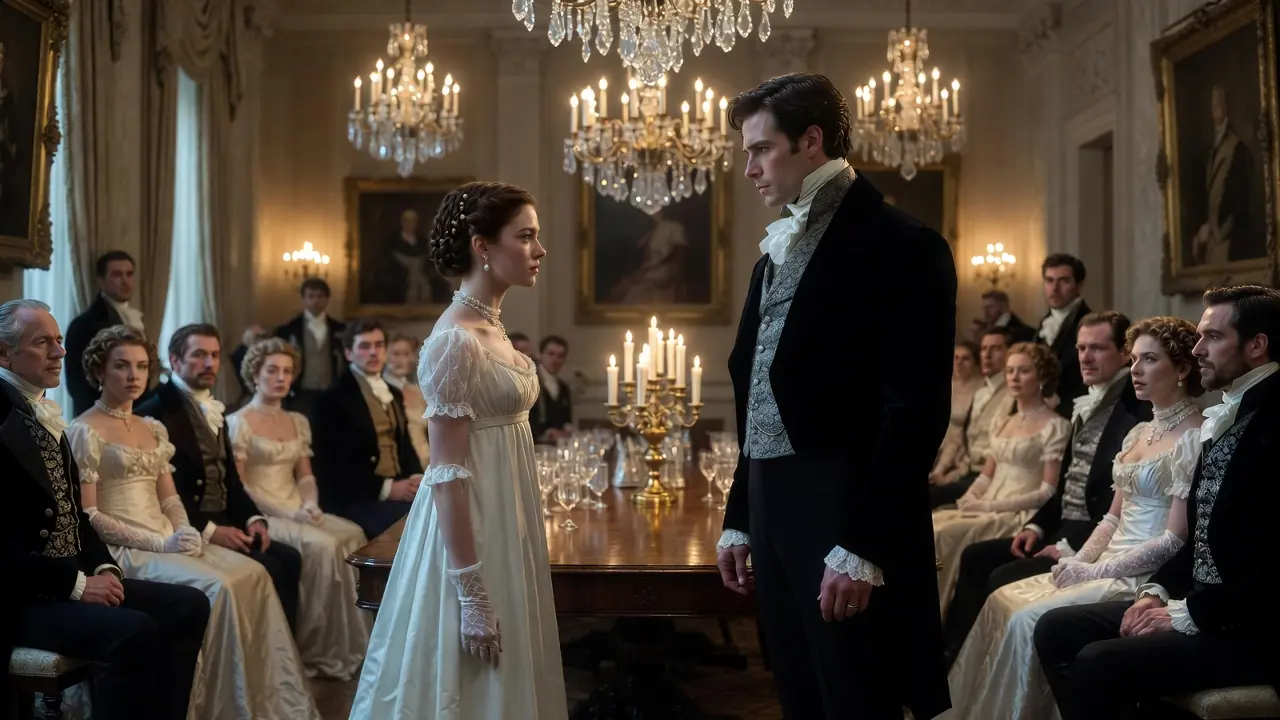
Julian came to stand before her.
“I need to ask you something,” he said.
She looked up.
“Not as your husband. Not as duke. As a man who has been blind in his own house.”
Vivian waited.
“How long have you been able to speak?”
The question struck the air between them.
Vivian looked at the fire.
Her heart began to beat hard.
She could write an answer.
She should write an answer.
But something inside her, something awakened by danger, by trust, by the sight of Julian reading her words as if they mattered, moved toward the locked door in her throat.
She had not spoken aloud in three years.
Her voice felt like a ghost.
Julian saw the struggle and stepped back.
“You need not answer now.”
That gentleness did what pressure never could.
Vivian opened her mouth.
The first sound was small.
Rough.
Almost nothing.
But it was there.
“Three,” she whispered.
Julian went utterly still.
Vivian’s hand closed around the arm of the chair.
“Three years.”
Her voice cracked on the second word.
Pain burned in her throat.
Julian did not move toward her. Did not exclaim. Did not ruin the moment with triumph.
He simply lowered himself into the chair opposite her, as if sitting could make the world less alarming.
“Why silence?” he asked quietly.
Vivian swallowed.
The answer came slowly, each word dragged from a place that had forgotten air.
“Because men speak over women. But they speak freely before furniture.”
Julian’s face changed.
Vivian looked at him.
“I became furniture.”
He closed his eyes briefly.
When he opened them, something in them was raw.
“I am sorry.”
Vivian shook her head.
“You did not make me silent.”
“No,” he said. “But I benefited from it.”
She did not deny that.
The fire cracked softly.
Vivian touched her throat.
“It hurts.”
“Then stop.”
She looked surprised.
Julian almost smiled.
“You may stop, Vivian.”
Her name in his voice, spoken like something living, nearly undid her.
She whispered one more sentence.
“I warned you because I did not want them to win.”
Julian leaned forward, elbows on his knees.
“They will not.”
The next weeks changed everything.
Not quickly.
Trust never moves quickly when it has had to survive cruelty.
Vivian spoke rarely at first, and only with Julian, Ruth, and eventually Lady Beatrice. Her voice tired easily. Some days it vanished again, not from inability but from old fear returning like weather.
Julian never demanded it.
He learned to read the difference between silence chosen for comfort and silence forced by pain.
That mattered.
He also began to speak more.
This surprised Vivian.
She had assumed his coldness was arrogance. It was not. Or not entirely. It was discipline hardened around old loneliness.
Julian had inherited the dukedom after the sudden deaths of his elder brother and father in the same year. He had been the spare son, educated for diplomacy and estate management but never meant to bear the title. His brother had been charming, reckless, beloved. Julian had been useful.
Then useful became necessary.
Necessary became duke.
And men who had smiled at him when he was second son now weighed him like property.
“I did not seek a wife because I wanted one,” he told Vivian one evening in the library. “I sought a wife because the family solicitors informed me that if I died without issue, the title might pass to a cousin who would sell half the estate and ruin the tenants.”
“A romantic proposal,” Vivian said.
Her voice was stronger by then.
Dry.
Julian looked at her.
Then laughed.
It startled them both.
Vivian smiled before she could stop herself.
His laughter faded into something softer.
“I deserved that.”
“You did.”
He watched her for a moment.
“You are different when you speak.”
“No,” Vivian said. “You simply have less room to imagine me.”
That sentence stayed with him.
She saw it settle.
Good.
The conspiracy deepened.
Julian’s men confirmed that Cecil had indeed met Lefèvre twice at the Clarendon. Horace Peyton had vanished from London for several days, likely warned. Lord Bellamy sent a frantic note denying involvement before anyone accused him, which confirmed more than he intended.
The forged documents, however, remained missing.
Without them, Julian had whispers.
Dangerous whispers, but not proof.
Vivian understood proof.
Her father had taught her.
“Men deny what is heard,” she told Julian over breakfast. “They fear what is written.”
“Then we need the letters.”
“Yes.”
“Cecil will not hand them to us.”
“No,” Vivian said, buttering her toast with perfect calm. “But he may show them to me.”
Julian’s eyes lifted sharply.
“No.”
Vivian looked at him.
He recognized his mistake immediately.
“I mean, it is too dangerous.”
“That is not the same as no.”
His jaw tightened.
“Cecil is cruel.”
“I know that better than you.”
The words landed hard.
Julian looked away first.
Vivian softened, just slightly.
“He thinks I am still silent. He thinks I am afraid. He thinks I am stupid enough to be wounded by the same knife twice.”
“And are you?”
“No,” Vivian said. “Now I know where the blade is.”
The plan was Lady Beatrice’s idea, which meant it was both socially acceptable and morally alarming.
She invited Cecil Peyton to tea.
Not at Ashworth Hall.
At her own London residence, where half the room would be respectable witnesses and the other half would be too curious to leave early.
Vivian attended in pale green silk, silent again by choice.
Cecil arrived smug.
He believed himself invited because Lady Beatrice wished to manage scandal discreetly. He believed Vivian remained trapped behind muteness. He believed Julian was searching in the wrong direction.
Men like Cecil often mistook their own confidence for intelligence.
Vivian let him.
After tea, she drifted toward the small conservatory.
Cecil followed.
Of course he did.
“You look well, cousin,” he said, once they were screened by orange trees and glass. “Duchess suits you. Though I wonder how long His Grace will find silence charming.”
Vivian looked at a blossom.
Cecil stepped closer.
“You should remember who first arranged your elevation. Uncle Horace was generous.”
Vivian nearly laughed.
She did not.
Cecil lowered his voice.
“I know you heard something at Whitcombe’s. You were always listening. Even when you pretended not to. But listening is not proof.”
Vivian turned toward him.
Her eyes widened slightly, the perfect imitation of fear.
Cecil smiled.
“There she is. Still in there, is she? The little girl from King Street.”
Vivian lowered her gaze.
He leaned closer.
“If Ashworth keeps digging, he will find only embarrassment. If you are wise, you will persuade him to stop. A wife has influence, even a defective one.”
Vivian let one tear gather in her eye.
It cost her less than she expected.
Cecil’s satisfaction made him careless.
“The documents are safe,” he murmured. “Far beyond your reach.”
Vivian’s fingers moved once at her side.
A signal.
Behind the conservatory screen, Lady Beatrice’s companion, Miss Harrow, listened with the alert focus of a woman who had spent thirty years being underestimated.
Cecil continued.
“Tell your duke that some signatures are difficult to explain. Tell him old letters can embarrass powerful men. Tell him—”
“Where?” Vivian whispered.
Cecil froze.
The single word had been barely audible.
His face drained of color.
Vivian lifted her eyes to his.
Then, in a voice still soft but clear enough to cut him open, she said, “Where are the documents, Cecil?”
For the first time in all the years she had known him, Cecil Peyton looked afraid.
It was a beautiful sight.
He stumbled back.
“You—”
“Speak carefully,” Vivian said. “Lady Beatrice’s walls have ears.”
At that exact moment, Lady Beatrice entered the conservatory.
“How fortunate,” she said brightly. “So do I.”
Cecil fled within ten minutes.
He left behind panic, which Julian’s men followed.
The documents were discovered two days later in the rented rooms of Mr. Penwell’s clerk, hidden in a false bottom beneath correspondence meant for Horace.
The forged signatures were excellent.
Not perfect.
Vivian proved that.
She sat in Julian’s study with the documents spread before her, her father’s magnifying lens in hand. Julian watched while she compared the signature strokes to authentic letters from his archive.
“The J is wrong,” she said.
Julian leaned closer.
“It looks identical.”
“To someone who reads names. Not to someone who reads hands.”
She pointed.
“You begin your J with pressure here, then ease. The forgery begins lightly and presses downward. A mimic copies the shape but not the habit.”
Julian looked at her.
“You learned this from your father?”
“Yes.”
“What else did he teach you?”
Vivian looked down at the papers.
“How to survive rooms where everyone smiles.”
The evidence was enough to corner Bellamy.
Bellamy gave up Lefèvre.
Lefèvre implicated Horace.
Horace tried to implicate Cecil.
Cecil tried to disappear.
He did not get far.
Justice in aristocratic circles rarely looked like justice to ordinary people. It moved quietly, protected reputations, exchanged public scandal for private ruin. But Julian was not interested in merely surviving embarrassment.
“They used my name,” he said. “They attempted fraud through diplomatic channels. They will answer publicly.”
“They will strike back,” Lady Beatrice warned.
“Let them.”
Vivian said nothing.
Julian looked at her.
She lifted her chin.
“Let them,” she agreed.
The reckoning came at Ashworth Hall in May.
A grand gathering.
Ostensibly, it was a spring dinner in honor of diplomatic reconciliation.
In truth, it was a courtroom disguised in candlelight.
The guest list was precise.
Lord Bellamy.
Monsieur Lefèvre.
Mr. Penwell.
Horace Peyton.
Cecil Peyton, pale and furious, compelled to attend by the threat of immediate legal action.
Witnesses from high society.
Two magistrates.
Lady Beatrice, armed with a fan and an expression that promised enjoyment.
Vivian wore white.
Not bridal white.
Not innocent white.
Austere, deliberate, luminous.
She descended the staircase on Julian’s arm while the hall below shimmered with silk, jewels, and unease.
Whispers followed.
The mute duchess.
The strange duchess.
The poor duchess.
Vivian smiled.
Let them speak.
Dinner was tense.
Julian waited until the final course had been cleared.
Then he rose.
The room fell silent.
“My friends,” he said, though his tone made the word dangerous, “I thank you for joining us. There is a matter requiring clarification, and I prefer clarity before rumor.”
Horace shifted in his seat.
Cecil stared at the table.
Julian continued.
“Documents have circulated bearing my signature. These documents imply commitments I never made and obligations I never authorized.”
A murmur moved through the room.
Lord Bellamy went gray.
Julian lifted one hand.
Mr. Carden entered with a tray of papers.
Copies were distributed.
Vivian remained seated, hands folded.
Horace stood abruptly.
“Your Grace, surely this is not appropriate dinner conversation.”
“No,” Julian said. “Fraud rarely is.”
Cecil pushed back his chair.
“I will not sit here and be insulted.”
Vivian rose.
The room shifted toward her out of reflex more than respect.
For three years, men had spoken over her.
For months, society had spoken around her.
Now she stood at the center of Ashworth Hall beneath a hundred candles and looked directly at Cecil Peyton.
“Sit down,” she said.
The room froze.
A woman gasped.
Lady Beatrice smiled slowly behind her fan.
Cecil’s face went white.
Vivian’s voice, though not loud, carried perfectly.
“I have heard enough men speak falsely in rooms where they believed me incapable of answer. Tonight, I will answer.”
No one moved.
Vivian turned to the assembled guests.
“My name is Vivian Élodie Ashworth. I am daughter of Sir Thomas Ashworth and Élodie de Villiers. I was not born mute. I was made silent by circumstance, cruelty, and the convenience of men who preferred me voiceless.”
Horace whispered, “Vivian.”
She looked at him.
He stopped.
“You sold me for ten pounds,” she said. “You described me as obedient, dull, and incapable. You were wrong on all counts.”
A ripple moved through the room.
Julian stood beside her, still as stone.
But his eyes were not cold.
They were proud.
Vivian lifted the forged document.
“These signatures are false. The hand that made them copied the duke’s name, but not his pressure, not his rhythm, not his habits. The letters connected to this scheme were hidden by Mr. Penwell’s clerk at the instruction of Cecil Peyton, acting with knowledge of Horace Peyton and in collusion with Monsieur Lefèvre and Lord Bellamy.”
Bellamy made a sound like a wounded animal.
Lefèvre rose.
“This is outrageous. You cannot prove—”
Vivian answered him in flawless French.
“I can prove every word. Would you prefer I repeat what you said at Lord Whitcombe’s table? You spoke of my husband as ignorant and of me as useless. You were mistaken twice.”
Lefèvre sat.
The magistrate nearest Julian leaned forward.
Vivian placed the documents before him.
“Here are the originals. Here are authenticated samples of His Grace’s hand. Here are notes taken from conversations overheard at Whitcombe House and corroborated by Lady Beatrice Ashworth’s companion. Here is the statement from Mr. Penwell’s clerk, secured this morning.”
She turned the final page.
“And here is the letter from Horace Peyton to Cecil Peyton instructing him to ensure that I remained silent and obedient because, and I quote, ‘the girl has ears enough to ruin us if she ever remembers she has a tongue.’”
No one breathed.
Horace’s face collapsed.
Cecil stood so quickly his chair fell backward.
“You ungrateful—”
Julian moved.
Only one step.
But it was enough.
Cecil stopped.
Vivian did not flinch.
That mattered more.
“Ungrateful?” she said. “No, Cecil. I remember every lesson you taught me. I learned to be still. I learned to listen. I learned that men who believe themselves powerful become careless when they believe women powerless.”
Her voice strengthened.
“And then I learned that my silence was not emptiness. It was preparation.”
The magistrates took the documents.
Bellamy confessed before midnight.
Lefèvre was recalled in disgrace.
Penwell lost his practice.
Horace Peyton’s debts consumed him.
Cecil attempted bluster, then denial, then bargaining. None worked. His name became poison in every room he had once entered with confidence.
Justice did not heal Vivian’s past.
But it named it.
Sometimes naming a thing is the first door out of it.
After the guests departed, Ashworth Hall stood quiet under the weight of what had happened.
Vivian went to the library.
She expected Julian to follow.
He did.
She stood near the shelves, still wearing white silk, her throat aching from so much speech.
For a long while, neither spoke.
Then Julian said, “You were magnificent.”
Vivian closed her eyes.
The word should have pleased her.
It did.
It also frightened her.
“I was angry,” she said.
“You were clear.”
“I wanted to hurt them.”
“You told the truth. If that hurt, the fault belongs to them.”
She turned.
“I do not know who I am now.”
Julian’s face softened.
“No?”
“For three years I was silent. Before that, I was my father’s daughter. My mother’s daughter. Then Peyton’s burden. Then your purchased wife.”
He flinched, but did not interrupt.
Vivian touched the back of a chair.
“Tonight, I spoke. Everyone looked at me. They heard me. And now I do not know what remains when survival is no longer the whole of me.”
Julian crossed the room slowly, stopping before her.
“Then we find out.”
“We?”
“If you permit it.”
Vivian looked at him.
There it was again.
Permission.
The wordless offering that had become his greatest kindness.
She lifted her hand and touched his sleeve, as she had on the day she left King Street.
This time, she did not do it because she had nowhere else to go.
She did it because she wished to.
“I permit it,” she said.
Their marriage became real not in one dramatic moment, but in hundreds of small ones that followed.
Vivian began speaking at breakfast.
At first only a few sentences.
Then more.
She corrected Julian’s French pronunciation with merciless precision.
He accepted this with surprising dignity until she told him his Italian sounded like a horse attempting opera. Then he laughed so hard Ruth dropped a spoon in the hall outside.
Vivian began teaching him languages in the mornings.
French for diplomacy.
Italian for poetry.
Latin for discipline.
He learned quickly, though not as quickly as she demanded.
“You are impatient,” he told her one morning.
“You are imprecise.”
“I am a duke.”
“Not in Latin.”
He looked at her.
She looked back.
He bowed his head over the grammar book.
“Yes, Duchess.”
That became their rhythm.
Lessons.
Documents.
Walks in the garden.
Conversations by the fire that wandered from estate matters to childhood memories, from politics to music, from grief to absurdity.
Julian told her about his brother.
Not all at once.
Grief, like trust, resists being dragged.
He spoke first of small things. His brother’s laugh. The way he could charm anyone. The debts he concealed. The danger he made beautiful until it was too late.
“I loved him,” Julian said one evening. “And I resented him. Then he died before I could forgive him for making me both love and resent him.”
Vivian sat beside him in the library.
“That is a very human way to grieve.”
He looked at her.
“You say that as though you have studied it.”
“I have survived it.”
He reached for her hand.
Slowly.
Giving her time to refuse.
She did not.
Their fingers intertwined.
It was not passion at first.
It was something quieter and more astonishing.
Safety.
Vivian had not known safety could feel like warmth instead of walls.
Ashworth Hall changed because Vivian changed.
Or perhaps because she began allowing the house to know she existed.
She opened the music room.
She had the covers removed from furniture shut away since Julian’s mother died.
She asked Mrs. Vale for reports on servant wages and discovered two departments had been underpaid by custom rather than law. She changed both.
She began a weekly reading hour for the younger housemaids and footmen who wished to improve their letters.
When the village schoolmaster fell ill, Vivian arranged for books from the Ashworth library to be copied and sent to the school.
Lady Beatrice declared it “dangerously French” and immediately donated money.
Vivian also wrote to women.
Quietly at first.
Widows in need of legal advice.
Girls with education but no position.
Wives trapped in households where their opinions were treated as inconveniences.
She did not become scandalous.
She became useful.
That was more threatening.
Society adjusted.
It always does when power changes hands gracefully enough to avoid open resistance.
The mute duchess became the learned duchess.
Then the French duchess.
Then, after she corrected a cabinet minister’s translation error at a private dinner without raising her voice, the formidable duchess.
Julian enjoyed that one.
“Formidable,” he said, reading the description aloud from a letter.
Vivian looked up from her embroidery.
“They mean difficult.”
“Yes.”
“You are enjoying this.”
“Immensely.”
She threw a spool of thread at him.
He caught it.
Laughed.
And somewhere in the echo of that laughter, Vivian realized she was happy.
The realization startled her so much she said nothing for the rest of the evening.
Julian noticed, of course.
Later, when they stood together near the upstairs gallery, he asked, “Are you unwell?”
Vivian looked down at the great hall below.
“No.”
“Have I offended you?”
“No.”
“Has someone else?”
“No.”
“Then what is it?”
She looked at him, this man who had bought her and then spent every day since trying to become worthy of the fact that she had stayed.
“I think I am happy,” she said.
His expression changed with such tenderness that she nearly had to look away.
“Is that alarming?”
“Yes.”
“Then we shall proceed carefully.”
She laughed.
He kissed her for the first time that night.
Not as a duke claiming a wife.
Not as a man taking what society said was his.
He kissed her as if asking a question.
Vivian answered.
Their daughter was born the following spring.
Vivian refused to be treated like porcelain during pregnancy, though Julian tried once and was so thoroughly corrected by both his wife and Lady Beatrice that he never attempted it again.
The birth was difficult but not dire.
Vivian held Julian’s hand and cursed in three languages, which the midwife later described as impressive.
When the child finally cried, small and furious and alive, Vivian began to weep.
Julian sat beside her, pale with relief.
“A girl,” the midwife said.
Julian looked at Vivian.
Vivian looked at the child.
“Catherine,” she whispered.
Julian’s eyes softened.
“After your mother?”
Vivian shook her head.
“My mother’s second name was Catherine. Ruth for the maid who first called me Vivian here.”
Julian smiled.
“Catherine Ruth Ashworth.”
The baby opened her mouth and gave another indignant cry.
Vivian laughed through tears.
“She has opinions.”
“Like her mother.”
“Pray she has better timing.”
Catherine Ruth grew in a house full of books, languages, music, and people who spoke to her as if her mind mattered from the beginning.
Vivian taught her French lullabies.
Julian taught her to inspect estate maps before she could properly pronounce acreage.
Lady Beatrice taught her to enter a room as if uncertain people were a nuisance rather than a threat.
Ruth, promoted eventually to Vivian’s personal secretary, taught her kindness in practical forms: remembering names, noticing tired faces, never ringing twice when once would do.
When Catherine was five, she asked why her mother sometimes touched her throat before speaking.
Vivian answered honestly.
“Because I once forgot my voice belonged to me.”
Catherine frowned.
“Who took it?”
Vivian looked across the nursery to where Julian stood by the window, pretending not to listen and failing.
“No one truly took it,” she said. “But some people made me afraid to use it.”
Catherine considered this.
Then, with the solemn authority of childhood, she said, “I shall use mine loudly.”
Julian coughed into his hand.
Vivian smiled.
“I expect you will.”
Years passed.
Horace Peyton died in obscurity, still insisting he had been misunderstood.
Cecil Peyton married badly, lost money, and lived long enough to be ignored by people he had once wished to impress.
Monsieur Lefèvre never returned to England.
Lord Bellamy survived socially but not comfortably, which Lady Beatrice considered a pleasing compromise.
Vivian did not dwell on them.
That was its own victory.
She had once thought healing meant the past losing its shape.
It did not.
The past remained.
King Street remained.
The attic room.
The gray gown.
The ten-pound note.
Cecil’s hand on her wrist.
Horace’s voice reducing her to usefulness.
All of it remained.
But it no longer ruled the room.
Vivian ruled the room.
Not loudly.
Not always.
But fully.
At forty, she was considered one of the most intelligent women in England’s private political circles, though no one officially admitted women participated in politics. Her translations were requested discreetly by men who would never publicly confess they needed them. Her advice shaped estate reforms across three counties. Her reading program became a model copied by other households under names that avoided crediting her directly.
She did not mind.
Much.
Julian minded more.
“You should publish,” he told her one evening.
They were in the library, older now, though not old. Catherine was upstairs arguing with her governess in French, a sign Vivian considered promising.
“Under my own name?” Vivian asked.
“Yes.”
“How radical you have become.”
“I married a revolutionary.”
“You bought a mute wife.”
Julian flinched.
He always did.
Vivian crossed to him and touched his face.
“I say it now because it no longer wounds me the same way.”
“It wounds me.”
“I know.”
“I would undo it if I could.”
“No,” Vivian said softly. “You would undo Horace. You would undo Cecil. You would undo the cage. But not us.”
Julian covered her hand with his.
“No,” he admitted. “Not us.”
She kissed him then, gentle with years.
The book she eventually published was titled On Voice and Education.
Not memoir.
Not confession.
Argument.
It spoke of girls’ education, of silence imposed by custom, of the moral danger in confusing obedience with virtue. It drew from philosophy, scripture, law, and lived observation. It was praised by some, condemned by others, and read by far more people than admitted to owning it.
Lady Beatrice bought fifty copies.
Julian bought one hundred and sent them anonymously to men who annoyed him.
Vivian pretended not to know.
When Catherine turned eighteen, she found the old notebook from King Street in her mother’s private desk.
She did not read it.
She brought it to Vivian.
“I think this is yours.”
Vivian looked at the worn cover.
For a moment, the years folded.
She saw the attic.
The cold.
The girl with ink-stained fingers writing secrets because speaking them was unsafe.
Catherine sat beside her.
“Were you very lonely?”
Vivian opened the notebook.
Her younger handwriting filled the pages, small and controlled.
“Yes,” she said. “But I was never empty.”
Catherine leaned against her shoulder.
“I’m glad Father found you.”
Vivian looked toward the window, where Julian walked in the garden below, pausing to inspect a rosebush as if it were an estate matter.
“He did not find me,” she said. “He bought me.”
Catherine stiffened.
Vivian took her hand.
“And then he learned me. There is a difference. The second mattered more.”
Catherine was quiet.
“Did you love him at first?”
“No.”
“When?”
Vivian watched Julian look up toward the window, as if feeling their gaze.
He raised one hand.
Vivian smiled.
“When he stopped trying to decide what I was and began asking what I thought.”
Catherine considered this with the seriousness of a young woman forming standards.
“Good,” she said. “Then I shall require the same.”
“Require more,” Vivian said. “You have the advantage of beginning with a voice.”
Catherine squeezed her hand.
“Because you reclaimed yours.”
Vivian looked down at the notebook.
Then she closed it.
“Yes,” she said. “And because my mother gave me one before anyone tried to take it.”
In her later years, Vivian Ashworth became a story.
Stories are dangerous things.
They simplify.
They polish.
They turn terror into drama and survival into destiny.
People said the Duke of Ashworth had married a mute woman who revealed herself to be brilliant.
They said she exposed traitors at a dinner table.
They said she spoke six languages.
They said she had frightened a French diplomat into silence.
They said her daughter had inherited her mind and her father’s stubbornness.
Some of it was true.
Some of it was improved by repetition.
The truth was quieter and stronger.
Vivian Ashworth had been a girl with a voice no one wanted to hear.
She had hidden it to survive.
She had listened when men mistook silence for ignorance.
She had accepted rescue without mistaking it for ownership.
She had learned that trust could be built sentence by sentence, choice by choice, morning by morning over tea, documents, books, and patience.
She had stood before the people who once benefited from her silence and spoken clearly enough to end them.
She had become duchess not when the chaplain named her one, but when she understood that title meant nothing unless she inhabited it fully.
And she did.
As wife.
Mother.
Scholar.
Strategist.
Teacher.
Partner.
Not ornament.
Not pity.
Not purchased thing.
Vivian.
On a late autumn afternoon many years after the day she left King Street, Vivian stood in the library at Ashworth Hall, watching Catherine teach her own little daughter the French word for courage.
“Courage,” Catherine said, “is courage in both languages.”
The child frowned.
“That is easy.”
Vivian laughed softly.
“No, darling. The word is easy. The thing is not.”
Julian, older now, silver at the temples, sat near the fire with a book open and unread in his lap.
He looked at Vivian across the room.
That look had changed over the years.
It had been assessment once.
Then curiosity.
Then respect.
Then love.
Now it was home.
Vivian crossed to him.
“Are you watching me, Your Grace?”
“Yes.”
“You used to be subtler.”
“I used to be more foolish.”
“True.”
He smiled.
She sat beside him.
For a while, they listened to Catherine and the child laughing over pronunciation. The fire burned low. Rain touched the windows. Ashworth Hall, once grand and cold, breathed around them like a living thing.
Julian took Vivian’s hand.
“Do you ever regret it?” he asked.
She knew what he meant.
The marriage.
The cost.
The past that had brought her here by such cruel roads.
Vivian looked at the shelves of books, the fire, her daughter, her granddaughter, the man beside her.
Then she touched the locket at her throat.
Her mother.
Her father.
The girl she had been.
The woman she became.
“No,” she said. “But I refuse to be grateful for suffering merely because joy followed it. Pain is not made holy by survival.”
Julian bowed his head.
A lesson accepted.
Vivian continued, voice steady.
“I am grateful for what I built after. For what we built. That is different.”
“Yes,” he said. “It is.”
The child across the room suddenly shouted, “Grandmama, how many languages can you speak?”
Vivian smiled.
“Enough to know when someone is lying.”
Catherine laughed.
Julian closed his eyes in amusement.
The child looked impressed.
“Will you teach me?”
Vivian rose.
“With pleasure.”
She crossed the room slowly, not because she was weak, but because she had learned not to hurry toward things that would wait lovingly for her.
Her granddaughter climbed into her lap with a book.
Catherine sat beside them.
Julian watched from near the fire.
And Vivian Ashworth, once sold as a mute bride for ten pounds, opened the book and began to read aloud.
Her voice filled the library.
Clear.
Certain.
Belonging entirely to her.
Outside, rain fell over Ashworth Hall, soft against stone, gentle over the old roofs and gardens.
Inside, the house listened.
And this time, everyone heard her.