The Duke thought she would never leave. So he kept cheating. She fled into the night with his greatest secret.
The night Abby Bentley walked out of Wilkinson Manor, she was soaked to the bone and holding something more dangerous than a weapon.
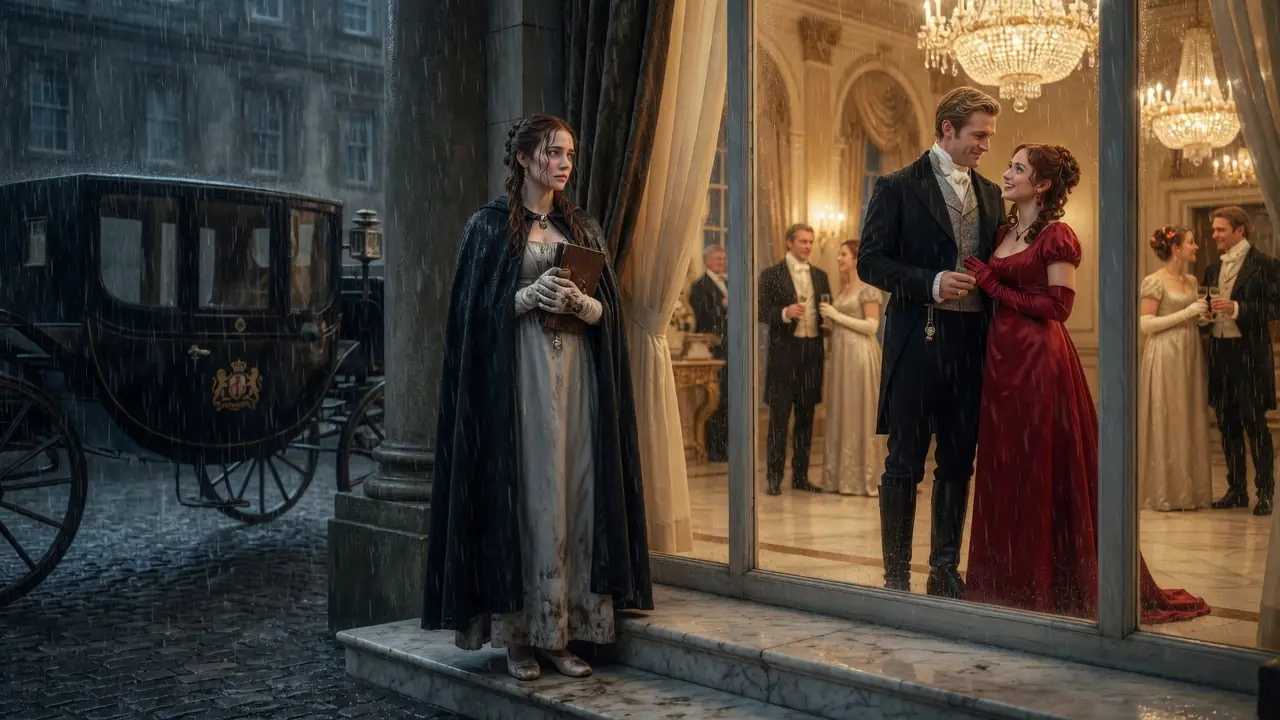
Inside, the chandeliers were blazing.
Duke Patrick Wilkinson was laughing, raising his glass to Yasmin Fitzgerald in the ballroom, the woman he had chosen over his own wife, in his own house, at his own party.
Abby had stood at that window for exactly three seconds, not to cry, not to beg. She had already done those things.
Tonight, she was counting.
What nobody in that ballroom knew, what Patrick himself did not fully understand, was that every military victory with his name on it, every treaty, every war council decision that made him the most feared duke in the realm, Abby had written all of it from a desk nobody visited, with ink-stained fingers nobody noticed.
And tonight, she had taken the one thing that proved it.
If Patrick woke up tomorrow thinking he could replace her, he was about to discover that some secrets, once removed, cannot be recovered. And some wives, once pushed far enough, stop running from something and start running toward something far worse for you.
One week before the night everything changed, Abby Bentley was sitting at a desk that no one was supposed to know existed.
It was tucked behind the false wall in the east corridor of Wilkinson Manor, a narrow room with a single window that faced the garden rather than the road, deliberately chosen so that no passing visitor would ever glance up and wonder why a light burned there at two in the morning.
The room smelled of beeswax candles and old paper. There was a pot of cold tea on the corner of the desk that Abby had forgotten to drink, a habit she had developed over five years of marriage, the habit of starting things and then becoming so absorbed in the work that everything else, the tea, the meals, the hours, simply dissolved.
She was working on the Aldenmore dispatch.
Three days prior, a courier had arrived at the manor with a sealed military correspondence from the northern garrison at Aldenmore, reporting unusual troop movements along the ridge pass that connected Wilkinson territory to the contested borderlands.
The garrison commander, a cautious man named Colonel Hewitt, had written in the standard military cipher that Patrick's war council used for sensitive communication.
What Colonel Hewitt did not know, what no one in Patrick's war council knew, was that the cipher they believed Patrick had personally designed and implemented was, in fact, the invention of his wife.
Abby had built the Wilkinson cipher from scratch in the second year of their marriage, during a particularly brutal winter when Patrick had come to her in a rare moment of visible panic, dropping a stack of intercepted enemy correspondence on her desk and telling her, with the impatience of a man unaccustomed to asking for help, that his code breaker had fallen ill and that he needed the letters decoded before dawn.
Abby had decoded all 14 letters in four hours.
Then, without being asked, she had redesigned his entire encryption system from the ground up, layering it with a mathematical pattern so complex that it could not be broken without understanding the base key, a key that existed nowhere on paper because it existed only in Abby's memory.
Patrick had presented the new cipher system to his war council the following week and accepted their praise with the ease of a man who had long since stopped feeling the weight of borrowed credit.
That was the arrangement.
That had always been the arrangement.
So, on the night the Aldenmore dispatch arrived, it was Abby who sat in her hidden room and decoded it, cross-referencing the troop movement data against her private maps, running the mathematics of supply lines and march distances with the focused precision of someone who had studied military logistics, not because anyone had asked her to, but because she understood instinctively that knowledge was the only currency that could not be taken from her by a husband who controlled everything else.
Her conclusion, reached at half past two in the morning, was unambiguous.
The movements at the ridge pass were not a military exercise.
They were a coordinated repositioning.
Someone in the borderlands was preparing for a strike on the eastern watchtower, and if Patrick's garrison did not reinforce the position within 72 hours, they would lose the pass entirely.
She wrote her analysis in clean, precise language on a single sheet of paper, sealed it inside a plain envelope, and slid it under the door of Patrick's private study before he woke.
At dinner that evening, Patrick sat at the head of the long mahogany table with the easy authority of a man born to occupy that chair. Yasmin Fitzgerald was seated to his right, which was not a position typically offered to guests who were merely family friends, but Patrick had long since stopped concerning himself with what was typical.
Yasmin was wearing gold that night, a bright, excessive gown with ruffled sleeves and a neckline that caught every flame in the room. She laughed frequently and loudly, and Patrick watched her with the particular softness in his expression that he had stopped directing at his wife sometime during the third year of their marriage.
Abby sat at the other end of the table in a high-necked gray dress with ink on her right index finger that she had scrubbed at but not entirely removed.
Patrick was explaining his military strategy to the three guests assembled for dinner, a local magistrate and his wife, and a visiting merchant from the western provinces who had made the mistake of asking an interested question.
Patrick spoke with great confidence about troop repositioning, about the tactical necessity of reinforcing the eastern watchtower, about his precise reading of the enemy's supply chain vulnerabilities. He used words like instinct and experience. He touched his medals once, briefly, the way a man touches a thing he wants others to notice.
Not once did he look at the other end of the table.
Yasmin leaned toward the magistrate's wife at one point during the meal and said something in a low voice that carried just far enough, something about gray being a color for widows and wallpaper.
The magistrate's wife laughed politely, the uncertain laugh of someone who was not sure if the joke was kind or cruel and had decided not to investigate the question.
Patrick heard it.
His smile did not change. If anything, it widened slightly, the way a man's smile widens when he is enjoying the company of someone who entertains him and the entertainment continues uninterrupted.
And then she picked up her fork again and continued eating because there was nothing else to do, and because she had learned, over five years, that reactions were expensive things she could not afford to waste.
What Yasmin Fitzgerald did not know, sitting in her gold dress at the right hand of the Duke, was that the military strategy Patrick had just delivered so confidently to the dinner table had been written by the woman in the gray dress at the other end.
What the magistrate's wife did not know, laughing at the joke about wallpaper, was that without the woman who resembled wallpaper, the entire Wilkinson estate would have collapsed under the weight of its own administrative incompetence within a calendar year.
Abby knew both of these things. She had known them for a long time.
She kept them the way she kept everything that mattered: quietly, close, and entirely to herself.
The day Abby learned the truth about what Patrick and Yasmin had planned for her, she was carrying a tea tray.
It was an ordinary afternoon. The manor was quiet in the way it was always quiet when Patrick had no guests, a heavy, formal silence that pressed against the walls like something held in.
Abby had asked the kitchen to prepare a pot of the Darjeeling that Patrick preferred, not because she felt any warmth toward him that particular afternoon, but because she had learned that small gestures of normalcy were the most effective armor.
A wife who brought tea was a wife who was not suspected of anything.
She had not intended to stop outside the study door. She had intended to knock, enter, set the tray down, and leave in under 40 seconds, which was approximately how long Patrick could remain in the same room as her before his attention drifted back to whatever correspondence or bottle of brandy was competing for it.
But she heard the voice before she reached the door.
Yasmin's voice was distinctive in the way that things designed to be noticed are distinctive, warm on the surface with something harder underneath. And the words that came through the heavy oak of the study door were not the words of a woman making a social call.
Abby stood in the corridor, and she listened.
The plan, as she was able to piece it together from the fragments that carried through the door, had apparently been forming for some months.
The annulment itself was not the surprise. Abby had suspected that was coming. What she had not anticipated, what she stood in the corridor absorbing with the particular stillness of a person who has just been hit with something they did not see approaching, was the second part.
Patrick's voice, measured and matter-of-fact, explained it to Yasmin the way he explained things he had already decided.
There was a physician named Dr. Harcastle who had agreed to provide the necessary documentation. A woman with Abby's disposition, the word Patrick used was peculiarities, and her documented history of what he described as nervous episodes, which was his interpretation of the two occasions in their marriage when Abby had cried in front of him, both times in response to things that warranted crying, could quite reasonably be assessed as requiring institutional care.
Whitmore House for Nervous Ailments was a two-day carriage ride north. It was, Patrick noted, very comfortable, very discreet, very permanent.
Yasmin asked one question.
She asked whether Abby could cause problems if she was not, as Yasmin phrased it, contained.
There was a pause before Patrick answered. Then he said that Abby knew certain things about certain arrangements and that those things could not be allowed to circulate freely. The physician's assessment would ensure that anything Abby said would be attributed to the instability of an unwell mind.
It was, Patrick said, the cleanest solution.
The tea tray was growing heavy in Abby's hands.
She stood in that corridor, and she experienced something she had not expected to experience in that moment.
Not fear, though fear was present. Not grief, though that was present too. Somewhere underneath everything else, there was the grief of a woman who had spent five years believing that loyalty was its own protection, that a man who needed her could not also wish to destroy her.
What she experienced, above everything else, was clarity.
The kind of clarity that arrives only when all the remaining options have been removed, the kind that does not feel like relief but functions exactly like it.
She turned around. She carried the tea tray back down the corridor. She set it on a window ledge outside the drawing room with perfect composure.
Then she went to her hidden room, sat at her desk, and began to plan with the same focused precision she applied to military dispatches and cipher systems.
The difference was that this time, she was planning for herself.
The night of the winter solstice ball, the rain started at half past nine.
It came in without ceremony, the way serious rain comes, not building gradually, but arriving all at once, as though the sky had simply made a decision. Within minutes, it was loud against the manor windows, drumming on the stone ledges, filling the drainpipes, turning the gravel paths outside into shallow rivers.
Inside, the ballroom blazed.
The chandeliers threw their light across 200 guests, across the ivory and gold of gowns, across the military decorations and the polished shoes and the champagne glasses raised in the particular brand of festivity that the wealthy practice when they want to feel certain that everything is well.
Patrick was near the center of it all, exactly where he preferred to be, laughing at something one of his officers had said, his blond hair catching the light, his smile engaging every person within its radius, except the one person to whom it was most owed.
Yasmin was beside him in scarlet, vivid and deliberate as a warning.
Abby had appeared at the start of the evening in her customary gray, had exchanged four minutes of polite conversation with the magistrate's wife, and had then excused herself on the grounds of a headache.
This was not unusual. Abby's headaches were a reliable feature of social occasions, and no one at Wilkinson Manor, from the Duke to the lowest kitchen boy, had ever thought to question them.
She went upstairs.
She did not go to her bedroom.
Patrick's private study was on the second floor, east wing, at the end of a corridor that the household staff had standing instructions to avoid after ten in the evening.
This had been Patrick's own rule, established early in their marriage, and never questioned. And Abby had always privately noted that a man with nothing to hide does not construct rules about who may approach which rooms and when.
She entered the study without a candle.
She did not need one. She had been in this room hundreds of times, had stood at this desk correcting Patrick's correspondence, had memorized the placement of every piece of furniture, every stack of ledgers, every irregularity in the floorboards that announced a person's approach before they arrived.
The safe was behind the portrait of Patrick's father. This was, Abby had always thought, an appropriately unimaginative choice for a man of his particular nature.
She moved the portrait on its hinge, which she had quietly oiled herself three weeks prior, during what the household had understood as a routine inspection of the east wing for damp.
The safe lock was a six-point combination mechanism. Patrick believed the combination was known only to himself and to the estate solicitor, a man named Mr. Albright, who came once a year and stayed for exactly two days.
What Patrick did not know was that Abby had observed him open the safe on 14 separate occasions over the course of their marriage. Not deliberately at first, simply because she was often present in ways Patrick did not register, and she had the kind of mind that retained sequences the way other minds retain faces.
By the fourth observation, she had the combination entirely.
She had never used it until tonight.
Her fingers found the dial in the dark. The rain against the windows was loud enough to cover the soft mechanical clicks as the tumblers aligned, one after another, with a patience and precision that would have surprised anyone who only knew the gray-dressed duchess who sat silently at the end of long dinner tables.
The safe opened.
Inside, arranged exactly as she had anticipated from her observations, were three items of significance.
A stack of correspondence bound in dark ribbon, a small leather pouch she knew contained the extortion documents Patrick held over two members of the King's Council, and the Wilkinson cipher, the leather-bound ledger wrapped in its oilcloth sleeve, heavy and unremarkable in appearance, catastrophic in implication.
Abby took the cipher.
She took nothing else.
From inside her cloak, she withdrew the replacement she had prepared, a ledger of identical dimensions and weight, which she had sourced through three separate transactions designed to be untraceable, and which she had spent the previous four evenings filling with dense, official-looking columns of numbers that meant absolutely nothing.
On the first page, in handwriting she had taken care to make slightly different from her own, she had written two words.
I quit.
She placed the dummy ledger in the exact position the cipher had occupied. She closed the safe. She replaced the portrait.
She stood in the dark study for a moment, the cipher pressed to her chest beneath her cloak, and she listened to the rain and the distant music from the ballroom two floors below, and she did not allow herself to feel anything that would slow her down.
She had already felt everything she was going to feel about this marriage. She had done that work in advance, alone, in the small hours, in the way she did all of her most important work.
The servants' entrance at the rear of the manor opened onto a narrow path that ran along the kitchen garden before meeting the tree line of the eastern wood. The perimeter of the Wilkinson estate was defined by a high stone wall that ran for nearly a mile in each direction, broken at three points by iron gates.
Two of those gates were staffed by guards at all hours. The third, the eastern auxiliary gate, was considered a secondary concern because it opened onto a path that led only into the wood, and from the wood to a farm track that connected to the post road three miles north.
Abby had decided, on the night she made her plan, that the eastern gate was the only viable option.
She had also noted, in the course of managing Patrick's security correspondence over the years, that the eastern gate operated on a locking mechanism that her predecessor as cipher architect, a largely forgettable man named Trellis, had connected to a coded release system when the gate was rebuilt four years ago.
The code had been entered into the Wilkinson cipher records, which Patrick's gate guards consulted via a sealed card posted at the gate itself. The card used a derivative of the original Wilkinson cipher.
Abby had designed the derivative.
She moved through the kitchen garden with her cloak pulled close, the cipher book held flat against her body with both arms. The rain was relentless now, turning the garden path to mud that pulled at her boots with every step.
The chandelier glow from the ballroom was visible through the trees as a bright smear against the dark, distant and entirely indifferent to anything happening outside its radius.
She heard the guards before she saw the gate. Two voices, low and slightly bored, sheltering under the stone overhang to the right of the iron frame. One of them was complaining about the rain. The other laughed at something. Neither of them was looking at the gate itself.
Abby approached from the left, staying in the shadow of the wall, placing each step with deliberate care on the grass rather than the gravel edging.
At the gate mechanism, mounted on a recessed panel in the wall, was the sealed card.
She did not need the card.
She lifted the cover of the mechanism, found the release levers in the configuration she had designed, and entered the sequence by touch alone, her fingers reading the positions in the dark, the way a musician's fingers read a familiar instrument.
The gate released with a sound that was almost entirely absorbed by the rain.
She pushed it open one inch, two inches, enough.
One of the guards shifted. A boot scraped on stone.
Abby went still against the wall, the gate at her back, one hand flat against the iron to prevent it swinging wider.
Silence.
The rain. A laugh between the two men about something unrelated to gates or missing duchesses.
Abby stepped through.
The wood on the other side was dark and loud with rain. The branches overhead offered no real shelter, the ground soft and uneven underfoot.
She had a small oil lamp in her cloak pocket, but did not light it. She moved by memory, by the mental map she had constructed from the estate survey she had processed over years of managing correspondence that Patrick signed without reading.
Three miles north, the post road. The arrangement she had made through a chain of three intermediaries, none of whom knew the others, for a hired carriage that would be waiting at the milestone at midnight.
She walked. The cipher book was soaking through the oilcloth at the edges, and she held it closer.
The morning after the winter solstice ball came in the color of old pewter, the light flat and damp, the manor grounds still wet from the night's rain.
Patrick Wilkinson woke at half past nine with the particular heaviness of a man who had drunk too much of the good brandy and slept too few of the necessary hours. He dressed without particular urgency, waved off the valet's attempt at conversation, and made his way to the dining room where breakfast had been laid in the formal manner he always required.
He ate without fully tasting anything.
He was replaying a conversation from the previous evening, something one of his officers had said about the borderland dispatches, something about a delay in expected intelligence.
Patrick had brushed it aside at the time with his usual confidence. In the sober gray of the morning, the detail itched at him in a way he could not quite locate.
After breakfast, he went to the study.
He needed to check the morning's coded correspondence, a routine task that he managed outwardly with complete authority.
What actually happened, and had always happened, was that the decoded analysis arrived on his desk each morning in Abby's small, precise handwriting, presented in plain language beneath the original cipher text, and Patrick would read the plain language version and give his instructions accordingly.
He had never, not once, successfully decoded a cipher communication himself.
He had never needed to.
He opened the study door. He crossed to the desk. He looked for the morning's decoded correspondence.
There was none.
He stood for a moment in the silence of the study, processing this absence the way a man processes an unexpected step that isn't there. A lurch of the stomach that precedes the understanding of what has happened.
Then he went to the portrait. He moved it aside. He opened the safe. He stared at the ledger inside for a long moment before he picked it up.
Something about the weight was wrong. Something about the cover was wrong.
He turned it over in his hands with a growing pressure behind his eyes that had nothing to do with the brandy. He opened it. He stood there, alone in his study, reading columns of numbers that told him absolutely nothing.
And then he turned to the first page, and he read two words in handwriting that was not quite Abby's, but was unmistakably composed by someone who knew exactly what they were leaving behind.
The sound that came out of Patrick Wilkinson in that moment was not a word.
It was the sound a man makes when the ground removes itself from beneath him, and the fall has already begun before he understands that he has stepped off the edge.
He was in the corridor within seconds, and then on the main staircase, shouting for the housekeeper, for the head footman, for the stablemaster, for anyone who could tell him where the Duchess had gone, and when she had last been seen, and why, why, why had no one thought to notice?
The housekeeper, a composed woman named Mrs. Ellsworth, informed him with careful calm that the Duchess's personal maid had found her mistress's bed unslept in when she arrived at seven that morning.
That several items of modest clothing were missing from the wardrobe.
That the Duchess's reading glasses case, the silver one that had been a wedding gift from her mother, was gone from the dressing table.
Patrick turned and put his fist through the plaster wall of the corridor. Then he stood there, chest heaving, knuckles bleeding slightly, staring at the hole he had made.
And in the terrible silence that followed, he became aware for the first time of something he had never once considered in five years of marriage.
He did not know what to do next.
He did not know how to decode the morning's correspondence.
He did not know the base key to the cipher that bore his name.
He did not know the combination to the safe because the number he believed was correct was opening a safe that now contained only a dummy book and a resignation written in two words.
He did not know which of his war council strategic decisions of the past three years had originated in his own thinking, and which had been quietly corrected without comment by the woman whose dress Yasmin Fitzgerald had compared to wallpaper at his dinner table.
He stood in the corridor of his grand manor in the flat pewter morning light, and the silence of the house pressed in around him.
And for the first time in his charming, decorated, entirely borrowed life, Duke Patrick Wilkinson was completely, irreversibly alone with his own limitations.
And somewhere three miles north of his estate, on the post road, a hired carriage was already an hour gone into the distance, carrying a woman in a dark cloak who was not crying, who was not looking back, who was holding a leather-bound book to her chest and watching the road ahead with the steady, clear eyes of someone who had already decided what happened next.
The war council met three days after the ball.
It was a standing obligation, scheduled months in advance, the kind of meeting that could not be postponed without generating exactly the sort of questions Patrick could not afford anyone to be asking.
So he sat at the head of the council table in his military regalia, medals catching the morning light, jaw set, with the practiced authority of a man who had spent years performing competence so convincingly that he had eventually forgotten it was a performance.
There were six men around that table. Colonel Hewitt, up from the northern garrison, gray-whiskered and watchful. Two senior officers whose names Patrick had memorized mainly for moments like this one. A cartographer named Aldous Fenn, thin and precise, who spoke exclusively in coordinates and distances.
The estate solicitor, Mr. Albright, present because certain territorial matters had legal dimensions. And Lord Cavendish Moore, a heavyset peer from the western reaches, whose support Patrick needed for the spring border negotiations, and who had a habit of asking follow-up questions that Patrick particularly disliked.
The matter on the table was the Aldenmore situation.
The same ridge pass. The same troop movements. The same 72-hour window that Abby had identified in writing four days ago. A resolution Patrick had delivered at dinner and received credit for, and then entirely forgotten the specifics of because the specifics had never lived in his mind to begin with.
They had lived in Abby's, and in her handwriting on a sheet of paper that was now, along with everything else she had ever written for him, wherever Abby was.
Which was not here.
Colonel Hewitt opened by asking Patrick to confirm the reinforcement orders for the Eastern Watchtower, noting that his garrison was awaiting instruction, and that the window was narrowing.
Patrick confirmed the orders with complete confidence and named the wrong regiment.
There was a pause around the table of the particular quality that occurs when experienced men register an error, but have not yet decided whether to say so directly.
Aldous Fenn looked at his maps. Mr. Albright examined his cufflink.
Colonel Hewitt, whose career had been built on the kind of blunt honesty that had never made him popular but had kept him alive, noted carefully that the regiment Patrick had named was currently stationed 40 miles south of Aldenmore and could not reach the pass within the necessary time frame.
Patrick said he was aware of that. He said it with tremendous authority.
He then named a second regiment, which Fenn, consulting his papers with the expression of a man who deeply wished he were somewhere else, noted was currently engaged in a supply rotation and was at reduced capacity.
Lord Moore asked, not unkindly, but not gently either, whether the Duke had reviewed the current disposition reports.
Patrick said he had reviewed them thoroughly.
Lord Moore asked a follow-up question, then another, then a third, each one peeling back one more layer of the confident surface Patrick was presenting, and beneath each layer there was nothing, just more performance, more certainty delivered without content, a man describing the exterior of a house he had never actually been inside.
By the time the meeting concluded an hour later, no decision had been made about Aldenmore.
Colonel Hewitt departed with the careful composure of a man who intended to take matters into his own hands the moment he was clear of the estate gates, which was exactly what he did.
The others left in the particular silence of men who have witnessed something they will discuss privately with each other later, and never mention to the person concerned.
Patrick remained at the head of the empty council table for some time after they had gone.
Yasmin found him there in the early afternoon.
She had come to the manor that morning under the auspices of returning a shawl she had borrowed from a guest at the ball, which was the kind of excuse that requires everyone involved to pretend it is plausible.
She was wearing a bright blue visiting dress and carrying a small dog that she sat on the council table without apparent awareness that one did not place small dogs on council tables.
She had heard about the meeting in the way that Yasmin always heard about things, through the side door of other people's conversations, with her ear pressed to the gap.
She told Patrick that she had a suggestion.
Her suggestion was that Patrick host a dinner for Lord Moore next week, something warm and social, with good wine and excellent entertainment, because in her experience men who had been made to feel welcome were far less likely to ask difficult questions afterward.
Patrick looked at her for a long moment. Then he asked, with a flatness in his voice that was new and not entirely controlled, whether she had any thoughts on the Aldenmore garrison disposition.
Yasmin considered this.
She said that Aldenmore was up north somewhere, wasn't it?
She said she had always found the northern territories terribly damp.
She asked whether the small dog could have some of the biscuits that were still on the council table from that morning's meeting.
Patrick stood up and walked to the window and stood there with his back to her for long enough that the silence became uncomfortable even by Yasmin's standards, which were not exacting on the subject of comfortable silences.
What Yasmin Fitzgerald was, she was genuinely good at a specific and narrow set of things.
She was good at walking into a room and commanding its attention. She was good at laughing at the right moment and being beautiful at all moments, and making powerful men feel that they were the most interesting person she had encountered that week.
These were real skills. They had served her well in every context she had previously occupied.
They were entirely without application to the administration of a duchy on the edge of a territorial crisis.
She had understood Patrick to be brilliant. Everyone understood Patrick to be brilliant.
It had been one of the primary attractions. A brilliant, powerful, titled man who looked the way Patrick looked and laughed the way Patrick laughed was an exceptional thing to be associated with.
Yasmin had been associated with him for two years, and had built a considerable portion of her social standing on the architecture of that association.
It was only now, watching him stand at the window in his medals looking lost, that she began to experience the first faint tremor of a question she had not previously thought to ask.
She stayed for another hour. She talked about the dinner party. She talked about a dress she had ordered from a seamstress in the city. She talked about a social engagement the following Saturday that she hoped Patrick would attend.
Patrick listened to none of it.
He was present in body, in the way that furniture is present, occupying space without contributing to what happened in the room.
When Yasmin left, the small dog tucked under her arm, she was smiling the way she always smiled when she departed a room, but there was something slightly mechanical in it that had not been there before, like a clock that is keeping time but running just a fraction slow.
The question she had not wanted to ask was getting louder.
The kingdom of Ashvern began where the Wilkinson Borderlands ended, separated by a range of low hills that were green in summer and gray in winter, and which had historically been considered an adequate buffer between two powers that preferred to coexist at a diplomatic distance.
Its capital, the city of Veltham, was compact and precise, a place that valued intelligence over spectacle, which was evident in its architecture, its libraries, its court, and its empress.
Abby arrived at the outer district of Veltham on the fourth day after her departure from Wilkinson Manor, having changed carriages twice and spent one night at a small inn under a name that was not her own.
She was tired in the bone-deep way of someone who has been running on precision and purpose and has not yet allowed the body to register the cost. Her gray dress was creased and slightly damp at the hem. Her hair, usually pinned to severity, had loosened into something that was almost becoming.
She was still wearing her ink-stained fingers and her round reading glasses, and she carried the cipher book wrapped in its oilcloth under her arm with the casual possessiveness of someone carrying the deed to their own future.
She had been planning this particular move for three weeks.
Inside the Wilkinson cipher, in the encoded section that Patrick had always treated as routine administrative notation, was a series of entries that were not administrative at all.
They were intelligence records, correspondence intercepts, land agreements, private letters between members of the Ashvern court and certain members of Patrick's own war council, letters that revealed, among other things, a quiet financial arrangement between Lord Moore and the Ashvern military that Patrick had never decoded because he could not decode anything, and had therefore dismissed the entries as bookkeeping.
One of those entries concerned the Empress of Ashvern directly.
It concerned a private matter of succession that her court had spent considerable effort keeping private, and which Patrick had possessed knowledge of for 18 months without understanding that he possessed it.
Abby understood it completely.
She did not intend to use it as a weapon. That was not who she was, and more practically, it was not the kind of opening move that produced the kind of outcome she needed.
She intended to use it as a key, as proof presented to the right person in the right way, that she possessed exactly the quality the Empress of Ashvern valued above all others in her advisers.
She had sent a letter ahead through the third intermediary in her chain, a man named Bertram Coles, who ran a book importing business in Veltham's merchant quarter, and who had, over a period of careful cultivation that Abby had begun 14 months prior, come to understand that the Duchess of Wilkinson was a woman who paid her debts and kept her word, and was perhaps worth knowing.
The letter had been brief and had contained, in its second paragraph, a single encrypted phrase that referenced the succession matter in terms legible only to someone who knew the matter existed.
The audience with the Empress was granted within 48 hours of Abby's arrival in Veltham.
The Empress of Ashvern was a woman in her mid-40s named Corinthia Vane, which was a name she had been given at birth and which suited her in the way that names sometimes suit people who have grown entirely into themselves.
She was not a tall woman, but she occupied space in the manner of someone who had never once questioned her right to it.
She received Abby in a private study, rather than the formal throne room, which was itself a message, and she looked at Abby for a long moment before saying anything.
Then she said, in a voice that was quiet and direct and did not bother with preamble, that the Duchess of Wilkinson was either the most valuable intelligence asset to present herself at the Ashvern court in 20 years, or an elaborate trap.
Abby placed the cipher on the desk between them.
She said it was neither.
She said she was a mathematician and a strategist who had spent five years working without credit, and that she had come to Ashvern with something of value to offer and a specific request to make in exchange.
She said she did not require money. She required standing. The kind that could not be retracted by a husband's decree or a purchased physician's note.
The Empress looked at the cipher. She looked at Abby.
She asked one question. A technical question about the encryption method. The kind of question designed to distinguish an originator from a carrier.
Abby answered it in two minutes on a sheet of paper, demonstrating not just the method but three of its potential vulnerabilities and the modification she had already made to address them.
The Empress was quiet for a long moment. Then the corner of her mouth moved in something that was not quite a smile but was adjacent to one.
She said that the Duchy of Wilkinson had always struck her as an operation whose reputation exceeded its actual capability.
Abby said with perfect composure that she was in a position to confirm that assessment.
The arrangement they reached that afternoon was not entered into any official record. It did not need to be.
It was the kind of agreement made between two people of sufficient intelligence to understand that the terms would be honored because both parties understood the cost of breaking them.
Abby would serve as an intelligence adviser to the Ashvern court on a basis that preserved her independence entirely. In exchange, Ashvern would extend to her the formal status of protected diplomatic associate. A designation that meant, in practical terms, that Patrick Wilkinson could not touch her.
She was given a set of rooms in the east wing of the Veltham court. They were not large rooms. They had a good window and a desk and adequate candlelight.
And within a week, the desk was covered in paper and the inkwell was in constant use.
And Abby Bentley, Duchess of Wilkinson, who had been told she was furniture, was building something that belonged entirely to herself.
Six months moved across the Duchy of Wilkinson the way a slow fire moves. Not explosive, but consuming, steady and patient and indifferent to the feelings of whatever it reduced to ash.
The Aldenmore pass fell in the third month.
Not dramatically, not in a single battle, but in the grinding way that strategic failures accumulate when no one at the center of power is capable of reading the intelligence correctly.
Colonel Hewitt did what he could independently and managed to hold the Eastern Watchtower longer than anyone predicted, but without coordinated orders and without the cipher key that would have allowed him to communicate securely with adjacent garrisons, the coordination eventually collapsed and the pass was ceded to the Borderland forces by default.
Patrick did not attend the war council meeting that formally acknowledged the loss.
He sent a written statement which no one who knew him believed he had written himself because it was too grammatically consistent and too strategically coherent, and several members of the council spent a private moment wondering who exactly had drafted it.
The answer was that Yasmin had tried, and that the first three drafts had been so inadequate that Patrick had eventually locked himself in the study and produced something himself, which had required four hours and the consumption of a significant quantity of brandy, and resulted in a document that was coherent in parts and increasingly desperate in others, and which Mr. Albright had quietly edited before it was circulated.
The finances of the estate deteriorated with the particular efficiency of a structure whose load-bearing wall has been quietly removed.
Abby had managed the duchy's coded financial correspondence alongside its military intelligence. She had tracked the payment schedules for the extortion arrangements Patrick maintained over his council connections. She had ensured that the various moving parts of his paper power were kept synchronized in ways that prevented any single thread from unraveling publicly.
Without her, the threads began to unravel.
Slowly at first. Then with gathering momentum, in the way that all things unravel when the person who understood the whole pattern is no longer present to notice which strand is pulling loose.
Yasmin noticed the change before Patrick acknowledged it.
She noticed it first in the small things. The way the dinner invitations from certain houses became less frequent. The way conversation paused for just a fraction too long when Patrick's name was mentioned in certain company.
She noticed it in Patrick himself, in the way the easy confidence that had always been his most reliable feature had developed a quality she could only describe as effortful. It required work now. It required maintenance.
And beneath it, when he was tired or when he had been drinking, there was something else entirely, something narrow and frightened that she found she did not particularly enjoy looking at.
She had not signed on for frightened.
She had signed on for powerful.
These were not, she was discovering, the same thing.
Patrick, for his part, had settled into a particular variety of desperation that expressed itself as action rather than stillness.
He could not remain inactive. Inaction required sitting with the understanding of his situation, and that understanding was too large and too damaging to sit with for long.
So he moved. He planned. He issued instructions and made arrangements and spent money he was increasingly uncertain he had on initiatives that had the shape of strategy without the substance.
The bounty arrangement was one such initiative.
He engaged three men through a contact in the city who specialized in the kind of work that did not appear in any official ledger to locate the Duchess of Wilkinson and return her to the estate.
He gave them a description which required no imagination on his part.
He gave them a story which did require some because the truth was too unflattering to be useful.
The story was that the Duchess had suffered a sudden nervous collapse following a period of extended illness, had fled the estate in a state of confusion in the night, and had stolen, in her disordered state, certain items of significant family value.
The items he specified were a silver reading glasses case and a leather-bound family ledger.
The men he engaged were competent within a specific and limited definition of the word. They were good at finding people who did not wish to be found, provided those people had not taken steps to ensure they would not be found.
They followed the post road north. They spoke to inn staff and carriage drivers and border crossing officials. They assembled, over the course of six weeks, a trail of evidence that led them to Veltham and then stopped with the abruptness of a door closing in a face.
The woman they were looking for was, according to every official record in the city of Veltham, a diplomatic associate of the Ashvern court.
She had standing. She had protection. She had a status that made her, in the technical language of the border treaties that Patrick himself had signed, entirely beyond the reach of private enforcement activity from Wilkinson territory.
One of the three men wrote a report. He sent it to the contact in the city. The contact relayed it to Patrick.
Patrick read the report standing in the study with the morning light coming in flat through the window, and for a long moment he was very still.
The way a man is still when he is recalibrating every assumption he has made about his situation and finding that none of the recalibrated figures are any better than the original ones.
Somewhere in the course of his marriage, while he had been accepting credit at dinner tables and laughing at Yasmin's comments about gray dresses, Abby Bentley had been building a contingency.
A patient, meticulous, entirely invisible contingency.
The escape had not been an impulse. The Ashvern connection had not been an accident. Every step had been calculated by a mind he had dismissed as decorative. Planned by a woman he had treated as furniture. Executed with a precision that he, who had spent years performing the identity of the sharpest strategic mind in the duchy, could only stand in front of and fully comprehend for the very first time.
He put the report face down on the desk. He poured a glass of brandy at ten in the morning.
He stood at the window and looked at the estate grounds, the formal gardens, the stone wall in the distance, the iron gate at the east end that someone had noted in a maintenance report he had never read had shown signs of recent use on the night of the winter solstice ball.
He thought about the two words in the dummy ledger.
He thought about them quite a lot in the hours when the brandy ran out and the night was quiet and there was nothing to perform for and no one watching.
I quit.
Two words written by a woman who had known, even as she wrote them, exactly how long it would take him to understand everything they meant.
The siege came in the early weeks of autumn, when the trees along the estate's perimeter had turned and were beginning to let go of their leaves in the quiet, inevitable way that things let go when the season is done with them.
It was not a siege in the loudest sense. There were no artillery positions or burning torches.
There were tents and flags and a line of soldiers that appeared one morning along the northern ridge of the Wilkinson grounds, positioned with the careful precision of a force that has no intention of attacking because it has already won and is simply waiting for the formalities to confirm what the mathematics have already determined.
The letter arrived the same morning.
It came through official channels, sealed with the Ashvern diplomatic mark, delivered by a rider who handed it to Mr. Albright at the gate with the composed efficiency of someone performing a routine task rather than delivering what it actually was, which was the end of something.
The letter was written in cipher.
Not the dummy cipher from the fake ledger.
The real Wilkinson cipher, the original system, rendered in the precise layered notation that Abby had built from the ground up in the second year of their marriage.
The header was the formal diplomatic designation of the Ashvern alliance. The body of the letter in cipher outlined the terms of a proposed negotiation regarding the cession of contested border territories and the restructuring of the Wilkinson duchy's military command.
At the bottom, where a letter of this nature would carry the name and seal of the issuing authority, there was an encrypted signature.
Patrick could not read it.
He had never been able to read the cipher. He had never needed to because the cipher had always been read for him.
He stood in the study holding the letter for a long time, turning it over, reading the header and the footer in the plain text portions that were legible, and staring at the encrypted body with the particular helplessness of a man confronting not just his ignorance, but the full shape of how that ignorance had been maintained for him with care and competence and complete invisibility by someone he had never thought to thank.
He called for Mr. Albright.
Mr. Albright looked at the letter and confirmed that it was in cipher and that he was unable to decode it.
He sent word to the war council.
Aldous Fenn looked at it for 20 minutes and said it was a sophisticated system and that he did not have the base key.
He sent a rider to the city to inquire whether there was a code breaker available for immediate engagement. The rider returned two days later with the name of a man who had attempted to work on the cipher and sent back a note saying the encryption was unlike anything in his professional experience and that he would require significantly more time and significantly more money than had been offered.
Patrick sat with the letter in the study on the third evening after its arrival, and he did something he had not done in a very long time.
He looked at it honestly.
Not as a performance, not as a problem to be managed through authority or charm or delegation. He looked at it as what it was, a message he could not read from a source he could not reach, carrying terms he could not evaluate regarding a territory he had already lost, written in a language that had only ever had one fluent speaker.
And at the bottom, that encrypted signature which he could not decode.
But above it, in the plain text designation line that protocol required to remain unencrypted, there was a title.
Diplomatic Chairwoman, Ashvern Alliance Intelligence Commission.
Beneath that title, in plain handwriting, was a name, not a cipher, not a code, just a name written in a script he had seen on thousands of documents over five years of marriage, undecoded dispatches and corrected correspondence and military analyses delivered silently to his desk in the mornings.
The handwriting was Abby's.
The negotiation tent was erected on neutral ground in the flat meadow that sat between the Wilkinson estate wall and the Ashvern encampment on a morning when the sky was pale and still, and the air had the clean, cold quality of something recently washed.
It was a formal structure, large enough for two delegations and a table and the various attending officials that proceedings of this kind required, floored with plain canvas and furnished without decoration because the people who arrange these things understood that simplicity communicates confidence in a way that elaboration never quite manages.
Patrick arrived with Mr. Albright and two officers whose function was largely ceremonial because the duchy had very little left that was not ceremonial.
He had dressed carefully, military regalia pressed and correct, the medals in their proper order. His hair was combed, his jaw was set.
He had worked very hard on the carriage ride to the meadow to reconstruct the performance that had always been his primary resource.
He sat down on his side of the table. He arranged his papers. He looked at the entrance to the tent and waited.
He heard her before he saw her, not her voice, but the sound of her footsteps, which he recognized with a physical jolt of memory that caught him entirely off guard, the particular rhythm of a step he had heard in the corridors of his own house for five years without ever registering that he had memorized it.
Then Abby walked into the tent.
She was wearing midnight blue, a deep, precise color that absorbed the light rather than competing with it. Her hair was dressed intricately at the back of her neck, severe and deliberate. Nothing like the tight scrape he had associated with the gray-dressed woman who moved along the walls of his manor.
Her posture was upright in a way that was not the posture of deference, but of authority, the kind that does not need to announce itself because it has nothing to prove.
She wore no reading glasses. She was carrying a leather document case, and she moved with the particular efficiency of someone who has somewhere to be and knows exactly how to get there.
She sat down across from him, and she looked at him directly with clear, composed eyes for exactly as long as it took to establish that she was not uncomfortable doing so.
Then she opened the document case and set the Wilkinson cipher on the table between them.
The room was very quiet.
Patrick looked at the cipher. He looked at Abby. Something moved across his face that was too complicated to name, something that had elements of recognition and shame and the particular anguish of a man who is beginning to understand fully and without the buffer of plausible alternative explanations exactly what he has spent five years doing.
He spoke first.
This was itself a concession he did not recognize as one because asking for things had always been the language of lesser positions, and Patrick had always positioned himself above that language.
He said her name. He said it quietly.
He asked her with a directness that was the first genuinely direct thing he had said to her in years to come home.
He said he understood now what he had not understood before. He said the duchy needed her. He said that without the cipher, without her knowledge, the entire operation was failing and would fail further, and that there was no solution available to him that did not begin with her return.
He said it carefully, with the practiced warmth of a man who knew how to deploy warmth when he required something. But underneath the warmth, which Abby had decoded years before she decoded anything else about their marriage, there was the truth, which was that every word of it was transactional.
He needed the reader. He needed the brain. He needed the infrastructure she had provided, and he was offering her in exchange the same arrangement she had left.
Abby looked at him for a long moment.
Then she reached out and placed her hand flat on the cover of the cipher, and she said, "You can have the book, Patrick. You never needed the book. You needed the reader, and she is never coming back."
She lifted her hand. She slid the cipher across the table toward him.
He picked it up, and she watched his face as he turned to a page at random and stared at the columns of numbers and letters that told him, as they had always told him, absolutely nothing without the key, without the mind that had built the system and held the key and read the meaning and translated it into the plain language that had made him, for five years, appear to be something he was not.
The negotiations that followed were not long.
Abby had structured the terms with the precision of someone who had anticipated every counterargument and addressed it in the document before it could be raised.
The border territories would be formally ceded. Patrick's military command would be restructured under Ashvern oversight. The duchy would retain its name and its lands, but surrender the independent military authority that had been, in practical terms, the source of its power and Patrick's reputation.
He signed because there was nothing else to sign, because the alternative was worse and the game had been over long before the tent was erected.
Mr. Albright witnessed the signature with the expression of a man who had suspected for some time that this was how things would end and had not found a way to say so.
Patrick set down the pen. He looked at Abby across the table, and in that look there was something that was not quite what he had offered at the beginning of the meeting, something less managed, something that might, in a different man, have been the beginning of a genuine reckoning.
He asked her one more thing.
He asked whether any of it had been real, by which he meant the five years, by which he meant the question that men ask when they have squandered something and only understand its value in the moment of its permanent absence.
Abby closed her document case. She stood.
She said that the work had been real. Every dispatch, every decoded letter, every corrected strategy, every morning she had slid the analysis under his door before he woke. The work had been entirely real.
Whether he chose to understand what that meant was no longer any concern of hers.
She left the tent.
Outside, the autumn air was cool and clean, and the sky had cleared to a pale winter blue. She walked across the meadow toward the Ashvern encampment, and she did not look back.
Not because looking back was beneath her, but because there was nothing behind her that she had not already accounted for. Every calculation made, every variable addressed, every outcome considered in advance in the quiet of a hidden room by ink-stained fingers that had worked through the night while the man who would sign the surrender drank brandy and laughed at dinner parties and believed that brilliance was something you wore rather than something you did.
Yasmin Fitzgerald had left Wilkinson Manor six weeks prior, quietly and without announcement, in the company of a wealthy land investor from the southern counties who had not yet discovered that Patrick's financial difficulties were more structural than temporary.
She had taken her scarlet dresses and her small dog and her perpetual smirk and departed with the practical efficiency of someone who had always understood on some animal level that the value of an association is determined entirely by what it can offer, and that an association which could no longer offer anything was not a thing to be loyal to.
She left behind one earring, gold and excessive, on the dressing table of the room she had occupied.
Patrick found it the morning after she left and put it in a drawer and did not take it out again.
The Duchy of Wilkinson did not collapse, not entirely, not in the sudden way of things that fall all at once.
It diminished.
The title remained, as titles do, long after the substance beneath them has eroded.
Patrick kept his name and his estate and his medals, and he attended the social occasions that still extended invitations, which became fewer as the months passed, and he gave no more dinner speeches about military strategy and no one asked him to.
The grandfather clock in the Wilkinson Manor hall still struck midnight every night as it had on the night Abby walked out of the servants' entrance into the rain. It struck midnight into rooms that were a little quieter than they used to be, and a little colder, and considerably more honest.
And in Veltham, in a set of rooms in the east wing of the Ashvern court, a lamp burned late most evenings at a desk covered in paper.
Abby Bentley was working as she had always worked, with complete absorption and no particular interest in whether anyone was watching.
The difference was that now the work was hers. The credit was hers. The outcomes were hers, and the name on every document she signed was her own.
She had replaced her reading glasses with a pair that had gold frames. She had left the gray dresses behind.
Her ink-stained fingers moved across the page with the same steady, precise efficiency they had always possessed, building something in the quiet, alone, by candlelight, the way she had always built things, the way she had always known she could.