Walter Reed had not worn his good suit in almost six months. Since his wife Eleanor passed, the dark navy jacket stayed covered in a garment bag at the back of his closet, untouched beside her old winter coat. Most mornings, he put on the same gray cardigan, the same brown slacks, and the same worn shoes, then sat at the kitchen table of his Chicago townhouse with a cup of black coffee cooling in front of him. At seventy-eight, the city outside his window still moved quickly, but Walter had begun to feel like a man watching life from behind glass.
For forty-two years, Walter had built Reed Family Restaurants from one small pizza shop into a chain across Illinois, Indiana, and Wisconsin. He never liked the word empire, even when newspapers used it, because the first shop had been nothing glamorous. It had been a narrow storefront with cracked tile, a secondhand oven, and Eleanor writing handwritten menus while Walter kneaded dough before sunrise. They built the company by remembering names, feeding hungry children who had no lunch money, and letting tired workers sit near the kitchen on cold nights.
After Eleanor died, Walter’s daughter, Patricia Reed, tried to convince him to retire completely. She was fifty-one, sharp, capable, and already running most of the company from the downtown office. Walter trusted her more than anyone, but he still read reports, inspected locations without warning, and noticed details others missed. The detail that bothered him most that autumn was one restaurant on West Madison Street.
The Madison location used to be one of his favorites. It had wide front windows, red brick walls, and a long wooden counter Eleanor had chosen herself in 1989. Families came after school games, construction workers came during lunch, and elderly neighbors used to sit near the back booth because Walter had once told staff never to rush them. But lately, complaints had started arriving about cold service, rude treatment, and a manager named Marcus Vale who cared more about wealthy customers than hungry people.
Patricia told Walter they could handle it through formal review. Walter listened, nodded, and asked for the files. There were three customer complaints, two employee reports, and one security note about Marcus ordering staff to remove a homeless veteran from the doorway during heavy rain. The note was written politely, but Walter could hear the cruelty hiding inside clean office language.
On a gray Thursday afternoon, Walter stood in his bedroom and opened the lower drawer of his dresser. Inside was an old beanie, a faded denim jacket, and a pair of scuffed boots he once wore while repairing the first shop’s roof. He did not want to trick anyone for pleasure. He wanted to see what Marcus would do when there was no title, no suit, and no reason to be kind except simple human decency.
By five o’clock, Walter stood two blocks from the Madison restaurant looking like a man most people would avoid. His white hair stuck from beneath the gray beanie, his denim jacket hung loose over his thin shoulders, and his hands shook slightly as he held a cardboard sign. He had written the words slowly with a black marker in his kitchen. Please give me a hot pizza.
The evening was cold, and traffic hissed over wet pavement as people hurried past him. Some looked away before their eyes reached his face. Others glanced at the sign and stepped farther from the curb, as if hunger could stain their coats. Walter had spent his life feeding strangers, but standing there invisible for twenty minutes taught him more than any office report could.
Inside the restaurant, customers sat under bright lights while staff carried hot pizza from the kitchen. Walter could smell melted cheese, tomato sauce, garlic, and baked dough every time the door opened. The smell pulled him backward through time to Eleanor laughing behind the counter with flour on her cheek. He pressed one trembling hand against the cardboard and reminded himself why he had come.
A young woman stopped first. Her name tag said Nora Mills, and she wore the red shirt of a delivery driver under a black jacket. She had a paper bag in one hand and a tired expression on her face, but when she saw Walter, her eyes softened. “Sir, are you okay out here?” she asked, stepping closer so he could hear over the traffic.
Walter lowered his eyes like a man embarrassed to be seen. “Just hungry, miss,” he said quietly. “I was hoping for something warm.” Nora looked toward the restaurant, then back at his sign. “Wait right here,” she said, though her own voice carried the exhaustion of someone who had been working since morning.
Before Nora could go inside, the restaurant door opened sharply. Marcus Vale stepped out wearing a black suit, polished shoes, and a manager badge clipped perfectly to his chest. He was thirty-nine, handsome in a hard way, with slicked-back hair and the quick eyes of a man who measured people by what they could spend. His gaze landed on Walter’s sign, then moved over Walter’s clothes with open disgust.
“Nora,” Marcus said, coldly, “why are you standing around during dinner rush?” Nora straightened, holding the paper bag close to her chest. “I was just checking on him, Mr. Vale.” Marcus looked at Walter as if the old man were trash blown against the glass. “He is not your responsibility, and he is not welcome in front of my restaurant.”
Walter kept his shoulders slightly bent and said nothing. Marcus walked closer and tapped the cardboard sign with two fingers. “You cannot stand here begging for pizza while paying customers are walking in.” Walter lifted his face slowly. “Son, I only asked for one hot meal.”
Marcus gave a short laugh. “Do not call me son.” Nora’s jaw tightened, but she stayed silent. Several customers near the window had begun watching, their forks paused over plates. Marcus noticed them, and instead of softening, he raised his voice as if performing authority.
“People like you scare families away,” Marcus said. “You stand outside with sad little signs and make everyone uncomfortable.” Walter’s hand tightened around the cardboard, but his voice remained gentle. “Does hunger make people uncomfortable, or does seeing it too close do that?” Marcus’s eyes sharpened. “Do not get clever with me, old man.”
Nora stepped forward, nervous but determined. “Mr. Vale, I can buy him a slice from my break money.” Marcus turned on her so quickly she flinched. “If you have money to give away, Nora, maybe you do not need extra delivery shifts.” Her face went pale, and Walter saw the fear of a worker who could not afford to lose a paycheck.
Walter looked through the window and saw a little boy at a booth watching him. The boy’s mother gently turned his face away, not out of cruelty, but discomfort. Walter remembered feeding children like that in the first shop, letting Eleanor slip extra slices into paper plates. He wondered when one of his restaurants had become a place where kindness needed permission.
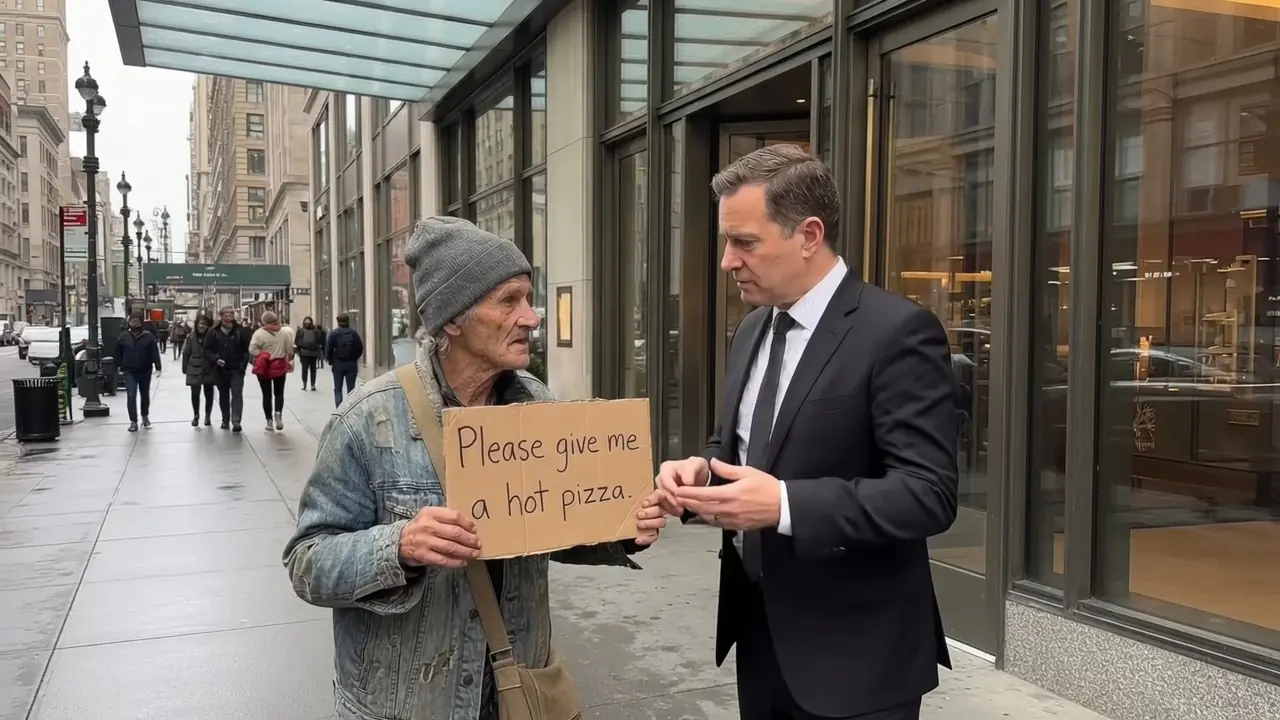
Marcus pointed toward the sidewalk. “Move along.” Walter did not move. “May I at least buy a small pizza if someone gives me enough?” Marcus smiled without warmth. “If you had money, you would not be standing here looking like a problem.”
Nora’s eyes flashed with anger. “He’s an elderly man.” Marcus lowered his voice, but it turned more dangerous. “And you are an employee who seems to forget her place.” Walter saw Nora swallow, saw her fingers tremble around the paper bag, and understood that Marcus did not save cruelty for strangers. He practiced it on anyone with less power.
The door opened again, and a customer named Allen Price stepped outside in a wool coat. He had been eating near the window with his teenage daughter, and his expression showed discomfort mixed with irritation. “Is there a problem here?” he asked. Marcus straightened at once, respectful now that a paying customer was speaking.
“No problem, sir,” Marcus said smoothly. “I am simply clearing the entrance.” Allen glanced at Walter and looked away. “Well, maybe do it quickly. My daughter doesn’t need to see this while she’s eating.” The words were not shouted, but they cut Walter more deeply than Marcus’s insults because they sounded ordinary.
Walter nodded slightly. “I apologize for disturbing your dinner,” he said. Allen shifted, embarrassed by the old man’s dignity. Marcus seized the moment and pointed down the block. “You heard the customer. Leave now, or I will call security to throw you out.” Nora whispered, “Mr. Vale, please.”
Marcus snapped his head toward her. “One more word and your shift is over.” Nora’s eyes filled with tears, but she did not back away. Walter looked at her and felt a sadness that was almost tenderness. In a building he owned, the only person brave enough to show mercy was the one with the least protection.
Walter reached slowly into his jacket. Marcus stepped back, suspicious. “What are you doing?” Walter pulled out a folded envelope, old but clean, sealed with Eleanor’s favorite paper clip. He did not open it yet.
Marcus scoffed. “If that is some sob story, save it.” Walter held the envelope in one shaking hand. “No sob story, Marcus.” The manager froze slightly at hearing his name from the old man’s mouth. Walter’s voice changed, not louder, but steadier.
Inside the restaurant, people had stopped pretending not to watch. Nora stared at Walter with confusion. Marcus’s face tightened as he tried to understand how this elderly stranger knew him. The cold air moved between them, carrying the smell of hot pizza through the open door.
Walter unfolded the first document. It was a property deed summary for the Madison building, followed by a corporate ownership letter bearing the seal of Reed Family Restaurants. Marcus looked at the papers, then back at Walter’s face, and the confidence drained from him one inch at a time. Walter removed his beanie slowly, revealing neatly combed white hair beneath the rough disguise.
“My name is Walter Reed,” he said. The customers near the door reacted first, a low murmur moving through them. Allen Price looked suddenly sick. Nora’s mouth parted, and her eyes dropped to the company logo on the paper.
Marcus took one step back. “Mr. Reed?” His voice cracked on the name. Walter did not smile. “Yes, Marcus. The hungry old man you wanted removed owns this building, this restaurant, and the company whose badge you are wearing.”
For a moment, Marcus looked like he might deny reality itself. “Sir, I didn’t recognize you.” Walter folded the paper carefully. “That was the point.” Nora looked down at the sidewalk, wiping quickly beneath one eye. Walter noticed but did not embarrass her by speaking of it yet.
Marcus forced a weak laugh and adjusted his suit jacket. “This is a misunderstanding. I was protecting the business environment.” Walter’s eyes hardened. “No, you were protecting your pride from the sight of someone poor.” Marcus’s face flushed, but he remained silent. The people by the window could hear every word now.
Walter turned slightly toward Nora. “This young woman offered to buy me food from her own break money.” Nora shook her head quickly, embarrassed. “It wasn’t much, sir.” Walter looked at Marcus again. “She had very little power, very little money, and more humanity than the manager I trusted with my wife’s restaurant.”
That sentence struck the hardest. Marcus knew the Madison location had been Eleanor Reed’s favorite because the staff manual mentioned it in the history section. He had once repeated that story during a corporate visit, smiling as if he respected it. Now the dead woman’s name stood between him and Walter like a witness.
Marcus lowered his voice. “Mr. Reed, if we could speak inside privately, I can explain.” Walter glanced at the customers watching through the glass. “You humiliated me publicly.” He stepped closer, his old eyes clear and cold. “Your explanation can stand where your cruelty stood.”
Nora looked frightened for him, but Walter did not need protection anymore. Marcus tried again, desperation breaking through his polished tone. “Sir, we get people asking for free food every day. If I allow one, more will come.” Walter nodded once. “And if one hungry person comes to a restaurant, the worst thing that can happen is that we feed them.”
Marcus stared at him, unable to answer. Walter continued, “My wife and I built this company by feeding people before we judged them.” His hand trembled, but his voice did not. “You turned that principle into a decoration on a training poster.”
Allen Price stepped forward awkwardly. “Mr. Reed, I didn’t mean anything by what I said.” Walter turned toward him. “Yes, you did.” Allen’s face reddened. “You wanted your daughter spared the sight of hunger, instead of taught how to answer it.” The man looked through the window at his daughter, who was watching with wide eyes.
Walter did not enjoy the shame in their faces. He had lived long enough to know that shame could either become growth or resentment. But he also knew silence protected the wrong people. So he let the moment breathe until every person in front of him understood the cost of looking away.
Then Walter faced Marcus one final time. “No need to call security, Marcus.” Marcus swallowed, hope and fear fighting across his face. Walter lifted the ownership papers slightly. “I came here to see your heart, and you just showed me an empty room.”
The words landed heavier than shouting. Marcus’s eyes dropped to the sidewalk. For the first time since stepping outside, he looked small. Not poor, not powerless, but small in the way cruel men become when power is removed from their hands.
Walter looked at Nora. “Would you please bring me one hot pizza?” Nora straightened, stunned. “Of course, sir.” Marcus started to speak, but Walter raised one hand. “Not from the kitchen yet. From your own choice, Nora.”
She understood. Nora turned and walked inside, and this time every customer watched her differently. A minute later, she returned with a small cheese pizza in a box, the kind employees could buy at discount. “I already paid for it,” she said softly. “Before he came outside, I was going to.”
Walter accepted the box with both hands. The warmth moved into his fingers, and for a moment he had to look away because it reminded him of Eleanor. “Thank you,” he said. “You gave before you knew I could return anything.” Nora’s chin trembled, but she nodded.
Then Walter opened the door and walked inside his own restaurant. The room fell quiet as he stepped past tables, still dressed like a forgotten old man, holding the pizza Nora had bought. He stopped in the center of the dining room and looked at the red brick walls Eleanor had loved. The place still had good bones, he thought, but it had been breathing bad air.
Patricia Reed arrived twenty minutes later. Walter had texted her one sentence: Come to Madison now. She entered in a charcoal coat, carrying a leather folder, her eyes moving from Walter’s clothes to Marcus’s pale face to Nora standing near the counter. Patricia had inherited Eleanor’s calm, but Walter saw the anger beneath it.
“Dad,” Patricia said carefully, “are you all right?” Walter nodded. “Hungry, mostly.” The line would have sounded amusing if the room were not still tense. Patricia looked at Marcus, and the manager straightened like a student before a principal.
Walter told her everything in front of Marcus. He did not exaggerate, did not decorate, and did not raise his voice. Nora confirmed the threats about her shift. Allen Price, to his credit, admitted what he had said, his voice low with shame while his daughter stared at the table.
Patricia opened her folder. “Marcus Vale, you are suspended immediately pending termination review.” Marcus’s face twisted. “Suspended? Over one misunderstanding?” Patricia’s eyes flashed. “Over a pattern that my father just confirmed with his own eyes.”
Marcus looked at Walter. “Sir, please. I have worked hard for this company.” Walter’s expression softened only slightly. “Hard work without character becomes danger when you are given authority.” Marcus opened his mouth, but no useful words came. A security guard from the neighboring building, called by Patricia, entered quietly and waited by the door.
Before Marcus left, Walter stopped him. “One more thing.” Marcus turned, humiliation burning across his face. Walter pointed gently toward Nora. “You owe her an apology.” Marcus looked as if the demand hurt more than the suspension.
Nora shook her head. “Mr. Reed, it’s fine.” Walter answered without looking away from Marcus. “No, it is not.” The room waited. Marcus’s jaw worked before he finally said, “I’m sorry, Nora.”
Walter’s eyes narrowed. “For what?” Marcus looked trapped. “For threatening your job when you were trying to help.” Nora held his gaze for one brave second. “Thank you,” she said, though her voice was still shaking.
After Marcus was escorted out, the restaurant did not immediately become cheerful. Customers whispered, employees moved carefully, and the ovens continued humming as if nothing historic had happened. Walter sat in the back booth, the one elderly customers used to favor, and opened the pizza Nora had bought. He took one bite and closed his eyes.
Patricia sat across from him. “You scared me,” she said. Walter chewed slowly, then swallowed. “I scared myself a little.” She looked at his worn jacket and tired face. “Mom would have hated seeing you stand out there like that.” Walter smiled sadly. “No. Your mother would have stood beside me with a bigger sign.”
Patricia looked toward Nora, who was quietly helping another employee at the counter. “She did the right thing.” Walter nodded. “When it cost her something.” Patricia understood the difference. Many people were kind when kindness was praised; fewer were kind when kindness threatened their paycheck.
By closing time, Walter had made his decision. Nora Mills would not remain a delivery driver struggling under cruel management. She would enter the company training program with full pay, mentored directly by Patricia’s regional team. The Madison location would receive new leadership, and every Reed restaurant would restore Eleanor’s old rule: no hungry elderly person, child, veteran, or worker would ever be turned away without food.
The next morning, the story spread faster than Walter expected. Someone had filmed part of the confrontation through the window, and by noon, local news stations were calling Reed Family Restaurants for comment. Patricia wanted a polished statement, but Walter wrote his own. It was short, plain, and sounded exactly like him.
“We failed when one of our restaurants made hunger feel unwelcome,” the statement said. “We are correcting that failure today.” It did not mention Marcus by name. Walter believed consequences were necessary, but cruelty did not need to become entertainment.
Two days later, Walter returned to the Madison restaurant in his good navy suit. The staff stood straighter when he entered, but he waved them back to work. Nora saw him from the counter and looked nervous, as if kindness had turned her life upside down too quickly. Walter walked to her and handed her an envelope.
She stared at it. “Sir?” Walter smiled. “Training program details, new salary, and a schedule that lets you still pick up your son from school.” Nora’s eyes filled instantly. “How did you know I had a son?” Walter nodded toward Patricia, who stood nearby. “Good leaders learn what their people carry.”
Nora covered her mouth with one hand. “I don’t know what to say.” Walter looked around the restaurant, now smelling of fresh dough and busy ovens. “Say you will remember how it felt to stand outside with me.” Nora lowered her hand and nodded. “I will never forget.”
That afternoon, an elderly man named Henry Collins came into the restaurant with only three dollars in his pocket. He asked quietly what he could afford. Nora heard him before anyone else and brought him to the back booth. She placed a hot slice, soup, and coffee in front of him, then marked the meal under the new Eleanor Fund button Patricia had added to the register.
Walter watched from near the kitchen doorway. Henry ate slowly, his hands wrapped around the coffee cup as if it were a small fire. No one stared, no one rushed him, and no manager told him he was bad for business. For the first time in months, Walter felt the Madison restaurant begin to resemble the place Eleanor had loved.
A week later, Marcus sent a letter. He apologized to Walter, to Nora, and to the company. Patricia suspected it was written partly because his lawyer advised it, but Walter read it anyway. The apology was careful, but one line felt honest: I confused control with leadership, and I forgot that every customer is a person before they are a transaction.
Walter did not give Marcus his job back. Mercy, he believed, did not require returning power to someone who had abused it. But he wrote a short reply telling Marcus to become better before seeking another position over people. It was not forgiveness exactly, but it was not revenge either.
Winter came early to Chicago that year. Snow dusted the sidewalks, and the Madison restaurant became busier than ever. The back booth filled every afternoon with elderly neighbors, bus drivers, tired workers, and sometimes people who simply needed warmth. Nora learned scheduling, inventory, customer service, and the harder art of correcting staff without humiliating them.
One evening in December, Walter sat alone in that back booth after the dinner rush. Patricia had gone home, Nora was closing the register, and the streetlights reflected on the front windows. He placed one hand on the wooden table and thought of Eleanor’s fingers tapping there years earlier. She would have liked Nora, he knew.
Nora came over with a small pizza box. “For you, Mr. Reed,” she said. Walter looked up. “I didn’t order.” She smiled. “No, but an old man once stood outside asking for one hot pizza, and I think he should finally get it without having to hold a sign.”
Walter laughed softly, then wiped one eye before she could pretend not to see. “Thank you, Nora.” She sat across from him for a moment, no longer just an employee, but someone trusted with part of his wife’s legacy. Outside, people hurried through the cold, but inside, the restaurant glowed with clean light, warm food, and the quiet dignity of being seen.
Walter opened the box and took in the smell of melted cheese and fresh bread. It was simple food, the kind he had built a life around. But that night, it tasted like proof that a place could lose its way and still be called back by one brave act of kindness. And Walter Reed, who had pretended to be invisible, finally saw his restaurant become visible to the people who needed it most.