The Saturday morning crowd had only begun filling Bennett Galleria when Arthur Bennett stepped out of a city taxi with one hand around his wooden cane. The shopping center rose above Michigan Avenue in polished stone and glass, its entrance framed by silver columns and carefully trimmed trees. Arthur paused beneath the revolving doors while his granddaughter-in-law, Emily Bennett, paid the driver before he could reach for his wallet. She returned to his side and gently took his arm as though supporting him were the most natural thing in the world.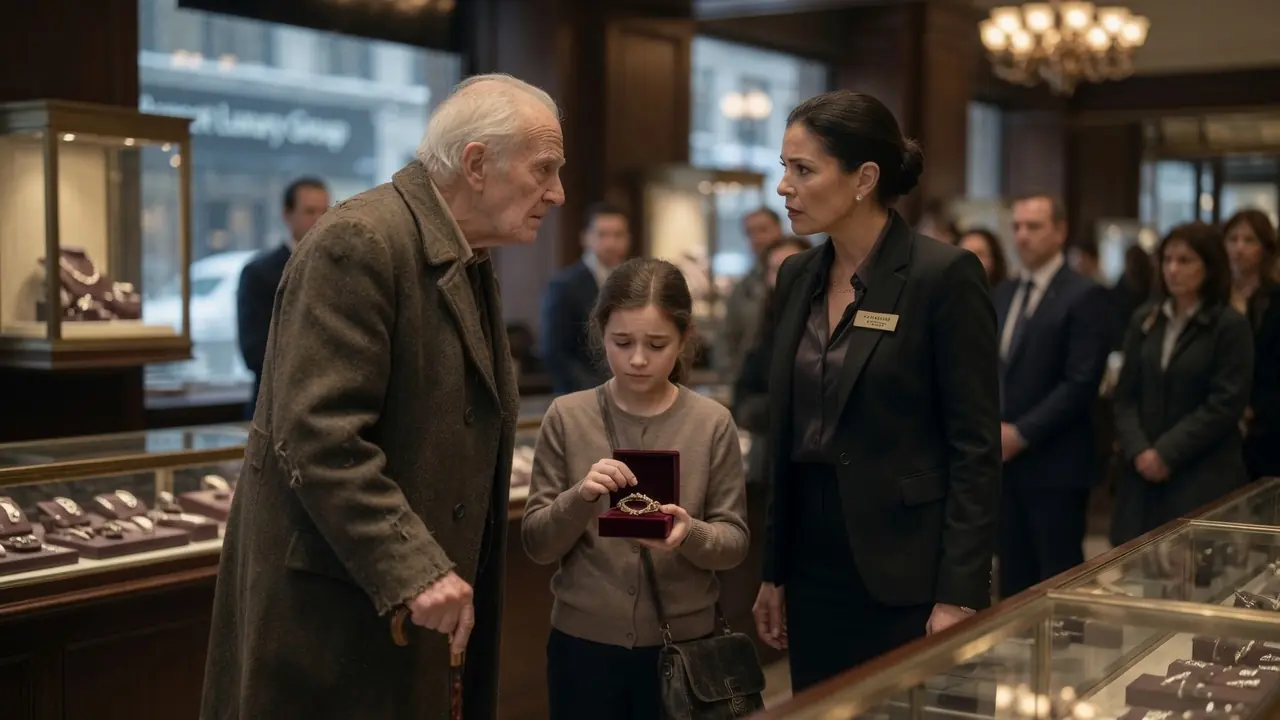
“You promised to let me pay today,” Arthur said.
“You promised not to argue with me before lunch,” Emily replied.
Arthur gave her a wounded expression.
“I made no such promise.”
“You nodded.”
“I was adjusting my hearing aid.”
Emily laughed, and the sound followed them into the bright central hall.
At seventy-eight, Arthur could still walk without assistance on good days, but hip surgery six weeks earlier had left his balance uncertain. His grandson Daniel worked long hours as a civil engineer and had offered to hire a private nurse, yet Emily insisted on helping Arthur herself. She brought meals, organized his medication, drove him to physical therapy, and sat beside him through the nights when pain made sleep impossible.
Arthur had spent most of his life surrounded by employees and advisors.
Very few people had ever cared for him without expecting something in return.
Emily did not know that Arthur had asked Daniel to bring her to Bennett Galleria under the excuse of needing new shoes. She believed they were simply spending the morning together while Daniel attended a construction meeting. Arthur had another purpose.
He intended to buy her a gift.
Not a small thank-you card or flowers that would fade within a week, but something she could keep long after he was gone. His late wife, Margaret, had always believed gratitude should be expressed while the person was still present to receive it. Arthur had failed to do that often enough during their marriage, and he had no intention of repeating the mistake with Emily.
“You have been staring at that jewelry store for ten minutes,” Emily said as they reached the second floor.
Arthur looked toward Maison Laurent.
The boutique occupied the most prestigious corner of the shopping center. Its entrance was framed in black marble, and its windows displayed diamond necklaces beneath narrow beams of white light. Security guards stood at both ends of the corridor, while elegantly dressed employees moved between glass counters inside.
“I thought we might look around,” Arthur said.
Emily followed his gaze and immediately shook her head.
“That place looks expensive.”
“Looking is free.”
“The salespeople might charge us for breathing.”
“Then I’ll hold my breath.”
She smiled but did not move.
Arthur wore a faded brown coat, dark trousers, and leather shoes that had been repaired twice. His clothes were clean and well maintained, but nothing about him suggested private wealth. Emily wore a simple blue dress under an inexpensive cream cardigan, and the handbag on her shoulder came from a neighborhood market.
Neither looked like Maison Laurent’s usual customer.
That was partly intentional.
Arthur had founded Bennett Luxury Group more than forty years earlier, but after handing daily control to a professional board, he stopped attending public openings and corporate events. Most newer employees knew his name only from documents. His photograph had not appeared in company advertising for nearly a decade.
Bennett Galleria still belonged to one of Arthur’s private holding companies.
Yet he had not entered the building as its owner in years.
He preferred arriving without assistants because people behaved differently when they believed nobody important was watching. A doorman who ignored an elderly stranger often became remarkably attentive after learning the stranger’s name. Arthur had seen it too many times to mistake performance for respect.
“Come with me,” he told Emily.
“I don’t need jewelry.”
“That is not the same as not deserving it.”
Emily looked at him suspiciously.
“What are you planning?”
“A peaceful shopping trip.”
“With you, peaceful usually means someone receives a legal notice.”
Arthur placed one hand over his heart.
“You wound me.”
She guided him toward the boutique anyway.
A young sales associate named Leah noticed them first. She stood near the entrance arranging appointment cards and began walking forward with a welcoming smile. Before she could reach them, the boutique manager stepped from behind the central display.
Vanessa Cole was forty-three, tall, controlled, and dressed in a charcoal suit that appeared tailored to the millimeter. Her hair was pinned neatly behind her head, and a small diamond brooch marked her position as manager. She looked first at Emily’s handbag, then at Arthur’s cane and repaired shoes.
Her expression changed.
It was subtle enough that most people might have missed it.
Arthur did not.
“Leah,” Vanessa called, “the Harrington consultation room needs more champagne.”
Leah stopped.
“But I was going to greet—”
“Now, please.”
Leah gave Arthur and Emily an apologetic glance before walking away.
Vanessa did not welcome them.
She watched as they approached a glass case filled with bracelets. Emily leaned slightly closer to examine a thin platinum piece set with small blue sapphires. It was elegant without appearing extravagant.
“That one is beautiful,” Arthur said.
“It probably costs more than our car.”
“Daniel’s car needs replacing anyway.”
Emily lowered her voice.
“Grandpa, please behave.”
Arthur smiled and reached toward the edge of the counter.
Vanessa moved quickly between them and the display.
“You may look,” she said, “but you are not permitted to touch anything.”
Emily immediately stepped back.
“I wasn’t touching it.”
“You were leaning over the glass.”
“I was trying to see the design.”
Vanessa folded her hands in front of her.
“Our pieces are valuable, and we maintain strict handling rules.”
Arthur looked toward another counter. A young man in jeans and a sports jacket was holding a diamond watch while his companion recorded him on her phone. No employee appeared concerned.
“Does the rule apply to everyone?” Arthur asked.
Vanessa followed his gaze.
“That gentleman has an appointment.”
“You did not ask whether we had one.”
“Do you?”
“No.”
“Then the situation is different.”
Arthur rested both hands on his cane.
“I would like to see the sapphire bracelet.”
Vanessa gave a restrained smile.
“That collection begins at eighteen thousand dollars.”
Emily touched Arthur’s sleeve.
“We can leave.”
Arthur remained where he was.
“I did not ask the price.”
Vanessa looked directly at his coat.
“I am trying to save all of us from an uncomfortable situation.”
“What situation would that be?”
“The embarrassment of selecting merchandise outside your realistic budget.”
Emily’s cheeks reddened.
Arthur felt her hand tighten around his arm. She had spent years learning to hide discomfort so other people would not feel guilty for causing it. Arthur recognized the habit because Margaret had done the same thing when they were young and poor.
“We only wanted to look,” Emily said quietly.
“And you have looked,” Vanessa replied. “Perhaps the department store downstairs would offer more suitable options.”
Arthur’s voice remained calm.
“My granddaughter-in-law cared for me after surgery. I brought her here because I wanted to buy her something beautiful.”
“That is a kind thought.”
Vanessa’s tone made the words sound like an explanation offered to a child.
“But kindness does not alter pricing.”
Arthur studied her face.
“Did I ask you to lower the price?”
“No.”
“Did I ask for credit?”
“No.”
“Did I attempt to touch the merchandise?”
Vanessa hesitated.
“You moved close to the display.”
“So do customers who wish to see jewelry.”
Several people nearby had begun watching. A middle-aged woman seated beside the private fitting room lowered her champagne glass. The young man holding the watch returned it to its tray.
Vanessa noticed the attention and became more defensive.
“Sir, Maison Laurent has standards.”
“Standards of service?”
“Standards of clientele.”
Emily looked down.
Arthur’s calm began turning cold.
“And which standard have we failed?”
Vanessa glanced at his shoes again.
She did not answer directly.
Instead, she raised one hand toward Leah, who had returned from the consultation room.
“Please contact security.”
Leah froze.
“Security?”
“These guests are refusing to cooperate.”
“We haven’t done anything,” Emily said.
Vanessa turned toward her.
“You were warned not to touch the displays, yet you continue arguing.”
“I never touched them.”
“You are disrupting other customers.”
Arthur looked around the boutique.
Nobody appeared disrupted except by Vanessa’s behavior.
One customer had begun recording on his phone.
Arthur faced the manager again.
“Why are you determined to remove us?”
Vanessa lowered her voice, though not enough to prevent others from hearing.
“Because this is not a public shelter where people wander in to pass time.”
Emily stared at her.
The insult struck harder than the earlier comments because Vanessa had finally abandoned the language of policy. Arthur saw humiliation spread across Emily’s face. She had worked double shifts during college, cared for her younger siblings, and entered the Bennett family without ever asking for money, yet one glance at her handbag had reduced her to someone considered unworthy of standing near a bracelet.
Arthur took out his phone.
Vanessa’s mouth tightened.
“Calling someone will not change our decision.”
“I am not calling anyone.”
He opened a secure company application and typed a short message to Samuel Price, Bennett Galleria’s property director.
Begin an immediate tenant conduct review at Maison Laurent. Freeze all security recordings. Send the ownership notice to every store device.
Arthur pressed send.
Emily watched him.
“Grandpa, what did you do?”
“Something I should have done earlier.”
For several seconds, the boutique remained silent.
Then Vanessa’s phone vibrated.
Leah’s device sounded next, followed by every employee phone in the showroom. The tablet at the reception desk displayed a red notification, and the large promotional screen behind the central counter faded to black.
White letters appeared across it.
NOTICE OF IMMEDIATE COMPLIANCE REVIEW
AUTHORIZED BY ARTHUR BENNETT
FOUNDER, BENNETT LUXURY GROUP
OWNER, BENNETT GALLERIA
A photograph appeared beneath the message.
It showed a younger Arthur standing beside the shopping center on the day construction began.
Leah covered her mouth.
One of the salesmen looked from the screen to the elderly man with the cane. Vanessa remained motionless, her face slowly losing color.
“Why is your name on that notice?” she whispered.
Arthur placed the phone back inside his coat.
“Because I came here to buy my granddaughter-in-law a gift in a building I own.”
Emily stared at him.
“You own this shopping center?”
“I planned to explain over lunch.”
“You said we were buying shoes.”
“I may have simplified the itinerary.”
Vanessa stepped closer.
“Mr. Bennett, I had no idea who you were.”
Arthur’s expression hardened.
“That is not a defense.”
“I believed you were—”
She stopped.
“A man who could not harm your career?” Arthur asked.
“No.”
“A poor customer?”
Vanessa glanced toward the people recording.
“This has been misunderstood.”
Arthur pointed toward Emily.
“You told my granddaughter-in-law she belonged in a department store downstairs.”
“I was suggesting a broader price range.”
“You compared us to people wandering into a shelter.”
“I used the wrong words.”
“You called security.”
“I was protecting the boutique.”
“From two people asking to see a bracelet?”
Vanessa’s practiced confidence collapsed.
She turned toward Emily.
“I apologize if you felt unwelcome.”
Emily looked at Arthur, then back at the manager.
“You are not apologizing for what you did. You are apologizing because you discovered who he is.”
Vanessa opened her mouth but found no answer.
The boutique doors slid open.
Samuel Price entered with the shopping center’s legal counsel, two compliance officers, and the head of building security. Samuel had worked for Arthur for nearly twenty years and recognized the danger in his silence.
“Mr. Bennett,” Samuel said.
“Preserve every recording from this morning.”
“It has already been secured.”
“Also preserve employee messages, customer complaints, and service records from the past two years.”
Vanessa’s eyes widened.
“Two years?”
Arthur looked at her.
“Was today an isolated mistake?”
“Yes.”
Leah lowered her gaze.
Arthur noticed.
“Miss, what is your name?”
“Leah Morgan.”
“Was today an isolated mistake?”
Vanessa turned sharply.
“Leah, think carefully before answering.”
Arthur tapped his cane once against the marble floor.
“She should think carefully because the truth matters, not because you are threatening her.”
Leah’s hands trembled.
“No, Mr. Bennett,” she said. “It wasn’t isolated.”
The boutique became completely silent.
Leah explained that employees were encouraged to identify “high-value clients” within thirty seconds of entry. People who wore inexpensive clothing, appeared elderly, spoke with strong accents, or asked about prices too early were labeled unlikely buyers. They were discouraged from touching merchandise and sometimes directed toward other stores.
“Vanessa called it protecting sales efficiency,” Leah said.
“That is standard luxury retail strategy,” Vanessa interrupted.
“No,” Arthur replied. “That is prejudice assigned a professional name.”
A second employee spoke.
He admitted that customers were sometimes followed by security based solely on appearance. Another employee revealed that complaint forms had been rewritten before reaching the corporate office. Vanessa had regularly described insulted customers as aggressive or confused.
Emily listened in disbelief.
“How many people did you treat this way?” she asked.
Vanessa’s face tightened.
“We operate a business, not a social program.”
Arthur looked at Samuel.
“Suspend her pending a complete investigation.”
Vanessa stepped backward.
“You cannot suspend me. I work for Maison Laurent.”
Samuel’s attorney opened a folder.
“Your lease gives Bennett Galleria the authority to remove tenant employees whose conduct creates legal or reputational risk to the property. Maison Laurent’s corporate office has already authorized temporary action.”
Vanessa stared at Arthur.
“You contacted them that quickly?”
“I did not build this company by moving slowly when people were being mistreated.”
Her voice became desperate.
“Please, Mr. Bennett. I have worked here for nine years.”
“How many years did customers leave this store believing they were not good enough to enter?”
“I was following company expectations.”
“Then the company will be investigated with you.”
Vanessa looked toward Emily.
“This happened because I did not recognize your family.”
Emily shook her head.
“That is exactly why it happened.”
Security escorted Vanessa to her office to collect her belongings. No one applauded, and Arthur did not smile. Watching someone lose authority gave him no pleasure because the damage had already been done to people who would never witness the consequences.
Maison Laurent closed for the rest of the day.
Arthur asked customers to leave contact information if they had seen or recorded the confrontation. Several agreed, including the young man who had been trying on the diamond watch. He canceled his purchase and told the corporate representative he would not return until the boutique changed its practices.
Emily remained beside the sapphire bracelet.
She looked at Arthur with a mixture of anger, surprise, and affection.
“You own the entire building and still let me pay for your taxi?”
“I believe in encouraging independence.”
“You also let me carry your groceries.”
“That was physical therapy.”
“For me?”
“For both of us.”
Emily tried not to laugh, but the tension broke.
Arthur looked at the bracelet through the glass.
“Do you still like it?”
“We are not buying jewelry after this.”
“Why not?”
“Because everyone will think they have to give it to me.”
“Then we will pay the listed price.”
“You don’t owe me eighteen thousand dollars.”
“I know.”
“You don’t owe me anything.”
Arthur’s expression softened.
“I also know that.”
Emily turned toward him.
“Then why are we here?”
He took a breath.
“Because you cared for me when I was frightened.”
She looked surprised.
“You were never frightened.”
“I was terrified.”
Arthur rarely admitted weakness, even to himself. After surgery, he had awakened unable to move his leg and convinced he would never walk independently again. Emily had sat beside the hospital bed and talked to him through the panic, never treating his fear as foolish.
“You stayed when I was angry,” he continued. “You brought me food when I refused to eat. You made me walk when I wanted to remain in bed and complain.”
“You complained while walking too.”
“I am talented.”
Emily’s eyes filled with tears.
Arthur reached for her hand.
“I cannot repay care like that, and I do not want to turn love into a debt. I simply wanted you to have something that reminded you how much you mean to this family.”
Emily looked at the bracelet again.
“Then not this one.”
Arthur frowned.
“You said it was beautiful.”
“It is, but I want something connected to Grandma Margaret.”
Arthur became still.
Emily had never met Margaret, who died two years before Daniel brought her home for the first time. Yet she often asked about her, cooked recipes from her notebooks, and kept one of her photographs near the kitchen window.
Arthur reached inside his coat and removed a small cloth pouch.
“I brought this just in case.”
Inside was Margaret’s old sapphire brooch.
The metal setting was damaged, and one small stone was missing, but the center sapphire remained deep blue. Margaret had worn it to every company anniversary dinner during the first twenty years of Bennett Luxury Group.
Emily touched the edge of the pouch.
“You carried this all morning?”
“I wanted to ask whether they could make it into something for you.”
Her tears finally fell.
“That would mean more than anything in those cases.”
The boutique’s senior jeweler, who had not participated in the confrontation, offered to examine the brooch. Arthur insisted the work be processed as an ordinary paid commission, with no discount and no special treatment beyond careful craftsmanship.
The jeweler designed a simple bracelet around Margaret’s sapphire.
It would take six weeks to complete.
During those six weeks, the investigation into Maison Laurent uncovered twenty-seven customer complaints that had never reached corporate leadership. Security recordings showed elderly shoppers ignored for long periods, a delivery worker being followed between cases, and a young couple asked to leave after questioning a financing fee.
Vanessa had personally approved most of those decisions.
Her employment was terminated.
Maison Laurent’s regional director also resigned after emails showed that he encouraged managers to focus exclusively on customers who “looked immediately profitable.” The company paid settlements to several affected shoppers and agreed to an independent monitoring program as a condition of keeping its lease.
Arthur could have evicted the boutique.
Some members of his board advised him to do exactly that. They argued that ending the lease would send the strongest message and protect Bennett Galleria’s reputation.
Emily disagreed.
“Closing the store punishes every employee,” she said during dinner one evening. “Some were afraid, but some tried to help.”
“Fear does not excuse silence,” Arthur replied.
“No, but people can learn to speak.”
Arthur considered her words.
The final agreement allowed Maison Laurent to remain under strict conditions. Employees received equal-service training from an outside organization, complaints went directly to an independent office, and commission structures were changed so workers were not rewarded for ignoring customers considered unlikely to spend large amounts.
Leah became assistant manager.
She accepted only after apologizing to Arthur and Emily.
“I should have stepped in sooner,” she said. “I knew what Vanessa was doing.”
Emily answered before Arthur could.
“Next time, step in before you know who is watching.”
Six weeks later, Arthur and Emily returned to collect the bracelet.
They wore the same clothes they had worn during their first visit.
Leah welcomed them at the entrance, then greeted the elderly couple behind them with equal attention. No champagne appeared, no employees gathered, and nobody behaved as though Arthur’s arrival required a performance.
That pleased him more than ceremony would have.
The jeweler opened a narrow velvet box.
Margaret’s sapphire rested at the center of a delicate platinum chain. The original brooch frame had been preserved beneath the setting, its scratches still visible on the back. A small engraving read: Care freely given is never forgotten.
Emily covered her mouth.
Arthur fastened the bracelet around her wrist.
“It is perfect,” she whispered.
“No,” Arthur said. “It is slightly too large.”
She laughed through her tears.
“You always have to ruin the moment.”
“I am protecting you from losing it.”
The jeweler adjusted the clasp.
Arthur paid the full invoice and requested an itemized receipt. He did not ask for a family discount, and nobody offered one. The transaction was ordinary, which made it feel honest.
As they left, they passed a woman wearing a grocery-store uniform. She stood uncertainly near a display of silver necklaces while holding a small envelope of cash.
A sales associate approached her.
“Welcome to Maison Laurent. What may I help you find today?”
The woman explained that she wanted an anniversary gift but had only three hundred dollars. The employee did not look disappointed or direct her toward the exit. She brought out three pieces within the budget and invited the woman to take her time.
Arthur stopped walking.
Emily followed his gaze.
“That is what you wanted, isn’t it?” she asked.
“Yes.”
“Not revenge.”
“No.”
Arthur had learned that humiliation could be punished in a moment, but culture changed only through repeated choices. Vanessa’s removal mattered, yet the true test would come on ordinary days when nobody powerful entered the boutique.
Months later, Bennett Galleria introduced a service charter across every store.
It contained no complicated language about customer value, luxury standards, or market positioning. The first rule was printed in large letters inside each employee room.
Respect is offered before wealth is proven.
Some retailers complained that the rule was unnecessary.
Arthur told them any business uncomfortable promising dignity should reconsider why it deserved customers.
Emily wore Margaret’s bracelet during her and Daniel’s first wedding anniversary. She also wore it when Arthur completed his final physical therapy session and walked through the clinic without his cane.
He claimed the applause embarrassed him.
Then he made the therapist record it twice.
Outside the clinic, Emily offered him her arm from habit.
Arthur took it even though he no longer needed the support.
“You know,” she said, “most grandfathers buy flowers.”
“Flowers die.”
“Most grandfathers also admit when they own a shopping center before security is called.”
“That would have damaged the educational value of the morning.”
Emily shook her head.
“You are impossible.”
Arthur smiled.
“That is why you take such good care of me.”
The story later spread through Chicago as the day a rude manager discovered that the poorly dressed elderly man owned the entire building. People enjoyed the reversal because it made arrogance look foolish and power appear at the perfect moment.
But Arthur always corrected those who told it that way.
Vanessa had not been wrong because she insulted a hidden millionaire.
She had been wrong because she insulted a human being.
Arthur’s ownership merely ensured that the truth could not be ignored.
Emily’s bracelet remained valuable because of the sapphire, the craftsmanship, and its connection to Margaret. Yet none of those things mattered as much as the quiet morning when Arthur placed it around the wrist of the woman who had helped him stand again.
He had entered Maison Laurent intending to buy gratitude.
He left understanding that gratitude could not be purchased.
It could only be expressed through respect, memory, and the willingness to protect another person’s dignity even when no reward was waiting behind it.