Gary Elkins had spent twenty years moving heavy drilling equipment into places where heavy equipment had no business going. He had crossed muddy leases in Wyoming, frozen access roads in Colorado, washed-out service tracks in Kansas, and creek beds that looked harmless until a man learned what kind of ground waited beneath the water. He was not careless, and he was not new. That was what made the morning at Lander Creek feel so humiliating.
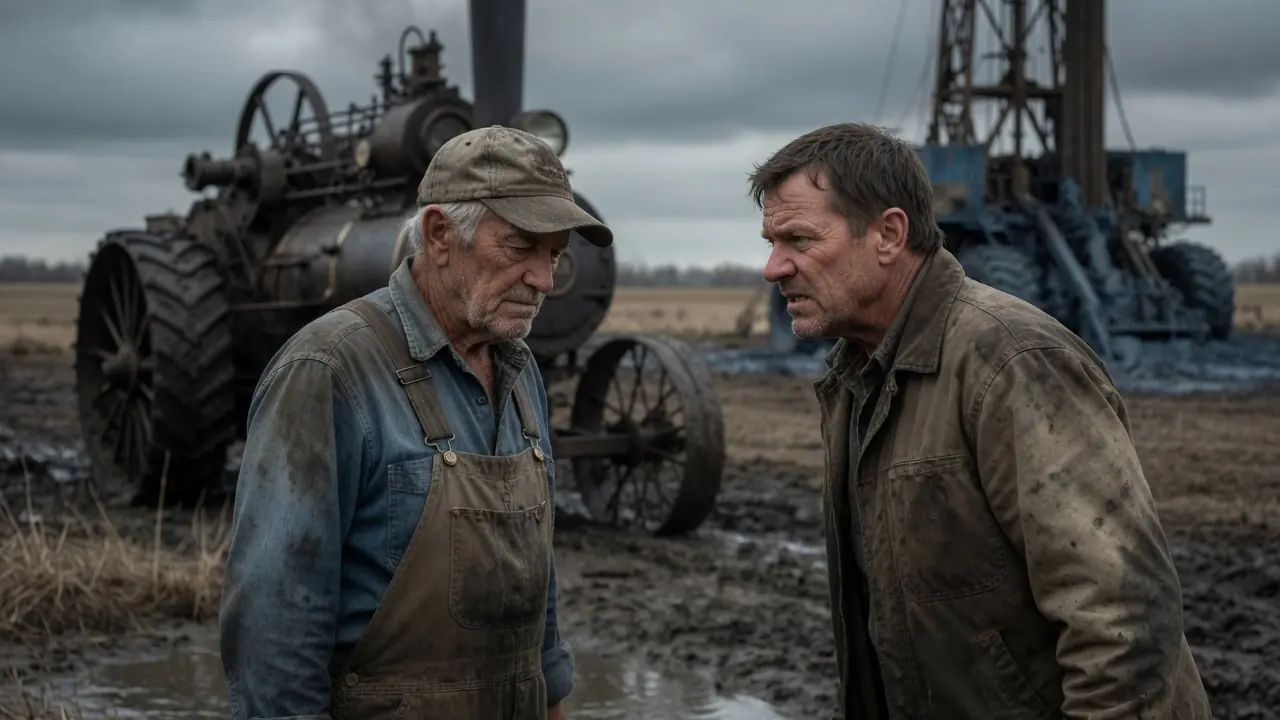
The rig was a 55-ton truck-mounted drilling unit, and by noon it looked less like equipment than a monument to a bad decision. Its front wheels had broken through the shallow gravel at the low-water crossing, and the blue clay beneath had swallowed the frame like wet cement. The chassis sat crooked in eighteen inches of water, nose angled downstream, wheels buried to the hubs. The diesel still ran, but the rig could not move an inch.
Gary stood on the bank with mud on his boots and fury burning behind his eyes. His crew stayed quiet because they knew the look on his face. A rig supervisor could survive mechanical trouble, weather trouble, even a bad road call if he fixed it fast enough. But a stuck rig in a creek, during a paid drilling schedule, with engineers already shaking their heads, was the kind of problem that followed a man’s name.
By the second day, the crane companies had both said no. The crane large enough to lift the rig could not safely set up on the bank because the same clay that trapped the rig would swallow the crane’s outriggers. The county road could not carry the axle load of the big recovery equipment without damage. The engineer from Kearney had written three pages of careful language that all meant the same thing: recovery was not practical unless they spent weeks building a temporary road and stabilizing the bank.
The insurance adjuster made it worse. He walked the site, took photographs, checked the policy, and explained that writing off the rig might cost less than recovering it. Gary listened without speaking. Every sentence sounded like someone lowering a lid over the machine he had kept running for four years.
Then Norma Kessler mentioned Cleat Warford. She stood near the fence line in work boots and a faded shirt, watching Gary stare at the creek like anger could pull steel from clay. Her family had farmed near Lander Creek for decades, and she knew that crossing better than any map. She told Gary there was an old farmer north of the county who still ran a working 1933 Case steam traction engine.
Gary nearly laughed. “Ma’am, I’ve got a 55-ton rig in a creek bed.”
Norma did not blink. “And you’ve got engineers who already told you they can’t help. Maybe ask the man who’s been pulling things out of this creek longer than they’ve been alive.”
Gary hated how little he had to lose. That evening, sitting in his truck with the written engineer’s report on the passenger seat, he opened the county phone book and found Warford, C. He dialed. Cleat answered on the second ring.
Gary explained everything, not because he believed the old man could solve it, but because desperation makes a man thorough. He described the rig, the angle, the depth, the clay, the crane reports, the insurance deadline, and the failed recovery options. Cleat listened without interrupting. When Gary finished, there was silence long enough that he thought the call had dropped.
Then Cleat asked, “Is the rig square to the current or angled?”
Gary sat up a little. “Angled about fifteen degrees. Nose downstream.”
“Drivetrain intact?”
“Yes. It runs. It just can’t get out of the clay.”
“South bank got gravel?”
“Some. A shallow bar maybe thirty feet out.”
Cleat paused again. “Then maybe you don’t have a lifting problem.”
Gary frowned. “What else would it be?”
“A moving problem.”
Gary looked through the windshield toward the dark outline of the creek. “The rig weighs 55 tons.”
“I know,” Cleat said. “I’m not planning to carry it home.”
The next morning, Cleat arrived at 6:45 in an old pickup, not with the steam engine yet, just himself, a thermos, and the kind of quiet that made other men feel loud. He was seventy-four, lean, weathered, and wore a work shirt that had seen more years than some machines. His cap was sweat-stained, his hands scarred and steady. He did not look impressive in the way engineers with clipboards looked impressive.
Gary met him at the bank. “You Cleat?”
“That’s right.”
Gary pointed toward the rig. “There it is.”
Cleat looked for a long time without speaking. That irritated Gary more than questions would have. He wanted motion, certainty, a decision. Cleat gave him none of that.
Finally, Gary snapped. “That is a 55-ton drilling rig, old man, not a stump for your museum tractor.”
Cleat turned his head slowly. His eyes were pale and calm, but there was nothing soft in them. “That’s why you failed already, Gary. You keep trying to lift what only needs to move.”
Gary stepped closer, anger rising because the old man had struck exactly where the embarrassment lived. “Two engineers said this recovery is impossible.”
Cleat wiped mud from his hands though he had not touched anything yet. “Then step aside and let a machine with patience teach your engineers what power actually means.”
No one spoke after that. Even Gary’s crew looked away because they knew their supervisor had been hit clean. Cleat did not gloat. He simply walked the bank.
For almost an hour, Cleat studied the ground with his feet. He pressed his heel into the gravel bar, stepped onto the edges where the gravel thinned, and tested the change from stone to clay. He walked like a man reading a page written under the soil. Then he waded into the creek, cold water up to his knees, and placed both hands against the rig’s frame.
Gary watched from the bank, arms crossed. He wanted to dismiss the old farmer. He wanted Cleat to say something foolish so the matter could be closed. Instead, Cleat moved with a careful certainty that made dismissal difficult.
Cleat pressed his boot into the blue clay near the buried front wheel. He watched how the water moved around the frame. He followed the line between the rig and the south bank, marking places in his mind where gravel still held beneath the water. After nearly two hours, he came back to the bank and stood beside Gary.
“The gravel bar will hold my Case,” Cleat said.
Gary’s mouth tightened. “You’re sure?”
“I’ve put her on worse.”
“What about the rig?”
Cleat looked at the buried machine. “Clay’s got suction on the frame. That’s the hard part. Break the suction slow, keep pressure steady, and the tires should ride the gravel once it starts moving.”
Gary shook his head. “You’re talking like this is simple.”
“No,” Cleat said. “Simple and easy aren’t the same thing.”
The insurance adjuster stepped forward carefully. “How much time would this take?”
Cleat looked at him as if the question itself was strange. “As long as it takes.”
Gary almost argued again, but something stopped him. The old man was not guessing. He was thinking from another world, one where machines did not win by speed, but by refusing to quit.
Cleat drove back to his farm at midmorning and fired the boiler after lunch. By four in the afternoon, the 1933 Case steam traction engine was rolling down the county road at four miles an hour. It moved like history had refused to stay in a museum. Steel wheels rang on gravel, smoke lifted into the summer air, and the exhaust chuffed with a deep, patient rhythm.
People noticed. A farmer shut off his tractor to watch it pass. A boy on a bicycle followed for half a mile. Two trucks fell in behind it at a respectful distance because word had already begun moving through the county. Cleat Warford was taking the old Case to Lander Creek.
Gary heard it before he saw it. A slow iron sound came down the road, nothing like a diesel truck or a modern tractor. When the Case appeared, Gary felt doubt return hard. The machine was huge, old, black with soot and age, its steel wheels tall and brutal, its boiler alive with pressure. It looked impossible and practical at the same time.
Cleat brought it onto the gravel bar and stopped exactly where he had planned. He climbed down, checked the ground again, then unloaded his rigging. Snatch blocks, steel cable, logging chain, railroad-rail anchor stakes, and tools worn smooth by decades of use. The crane engineers had returned to watch, and their expressions shifted from amusement to caution as they saw the rating stamped into Cleat’s blocks.
He worked until dark setting the anchors. He drove railroad rails into the south bank, two on each side, and checked their bite by feel. He ran the cable from the Case through the first snatch block, across the creek to a second block chained to the rig’s front frame, then back to a deadman anchor behind the Case. The setup gave him a two-to-one mechanical advantage.
Gary watched him rig, unable to keep quiet. “You think 36,000 pounds of pull is enough for 110,000 pounds of rig?”
Cleat did not look up. “If I were lifting it, no.”
“You’re not lifting it.”
“Now you’re learning.”
Gary clenched his jaw, but he stayed silent. Cleat checked every connection twice, then a third time at first light. He treated the cable like it was alive, coiling it correctly, guarding it from kinks, keeping every man away from the danger zone. A steel cable under load could kill faster than any mistake in the creek.
By 7:00 the next morning, the Case had pressure. The gauge held close to 140 pounds per square inch. A crowd had gathered on the south bank: Gary’s crew, two engineers, the insurance adjuster, Norma Kessler, farmers, families, and a photographer from the local paper. Gary hated the crowd at first. He did not want witnesses if the attempt failed.
Cleat climbed onto the Case platform. He looked once at the steam gauge, once at the rigging, once at the creek. Then he opened the throttle.
The flywheel began turning slowly. Steam entered the cylinders, and the old machine took the load without drama. The cable tightened inch by inch, not snapping, not jerking, just building tension until it hummed low across the creek. The snatch blocks groaned. The anchor stakes trembled but held.
For two minutes, nothing happened.
Gary felt heat crawl up his neck. The crowd watched in silence. The rig sat in the creek exactly where it had been, buried and stubborn. He imagined the engineers thinking what he had thought all along: the old farmer had brought a beautiful antique to lose an argument against blue clay.
Cleat did not change the throttle. He did not panic, surge, or pull harder to impress anyone. The Case chuffed once per second, steady and patient, applying the same pressure without flinching. The clay held.
Then the creek bed made a sound.
It was low, wet, and ugly, like the earth itself had taken a breath. The rig shifted six inches toward the south bank. Only six inches, but the crowd reacted as if it had leapt clear of the water.
Gary stepped forward, eyes wide. “It moved.”
Cleat kept his hands steady. “It’ll move more if you don’t start yelling at it.”
The rig moved again. A foot. Then another. The suction had broken, and once it broke, the impossible became work. Slow work, dangerous work, but work all the same.
At nine minutes, Gary waded into the creek and signaled his operator. The diesel engine of the drilling rig turned over and caught on the second try. Gary felt a surge of fierce pride through the fear. He had maintained that machine well, and now it answered him when he needed it.
Cleat kept pulling. The Case did not roar or lurch. It pushed steam through pistons, turned iron through gears, and held the line as if time itself was part of its horsepower. The rig’s front tires found gravel, then the rear wheels began to help. Slowly, the buried frame rose from the grip of the clay.
Twenty-seven minutes after the first pull, the drilling rig drove onto solid ground.
The crowd exploded. Men shouted, women clapped, and one of Gary’s crew laid on a truck horn until the sound echoed across the creek. The engineers stared at the rig like it had betrayed their report by surviving. Norma Kessler folded her arms and smiled like she had known the ending all along.
Cleat shut down the throttle.
The flywheel slowed. The cable slackened. The Case sat quietly on the gravel bar, smoke drifting upward, as if it had done nothing special at all.
Gary walked toward Cleat while the old farmer was already unrigging. That was the thing that struck him most. Cleat did not stand there accepting applause. He went straight to the cable, the blocks, the anchors, because a job was not finished until the equipment was put away safely.
“Mr. Warford,” Gary said.
Cleat looked up.
“I had two engineers and an insurance adjuster tell me that rig was gone.”
“I know.”
“How did you know it wasn’t?”
Cleat coiled another length of cable before answering. “They were answering the wrong question.”
Gary looked at him. “What question should they have asked?”
“Not how much force it takes to lift it,” Cleat said. “How much force it takes to start it moving.”
The Kearney engineer, standing nearby, heard that and stepped closer. His face was no longer skeptical. It was thoughtful, almost humbled.
Cleat continued, “You bring a crane mind to every problem, pretty soon everything looks like it needs lifting. Your rig didn’t need air under it. It needed patience beside it.”
Gary looked back at the rig on solid ground. Mud poured off the frame in heavy sheets. The machine looked bruised, but alive.
The engineer said quietly, “We calculated lift capacity. We didn’t calculate sustained lateral movement.”
Cleat nodded. “That’s why you got the wrong answer.”
No one argued.
Gary removed his cap and looked at the old man. “I was rude yesterday.”
“You were scared.”
“That doesn’t excuse it.”
“No,” Cleat said. “But it explains it.”
Gary held out his hand. “Thank you.”
Cleat shook it once. “Maintain that rig better than you talk to strangers.”
Gary gave a short, embarrassed laugh. “Fair enough.”
The rig went to Lexington for inspection over the next few days. The frame was sound, the drivetrain survived, and the drilling components were in better shape than anyone expected. Within two weeks, the machine was back at work. The insurance adjuster rewrote his notes. The engineer filed a supplemental report explaining that the recovery had succeeded by sliding the rig with sustained force instead of lifting it with a crane.
The report was three pages long, but everyone in the county summarized it differently. The engineers said it was impossible. Cleat brought the Case.
Gary paid Cleat three hundred dollars. Cleat had asked for two hundred and fifty. Gary insisted on the extra because sometimes money cannot say enough, but a man still tries to make it speak.
Cleat drove the Case home at four miles an hour through the summer evening. The machine chuffed along the road, smoke rising in a straight line above it. He stopped at Norma Kessler’s lane, and she came to the fence.
“I heard it worked,” she said.
“It worked.”
“I knew it would.”
Cleat’s mouth twitched. “I thought it would. There’s a difference.”
Back home, Cleat cooled the boiler properly, checked the flues, greased the guides, and wrote the job in his notebook. Lander Creek, drilling rig recovery, two-block rig, 27 minutes from movement to bank, boiler pressure held steady, machine ran well. That was all. No victory speech, no claim of genius, no insult toward the engineers.
But the story did not need decoration to travel. By the county fair, everyone had heard it. By harvest, men were telling it at grain elevators with their own hands shaping invisible cables in the air. By winter, children who had never seen steam power knew there had once been a rig in Lander Creek and an old Case that pulled it free when modern equipment could not.
Gary carried the lesson differently. He remained a good supervisor, but he became slower to dismiss local knowledge. When an old farmer said a crossing was bad, Gary listened. When a rancher warned that a dry-looking draw had no bottom after rain, Gary did not ask for a soil report before taking the warning seriously. He had learned, in front of seventy people, that expertise is not always wearing the newest jacket.
Years later, Gary returned to Dawson County for another job and stopped by Cleat’s farm. The old Case sat in the equipment barn, clean, greased, and ready. Cleat was older by then, moving slower, but his eyes were still sharp.
Gary stood beside the steam engine for a long time. “I still tell that story.”
Cleat checked a valve fitting with his fingers. “Tell it right?”
“I tell them I was wrong.”
“That’s a good start.”
“I tell them you saved the rig.”
Cleat looked at him. “The Case saved the rig. I just knew what to ask from her.”
Gary nodded. “That sounds more like you.”
Cleat smiled faintly. “Machines don’t like being credited for miracles. They prefer maintenance.”
In 2007, Cleat finally stopped running the Case himself. Arthritis had taken enough feeling from his fingers that he no longer trusted his hands with live steam. A man who could not fully feel a valve had no business managing a boiler at pressure, and Cleat respected the machine too much to pretend otherwise. He handed it to his nephew Dean, along with the service notebook that held decades of entries.
He told Dean one thing above all others. “Use her. Don’t let her sit. A machine that sits goes backward.”
Cleat Warford died in 2012 at ninety years old. He had farmed most of his life and run the Case for more than half a century. He left behind land, tools, stories, and a way of seeing problems that no manual could fully capture.
The Case still runs in Keith County. Dean fires it at fairs and heritage events, not as a dead relic but as a working machine under load. When the flywheel turns and the exhaust chuffs, people stop talking. They understand, even if only for a moment, that old does not mean weak and modern does not always mean right.
And at Lander Creek, the gravel bar is still there. Most people who drive past would never know that a 55-ton drilling rig once sank there and that two crane companies gave up on it. They would never know a furious drilling supervisor once mocked an old farmer’s steam tractor as a museum piece. They would never know that twenty-seven minutes of patient force changed what everyone thought was possible.
But in Dawson County, the story remains.
It is told because it is not really about steam against diesel, or old against new, or farmers against engineers. It is about the danger of answering the wrong question with complete confidence. It is about a man who knew his machine well enough to see what others missed.
The rig did not need to be lifted.
It needed to move.
And Cleat Warford, with his quiet eyes and ancient Case, knew that some loads only surrender when power stops trying to impress them and starts outlasting them.