Jason Keller walked into the John Deere dealership in Harrison County, Iowa, with dust on his boots and three years of numbers under his arm. The showroom smelled like new rubber, polished paint, coffee, and expensive promises. Green combines stood under bright lights like trophies, their metal clean enough to reflect the ceiling. Jason had grown up believing those machines were more than equipment, but that morning, he carried proof that pride had nearly cost his family everything.
The salesman at the center desk looked up before Jason reached him. His name was Grant Holloway, forty-five years old, white skin, slicked-back blond hair, clean green dealership polo, khaki pants, and the relaxed smile of a man who had spent years selling confidence to farmers already drowning in payments. Grant saw Jason’s faded plaid shirt, dusty jeans, and worn work boots before he saw the folder. His eyes dropped to the red-and-silver Massey Ferguson logo printed on the top report. His smile turned mean.
“Massey papers?” Grant said, loud enough for the nearby parts counter to hear. “Cheap iron doesn’t belong here.”
Jason stopped across from the table. He did not answer right away. He had expected the laugh, maybe even wanted it, because the numbers in his folder had been sharpened by three seasons of hard truth. He sat down, placed the folder on the sales table, and looked Grant directly in the eye.
“Cheap iron saved our farm,” Jason said.
Grant leaned back in his chair and tapped a pen against the tabletop. “One harvest doesn’t beat John Deere pride.”
Jason opened the folder slowly. “Pride didn’t pay our debt. The numbers did.”
Grant’s pen stopped tapping, but his smirk stayed in place. He had heard desperate farmers talk before, and he knew the tone of a man trying to justify a bad purchase. In his mind, Jason Keller was another young operator who had bought a used machine at auction, gotten lucky once, and walked into a dealership pretending luck was wisdom. Men like that usually came back by the second breakdown, asking about financing with softer voices.
Jason knew exactly what Grant saw. A young farmer with no polish, no new truck outside, no salesman-friendly confidence. He knew Grant had already decided that a green showroom outranked a brown folder. But Jason had not come to beg for respect; he had come because Grant Holloway had called his father the week before and laughed about the Keller farm “running auction leftovers.”
That phone call had brought Jason here.
The Keller farm had been under pressure since the commodity crash of 2014. Equipment financing had piled up faster than profit, and every season felt like working just to keep lenders calm. Jason’s father, Tom Keller, had believed in brand loyalty like other men believed in church hymns. His father bought the same color, his grandfather bought the same color, and Tom thought survival meant staying with what the family had always trusted.
Jason had believed that too, until the bills started telling a different story. Interest alone had been eating money they needed for seed, fuel, repairs, and the kind of breathing room a farm never appreciated until it disappeared. Their machine shed was full of expensive loyalty and quiet panic. Every time Jason ran the numbers, the same truth came back: tradition was not lowering the payments.
That was why he had gone to the auction in Missouri and bought a used Massey Ferguson 9545. Six years old, lower hours, clean engine, bigger grain tank, and a price low enough to make sense. His father had stared at that red-and-silver combine when it rolled into the yard like Jason had brought home a betrayal. For four days, Tom barely spoke to him.
Then harvest started.
The Massey cut more acres per day than the machine they had trusted for years. It burned less fuel, ran cooler, lost less grain, and did not call for help every time the pressure got heavy. While the old machine waited on parts, the Massey kept moving under field lights. By the end of the season, Jason had numbers no salesman could dismiss without lying.
Grant Holloway had not seen those numbers. He had only heard that the Keller farm had switched brands and decided to turn it into a joke. At the co-op, he had told two neighbors that Jason Keller would be “back in green before he learned how expensive cheap could get.” The words reached Jason by supper. Tom had heard them too and said nothing, but Jason saw the old pain in his father’s face.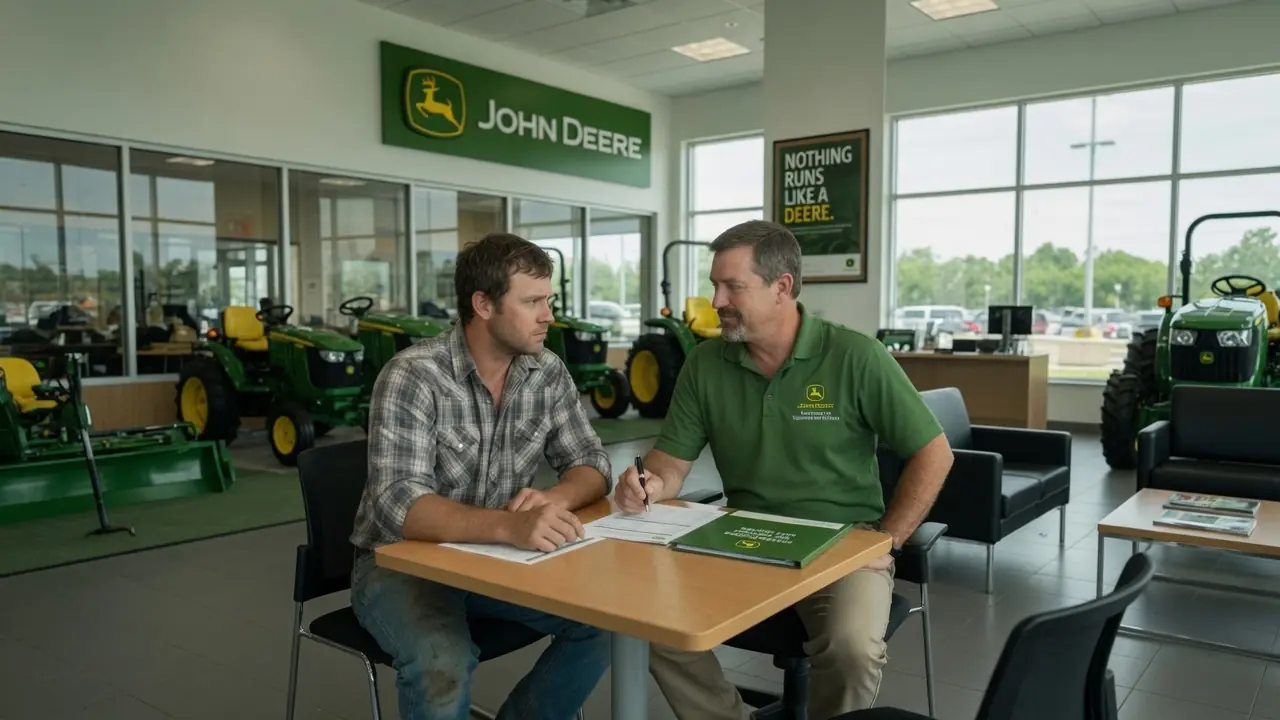
So Jason printed every report.
Fuel cost. Acres cut. Service calls. Grain loss. Operating expense. Auction price. Loan payoff. Resale estimate. He put them all in a folder, drove to the John Deere dealership, and decided if Grant wanted to laugh, he could laugh at the math in person.
“No,” Jason said. “The harvest did.”
Grant picked up the page with two fingers. “These are your numbers.”
“They came from our fuel logs, field records, service invoices, and elevator tickets.”
“Still your numbers.”
Jason pulled out another sheet. “Then here are the parts invoices. Here are the dealer service bills. Here’s the loan statement before we sold the second machine. Here’s the auction settlement after we sold it. Here’s the balance after we paid down interest.”
Grant’s smile tightened. “You came prepared.”
“I came tired.”
The words were quieter than Grant expected. For a second, the salesman looked up from the papers and saw something under Jason’s calm that made the joke less easy. Jason was not there for entertainment. He was there with the face of a man who had watched his family farm stand eighteen months from foreclosure and had been forced to choose between hurting his father’s pride or losing everything that pride was supposed to protect.
Grant looked away first.
He tapped the paper again. “A used Massey had one good season. That doesn’t rewrite the market.”
Jason slid the second page forward. “It had three.”
Grant’s eyes flicked down.
Jason continued, “First season, it handled over half our harvest with zero service calls. Second season, we ran it harder because weather gave us three days to finish before rain. It held. Third season, it cut over six thousand total acres across corn and beans since we bought it, with operating costs lower than what we were paying before.”
Grant’s jaw moved slightly. “You expect me to believe one used machine carried your whole operation?”
“No,” Jason said. “I expect you to read.”
That hit harder than shouting would have. Grant leaned forward, pride pulling him back into the fight. “Careful, kid.”
Jason did not move. “I was careful when I drove seven hours to the auction. I was careful when I checked the engine, hours, belts, tank, tires, and service history. I was careful when I took a decision home that made my father stop talking to me. I’m done being careful with men who laugh before looking.”
Grant’s face flushed. His pen began tapping again, faster this time. “Your father should’ve taught you loyalty.”
Jason’s eyes hardened. “He did.”
“Then you forgot it.”
“No,” Jason said. “I learned what loyalty is supposed to protect.”
For the first time, the showroom around them seemed to quiet. A man at the parts counter slowed his conversation. A mechanic near the service door looked over. Grant noticed the attention and hated it. He had started this moment with a joke, but Jason was turning it into something heavier.
Grant leaned across the table. “You think bringing those papers here embarrasses me?”
Jason shook his head. “I think refusing to read them will.”
Grant laughed once, but it sounded forced. “Farmers get emotional when they’re broke.”
Jason slid the debt statement forward. “We were broke because we kept making emotional equipment decisions and calling them tradition.”
The page landed between them like a challenge. Grant looked down despite himself. The numbers were clear. Loan balances, interest payments, payoff amounts, operating expense comparisons. No speech could soften them. No brand slogan could make them disappear.
Grant picked up the cost-per-acre sheet and scanned it. His expression did not collapse, but it changed in small ways: the jaw tightening, the eyes narrowing, the pen lowering to the table. Jason watched him reach the line comparing fuel costs. Then the line showing service calls. Then the resale value after three seasons.
Grant set the page down. “This doesn’t include everything.”
“It includes what mattered enough to decide whether we kept the farm.”
Grant looked at him. “You’re oversimplifying.”
Jason leaned forward. “No, Grant. You’re overcomplicating because simple truth makes your sales pitch look expensive.”
The salesman’s face went still.
Jason took out the final page. “We sold the second machine. Paid down debt. Reduced operating costs. Finished harvest ahead of weather. The Massey still held its value. Three years later, we weren’t just surviving. We were ahead.”
Grant stared at the folder.
Jason’s voice dropped. “That is what you called cheap iron.”
The insult hung between them now, turned back toward the man who had thrown it. Grant looked at the green combine display behind Jason, then back to the papers. For the first time, his confidence seemed less like certainty and more like a habit he was struggling to maintain. The dealership lights made everything shine except the truth sitting on the table.
Grant cleared his throat. “You understand my job is to sell equipment.”
Jason nodded. “I understand your job better than you think.”
“Then you understand we believe in what we sell.”
“I believe in what works.”
Grant frowned. “That sounds nice until something breaks and the parts aren’t here.”
Jason slid another sheet forward. “Parts log.”
Grant did not reach for it.
Jason continued, “Three seasons. One belt replacement. Routine filters. Grease. Oil. No major failures. Meanwhile, before we switched, service calls were eating time we didn’t have and money we couldn’t spare.”
Grant’s eyes stayed on the page.
Jason let the silence stretch. He had learned silence from his father, but he used it differently. Tom used silence to end conversations. Jason used it to make people sit with what they had been avoiding.
Finally, Grant said, “Why come here?”
Jason sat back. “Because you called my father.”
Grant blinked.
“You told him he’d regret listening to his son. You laughed about our farm like it was a lesson waiting to happen.” Jason’s voice stayed controlled, but the hurt under it was impossible to miss. “My father carried that brand loyalty for forty years. Letting go of it cost him more than money. You didn’t just insult a machine. You insulted the hardest decision he ever had to admit was right.”
Grant’s eyes shifted toward the glass wall beside the manager’s office. His reflection stared back at him in a green polo. For a moment, he seemed to see himself from outside: a salesman behind a polished table mocking a man whose family had survived by doing what he told them not to do. He picked up the first report again, slower this time.
Jason watched him read.
Not skim.
Read.
Grant turned one page, then another. The longer he looked, the less he spoke. His smirk vanished completely when he reached the three-year total. Twenty-two thousand dollars saved in operating costs. Debt reduced. Equipment value preserved. Cash flow positive. One farm pulled back from the edge.
When Grant finally set the papers down, he did not look at Jason right away.
“That’s a good result,” he said.
Jason almost laughed. “That’s all?”
Grant rubbed the side of his jaw. “It’s a strong result.”
“It saved us.”
Grant looked up then, and something in his expression had shifted from defense to discomfort. “I didn’t know you were that close to losing the place.”
“You didn’t ask.”
“No,” Grant admitted. “I didn’t.”
Jason closed the folder halfway, then stopped. “That’s the problem with loyalty speeches. They sound noble until you realize they’re being paid for by people who can’t afford the wrong answer.”
Grant sat back heavily. “I grew up green.”
“So did a lot of people.”
“My dad sold equipment here before me.”
Jason looked at him. “Then he probably taught you to respect farmers before selling to them.”
Grant did not answer.
The showroom noise returned in pieces around them. A phone rang at the front desk. Someone laughed near the service entrance, then grew quiet again. The world had not stopped, but the table had become its own small courtroom.
Grant picked up the cost sheet again. “Your fuel burn numbers are lower than I expected.”
“They were lower than I expected too.”
“And zero service calls that first season?”
“Zero.”
“What about grain quality?”
“Cleaner than what we were used to. Lower loss. Better sample.”
Grant breathed out. “That would matter in soybeans.”
“It did.”
For the first time, the question sounded like curiosity rather than attack. Jason noticed and eased slightly, though he did not soften completely. He had not come to convert Grant. He had come to make him stop laughing.
Grant looked at the folder. “You know I can’t stand here and tell people to buy Massey.”
Jason nodded. “I’m not asking you to.”
“Then what are you asking?”
Jason held his gaze. “The next time a farmer walks through that door with dirty boots and a decision you don’t understand, don’t laugh before you know what he survived.”
Grant’s eyes dropped to Jason’s boots.
The boots were worn, dusty, and creased at the ankle. They had walked fields before sunrise, machine sheds after midnight, lender offices, auction lots, and the edge of family arguments. Grant had seen them as proof of weakness. Jason had brought them as proof of work.
Grant’s voice was quieter when he spoke. “I was out of line.”
Jason waited.
Grant swallowed. “Massey papers or not, I shouldn’t have said cheap iron doesn’t belong here.”
“No,” Jason said. “You shouldn’t have.”
Grant nodded slowly. “I apologize.”
Jason studied him. “For what?”
Grant looked uncomfortable, but he answered. “For mocking you. For mocking your decision. For assuming I knew more about your farm than the man running it.”
Jason did not smile, but something in his shoulders loosened. “That’s closer.”
Grant looked at the reports again. “Would you leave copies?”
Jason raised an eyebrow.
“Not for sales,” Grant said quickly. “For me. I want to understand the numbers.”
Jason considered it. Then he pulled out a duplicate packet from the folder and placed it on the table. “Read them before you use them in any argument.”
Grant gave a small, ashamed nod. “Fair.”
Jason stood and gathered the original reports. Grant stood too, but not with the same swagger as before. The green showroom around them still gleamed, but the table between them no longer felt like a place where a salesman measured a farmer. It felt like a place where one man had been forced to respect another man’s math.
Before Jason turned to leave, Grant said, “Your father know you came here?”
Jason paused. “He knows.”
“What did he say?”
Jason looked toward the dealership doors, where daylight shone across the entrance. “He said not to let you talk over the numbers.”
Grant gave a faint, rueful smile. “Sounds like a smart man.”
“He became one the hard way.”
Jason walked out of the dealership with the folder under his arm. Outside, his pickup sat between two newer trucks, dusty and ordinary under the clean afternoon light. He climbed in, shut the door, and sat still for a moment before starting the engine. His phone buzzed in the cup holder.
It was a message from Tom.
Well?
Jason smiled faintly and typed back: He read them.
A moment later, Tom replied: Good.
That was all. From Tom Keller, it was enough.
Jason drove back toward the farm, passing cornfields that had already been cut clean and brown for the season. The land looked quiet now, but he knew what it had taken to keep it. Three years earlier, the farm had felt like a house filling with water while everyone argued about which bucket looked more traditional. Now, for the first time in years, the numbers gave them room to breathe.
Back at the John Deere dealership, Grant Holloway sat alone at the sales table after Jason left. He did not immediately return to his desk or make another call. He opened the duplicate packet and read the first page again, this time without preparing an argument in his head. The figures were plain, stubborn, and impossible to flatter.
A younger salesman walked by and nodded toward the door. “What was that about?”
Grant looked at the papers. “A farmer who knew his numbers.”
The younger salesman smirked. “Massey guy?”
Grant looked up sharply. “Don’t start.”
The younger man blinked, surprised. “I was just joking.”
Grant stared at him for a long second, then looked back down at the reports. “That’s how it starts.”
The younger salesman walked away quietly.
Grant spent the rest of the afternoon distracted. Every time a farmer entered the showroom, he noticed the boots first, then forced himself to look at the face. He noticed the hands, the posture, the tiredness behind polite smiles. For years, he had treated dealership knowledge like authority, but Jason’s folder had shown him something he should have known already: the real test of a machine was not the brochure, the paint, or the sales floor. It was whether a family still owned their land after harvest.
That evening, before closing, Grant put Jason’s reports in his desk drawer. Then he took them out again and placed them on top. Hiding them felt too much like returning to the man he had been before lunch.
A week later, an older farmer came into the dealership wearing stained coveralls and carrying a notebook full of handwritten calculations. Grant saw two other salesmen exchange a look. A month earlier, he might have joined them. Instead, he walked over, pulled out a chair at the sales table, and said, “Let’s see what your numbers say.”
The old farmer looked surprised. Then grateful.
Grant thought of Jason Keller’s cold stare and worn boots. He thought of the sentence that had followed him all week. Pride didn’t pay our debt. The numbers did.
Months passed before Jason returned to the dealership. This time, he came for a part that fit a grain cart, not to argue. Grant saw him at the counter and walked over without the old smirk. Jason noticed the change but said nothing.
“Farm still running well?” Grant asked.
Jason nodded. “Better than it was.”
“Massey still holding?”
“Still holding.”
Grant looked down briefly. “Good.”
Jason studied him. “You read the packet?”
“More than once.”
“And?”
Grant took a breath. “You were right.”
Jason did not answer immediately. Those words, simple as they were, carried weight because men in farm country did not hand them out easily. Not salesmen. Not fathers. Not sons.
Finally, Jason said, “Took you long enough.”
Grant almost smiled. “Fair.”
Jason paid for the part and turned to leave. At the door, he glanced back once and saw Grant sitting with another farmer at the same small sales table. The farmer had papers spread out, and Grant was listening instead of talking. Jason did not know if that meant Grant had changed for good, but it meant the folder had done more than win one argument.
When Jason got home, Tom was in the machine shed, standing beside the Massey Ferguson 9545. The red-and-silver combine sat clean and ready, still looking strange next to the older pieces of equipment from their family’s past. Jason leaned against the doorway and watched his father run one hand along the fender.
“Went by the Deere dealer,” Jason said.
Tom looked over. “Need anything?”
“Just a part.”
Tom nodded. “Holloway say anything stupid?”
Jason smiled. “No. Actually, he said I was right.”
Tom’s eyebrows lifted. “Must’ve hurt him.”
“Probably.”
Tom looked back at the combine. “Good.”
They stood in quiet for a while, father and son, both looking at the machine that had once felt like a betrayal and now felt like a second chance. Jason thought about the first time it rolled into the yard, the way Tom turned away without a word. He thought about the night Tom climbed into the cab and asked how it handled. He thought about the day his father finally said he had been wrong.
The farm had been saved by a machine, but not only by a machine. It had been saved by the willingness to question pride, to hurt tradition before tradition buried them, and to let numbers speak when feelings were too tangled to trust. Jason had learned that hard decisions rarely felt brave while you were making them. Most of the time, they just felt lonely.
Tom broke the silence. “You know, your grandfather would’ve hated that combine.”
Jason laughed. “Yeah.”
Tom smiled faintly. “Then he would’ve seen the numbers and pretended he liked it all along.”
“That sounds about right.”
Tom patted the fender once. “We ran the numbers, and the numbers didn’t lie.”
Jason looked at his father, then at the combine. That line had become their answer whenever neighbors asked why they had switched, why they had walked away from old loyalty, why they had trusted a used machine when everyone expected them to stay in line. It was simple, plain, and impossible to argue with.
Across the county, men would still defend paint colors like family names. Dealerships would still polish machines under bright lights and sell pride as if pride could be financed. But on the Keller farm, the lesson had already been paid for.
Loyalty mattered.
But not more than land.
Not more than survival.
Not more than a father admitting his son had seen the truth first.
And not more than the numbers that kept the farm alive when pride would have let it die.