Roy Canfield did not walk into Greenline Equipment that Thursday morning looking for a fight. He walked in with his worn seed corn cap in one hand, a folder of invoices tucked beneath his arm, and thirty-one years of loyalty sitting heavy in his chest. The glass doors slid open with the same soft hiss they had made for years, letting him into a bright showroom filled with polished green tractors, glossy banners, and the smell of rubber tires and floor wax. For a moment, everything looked exactly as it always had, and that was what made the truth hurt worse.
His father had brought him into that dealership when Roy was still young enough to swing his legs from the passenger seat of an old pickup. Back then, Greenline had been smaller, rougher, and run by men who knew every farmer by name before they knew the model of his tractor. Roy remembered his father shaking hands with the original owner near the parts counter, both men leaning over a paper invoice like a handshake still meant something. That memory had stayed with Roy so long that he had mistaken it for proof the dealership had stayed honest too.
For more than three decades, Roy had bought equipment there, financed equipment there, and called their service department whenever a machine went down at the wrong time. He had signed work orders in the middle of planting season without reading them closely, because when a tractor sat dead in the field and rain was coming, a farmer did not have time to become a lawyer. He had trusted the counter. He had trusted the green logo on the wall. Most of all, he had trusted the relationship his father had built before Roy even owned land in his own name.
That trust had begun to crack two weeks earlier in a parking lot across the county. Roy had stood outside Hartfield Ag, a Massey Ferguson dealership he had never used before, staring at a repair estimate that made his stomach turn cold despite the July heat. Eight hundred forty dollars, parts and labor included. He had read the number three times, then checked the header to make sure it belonged to his tractor and not someone else’s lawn mower.
The hydraulic pressure problem that Greenline had charged him thousands to chase had been explained to him by Dale From, Hartfield’s service manager, in less than fifteen minutes. Dale had asked better questions than Greenline had asked in years. He wanted to know what had failed first, what had been replaced, what symptoms returned, and whether the circuit had ever been fully recalibrated after the first repair. Roy had answered slowly, feeling more foolish with each detail because the pattern suddenly sounded obvious when someone cared enough to listen.
The final Hartfield invoice came in lower than the estimate. Eight hundred fifteen dollars. Roy had looked at that number beside Greenline’s last bill for six thousand four hundred dollars and felt something inside him go still. It was not the kind of anger that made a man shout. It was the kind of anger that made him quiet enough to start adding.
For three weekends, Roy sat in his farm office after supper with old invoices spread across the desk. His wife, Linda, brought coffee the first night and then stopped interrupting because she knew his face. Roy compared labor hours, parts descriptions, diagnostic fees, return visits, and service notes written in vague language that now seemed deliberately cloudy. By the end of the third Sunday, his yellow legal pad carried a number large enough that Linda sat down when he showed it to her.
“Are you sure?” she asked.
“No,” Roy said. “Not about every line. But I’m sure enough.”
Linda looked at the stack of invoices, then at the man she had married nearly thirty years earlier. “What are you going to do?”
Roy leaned back in his chair and stared at the paper until the numbers blurred. “I’m going to ask them to explain it.”
Linda did not smile. “And if they don’t?”
Roy folded the top invoice carefully. “Then I’ll know the answer anyway.”
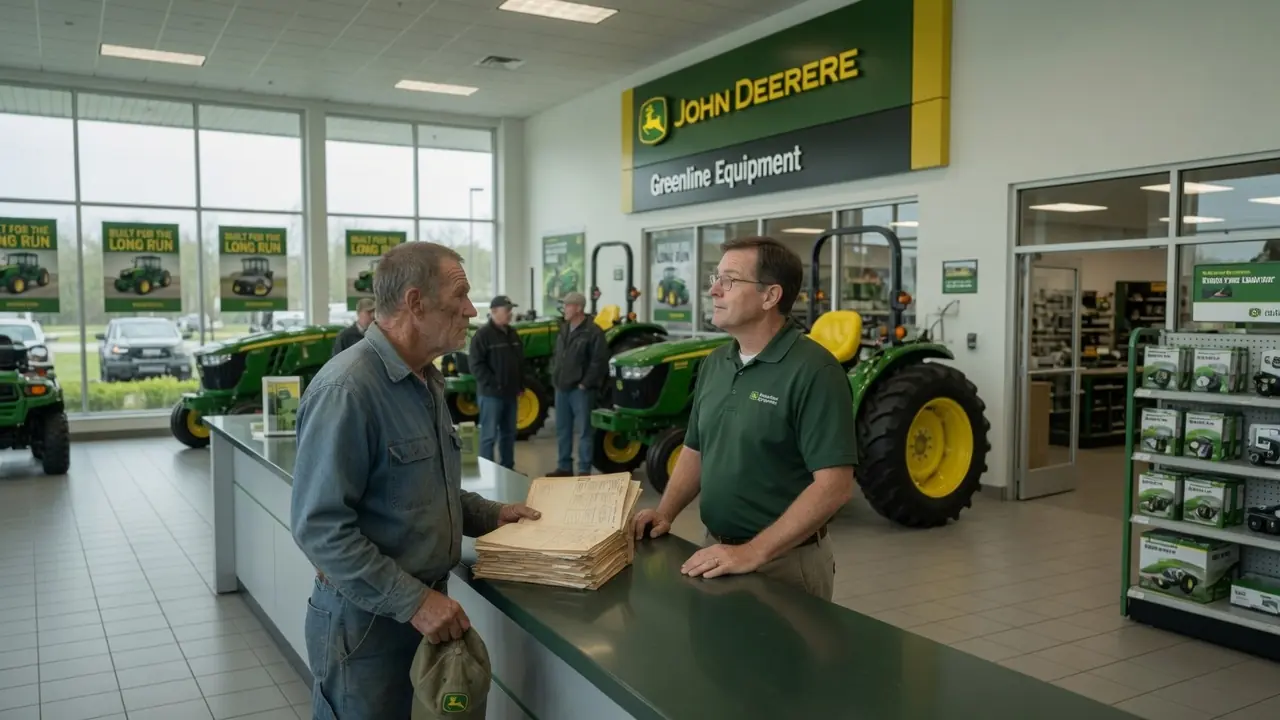
That was how he found himself inside Greenline Equipment with the folder under his arm and a heaviness in his steps. A young salesman near the compact tractors raised a hand, then lowered it when he saw Roy’s face. Two farmers from the north township stood by a planter display, talking in low voices. Behind the service counter, Martin Keller was laughing at something on his computer screen.
Martin had been Greenline’s service manager for six years. He was younger than Roy by nearly fifteen years, with neat hair, a company polo, and the easy confidence of a man who had learned to speak in phrases that sounded helpful without committing to anything. Roy had dealt with him many times. Martin always called him “Roy” in a tone that suggested friendship, though Roy could not remember Martin ever asking about Linda, the farm, or whether harvest had gone well.
“Roy Canfield,” Martin said, looking up with a smile. “Didn’t expect to see you today. That 7830 giving you trouble again?”
Roy placed the folder on the counter.
The smile flickered slightly.
Martin glanced at the folder, then toward the waiting area. “Sure. You want to step into my office?”
“No.”
The word came out flat, not loud, but it changed the air between them. The two farmers near the planter display stopped pretending not to listen. A parts clerk at the far end of the counter slowed his hands over a box of filters. Martin’s smile returned, but thinner.
“All right,” Martin said. “What’s the concern?”
Roy opened the folder and laid the last Greenline invoice on the counter. The paper was clean because Roy had kept every record neatly, the way his father had taught him. “This repair. Six thousand four hundred dollars.”
Martin looked down. “Hydraulic control valve assembly and sensor diagnosis. Yes, I remember that one.”
Roy placed the Hartfield invoice beside it. “This repair. Eight hundred fifteen dollars.”
Martin’s eyes moved to the other page, then stopped.
“It was the same hydraulic pressure control circuit,” Roy said. “Same tractor. Same pattern of failure. Dale From over at Hartfield explained the root problem in one conversation. He recalibrated the circuit, replaced the secondary sensor, and had it done before the rain came.”
Martin did not touch either paper. “Different shops can approach repairs differently.”
Roy nodded once. “That’s what I thought you’d say.”
“Because it’s true.”
“Maybe.” Roy opened the folder wider and took out two more invoices. “But this one was eighteen months earlier. Failed hydraulic pressure sensor. Two thousand nine hundred dollars. And this one came eight months after that. Control valve assembly. Three thousand five hundred dollars.”
Martin’s jaw tightened.
Roy placed those invoices in a row, one after another, like evidence being laid before a jury. “Three visits. One circuit. More than twelve thousand dollars over eighteen months. Then Hartfield fixed the actual issue for eight hundred fifteen.”
A man waiting near the parts counter turned fully toward them now. Martin noticed and lowered his voice. “Roy, let’s not discuss this in front of everyone.”
Roy looked around the showroom. The green tractors gleamed under white lights. Promotional posters promised reliability, partnership, and service farmers could count on. For thirty-one years, Roy had believed those words belonged to him too. Now they looked like paint over rotten wood.
“Why not?” Roy asked. “I paid in front of everyone. Bought tractors in front of everyone. Recommended this place in front of everyone.”
Martin leaned closer. “These invoices were approved by you.”
There it was. Not an explanation. Not an apology. A shield made of signatures.
Roy felt the words land exactly where Martin intended them to land, against his pride. Yes, he had signed. Yes, he had trusted. Yes, he had been busy, tired, pressured by weather, and too loyal to ask questions he should have asked long ago. But shame, he had learned, was useful only if it led a man to truth instead of silence.
“I did approve them,” Roy said. “That’s the part I’m responsible for.”
Martin blinked, as if he had expected denial instead of agreement.
Roy tapped the $6,400 invoice with one thick finger. “But my signature doesn’t explain these labor hours.”
Martin breathed out through his nose. “Labor depends on diagnostic complexity.”
“Then explain the complexity.”
“I’m not sure I can do that from memory.”
“I brought your notes.”
Roy slid the service notes forward. Martin looked at them, and for the first time that morning, his confidence shifted into something close to caution. The notes were vague, full of phrases like “continued troubleshooting,” “confirmed intermittent pressure loss,” and “additional inspection required.” They sounded technical to a man in a hurry. They sounded empty to a man who had spent three weekends comparing them against real standards.
Roy pulled another sheet from the folder. “Manufacturer’s labor guide. Standard time for the work listed. Hartfield walked me through it.”
Martin’s face darkened. “Hartfield has every reason to make us look bad.”
“They didn’t make you write these hours.”
The parts clerk looked down quickly. One of the farmers near the planter display muttered something under his breath. The showroom felt smaller now, as if the walls had leaned in.
Martin straightened. “Roy, I understand you’re upset, but service work is not always simple. You’ve been farming long enough to know that.”
Roy almost laughed, but there was no humor in him. “I’ve been farming long enough to know when someone answers a question by walking around it.”
Behind him, the glass doors opened and a woman stepped inside carrying a parts return box. She paused when she sensed the tension. Roy did not turn. He kept his eyes on Martin, not because he enjoyed making the man uncomfortable, but because looking away now would feel like signing another invoice without reading it.
“Thirty-one years,” Roy said quietly. “That’s how long my family has done business here.”
Martin softened his tone, but it came too late. “And we value that relationship.”
“No.” Roy shook his head. “You valued the habit. There’s a difference.”
Martin’s mouth opened, then closed.
Roy pulled the yellow legal pad from the folder. It was not pretty, not typed, not polished. Just rows of dates, invoice numbers, jobs, billed hours, estimated standard hours, and notes in Roy’s careful handwriting. He turned it toward Martin.
“I went back eleven years,” Roy said. “Not every repair. I’m not claiming I know everything. But I know enough.”
Martin stared at the pad without reading every line. He did not need to. The shape of the comparison was clear. The story did not depend on one bad bill. It stretched backward, quiet and steady, through years of assumption.
“You should have come to us sooner,” Martin said.
Roy nodded. “Yes. I should have.”
Again, Martin seemed unsettled by Roy accepting his own part of the failure.
“But I’m here now,” Roy continued. “So explain it.”
Martin looked toward the office hallway. “I’d need the owner involved.”
“Get him.”
That caused another silence.
A salesman disappeared into the back. A few minutes later, Aaron Pike, Greenline’s general manager, came out wearing a white dress shirt and the expression of a man who had been interrupted from something more profitable. Aaron had taken over after the dealership changed ownership the second time. He liked golf outings, customer appreciation lunches, and speeches about family values. Roy had never once seen him climb into a broken machine.
“Roy,” Aaron said warmly. “I hear there’s a billing concern.”
“A billing pattern,” Roy said.
Aaron glanced at Martin, then at the papers. “Why don’t we step into my office and sort this out privately?”
Roy’s eyes did not move. “Martin already asked. I said no.”
Aaron’s smile tightened. “Well, I’m not sure the showroom is the best place for a complex service discussion.”
“It became the best place when your counter became the place I trusted for thirty-one years.”
The words carried. Customers heard them. Employees heard them. Aaron heard them too, and his face changed just enough for Roy to know he had finally reached the real concern. Not fairness. Not truth. Reputation.
Aaron picked up the Hartfield invoice. “You took a John Deere tractor to a Massey dealer?”
Roy watched him. “That’s your first question?”
“It’s a relevant question.”
“No,” Roy said. “The relevant question is why they fixed for eight hundred fifteen what you billed me thousands not to fix.”
Aaron set the invoice down. “We cannot speak to another dealership’s work quality.”
“The tractor has run three weeks without a problem.”
“That doesn’t mean—”
“It means it works,” Roy cut in.
Aaron’s jaw tightened. “Roy, you know we’ve always taken care of you.”
For a moment, Roy saw his father again, standing at the old counter with grease under his nails and trust in his hand. He saw every emergency call, every purchase, every nod across the parts desk, every moment he had defended Greenline to neighbors who complained about prices. He had mistaken history for care. He had mistaken familiarity for loyalty returned.
“No,” Roy said. “You took my calls. You cashed my checks. That’s not the same thing.”
Aaron’s face flushed.
Martin shifted behind the counter. “Roy, that’s unfair.”
Roy looked at him. “So were these invoices.”
No one spoke.
The man near the parts counter stepped closer. He was older, with a seed company jacket and dirt still on his boots. “Can I see that?” he asked, nodding toward the Hartfield invoice.
Aaron turned sharply. “This is a private customer matter.”
Roy picked up the invoice and handed it to the man. “It was private when I didn’t understand it.”
The man read the page, then glanced toward Martin. “Eight hundred fifteen?”
Roy nodded.
“For that hydraulic circuit?”
“Yes.”
The man gave a low whistle and handed the paper back. That whistle did more damage than shouting would have. It sounded like recognition.
Aaron lowered his voice. “Roy, I strongly suggest you consider what you’re implying before you damage a relationship that has served your family for decades.”
That was the wrong sentence.
Roy closed the folder slowly. His hands were steady now. The anger had burned down into something cleaner. “Aaron, the relationship is already damaged. I’m just the first one in this room saying it out loud.”
Aaron took a breath. “What do you want?”
Roy had asked himself that question before driving over. At first, he thought he wanted money back. Then he thought he wanted an apology. By the time he pulled into Greenline’s parking lot, he understood he wanted something neither Martin nor Aaron could give him. He wanted the last thirty-one years to mean what he thought they had meant.
“You can’t give me what I want,” Roy said.
Aaron frowned. “Then why come here?”
Roy looked around the showroom one last time. “Because I needed to know whether you would explain it or manage it.”
“And?”
Roy tucked the invoices back into the folder. “You managed it.”
He put on his cap.
Martin stepped forward. “Roy, wait. We can review the invoices.”
“You had years to review them.”
Aaron’s voice hardened. “If you walk out angry, you may regret making decisions based on one outside estimate.”
Roy turned back. “I’m not angry.”
That was not entirely true, but it was true enough.
“I’m awake,” he said.
Then he walked out.
Outside, the sun was high over the parking lot. Roy stood beside his pickup for a long moment, the folder under his arm, listening to the sound of traffic on the highway. He did not feel victorious. A man does not celebrate discovering he has been foolish with his trust. He only feels older, quieter, and more careful about where he sets it down next.
Before driving home, Roy called Linda.
“Well?” she asked.
“They didn’t explain it.”
“I’m sorry.”
Roy looked through the windshield at the green sign above the dealership entrance. “I am too.”
That afternoon, he drove to Hartfield Ag. Dale From was at the service desk, sleeves rolled, talking to a mechanic about a baler. When he saw Roy, he nodded in recognition but did not perform surprise or friendliness for show. Roy appreciated that.
“Tractor still running right?” Dale asked.
“Running fine.”
“Good.”
Roy placed the folder on the counter. “I need a second conversation.”
Dale looked at the folder, then at Roy’s face. “About the old invoices?”
“About the future.”
Dale listened while Roy explained his equipment needs for the next eighteen months. Two tractors were already in his planning cycle. The combine would need replacement soon. The planter was due for a serious decision. None of that business had ever been meant for Hartfield, but trust had moved, and the money would follow.
Dale brought in Karen Stelz, Hartfield’s sales manager. Karen did not start by showing Roy what was sitting on the lot. She asked about acres, soil, field windows, hydraulic demands, financing limits, service expectations, and how Roy actually used his machines when the weather turned against him. She wrote things down. She asked follow-up questions. She did not once say, “That’s how we’ve always done it.”
Roy did not buy that day. He went home, ran numbers, talked with Linda, and walked his fields in the evening while the sky turned purple over the corn. By the end of the week, he knew. By the end of the month, he had ordered his first tractor from Hartfield.
Word spread slowly, the way practical truth spreads among farmers. Roy did not make speeches at the diner. He did not post angry letters or storm into meetings. When a neighbor asked why he had gone red instead of green, Roy opened his folder and showed the invoices side by side.
The numbers did the talking.
One neighbor went home and pulled his own service records. Another called Hartfield before harvest. A third stopped Roy after church and asked for Dale From’s number in a voice that suggested he had been waiting for permission to question his own bills. Roy gave the number without commentary.
Greenline did not collapse. Big businesses rarely fall from one man’s disappointment. The dealership stayed open, sold equipment, ran service trucks, and kept its green machines lined beautifully behind clean glass. But some accounts went quiet.
Roy knew because farmers noticed what other farmers drove. He saw a new tractor from Hartfield on Gerald Voss’s place. He saw the north township operation move a service truck call away from Greenline. He heard, months later, that Aaron Pike had started offering “customer loyalty reviews” to long-term accounts.
The phrase made Roy laugh once, without joy.
A year after the confrontation, Roy returned to Greenline for the first time, but not as a customer. His nephew wanted to look at a used mower listed online, and Roy agreed to ride along. When the glass doors opened, the showroom still smelled the same. The tractors still shone. The posters still promised partnership.
Martin Keller was no longer behind the service counter. A younger woman stood there instead, explaining a bill carefully to an older farmer line by line. Roy paused long enough to hear her mention labor standards before the customer asked. That small detail stayed with him.
Aaron Pike saw Roy from across the showroom. For a moment, neither man moved. Then Aaron gave a stiff nod. Roy returned it because his father had also taught him manners cost nothing unless they were used to hide cowardice.
His nephew did not buy the mower. The price was high, and the trade-in allowance made no sense. In the truck afterward, the young man shook his head. “Uncle Roy, how do you know when a dealer’s worth trusting?”
Roy looked through the windshield at the road home. The question was simple, but the answer had cost him thirty-one years to learn.
“You don’t know by how long you’ve been going there,” Roy said. “You know by what they’re willing to explain when you finally ask.”
His nephew nodded slowly.
Roy reached behind the seat and pulled out a manila folder. He did not carry it everywhere, but he had brought it that day because some lessons were better shown than told. At a stop sign, he handed over copies of the two invoices: Greenline’s $6,400 bill and Hartfield’s $815 final repair.
His nephew stared at them. “That’s the same tractor?”
“Yes.”
“Same problem?”
“Same circuit.”
The young man looked sick. “What did you do?”
Roy watched a combine move across a distant field, its dust trailing behind it like memory. “I stopped rewarding them for my own habit.”
That was the heart of it, and Roy knew it more clearly with every passing season. Greenline had overcharged him, or at least failed him badly enough that the difference no longer mattered. But the betrayal had survived because Roy had fed it with silence, loyalty, and the old comfort of not checking what felt familiar.
He did not tell the story to make himself look clever. He told it because he had not been clever soon enough. He had been busy. He had been trusting. He had been human.
Years later, when younger farmers came to him for advice, Roy would take out the invoices and lay them side by side on his office desk. He would not raise his voice. He would not call anyone a thief. He would simply point to the numbers and let the silence do its work.
Eight hundred fifteen dollars.
Six thousand four hundred dollars.
The difference between those numbers was not just money. It was a measure of attention, honesty, habit, and the dangerous comfort of relationships that stopped being earned because they had lasted too long. It was the cost of assuming trust could run forever without maintenance.
Roy still believed in loyalty. He believed in handshakes, long relationships, and doing business with people who knew your land and your name. But he no longer believed loyalty meant closing your eyes. A good relationship could survive questions. A bad one depended on you never asking them.
And every time he passed the Greenline sign on the highway, Roy thought of his father at the old counter, shaking hands with men who had understood that trust was work. Then he thought of himself, standing in the new showroom with invoices spread beneath bright lights while everyone pretended not to listen. That was the day thirty-one years ended.
Not with shouting.
Not with revenge.
Just with a farmer placing two numbers on a counter and finally making the truth explain itself.