Broken Bow, Nebraska, March 2000.
Tom Henderson had been selling Case IH tractors in Broken Bow for seventeen years.
He had watched farmers trade in worn-out machines they had forced through one final season, arranged financing packages that stretched families so thin that daylight seemed visible through their budgets, and witnessed good people lose farms their grandparents had built.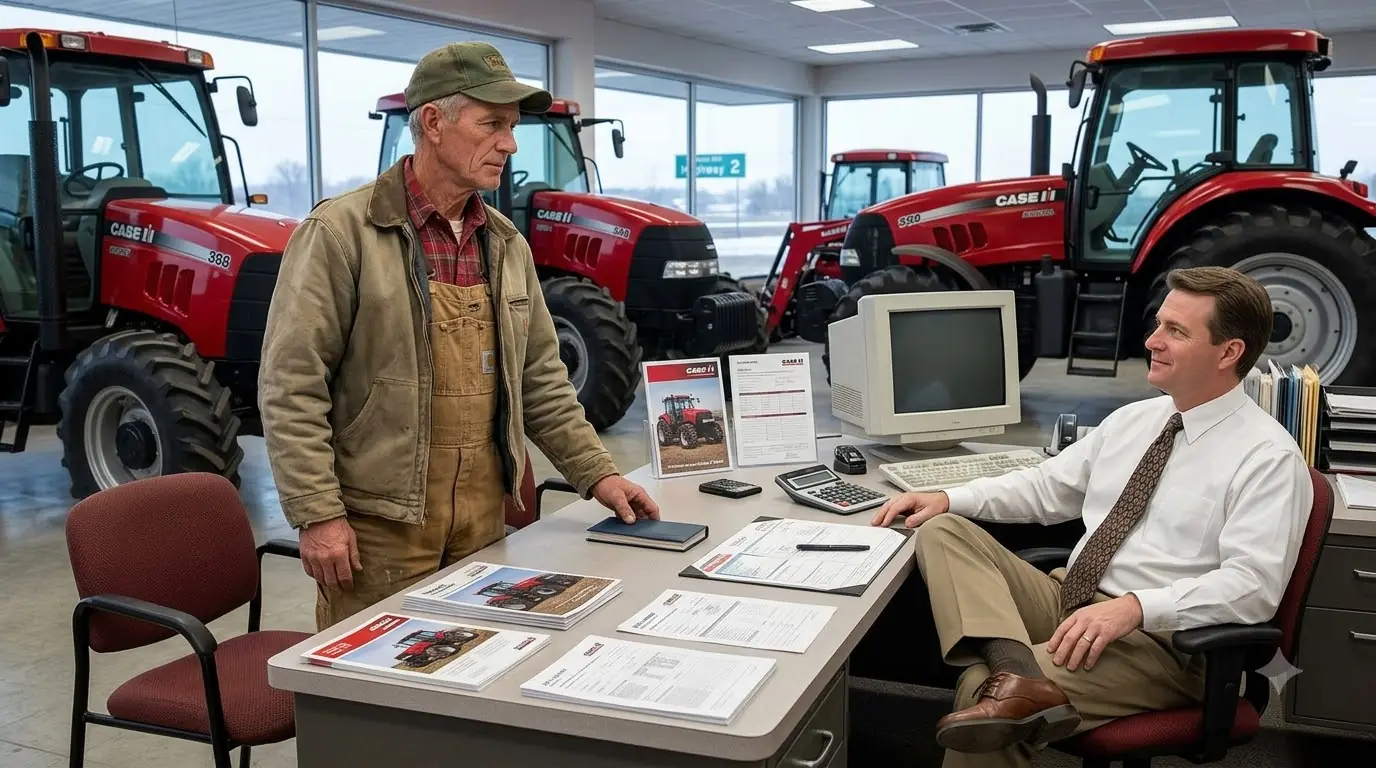
He had also watched a few fortunate operators make the right decision at exactly the right time.
But Tom had never met anyone like the man who walked through the dealership door on a Tuesday morning in March 2000.
Harold Bergstrom was fifty-eight years old. He wore faded Carhartt bib overalls, a John Deere cap that was probably older than Tom’s youngest child, and boots that clearly spent most of their time in fields rather than offices.
Harold walked with the slight forward lean of a man who had spent decades sitting on tractor seats. His handshake possessed the particular firmness that came from a lifetime of physical work.
“I need to talk about tractors,” Harold said.
Tom gestured toward the chair across from his desk.
It was a standard opening. Every farmer entering the dealership needed to talk about tractors.
“What are you considering?” Tom asked. “A trade-in or an upgrade?”
Harold lowered himself into the chair.
“Neither.”
He rested his hands on his knees.
“I want to purchase five MX Magnums.”
Harold paused.
“Cash.”
Tom’s pen stopped moving.
He looked up and studied Harold’s face.
The man was completely serious.
“I am sorry,” Tom said carefully. “Did you say five?”
“Five.”
“And you said cash?”
“Cash.”
Tom placed the pen on his desk.
During seventeen years of selling agricultural equipment, he had financed transactions worth more than a million dollars. He had arranged leases covering entire fleets and created payment schedules that lasted through several crop cycles.
He had never heard anyone casually announce that he intended to purchase more than half a million dollars in tractors and pay the entire amount without financing.
“Mr. Bergstrom,” Tom began, “I do not mean any disrespect, but that could be six hundred fifty thousand dollars.”
“Give or take,” Harold interrupted. “It depends on the configurations.”
He leaned back slightly.
“I know what they cost.”
Silence settled between them.
Outside, a tractor-trailer loaded with fertilizer rumbled along Highway 2. The fluorescent lights above Tom’s desk produced a quiet electrical hum.
Tom tried to determine whether he was participating in an elaborate farming-community joke or whether the man sitting across from him genuinely intended to purchase five new tractors.
Before going farther, it was important to understand that Harold’s decision did not appear out of nowhere. The equipment specifications, economic conditions, farm-crisis history, and financial calculations surrounding the purchase reflected the agricultural realities of rural Nebraska at the beginning of the twenty-first century.
Harold had spent decades preparing for that morning.
He was born in 1942, during the middle of the Second World War, on the same Custer County farm where he still lived in 2000.
His father, Leonard Bergstrom, purchased the original quarter section in 1938. Leonard paid $3,200 for 160 acres, using money borrowed from an uncle because few banks were willing to make agricultural loans in Nebraska during that period.
Leonard had survived the Dust Bowl.
He had watched neighbors lose their land at public auctions. He had seen educated men accept exhausting labor for thirty cents an hour because no better work existed.
Those experiences shaped every financial decision he made afterward.
Leonard taught his son one lesson above all others.
“Never owe more money than you could pay back tomorrow.”
Harold grew up watching his father make choices that seemed irrational to their neighbors.
During the agricultural expansion of the 1950s, other farmers borrowed money to purchase newer machinery and additional land. Leonard continued operating equipment that had already been old when Harry Truman was president.
While neighboring farms expanded, Leonard saved.
At first, he stored money in coffee cans. Later, he placed it in bank accounts and Treasury bonds.
He lived as though the Great Depression had never ended, even after conditions improved.
“That is what gets people into trouble,” Leonard would say while standing beside his aging John Deere Model A.
“They convince themselves that good times will last forever.”
“They do not.”
“Bad times return. They always return.”
Leonard would then look across his fields.
“When they do, I will still have my farm.”
Harold absorbed those lessons completely.
He took control of the operation in 1967, when he was twenty-five years old. Leonard gave him the original 160 acres and sold him another 160 acres accumulated during the intervening years.
Harold paid cash.
The money came from five years of construction work in Lincoln before he returned home to farm.
From his first day as the primary operator, Harold followed his father’s rules.
If he could not pay cash, he did not purchase it.
If he could not afford to lose something, he did not risk it.
If he did not genuinely need something, he did not buy it at all.
The early 1970s were difficult.
People often remembered the agricultural boom at the end of the decade, but the first years were unstable. Corn prices moved between roughly $1.18 and $1.57 per bushel.
Harold operated old machinery and rented additional land only when he could afford it. He saved every dollar not required for seed, fuel, repairs, taxes, or feeding his young family.
His wife, Martha, managed the books and kept the household budget as tight as a bowstring.
Then the boom arrived.
In 1977, 1978, and 1979, land values climbed rapidly. Corn reached $2.50 per bushel and then approached $3.
Farmers throughout Nebraska purchased larger properties and more powerful equipment. Expansion became the dominant strategy.
National agricultural leaders encouraged operators to become larger or leave farming, and many families took that message seriously.
Harold did not.
He continued farming his 320 acres.
He rented another quarter section when the price was reasonable. He operated tractors older than his marriage and placed his savings into certificates of deposit paying interest rates near fourteen percent.
“You are missing the opportunity,” neighbors told him.
“Land will never be cheaper than it is now.”
“You need to borrow money and expand while you still can.”
Harold smiled and answered that he was satisfied with what he had.
Then 1981 arrived.
Interest rates climbed above twenty percent. Corn prices collapsed, and land values fell by approximately sixty percent during the following years.
The farm crisis struck rural Nebraska with devastating force.
Between 1982 and 1987, Custer County lost dozens of family farms to foreclosure.
Harold watched families who had farmed for three generations sell their equipment from their own yards. He watched neighbors leave properties their ancestors had owned for nearly a century.
He saw men in their fifties accept minimum-wage jobs in town after losing everything they had spent their lives building.
Harold did not lose his farm.
He owed nothing.
He continued operating his 320 acres, rented the neighboring quarter section, maintained old machinery, and kept saving.
The certificates of deposit continued producing double-digit returns while indebted operators around him struggled to survive.
In 1984, Harold’s neighbor Roy Heineman could no longer continue.
Roy’s 160 acres went to auction.
Harold purchased the property for $280 per acre, approximately half the price Roy had paid during the peak of the boom.
Harold felt terrible benefiting from his neighbor’s loss.
Roy understood.
“Better you than a bank or some corporation from Omaha,” he told Harold.
By 1987, when the worst of the crisis had passed, Harold controlled 640 acres. The original 160 acres had been given to him by his father, and the remaining 480 were owned free and clear.
Harold was forty-five years old.
He had no debt, money in the bank, and enough land to support another generation if his son ever decided to return.
That son was Michael.
Michael Bergstrom was born in 1974.
He grew up watching his father spend eighteen-hour days operating machinery that appeared ready for a museum. He watched his mother prepare school lunches consisting mostly of peanut butter sandwiches.
Michael wore clothes passed down by cousins and boots purchased from a secondhand store in Kearney.
His father drove a pickup truck older than Michael.
The farmhouse had one bathroom and a furnace that barely survived the Nebraska winters.
As a child, Michael assumed his family was poor.
Only later did he understand the difference between looking poor and being financially vulnerable.
The Bergstrom family never worried about losing the farm.
They did not watch the mailbox with dread, waiting for letters from banks. They did not wonder whether one weak harvest would force them from the land.
Michael entered the University of Nebraska in 1992 to study agricultural economics.
He returned to the farm in 1996 and began working beside his father.
Over time, he realized that what had looked like poverty was discipline.
What had seemed like excessive caution was strategy.
His father was not poor.
His father was liquid.
Back inside the dealership in March 2000, Tom Henderson continued processing Harold’s announcement.
“Mr. Bergstrom,” Tom began again, “I need to be direct with you.”
“Five MX Magnums, depending on configuration, will cost more than six hundred thousand dollars.”
He leaned forward.
“Operations purchasing a fleet that large are normally farming several thousand acres.”
“Forty-eight hundred acres as of next month,” Harold said.
Tom stopped.
“I have signed agreements for three adjoining properties, and I am taking over the Schneider ground when Earl retires in April.”
Harold folded his hands.
“I currently own or control approximately 2,080 acres.”
“The additional leases total 2,720 acres.”
“That puts me at 4,800.”
“I need the tractors before spring planting.”
Tom leaned back.
This was real.
“May I ask something?”
Harold nodded.
“Financing rates are relatively favorable right now. Prime is approximately eight and a half percent.”
Tom opened a rate sheet.
“We could probably arrange a competitive agricultural-equipment loan.”
“No financing,” Harold said.
“Cash.”
He looked directly at Tom.
“That is not negotiable.”
Harold continued before the dealer could respond.
“What I need from you is the correct price, the correct configurations, and delivery on schedule.”
“If you can provide those things, I am prepared to write the deposit check today.”
Tom retrieved his pen.
“All right.”
He opened a blank order form.
“Let us discuss exactly what you need.”
Harold wanted five MX Magnum tractors, but they would not be identical.
He wanted two MX270s, the largest machines in the group, producing approximately 270 horsepower for heavy pulling.
He wanted two MX230s producing approximately 230 horsepower. Those tractors would become the primary machines for most field operations.
The final machine would be an MX210 producing approximately 210 horsepower for lighter work, transportation, and backup duties.
“Why five?” Tom asked. “Why not purchase three larger tractors or seven smaller ones?”
“Because I have completed the calculations,” Harold said.
He removed a folded sheet of paper from his pocket.
“Forty-eight hundred acres, primarily corn and soybeans, with some wheat.”
He spread the paper across Tom’s desk.
“The spring planting window in Nebraska is short. When soil conditions are correct, I need to cover approximately four hundred acres every day.”
Harold tapped one section of the page.
“Two MX270s pulling twenty-four-row planters will provide the capacity.”
“The MX230s will handle fertilizer application, secondary tillage, cultivation, and other heavy fieldwork.”
He moved his finger to the final column.
“The MX210 will pull the soybean planter, perform lighter cultivation, transport equipment, and run to town for parts when something breaks.”
Harold looked up.
“Five tractors for five operators during the busiest part of the season.”
“Michael and me, two hired men, and one available backup operator.”
“That is the number the operation requires.”
Tom wrote quickly.
Harold was not casually purchasing machinery.
He had designed an equipment fleet through operational analysis.
“Configuration,” Harold continued. “I want the track-ready option on the MX270s.”
“Front-wheel assist on all five.”
“Factory radar for speed calibration.”
“Comfort cabs with air-suspension seats.”
“Five-forty and one-thousand-rpm PTO capability on everything.”
He pointed toward the hydraulic specifications.
“I also want the premium hydraulic package.”
“I will be running heavy implements.”
Tom struggled to keep pace with the requirements.
“Mr. Bergstrom, this resembles the specification sheet we would prepare for one of our most sophisticated commercial operations.”
He looked up.
“You have clearly considered every detail.”
“I have had twenty years to consider it,” Harold said.
That was true.
Everything Harold had done since the farm crisis had been leading toward this decision.
When the crisis ended, he did not abandon his conservative approach.
He continued farming his 640 acres and saving, but he also began watching.
He watched which parcels might become available.
He watched which landowners were preparing to retire.
He watched which families had grown tired of fighting weak commodity prices and were considering moving into town.
Harold built relationships with nearly every landowner within ten miles.
He established a reputation as a reliable tenant.
He always paid cash.
He always paid on time.
He repaired fences, controlled weeds, protected the soil, and did not complain about difficult ground.
When land became available, Harold was frequently the first person called.
By 1995, he was farming approximately 1,680 acres.
By 1999, he had reached roughly 2,080 acres.
Harold also knew that three major properties would become available in 2000.
Earl Schneider was retiring and controlled 1,120 acres.
The Morrison estate was settling 640 acres.
The Johansson family wanted to leave farming and had 960 acres available.
Together, the three properties totaled 2,720 acres.
Harold had positioned himself to secure all of them.
To farm 4,800 acres, he required equipment designed for 4,800 acres.
His existing fleet consisted mainly of tractors manufactured during the 1970s and early 1980s. Every machine had been maintained meticulously, but the equipment was fundamentally too old for the scale he intended to operate.
He needed modern horsepower.
He needed stronger hydraulic systems and comfortable cabs so his crew could work long days without destroying their bodies.
Most importantly, he needed reliability that his aging machinery could no longer guarantee.
In January 2000, Harold visited his banker.
He did not go there to request a loan.
He went to confirm that he had enough money to proceed safely.
“Harold,” the banker said while reviewing the statements, “you have approximately nine hundred twenty thousand dollars in liquid assets.”
The total included certificates of deposit, money-market accounts, and Treasury securities.
“You could invest this more aggressively,” the banker continued. “The stock market is performing extremely well. Technology companies are—”
“I need to spend six hundred fifty thousand dollars on tractors,” Harold interrupted.
The banker stared at him.
Harold placed another set of figures on the desk.
“If I do that, can I still maintain enough operating capital for two years if commodity prices remain flat?”
The banker performed the calculations.
Land-rent payments would be supported by existing farm revenue. Michael’s salary remained modest.
Operating 4,800 acres would require approximately $450,000 per year, but crop income, insurance protection, and continuing revenue would cover most of those expenses.
Spending $650,000 from $920,000 in liquid assets would leave roughly $270,000, plus whatever the operation generated during the following seasons.
“You can do it,” the banker concluded.
Then he looked at Harold more seriously.
“But you are fifty-eight years old.”
“You are considering spending nearly two-thirds of your liquid net worth on farm equipment inside an uncertain agricultural economy.”
“Are you sure?”
Harold was sure.
He understood something Tom Henderson did not yet know and many Nebraska farmers had not recognized.
The year 2000 was an unusually strategic moment to purchase tractors.
On paper, the agricultural economy in Nebraska was mediocre.
Corn traded around two dollars per bushel. Soybeans sold near four dollars and fifty cents.
Those prices were not disastrous, but they did not create excitement.
Average farm income had improved slightly from the previous year but remained far below the peaks of the late 1970s and the stronger years that would arrive later.
Nebraska farmland values were stable rather than spectacular. Cropland averaged approximately $840 per acre.
Most farmers were holding their positions.
They were not necessarily losing money, but few were earning enough to justify aggressive expansion.
Equipment prices had continued rising.
A fully equipped Case IH MX270 listed for roughly $135,000 in 2000.
That was expensive, but it was still far less than the cost of comparable high-horsepower tractors fifteen years later.
The MX Magnum series also represented a period before later emissions equipment, extensive software integration, and specialized diagnostic systems greatly increased the price and complexity of agricultural machinery.
Interest rates were another factor.
The prime rate in March 2000 was approximately eight and a half percent. Agricultural equipment financing often carried rates closer to nine or ten percent.
Those rates made payments possible, but financing still added substantial costs.
A $135,000 tractor financed over seven years at approximately nine percent could ultimately cost around $182,000.
Across five tractors, interest could add more than two hundred thousand dollars to the transaction.
Harold intended to pay no interest.
He also valued the relative mechanical simplicity of the MX Magnum platform.
The tractors belonged to a generation produced before the most restrictive later emissions standards. Their engines and hydraulic systems could still be maintained by experienced mechanics using conventional tools.
They were reliable, repairable, and less dependent on specialized computer diagnostics than later equipment.
Harold believed that mattered.
He also believed commodity prices would eventually rise.
His conclusion did not come from excitement or speculation.
It came from numbers.
The United States corn crop had been large, and ending stocks were building. At the same time, global population and urban consumption continued increasing.
More importantly, the national discussion surrounding renewable fuels and ethanol was becoming serious.
Environmental policies were encouraging cleaner-burning fuels. Agricultural economists were studying how expanded ethanol production could affect domestic corn demand.
Harold read everything he could obtain.
The research suggested that demand could increase significantly during the next five to ten years.
If Harold was correct, grain prices and farmland values would rise.
Farmers positioned with sufficient acreage, modern equipment, and little or no debt could earn extraordinary returns.
If he was wrong, the risk remained manageable.
He would still control 4,800 acres, possess equipment capable of operating for twenty years, and retain enough working capital to survive a reasonable downturn.
The possible reward was enormous.
The potential loss could be contained.
Back at the dealership, Tom finished entering figures into his calculator.
“Two MX270s at one hundred thirty-five thousand dollars each,” he said. “That is two hundred seventy thousand.”
“Two MX230s at one hundred eighteen thousand each. That adds two hundred thirty-six thousand.”
“One MX210 at one hundred eight thousand.”
Tom pressed the final key.
“The total list price is six hundred fourteen thousand dollars.”
He reviewed the page.
“With a fleet discount, I believe I can reduce it to approximately five hundred ninety thousand.”
“Delivery in six weeks.”
“You would receive everything by the middle of April, before spring planting.”
Harold nodded.
“What about parts inventory and service?”
Tom looked up.
“What about them?”
“I will be operating five tractors built on related platforms.”
Harold pointed toward the equipment list.
“I want your dealership to maintain a standing inventory of commonly required parts with priority access for my operation.”
“Hydraulic hoses, filters, belts, and sensors.”
“If a tractor stops during planting, I need the necessary part the same day.”
“Can you provide that?”
Tom was impressed.
“We can create that arrangement.”
“Most customers do not discuss parts logistics until a machine has already failed.”
“Most customers do not operate equipment the way I do,” Harold said.
“I maintain every machine.”
“Scheduled service happens on time, every time.”
“Fluids are changed according to specifications.”
“I do not abuse equipment.”
He leaned forward.
“But when conditions are right, we work eighteen hours a day, seven days a week, through planting and harvest.”
“I need to know your dealership can support that pace.”
“We can,” Tom said. “I will establish a priority-service agreement.”
“If something fails, you call and we respond.”
Harold reached into his jacket and removed a checkbook.
Tom’s eyes widened.
He had expected Harold to say he needed to speak with his banker, arrange a transfer, or return another day.
Harold began writing immediately.
“Sixty-thousand-dollar deposit,” he said.
He tore out the check.
“Approximately ten percent.”
“I will wire the balance to your account the day before delivery.”
Harold placed the check on the desk.
“I want all five tractors delivered to my farm on the same day.”
“They must be serviced, fueled, and ready to work.”
“I want your best mechanic to spend four hours with my crew reviewing operations, maintenance schedules, and troubleshooting.”
He looked directly at Tom.
“I want every agreement in writing.”
Tom picked up the check.
It was drawn on First National Bank of Broken Bow.
The signature was clear and confident.
This was not a joke.
“Mr. Bergstrom,” Tom said, “may I ask you something?”
“Certainly.”
“How long have you been planning this?”
Harold smiled for the first time since entering the dealership.
“Since 1982.”
Tom waited.
“When I watched my neighbors lose everything, I made a decision.”
Harold glanced through the office window toward the machines outside.
“If I ever received the opportunity to expand, I would do it correctly.”
“No debt.”
“No risk I could not manage.”
“No careless mistakes.”
Tom shook his head.
“Most farmers I know are heavily leveraged.”
“They borrow money to make payments on last year’s borrowing.”
“You are doing the opposite.”
“That is why I expect to still be farming in twenty years,” Harold replied.
“Many of them will not be.”
The tractors arrived on April 18, 2000.
All five rolled into the Bergstrom farm together.
Their bright red paint and large Case IH lettering made them look like spacecraft inside Harold’s machine shed.
Michael stood with his mouth open.
The two hired men, local operators Harold had known for years, were nearly speechless.
“Dad,” Michael said, “I knew we were expanding, but this is…”
“This is what the operation requires,” Harold answered.
“To farm forty-eight hundred acres professionally, you need professional equipment.”
He placed a hand against the nearest MX270.
“This is what professionals use.”
That spring, they planted approximately 3,200 acres of corn and 1,600 acres of soybeans.
The MX270s pulled the twenty-four-row planters with ease.
The MX230s handled fertilizer work, cultivation, and secondary tillage.
The MX210 managed lighter jobs, pulled the soybean planter, transported equipment, and traveled for parts whenever necessary.
They completed planting in seventeen days.
Harold had never planted that much ground so quickly.
The 2000 crop was good, although not extraordinary.
Corn averaged approximately 168 bushels per acre. Soybeans produced around forty-six bushels per acre.
At two-dollar corn and soybeans near four dollars and fifty cents, the operation generated roughly $1.4 million in gross revenue.
After expenses, Harold retained approximately $280,000.
The earnings did not fully replace the cash spent on tractors, but the farm remained stable and immediately began rebuilding liquid capital.
The 2001 season produced similar results.
The crop was respectable, and prices remained mediocre.
Harold earned approximately $310,000 after expenses.
The tractors performed flawlessly.
No major breakdowns occurred.
The year 2002 brought drought.
Yields declined nearly thirty percent.
Harold’s crop insurance and financial reserves prevented the weak season from becoming a crisis.
Even with reduced production, the farm retained approximately $180,000.
In 2003, weather improved and grain prices began rising.
Corn moved toward $2.45 per bushel.
Soybeans approached $5.80.
Harold’s net income increased to roughly $420,000.
Then the ethanol expansion began changing the agricultural economy.
The Energy Policy Act of 2005 encouraged increased renewable-fuel production.
Corn demand accelerated.
By 2006, corn reached approximately three dollars per bushel.
By 2007, it approached four dollars.
During 2008, prices temporarily climbed above seven dollars.
For an operation planting 3,200 acres of corn at approximately 175 bushels per acre, seven-dollar corn could generate gross revenue near $3.9 million.
Soybeans also rose dramatically.
At roughly sixteen dollars per bushel and fifty bushels per acre across 1,600 acres, soybean revenue could approach $1.28 million.
In 2008, the Bergstrom operation grossed more than five million dollars.
After expenses, Harold retained approximately $2.1 million.
The tractors purchased with cash eight years earlier continued operating reliably.
The land Harold had secured had multiplied in value.
He still owed no one a dollar for the machinery.
In 2009, Tom Henderson visited the Bergstrom farm.
He wanted to know whether Harold might be interested in replacing or expanding the fleet.
“Those MX Magnums treat you well?” Tom asked.
“They have been nearly perfect,” Harold replied.
“Not one regret.”
Harold looked across the machine shed.
“Best purchase I ever made.”
Tom smiled.
“When you entered my dealership in 2000, I thought you were either joking or completely unreasonable.”
“I could not believe anyone would spend that much cash on tractors.”
“And now?” Harold asked.
“Now I tell the story to nearly every farmer who walks through my door.”
Tom laughed.
“The man who paid cash, timed the purchase perfectly, and positioned himself for a boom almost nobody expected.”
He shook his head.
“You have become a legend around here.”
“People ask how you did it.”
Harold thought before answering.
“My father taught me never to borrow more than I could repay tomorrow.”
“I took the lesson farther.”
“I decided not to borrow unless there was absolutely no alternative.”
Harold rested one hand against the tractor.
“That required living conservatively for forty years.”
“It meant watching other people expand while I waited.”
“It meant my son grew up believing we were poor.”
He looked toward the farmhouse.
“But when the opportunity came, I could act.”
“No bank approval.”
“No financing contingency.”
“No fear that one miscalculation would take everything.”
“Only a clear opportunity to build something that could last.”
“Michael will inherit an extraordinary operation,” Tom said.
“If he wants it,” Harold replied.
“That decision belongs to him.”
“But if he takes it, he will receive a farm with no debt, dependable equipment, and a proven system.”
“He can build from there.”
Michael did want it.
In 2012, when Harold was seventy years old, father and son formalized the transition.
Michael assumed responsibility for daily operations.
Harold remained involved but reduced his workload.
The lessons Leonard Bergstrom had learned during the Dust Bowl passed to Harold.
The lessons Harold reinforced by surviving the farm crisis of the 1980s passed to Michael.
The discipline reached a third generation.
By 2019, Michael farmed approximately 6,400 acres.
The original five MX Magnums remained on the farm nineteen years after their purchase.
Newer tractors handled the primary fieldwork, but the MX machines continued serving as dependable backups.
They still started.
They still worked.
They remained evidence that decisions appearing unreasonable in the moment could look brilliant with enough hindsight.
Harold’s experience also illustrated a larger financial principle.
Agricultural debt expanded significantly during the decades following his purchase.
Farmers who borrowed heavily during strong commodity years sometimes found themselves vulnerable when prices weakened.
Operations carrying high debt-to-asset ratios had less freedom during agricultural downturns.
Harold’s strategy of zero debt, deliberate timing, and conservative expansion placed his farm among the most financially stable operations in the region.
Paying cash for the equipment eliminated monthly loan payments.
That protected operating cash flow.
When grain prices rose during 2007 and 2008, Harold retained far more of the profit than competitors using a substantial portion of revenue to service debt.
The Case IH MX Magnum series also represented a significant period in agricultural machinery.
Introduced near the end of the 1990s, the tractors belonged to one of the final generations of large machines produced before later emissions systems and advanced electronics greatly increased complexity.
The engines used comparatively straightforward fuel systems.
They had no diesel exhaust fluid, diesel particulate filters, or selective catalytic reduction systems.
The hydraulic systems were sophisticated for the period but remained understandable to experienced mechanics.
The cabs were comfortable without being dominated by computer systems.
Later emissions regulations caused high-horsepower tractors to become increasingly expensive.
A tractor comparable to the MX270 could cost more than twice as much fifteen years later.
Harold purchased at the end of an era when a large tractor could remain powerful, comfortable, and repairable without requiring specialized software for every diagnosis.
From an agricultural-economics perspective, his strategy demonstrated a principle farmers sometimes forgot.
Timing involved more than planting dates and harvest windows.
It also meant preparing to act when rare opportunities appeared.
Harold spent approximately twenty years building liquid capital, developing relationships with landowners, and creating a reputation as a trustworthy operator.
When acreage became available, he was prepared.
When he needed equipment, the money was available.
When commodity prices strengthened several years later, the operational capacity was already in place.
When agriculture weakened again during the following decade, the farm still possessed the financial reserves to survive.
Modern farmers faced similar choices.
They had to decide whether to purchase new GPS-guided equipment or continue maintaining older, simpler machinery.
They had to determine whether to expand when land became available or remain at a comfortable scale.
They had to choose between financing growth and paying cash to reduce risk.
No single answer worked for every operation.
Harold’s approach succeeded because it matched his circumstances, temperament, and long-term preparation.
The broader principle remained relevant.
An operator needed to understand the numbers, know how much risk the family could tolerate, and prepare for opportunities rather than blindly following neighbors.
Agricultural equipment continued changing after 2000.
By 2024, a fully equipped high-horsepower Case IH Magnum could list for more than four hundred thousand dollars.
Modern tractors offered satellite guidance, automated steering, telematics, yield monitoring, and advanced environmental systems.
They were extraordinarily capable.
They were also expensive and technically complex.
The question for each farmer became whether the additional capabilities produced enough value to justify the purchase, or whether carefully maintained older equipment offered a better financial return.
Farms with lower debt generally possessed more flexibility during supply-chain disruptions, inflation, and sudden increases in fertilizer prices.
Operators burdened by large payments had fewer options.
Harold’s refusal to carry debt was extreme, but it placed him inside the most resilient category possible.
When equipment deliveries slowed and input costs rose, the Bergstrom farm could adjust without negotiating every decision with a lender.
Harold Bergstrom died in 2021 at the age of seventy-nine.
He had farmed for fifty-four years.
He survived the agricultural crisis of the 1980s, navigated the commodity expansion of the 2000s, and watched the family operation grow from 160 acres into more than 6,000 acres across three generations.
He followed one simple principle throughout his life.
Only spend money you actually possess.
The five MX Magnum tractors purchased for approximately $590,000 in 2000 remained on the farm when Harold died.
They were still functional after twenty-one years.
Each machine had provided thousands of hours of service.
The purchase price, spread across the life and productivity of the tractors, became remarkably low compared with frequently replacing financed equipment.
Harold also avoided hundreds of thousands of dollars in potential interest.
The most important benefit, however, was not the amount saved.
It was freedom.
Harold could make decisions based on what benefited the farm rather than what a lender approved.
He could survive drought, weak prices, equipment failures, or personal health problems without watching debt payments consume the operation.
He possessed the peace of knowing that whatever happened, the farm was not continuously losing cash to creditors.
Michael Bergstrom continued farming the family land.
He added modern equipment with updated technology, but he kept one of Harold’s original MX270s fully restored inside the machine shed.
The tractor became a reminder.
It represented the day in 2000 when Harold entered a dealership and announced that he intended to purchase five tractors with cash.
It reminded Michael that decisions appearing irrational could be the result of decades of preparation.
It represented patience, discipline, and strategic thinking.
Most importantly, it reminded the family that success did not always come from following the crowd.
Tom Henderson eventually retired from the equipment business.
He continued telling the story of Harold Bergstrom, the farmer who entered with a checkbook and changed Tom’s understanding of what was possible.
Harold demonstrated that the most important resource in agriculture was not always acreage, machinery, or rain.
Sometimes it was capital the farmer actually owned.
When Harold walked into the Case IH dealership in March 2000, he was not simply purchasing five tractors.
He was making a statement.
Forty years of conservative discipline had positioned him for one extraordinary moment.
He proved that success did not require doing what everyone else was doing.
Sometimes success came from doing the opposite.
The dealer initially believed the announcement might be a joke.
Harold Bergstrom proved it was wisdom.