Clifton Ward had not parked outside Harland Drove’s John Deere dealership in almost four years. The building still sat along Route 61 with the same green sign, the same polished glass front, and the same row of new tractors lined up like trophies behind the showroom window. To anyone driving past, it looked like a place built on loyalty, reliability, and long relationships with the farmers who kept the county alive. To Clifton, it looked like the place where a company had taken his trust, stamped it “inconclusive,” and sent him a bill for $11,400.
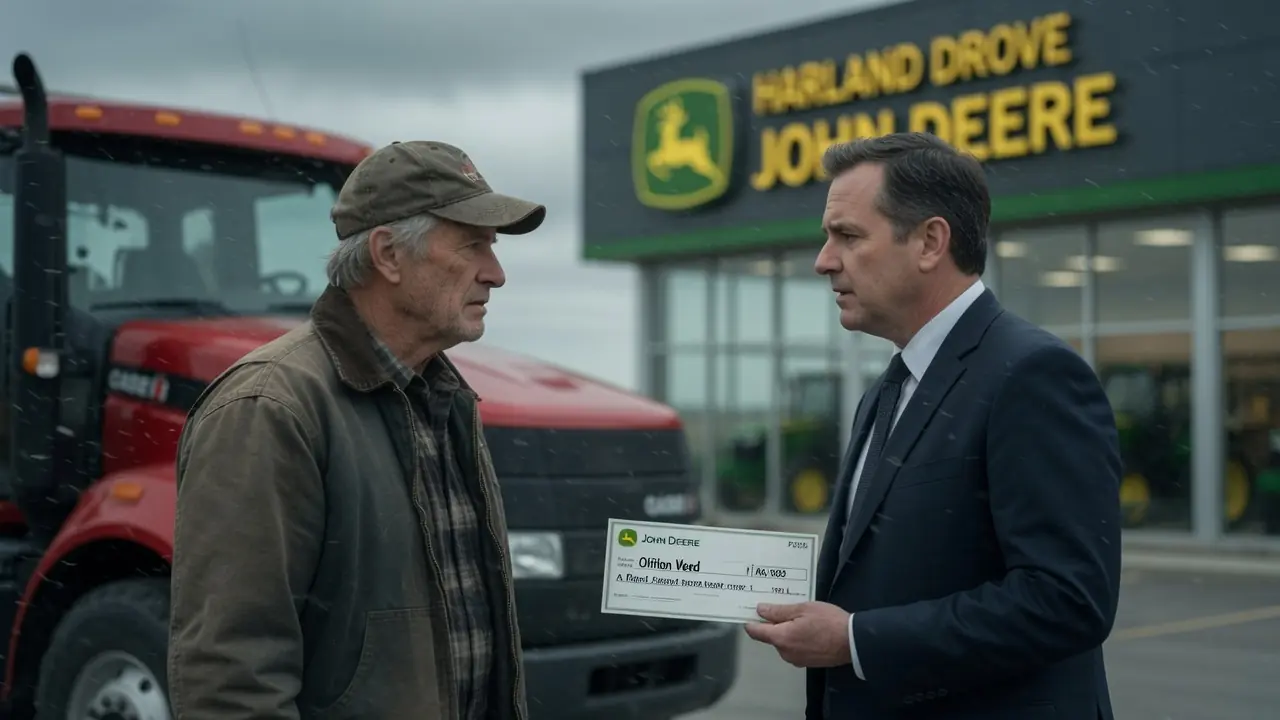
He arrived in a red Case IH truck just after nine on a cold March morning. The wind moved across the parking lot in thin hard gusts, lifting dust and dry leaves near the curb. Clifton parked far from the entrance, not because spaces were full, but because he had no intention of stepping inside. He turned off the engine and sat for a moment with both hands on the wheel, looking through the windshield at the green machines shining behind glass.
The dealership brought back memories with the uncomfortable clarity of a receipt kept too long in a drawer. He remembered bringing in his John Deere 8285R during planting season after a hydraulic fault code stopped him in the East Field. He remembered being told the repair would be covered under warranty. He remembered the phone call two days later, when Harlan Drove said the warranty authorization team had denied the claim because of a fluid specification problem.
The wrong fluid had been placed in the machine during a service interval. That machine had been serviced exclusively by Harland Drove’s authorized technicians for four years. Clifton had asked the obvious question then, and he still remembered the silence that followed. If the dealer had done every service, then where had the wrong fluid come from?
That silence had cost him $11,400 and fourteen days of planting season. It had also cost John Deere something no invoice could properly measure. It had cost them the quiet confidence of a farmer who had run green machines for thirty-one years. Clifton had paid the repair under protest, finished planting, opened a manila folder at his kitchen table, and completed the accounting.
After that, he sold every John Deere machine on his farm. The 8285R went first, then the utility tractors, then the combine. The Case IH machines arrived a few weeks later, unfamiliar in their controls and feel, but honest in the way that mattered most. The dealer who serviced them, Frank Elbert, said what was wrong when something was wrong and fixed what his people were responsible for fixing.
Clifton had never turned the switch into a campaign. He did not post online, call reporters, or stand at the dealership gate with a sign. When neighboring farmers asked him why he had changed brands after three decades, he answered. He gave them the full account, every number, every date, every phone call, without anger and without decoration.
That was how the story moved through Pike County. It traveled at grain elevators, co-ops, kitchen tables, and machine sheds. Farmers did not need a speech from Clifton to understand what had happened. They only needed the facts, and the facts were more damaging than anything anger could have invented.
Four years later, John Deere finally noticed the numbers. Sales across Pike County had dropped hard enough that a regional director named David Castille could not call it normal market movement. There was no drought pattern, no competing dealership opening, no simple explanation hidden in a spreadsheet. The decline began after Clifton sold his green machines, and it spread through the same trust networks that had carried his quiet account.
David Castille read Clifton’s file. He read the warranty denial, the service history, the $11,400 repair charge, and the final $4,500 goodwill credit offer. He called Harlan Drove and pressed him for the truth. Eventually, Harlan admitted what the file had always pointed toward: his technician had used the wrong hydraulic fluid grade at the February 2018 service interval.
Now David was driving to the dealership where the damage had begun. He had asked Clifton to meet him there, not at Clifton’s farmhouse, not at a conference room, not at a neutral place where the truth could feel softer. Clifton had agreed for one reason. If John Deere wanted to speak about what happened, then the words should be said where the wrong had first been protected.
A black company SUV pulled into the parking lot at 9:12. Clifton watched it park near the entrance. David stepped out wearing a John Deere jacket, dark trousers, and the expression of a man who had rehearsed a difficult conversation many times and still knew it might not be enough. He carried a folder in one hand.
Clifton got out of his truck. The wind pressed against his coat, but he did not button it. He stood beside the red truck and waited while David crossed the parking lot. Behind David, the dealership’s glass doors opened and closed as customers moved in and out, unaware that the company’s real problem was standing outside in the cold.
“Mr. Ward,” David said.
“David.”
They shook hands. Clifton’s grip was firm but not welcoming. David seemed to understand the difference. He glanced once toward the showroom, then back at Clifton.
“Thank you for meeting me.”
“I didn’t come for you,” Clifton said. “I came for the place.”
David nodded slowly. “I understand.”
“No,” Clifton said, looking past him at the green tractors. “You’re beginning to.”
The sentence landed without volume but with weight. David did not argue. He had spent enough time with the file to know that Clifton was not a man who wasted words. If Clifton corrected him, it was because the correction belonged in the accounting.
David opened the folder. “I’ve reviewed the full record. Your service history, the warranty denial, the fluid specification dispute, the regional review, and the corporate response.”
“I know what’s in the folder.”
“I also spoke with Harlan Drove.”
Clifton’s eyes hardened slightly. “Then you heard the word he should’ve used four years ago.”
David paused. “Yes.”
Clifton waited.
David drew a breath. “His technician used the wrong hydraulic fluid grade at the February service interval.”
The dealership noise seemed to fade for a moment. Clifton did not react with surprise because surprise belonged to people who had not already known the truth. He simply looked at David the way a farmer looks at a field after weather confirms what the soil had been saying for weeks.
“Say the rest,” Clifton said.
David looked toward the dealership building. “Harlan suspected it in April of 2018 and still reported the investigation as inconclusive.”
Clifton nodded once. “That’s the word that did the damage.”
“Inconclusive?”
“No,” Clifton said. “Cowardice.”
David swallowed.
The glass doors opened behind them. A salesman stepped outside, saw Clifton, saw David, and stopped for half a second before pretending he had only come to check something near the entrance. Clifton noticed but did not look away from David. The dealership had listened too late four years ago. If it listened now, that was its own discomfort to carry.
David removed a check from the folder and held it in both hands. “John Deere was wrong. The warranty denial was wrong, the dealer’s handling was wrong, and the customer relations response was wrong. This is the full $11,400 you should have received in April of 2018.”
Clifton looked at the check but did not take it.
The amount was correct. That mattered. Clifton was a man who believed correct numbers should be recognized, even when they arrived too late. But the check looked strangely small against the dealership building behind David, against four years of trust lost, against the farmers who had already made their own decisions.
“That number was right four years ago,” Clifton said.
“Yes.”
“You only found it after the county walked away.”
David lowered his eyes for one second. “Yes.”
Clifton studied him. There was no excuse in David’s answer, and no corporate padding around it. Just yes. That counted for something, but not for everything.
David held the check out again. “I drove here to make it right.”
Clifton’s expression sharpened. “No, David. You drove here because one honest farmer cost you more than one bad warranty claim.”
The words struck hard enough that even the salesman near the door stopped pretending not to listen. David’s face tightened, but he did not deny it. He looked down at the check, then back at Clifton.
“That’s true,” he said. “But it’s not the only truth.”
Clifton waited.
David continued. “I drove here because the file showed me what happened, and because Harlan confirmed what should have been admitted then. I drove here because the company’s answer was wrong even before the sales numbers proved it was expensive.”
Clifton’s eyes remained hard. “Would you be here if Pike County sales hadn’t dropped?”
David took time before answering. That was the first thing Clifton respected about him that morning. A fast answer would have been a sales answer. A careful answer at least had a chance of being true.
“I don’t know,” David said.
Clifton almost smiled, but not kindly. “That’s the first honest thing John Deere has said to me in four years.”
David accepted it. “Then I’ll keep being honest. The sales decline forced me to open the file. But once I opened it, the file forced me to come here.”
The wind moved between them. A truck passed on Route 61, its tires humming against cold pavement. Inside the showroom, the green tractors gleamed as if polish could protect them from what was happening outside.
Clifton looked toward the dealership doors. “Harlan inside?”
“Yes.”
“Did he know you were meeting me here?”
“Yes.”
“Did he want to come out?”
David’s jaw tightened. “He offered.”
“And?”
“I told him no.”
Clifton looked back at him. “Why?”
“Because this conversation isn’t his chance to stand beside an apology he didn’t earn.”
The answer surprised Clifton more than he showed. For four years, every official sentence from John Deere had been shaped to avoid full responsibility. This man had just refused to share responsibility with someone who had hidden from it.
Clifton looked at the check again. “What do you want in return?”
“Nothing.”
“Nothing?”
“The check is not a goodwill credit. It is not a loyalty offer. It is not tied to a future John Deere purchase. It is the amount you paid for damage that should not have been charged to you.”
Clifton’s voice stayed cold. “And the fourteen days?”
David’s face tightened. “I can’t repay planting time.”
“No.”
“I can acknowledge it.”
“That doesn’t get acres planted.”
“No,” David said. “It doesn’t.”
Clifton looked at him for a long moment. “And the four years?”
David did not answer immediately.
Clifton stepped closer, his voice low but sharp. “Four years, David. Four years of neighbors asking why I switched. Four years of me telling them the truth. Four years of farmers sitting at their own kitchen tables, looking at their own machines, and deciding whether John Deere would stand behind them if the wrong thing happened.”
David nodded slowly. “I know.”
“No, you have data. You don’t know.”
That hit harder. David looked down at the parking lot pavement. For the first time that morning, he seemed less like a regional director and more like a man standing in the place where a spreadsheet had become human.
“You’re right,” David said.
Clifton pointed toward the dealership windows. “You see those tractors?”
“Yes.”
“For thirty-one years, that color meant something on my farm. It meant service. It meant parts. It meant if I did my part, the dealer and the company would do theirs.” His voice hardened. “Then I did my part, and when it cost somebody money to admit the truth, every man in that building suddenly forgot how responsibility works.”
David turned slightly toward the showroom. Harlan Drove was visible behind the glass now, standing near the parts counter. He was not coming outside. Clifton noticed that too.
“You want to know why the county followed me?” Clifton asked.
“Yes.”
“It didn’t follow me.”
David looked back at him.
“I didn’t lead anybody anywhere,” Clifton said. “I didn’t tell Boyd Sellers to switch. I didn’t tell the Thompsons to switch. I didn’t tell any man in this county what color to run. They asked me a question, and I answered it clean.”
David held the folder tighter.
“That’s what you still don’t understand,” Clifton continued. “Out here, trust doesn’t move through advertising. It moves through men who have to live with the truth after the salesman goes home.”
David was silent.
Clifton looked at the check again. “That paper fixes a bill. It does not fix the conversation.”
“No,” David said quietly. “It doesn’t.”
“And the conversation is what cost you Pike County.”
David nodded. “Yes.”
The dealership doors opened again. This time Harlan Drove stepped outside. He stayed near the entrance at first, hands in the pockets of his dealership jacket. Clifton looked at him, and the old anger did not rise the way it once had. What he felt now was colder and cleaner. Harlan was not a monster. He was worse in a way: a man who had known enough truth to do right and had chosen a safer word instead.
“Inconclusive,” Clifton said, not loudly.
Harlan heard it.
His face changed.
David turned. “Harlan, stay inside.”
Harlan hesitated. “Clifton, I just wanted to say—”
“No,” Clifton said.
One word. It stopped Harlan as completely as a locked gate.
Clifton took two steps toward him. David did not interfere. The salesman near the entrance disappeared back inside, perhaps to avoid becoming part of the scene.
“You had your chance to say it in April of 2018,” Clifton said. “You had it when I asked if your technician could prove he didn’t cause the fluid issue. You had it when I paid the bill. You had it when I left with the machine. You had it every day after that while my file sat in your system.”
Harlan’s face reddened. “I didn’t have written confirmation.”
Clifton’s voice cut like wire. “You had enough truth to protect yourself and not enough courage to protect your customer.”
Harlan looked down.
The parking lot went quiet except for the wind.
David said nothing, and Clifton respected that too. This part of the accounting did not belong to the regional director. It belonged to the dealer who had chosen the word “inconclusive” because it was cheaper than honesty.
Harlan swallowed. “I’m sorry.”
Clifton looked at him for a long moment. “I believe you’re sorry it cost you.”
Harlan flinched.
“But I don’t know that you’re sorry it happened,” Clifton added.
David looked away.
Harlan had no answer. After a moment, he turned and went back inside. The glass doors closed behind him, and the dealership swallowed him up with its bright lights and clean floors.
Clifton returned to David.
“Now,” Clifton said, “we can finish.”
David extended the check again. Clifton took it this time. He looked at the amount, the printed name, and the company issuing it. The paper was correct. Late, but correct. He folded it once and held it beside his coat.
“I’m not switching back,” Clifton said.
“I’m not asking you to.”
“Frank Elbert runs an honest operation.”
“I’ve heard that.”
“His machines do what I need them to do.”
“I understand.”
Clifton’s eyes narrowed. “Do you?”
David looked toward the red Case IH truck, then toward the green tractors behind glass. “I understand that your decision was not emotional. It was earned.”
Clifton nodded slightly. That answer was close enough.
“I’ll tell Boyd Sellers you came,” Clifton said.
David gave a faint tired smile. “That may be the most important review I ever receive.”
“I’ll tell him you brought the right number.”
“Thank you.”
“I’ll tell him you said the warranty denial was wrong.”
“That is accurate.”
“I’ll tell him Harlan came outside and still couldn’t carry the truth properly.”
David exhaled. “That is also accurate.”
Clifton slipped the check into the manila folder he had brought with him. David noticed it then, old, worn at the edges, thick with documents. The folder seemed almost alive between them, carrying every receipt, every call note, every offer, every refusal, every piece of paper that had survived what trust did not.
“Is that the original file?” David asked.
“Yes.”
“You brought it here?”
“This is where it started.”
David looked at the folder with something close to respect. “And now?”
Clifton tapped the folder once. “Now it’s complete.”
The words did not mean forgiven. David understood that. Complete meant the final document had been added. The right number had found its place. The accounting could close, even if the relationship could not be reopened.
“What happens now?” David asked.
Clifton looked over the dealership one last time. “Now I go back to work.”
“That’s all?”
“That’s enough.”
David nodded slowly. “Mr. Ward, I know this may not matter, but I am going to take this back to St. Louis and make sure they understand what happened here.”
Clifton’s face did not change. “They won’t.”
David looked stung. “Why do you say that?”
“Because companies understand numbers before they understand people.”
David held his ground. “Then I’ll start with the numbers.”
Clifton pointed toward the dealership. “Start with this one. Eleven thousand four hundred dollars saved them nothing.”
David nodded.
“Then give them the next number,” Clifton said. “Thirty-four percent.”
David’s eyes lowered.
“And after that, give them the number they can’t put on a chart.”
“What number is that?”
Clifton opened his truck door. “Every farmer who heard the truth from a man he trusted.”
David did not speak.
Clifton climbed into the red truck, then paused with the door still open. “David.”
“Yes?”
“Out here, an apology counts for something.”
David looked up.
“But only if it arrives before people have to live without it.”
He closed the door.
The red truck started, steady and low. Clifton pulled away from the dealership without looking back. He passed the green sign, the new tractors, the service bays, and the glass showroom where Harlan Drove stood watching from inside. None of it followed him.
David remained in the parking lot after the truck disappeared onto Route 61. The cold wind moved across his face, but he did not return inside right away. He looked at the dealership building and understood, more clearly than he had from any report, why the county had changed. It had not been captured by a competitor. It had been released by disappointment.
A company had treated one farmer’s legitimate wrong as a cost to minimize. The farmer had treated it as an accounting to complete. The company offered $4,500 against $11,400, and the farmer did not rage. He simply stopped buying, stopped calling, and told the truth when asked.
That truth had done what no protest could do. It moved through Pike County without needing permission. It crossed fence lines, coffee tables, service counters, and grain elevator conversations. By the time John Deere came looking for the loss, the loss had already become ordinary.
David finally walked toward the dealership doors. Before entering, he looked once more at the spot where Clifton’s red truck had been parked. The space was empty now. That emptiness felt more instructive than the full showroom.
Inside, Harlan was waiting near the counter.
“How did it go?” Harlan asked.
David looked at him. “He took the check.”
Harlan seemed relieved.
David’s voice hardened. “Don’t mistake that for repair.”
Harlan’s relief faded.
David walked past him into the office and closed the door. He opened Clifton Ward’s file on the desk and added one final note from the meeting. Not a sales note. Not a retention note. Not a customer recovery note.
A trust failure left uncorrected became a county-level market loss.
Then he stopped, stared at the sentence, and added another line.
The customer was right from the beginning.
Outside, the green tractors still gleamed behind glass. Inside the office, the file no longer looked like an old complaint. It looked like a warning.
Miles away, Clifton turned down the road toward his farm. The manila folder sat on the passenger seat, heavier with the check inside it but lighter in another way. When he reached home, he would place it back in the filing cabinet beside the original receipt, the warranty denial, and the record of the final corporate offer. Then he would start his Case IH and get back to work.
He did not need John Deere to apologize in order to know he had been right. He did not need the check to prove the number. He did not need the regional director’s visit to justify the decision he had made at his kitchen table four years earlier. The accounting had always said what it said.
But now the folder was complete.
And outside Harland Drove’s John Deere dealership, in the same parking lot where the relationship should have been protected years before, the truth had finally been spoken aloud.
Not loudly.
Not perfectly.
Not soon enough.
But honestly.
For Clifton Ward, that was enough to close the file.
For John Deere, it was only the beginning of understanding what the file had cost.