Harvey Wilkins had spent forty years believing cattle were easier to understand than people. Cows did not smile while lying, did not shake your hand while planning to cheat you, and did not pretend respect while counting the acres they wished belonged to them. On his Montana ranch, just beyond the low hills where the wind never seemed to rest, Harvey trusted weather, fences, feed, and animals more than he trusted any man in a clean vest. That was why, when his oldest cow Bessie began staring into the abandoned stone well every morning, Harvey noticed long before anyone else cared.
Bessie was not a valuable cow by ordinary ranch standards anymore. She was old, heavy in the knees, slow to rise, and missing the bright strength she had carried in her younger years. But Harvey loved her the way a man loves an animal that has shared hard seasons with him. She had survived blizzards, drought, one lightning-split cottonwood, and the year feed prices nearly broke him.
For ten years, Bessie had followed the same strange ritual. At dawn, before the rest of the herd spread into the pasture, she walked to the far side of the ranch where an old stone well stood half-forgotten near a leaning fence. The well had not been used since Harvey’s father was alive, and its wooden cover had rotted away decades ago. Bessie would lower her head over the darkness and stare, breathing slowly, as if something at the bottom was calling only to her.
At first, Harvey thought it was nothing. Animals had habits, just like people, and old cows were allowed their mysteries. He had seen horses refuse a water trough for no reason, dogs bark at empty corners, and chickens panic at a shadow no human could see. So when Bessie stood at the well, Harvey shook his head, muttered, “You’re an odd old girl,” and went back to work.
But the ritual did not fade. It grew stronger. Some mornings, Bessie would leave fresh hay untouched just to walk toward the well. Other mornings, she stood there through rain, heat, and cold wind, her ears twitching, her nostrils flaring at whatever rose from the dark stones below.
Harvey’s hired hand, Miguel Torres, was the first to say it aloud. “Boss,” he said one morning, leaning on a fence rail, “that cow isn’t just staring.” Harvey looked up from tightening a gate hinge. Miguel nodded toward Bessie, who stood frozen near the well. “She’s smelling something.”
Harvey wiped sweat from his forehead and watched the cow. The idea should have sounded foolish, but it did not. Bessie’s nose moved carefully, pulling in the air from the well in long, patient breaths. She was not lost in age or confusion. She was paying attention.
That afternoon, Harvey walked to the well and leaned over the stones himself. He smelled damp earth, old water, minerals, and something else he could not name. It was faint, oily, sharp enough to catch at the back of his throat. He stepped back, frowning, and looked at Bessie as she chewed slowly beside him.
“You know something, don’t you?” he murmured.
Bessie blinked at him with dark, calm eyes.
The ranch beside Harvey’s belonged to Victor Hale, a wealthy cattleman who had arrived in the county fifteen years earlier with money from real estate and a habit of treating old ranchers like museum pieces. Victor’s house was twice the size of Harvey’s, built from pale stone with high windows and a circular driveway. His fences were new, his boots were polished, and his cattle looked like they had been arranged for photographs. He called Harvey “old-timer” even though Harvey had asked him not to.
Victor had wanted Harvey’s land for years. He never said it plainly, because men like Victor preferred smiles to open threats. Instead, he offered “partnerships,” “consolidation ideas,” and “retirement opportunities” whenever prices were bad or drought hit hard. Harvey always refused, and every refusal made Victor’s politeness thinner.
The morning everything changed began with Bessie refusing to move. She had gone to the well before sunrise and stayed there past breakfast, past the first feeding, past the hour when the herd drifted toward the north pasture. Harvey called her once, then twice. She did not turn.
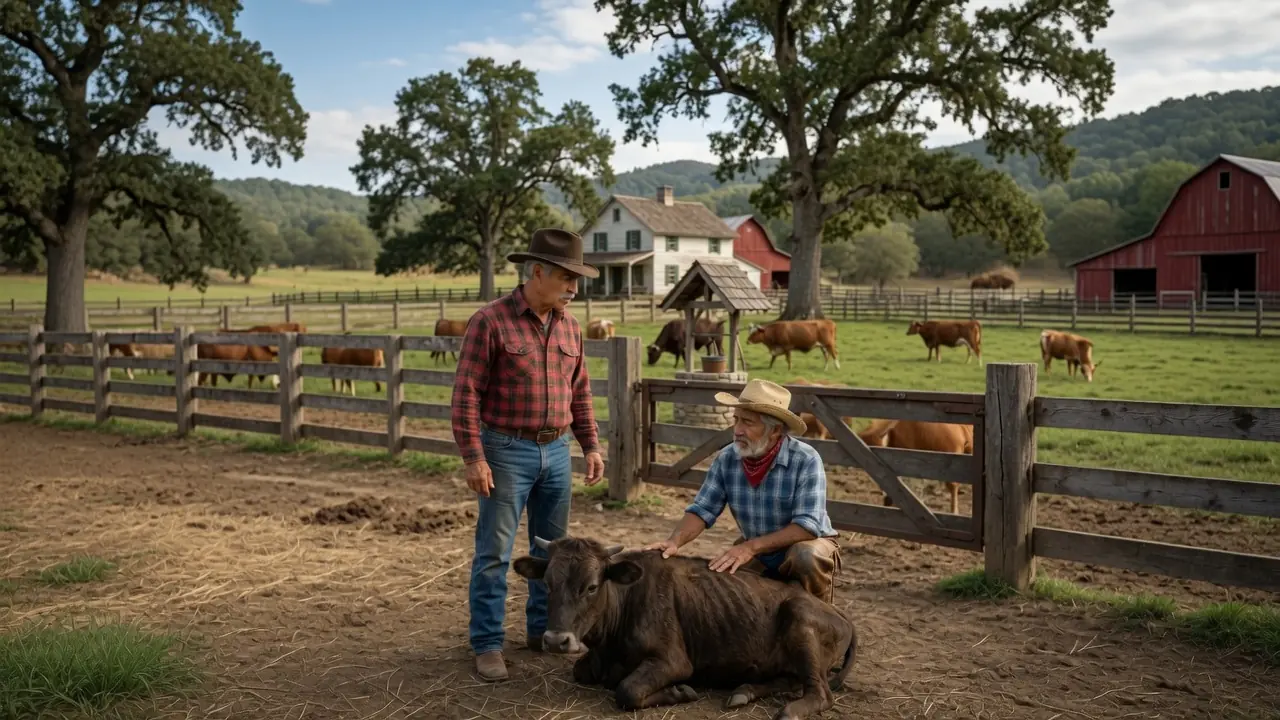
By midmorning, she had sunk down beside the well, folding her legs under her heavy body. That frightened Harvey more than the staring ever had. Bessie was old, but she was stubborn, and she did not lie down in open dirt unless something was wrong. Harvey crossed the yard quickly, knelt beside her, and placed one hand on her neck.
Bessie breathed heavily, her eyes still turned toward the well.
Miguel wanted to call the veterinarian. Harvey agreed, but before Miguel reached the truck, Victor Hale rode over from the adjoining pasture with two of his men behind him. He had seen the commotion from the ridge and clearly smelled an opportunity before understanding the trouble. He dismounted near the gate, smooth and confident, wearing a brown leather vest too clean for real work.
“Well now,” Victor said, looking down at Bessie. “Looks like the old cow finally gave out.”
Harvey kept his hand on Bessie’s neck. “She isn’t dead.”
“Not yet.” Victor looked toward the well and smirked. “Still staring at that hole? I told folks years ago that animal was half crazy.”
Miguel’s face hardened, but Harvey lifted one hand slightly, warning him not to speak. Harvey had learned long ago that anger gave men like Victor a stage. He looked up slowly. “She’s been smelling something down there.”
Victor laughed. “Harvey, she’s a cow. She smells mud, rot, and whatever else old holes collect.”
“Maybe.”
Victor stepped closer, glancing toward the ranch house, the pasture, the well, and then back at Harvey. “You know, this is exactly what I mean when I say this place is getting too much for you. Old wells, sick cattle, broken fencing. A man reaches an age where he ought to think practically.”
Harvey stood then. His knees cracked, but his eyes stayed steady. “If you came to talk about buying my land, you can ride back home.”
“I came as a concerned neighbor.”
“No, Victor. You came because you saw weakness.”
The words hung in the bright air between them. Victor’s smile faded for half a second before returning colder than before. He nodded toward Bessie. “Fine. Investigate your magic cow, then. Maybe she found buried treasure.”
Harvey looked at the old well. Something in that mocking sentence settled inside him like a challenge. He had ignored Bessie’s warning for too many years because people would laugh. Now the man who wanted his ranch was standing in his yard laughing already.
“Get the rope,” Harvey told Miguel.
Miguel stared at him. “Boss?”
“I’m going down.”
Victor’s eyebrows rose. “Into that well? At your age?”
Harvey did not look at him. “My age has hauled calves in blizzards, rebuilt fences after fire, and buried better men than you. It can handle a well.”
Miguel brought the strongest rope from the barn and tied it to the old iron ring set into the well’s stone collar. Harvey fetched a lantern, gloves, and a cloth to cover his mouth against the smell. Victor stood nearby with his arms crossed, trying to look amused, but curiosity had begun to pull at him. His men whispered behind him.
The descent was slow. The stone shaft was narrow, damp, and cold compared to the sunlit ranch above. Harvey braced his boots against the sides and lowered himself inch by inch while Miguel controlled the rope from above. The smell grew stronger as he dropped, sharp and thick, not like dead leaves or stagnant water, but like machine grease mixed with earth.
Halfway down, Harvey almost turned back. His shoulder ached, his palms burned inside the gloves, and the darkness below seemed deeper than it should have been. Then Bessie let out a low, strained sound from above. It echoed faintly into the well, and Harvey kept going.
His boots touched muddy ground at the bottom. The lantern light wavered against slick stone. For a moment, he saw only black water pooled around his feet and roots pushing through cracks in the old wall. Then the mud shifted.
Something thick and black seeped through a split in the stone floor.
Harvey crouched carefully, holding the lantern closer. The substance bubbled slowly, catching the light with a rainbow sheen. He touched it with one gloved finger, rubbed it against his thumb, and felt his heart begin to pound. This was not ordinary mud.
Above him, Victor called down, “Find your treasure, Harvey?”
Harvey did not answer at first. He stared at the black seep, the cracked stone, the oily surface, and the faint vapor curling upward from the earth. Bessie had not been staring at nothing. She had smelled what no human had bothered to understand.
“Pull me up,” Harvey said.
His voice sounded different even to himself.
When he emerged from the well, his shirt was streaked with mud and sweat, and his face had gone pale beneath his weathered skin. Miguel grabbed his arm and steadied him. Bessie lifted her head slightly, as if she already knew the answer.
Victor stepped forward. “Well?”
Harvey opened his fist. Black, oily mud smeared across his glove.
Victor’s expression changed. It was subtle at first, then impossible to hide. His smirk vanished. His eyes sharpened. He looked from Harvey’s glove to the well, then to the land stretching behind the ranch house.
“What is that?” Miguel asked quietly.
Harvey looked at Victor, then back at the well. “I think Bessie found oil.”
The words moved through the yard like thunder without sound. Victor’s two men stopped whispering. Miguel crossed himself under his breath. Bessie exhaled heavily and lowered her head to the dirt again.
Victor recovered quickly, but not quickly enough. Harvey saw the hunger flash across his face before he buried it under concern. “Now, Harvey, let’s not get ahead of ourselves. Could be old contamination. Could be runoff. You need experts before making wild claims.”
“I know.”
“I can help arrange that.”
Harvey removed his glove slowly. “No.”
Victor stiffened. “No?”
“No, Victor. You won’t arrange anything for me.”
The wealthy rancher smiled tightly. “Don’t be foolish. If there’s even a possibility of mineral value here, you’ll need lawyers, geologists, contracts, permits. Men will come from all directions. They’ll confuse you before lunch.”
“Then I’ll be confused without you.”
Victor’s voice lowered. “Harvey, you don’t understand what this could be worth.”
Harvey looked down at Bessie, his old cow lying beside the well she had guarded for years. Then he looked back at Victor. “That’s exactly why you won’t touch it.”
The next forty-eight hours were the longest Harvey had known since his wife died. He called his nephew Daniel, who worked as an attorney in Billings, and told him only enough to get him to the ranch by morning. Daniel arrived with a mineral rights specialist, a geologist, and a seriousness that made Harvey understand the world had already begun shifting under his boots.
The geologist, Dr. Elaine Mercer, examined the well first. She took samples from the black seep, tested vapors, inspected the surrounding land, and asked Harvey questions about water changes, odors, soil discoloration, and Bessie’s behavior. Harvey answered everything he could. Each time he mentioned the cow, Dr. Mercer listened instead of laughing.
By sunset, her face had grown very still.
“I need more testing,” she said, “but this is not ordinary contamination.”
Daniel looked at her. “Elaine.”
She glanced toward the well, then toward the pasture. “There may be a significant petroleum reservoir beneath this property.”
Harvey sat down on the porch step because his legs suddenly felt untrustworthy. Miguel stood beside the fence, staring at the ground like oil might burst through it at any second. Bessie had been moved into the shade with fresh water and hay, and for once she was no longer staring at the well. She seemed tired, relieved, almost done with her work.
The news did not stay quiet for long. It never does when land and money meet. Within a week, trucks came down the road. Surveyors marked sections. Men in clean boots asked to speak with Harvey. Company representatives offered “preliminary discussions” and “friendly introductions” while Daniel stood beside his uncle like a locked gate.
Victor Hale came too.
This time, he did not arrive laughing. He came in a black truck, alone, wearing a dark hat and the serious expression of a man who had spent the night regretting every insult he ever made too publicly. Harvey met him near the cattle gate, the same place where Bessie had lain when the black mud first came up from the well.
“I owe you an apology,” Victor said.
Harvey said nothing.
Victor cleared his throat. “I spoke carelessly the other day.”
“You spoke honestly.”
That struck harder than Victor expected. His jaw moved once. “I was wrong about the cow.”
“You were wrong about more than the cow.”
Victor looked toward the ranch house, the cattle, the well, the old fencing, the land he had wanted to absorb into his own empire. “Harvey, if this turns into what people say it might, you’ll need allies.”
Harvey’s eyes narrowed. “You mean buyers.”
“I mean experienced partners.”
“You wanted this ranch when you thought it was tired dirt and an old man’s problem. Now you want it because Bessie found what you couldn’t see.”
Victor’s face hardened slightly. “Sentiment won’t protect you from oil companies.”
“No,” Harvey said. “But neither will greed.”
For the first time since Harvey had known him, Victor had no smooth reply ready. He looked older standing there, smaller too, though his clothes were still expensive and his boots still polished. Harvey almost felt sorry for him, but not enough to forget the years of pressure disguised as neighborly advice.
“I’m not selling,” Harvey said.
Victor’s eyes flashed. “Everything sells eventually.”
Harvey stepped closer. “Not everything belongs to men who can count money faster than they can count what matters.”
Victor left without shaking his hand.
The official confirmation came three weeks later. Dr. Mercer returned with a full report and laid it on Harvey’s kitchen table beside a pot of black coffee and Linda Wilkins’s old sugar bowl. Harvey had not moved the sugar bowl since his wife died; even now, with oil men circling his fence lines, he could not bring himself to put it away.
“It is substantial,” Elaine said.
Daniel let out a breath. “How substantial?”
Elaine looked at Harvey. “Potentially one of the larger untapped private reserves in this part of the state.”
Harvey looked through the kitchen window toward the pasture. Bessie stood under a cottonwood tree, chewing hay slowly, her old ribs moving under her hide. He thought about all the mornings she had stared into that well while he ignored the message because it came from an animal and not a man in a suit.
“How much money?” Miguel asked from the doorway, then immediately looked embarrassed. “Sorry.”
Daniel gave a humorless laugh. “A lot.”
Harvey did not smile. The number, when they eventually discussed it, felt unreal. Too large for the kitchen, too large for the old table, too large for a man who still patched gloves instead of buying new ones. Wealth had always been something beyond his fence, visible in Victor’s stone house and polished trucks. Now it had been sleeping beneath Harvey’s dirt all along.
The contracts took months. Harvey refused to sign quickly, which annoyed every company representative who tried to charm him. Daniel brought in environmental experts, mineral rights attorneys, and independent negotiators. Harvey made one rule before any agreement moved forward: the ranch would not be destroyed for money.
Some men laughed politely when he said it. Those men were not invited back. Others listened carefully, explained controlled drilling options, water protections, cattle pasture limits, and long-term restoration terms. Harvey chose the ones who treated the land like something living rather than something to drain.
Victor watched from the neighboring ridge. He watched survey flags appear and disappear. He watched Harvey’s old driveway get reinforced for work trucks. He watched men who had once driven past Wilkins Ranch without slowing now park there for meetings. For years, Victor had believed he was the powerful man in the valley, and now power had shifted because an old cow stared into a well.
One afternoon, months after the discovery, Victor came again. This time, he found Harvey sitting beside Bessie near the barn. The cow was weaker now, her breathing slower, her eyes cloudy but calm. Harvey had one hand resting on her neck, just as he had on the day the truth surfaced.
Victor removed his hat. “I heard she’s not doing well.”
Harvey nodded. “She’s old.”
A silence passed between them.
Victor looked at the cow, then at the well beyond the fence. “Strange thing,” he said quietly. “Everything changed because of her.”
Harvey stroked Bessie’s neck. “No. Everything changed because I finally listened.”
Victor absorbed that. For once, he did not argue. “I spent years trying to buy this place.”
“I know.”
“I thought you were holding on out of stubbornness.”
“I was.”
Victor glanced at him.
Harvey’s mouth twitched faintly. “But sometimes stubbornness is just loyalty with work boots on.”
That almost made Victor smile, but it faded quickly. He looked toward his own ranch, his large house shining beyond the pasture. “I have more land than I need and less peace than I expected.”
Harvey did not answer.
Victor put his hat back on. “Take care of her.”
“I will.”
Bessie died two weeks later under the cottonwood tree, with Harvey beside her and Miguel standing a few steps away wiping his eyes. They buried her near the old well, not too close to the work site, but close enough that Harvey could see both from the porch. Daniel suggested a small marker, and Harvey chose a flat stone with simple words.
Bessie.
She knew first.
The money came slowly, then heavily. Royalties, lease payments, and contracts transformed Wilkins Ranch from a struggling cattle operation into the center of county speculation. People who had not visited Harvey in years suddenly remembered they were friends. Distant relatives called. Banks offered services. Charities sent letters. Salesmen appeared with trucks, tractors, investment plans, and smiles polished brighter than Victor’s boots.
Harvey changed less than people expected. He repaired the barn roof, paid Miguel enough to buy his own house, cleared every debt tied to the ranch, and set up college funds for Miguel’s children. He donated to the volunteer fire department, the rural clinic, and the local school’s agriculture program. He bought one new truck, then complained it had too many buttons.
The biggest change came the following spring. Harvey purchased a struggling neighboring farm, not Victor’s, but one owned by a widow whose sons had moved away. Instead of adding it to an empire, he placed it into a conservation trust with grazing rights, water protections, and a youth agriculture training program. When reporters asked why, Harvey shrugged.
“Land kept me alive before money found me,” he said. “Seems wrong to forget which one came first.”
Victor Hale eventually sold part of his own operation, though not to Harvey. Some said he had lost interest. Others said he could not stand watching Harvey become richer by accident than he had become by strategy. Harvey never asked.
Years later, the old well remained fenced and protected, no longer abandoned, no longer dismissed. School groups came sometimes to hear about geology, ranching, and the strange story of a cow that noticed what men missed. Harvey would stand beside the fence with his hat low over his eyes and tell the story simply, never making himself sound cleverer than he had been.
“I ignored her for ten years,” he would say. “That’s the part folks forget.”
The children always laughed at that, but Harvey meant it. Bessie had not changed his life because she was magical. She changed it because she paid attention to something steady and Harvey eventually humbled himself enough to follow her gaze. That, he believed, was the lesson worth keeping.
On quiet evenings, when the work trucks were gone and the cattle moved gently across the pasture, Harvey still walked to Bessie’s grave. He would stand there with one hand on the fence and look toward the old well. Sometimes the Montana wind carried a faint mineral smell from the earth, and sometimes it carried only dust, grass, and the warm breath of cattle.
Either way, Harvey listened.
He listened to the land, to the animals, to the silence beneath ordinary things. He listened because the greatest fortune of his life had not arrived with a shout, a contract, or a man in a suit. It had come as a patient old cow staring into darkness every morning until her farmer finally understood.
And Harvey Wilkins, who had once thought he was only saving a sick animal, learned that some blessings do not knock at the door. Some stand quietly by an old well for years, waiting for someone wise enough to stop laughing and look down.