Nobody in Calhoun County looked at the Merritt Farms back forty anymore unless they were passing it on the road and wanted something to shake their heads at. The field had been empty for eleven years, cracked in summer, pale in winter, and stitched with weeds that even the deer seemed to avoid. Old-timers said it had gone bad after the flood, the spring when two rows of planting equipment sank axle-deep into the wet clay and Harlan Merritt was dragged from the mud with a back injury that never healed right. Since then, the land had sat like a family shame no one wanted to discuss.
Eli Merritt was thirteen the summer he started walking the fence line with his great-grandfather’s soil probe. He was a thin boy with quiet eyes, the kind of child adults forgot was in the room until he asked a question too sharp to ignore. Most boys his age were thinking about baseball, trucks, or how to avoid chores, but Eli had found Theodore Merritt’s old farm journals in a trunk beneath the attic window. The leather covers were cracked, the pages smelled of dust and cedar, and the pencil marks inside felt like someone speaking across time.
His great-grandfather had written about everything. Rainfall, frost dates, seed varieties, wind direction, earthworms, birds, soil smell after storms, and which corner of which field stayed dark longest after a hard rain. Eli read the journals at night with a flashlight under his quilt, turning pages slowly because the handwriting was careful but faded. He did not tell his parents at first. He felt as if he had found a secret language the farm still remembered even though everyone else had stopped listening.
One page troubled him more than the rest. Theodore Merritt had written about the northeast corner of the back forty as if it were the heart of the whole property. He wrote that the soil there “held sweetness after rain” and that worms gathered beneath the surface even in dry spells. He noted that crops in that corner stood stronger, not because of fertilizer, but because “the water travels where the eye cannot follow.” Eli read that sentence so many times he could almost hear his great-grandfather breathing through it.
The problem was that no water traveled there now. The back forty looked dead from one fence to the other. In August, the ground cracked open in thin gray lines, and the weeds stood dusty and brittle. The middle of the field still pooled after storms, but the northeast corner stayed strangely firm, cooler beneath Eli’s palm, and darker under the crust if he scraped away the top inch of soil.
That difference was what caught him.
On a Monday morning before school, Eli walked to the fence line with the soil probe and stopped at the corner Theodore had described. Grasshoppers leapt around his boots while the sun came up behind the barn in long flat stripes. He pressed the probe into the ground, then knelt and placed his palm against the soil. It was cooler than it should have been.
He stayed there for almost five minutes, perfectly still. His mother, Vera, watched from the kitchen window and wondered what had gotten into him. His father, Martin Merritt, stood on the porch with coffee in his hand, looking tired before the day had even begun. Neither of them called out. On a farm, a child staring at dirt was not urgent unless something was bleeding.
Eli stood at last, walked back to the barn, and returned with a spade.
That was when Chet Dolan noticed him.
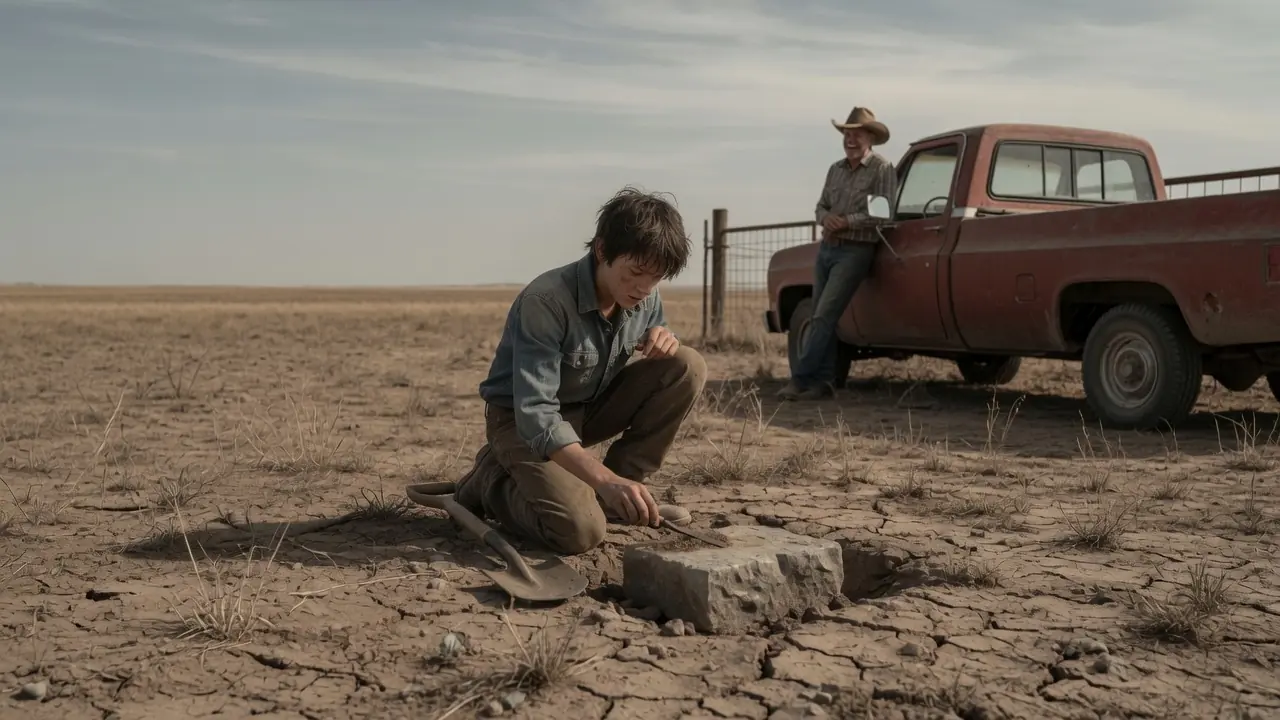
Chet and his brother Rudy farmed the land next door and had opinions as solid as fence posts. Chet pulled his truck up near the road, lowered the window, and watched Eli shove the spade into clay-packed ground. Rudy sat in the passenger seat, eating peanuts from a paper bag and looking amused. After a few minutes, Chet got out and leaned against the truck.
“Son,” Chet called, “that ground’s been dead since it flooded. You’re not going to find anything worth finding.”
Eli looked up, squinting in the sun. He nodded politely.
Then he kept digging.
Chet laughed, not cruelly at first, but with the easy certainty of a man who believed age had made him right. “You hear me, boy? That field already broke your granddaddy’s back and your family’s patience. Best thing you can do is leave it alone.”
Eli pushed the spade deeper. “Yes, sir.”
Chet frowned. “Yes, sir, what?”
“Yes, sir, I hear you.”
Rudy laughed from the truck. “He hears you. Just doesn’t care.”
Eli did care, but not about their laughter. He cared about the way the spade went into the northeast corner differently than it went into the rest of the field. The top layer was hard, but under it the soil loosened with a cooler resistance. It did not feel dead. It felt covered.
That afternoon, after school and chores, Eli returned to the hole. His mother brought him water and stood beside him for a while, watching the odd curved line of disturbed soil he had begun to make. “What are you looking for?” she asked. Eli wiped sweat from his forehead with his sleeve. “I don’t know yet.”
“That is not a comforting answer.”
“I know.”
Vera studied him. She had learned not to push Eli too hard when his mind had caught hold of something. “Does this have to do with those journals you’ve been reading?”
He looked surprised, then sheepish. “You knew?”
“I wash your sheets. Flashlight batteries fall out.”
Eli lowered his eyes. “Great-Grandpa Theodore wrote that water moved under this corner.”
Vera looked across the cracked field. “There hasn’t been water here in years.”
“That’s what everyone says.”
“And what do you say?”
Eli pressed his hand to the ground. “I say this part doesn’t feel like the rest.”
She did not laugh. That was one of the reasons Eli loved her most. Vera Merritt had known disappointment, debt, crop failure, and the slow fear of watching her husband inherit land he was afraid to want. But she still believed children sometimes heard truth before adults allowed themselves to.
By the second week, the neighbors had stopped only laughing and started watching. Eli dug before school and after chores. He did not move in straight lines. He did not dig like a boy trying to make a hole. He dug like someone following a path beneath the earth.
Old Dale Fesser came one afternoon and stood at the fence with his thumbs tucked into his suspenders. Dale had farmed Calhoun County for fifty years and was the sort of man people listened to even when he was wrong. He watched Eli’s pattern for nearly twenty minutes. Finally, he spat into the grass and said, “That child is reading the land.”
Chet Dolan smiled. “Is he reading it right?”
Dale narrowed his eyes. “No.”
Eli heard them but did not answer.
He kept digging.
That evening, his father came down to the field. Martin Merritt had not liked looking at the back forty since taking over the farm. It represented everything he had inherited but did not know how to fix. He loved the farm, but love had become tangled with fear, and fear had a way of making a man call things hopeless before they could disappoint him again.
“You’re making people talk,” Martin said.
Eli leaned on the spade. “They were already talking.”
“Fair enough.”
Martin looked at the curved trench, then at his son. He wanted to tell him to stop, partly because he feared the boy would be mocked and partly because he feared Eli might find nothing. Hope was dangerous in a family that had already buried too much of it. Still, he saw Theodore’s journal tucked into Eli’s back pocket and could not bring himself to kill whatever had started there.
“You need help?” Martin asked.
Eli’s face changed. “Maybe tomorrow.”
Martin nodded, trying to hide how much that answer meant. “Tomorrow, then.”
The day Eli found the first stone was a Thursday in early September. The air was heavy, the sky low with clouds that refused to rain, and the field smelled of dust and dry weeds. Eli had gone down about eighteen inches where the soil felt cooler against the blade. He pressed the spade deeper, expecting root or clay.
Instead, the metal struck something hard.
Not the dull thud of bedrock.
Not the snap of wood.
A hollow ring rose from the ground.
Eli froze.
At the fence, Chet Dolan’s laugh caught halfway out of his throat. “What was that?”
Eli dropped the spade and knelt in the dirt. His heart began beating so hard he could hear it. He brushed soil away with both hands, careful, almost afraid to move too fast. A flat corner emerged beneath the clay, then an edge, then a squared surface fitted against another stone.
Chet walked closer.
Rudy got out of the truck.
Eli cleared more dirt until there could be no mistake. It was not natural rock. It had been shaped, placed, and buried by human hands.
Eli looked up at Chet. His voice was quiet, but it carried. “That’s not rock, Mr. Dolan. Somebody built this.”
For once, Chet had nothing ready to say.
Eli ran to get his father. Martin came back with a shovel, Vera behind him, both moving faster than they had in months. Together, father and son widened the hole, working around the stone edge while Vera stood with one hand pressed to her mouth. Within an hour, they uncovered a narrow stone-lined channel angling beneath the old field.
Martin knelt beside it, breathing hard. “What is this?”
Eli pulled Theodore’s journal from his pocket with dirty fingers. The page was already marked by a folded corner. He read aloud: “Water travels where the eye cannot follow. The northeast corner will live if the old path stays open.”
Vera whispered, “The old path.”
By sunset, half the road knew something had been found. Dale Fesser arrived with a lantern. Chet returned with Rudy, both pretending they had only come back because they were passing by. Vera called Amos Webb, a retired county surveyor who knew more about old drainage systems than anyone still living.
Amos came the next morning in a straw hat, carrying a measuring rod and a leather folder of old maps. He was seventy-six, sharp-eyed, and slow-moving, with hands that trembled until they touched land records. Then they became steady. He crouched beside the exposed stones and said nothing for so long that everyone else stopped speaking too.
He ran one finger along the cut edge of the stone. He looked at the angle of the trench. He stood, turned toward the upper hillside, then traced an invisible line across the field with his eyes. When he finally spoke, his voice had changed.
“I know what this is.”
Chet folded his arms. “Well?”
Amos looked at Eli, not Chet. “Your great-grandfather built a stone water channel.”
Martin frowned. “Like a drain?”
“More than a drain.” Amos tapped the edge with his rod. “Before clay tile and pumps, some farmers built hand-cut stone channels to guide subsurface water. If there was a spring seep up high, they could capture slow water and carry it through the field without a pump, without pipe, without a machine.”
Dale stared toward the hillside. “You’re saying water may still be moving under here?”
“I am saying this field may not have died,” Amos replied. “It may have been disconnected.”
The words changed the air.
Disconnected.
Not dead.
Eli felt them settle inside him like a bell still ringing after it had been struck.
For the next three weeks, the Merritt back forty became the most talked-about field in Calhoun County. Men who had mocked Eli now appeared with shovels. Dale came every morning. Amos marked angles with small flags. Martin worked beside his son until his back forced him to rest, then returned anyway with a brace under his shirt and stubbornness in his jaw.
They traced nearly sixty feet of stone channel. Some sections were collapsed, clogged with silt and roots, but the shape remained. A second line branched beneath what had once been a drainage ditch, forming a Y-shaped system under the soil. Theodore Merritt had not guessed at water. He had studied it, shaped it, and taught the land how to carry it.
Eli listened to every explanation, asked questions, and wrote notes in his own cheap school notebook. For the first time, he understood that farming was not only planting and harvesting. It was memory. It was patience. It was seeing what the land had done before and asking why it had stopped.
The day they flushed the first channel, nearly thirty people came to watch. Chet Dolan stood beside Eli with his cap in his hands, no longer leaning, no longer laughing. Water was pushed into the upper section to break loose decades of silt. At first, muddy sludge seeped from the lower end. Then the flow stopped.
Chet muttered, “Maybe that’s all there is.”
Eli did not answer.
He crouched and placed his hand on the soil.
A minute passed.
Then another.
Slowly, the ground near the exposed channel darkened. Not with floodwater, not with surface runoff, but from beneath. A crescent of dampness spread through the soil, cool and clear. Then cold water rose gently through the stone-lined path, seeping upward as if the field had remembered how to breathe.
No one spoke.
The water did not rush. It simply returned.
Vera began to cry quietly. Martin put one hand on Eli’s shoulder and held it there. Dale removed his hat. Amos smiled like a man seeing an old map prove itself alive.
Chet Dolan swallowed hard. “Your great-granddad knew something the rest of us forgot.”
Eli looked at the darkening soil. “He wrote it down.”
Chet nodded slowly. “And you listened.”
That winter, Martin Merritt made the decision no one expected. He would not sell the back forty. He would farm it again. Not all at once, not foolishly, and not with the old pride that had nearly ruined it before. He would begin with the northeast corner, restore the channel, rebuild the soil, and let the field return one careful acre at a time.
In early spring, Eli and his father planted a cover crop mixture of crimson clover and winter rye. The ground still looked rough, but it no longer looked abandoned. The restored moisture held beneath the surface, feeding roots and softening clay. Earthworms appeared first, then beetles, then the darker smell of living soil after rain.
Dale walked beside Eli one April morning, pointing with his cane at the young green growth. “You see how those roots break the hardpan?”
Eli nodded. “They make channels.”
“Small ones,” Dale said. “But millions of them. Water, air, life. That’s how ground forgives you.”
Eli looked over the field. “Does land forgive?”
Dale considered that. “If you stop insulting it.”
By May, farmers who once laughed at Eli’s spade began asking his opinion about drainage. It embarrassed him. He did not feel like an expert. He felt like a boy who had read old journals and trusted a cool patch of soil when everyone else told him it meant nothing.
The county extension office invited him to speak at a spring meeting. Eli stood at the front of the room in a clean shirt his mother had ironed twice. His voice shook at first, especially when he saw Chet, Rudy, Dale, Amos, and half the county watching him. Then he opened Theodore’s journal and placed it on the table.
“I didn’t discover the stone channel,” Eli said. “My great-grandfather already knew it was there. I just believed him enough to dig.”
The room went quiet.
He continued, looking down at the page. “The important thing wasn’t the stones. It was the watching. He noticed earthworms, soil smell, where water stayed, where crops stood stronger. He wrote it down because he thought the land was worth remembering.”
Chet lowered his eyes.
Eli closed the journal. “I think maybe we lose land before it dies. We lose it when we stop paying attention.”
No one clapped at first. Then Dale began, slow and firm. Amos joined. Then the room followed, until Eli stood red-faced and uncomfortable while his mother cried in the back row and his father stared at the floor like he was trying not to do the same.
That summer, the northeast corner of the back forty turned green for the first time in eleven years. It was not perfect. Some patches still struggled, and weeds fought hard for the ground they had claimed. But the soil stayed darker after rain, the roots held better, and the restored channel kept feeding the land with quiet patience.
Eli spent more time there than anywhere else. Sometimes he sat with Theodore’s journal open beside him, writing his own notes in the margins of a new notebook. He recorded rainfall, soil temperature, worm counts, and the smell of the earth after storms. He did not know whether anyone would read his notes fifty years later, but Theodore had taught him that memory only works if someone leaves a trail.
One evening in late August, almost a year after Eli first stopped at the fence line, Martin found him sitting by the restored channel. The sun was going down, turning the field copper and green. Crickets had begun their thin evening music. The air smelled of clover, damp soil, and something close to hope.
Martin sat beside his son with a careful groan. “You know, I was going to sell this piece.”
Eli looked at him. “I know.”
“I thought it was dead.”
“So did everyone.”
Martin nodded. “Not you.”
Eli picked up a small clod of dark soil and broke it gently in his hand. “I wasn’t sure it was alive. I just wasn’t sure it was dead.”
His father smiled faintly. “That may be enough sometimes.”
They sat in silence for a while. Across the field, the restored channel lay hidden again beneath earth and roots, doing its work where the eye could not follow. That pleased Eli. Some things did not need to be seen to matter. Some things only needed to be trusted, tended, and kept open.
A truck slowed on the road. Chet Dolan leaned out the window, lifted one hand, and called, “Field looks good, Eli.”
Eli waved back.
Martin chuckled. “Never thought I’d hear that.”
Eli smiled. “Me neither.”
The truck drove on, leaving dust hanging briefly in the evening light. Eli looked over the back forty and thought of the first day Chet laughed, the hollow ring of the spade, the first wet crescent of returning water. He thought of Theodore Merritt kneeling in this same field decades earlier, listening to the ground with the patience of a man who knew land was never silent.
The farmers had laughed when a thirteen-year-old boy dug the dead field. They had seen only cracked clay, weeds, and wasted effort. But Eli had followed the old words, the cool soil, the curved path, and the stubborn belief that the earth remembered more than people did.
And when water rose from the soil, it did more than save a field.
It brought back a family’s faith.
It humbled men who thought experience meant they had nothing left to learn.
And it taught Eli Merritt that sometimes the most incredible thing buried in the ground is not treasure, not gold, and not a miracle.
Sometimes it is only a forgotten path waiting for one patient hand to open it again.