The insult hung above the muddy entrance to Dead Man’s Marsh as thunder rolled somewhere beyond the reeds. Caleb Turner did not move, although Harold Boudreaux’s finger remained less than an inch from his chest. At thirty-four, Caleb was already known across Cameron Parish as a quiet man who repaired his own engines, paid his bills on time, and spoke only after he understood what he was looking at. Harold, a wealthy fifty-eight-year-old rice farmer with thick white hair, a heavy frame, and a voice that could fill the feed store, believed quietness meant weakness.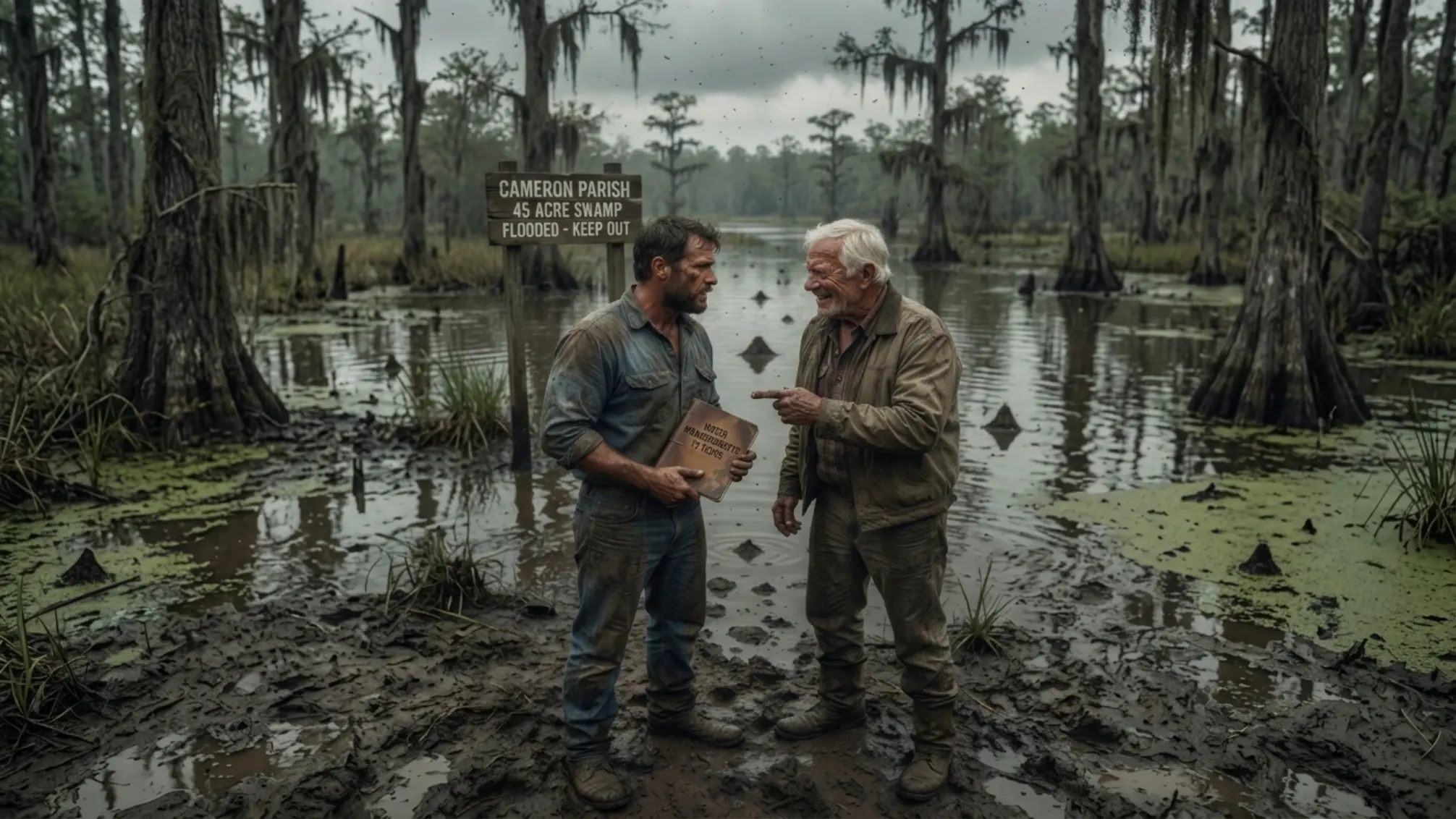
Behind them stretched forty-five acres of shallow water, tangled marsh grass, mud, insects, and half-submerged cypress roots. The parish called it Dead Man’s Marsh because every owner who had tried to tame it had lost money and left. During rainy months, water swallowed almost every patch of ground, and during dry months, the mud became thick enough to trap cattle and machinery. To Harold and the men who had followed them from the county auction, the property was not land at all but a public joke Caleb had purchased for eighteen hundred dollars.
Caleb’s final bid had consumed nearly everything he had saved over four difficult years. The auction room had erupted in laughter when the gavel fell because no one else had raised a hand. One man suggested Caleb should open a mosquito ranch, while another asked whether he planned to grow rice for alligators. Harold had laughed hardest, then followed Caleb to the marsh in his polished pickup because humiliating him once inside the courthouse had not been enough.
What none of them knew was that Caleb had studied the property for almost ten years. He first noticed it at twenty-four, shortly after his father died from a heart attack while repairing irrigation equipment. Caleb inherited forty struggling acres, unpaid loans, and machinery held together by wire, borrowed parts, and stubbornness. That sudden responsibility taught him not to trust confident opinions until he had inspected the evidence beneath them.
Whenever his own chores ended early, Caleb drove to the marsh with a notebook and walked its perimeter. He measured water after storms, marked where it entered from northern drainage channels, and studied where it left through a narrow southern cut. He examined the heavy clay soil, mapped the higher ridges hidden beneath grass, and recorded the appearance of natural crawfish burrows along the banks. The swamp changed every season, but its changes followed patterns the other farmers never remained long enough to notice.
Most previous owners had asked how to remove the water. They dug drainage ditches, brought in pumps, and tried to force the wetland to behave like dry farmland. Every attempt failed because heavy rain refilled the low ground faster than machines could empty it. Caleb had begun asking a different question: what could the land produce precisely because it held water?
Harold finally lowered his hand, but his grin remained. He told Caleb that books and notebooks did not make a farmer, then warned that mud would swallow every dollar he owned. Caleb opened the weathered folder containing the deed, folded the papers carefully, and placed them inside his truck. He did not explain his research, because he had learned that people determined to laugh rarely listened until results made silence unavoidable.
That evening, Caleb stood alone beside the marsh while sunlight faded beneath low clouds. Fear tightened his stomach as he looked across water that reflected the sky like cracked glass. Eighteen hundred dollars was small compared with the value of good farmland, but it represented the emergency cushion protecting his home, crops, and future. If he was wrong, no neighbor would merely say he had failed; the entire parish would treat him as proof that patient men could still make foolish decisions.
He returned the next morning before sunrise carrying coffee, survey stakes, and three notebooks. Instead of draining the property, he spent months measuring it more precisely. He recorded water depth after every storm, checked soil texture across dozens of locations, and marked places where vegetation already supported dense populations of insects and small aquatic life. Passing drivers slowed to watch him walk through waist-high reeds and assumed he was too ashamed to admit he had no plan.
In October, Caleb drove nearly three hours to Baton Rouge and entered the Louisiana State Agricultural Library. There he met Eleanor Price, a silver-haired archivist who listened without interrupting while he described the marsh. She returned from a storage room carrying research reports on commercial crawfish production, lowland water systems, clay soils, seasonal flooding, and integrated wetland farming. For two full days, Caleb compared every report with the figures in his notebooks.
The match was so close that he reread several pages to be certain excitement had not distorted his judgment. Crawfish farms required shallow controllable water, heavy soil capable of holding moisture, natural vegetation, and seasonal drainage that encouraged burrowing and reproduction. Dead Man’s Marsh possessed all of it, but in an unmanaged form. The property was not resisting crawfish production; it had already built most of the environment he needed.
Caleb returned home and covered his kitchen table with maps, library notes, rainfall records, and cost estimates. He calculated the price of small levees, water gates, breeding stock, traps, fuel, and repairs, then reduced the plan until he could begin without borrowing against his original farm. The first year would not make him rich, and might not make him anything. His goal was to prove the system worked on ten acres before expanding across the remaining water.
When word spread that Caleb intended to raise crawfish, the parish discovered a fresh reason to laugh. At Boudreaux Feed and Supply, Harold announced that Caleb had paid for something everyone else caught free in roadside ditches. Men at the counter joked that he would soon sell bottled swamp water to tourists. Caleb heard the comments, purchased wire and replacement bolts, and left without defending himself.
The only man who offered serious help was Raymond Landry, a forty-eight-year-old mechanic with a thick black mustache, weathered skin, and hands permanently stained by engines. Years earlier, when Raymond’s repair shop nearly collapsed during an economic downturn, Caleb had helped rebuild the roof and refused payment until the business recovered. Raymond arrived at the marsh with an aging excavator, two shovels, and a simple promise that he would stay until the first section held water properly.
Together they shaped narrow channels and low earthen levees through winter. The work was miserable, slow, and physically punishing. Machinery sank, boots disappeared in mud, and one borrowed pump failed so often that Raymond threatened to bury it beneath the very levee it was supposed to protect. Yet each completed channel proved Caleb’s measurements accurate because the water moved where he expected and settled at nearly the depth his calculations required.
Harold visited twice during construction. The first time, he remained beside his truck and shouted that the levees would collapse in the next heavy storm. The second time, he walked closer, inspected a water gate, and asked who had designed it. Caleb answered that he had, and Harold responded with a laugh that sounded slightly less certain than before.
By March 1988, the first ponds were ready. Caleb released the breeding crawfish on a cloudy morning while Raymond watched from the levee. There was no celebration when the animals disappeared beneath the brown water, only small ripples that vanished within seconds. Caleb felt the full weight of his decision because everything he owned now depended on living creatures he could no longer see.
Waiting became harder than construction. From the road, the farm looked exactly like the swamp people remembered, and that appearance fed every rumor. Harold called it the parish’s largest mosquito nursery, while other farmers predicted Caleb would quietly abandon the property before Christmas. Caleb kept records, monitored burrows, adjusted water depth, and refused to confuse invisible progress with no progress.
Then three days of violent spring rain struck Cameron Parish. Water rose faster than Caleb’s conservative estimates, and fifty yards of a new levee collapsed during the night. By sunrise, muddy water poured through the breach, carrying debris across a section intended for breeding. Caleb stood motionless in the rain, staring at months of work disappearing through a gap wider than his house.
For several hours, he believed the failure proved Harold right. He had studied the land longer than anyone else, yet his design had still broken under the first major test. Raymond found him sitting on the truck’s tailgate after dark, soaked, exhausted, and silent. Instead of offering comfort, the mechanic asked what the broken levee had revealed.
The question reminded Caleb of something his father often said when machinery failed during harvest: a breakdown did not always mean the machine was useless; sometimes it was explaining what it needed. The storm had not proven crawfish could not thrive there. It had shown that the eastern spillway was too narrow and that one embankment required stronger clay. Caleb opened his notebook and began drawing repairs before the rain had completely stopped.
They rebuilt the damaged section wider and stronger, then added emergency overflow channels at two lower points. Summer brought predators, inconsistent growth, and several ponds that produced far fewer juveniles than expected. Birds learned where to feed, raccoons raided shallow edges, and oxygen levels dropped when vegetation became too dense. Caleb treated each setback as information, modifying habitat and rotation rather than repeating the same mistake.
By autumn, the first unmistakable signs appeared. Burrows multiplied along the banks, young crawfish occupied areas that had shown little activity months earlier, and evening water surfaces trembled with hundreds of small movements. Caleb collected samples, weighed them, recorded growth, and compared the numbers with research projections. The results were not spectacular, but they were real.
Harold stopped beside the road one evening and watched Caleb empty a test trap. It contained only a modest catch, yet the crawfish were healthy and uniform. Harold asked whether that was supposed to impress him. Caleb replied that it was supposed to teach him, then reset the trap without offering further explanation.
The next three years demanded more patience than Caleb expected. Some seasons produced promising numbers, while others exposed weaknesses in water timing, forage, or breeding density. He expanded slowly, using income from his original farm and mechanical work to improve one section at a time. He refused offers from lenders who wanted his home as collateral because success built on desperate debt could disappear after one hurricane.
Cameron Parish kept laughing because the trucks had not arrived yet. The swamp still looked like water and grass to anyone driving past at fifty miles per hour. What the road could not reveal was a carefully managed system of breeding zones, drainage cycles, forage growth, and reinforced levees. Caleb’s greatest advantage remained the same one he had possessed at the auction: he stayed long enough to understand what others dismissed after a glance.
In the spring of 1992, five years after the purchase, the first major harvest began before sunrise. Caleb, Raymond, and four temporary workers moved along the ponds lifting traps heavy enough to strain their shoulders. Healthy crawfish covered the sorting tables in red-brown layers, clicking and shifting as new traps arrived. By midmorning, every crate Caleb owned was full.
He checked the totals twice because the harvest exceeded the most hopeful projection in his notebook. Years of ridicule, storms, repairs, and delayed income had become measurable weight stacked beneath a tin roof. Raymond slapped the back of Caleb’s shoulder and told him the swamp finally looked expensive. Caleb smiled, but immediately began calculating storage, transport, and how quickly the catch had to reach buyers.
Samples reached Vincent LeBlanc, a seafood distributor near Lake Charles who had grown up in a commercial fishing family. Vincent trusted quality more than stories, so he inspected three separate shipments before visiting the farm. He spent hours reviewing pond records, harvest timing, mortality rates, and handling practices. At sunset, he offered Caleb a multiyear supply contract that would provide predictable income without requiring reckless expansion.
The first refrigerated truck arrived the following week. It passed Boudreaux Feed and Supply just after dawn, turned onto the narrow road, and stopped beside Caleb’s loading shed. A second truck came three days later, then another the following week. Drivers who once used Dead Man’s Marsh as a punch line began using it as a destination.
Harold saw the trucks from the café window. He abandoned his coffee, climbed into his pickup, and drove to the marsh before pride could convince him to stay away. When he arrived, Caleb was checking crates while workers loaded the latest order. Harold stood at the entrance, watching money move out of the water he had called worthless.
“You invited me at sunrise,” Harold said.
“That was five years ago.”
“I was busy.”
Caleb looked toward the road, where another truck approached through the morning haze. “Looks like you made it before the apology did.”
Harold’s face hardened because several workers could hear them. He reminded Caleb that one successful harvest did not create a lasting farm and claimed crawfish prices could collapse before the next season. Caleb agreed that markets changed, weather turned, and no honest farmer was safe from failure. Then he asked whether any of those facts had made the land worthless.
Harold stared across the ponds. For the first time, he examined the reinforced levees, managed vegetation, water controls, sorting area, and records clipped beneath the shed roof. This was not luck splashing in an abandoned swamp. It was a system built from observation, repeated failure, and decisions made long before anyone else could see a harvest.
Still, Harold could not force the apology past his pride. He said the crawfish might disappear after one bad year, then turned toward his truck. Caleb did not stop him. He had never needed Harold’s words as much as Harold imagined.
Within months, landowners from neighboring parishes began visiting. Some owned low ground they considered useless, while others managed rice fields capable of supporting seasonal crawfish production. Caleb explained water control, clay structure, forage, burrowing cycles, and the mistakes that cost him the most time. He charged for detailed design work when appropriate, but never humiliated the farmers who had once laughed.
Ronald Pierce, a broad sixty-two-year-old farmer who had mocked Caleb at the auction, arrived one afternoon and admitted he had been wrong. Caleb accepted the statement without making him repeat it. They spent two hours walking the original ponds because Caleb believed understanding mattered more than revenge. Ronald left with notes for ten wet acres on his own property.
Success spread beyond the marsh. Seasonal workers received steadier employment, local repair shops maintained pumps and trucks, and nearby suppliers sold more traps, feed, fuel, and equipment. The land people said possessed less value than the water covering it began supporting families who had never owned a piece of it. Caleb’s private risk became part of the parish economy.
Independent appraisers soon valued the operation at many times the eighteen hundred dollars paid at auction. Buyers offered to purchase it, and one company proposed a price large enough to erase every remaining worry from Caleb’s life. He refused because they valued the income but misunderstood the knowledge holding it together. The marsh was not a trick that could be copied by taking possession of water.
Harold returned during the next harvest, this time without an audience. He found Caleb repairing a gate beside the oldest pond. Age had not softened the rice farmer’s booming voice, but it had stripped some certainty from it. He admitted that his own eastern fields were holding too much water and asked whether crawfish rotation might work there.
Caleb could have laughed. He could have repeated every insult, pointed toward the trucks, or demanded the apology he had promised to drag from the swamp. Instead, he asked Harold about soil, drainage, crop timing, and how long the fields remained flooded. The questions forced Harold to lower his defenses because they treated him as a farmer facing a problem rather than an enemy begging for mercy.
After an hour, Caleb told him the plan might work on twenty acres if he modified two drainage channels and avoided expanding too quickly. Harold stared at him, ashamed by the generosity he had not earned. “Why would you help me after what I said?” he asked. Caleb answered that bad judgment was not always permanent unless a man chose to protect it.
Harold finally removed his hat. “I called you an idiot in front of half the parish.”
“You did.”
“I said I’d watch you crawl away.”
“I remember.”
The older farmer looked across the productive water. “I was wrong.”
Caleb nodded toward a line of traps waiting beside the levee. “Good. Now help me pull those before the sun gets higher.”
That morning became the beginning of an uneasy respect. Harold invested cautiously in crawfish production beside his rice fields and followed Caleb’s instructions even when impatience tempted him to cut corners. His first harvest was modest, but profitable enough to continue. At the feed store, he stopped men from mocking other farmers’ unfamiliar ideas by reminding them that the loudest laughter in Cameron Parish once belonged to him.
Caleb never expanded recklessly. He strengthened levees, improved drainage, added storage, and maintained detailed records through floods, droughts, price changes, and equipment failures. When strong years produced extra income, he saved before purchasing neighboring land. When weak years arrived, those reserves protected workers and prevented desperate decisions.
His son Ethan grew up walking the ponds. Caleb taught him not only what to do but why each action mattered: when to flood, when to drain, how to inspect burrows, and how water movement changed after different storms. He showed Ethan the oldest notebooks, including pages stained during the first levee collapse. Failure remained inside the farm’s education rather than being hidden from the next generation.
By 2015, Caleb was sixty-two, his beard almost entirely silver and his movements slower than before. Dead Man’s Marsh had become one of southwestern Louisiana’s most respected crawfish operations, with stronger levees, refined channels, dependable buyers, and a reputation built on consistent quality. Yet Caleb considered the transfer of knowledge more important than the valuation of the farm.
Ethan, now thirty-eight, managed much of the daily operation, while his fifteen-year-old son Noah followed both men with endless questions. Noah wanted to know why one pond was deeper, why vegetation differed near certain banks, and why an older gate remained in place when newer equipment existed. Caleb sometimes answered directly, but often told him to watch the water and return with his own explanation.
Three generations walked the same levees where neighbors had once stopped their trucks to laugh. The farm office contained shelves of notebooks documenting rainfall, harvests, losses, repairs, prices, predators, water depth, and decisions across nearly four decades. Caleb believed undocumented experience disappeared when the person carrying it was gone. Writing transformed memory into inheritance.
A regional agricultural reporter visited that autumn and asked Caleb for the secret behind turning worthless swamp into a successful business. Caleb looked across the water and rejected the word worthless. The land had never lacked value, he explained; people had lacked understanding. They measured it against cornfields and cattle pasture, then blamed the marsh when it refused to become either.
The reporter expected a complicated business formula, but Caleb offered something simpler. Observation had to come before ambition. A farmer should understand what land naturally wanted to do before spending money forcing it to do something else. Dead Man’s Marsh succeeded because Caleb eventually stopped imagining dry fields and began building around water.
Harold attended the farm’s thirtieth harvest gathering. He was older, thinner, and walked with a cane, but his voice could still quiet a crowd. In front of workers, buyers, neighbors, and three generations of Turners, he told the story of pointing a finger into Caleb’s chest and calling him an idiot. Then he admitted that Caleb had not dragged an apology from the swamp; he had allowed Harold enough time to walk into it honestly.
Caleb stood beside him and said the apology mattered less than what happened afterward. Harold had changed his own operation, defended younger farmers from ridicule, and admitted mistakes without pretending he had always believed. The whole parish had watched him laugh, but it also watched him learn. That transformation carried more value than public humiliation ever could.
At sunrise the next morning, Caleb walked alone to the original pond. Mist hovered above the water, insects moved among the reeds, and small ripples spread where crawfish remained hidden beneath the surface. The place still looked like a swamp because success had never required disguising its nature.
He opened the first notebook he had carried there as a young man. On one faded page, he had written a sentence before purchasing the land: “No land is dead until people stop asking what it can become.” The words appeared naive beside decades of hard experience, yet they had survived every test.
Caleb closed the notebook as a harvest truck approached along the entrance road. Its engine grew louder, then passed the spot where Harold once promised to watch him crawl away. The truck did not prove Caleb had defeated a swamp. It proved he had listened long enough to work with it.
The parish had laughed because forty-five flooded acres looked like failure when judged by the wrong standard. Caleb had seen moving water, clay soil, natural burrows, and a system waiting to be understood. He did not discover treasure buried beneath the mud; he discovered purpose inside conditions everyone else wanted to erase.
Dead Man’s Marsh became valuable without becoming something else. Its water remained shallow, its soil remained heavy, and its reeds still moved beneath Louisiana wind. The transformation happened in the relationship between the farmer and the land. Once Caleb understood what the marsh offered, every obstacle became part of a design rather than evidence of defeat.
Years later, people still told the story as though the outcome had been obvious from the beginning. They remembered the trucks, contracts, harvests, and rising property value, but forgot the broken levee, empty traps, sleepless calculations, and years when laughter remained louder than profit. Caleb never forgot because those difficult seasons contained the knowledge that made later success possible.
The final lesson he gave Noah was not about crawfish. It was about judgment. Never call a place useless merely because it refuses to serve the first purpose someone demands from it, he said, and never call a person foolish simply because the result of patient work is still hidden.
Then Caleb pointed across the water where sunrise broke through the mist. Beneath that ordinary surface moved the harvest that had changed his family, humbled his critics, and given Dead Man’s Marsh a future. The whole parish had once stared at the same water and seen nothing.
Caleb Turner had simply stayed long enough to see what was already there.
And when farmers asked whether courage had mattered more than knowledge, Caleb shook his head. Courage had opened the gate, but discipline had kept him there through failure. The swamp rewarded neither pride nor fantasy. It rewarded attention, humility, and the willingness to change a plan without abandoning the purpose behind it. That was how ridicule became respect, and water became a legacy for generations.