Naomi Grant boarded Flight 618 with no assistant, no security detail, and no diamond watch on her wrist. She wore a simple black suit, carried one small leather bag, and kept her hair pulled back neatly as she stepped into the first-class cabin. To anyone watching quickly, she looked like a tired business traveler hoping for a quiet flight from Atlanta to Los Angeles. That was exactly what she wanted people to think.
That morning, Naomi had signed the final acquisition papers for Meridian Skies Airways, a struggling luxury airline known for beautiful lounges, expensive tickets, and ugly complaints hidden inside customer service reports. Her advisors wanted her to inspect operations from a conference room, surrounded by executives who would smile, flatter her, and show her whatever version of the company they wanted her to see. Naomi refused. Her father had taught her that a company showed its real face when it believed nobody powerful was watching.
So she booked a first-class ticket under her middle name, Naomi Elise, using a private account. She wanted to see how the airline treated customers when there were no cameras, no press releases, and no new CEO standing at the front of the cabin. She had read the complaints, but paper could only tell part of the truth. The real truth lived in tone, hands, eyes, and the little humiliations employees thought they could deny later.
Her seat was 2A, a wide leather seat beside the window. Naomi placed her bag in the overhead bin and sat down quietly, her boarding pass folded in her hand. Across the aisle, a man in a navy suit glanced at her, then looked away. Behind her, two other first-class passengers whispered softly, their voices lowering the moment Naomi settled into the seat.
The lead flight attendant entered the cabin with a polished smile and a silver tray carrying glasses of champagne. Her name tag read Brielle Hart. She had blonde hair twisted into a tight bun, red lipstick, and the confident posture of someone who believed the aisle belonged to her. She moved from passenger to passenger, offering drinks with a voice sweet enough to sound practiced.
“Welcome aboard, Mr. Whitman,” Brielle said warmly to the man across from Naomi. “Champagne before takeoff?”
He accepted with a grin.
Brielle turned to the next passenger. “Mrs. Langford, lovely to see you again. Your usual sparkling water?”
The woman smiled as if Brielle had just proven the airline still remembered important people.
Then Brielle reached Naomi.
Her smile faded before she even asked a question.
Naomi looked up calmly. “Good afternoon.”
Brielle’s eyes moved over Naomi’s suit, her shoes, her face, then the empty champagne glass closest to her tray. She did not lift it. Instead, she tilted her head slightly, as if trying to solve a problem. The cabin seemed to quiet without anyone admitting they were listening.
“Ma’am,” Brielle said, “are you sure you’re in the right cabin?”
Naomi held out her boarding pass. “Seat 2A.”
Brielle did not take it gently. She snatched it between two fingers, glanced down for less than a second, and frowned. “This ticket was scanned at the gate?”
Naomi’s jaw tightened, but her voice stayed even. “Yes.”
Brielle looked toward the front of the plane, then back at her. “First class is full today. Sometimes passengers from economy get confused during boarding.”
The man across the aisle shifted in his seat. Naomi saw him notice the empty space in front of her, the printed seat number, the ticket in Brielle’s hand, and still say nothing. That was how humiliation worked best. Not only through the person delivering it, but through everyone watching who decided silence was easier.
“I am not confused,” Naomi said.
Brielle gave a small laugh, not kind enough to be called polite. “I didn’t say you were. I’m just saying this area is reserved for premium passengers.”
Naomi’s fingers rested on the armrest. “And my ticket says premium passenger.”
Brielle’s expression hardened. “I’ll need to verify that.”
“You didn’t verify his,” Naomi said, nodding slightly toward the man across the aisle. “Or hers.”
Brielle’s smile returned, but this time it was sharp. “They’re regulars.”
Naomi looked directly at her. “And I’m a passenger.”
For a moment, Brielle seemed offended by the simplicity of that answer. She looked at the boarding pass again, then at Naomi’s seat, then deliberately let the paper fall onto Naomi’s lap instead of handing it back. It was a small action, quick enough to be excused later as an accident, but clear enough for every person nearby to understand.
Naomi did not pick it up immediately.
Brielle lowered her voice. “People who belong in first class usually don’t make a scene.”
Naomi’s eyes lifted slowly. “I haven’t made one.”
“Not yet,” Brielle said.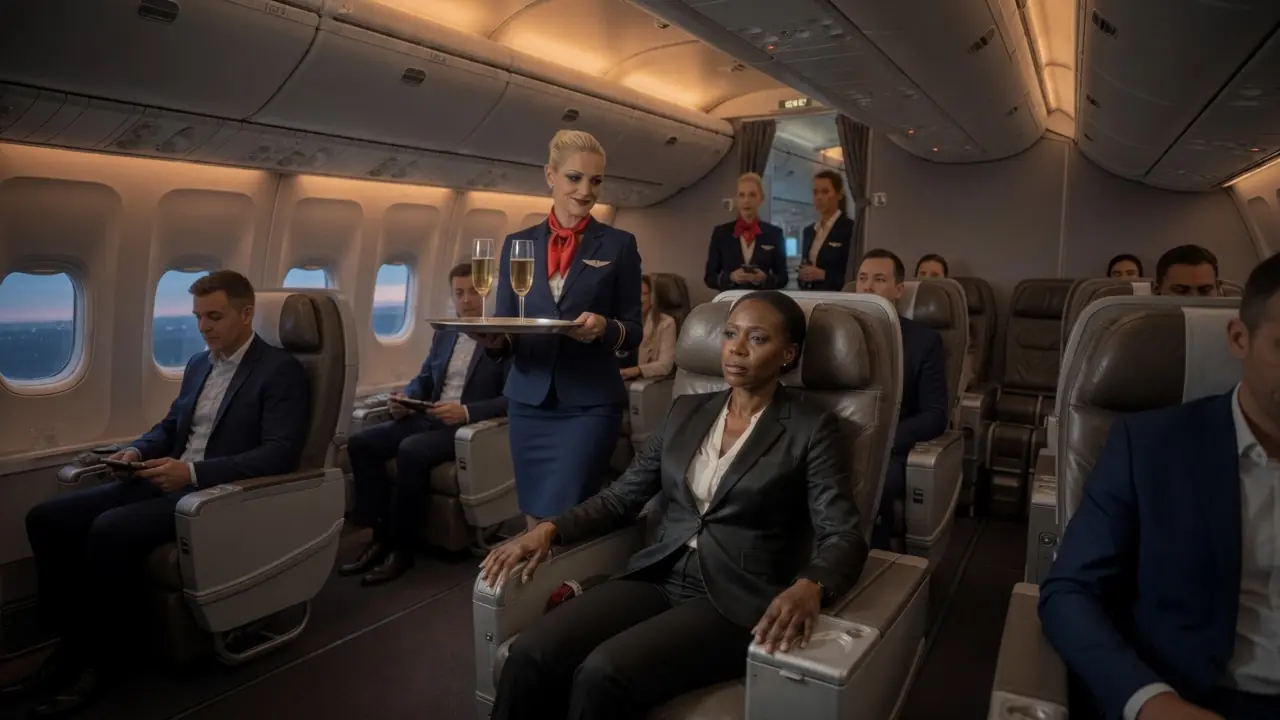
A young flight attendant standing behind the curtain froze with a stack of menus in her hand. Her name tag read Maya. She looked at Naomi with quiet concern, then at Brielle with fear. Naomi noticed that fear. It told her Brielle’s cruelty was not new.
Brielle straightened and lifted the tray again. “I’ll let the gate agent confirm your ticket. Until then, I’m going to ask that you remain seated and not disturb the other first-class guests.”
Naomi looked around the cabin. No one had been disturbed until Brielle stopped in front of her. But the passengers stared at their phones, their drinks, their watches, anything except the Black woman being questioned in a seat she had paid for. Naomi bent down slowly, picked up the boarding pass from her lap, and smoothed it against her knee.
“You dropped this,” Naomi said.
Brielle’s mouth tightened. “Excuse me?”
“You dropped my boarding pass on my lap.”
Brielle leaned closer, still holding the champagne tray between them like a polished barrier. “Ma’am, I would advise you to adjust your tone before we involve airport security.”
That sentence moved through the cabin like a cold wind.
Naomi’s hand tightened around the boarding pass, but her face stayed calm. “You are threatening to remove me for sitting in my assigned seat?”
Brielle smiled. “I am protecting the comfort of the cabin.”
“No,” Naomi said softly. “You are protecting your assumption.”
The words landed harder than Brielle expected. Her eyes flashed, and the red in her cheeks deepened. She glanced around, perhaps hoping another passenger would defend her. None did. They were brave enough to watch, not brave enough to speak.
Before Brielle could answer, Maya stepped forward carefully. “Brielle, I can check the manifest. It may just be—”
Brielle cut her off without looking back. “I have it handled.”
Maya stepped back, lowering her eyes.
Naomi watched that too.
Brielle moved closer to the overhead bin above Naomi and opened it with unnecessary force. “Is this your bag?”
“Yes.”
“It needs to be placed properly.”
“It is placed properly.”
Brielle pulled it out anyway. The leather bag dropped against Naomi’s shoulder before Brielle caught it by the handle. Gasps moved softly from the nearby seats. Naomi stood then, not quickly, not dramatically, but with enough control to make the cabin still.
“Put my bag back,” Naomi said.
Brielle held the bag in one hand and the tray in the other, her smile gone. “Sit down.”
“No.”
The word was quiet, but the air changed.
Brielle stared at her. “You are refusing a crew instruction?”
Naomi took one step closer, her eyes steady. “I am refusing to let you use airline policy as a costume for disrespect.”
The man across the aisle finally spoke, but not to defend Naomi. “Can we just take off? Some of us have meetings.”
Naomi turned toward him briefly. “So do I.”
Brielle seized the moment. “Exactly. The cabin does not need this disruption.”
Naomi looked back at her. “Then stop creating one.”
The young flight attendant Maya’s face twitched, almost a smile, before she hid it. Brielle noticed and snapped her head toward her. “Go prepare the galley.”
Maya disappeared behind the curtain.
Brielle returned Naomi’s bag to the overhead bin with a hard shove. Then she leaned close enough that only Naomi and the nearest passengers could hear. “I don’t know how you got this ticket, but I know when someone doesn’t fit the cabin.”
Naomi felt the old anger rise, the kind she had carried through boardrooms where men called her lucky, banks where clerks asked for extra identification, and charity galas where donors assumed she was staff. She had built companies, saved jobs, bought failing businesses, and still there were people like Brielle who could look at her and see only a person to be questioned.
But Naomi had learned long ago that rage was useful only when disciplined.
She sat back down, slowly.
Brielle seemed to think she had won.
“Wise choice,” she said.
Naomi looked out the window as the cabin door closed. The plane pushed back from the gate, and Brielle went through safety announcements with a bright professional smile, as if she had not just tried to humiliate a passenger in front of half the cabin. Naomi kept her breathing steady. She did not call her legal team. She did not reveal herself. Not yet.
She wanted to see how far Brielle would go when she believed the woman in 2A had no power.
After takeoff, the cabin service began. Brielle served warm nuts to every passenger except Naomi. She offered menu choices across the aisle, behind her, then walked past seat 2A as if it were empty. When Naomi pressed the call button, Brielle took almost seven minutes to respond.
“Yes?” she asked.
“I’d like a menu, please.”
Brielle glanced toward the galley. “We may be short.”
Naomi looked at the stack of menus visible behind her. “There are several on the counter.”
Brielle’s lips thinned. “Those are reserved.”
“For whom?”
“For passengers who requested them earlier.”
Naomi looked at her for a long second. “You mean passengers you chose to serve earlier.”
Brielle leaned down, voice low again. “You really don’t know when to stop, do you?”
Naomi’s reply was colder than the window beside her. “I know exactly when to stop. I’m waiting to see if you do.”
Brielle walked away without giving her the menu.
A few minutes later, Maya appeared with a tray and quietly placed a menu beside Naomi’s hand. “I’m sorry for the delay, ma’am.”
Naomi looked at her name tag. “Thank you, Maya.”
Maya hesitated. “Would you like sparkling water or tea?”
“Tea, please.”
Maya nodded, then lowered her voice. “And for what it’s worth, your ticket is on the manifest. Seat 2A. Confirmed paid fare.”
Naomi studied the young woman’s face. “Did Brielle know that?”
Maya’s eyes flicked toward the galley.
That was answer enough.
“Thank you,” Naomi said again.
Maya returned to the galley, but Brielle saw the exchange. When she came back down the aisle, her expression had sharpened into open hostility. She stopped beside Naomi and picked up the menu Maya had left.
“I didn’t authorize this.”
Naomi looked at her hand on the menu. “You don’t need to authorize me reading dinner options.”
Brielle’s smile turned cruel. “You’re very comfortable acting entitled.”
Naomi stood again, slowly enough that every passenger saw it.
“No,” she said. “I’m very comfortable recognizing discrimination when it wears a uniform.”
The cabin went silent.
Brielle’s face flushed. “That is a serious accusation.”
“It is a serious pattern.”
“Sit down.”
“Pick up my boarding pass,” Naomi said.
Brielle froze. “What?”
Naomi pointed to the floor beside her seat. During the earlier bag incident, the boarding pass had slipped from the armrest and fallen near Brielle’s shoe. Brielle had stepped around it twice without touching it.
“You dropped it. You ignored it. Now pick it up and hand it to me properly.”
Brielle stared at the paper, then back at Naomi. “I don’t pick things off the floor for passengers.”
Naomi’s eyes did not move. “No. You only drop them on Black women’s laps.”
A man behind Naomi muttered, “Oh my God.”
Brielle snapped, “That is enough.”
“No,” Naomi said, her voice finally carrying through the whole cabin. “Enough was when you questioned my seat. Enough was when you snatched my ticket. Enough was when you threatened security. Enough was when you pulled my bag from the bin and struck my shoulder with it. Enough was when you served everyone here but me.”
Brielle’s hand trembled around the menu, but she lifted her chin. “I will not be spoken to this way on my aircraft.”
Naomi’s expression changed.
The cabin felt it before Brielle understood it.
“Your aircraft?” Naomi asked softly.
Brielle swallowed. “This airline has standards.”
Naomi reached into the inner pocket of her jacket and removed a slim black card holder. From it, she pulled a temporary executive credential issued that morning. Her name was printed clearly across the front.
Naomi Elise Grant.
Chief Executive Officer.
Meridian Skies Airways.
Brielle stared at it.
At first, she looked confused. Then her eyes flicked from the credential to Naomi’s face, then back again. The color drained from her cheeks so quickly that even the man across the aisle sat up straighter. Behind the curtain, Maya stepped into view and froze.
Naomi held the credential steady.
“You are correct about one thing,” she said. “This airline has standards. You just failed every one of them.”
Brielle’s mouth opened, but no sound came out.
Naomi bent down, picked up her own boarding pass, and placed it on the armrest. “You said I didn’t fit the cabin. You said people who belong here don’t make scenes. You threatened to remove me from a seat on an aircraft owned by the company I acquired this morning.”
Brielle finally found her voice. “Ms. Grant, I didn’t know—”
“That I was CEO?” Naomi interrupted. “That is the problem, Brielle. You should not need to know who owns the airline before treating a passenger like a human being.”
The words struck the cabin harder than any shout could have.
Maya’s eyes filled with tears, though she tried to blink them away. Several passengers lowered their faces in shame. The man across the aisle cleared his throat and looked toward the window, suddenly very interested in clouds.
Brielle stepped back. “I apologize if you felt—”
“No,” Naomi said sharply. “Do not apologize for my feelings. Apologize for your actions.”
Brielle’s lips trembled. “I apologize for how I handled the situation.”
Naomi’s gaze did not soften. “Name the situation.”
Brielle looked around the cabin, trapped by every witness she had assumed would protect her with silence. “I questioned your right to sit here.”
“And?”
“I mishandled your boarding pass.”
“And?”
Brielle’s voice cracked. “I treated you unfairly.”
Naomi leaned slightly forward. “Because?”
Brielle’s eyes filled with panic. She could not say it. Not because she did not know, but because saying it would make the truth official.
Naomi nodded slowly. “That silence is the first honest thing you’ve offered me today.”
The captain’s voice came through the intercom, announcing cruising altitude and expected arrival time. It sounded absurdly normal after what had just happened. Brielle stood in the aisle with her hands clenched, her authority collapsing in front of the very passengers she had tried to impress.
Naomi turned toward Maya. “Maya, please ask the purser to join us.”
Maya nodded quickly. “Yes, Ms. Grant.”
Brielle whispered, “Ms. Grant, please. I’ve been with Meridian for twelve years.”
Naomi looked at her, and there was no cruelty in her face. That made the moment worse for Brielle, because cruelty would have given her something to resist. Naomi’s calm left only the truth.
“Twelve years,” Naomi said. “Then you had twelve years to learn dignity.”
The purser arrived, a silver-haired man named Andrew who looked stunned by the credential in Naomi’s hand. He listened as Naomi described what happened, then asked Maya to confirm. Maya’s voice shook at first, but it grew steadier as she spoke. She confirmed the ticket was valid, confirmed Brielle had known, confirmed the boarding pass, the bag, the skipped service, and the threat to involve security.
Brielle stared at Maya with betrayal.
Naomi saw it and turned cold again. “Do not look at her like that. She did not ruin your career by telling the truth. You damaged it by trusting everyone else to stay quiet.”
Andrew’s face tightened with embarrassment. “Ms. Grant, on behalf of the crew—”
“This is not about a speech,” Naomi said. “This is about culture.”
Andrew nodded.
Naomi looked around the cabin. “And it is about witnesses.”
The passengers shifted uncomfortably.
She did not ask for their apologies. She did not need them. Their silence had already said enough. But she wanted them to feel the weight of comfort purchased at someone else’s humiliation.
For the rest of the flight, Brielle was removed from direct cabin service. Andrew assigned Maya to seat 2A, though Naomi made clear she did not want special treatment. She wanted the service every passenger had already paid for. Maya brought tea, dinner, and later a quiet apology for not speaking sooner.
Naomi accepted the tea but not the guilt.
“You were afraid,” Naomi said.
Maya looked down. “She makes people afraid.”
“Then that changes today.”
Maya’s eyes lifted.
Naomi gave her a business card. “Email me tomorrow. Tell me what needs to be fixed. Not the polished version. The real one.”
Maya held the card like it was something fragile. “Yes, ma’am.”
When the plane landed in Los Angeles, two airline executives were already waiting at the gate. Naomi had sent one message through the in-flight Wi-Fi after the confrontation. Not a dramatic message. Just enough to make the right people move before the aircraft door opened.
Brielle stood near the front of the cabin, pale and silent. She no longer looked polished. Her red scarf sat crooked at her neck, and her hands were clasped tightly in front of her. As passengers gathered their bags, several avoided Naomi’s eyes.
The man across the aisle paused beside her. “Ms. Grant,” he said awkwardly, “I should have said something earlier.”
Naomi looked at him. “Yes. You should have.”
He nodded, ashamed, and left.
When the cabin emptied, Naomi stepped into the jet bridge. The executives straightened immediately. One of them, Harold Pierce, had been interim operations director for three years. He wore the expression of a man who already knew the acquisition had become more dangerous than expected.
“Ms. Grant,” he said. “We are deeply sorry.”
Naomi handed him Brielle’s written incident record, which Andrew had prepared before landing. “Sorry is not a system.”
Harold swallowed. “Of course.”
“I want Brielle Hart removed from passenger-facing duty pending full investigation. I want complaint records from the last five years reviewed by an outside team. I want every discrimination complaint reopened, not summarized by the people who buried it. And I want crew members interviewed without supervisors in the room.”
Harold nodded quickly. “We’ll begin immediately.”
Naomi looked through the aircraft door, where Maya stood near the galley, watching quietly. “Start with the employees who were too scared to speak.”
Brielle stepped forward, tears now visible. “Ms. Grant, please. I made a terrible mistake, but I have a family. I need this job.”
Naomi turned to her. “So did the passengers you humiliated. They had families. Careers. Sick parents. Weddings. Funerals. Meetings. Lives. You never wondered what they needed when you decided they didn’t belong.”
Brielle wiped her face. “I’m sorry.”
Naomi’s voice softened slightly, but not enough to save her. “You may be. But regret after consequence is not the same as character before power.”
Brielle lowered her head.
The story reached the press two days later, though Naomi never released the passenger details. Someone in first class had recorded part of the exchange, and the video spread quickly. The internet gave it a title before the news did: “The CEO in 2A.”
Meridian Skies issued a public statement announcing an independent review, leadership restructuring, and mandatory anti-discrimination reform across all customer-facing roles. But Naomi knew statements were easy. Reform had to be built where people could not pose for it.
Over the next month, Naomi worked harder inside Meridian than any outside article knew. She met with gate agents, baggage handlers, junior flight attendants, customer support contractors, and passengers who had filed complaints and never received answers. The stories were painful in their similarity. Black passengers questioned more often. Latino families moved without explanation. Elderly travelers ignored. Disabled passengers treated like delays instead of customers. Employees who objected were labeled difficult or denied promotions.
Brielle had not been the disease.
She had been a symptom that smiled.
Naomi removed three senior managers who had dismissed complaints as “misunderstandings.” Harold Pierce resigned before she could fire him. Maya became part of a new passenger dignity task force, not because she had been perfect, but because she understood fear from the inside and truth from the cost of speaking.
Six months later, Naomi boarded another Meridian flight.
This time, everyone knew who she was.
But she still paused at the first-class cabin entrance and watched before announcing herself. A young Black college student sat in 1C, nervously holding a boarding pass. A flight attendant smiled at him, checked his seat with warmth, and said, “Welcome aboard, Mr. Ellis. We’re glad you’re with us today.”
Naomi stood quietly for a moment.
The words were simple.
That was why they mattered.
Maya, now a lead trainer, spotted Naomi near the galley and smiled. “Ms. Grant. Seat 2A again?”
Naomi looked toward the seat where everything had changed. “Not today.”
Maya tilted her head.
Naomi smiled faintly. “Today I just wanted to see if the airline could recognize a passenger before recognizing power.”
Maya glanced toward the young student in 1C, then back at Naomi. “We’re learning.”
Naomi nodded. “Good. Keep learning.”
As she walked back through the jet bridge, Naomi thought of Brielle’s champagne tray blocking the aisle, the boarding pass dropped onto her lap, the bag hitting her shoulder, the cold little sentence about people who did not fit the cabin. She remembered every second clearly. But the memory no longer ended with humiliation.
It ended with Brielle staring at the CEO credential.
It ended with Maya telling the truth.
It ended with an airline learning that first class meant nothing if dignity was not included in the fare.
And somewhere above the clouds, in a cabin that had once gone silent, the company Naomi bought finally began to speak differently.