“Come here, sweetheart. Women who wander into my alley usually leave crawling.”
Marcus Doyle’s thick fingers closed beneath Sergeant Alicia Brooks’s chin and forced her face upward. Behind her, another biker trapped both of her wrists against the small of her back while pressing his forearm into her waist. Several more men blocked the exits, their black leather vests and tattooed arms filling the narrow industrial alley.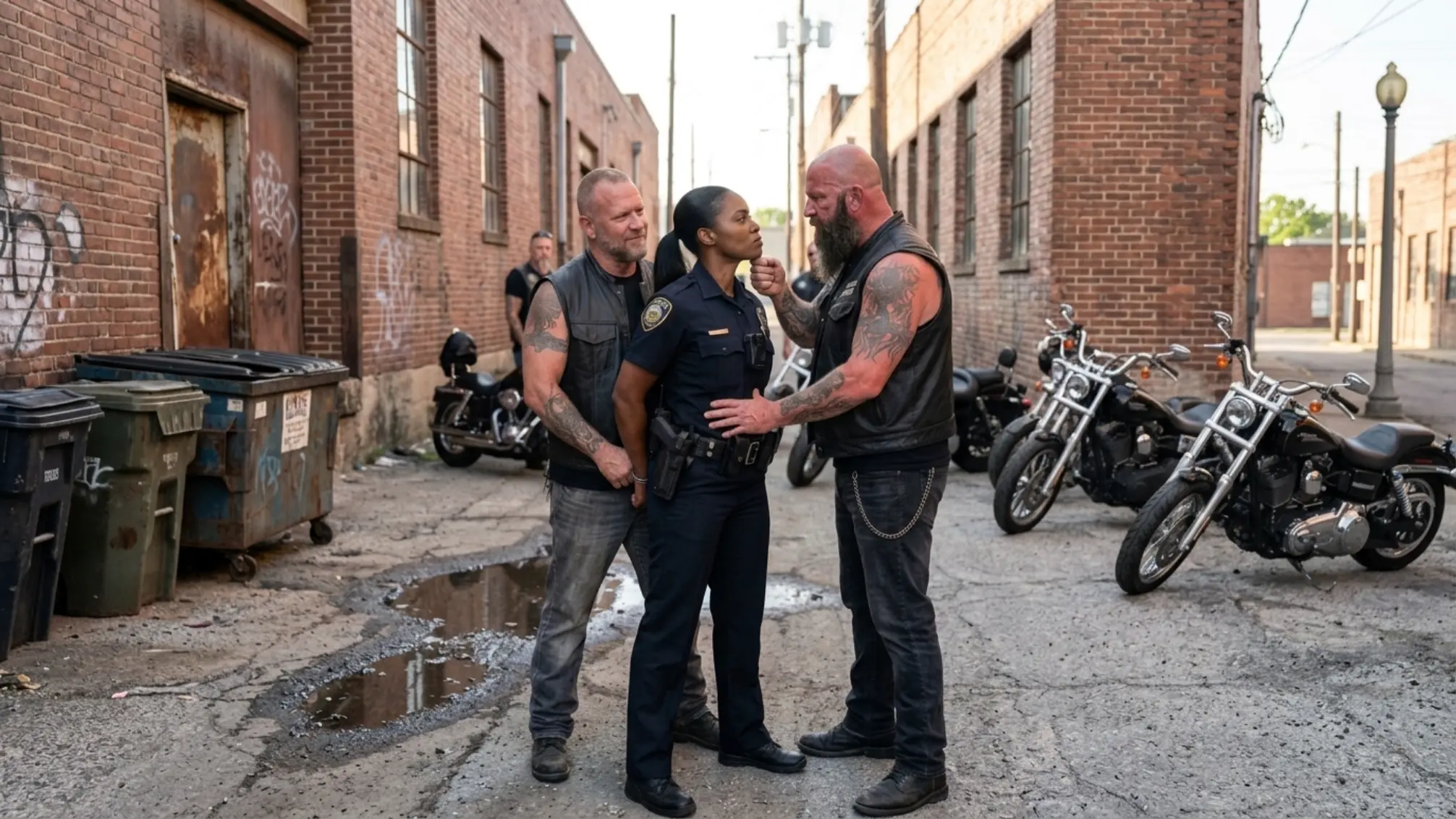
Alicia did not struggle.
She met Marcus’s cruel stare with calm dark-brown eyes. “Keep touching me, and that hand comes off first.”
The biker restraining her laughed near her ear. “You’re surrounded, badge. Nobody’s coming to save you.”
Alicia leaned slightly toward Marcus, allowing him to mistake control for surrender. “Good. Then nobody interrupts me when I put you both down.”
The smile faded from Marcus’s face.
The late-afternoon sunlight cut between the old warehouses, illuminating floating dust and puddles left by the previous night’s rain. Rusted fire escapes clung to the brick walls, while electrical cables sagged between leaning poles. Three motorcycles idled at the far end of the alley, their engines producing a low, steady growl.
Alicia had entered the riverfront industrial district after completing a youth outreach event at Jefferson Community Center. The event had lasted longer than expected because several teenagers stayed behind to ask about joining the police academy. Alicia had answered every question, helped stack the folding chairs, and promised to return the following month.
She could have driven back to the precinct.
Instead, she chose to walk several blocks to where her patrol vehicle was parked. The service alley between the warehouses shortened the route by nearly ten minutes, and she had crossed it dozens of times without trouble.
That afternoon, the silence changed before she saw anyone.
Alicia had learned to recognize unnatural quiet during two deployments as a United States Marine. Ordinary places carried ordinary noise: distant traffic, birds, machinery, people arguing through open windows. When those sounds disappeared together, someone was usually waiting.
She heard the motorcycles next.
Not moving.
Waiting.
Alicia continued forward without reaching for her weapon. Drawing too early could turn a tense encounter into a deadly one, especially when she did not yet know how many men were hidden between the buildings. She kept her steps measured and used reflections in the puddles to study movement behind her.
Seven men emerged.
Two stepped from behind a dumpster. Another left an open loading doorway. Three remained near the motorcycles, and Marcus approached from the center of the alley like a man entering a stage built for him.
Alicia recognized the patches immediately.
The Iron Vultures Motorcycle Club had been connected to illegal weapons sales, extortion, assault, and a string of robberies across three counties. Most charges collapsed because witnesses became frightened or suddenly remembered nothing. Marcus Doyle had never spent more than two years in prison despite a criminal record stretching across three decades.
At six feet four inches, Marcus was broad enough to block the alley by himself. His bald head shone beneath the sunlight, and a long dark beard streaked with gray covered most of his scarred face. Tattoos climbed from his wrists across both arms and vanished beneath his sleeveless leather vest.
The biker behind Alicia was Rafe Kellen, Marcus’s longtime enforcer.
Rafe was slightly shorter but equally powerful, with a shaved head, tattooed shoulders, and a hard grin that suggested he enjoyed hurting people more than he enjoyed being paid for it. Alicia had seen his photograph in multiple case files involving witness intimidation.
Marcus had not stopped her by accident.
“Afternoon, Officer,” he said when they first surrounded her.
“Move aside.”
He grinned. “No manners?”
“I gave you a lawful order.”
Marcus circled her slowly. “This isn’t your precinct.”
“The law still reaches this alley.”
Several bikers laughed.
Rafe moved behind her while another man blocked the route she had used to enter. Marcus stepped close enough that Alicia smelled cigarettes and motor oil on his vest.
“You people have been visiting our clubhouses,” he said. “Asking questions about missing shipments.”
“I investigate crimes.”
“You harass honest businessmen.”
“Honest businessmen don’t need seven men to speak to one woman.”
The laughter stopped.
Marcus’s eyes narrowed, but his smile remained. “You think that uniform protects you?”
“No. It identifies me.”
He touched the metal badge above her chest pocket with one finger. “We’ve torn uniforms before.”
Alicia watched his right shoulder.
Men often revealed their intended movement there before their hands moved. Marcus’s shoulder lowered slightly, and his hand rose toward her face. At the same time, Rafe stepped closer from behind.
She could have struck immediately.
Instead, Alicia allowed Marcus to seize her chin and Rafe to trap her wrists. She wanted both men committed to positions they could not easily change. She also wanted the smaller bikers to believe the danger had passed.
Predators became careless once they believed prey was controlled.
Marcus leaned into her face. “Nobody is coming, sweetheart. We leave uniforms in the gutter.”
Alicia studied the angle of his elbow.
His weight rested mostly on his front foot. Rafe’s grip was strong but uneven, with his right hand higher than the left. His chest pressed close behind her, limiting his ability to absorb a backward strike.
The other bikers had spread out to watch.
None had drawn a firearm.
That was the only permission Alicia needed.
She shifted her hips sharply to the left and dropped her weight. Rafe expected her to pull forward, so the sudden downward movement broke the alignment of his wrists. Alicia rotated both arms toward his weaker thumb, tore one hand free, and drove the back of her skull into his nose.
Cartilage cracked.
Rafe released her with a shout and stumbled backward, blood pouring between his fingers. Before Marcus could respond, Alicia trapped the wrist of the hand gripping her chin and rotated it outward with both hands.
Marcus’s fingers opened instantly.
Alicia stepped beneath his arm, twisted his wrist behind his back, and forced his elbow toward the sky. The massive biker dropped to one knee because the joint gave him no other choice.
The entire reversal took less than three seconds.
One of the bikers rushed her from the right.
Alicia released Marcus, pivoted, and drove the heel of her palm beneath the attacker’s jaw. His head snapped backward. She followed with a low kick to the outside of his knee, sending him crashing against the brick wall.
Another man grabbed her shoulder.
She hooked his arm, turned beneath it, and used his forward momentum to throw him over her hip. He landed hard in a shallow puddle, the impact knocking the breath from his lungs.
“Back up!” Alicia commanded.
The remaining bikers hesitated.
Marcus rose behind her, roaring with rage. He swung a heavy right fist toward her head. Alicia slipped beneath it, drove a short punch into his ribs, and struck the side of his knee with her boot.
Marcus staggered but did not fall.
He grabbed the front of her uniform and attempted to throw her against the wall. Alicia stepped inside his reach, trapped his elbow, and slammed her forearm across his throat. When his balance shifted, she swept his lead leg and drove him onto the pavement.
The back of his leather vest hit first.
His head stopped inches above the concrete because Alicia still controlled his arm. She had no intention of killing him, even if he had entered the confrontation believing he could kill her.
Rafe wiped blood from his face and charged.
Alicia released Marcus and turned.
Rafe reached for her duty belt, possibly attempting to take the pistol from its holster. Alicia trapped his hand before it touched the retention strap, drove her elbow into his chest, and twisted the arm downward.
His shoulder struck the brick wall.
She pinned him there.
“Reach for my weapon again,” she said, “and you lose the arm.”
Rafe growled and tried to turn.
Alicia increased the pressure until he froze.
Behind her, Marcus pushed himself upright. His face had changed. The amusement was gone, replaced by humiliation and a fury made more dangerous by the men watching him fail.
“Get her!” he shouted.
The three bikers near the motorcycles began moving.
Alicia released Rafe and stepped backward until the wall protected one side of her body. She placed one hand near her holstered pistol but did not draw it.
“Stop advancing.”
They continued.
“I will defend myself.”
One man removed a folding knife from his vest.
That changed the encounter.
Alicia drew her service pistol and aimed directly at his chest. Her voice became completely flat.
“Drop the knife.”
The biker stopped.
Marcus pointed at her. “She won’t shoot. Too many cameras and reports.”
Alicia never looked away from the knife. “You should ask yourself whether he believes that strongly enough to die for you.”
The biker looked toward Marcus.
Marcus said nothing.
The knife struck the pavement.
“Kick it away.”
He obeyed.
A second biker slowly raised both hands, but the third reached toward the back of his waistband. Alicia shifted her aim.
“Hands where I can see them.”
He froze with his fingers beneath his vest.
“Now.”
The man raised both hands.
Alicia used her free hand to press the emergency button on her radio. The signal transmitted her exact position to dispatch and activated the microphone automatically.
Marcus heard the confirmation tone.
His expression tightened. “You said nobody was coming.”
“I said nobody would interrupt me before I put you down.”
Sirens sounded in the distance.
The bikers began looking toward both ends of the alley. One moved toward the motorcycles, but Alicia redirected her weapon.
“Stay where you are.”
“This is our property,” Marcus said.
“No. The warehouses belong to the city redevelopment authority. You are trespassing on the same land where you just assaulted a police officer.”
Marcus wiped blood from the corner of his mouth. “You think a badge makes you tough?”
Alicia kept the pistol steady. “The Marines handled that before the badge.”
Rafe stared at her. “You were military?”
“Sergeant, Second Combat Engineer Battalion.”
The information moved through the group like a sudden cold wind.
The men had expected an officer who could be frightened, embarrassed, or overwhelmed by numbers. They had found a woman trained to function while surrounded, exhausted, and under attack.
Marcus tried to recover control. “Seven against one, and you think you won?”
Alicia glanced toward the four men already struggling to stand. “Count again.”
The first patrol cruiser entered the alley from the south, followed by two more vehicles from the opposite direction. Officers emerged with weapons ready, ordering everyone to the ground.
Alicia holstered her pistol only after the responding officers took control.
Marcus remained standing.
“On your knees,” Officer Daniel Reeves commanded.
Marcus looked at Alicia. “Tell your dogs to lower their guns.”
Alicia stepped toward him. “You had your chance to walk away.”
“You touched me first.”
Six officers had body cameras running. Alicia’s emergency radio recording had captured the threats, the assault, and every command she issued before using force. Two warehouse cameras also pointed toward the alley.
Marcus’s story was already collapsing.
He slowly lowered himself to his knees.
Rafe resisted when officers attempted to handcuff him. He pulled one arm free and shoved Officer Reeves. Alicia stepped forward, but two other officers controlled Rafe and forced him facedown.
The remaining bikers surrendered without further resistance.
Within minutes, seven men sat in handcuffs along the brick wall. Their motorcycles were secured, their weapons collected, and their clothing photographed for evidence. Officers recovered three knives, brass knuckles, a concealed handgun with an altered serial number, and several bags containing suspected narcotics.
Marcus watched the search with growing tension.
The confrontation had created probable cause for arrests that would open doors investigators had been trying to reach for months.
Captain Samuel Grant arrived as paramedics examined Alicia’s wrists. Red marks circled both of them, and one knuckle had split against Marcus’s ribs.
Grant looked at the bikers, then at her. “You all right?”
“I’m fine.”
“That is not what I asked.”
“My wrists are sore. Nothing feels broken.”
He looked toward Marcus. “What happened?”
“He attempted to intimidate me about the Vultures investigation. Rafe restrained me. Marcus grabbed my face. Four others attacked after I defended myself. One drew a knife, and another reached toward a concealed weapon.”
Grant’s eyes moved to her body camera. “Still recording?”
“Yes.”
Marcus shouted from the wall. “She assaulted us. We were talking, and she went crazy.”
Grant turned toward him. “Did talking involve holding her arms and grabbing her chin?”
Marcus stared silently.
A young biker sitting near him lowered his head.
Grant faced Alicia again. “You recognized them?”
“Marcus Doyle and Rafe Kellen immediately. Two others appear in our organized-crime files. I can identify them properly at the station.”
An unmarked vehicle stopped at the alley entrance.
Detective Lisa Chen stepped out, already wearing gloves. She had spent nearly eighteen months investigating the Iron Vultures’ suspected role in weapons trafficking. When she saw the arrested men and seized handgun, she looked at Alicia with open disbelief.
“You caught Marcus Doyle in an alley?”
“He caught himself.”
Chen examined the altered handgun. “This may connect to the Harbor Street shooting.”
Marcus began cursing.
Detective Chen smiled slightly. “That sounds encouraging.”
The bikers were transported separately to prevent them from coordinating their stories. Marcus continued making threats as officers guided him into a cruiser.
“This city belongs to us,” he told Alicia.
She stood beside the open rear door. “It belonged to the people you terrorized before you arrived, and it will belong to them after you’re gone.”
“You think this ends because you won one fight?”
“No. It begins because you made the mistake on camera.”
The cruiser door closed.
At the hospital, a doctor confirmed Alicia had bruised wrists, a strained shoulder, and two small cuts that required no stitches. Department policy required examination after any physical attack, though she argued that the paperwork would hurt longer than the injuries.
Captain Grant did not laugh.
“You could have been killed.”
“I knew what I was doing.”
“You were surrounded by seven men.”
“I counted.”
“That is not comforting.”
Alicia looked through the hospital window toward the setting sun. “They wanted fear. If I had drawn my weapon immediately, Marcus would have claimed I threatened unarmed men. If I had backed away, they would have followed and controlled the scene.”
“So you let them grab you?”
“I let two of them commit fully before I moved.”
Grant stared at her for several seconds. “That is the most Marine answer I have ever heard.”
The internal use-of-force review began the next morning.
Alicia submitted her report, body-camera footage, radio recording, medical records, and detailed description of every strike. The warehouse-security video showed Marcus surrounding her, Rafe restraining her, and the others joining only after she broke free.
The evidence supported every decision.
The review board cleared her of wrongdoing.
The criminal investigation produced results far beyond the alley assault. The handgun recovered from one biker matched ballistic evidence from an unsolved shooting at Harbor Street. A phone seized during the arrest contained messages describing weapons deliveries, protection payments, and intimidation of local business owners.
Search warrants followed.
Police raided two Iron Vultures clubhouses, a storage building near the freight yard, and a repair garage registered to Marcus’s cousin. Investigators recovered stolen motorcycles, illegal firearms, cash, and records listing businesses forced to pay for “security.”
Several victims finally agreed to speak.
They had watched Marcus and Rafe leave the alley in handcuffs. The image weakened the mythology that the Vultures could not be touched.
A restaurant owner described years of extortion. A mechanic produced security footage showing stolen bikes being dismantled. A former gang associate explained how Marcus ordered witnesses threatened before court appearances.
The federal government joined the investigation within weeks.
Marcus faced charges for assaulting an officer, unlawful restraint, criminal intimidation, conspiracy, firearms offenses, and racketeering activity. Rafe faced similar charges, including attempting to disarm a police officer.
Both men initially refused plea agreements.
Marcus believed fear would still protect him.
Then the young biker who had dropped the knife agreed to cooperate. He had joined the Vultures only eight months earlier and understood that Marcus would sacrifice him before risking himself. His testimony connected the gang leader directly to multiple violent crimes.
The organization began collapsing from the inside.
Alicia returned to duty five days after the alley attack. She expected quiet support from coworkers and uncomfortable attention from supervisors.
Instead, a video appeared online.
A warehouse employee had recorded part of the confrontation through an upper-floor window. The footage showed Marcus gripping Alicia’s face, Rafe holding her wrists, and Alicia reversing both men before dropping two additional attackers.
The clip spread quickly.
Commenters called her fearless, unstoppable, and dangerous. Some treated the attack like an action film, replaying her movements in slow motion.
Alicia disliked all of it.
She had not entered the alley to prove women could fight or to become a symbol. She had been walking back from helping teenagers at a community event.
The violence had been forced upon her.
At the next youth outreach program, nearly twice as many students attended. Several approached her afterward, excited about the viral video.
“Were you scared?” a sixteen-year-old girl asked.
Alicia considered lying.
“Yes.”
The girl looked surprised. “You didn’t look scared.”
“Courage isn’t the absence of fear. It’s making the right decision while fear is present.”
“Did the Marines teach you that?”
“Life did. The Marines made me practice.”
A boy near the back asked why she had not simply shot the bikers.
“Because force is not punishment,” Alicia answered. “My job was to stop the threat with the least force that safely worked. A weapon appeared only after several men attacked me. Before that, I used what was necessary to regain control.”
The students became quieter.
Alicia wanted them to understand that strength was not measured by how much pain someone could inflict. Real control meant remaining capable of choosing restraint even while angry.
The criminal trial began ten months later.
Marcus entered the courtroom wearing a suit that could not hide the violence in his face. Without the leather vest, motorcycles, and men surrounding him, he looked smaller than he had in the alley.
His attorney argued that Alicia provoked the confrontation by entering an area associated with the Iron Vultures. He described her as an aggressive former Marine trained to overpower ordinary civilians.
The prosecution played the warehouse video.
Marcus’s voice filled the courtroom.
“Nobody is coming, sweetheart. We tear up uniforms here.”
Then the jury watched him seize her chin while Rafe restrained her wrists.
The defense’s argument disappeared in less than thirty seconds.
Alicia testified for three hours. She described every warning, movement, and tactical decision without exaggeration. When Marcus’s attorney suggested she enjoyed humiliating the men, she looked directly at him.
“I wanted to walk back to my vehicle. They chose everything after that.”
Marcus was convicted on every major charge.
Rafe pleaded guilty before his own trial began. Several gang members accepted agreements requiring cooperation against the remaining leadership. The Iron Vultures lost their clubhouses, money, motorcycles, and the fear that had protected them.
Two years after the alley confrontation, Marcus received a long federal prison sentence.
Alicia attended the sentencing but did not speak. Several victims addressed the court instead, including the restaurant owner, the mechanic, and a woman whose brother had been assaulted after refusing to transport illegal weapons.
Their words mattered more than hers.
Outside the courthouse, reporters surrounded Alicia.
One asked what she had felt when Marcus first said, “Come here, sweetheart.”
Alicia looked toward the courthouse doors where deputies had taken him away.
“He thought disrespect made him powerful,” she said. “It only made him careless.”
Another reporter asked whether she considered herself lucky.
“I was prepared. The responding officers were fast, and the evidence was clear. Call it luck if you need to, but none of those things happened by accident.”
She returned to the riverfront industrial district several weeks later.
The alley looked different.
One warehouse had become an art studio, while another was being renovated into affordable offices for small businesses. Fresh lights had been installed above the service entrances, and the broken pavement had been repaired.
A mural covered the brick wall where the arrested bikers had once sat in handcuffs.
It depicted young people rebuilding the neighborhood with books, tools, paintbrushes, and musical instruments. Alicia stood before it for several minutes.
She did not see Marcus’s face when she looked at the alley.
She remembered the teenagers from the outreach center and the girl who had asked whether courage required the absence of fear.
The Iron Vultures had believed the alley belonged to them because people were afraid to enter it. Marcus believed seven men, two blocked exits, and one hand beneath a woman’s chin were enough to decide how the confrontation would end.
He had mistaken numbers for strength.
He had mistaken a uniform for weakness.
Most of all, he had mistaken Alicia’s calm for surrender.
“Come here, sweetheart,” he had said, certain she would become another frightened person whose silence protected his reputation.
Instead, he cornered a former Marine who understood leverage, timing, restraint, and the difference between threatening power and possessing it.
Marcus entered the alley believing nobody would come to save her.
He never understood that Alicia Brooks had already decided she did not need saving.