The first piece of the boarding pass landed beside the Black woman’s right shoe.
The second floated beneath the gate counter.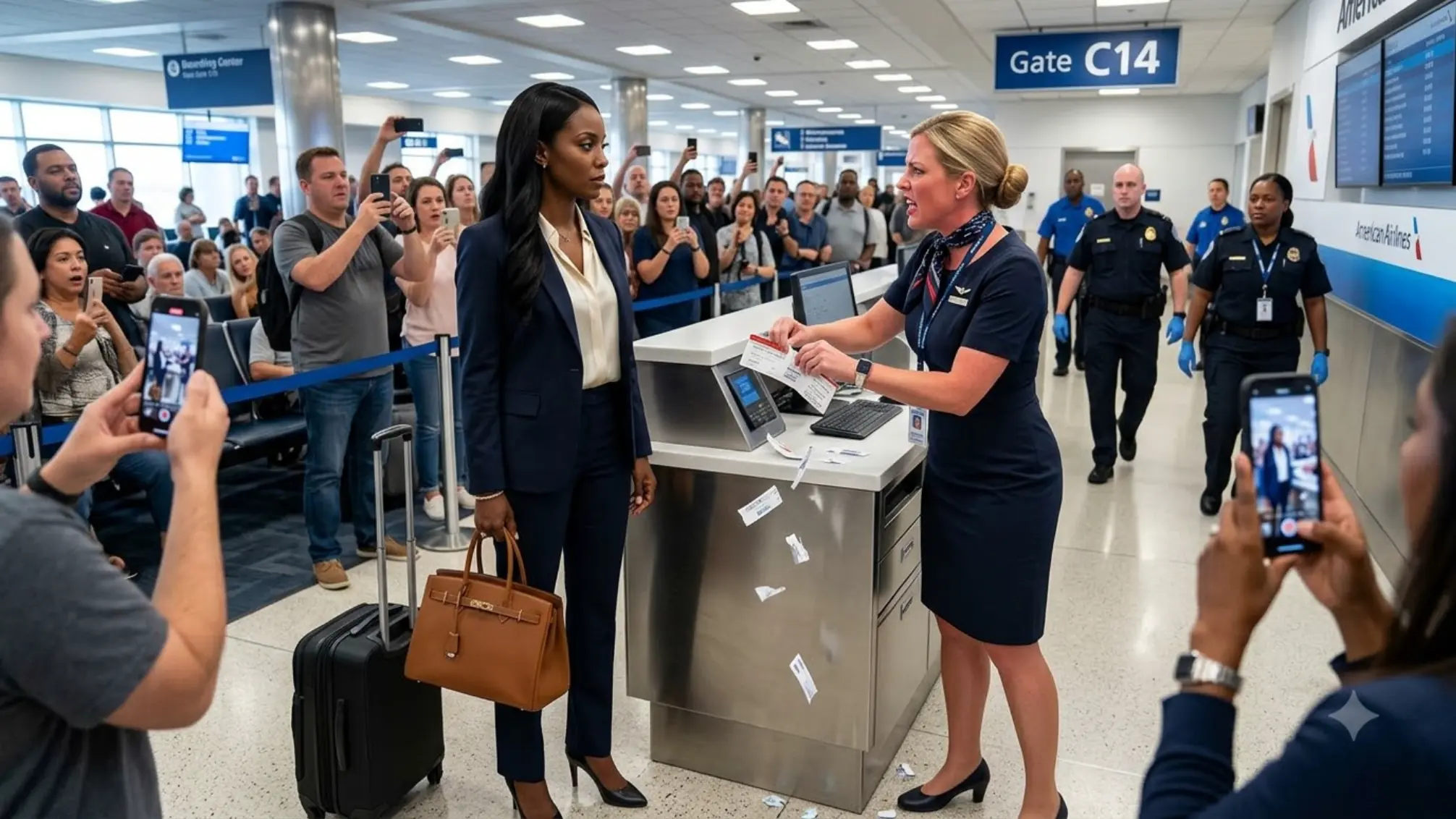
The third caught briefly against the wheel of her black suitcase before the air from the terminal ventilation sent it sliding across the polished floor.
The Gate Agent looked pleased with herself.
“First class isn’t where you fake your way into,” she said, tearing the remaining half directly down the middle. “Get out of my gate.”
Dozens of passengers at Gate C14 had stopped talking.
Several phones were already raised.
The Black Woman stood perfectly still.
She was forty-one, elegant without looking flashy, with deep-brown skin, long glossy black hair swept over one shoulder, intelligent dark eyes, and the quiet confidence of someone who rarely needed to announce authority before using it. She wore a dark navy tailored pantsuit over a cream silk blouse, black heels, and carried a structured brown leather handbag.
Nothing about her expression changed as the ticket pieces reached the floor.
The Gate Agent leaned forward.
“You heard me.”
The Black Woman looked at the fragments.
Then at the employee’s name badge.
Then directly into her eyes.
“Rip another piece,” she said calmly. “I want every camera to catch exactly how you treat my passengers.”
The Gate Agent laughed.
“Your passengers?”
She pointed sharply toward two airport security officers approaching through the crowd.
“Security, get this fraud out before I have her banned.”
The Black Woman turned slightly toward the officers.
“Call them closer.”
Her voice never rose.
“Then check who bought this airline ten minutes ago.”
The Gate Agent’s smile faltered.
Only for a second.
Then she laughed even harder.
That reaction told the Black Woman everything she needed to know.
Three months earlier, Northstar Meridian Airlines had looked like one of the healthiest mid-sized carriers in the United States.
Revenue had climbed for four consecutive quarters.
Premium-cabin sales were strong.
Customer loyalty memberships were increasing.
The company operated more than three hundred daily flights through Dallas, Atlanta, Charlotte, Denver, and New York.
Its executives repeatedly described the airline as efficient, disciplined, and customer-focused.
The Black Woman knew better.
Her investment group had spent almost a year evaluating Northstar Meridian before agreeing to purchase a controlling stake.
Financially, the airline made sense.
Culturally, something did not.
During due diligence, her legal team discovered an unusual cluster of passenger complaints involving premium boarding.
The reports looked unrelated until someone organized them chronologically.
A Black physician with a confirmed first-class reservation had been asked to verify his seat three separate times.
A Latino business owner traveling with his teenage son had been told he was standing in the wrong boarding lane despite having Group One printed clearly on both tickets.
A construction-company president wearing work boots had been asked whether he had received an “accidental upgrade.”
A Black attorney said a gate employee scanned her ticket, stared at her, and then called a supervisor because the reservation “didn’t look right.”
A retired teacher had been removed from her assigned premium seat after a frequent flyer complained that she looked “confused.”
The language inside Northstar’s official complaint summaries was much softer.
Passenger misunderstanding.
Boarding communication issue.
Seat verification procedure.
No discriminatory intent established.
The Black Woman did not trust polished summaries.
She asked to see the original complaints.
That was where the pattern became impossible to ignore.
Passengers repeatedly used the same words.
They acted like I didn’t belong.
They assumed my ticket wasn’t mine.
They made me prove I had paid.
Everyone else was waved through.
One employee’s name appeared more frequently than any other.
The Gate Agent at C14.
She had worked for Northstar Meridian for eleven years.
Her personnel file looked excellent.
Few absences.
Strong boarding efficiency.
High on-time performance.
Repeated praise from local management for “controlling premium-lane integrity.”
But buried inside customer-service archives were thirteen complaints connected directly to her.
Only one had led to formal counseling.
The others had been downgraded.
The Black Woman asked the company’s acting CEO why.
He blamed fragmented systems.
She asked the Dallas Station Manager.
He blamed demanding passengers.
She asked Human Resources.
They said no clear pattern had been established.
That answer bothered her most.
There was absolutely a pattern.
People simply had not wanted to see it.
So before publicly announcing the acquisition, the Black Woman made a decision her attorneys considered unnecessary.
She would fly Northstar Meridian anonymously.
No executive escort.
No priority protocol beyond the ticket she legally purchased.
No notification to station leadership.
Her reservation was booked under a shortened version of her legal name.
Only four people knew.
Her general counsel.
The board chairman.
The head of corporate compliance.
And the executive overseeing the acquisition closing.
The ownership transfer would legally finalize at 12:20 p.m. Central Time.
Her flight boarded at 12:30.
The timing was intentional.
For ten minutes, she wanted to experience Northstar Meridian not as a potential buyer.
But as its owner whom nobody recognized.
She arrived at Dallas International at 10:47.
Security was uneventful.
The lounge was professional.
A bartender welcomed her.
A customer-service employee answered a question politely.
For nearly ninety minutes, the Black Woman wondered whether the complaints represented isolated problems rather than systemic culture.
Then she reached Gate C14.
The first announcement came at 12:17.
“Northstar Meridian Flight 482 to New York will begin preboarding shortly.”
The Black Woman stood near the Group One lane.
She had seat 2C.
Paid first class.
No upgrade.
No employee travel.
No special accommodation.
The Gate Agent noticed her almost immediately.
Her eyes moved from the Black Woman’s face to her handbag, then to the lane sign.
“Ma’am?”
“Yes?”
“General boarding hasn’t started.”
“I know.”
“This lane is first class and top-tier members.”
“I know.”
The Black Woman smiled politely and continued reading an email on her phone.
The Gate Agent remained there.
“Can I see your boarding pass?”
The Black Woman displayed it.
The employee scanned the barcode.
Green.
Valid.
Seat 2C.
Group One.
Everything correct.
Still, the Gate Agent did not move.
“Where did you get this ticket?”
The Black Woman looked up.
“Excuse me?”
“Was it upgraded?”
“No.”
“Employee voucher?”
“No.”
“Compensation certificate?”
“No.”
The Gate Agent narrowed her eyes.
“You bought first class?”
The Black Woman studied her.
“Yes.”
A white businessman standing directly behind her held an identical Group One boarding pass.
The Gate Agent had not asked him anything.
That detail entered the Black Woman’s memory immediately.
“Is there a problem?”
“I’m checking.”
“You scanned it.”
“I know how to do my job.”
“Then what did the scanner say?”
The Gate Agent’s mouth tightened.
“Stand over there.”
She pointed away from Group One.
The Black Woman did not move.
“For what reason?”
“While I verify the reservation.”
“You just verified it.”
“I said move.”
Several passengers began watching.
The Black Woman looked at her watch.
12:20.
Somewhere inside a corporate legal office in New York, final signatures were being transmitted.
Northstar Meridian Airlines was officially changing ownership.
Nobody at Gate C14 knew.
The Black Woman looked back at the Gate Agent.
“Am I being denied boarding?”
“I’m investigating ticket fraud.”
That was a serious accusation.
The Black Woman’s expression hardened slightly.
“What evidence of fraud do you have?”
The Gate Agent tapped the computer screen.
“Something doesn’t look right.”
“What?”
“I don’t discuss security systems with passengers.”
“Then call a supervisor.”
That answer irritated her.
Not because it was unreasonable.
Because it sounded like a challenge.
The Gate Agent walked behind the counter and typed rapidly.
A second employee approached.
“What’s going on?”
“Possible fraudulent premium reservation.”
The second employee looked at the screen.
Then looked at the Black Woman.
Then back at the monitor.
“I’m showing confirmed.”
The Gate Agent lowered her voice.
“Look at how it was issued.”
The colleague leaned closer.
“Direct website purchase.”
“Exactly.”
The second employee looked confused.
“That’s normal.”
The Gate Agent glared.
The colleague stopped talking.
The Black Woman noticed that too.
Fear.
Not dramatic fear.
Workplace fear.
The kind created when employees learn that contradicting certain people costs more than agreeing with them.
The Gate Agent came back around.
“Identification.”
The Black Woman handed over her driver’s license.
The name matched the reservation.
The Gate Agent compared them twice.
Then three times.
“Second ID.”
“That is government-issued identification.”
“I want another.”
“Why?”
“Because I asked.”
The businessman behind the Black Woman finally spoke.
“Her ticket scanned green.”
The Gate Agent snapped toward him.
“Sir, stay out of this.”
He raised his hands.
“Fine.”
Another passenger quietly began recording.
The Black Woman saw it.
So did the Gate Agent.
“Put the phone away.”
The passenger replied, “I’m standing in a public terminal.”
The Gate Agent turned back toward the Black Woman.
“You people always turn a simple verification into some huge drama.”
Silence spread across the boarding area.
The Black Woman’s eyes narrowed.
“You people?”
The Gate Agent recognized the mistake.
Her face flushed.
“I mean passengers who refuse instructions.”
“No.”
“You know exactly what I meant.”
The Gate Agent’s voice rose.
“See? This attitude is why we have problems.”
The Black Woman remained calm.
“What problem?”
“You came into my premium lane acting entitled.”
“I have a premium ticket.”
“That doesn’t mean you own the place.”
The Black Woman almost smiled.
Not yet, she thought.
Technically, that sentence had stopped being true about twenty-five seconds earlier.
Her phone vibrated inside her handbag.
She already knew what the message said.
CLOSING COMPLETE. OWNERSHIP TRANSFER EFFECTIVE 12:20 CT.
She did not check it.
The Gate Agent reached across the counter.
“Give me the boarding pass.”
The Black Woman handed it over.
The employee stared at it.
Then something seemed to change in her expression.
She had reached the point where she needed to prove she had been right.
Instead of admitting the reservation was valid, she tore the pass once.
A gasp came from the crowd.
Then she tore it again.
And again.
White pieces fell between them.
“There.”
The Gate Agent dropped the remains.
“Problem solved.”
For several seconds, nobody spoke.
The Black Woman looked at the floor.
One passenger whispered, “What the hell?”
The Gate Agent crossed her arms.
“You’re not boarding this aircraft.”
The Black Woman slowly raised her eyes.
“On what authority?”
“Mine.”
“No.”
The Gate Agent stepped forward.
“Yes.”
“You have a valid reservation in your system.”
“Not anymore.”
“What did you change?”
The Gate Agent did not answer.
The Black Woman looked toward the computer.
“If you canceled my reservation after confirming my identity, that action is logged.”
For the first time, uncertainty appeared.
Only briefly.
Then arrogance returned.
“I know how the system works better than you do.”
“I certainly hope you think so.”
The Gate Agent pointed toward the terminal.
“Leave.”
The Black Woman remained where she was.
That was when security arrived.
Two airport officers approached.
The Gate Agent spoke first.
“She attempted to board using a suspicious first-class reservation and became confrontational when I stopped her.”
The Black Woman turned toward the officers.
“Please ask her to show you the reservation history.”
The older officer looked at the Gate Agent.
“Can we see it?”
The Gate Agent hesitated.
Then clicked through several screens.
The officer leaned forward.
“Looks like it was valid.”
“It was flagged.”
“Where?”
“I cleared the flag.”
The Black Woman looked directly at her.
“There was never a flag.”
The Gate Agent turned angrily.
“You need to stop talking.”
The officer frowned.
“Ma’am, let’s keep everybody calm.”
The Black Woman nodded.
“I am calm.”
That was undeniable.
The Gate Agent was visibly angrier than she was.
Then the Airport Duty Manager arrived.
He was a white man in his early fifties wearing a dark blazer and a Northstar Meridian identification badge.
The Gate Agent looked relieved.
“Thank God.”
She explained everything rapidly.
Possible fraud.
Refusal to comply.
Hostile passenger.
Security risk.
The Duty Manager barely looked at the computer.
Instead, he looked at the Black Woman.
“Ma’am, perhaps it would be best if we rebook you later after we investigate.”
The Black Woman stared.
“You haven’t investigated yet.”
“We’re trying to de-escalate.”
“By removing the passenger whose ticket was valid?”
“I didn’t say that.”
“You just offered to rebook me.”
The Duty Manager sighed.
“Sometimes it’s easier for everybody if we reset the situation.”
The Black Woman looked at him for a long moment.
That sentence entered the mental file too.
Easier for everybody.
Meaning easier for management.
Not fair.
Not correct.
Easier.
“What happens to her?” the Black Woman asked.
He looked confused.
“Who?”
“The employee who tore a valid first-class ticket.”
“We can discuss that internally.”
“After I leave?”
“Yes.”
“So your immediate solution is to remove me and protect her from public consequences.”
The Duty Manager’s expression hardened.
“I’m not going to debate management procedures with you.”
The Black Woman nodded slowly.
“Good.”
She picked up one piece of the torn boarding pass.
“Because you’ll have plenty of time to explain them later.”
Her phone vibrated again.
Then something happened behind the gate counter.
Every company tablet chimed.
One after another.
The Gate Agent looked down.
The Duty Manager pulled out his phone.
The second gate employee checked hers.
A notification appeared simultaneously across Northstar Meridian’s internal corporate network.
URGENT CORPORATE ANNOUNCEMENT
Effective immediately, Meridian Capital Aviation Holdings has completed acquisition of a controlling interest in Northstar Meridian Airlines.
The Gate Agent stopped reading.
The Duty Manager continued.
His face changed.
Dr. Kesha Washington has been appointed Owner, Executive Chair, and Chief Executive Officer effective 12:20 p.m. Central Time.
Beneath the message appeared an official corporate photograph.
The Black Woman standing directly in front of them.
Different hairstyle.
Different suit.
Same face.
The second gate employee’s mouth fell open.
The Duty Manager slowly looked up.
The Gate Agent stared at her device.
Then at the Black Woman.
Then back at the photograph.
“No.”
The Black Woman said nothing.
The Gate Agent enlarged the image with trembling fingers.
“No.”
One airport officer looked over her shoulder.
Then toward the Black Woman.
The entire gate had become silent.
The Duty Manager spoke first.
“Dr. Washington?”
The Black CEO lifted her handbag from the floor.
“Yes.”
The Gate Agent stumbled backward.
“This is some kind of—”
“No.”
The CEO’s voice remained calm.
“It isn’t.”
“I didn’t know.”
The CEO looked at her.
“That is the point.”
Nobody moved.
The Gate Agent swallowed.
“If I had known who you were—”
“Exactly.”
The CEO stepped closer.
“If you had known I owned the airline, you would have treated me differently.”
The Gate Agent opened her mouth.
Nothing came out.
The CEO continued.
“I didn’t come here to learn how employees treat the owner.”
She looked around the gate.
“I came here to learn how they treat someone they believe has no power.”
The Duty Manager suddenly became extremely interested in helping.
“Dr. Washington, I sincerely apologize. We can immediately restore your reservation, personally escort you aboard, and—”
“No.”
He stopped.
“You were here before the announcement.”
His face fell.
“You had the same information five minutes ago.”
“I was trying to—”
“You tried to remove me because that was easier than questioning her.”
He said nothing.
The CEO turned toward the security officers.
“Thank you for checking the system.”
The older officer nodded.
She turned toward the passengers.
“Anyone who recorded this, please preserve the original video. Corporate Legal may request copies.”
Phones remained raised.
Then she looked at the Gate Agent.
The woman was pale now.
“Am I fired?”
The CEO considered her.
“No.”
The Gate Agent blinked.
Relief appeared.
Then disappeared when the CEO continued.
“You are suspended pending investigation.”
The Duty Manager looked toward her.
“And you are too.”
His face dropped.
“Dr. Washington—”
“Do not make me repeat myself.”
He stopped.
The CEO did not board Flight 482.
Instead, she walked into a small conference room near the gate with Corporate Compliance on speakerphone.
Within an hour, investigators preserved the reservation history.
The system showed exactly what she suspected.
Her ticket had been valid from the beginning.
No fraud alert existed.
No security warning.
The Gate Agent had manually canceled the boarding document after the confrontation began.
Then investigators examined older incidents.
Thirteen passenger complaints.
The number quickly grew.
Employees contacted Compliance after seeing the corporate alert.
One gate worker said the Gate Agent routinely questioned passengers who “didn’t look premium.”
Another admitted management sometimes instructed employees to rebook offended passengers rather than confront staff because delays damaged performance metrics.
A third employee produced internal chat messages.
One message from the Gate Agent read:
2B looks like an upgrade. Verify before boarding.
Another:
Premium cabin getting too casual lately.
A supervisor had reacted with a laughing emoji.
Nobody had challenged it.
The CEO stared at the screen.
This was larger than one employee.
The same problem she had seen throughout due diligence now had a shape.
People were not simply making individual mistakes.
Metrics rewarded speed.
Managers disliked complaints.
Supervisors protected employees who kept flights moving.
Passengers who challenged treatment were classified as difficult.
Then their complaints were softened until nobody upstairs understood what actually happened.
At five that afternoon, the CEO called an emergency leadership meeting.
The former acting CEO joined by video.
Human Resources.
Customer Experience.
Station Operations.
Legal.
Compliance.
She began with one question.
“How many of you knew we had repeated premium-access complaints in Dallas?”
Several hands rose.
Second question.
“How many of you read the original passenger statements?”
Almost every hand dropped.
That silence angered her more than Gate C14 had.
“You managed summaries.”
Nobody answered.
“You managed dashboards.”
Still silence.
“You managed complaint counts.”
She placed the torn ticket pieces on the table.
“But you did not manage people.”
The investigation lasted seven weeks.
The Gate Agent was ultimately terminated after investigators found repeated policy violations, inappropriate passenger profiling, false statements in incident reports, and unauthorized reservation changes.
The Duty Manager was removed from management after investigators concluded he had repeatedly prioritized operational convenience over fair complaint review.
Several supervisors received disciplinary action.
Two senior executives resigned.
But the CEO refused to allow the company to announce that the problem had been solved.
One employee losing her job did not repair a culture.
Northstar Meridian rebuilt its complaint system.
Original passenger complaints could never again be overwritten.
Manager summaries would exist separately.
Any employee who canceled a valid reservation after passenger confrontation would trigger automatic review.
Repeated seat-verification incidents involving similar demographic patterns would be flagged for independent analysis.
Most importantly, station managers were evaluated not merely on on-time departure statistics, but on validated passenger-treatment metrics and complaint integrity.
The CEO also created a simple policy:
A valid boarding pass is presumed valid regardless of how the passenger looks.
It sounded embarrassingly obvious.
That was exactly why she wanted it written.
Three months later, the CEO returned to Gate C14.
This time everyone recognized her.
That disappointed her slightly.
She wore jeans, a cream sweater, and carried the same brown handbag.
The gate counter had a new manager.
Passengers lined up.
Group One was called.
A Black man in his twenties approached wearing gray sweatpants, sneakers, headphones, and a faded college sweatshirt.
The employee scanned his ticket.
Green.
“Welcome aboard, sir.”
Nothing else.
No second look.
No question about upgrades.
No verification of how he paid.
The young man continued down the jet bridge without realizing the CEO was watching.
She smiled.
That was the result she wanted.
Not apologies when important people were present.
Ordinary professionalism when nobody special appeared to be watching.
Later that year, Northstar Meridian held its annual leadership conference in Atlanta.
More than four hundred managers attended.
The CEO stood on stage.
Behind her was no photograph of Gate C14.
No viral video.
No image of the torn boarding pass.
Instead, the screen displayed one sentence:
HOW DO YOU TREAT SOMEONE WHEN YOU BELIEVE THEY CAN DO NOTHING FOR YOU?
The room became quiet.
The CEO walked slowly across the stage.
“Most of you know what happened to me in Dallas.”
Several people nodded.
“The popular version of the story is that an employee tore up a Black woman’s first-class ticket and then discovered she owned the airline.”
A few uncomfortable smiles appeared.
“That is not the lesson.”
She paused.
“If your lesson is, ‘Be careful who you disrespect because they might secretly be the CEO,’ then we learned nothing.”
The room went completely still.
“I should have received the same treatment if I had been a nurse.”
She took another step.
“A teacher.”
Another.
“A grandmother.”
“A cashier.”
“A woman taking her first flight.”
“A passenger who saved for three years to buy one first-class ticket.”
She stopped at center stage.
“My title should not have mattered.”
The managers listened.
“What mattered was the boarding pass.”
She looked across the room.
“It was valid.”
That sentence became part of Northstar Meridian’s training program.
Not because it was clever.
Because it stripped the situation to its simplest truth.
Months later, the CEO received a handwritten letter.
It came from the physician who had filed one of the original complaints.
He wrote that after the Dallas incident became public, the airline contacted him, reviewed his case, refunded his fare, and apologized.
But the final paragraph mattered most.
I do not care about the refund.
I care that someone finally believed me.
The CEO read that sentence twice.
Then she placed the letter beside the torn pieces of her own boarding pass, which she had kept inside her desk.
Her general counsel once asked why.
“Evidence?”
“No.”
“Souvenir?”
“Definitely not.”
“Then why?”
The CEO looked at the pieces.
“Because paper told the truth before people did.”
Her lawyer raised an eyebrow.
“The boarding pass?”
“It said exactly where I belonged.”
She smiled faintly.
“Everyone else added their assumptions.”
A year after the acquisition, Northstar Meridian reported its strongest customer-satisfaction scores in company history.
But the CEO cared more about another statistic.
Formal complaints increased during the first six months.
Some executives initially panicked.
She did not.
It meant people believed reporting might matter.
Later, complaints began decreasing again.
This time, independent audits confirmed the decline reflected improved service rather than rewritten language.
That difference mattered.
One evening, the CEO arrived at Dallas International after a long meeting.
She walked past Gate C14.
The terminal was quiet.
No confrontation.
No cameras.
No corporate alert.
Just passengers waiting for flights.
She stopped beside the exact place where her boarding pass had been torn.
A cleaning employee pushed a cart nearby.
“Ma’am, you okay?”
The CEO looked at him.
“Yes.”
He nodded and continued.
She glanced toward the gate counter.
For a moment, she could almost see the fragments falling again.
The Gate Agent’s expression.
The Duty Manager choosing convenience.
Security checking the truth when management would not.
Then the alert hitting every device.
People loved that part of the story.
The dramatic reversal.
The instant silence.
The woman they dismissed suddenly becoming the most powerful person in the company.
But the CEO understood something the viral clips never captured.
She had already been the owner when the ticket was torn.
Nothing about her changed when the notification appeared.
Only their knowledge changed.
That was what made the encounter so revealing.
Before the alert, she was treated like a problem.
After the alert, everyone wanted to serve her.
Same woman.
Same ticket.
Same gate.
Same clothes.
Same facts.
Different perceived status.
That difference was precisely the disease she had gone looking for.
The CEO continued walking.
Her phone displayed tomorrow’s schedule.
Board meeting.
Operations review.
New employee orientation.
Then one item made her smile.
Flight 482 — Dallas to New York.
Same route.
She had booked seat 2C.
Again.
The following morning, she arrived carrying no entourage.
The employee at Gate C14 recognized her, of course.
But before boarding began, the CEO watched another woman approach the counter.
Black.
Maybe sixty.
Comfortable sneakers.
A large floral handbag.
She looked uncertain.
“Excuse me,” the woman said. “I’ve never flown first class before. Does this ticket mean I get in this line?”
The gate employee looked at the boarding pass.
Then smiled.
“Yes, ma’am.”
The woman seemed relieved.
“I didn’t want to stand somewhere I wasn’t supposed to.”
“You’re exactly where you’re supposed to be.”
The CEO looked away before anyone noticed her expression.
That sentence meant more than every press release the company had issued after the scandal.
Exactly where you’re supposed to be.
That was all the first boarding pass had said too.
Seat 2C.
Group One.
First class.
Valid.
The Gate Agent had torn the paper because she believed she could decide something the ticket had already established.
She had been wrong.
And by making that mistake in front of the woman who had just purchased the airline, she gave Northstar Meridian something its glossy reports had failed to provide for years.
The truth.
Not about one rude employee.
About an entire organization that had learned to ask the wrong question.
Does this person look like they belong here?
The new CEO replaced it with a much simpler one.
What does the valid ticket say?
At Gate C14, the answer had always been obvious.
Nobody needed a corporate ownership alert to read it.
They simply needed to believe the Black woman holding it.