The three hundred turkey poults arrived at Buck Hollow auction on the hottest Thursday of June. They were packed into stacked wire cages beside the feed cooperative, panting beneath a sheet-metal awning that offered little protection from the Oklahoma sun. Their feathers were still soft, their heads small, and their frightened cries blended into one endless sound. Every farmer who passed the cages shook his head before moving on.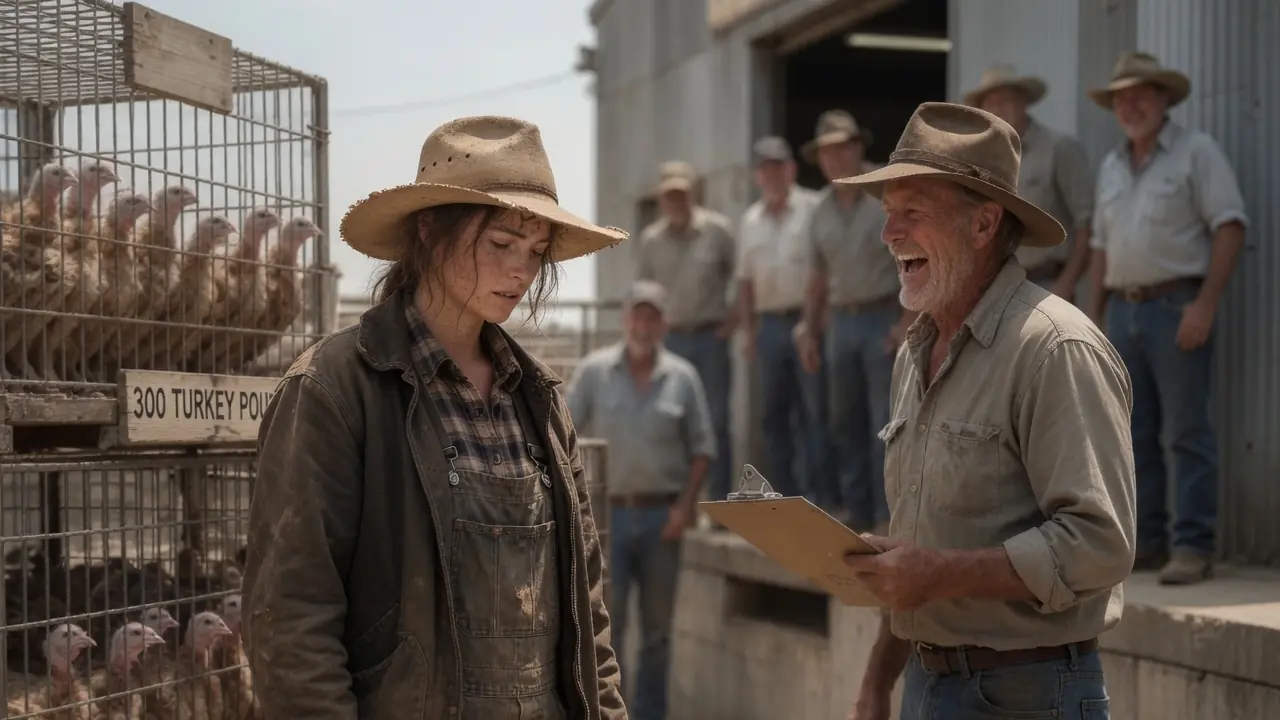
Clara Wren stood beside them wearing a torn denim shirt, mud-stained trousers, and the straw hat her grandfather had worn before he died. At twenty-four, she looked younger than most people expected a farm owner to look and more exhausted than anyone her age should have been. She had come to Buck Hollow intending to purchase two bags of discounted seed and a used water pump. Instead, she stopped beside the cages and began reading the faded delivery tags tied to the wire.
The labels identified the birds as slow-growing mixed heritage poults from a breeder in Kansas. If that information was correct, they would need longer than the remaining months to reach the size most Thanksgiving customers expected. Raising three hundred birds through the summer heat would require feed, shelter, medicine, clean water, fencing, and more labor than Clara could provide alone. To every experienced farmer in the yard, the shipment represented three hundred ways to lose money.
Old Reuben Vale owned the auction yard and half the grain storage buildings in Buck Hollow County. He was sixty-eight, broad through the chest, and proud of knowing exactly when desperation made people easier to bargain with. Reuben stood near the cages holding a clipboard, laughing with several local farmers who had already refused the lot. When he saw Clara examining the tags, his smile widened.
“Those are not garden chickens, girl,” he called. “They’ll eat your grandmother’s farm before they ever reach Thanksgiving.”
The men around him laughed.
Clara ignored them and reached through the wire carefully. One poult pecked weakly at her thumbnail, while another shifted beneath the others to escape the heat. She examined their legs, breast shape, feather color, and the small marks on the shipping bands. Something about the birds did not match the description on the delivery sheet.
“How much for the full lot?” she asked.
Reuben lowered his clipboard. “You cannot be serious.”
“I asked for the price.”
“Three hundred poults, damaged shipment, sold without guarantee.” He looked toward the farmers, making certain he still had an audience. “Three hundred dollars takes them all, and once they cross that gate, every dead bird belongs to you.”
Clara calculated silently.
Three hundred dollars was nearly everything left in the emergency account at Wren Hollow Farm. Her grandmother’s property taxes were due in six weeks, the west pasture fence needed repair, and the bank had already warned them that another late loan payment could trigger foreclosure proceedings. Spending the money on uncertain birds might destroy the only home Clara had ever known.
Reuben saw the hesitation and laughed again.
“You’re risking your grandmother’s last dollars on three hundred summer poults that won’t survive until Thanksgiving.”
Clara removed a folded envelope from her shirt pocket. Inside were the dollars she had received from selling her grandfather’s remaining tools, money she had promised would be used only to protect the farm. Her hands tightened around the envelope before she placed it on Reuben’s clipboard.
“Then write my name beside every cage.”
The laughter grew louder.
Reuben counted the money and shook his head. “When they die, don’t come begging this town for help.”
Clara met his eyes. “No, Reuben. Remember your laughter when this town comes begging me.”
The yard became quiet for one brief second.
Then the men laughed harder than before.
Clara did not explain what she had noticed on the shipping bands. She did not tell them the breeder code belonged to a commercial hatchery known for fast-growing white turkeys, not the slow heritage strain written on the auction sheet. She did not mention that the birds’ heavy feet and wide breast structure already suggested the same thing. Someone had attached the wrong paperwork after the truck was rerouted during a storm.
If Clara was right, the poults had enough time to reach market weight before Thanksgiving.
If she was wrong, Reuben’s laughter would follow her all the way to the foreclosure auction.
Transporting the birds became the first problem. Clara owned an aging pickup with a wooden livestock trailer that had not been used since her grandfather sold the final flock of sheep. The trailer floor had two weak boards, one wheel bearing needed grease, and the roof leaked around every bolt. Clara spent forty minutes reinforcing the floor with scrap lumber while the auction employees watched from the shade.
Only one person offered assistance.
Seventeen-year-old Eli Mercer worked part-time loading feed bags at the cooperative. He was thin, quiet, and treated by most farmers as though his youth made him invisible. Without asking permission, Eli brought a water hose, filled several shallow pans, and helped Clara move the cages away from direct sunlight.
“You know these aren’t heritage birds,” he whispered.
Clara looked at him. “What makes you say that?”
“My uncle raised commercial whites before his barn burned.” Eli pointed toward one bird. “The legs are wrong for heritage poults.”
Clara nodded. “I noticed.”
“Then why did the papers say otherwise?”
“Someone made a mistake.”
Eli looked toward Reuben. “Or someone wanted them cheap.”
Clara followed his gaze.
Reuben had already turned away, but she noticed a second buyer standing beside his office. The man represented a large poultry broker from Tulsa. He had been examining the cages earlier but stopped bidding after Reuben loudly described the birds as late-season heritage stock.
Perhaps Reuben had been wrong.
Perhaps he had intended to purchase them privately after no local farmer took the risk.
Clara filed the thought away.
By sunset, the cages were secured inside the trailer. The birds had water, the road temperature had fallen, and Clara’s pickup was pulling them toward Wren Hollow Farm. Eli rode beside her because she offered him twenty dollars to help unload, though she did not yet know how she would pay him after spending nearly everything at the auction.
Wren Hollow sat eleven miles south of Buck Hollow near the edge of a dry creek. The farmhouse leaned slightly toward the east, the red barn had lost half its paint, and weeds grew through the remains of an old poultry yard behind the machine shed. Clara’s grandmother, Ruth Wren, waited on the porch with both hands resting on her cane.
Ruth was seventy-six and had spent her entire life surviving decisions other people called impossible. She married at seventeen, raised four children through drought and debt, and kept the farm after her husband’s stroke reduced him from a powerful cattleman to a man who needed help lifting a spoon. Yet even Ruth’s courage faltered when she saw the trailer filled with turkeys.
“What have you done?” she asked.
Clara climbed from the pickup. “Bought our Thanksgiving crop.”
“With what money?”
“The tool money.”
Ruth closed her eyes.
Eli remained near the trailer, pretending not to hear the argument. Clara waited for her grandmother to shout, but Ruth’s voice became quieter instead. Disappointment always sounded worse when spoken softly.
“That money was for taxes.”
“I know.”
“If these birds die, we lose more than three hundred dollars.”
“I know.”
“Then tell me you have a plan.”
Clara looked toward the abandoned brooder house beyond the barn. Its windows were broken, the door hung crooked, and weeds reached nearly to the roof. It had not held poultry since Clara was nine years old.
“I have the beginning of one.”
Ruth stared at her for a long moment. Then she turned toward Eli. “Young man, can you carry lumber?”
“Yes, ma’am.”
“Good. The beginning of her plan needs a roof before dark.”
They worked beneath lantern light.
Clara and Eli repaired the windows with wire mesh, replaced two floorboards, and hung old feed sacks across gaps in the walls. Ruth cleaned watering pans while seated on an overturned crate and insulted every tool that failed to cooperate. The building remained rough, but by midnight it was secure enough to hold the birds safely.
The first night nearly ended the entire venture.
A section of temporary fencing collapsed after the poults crowded toward one corner. Twelve birds became trapped beneath the others before Clara and Eli reached them. They saved ten, but two died in Clara’s hands before dawn.
She buried them beneath the cottonwood tree near the creek.
Ruth stood beside her while she covered the small bodies with soil. “Livestock does not forgive learning slowly,” she said.
“I know.”
“No, you know the words. Knowing the cost is different.”
Clara wiped dirt from her hands. “Should I take them back?”
“Reuben would charge you to unload them.”
“That was not my question.”
Ruth looked toward the brooder house. “No. You bought responsibility. Now become worthy of it.”
For the next three weeks, Clara slept less than four hours each night.
She rose before sunrise to clean water containers, check breathing, inspect droppings, and separate weaker birds. During the hottest hours, she hung wet burlap along the shade side of the building and used an old grain fan to move air across the pens. At night, she repaired the pasture fence and worked temporary shifts at a roadside diner to pay for feed.
Eli returned every afternoon.
Clara told him she could not afford regular wages, but he continued helping in exchange for supper and the promise of payment after Thanksgiving. He repaired feeders from scrap metal, rebuilt an old water line, and found used fencing behind his uncle’s collapsed barn. Within a month, the neglected poultry yard had become a functioning range.
The birds grew faster than expected.
Their bodies broadened, their white feathers filled in, and their appetite became enormous. Clara recorded weekly weights in her grandfather’s cattle ledger. By mid-July, the average growth matched the commercial breed guide she had ordered from the county library.
She had been right about the breed.
That did not mean the farm was saved.
Feed prices climbed after flooding damaged cornfields farther north. Reuben controlled the largest local feed supply and offered Clara no discount. When she arrived at Merritt Cooperative to purchase another twenty bags, he leaned against the loading platform and announced the total loudly enough for every farmer nearby to hear.
“Still feeding your Thanksgiving miracle?”
“Still selling overpriced grain?”
Several men laughed, but this time not all of them laughed at Clara.
Reuben’s smile disappeared. “Cash only.”
“The cooperative allows thirty-day accounts.”
“For established operations.”
“My grandmother has bought feed here for forty years.”
“Your grandmother bought cattle feed. You are gambling on birds.”
Clara placed her remaining diner wages on the counter. It covered only twelve bags.
Eli stepped forward. “The price board says members receive the county rate.”
Reuben looked at him coldly. “You want to keep working here?”
Eli lowered his eyes.
Clara purchased the twelve bags and left without arguing further. In the pickup, Eli apologized for remaining silent.
“You need the job,” Clara said.
“So do you.”
“I need you to remember what he said.”
That evening, Ruth opened the locked drawer in her bedroom and removed a small gold wedding ring. It was the only valuable object she still owned. Clara understood immediately.
“No.”
“We need feed.”
“Grandpa gave you that ring.”
“He gave me this farm too.”
“I will find another way.”
Ruth closed Clara’s fingers around the ring. “A symbol is meant to protect what it represents. Your grandfather did not marry me so I could watch his land disappear while jewelry sat in a drawer.”
Clara sold the ring to a jeweler in Oklahoma City.
The money purchased enough grain for three weeks and the materials to create movable grazing pens across the lower pasture. The turkeys began eating clover, insects, seeds, and fallen fruit in addition to prepared feed. The approach reduced costs and kept the birds healthier, though moving three hundred growing turkeys twice each day exhausted Clara.
People drove slowly past the farm to stare.
Some stopped at the fence and counted the birds. Others asked whether Clara had begun regretting the auction. Reuben told customers at the diner that half the flock would die during the first August heat wave.
The heat wave arrived on the ninth of August.
For six days, afternoon temperatures rose above one hundred degrees. The wind disappeared, and the farm pond dropped several inches. Turkeys could not tolerate the conditions without constant water, shade, and air movement.
Clara built shade frames from old tobacco poles and canvas. Eli repaired three discarded fans, while Ruth spent every afternoon filling shallow cooling pans despite the swelling in her hands. Clara ran the well pump until the motor overheated, then carried buckets from the farmhouse when the pressure failed.
On the fourth day, lightning struck a power line two miles away.
The fans stopped.
Within minutes, several birds began collapsing.
Clara called the utility company, but crews were already overwhelmed by outages across the county. She tried starting the old diesel generator, but the engine turned without catching. The fuel pump had failed.
A truck appeared near the barn.
Harold Beck, one of the farmers who had laughed at the auction, climbed out carrying a portable generator. He did not meet Clara’s eyes.
“My wife heard the power was out.”
Clara looked at the generator. “Why are you helping?”
Harold glanced toward the panting birds. “Because I laughed at you, not them.”
They connected the fans.
Another neighbor arrived with two hundred feet of extension cord. Then a retired electrician helped repair the well control. Nobody apologized directly, but the birds survived the hottest night because three men decided embarrassment mattered less than doing what was right.
Clara lost nine turkeys during the heat wave.
She recorded every death in the ledger.
By September, two hundred and eighty-three birds remained.
Their average weight exceeded expectations, and the first restaurant owner asked whether Clara intended to sell locally. She had not yet decided. Reuben had connections with every major buyer in the county, and selling through his auction would return control to the man who hoped she failed.
Ruth suggested direct orders.
“We do not have customers,” Clara said.
“We have a town.”
“A town that laughed.”
“A town still eats.”
Clara designed a simple order sheet and placed copies at the diner, hardware store, veterinary clinic, and church bulletin board. She offered whole birds at a fair price with a reduced deposit for families ordering before October. Each bird would be processed through a licensed facility outside Tulsa and returned chilled two days before Thanksgiving.
The first week brought only seven orders.
The second brought twelve.
Most people preferred supermarket prices and did not trust a young farmer whose flock had begun as a county joke. Reuben made the problem worse by telling customers that Wren Hollow had no confirmed processing contract. He predicted Clara would take deposits and fail to deliver.
She responded by posting the contract publicly.
Orders rose to thirty-four.
Still not enough.
Clara needed to sell at least two hundred birds to pay feed costs, taxes, processing, and Eli’s wages. Anything less would leave the farm deeper in debt than before. She began contacting restaurants, small grocers, and community organizations across three counties.
A senior center in Tulsa ordered fifteen.
A church ordered ten for a community meal.
Two restaurants reserved twenty-five birds after visiting the farm and seeing the flock. By early October, Clara had one hundred and twelve confirmed orders.
Then disease appeared at a commercial turkey operation in northern Oklahoma.
The infected farm was far from Wren Hollow, but news traveled faster than facts. Buyers began canceling poultry orders across the state. Supermarkets reduced local purchases, restaurants switched menus, and customers called Clara asking whether her birds were safe.
Clara invited the county veterinarian to inspect the farm.
Dr. Samuel Ortega tested the flock, reviewed sanitation records, and certified that the birds showed no signs of disease. Clara posted the written report at every order location. She also created a visitor barrier, disinfected footwear, and stopped allowing curious neighbors near the pens.
Reuben laughed at those precautions.
“Acting like a corporation now?”
Clara stood outside the feed cooperative holding another expensive invoice. “Acting like someone responsible for three hundred lives.”
“Two hundred and eighty-three.”
She looked at him.
He smiled. “People talk.”
“They also remember.”
Reuben stepped closer. “You think Thanksgiving will make you rich?”
“I think it will pay what I owe.”
“You will never control the market.”
“I do not need the market.”
“What do you need?”
“People who trust the farm more than the man selling rumors.”
His face hardened.
Two weeks later, the Merritt Cooperative board informed Clara that her account had been suspended because of “credit concerns.” She had never used credit there, but the suspension prevented her from purchasing at member prices. Reuben expected the higher retail cost to drain what little cash she had left.
This time, Eli did not remain silent.
He had found invoices showing that Reuben charged different prices to farmers he disliked while giving hidden discounts to friends. The records also revealed that the turkey shipment’s original hatchery certificate had arrived with the correct commercial breed information. Reuben had replaced it with a handwritten auction sheet describing the birds as slow-growing heritage poults.
He wanted the lot to appear worthless.
The Tulsa poultry broker had agreed to purchase them privately after the auction closed.
Clara’s bid ruined the arrangement.
Eli brought copies of the documents to Ruth’s kitchen table. “If I report this, I lose my job.”
Ruth poured him coffee. “If you do not report it, you keep a job that requires you to help cheat people.”
“I help my mother pay rent.”
“Then we find honest work before you tell the truth.”
Clara offered him permanent employment beginning immediately, though the farm could pay only modest wages until Thanksgiving. Eli accepted and submitted the records to the cooperative board.
Reuben was suspended pending investigation.
The cooperative restored Clara’s purchasing rights and refunded the price difference from earlier feed sales. It was not enough to erase the debt, but it carried the flock through the final month.
By November, the turkeys had become the largest healthy flock in the county.
Their feathers shone white beneath the autumn sun, and their calls rolled across the lower pasture each morning. Clara had two hundred and six confirmed orders, enough to survive if every customer paid the remaining balance. She reserved another thirty birds for late local sales and planned to keep several breeding candidates only until Ruth reminded her the commercial strain was not suited to long-term natural reproduction.
For the first time since June, Clara allowed herself to imagine paying the taxes.
Then the regional Thanksgiving supply collapsed.
A refrigeration failure spoiled thousands of processed turkeys at a major distribution center serving central Oklahoma. Two supermarket chains announced emergency shortages nine days before Thanksgiving. Prices rose immediately, and families who had waited to purchase discovered empty freezers.
Telephones began ringing at Wren Hollow.
Restaurants wanted ten birds, then twenty. A hotel offered twice Clara’s asking price for the entire unsold flock. A food distributor from Oklahoma City offered enough money to clear most of the farm debt if she canceled local reservations and sold everything to him.
The offer arrived in writing.
Clara sat at the kitchen table staring at the number.
Ruth read the contract beside her. “This saves the farm.”
“It breaks two hundred promises.”
“The deposits can be refunded.”
“They trusted us before the shortage.”
“Trust does not pay taxes.”
“No. It keeps people from becoming Reuben.”
Ruth looked at her granddaughter for a long time.
Then she folded the contract.
“Your grandfather would have chosen the promises.”
“What would you choose?”
Ruth touched the bare finger where her wedding ring once rested. “I already chose the farm. Now you choose what kind of farm it becomes.”
Clara refused the distributor.
She honored every confirmed order at the original price, limited late buyers to one bird per family, and reserved twenty turkeys for the senior center, food pantry, and families referred by the local school. The hotel purchased only six at the regular commercial rate.
People began arriving before sunrise on Thanksgiving week.
Cars lined the dirt road toward the pasture. Clara, Eli, Ruth, and six volunteers organized order lists beneath the barn awning. Each customer received the bird reserved under their name, a printed preparation guide, and a small package of herbs Ruth had dried from the garden.
Then Reuben Vale appeared.
The cooperative investigation had removed him as auction manager and required repayment of several pricing discrepancies. He still owned part of the property, but his authority had collapsed. Reuben stood at the end of the line holding no clipboard.
Clara noticed him but continued serving customers.
When his turn came, he removed his hat.
“My daughter has twelve people coming tomorrow,” he said. “She could not find a turkey.”
Clara checked the list. “Did she place an order?”
“No.”
“We have three late-sale birds remaining.”
“I need one.”
The people nearby became quiet.
This was the moment Clara had predicted in June. Reuben had told her not to beg when the birds died. Now he stood at her gate while the flock he had mocked fed the county.
Clara could have doubled the price.
She could have refused him and repeated his own words. Several people expected her to do exactly that.
Instead, she wrote his daughter’s name on the late-sale sheet.
“One bird per family. Same price as everyone else.”
Reuben looked surprised. “You could charge more.”
“I could.”
“Why don’t you?”
“Because hunger should not become punishment.”
His eyes moved toward the barn, the order line, and the workers carrying chilled turkeys toward waiting cars. “I was wrong about you.”
“You were wrong about the birds first.”
“I changed the paperwork.”
Clara remained still.
Reuben lowered his voice. “I thought the broker would buy them cheap. When you bid, I wanted you to fail.”
“I know.”
“You could report me again.”
“The board already has the records.”
“What do you want from me?”
Clara looked toward Eli, who was helping an elderly customer load a box.
“Pay every farmer you overcharged. Apologize to Eli. And stop believing experience gives you the right to humiliate people who see something you missed.”
Reuben nodded slowly.
“I can do that.”
“Then begin.”
Before leaving, he turned toward the pasture.
Only a handful of birds remained, reserved for final customers. The empty pens, repaired fencing, and clean water lines showed the labor hidden behind Clara’s success. There had been no miracle, only hundreds of ordinary decisions made correctly when failure would have been easier.
Thanksgiving morning arrived clear and cold.
Wren Hollow’s farmhouse kitchen filled with the smell of bread, sage, onions, and roasted turkey. Ruth sat at the table wearing a plain silver band Clara had purchased after paying the property taxes. It was not her original wedding ring, but Clara had engraved the inside with the words The farm survived.
Eli joined them for dinner.
So did Harold Beck, the farmer who brought the generator during the heat wave, and his wife. Two families from town arrived carrying pies because Clara had reserved turkeys for them after layoffs left them unable to afford supermarket prices.
Before the meal, Ruth looked around the crowded table.
“Last year, this house was quiet.”
Clara glanced toward the window.
Beyond the glass, the lower pasture rested empty beneath the winter light. The brooder house had a new roof, the feed account was current, and the bank had withdrawn its foreclosure warning after receiving payment. The farm was not wealthy, but it had survived.
“What happens next year?” Eli asked.
Clara had already begun planning.
Wren Hollow would raise a smaller flock under advance contracts, giving customers clear production numbers and protecting the farm from sudden market changes. The old poultry house would become a licensed brooding facility, and Eli would manage equipment and sanitation. Clara also intended to form a purchasing group with neighboring farms so no single feed dealer could control prices.
Ruth smiled. “Sounds expensive.”
“It is.”
“Sounds difficult.”
“It is.”
“You buying another three hundred auction birds?”
“Never.”
A turkey called from the barn.
Everyone looked toward the sound.
Clara had kept one bird temporarily because it was too small for processing and needed additional care. Ruth laughed until tears filled her eyes.
“Never lasts a very short time on this farm.”
By Christmas, Reuben completed the first repayments ordered by the cooperative board. He apologized to Eli in front of the same loading platform where he once threatened his job. The apology was awkward and incomplete, but Eli accepted it without pretending the harm had disappeared.
The town remembered Thanksgiving.
Not because Wren Hollow supplied every household, but because Clara refused to exploit the shortage. People who once laughed at the dirty young woman beside three hundred cages now spoke about her as though they had always believed in her.
Clara corrected them when necessary.
“You laughed too,” she told Harold one morning.
“I brought the generator.”
“You did both.”
He nodded. “People can be ashamed and still become useful.”
Clara liked that answer.
The following June, exactly one year after the auction, Clara returned to Buck Hollow. The yard remained dusty, the metal buildings still trapped heat, and farmers still gathered near the cooperative entrance to judge whatever arrived looking weak.
A new shipment of poultry waited beneath the awning.
This time, the paperwork was accurate.
The cooperative had created a verification rule requiring original hatchery certificates before livestock could be listed. Eli’s evidence and Clara’s story had made summaries insufficient.
A young woman stood beside one cage examining the birds.
Two older farmers laughed at her questions.
Clara walked over and handed her the full certificate.
“Read every line,” she said.
The woman looked up. “Are these worth buying?”
Clara studied the birds, the weather, and the uncertainty inside the question. Then she looked toward the rebuilt Wren Hollow truck parked outside the gate.
“That depends on whether you are buying hope or buying responsibility.”
“What is the difference?”
“Hope believes the birds will save you.”
Clara touched the edge of the cage.
“Responsibility means you save them first.”
Behind her, the farmers stopped laughing.
They had learned what happened when Clara Wren saw value before the rest of Buck Hollow did.
The three hundred summer turkeys had not merely preserved her grandmother’s farm. They exposed a dishonest dealer, restored fairness to the cooperative, fed families during a shortage, and taught an entire county that ridicule often revealed more about the crowd than the person standing alone.
By Thanksgiving, the town had arrived at Clara’s gate ashamed.
By the following summer, they arrived ready to listen.