“This fake ID isn’t getting you through my gate.”
The young security guard tapped the edge of the plastic credential with one finger and gave the elderly woman a smile that was not friendly enough to be called polite.
Evelyn Mercer did not lower her hand.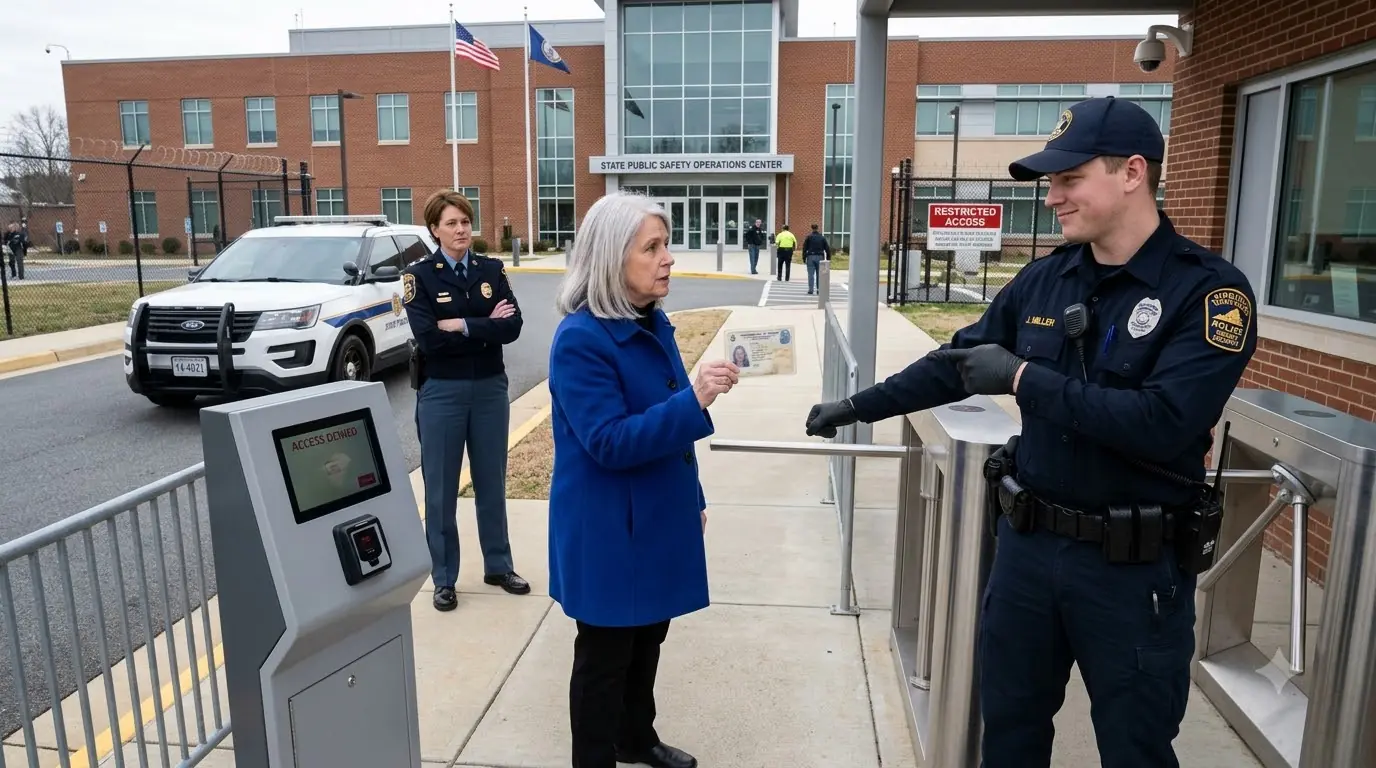
She was seventy-two years old, with shoulder-length silver-gray hair, a straight posture, and the patient expression of someone who had spent decades watching people make confident statements before checking whether they were true.
Her royal-blue coat was simple. Her black trousers were neatly pressed, and her shoes looked comfortable rather than expensive.
Nothing about her appearance suggested importance.
That was exactly why Tyler Reed had already decided she had none.
Tyler was twenty-eight, tall, broad-shouldered, and less than six months into his position with Sentinel Ridge Security, the private company contracted to control exterior access at the Virginia State Public Safety Operations Center.
He looked again at the credential.
It was thicker than modern access cards. The photograph had been taken years earlier, when Evelyn’s hair was mostly dark, and the state seal belonged to an older design no longer printed on current employee badges.
There was no bright holographic strip.
No modern QR code.
No visible expiration date.
To Tyler, it looked ancient.
To Evelyn, it looked exactly the way it was supposed to look.
“Then let the system check it,” she said.
Tyler laughed softly.
“Ma’am, I know what a real state credential looks like.”
Evelyn glanced toward the electronic access kiosk beside him.
“Apparently, you know what a new one looks like.”
Behind the gate stood the sprawling operations complex: two low concrete buildings connected by glass corridors, rows of secure doors, a communications wing, administrative offices, technical rooms, emergency planning suites, and an underground document archive that almost nobody outside senior staff knew existed.
A white government sedan was parked beyond the barrier.
Near it stood a dark-haired woman in a formal navy public-safety uniform, speaking on her phone.
Tyler had not noticed her yet.
Evelyn had.
“Step away from the kiosk,” Tyler said.
She did not move.
“I have an appointment.”
“With who?”
“The commissioner.”
That made him smile wider.
“Of course you do.”
Evelyn looked at him for another second.
Then she slipped the old credential back into her hand and turned toward the kiosk.
Tyler immediately stepped sideways.
“Ma’am, I said you’re not authorized.”
“You said my credential looked fake.”
“It is fake.”
“You haven’t checked it.”
“I don’t need to.”
That sentence changed Evelyn’s expression.
Not dramatically.
She simply stopped looking amused.
For nearly thirty years, Evelyn had worked around systems designed to protect important facilities from exactly that kind of thinking.
Technology failed.
Cards broke.
Servers went offline.
Power disappeared.
Employees forgot passwords.
But the most dangerous failure had always been human certainty unsupported by verification.
She pointed toward the kiosk.
“Does your terminal still have a continuity-entry screen?”
Tyler frowned.
“A what?”
Evelyn looked past him toward the small rectangular display.
That answer concerned her more than the insult.
She reached toward the lower corner of the touchscreen.
Tyler started to block her hand.
Before he could, Evelyn tapped three points along the screen border in a sequence that was not shown in any normal training menu.
The ordinary visitor screen disappeared.
A black window opened.
TYLER stopped moving.
Across the top appeared a simple line:
CONTINUITY AUTHORIZATION MODE
“What did you just do?” he demanded.
Evelyn entered six digits.
Then four letters.
Then another six-digit sequence.
The terminal paused.
A soft electronic tone sounded.
The screen turned green.
CONTINUITY AUTHORITY VERIFIED
MERCER, EVELYN R.
ACCESS CLASS: LEGACY ADMINISTRATIVE
AUDIT SESSION: ACTIVE
Behind them, the vehicle barrier lifted.
Two locked pedestrian gates released at once.
Inside the security booth, a second monitor flashed amber.
Then a third.
Tyler stared at the screens.
“What the hell?”
Evelyn removed her finger from the kiosk.
“That,” she said quietly, “was verification.”
A woman’s voice came from behind him.
“Mr. Reed.”
Tyler turned.
The woman who had been standing beside the white sedan was walking toward them.
Forty-four-year-old Dana Whitaker had served as Virginia’s State Public Safety Commissioner for three years, but Tyler had only seen her twice from a distance.
Now she was ten feet away.
Her face was calm.
That somehow made everything worse.
Tyler straightened instantly.
“Commissioner.”
Dana stopped beside Evelyn.
“Her authorization is valid,” she said. “Step aside.”
Tyler opened his mouth.
No explanation came out.
Evelyn slipped the credential into her coat pocket.
“Next time,” she said, “verify before you assume.”
Then she walked through the open gate.
Tyler thought the embarrassment was the worst thing that had happened to him that morning.
He was wrong.
The green screen had done more than open a gate.
It had activated an audit.
And the audit had already found something.
Twenty-three minutes earlier, Dana Whitaker had been waiting for Evelyn inside the operations center because of an email that had arrived at 4:17 that morning.
The message came from the state’s automated facilities-monitoring system.
Three lines had been flagged.
ACCESS EVENT: ARCHIVE CORRIDOR C
TIME: 02:13
CREDENTIAL STATUS: INACTIVE
Dana had read the report twice.
The credential belonged to a former procurement analyst whose access had been disabled almost four years earlier.
Yet according to the system, someone had used that credential at 2:13 a.m. to enter a corridor containing restricted purchasing evaluations, vendor proposals, infrastructure contracts, and emergency supply agreements.
That should have been impossible.
More troubling, it was not the first time.
Two similar events had occurred during the previous eleven weeks.
Both had been automatically downgraded by a local security administrator as “reader synchronization errors.”
Dana wanted someone independent to look at them.
She called Evelyn.
Few people still working for the state knew why that name mattered.
Evelyn had joined the government technology division in 1989, when secure-access systems were primitive and half the records still lived on paper.
By the late 1990s, she was leading a small team responsible for designing continuity procedures for facilities that could not simply close when computers failed.
The system Tyler had accidentally mocked that morning was partly hers.
Legacy authorization credentials were rare.
They were not employee badges.
They were not designed for daily use.
They existed for emergencies, technical audits, controlled continuity testing, and a handful of specialized administrative functions where an individual’s authority needed to survive multiple generations of hardware.
There were fewer than twenty active credentials of that class left in the state.
Evelyn’s was one of them.
But the credential alone did almost nothing.
Without the protected code sequence stored separately in her secure authentication device, it was just an old piece of plastic.
That separation was intentional.
Someone looking only at the card would see something outdated.
Someone using the system would see the truth.
That morning, Tyler had chosen the first option.
Dana had watched the final thirty seconds of the confrontation from across the lot.
She was angry.
But not because Tyler had embarrassed Evelyn.
Dana knew Evelyn well enough to understand that embarrassment was the last thing capable of upsetting her.
What troubled Dana was something Evelyn said once they entered the administration building.
“He didn’t know the continuity screen existed.”
Dana pressed the elevator button.
“He’s a contractor. They may not train them on legacy protocols.”
“They’re required to.”
Dana looked at her.
Evelyn continued.
“Section seven of the site-access contract. Exterior personnel must recognize legacy verification procedures because continuity credentials are specifically designed to function during system transitions.”
The elevator opened.
Dana stepped inside.
Evelyn followed.
“So he missed part of training.”
“Possibly.”
The doors closed.