Eleanor Whitmore had dreamed about entering Luminaire for seven years, though the building technically belonged to her. She had signed the original purchase papers, paid the first deposit, and still held the deed through a family trust established before the restaurant opened. Yet during all those years, she had never crossed its polished green doors as a guest. Grief had kept her away more effectively than any lock.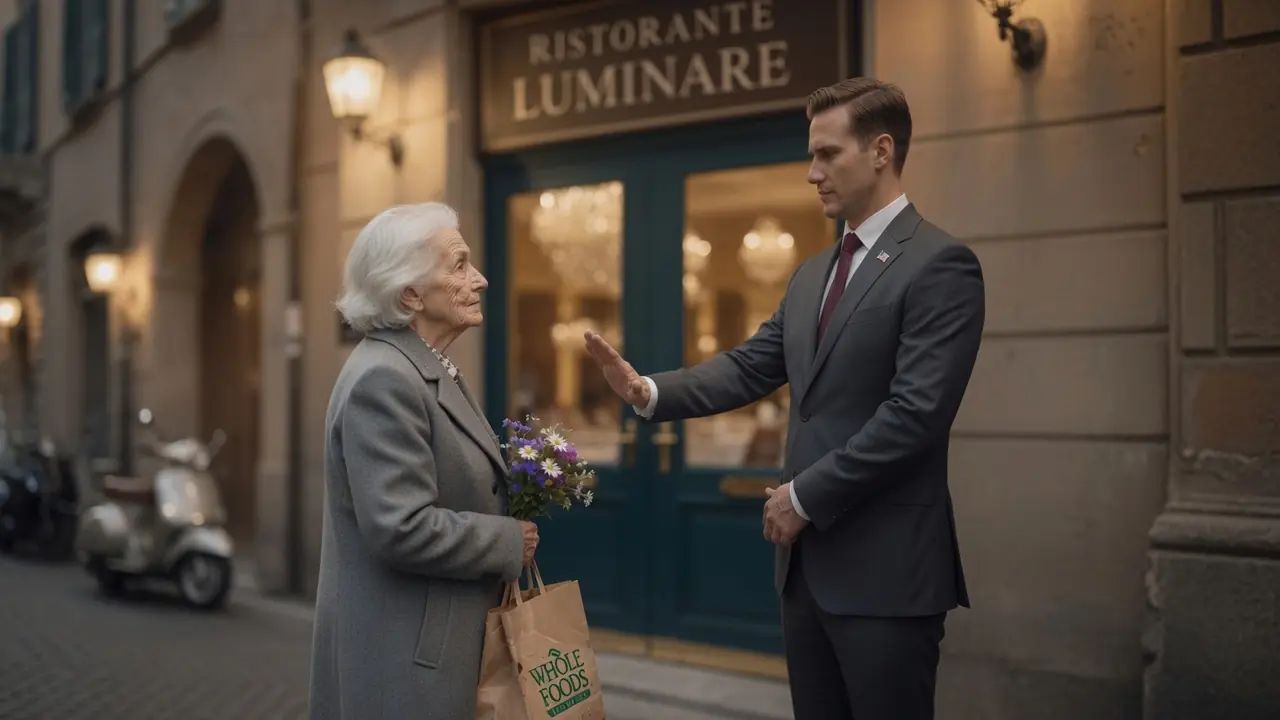
Luminaire stood on a historic street in downtown Chicago, surrounded by luxury hotels, private galleries, and stores where ordinary objects appeared expensive merely because they rested beneath glass. Crystal chandeliers glowed through its tall front windows, and uniformed attendants welcomed guests beneath brass lanterns. Restaurant magazines described it as an extraordinary dining experience where reservations were often secured months in advance. Few people knew its beginning had been far less glamorous.
Thirty-eight years earlier, Eleanor and her husband, George Whitmore, had operated a twelve-seat diner near the South Side railway yards. George cooked while Eleanor served tables, balanced accounts, washed dishes, and raised their only son in a room above the kitchen. They opened before sunrise for factory workers and stayed late for nurses finishing evening shifts. On difficult weeks, they fed people who could not pay and wrote the cost inside a notebook marked Someday.
George believed every meal should protect a person’s dignity. He never announced when someone received food without paying, and he never allowed customers to thank him publicly. He would simply place a plate on the counter and say someone had already covered it. Often, no one had.
The diner survived recessions, neighborhood changes, and one kitchen fire that nearly ended everything. Daniel grew up sleeping beneath the register during late shifts, folding napkins after school, and listening to his parents discuss which bills could wait another week. By the time he graduated from college, George’s cooking had attracted business leaders, journalists, and visiting performers. Daniel believed his father deserved a restaurant grand enough to match his talent.
George resisted the idea.
He liked knowing every customer’s name and disliked food descriptions that required explanation. Eleanor supported Daniel because she understood that her husband’s humility sometimes became fear of wanting more. She sold a small inherited property, withdrew most of their savings, and purchased the old Luminaire building when it was still an abandoned bank.
The renovation took three years.
George designed the kitchen but died from a sudden heart attack four months before the restaurant opened. Eleanor never forgot standing inside the unfinished dining room while construction dust floated beneath the new chandeliers. Daniel held her shoulders and promised they would finish the dream. Eleanor agreed, but she could not attend the opening.
She transferred restaurant operations to Daniel while keeping the building inside the Whitmore Family Trust. Every year, he invited her to Luminaire for George’s birthday. Every year, Eleanor found a reason to decline.
On the seventh anniversary of George’s death, something changed.
Eleanor woke before dawn and opened the wooden box containing his watch, wedding ring, and handwritten recipes. Beneath the papers lay a photograph of George standing outside the unfinished restaurant. He wore a hard hat crooked over his gray hair and held a paintbrush like a conductor’s baton.
On the back, he had written one sentence.
Save me a table near the kitchen so I can hear the plates moving.
Eleanor cried for nearly an hour.
Then she dressed.
She chose a faded floral dress, a thick beige cardigan, and comfortable navy shoes. Her clothes were clean but old, and the cardigan carried one repaired elbow where George had once caught it on a pantry nail. Eleanor considered wearing the dark suit Daniel bought her, but she wanted to arrive as the woman George had known.
She purchased a small bouquet of purple asters from a neighborhood grocery store. They had been George’s favorite flowers because he claimed they looked imperfect enough to be honest. The cashier placed them inside a brown paper bag beside a loaf of bread and a jar of preserves Eleanor planned to take home afterward.
Daniel did not know she was coming.
Eleanor wanted to surprise him.
She took the bus downtown and walked the final two blocks slowly, leaning on a folding cane she disliked using in public. The evening air was cold enough to redden her cheeks, and traffic moved loudly between the tall buildings. When Luminaire appeared at the end of the street, Eleanor stopped.
The restaurant looked exactly as George imagined it.
Brass lanterns illuminated the stone exterior. The dark green entrance carried gold lettering above polished double doors, while crystal chandeliers shone beyond the windows. Guests in tailored coats stepped from expensive cars and passed inside without hesitation.
Eleanor held the flowers closer.
“You made it,” she whispered.
She approached the entrance.
A security guard stepped into her path.
Marcus Reed was thirty-seven, broad-shouldered, and dressed in a tailored charcoal suit rather than a traditional uniform. A discreet earpiece connected him to the restaurant’s internal security team. He had worked at Luminaire for eight months and viewed his job as protecting the restaurant from anyone who might disturb its image.
His eyes moved from Eleanor’s cardigan to her paper grocery bag.
“Can I help you?” he asked.
“I hope so.” Eleanor smiled nervously. “I’m here to see Daniel Whitmore.”
“Do you have an appointment?”
“No.”
“A reservation?”
“Not exactly.”
Marcus’s expression changed. “Then you cannot enter.”
“I only need a moment.”
“Mr. Whitmore is working.”
“He always is.”
Marcus looked toward the guests approaching behind her. “Please step away from the entrance.”
Eleanor moved slightly to one side, believing he simply needed to clear the doorway. A young couple passed between them, and Marcus opened the door with a courteous smile.
“Good evening, Mr. and Mrs. Bennett.”
Once the couple entered, Eleanor stepped forward again.
“Would you tell Daniel that Eleanor is here?”
“Eleanor who?”
“Whitmore.”
Marcus glanced at her bag and almost smiled. “You share the owner’s surname?”
“I am his mother.”
The smile appeared fully this time.
Two attendants standing near the valet station looked toward each other. Eleanor noticed their reaction but did not understand it immediately. Marcus had heard many people claim personal connections to wealthy guests, executives, and owners. He had learned to treat every unexpected story as manipulation.
“Mr. Whitmore’s mother does not arrive carrying grocery bags,” he said.
Eleanor lowered her eyes toward the brown paper bag. “I stopped for bread.”
“That is not my concern.”
“Then please call him.”
“He is hosting an important dinner.”
“I can wait inside.”
“No.”
The answer came more sharply than necessary.
Eleanor looked through the glass doors. A hostess stood behind a marble reception desk while servers moved between the dining room and kitchen. Somewhere beyond them, Daniel was managing the restaurant his parents had built from a dream and decades of sacrifice.
“I don’t need a table,” she said. “I only came to leave these flowers at the table near the kitchen.”
Marcus folded his hands in front of him. “Madam, this is not a place where people walk inside to leave things.”
“My husband designed that table.”
A man waiting for his car laughed quietly.
Eleanor heard him.
Marcus glanced toward the man and seemed encouraged by the attention. “Your husband designed a table inside Luminaire?”
“He helped design the whole restaurant.”
“Of course.”
The mockery became unmistakable.
Eleanor’s fingers tightened around the flowers. “His name was George Whitmore.”
“I know the story of this restaurant.”
“Then you know his name.”
“I know wealthy people often attract strangers who imagine connections.”
Eleanor stared at him. “I was married to George for forty-six years.”
“Do you have identification?”
“Yes.”
She opened her handbag and searched for her wallet. Her fingers moved slowly because arthritis made the small zipper difficult. Marcus watched impatiently while another group of guests arrived.
“Step away from the doors,” he repeated.
“I am looking for my identification.”
“You should have prepared it before approaching a private entrance.”
“This is a restaurant.”
“It is private property.”
Eleanor finally removed her driver’s license.
Marcus glanced at it without taking it. Her full name, Eleanor Rose Whitmore, appeared clearly beside her photograph.
“That proves your name,” he said.
“It proves what you asked.”
“It does not prove a relationship to the owner.”
“Call him.”
“No.”
Eleanor took a breath. “Young man, I have traveled across the city in the cold to honor my husband. I am not asking you for money, food, or special treatment.”
Marcus looked toward the floral grocery bag. “People who belong here usually understand they need reservations.”
“I do belong here.”
“Your clothing suggests otherwise.”
The sentence hurt more than Eleanor expected.
She had spent decades standing beside customers who counted coins before ordering coffee. George never treated clothing as evidence of character or money as proof of worth. Now, outside the restaurant created in his name, a stranger was using both to decide whether his widow deserved entry.
A small crowd had begun forming near the doorway.
Some guests waited for cars. Others had slowed because they sensed conflict. No one intervened.
Eleanor lifted the flowers. “I came to remember my husband.”
Marcus raised one hand between them. “This entrance is for paying guests, not old women carrying grocery bags.”
Several people looked away.
Eleanor’s face burned.
“I can pay,” she said quietly.
“A dinner here may cost more than your monthly income.”
“You know nothing about my income.”
“I know what problems look like before they enter the building.”
Eleanor felt her hope collapsing.
She had survived George’s death, seven lonely anniversaries, and the difficult courage required to come there. Yet Marcus had reduced all of it to a cardigan, old shoes, and a paper bag. She looked toward the glowing chandeliers once more.
“Please tell Daniel I came.”
Marcus pointed toward the sidewalk. “Leave now, or I will have you removed.”
“Removed?”
“Physically, if necessary.”
Eleanor stepped backward.
Her cane caught against the stone curb, and she nearly lost her balance. The flowers slipped from her hand, scattering several purple petals across the pavement. The loaf of bread inside the grocery bag pressed against one side, tearing the paper.
A young valet named Caleb Foster moved forward to help.
Marcus stopped him with a look.
Eleanor bent slowly to retrieve the flowers herself. Pain moved through her knee, but she refused to let anyone see her struggle. One of the asters had broken near the stem.
She held it carefully.
“You should be ashamed,” Caleb whispered to Marcus.
Marcus heard him. “Return to your station.”
“She only asked you to make a call.”
“I said return to your station.”
Caleb stepped back, but anger remained on his face.
Eleanor straightened and looked toward Marcus one final time. “George would never have allowed this.”
“George Whitmore is dead,” Marcus replied. “And saying his name does not make you important.”
The doors opened behind him.
Daniel Whitmore stepped outside.
At forty-five, Daniel resembled his father more strongly than he realized. He had the same dark eyes, square shoulders, and habit of loosening his tie whenever he left the dining room. He was speaking to head chef Sofia Ramirez when he noticed the elderly woman holding damaged flowers near the curb.
His face changed instantly.
“Mom?”
Eleanor turned.
Daniel crossed the pavement quickly. He took her arm gently, then looked at the flowers, torn bag, and pain in her expression.
“What happened?”
Marcus became still.
Eleanor attempted a smile. “I wanted to surprise you.”
Daniel stared at her cardigan. “You came.”
“I found Dad’s note.”
Emotion moved across his face, but it vanished when he saw how the surrounding guests were watching them. He turned toward Marcus.
“Why is my mother standing outside?”
Marcus opened his mouth.
No answer came.
Daniel looked toward Caleb. “What happened?”
Caleb hesitated.
Eleanor touched her son’s sleeve. “It doesn’t matter.”
“It matters to me.”
Marcus finally spoke. “Mr. Whitmore, she arrived without a reservation and claimed to be related to you. I was protecting the restaurant.”
“From my mother?”
“I had no way to verify her story.”
“She showed you identification,” Caleb said.
Marcus glared at him.
Daniel noticed. “Continue, Caleb.”
The valet described the entire exchange.
He repeated Marcus’s comments about Eleanor’s clothing, monthly income, grocery bag, and threat to remove her physically. Each sentence made Daniel’s face colder.
Marcus attempted to interrupt.
“She was blocking the entrance.”
“I stepped aside,” Eleanor said quietly.
“You returned repeatedly.”
“Because you refused to call my son.”
Daniel looked toward the phone clipped inside Marcus’s jacket. “You could have verified her identity in less than one minute.”
Marcus adjusted his cuffs. “Many people claim relationships to powerful guests.”
“My mother is not a powerful guest.”
He placed one arm around Eleanor.
“She is the reason this restaurant exists.”
The waiting crowd became silent.
Daniel turned toward the doors and addressed the nearby employees. “Luminaire was purchased with my mother’s savings. She sold property inherited from her parents and risked nearly everything to create this building.”
Marcus’s face lost color.
Daniel continued. “My father designed the kitchen. My mother financed the purchase, supervised renovation accounts, and still legally owns this property through the Whitmore Family Trust.”
A woman standing near the valet station lowered her phone.
Marcus stared at Eleanor.
“You own the building?”
Eleanor looked at him with tired eyes. “I tried to tell you I belonged here.”
His posture collapsed.
“Mrs. Whitmore, I apologize.”
“For what?” Daniel asked.
Marcus looked toward him. “For misunderstanding the situation.”
Daniel’s voice became cold. “What did you misunderstand?”
“I did not know who she was.”
“That is not an apology.”
Marcus swallowed. “I should have confirmed her identity.”
“You should have treated her with dignity before confirming anything.”
Guests stood in complete silence.
Daniel picked up the broken flower from the pavement. “You threatened to have an elderly woman physically removed because her clothing did not satisfy you.”
“I was protecting the restaurant’s standards.”
Eleanor spoke before Daniel could answer.
“My husband’s standards?”
Marcus looked at her.
“George fed people who had no money,” she continued. “He seated factory workers beside executives and never asked which person deserved the better plate.”
She pointed toward the glowing dining room.
“This place was supposed to honor that.”
Marcus lowered his eyes.
Daniel removed the small communications device from Marcus’s lapel. “You are suspended immediately.”
“Mr. Whitmore, please.”
“Turn over your access card.”
“I have worked here eight months without a single security incident.”
Caleb spoke quietly. “That is not true.”
Daniel turned toward him.
The valet explained that Marcus had driven away other elderly visitors, delivery workers, and people waiting for family members. One month earlier, he prevented a retired teacher from entering because her dress looked too inexpensive for a private anniversary dinner. She had possessed a valid reservation.
A hostess standing inside the doorway stepped forward.
Her name was Lauren Brooks. She confirmed Caleb’s account and described three written complaints that disappeared after Marcus submitted internal reports describing the guests as disruptive.
Marcus shook his head. “They are exaggerating because they dislike enforcement.”
Daniel looked toward Sofia. “Call Claire Benton and human resources. Preserve every security recording and complaint from the last year.”
Marcus’s face hardened. “You are destroying my career because I did not recognize your mother.”
Eleanor looked directly at him.
“No,” she said. “You damaged your career because you recognized an old woman you believed could not harm you.”
The truth silenced him.
Marcus removed his access card and handed it to Daniel. A second security employee escorted him away from the entrance. He passed the same guests whose approval had seemed so important minutes earlier.
No one defended him.
Daniel turned toward his mother.
“I’m sorry.”
“You did not do it.”
“It happened at my door.”
Eleanor touched his cheek. “Then change what happens at your door.”
He nodded.
Daniel carried her grocery bag while Caleb gathered the scattered flowers. Together they entered Luminaire. Every employee near the entrance stood straighter, but Eleanor did not want frightened attention.
“Please continue working,” she said.
The dining room stretched beneath crystal chandeliers and painted ceilings. Tables were covered with white linen, and silverware reflected the light. Guests turned as Eleanor passed, some recognizing what had happened outside.
Daniel guided her toward a small table near the kitchen doors.
It was simple compared with the rest of the dining room. No grand view surrounded it, and the sound of moving plates, calling cooks, and opening ovens could be heard through the wall.
A small brass plaque rested beside the place setting.
George Whitmore’s Table
Eleanor stopped walking.
Daniel pulled out the chair.
“I kept it for you.”
She touched the plaque. “He wanted to hear the plates moving.”
“I know.”
Eleanor placed the purple asters beside the empty chair across from her. Daniel sat there after asking permission, though both understood the seat belonged to George in memory.
Sofia came from the kitchen carrying a small bowl of soup.
“This was his recipe,” she said.
Eleanor tasted one spoonful and closed her eyes. The seasoning was slightly different, but the smell brought back the old diner, George’s stained apron, and Daniel asleep beneath the register.
“He would complain about the salt,” she said.
Sofia smiled. “Your son already does.”
Daniel laughed through tears.
During dinner, Eleanor told him she had almost turned away before he came outside. Daniel listened without defending himself or the restaurant. He understood that ownership did not erase his responsibility for the culture beneath his leadership.
The investigation began the following morning.
It uncovered eleven complaints involving Marcus and two hosts who supported his informal appearance rules. Guests wearing simple clothing were asked for additional proof of reservations. Elderly visitors were redirected toward cheaper restaurants, while delivery workers were instructed to use an unsafe alley entrance even during severe weather.
Several employees had objected privately.
They remained silent publicly because Marcus influenced schedules, tip assignments, and performance reports. Management saw no serious problem because complaints were rewritten before reaching Daniel.
Marcus’s employment was terminated.
One host resigned, while another accepted discipline and extensive retraining after admitting she had copied Marcus’s behavior to protect her position. Lauren Brooks became guest-access coordinator, and Caleb Foster was offered a full-time hospitality training role.
Eleanor insisted that the changes go beyond punishment.
Luminaire created a clear entrance policy stating that every visitor would be welcomed before being questioned about reservations. Employees could still verify bookings and protect guests from genuine threats, but clothing, age, race, disability, accent, and visible wealth could never replace behavior as evidence.
The restaurant also reserved George’s Table for one community meal each evening.
A customer, worker, traveler, or elderly resident facing hardship could eat there privately without public explanation. Payment came from the Someday Fund, named after the notebook George and Eleanor used inside their first diner.
Daniel worried that his mother might feel the program turned George’s memory into publicity.
Eleanor agreed only under strict conditions.
No photographs of recipients would be taken. No social-media posts would announce free meals. Nobody receiving help would be required to tell a sad story, thank the restaurant publicly, or prove suffering to a room of strangers.
“Feed them,” she said. “Do not purchase their gratitude.”
The program began quietly.
Three months later, Eleanor returned to Luminaire wearing the same cardigan. This time, a new security guard named Andrew Cole opened the door without knowing who she was. He saw the grocery bag in her hand and offered to carry it.
“I can manage,” Eleanor said.
“Of course. Please tell me if that changes.”
She smiled.
Near the reception desk, an elderly man in work clothes waited while his granddaughter parked the car. Nobody questioned why he stood beneath the chandeliers. A hostess offered him water and showed him a chair.
Eleanor watched for several minutes.
Daniel approached from the dining room but did not interrupt until she turned toward him.
“Well?” he asked.
“Better.”
“Only better?”
“Your father believed perfection made people lazy.”
Daniel laughed. “He said that about my cooking.”
“He said it about everything.”
They sat at George’s Table.
The purple asters had been dried and preserved beneath a glass frame on the wall. Beside them hung the photograph of George outside the unfinished restaurant, holding his paintbrush and wearing the crooked hard hat.
Eleanor looked around the room.
Luminaire no longer felt like a monument she was afraid to enter. It felt connected again to the small diner where George fed exhausted workers and quietly covered meals for strangers.
A year after the incident, Marcus wrote Eleanor a letter.
He did not ask for his job back.
He admitted that he had spent years confusing exclusion with professionalism. He wrote that his greatest shame was not failing to recognize a wealthy owner, but believing poverty made humiliation acceptable.
Eleanor read the letter twice.
She did not erase what happened, and she did not invite him into her life. She sent one response.
Use what you learned at the next door you are trusted to guard.
That was all.
On the eighth anniversary of George’s death, Eleanor arrived at Luminaire before opening. Daniel met her outside carrying a fresh bouquet of purple asters.
No guard blocked her path.
No employee asked whether she could afford to enter.
Daniel offered his arm, and she took it.
Together they walked toward the table near the kitchen, where the sound of plates moving filled the room exactly as George had hoped.
Marcus once believed his worst mistake was humiliating the woman who owned the restaurant.
He was wrong.
His worst mistake was believing an elderly woman needed to own anything before she deserved to come through the door.