Adam Rivera liked jobs that had instructions hidden inside the problem. A leaking sink told you where to look if you knew how to listen: under the basin, around the compression nut, near the trap where old seals gave up and tiny drops became a steady rhythm. A loose hinge, a crooked shelf, a jammed window, a broken rail—all of them had causes, tools, and endings. People were harder because they could smile at you while hiding the part that hurt.
At thirty-two, Adam had built a small handyman business out of a white work van, a stack of business cards, and a reputation for showing up when he said he would. He wore blue work shirts with rolled sleeves, kept his tools cleaner than his kitchen, and drank coffee from gas stations like it was a professional requirement. On Maple Street, people called him when something cracked, leaked, leaned, or stopped making sense. He fixed what he could, charged less than he should, and left before gratitude became conversation.
Mrs. Linda Holloway lived two houses down from him in a pale yellow home with white shutters and flower boxes that changed with the seasons. She was sixty-one, widowed, gentle, and dangerous in the way kind women were dangerous: she noticed everything. She noticed when Adam skipped meals, when he looked tired, when he tried to refuse banana bread, and when he smiled without letting the smile reach all the way to his eyes. She never pushed too hard, but she never fully looked away either.
That Thursday afternoon, she called because her kitchen sink had started dripping into a mixing bowl. Adam arrived twenty minutes later with his toolbox in one hand and a quiet plan in his head: fix the leak, accept one slice of banana bread, politely refuse extra payment, then go home. Mrs. Holloway opened the door with reading glasses on top of her head and flour on one cheek. “There’s my hero,” she said, stepping aside before he could protest the word.
The kitchen smelled like sugar, butter, and something rising in the oven. Adam set his toolbox under the sink, opened the cabinet doors, and lowered himself to one knee. “Compression nut’s loose,” he said after a quick look. “Should be simple.” Mrs. Holloway laughed softly from the counter and said her late husband used to call everything simple right before spending three hours sweating and blaming the manufacturer.
For a few minutes, it was exactly the kind of job Adam liked. A silver bowl caught steady drops beneath the pipe. His wrench turned smoothly. The leak had a cause, and the cause had a fix. Then the front door opened, and a young woman’s voice called, “Mom?”
“Kitchen,” Mrs. Holloway answered.
Two sets of footsteps came down the hall. Adam glanced out from beneath the sink and saw Paige and Audrey Holloway for the first time as grown women instead of smiling faces in old graduation photos. Paige came in first wearing scrubs under a denim jacket, bright-eyed and grinning as if life was a joke she had already decided to enjoy. Audrey followed with a sketch tube under one arm, dark hair loose around her shoulders, wearing jeans and a cream sweater that made her look quieter than her sister but no less confident.
Mrs. Holloway introduced them like she was unveiling two miracles she had somehow survived raising. “Girls, this is Adam from down the street. He’s saving us from indoor flooding.” Paige leaned against the counter and said, “Hi, Adam from down the street.” Audrey looked at his wrench, then his face, and asked, “You always fix sinks in a button-down shirt?”
Adam glanced down at his blue work shirt, sleeves rolled, a faint old grease mark near the pocket. “It’s my formal plumbing attire,” he said. Paige laughed immediately. Audrey smiled more slowly, like she was trying not to give him the satisfaction, and that smile made Adam forget the name of the tool in his own hand.
Mrs. Holloway said she needed to run next door for a pie plate and gave her daughters a warning not to bother him. The second she left, the kitchen became too quiet. Adam slid back under the sink and focused on tightening the nut, but he could feel Paige crouching near the cabinet and Audrey standing close enough that the clean scent of vanilla and rain drifted from her sweater. “You’re nervous,” Audrey said.
“I’m focused,” Adam replied.
“That’s what nervous people call it.”
Paige rested her chin in her hand. “He’s definitely nervous.”
“I am holding a wrench under pressurized water,” Adam said. “Respect the danger.”
Audrey leaned closer, and the twins exchanged a look that Adam did not trust. It was the kind of look people developed after a lifetime of finishing each other’s thoughts and starting trouble with only half a sentence. Paige smiled first. Audrey’s smile came slower.
Then they whispered together, “Our bed is broken, too.”
Adam’s brain stopped working for one full second. The pipe chose that exact moment to spit a thin stream of cold water onto his collar. He jerked back, bumped his head against the underside of the cabinet, and heard Paige burst out laughing while Audrey covered her mouth, shoulders shaking.
“Careful,” Audrey said, still laughing softly. “You’ll hurt yourself.”
“I was doing great,” Adam muttered, rubbing the back of his head, “until the furniture report.”
Paige tilted her head. “Furniture report?”
“You said your bed was broken.”
“Our bed frame,” Audrey clarified, smiling with suspicious innocence. “At our apartment.”
“It makes a horrible sound,” Paige added.
Adam stared at the pipe as if the sink had betrayed him. He finished the repair with more dignity than he felt, tested the faucet, dried the joint, and found no more drip. When Mrs. Holloway returned, she noticed his damp collar immediately. “Oh, honey, did the sink fight back?” Adam said the sink lost, but Paige’s grin told everyone there had been casualties.
Mrs. Holloway sighed when the twins mentioned the bed frame. “It’s old iron, and I told them to buy a new one.” Audrey said it was not falling apart, only emotionally distressed. Paige said it squeaked when anyone breathed near it. Mrs. Holloway turned to Adam and asked if he could look at it sometime, and because Adam fixed things, because saying no to Mrs. Holloway felt like kicking a flower box, and because Audrey was watching him, he agreed to stop by the next evening.
By five fifty-eight the next day, Adam stood at the entrance to an old building on Cooper Street with his toolbox, cordless drill, and a stern warning to himself. Fix the bed frame. Collect payment. Leave. No lingering, no complicated conversations, no getting pulled into whatever had happened in Mrs. Holloway’s kitchen.
The Holloway twins’ apartment sat above Bellamy Bakery, up a narrow stairwell that smelled of cinnamon, yeast, sugar, and old brick. Before Adam could knock, Paige opened the door in black leggings and an oversized college sweatshirt, her hair twisted into a messy knot. “You’re early,” she said. “Two minutes.” Adam said that still counted, and Paige called over her shoulder, “Audrey, the professional is here.”
The apartment was small but warm, with slanted floors, tall windows facing the street, mismatched bookshelves, plants in chipped ceramic pots, and two abandoned coffee mugs on the table. Audrey came from the hallway wearing paint-splattered jeans and a soft green sweater, her dark brown hair pinned up with a pencil. Adam had seen people dress carefully to be noticed. Audrey looked like she had simply been living her life, which somehow made looking away harder.
“So,” Adam said, clearing his throat. “The bed frame?”
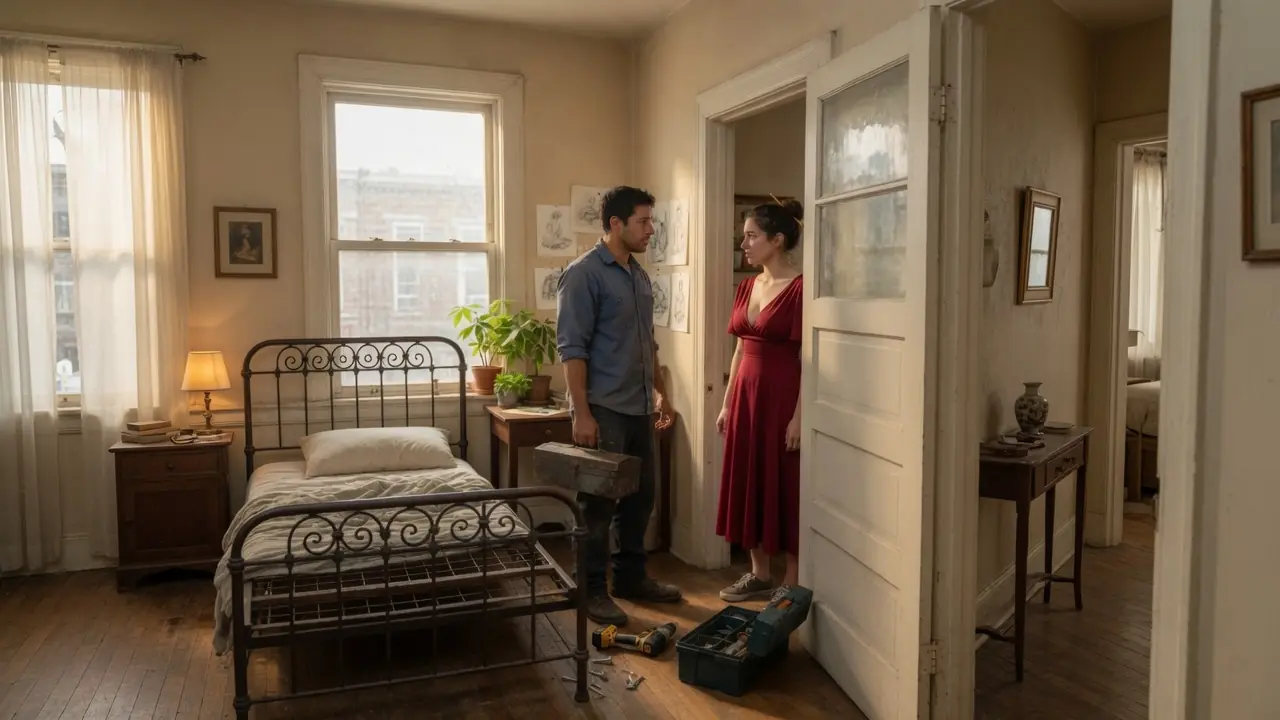
Paige led him down a short hall to the bedroom. Adam stopped at the doorway when he saw two twin beds pushed against opposite walls. One was neatly made with a gray quilt and stacked pillows. The other looked like someone had wrestled the blanket and lost. Paige pointed to the messy bed and said, “Mine,” while Audrey pointed to the neat one and said, “Hers.”
Adam released a breath before he could stop himself.
Paige caught it instantly. “Were you worried, Adam?”
“No.”
Audrey leaned against the doorframe beside him. “He was worried.”
“I inspect all rooms with the same level of concern,” Adam said, kneeling beside Paige’s old iron bed frame. Paige called that very professional, and Adam was grateful for the repair because metal, bolts, and center supports were safer than faces, smiles, and questions that reached too deep.
The frame was old, probably thrifted, with one corner separated from the side rail and a center support bent enough to make the mattress sag. Two bolts were missing. Another was stripped. The repair was not difficult, but the apartment made concentration difficult because Paige teased easily and Audrey watched quietly, as if she saw not only what Adam did, but how he moved through a room trying not to take up emotional space.
After a while, Paige wandered to the kitchen to check her phone, leaving Audrey crouched nearby. Adam tightened a bracket and said, “You don’t have to watch.” Audrey answered, “I know.” He looked up, and she held his gaze. “Then why are you?”
She shrugged, but her smile faded. “Because you seem like the kind of person who fixes everything and then disappears before anyone can thank you properly.”
The drill went still in Adam’s hand.
“That’s specific,” he said.
“My mom likes you,” Audrey replied. “She says you’re kind, but hard to read.”
“Your mom should run a background check service.”
Audrey laughed softly, then grew more serious. “She also said you looked sad when she mentioned my dad.”
Adam turned back toward the frame. “Your mother notices a lot.”
“She does.”
The room settled into a quieter silence. Adam did not know why the words came out, but they did. “My ex used to say I was like a locked garage. Useful, full of tools, impossible to get into.”
Audrey did not laugh. She did not turn it into a joke. She only said, “That’s a cruel thing to call someone.”
“She wasn’t trying to be cruel.”
“Still.”
Adam looked at her then. Audrey’s eyes were steady, soft, and curious without being invasive. It had been a long time since someone had looked at him like he was not a project, a disappointment, or a man whose distance needed to be conquered. He did not know what to do with that, so he picked up the drill and finished the job.
When the frame stopped squeaking and the mattress no longer sagged, Paige returned and tested it with a dramatic bounce. “Magic,” she announced.
“Bolts,” Adam corrected.
Audrey ran one hand along the repaired iron rail. “Thank you.”
“You’re welcome.”
Paige grabbed her purse from the dresser and announced she was going downstairs for dinner. “Audrey, pay the man.” Then she winked at Adam and disappeared before either of them could object. The apartment door closed, and the air changed.
Audrey pulled a small cash box from her dresser and asked how much she owed. Adam said forty dollars. Audrey looked at him like he had insulted math itself. “You drove over, brought parts, fixed a bed frame old enough to qualify for a pension, and you want forty?”
“The bolts were cheap.”
“My mother warned me you do this.”
“Do what?”
“Undervalue yourself.”
Adam looked away first, which was starting to feel like a habit around Audrey Holloway. She counted out seventy-five dollars anyway, folded the bills once, and held them toward him. He tried to refuse, but she did not move her hand. “Take it,” she said. “Maybe it wasn’t hard for you. That doesn’t mean it wasn’t worth something.”
He accepted the money. “Thank you.”
Neither of them moved after that. The bedroom was soft in the evening light, with sketches pinned above Audrey’s desk, plants near the window, and a half-finished painting propped against the wall. It showed rooftops on Cooper Street at sunrise, but the colors were kinder than real life, as if Audrey painted what buildings might become when no one was rushing past them.
“You painted that?” Adam asked.
“Started it,” Audrey said. “I keep changing my mind.”
“Looks finished to me.”
“That’s because you’re practical.”
“And you’re not?”
“I’m practical when I have to be.” She stepped closer to the painting, studying it. “But I like leaving room for things to become something else.”
Adam did not know what to say to that because it sounded too much like a warning and too much like an invitation. His phone buzzed in his pocket, saving him and irritating him at the same time. It was a message from Mrs. Holloway: Did my girls behave? Audrey read it upside down and smiled when Adam typed, Perfectly.
“Liar,” she said.
“Diplomat.”
She laughed, and the sound loosened something in his chest. Adam closed his toolbox, picked it up, and forced himself to remember the plan. Fix the bed frame. Collect payment. Leave. He had done the first two. The third should have been easy.
“I should go,” he said.
“Should you?”
The question was soft, but it hit harder than teasing. Adam looked at the doorway, then back at her. “Audrey, I’m not trying to be rude.”
“I know.”
“And I’m not pretending I don’t notice you.”
Her smile faded into something honest. “Good.”
“But your mom is my neighbor. You’re her daughter. Paige is your sister. I came here for a repair job.”
“And now the repair job is done,” Audrey said.
“Technically.”
She folded her arms. “You are very committed to technicalities.”
“They’ve kept me alive.”
Audrey stepped into the doorway—not blocking him completely, not touching him, only standing there with enough stillness to make the room feel smaller. “Can I ask you something?”
“Sure.”
“If Paige hadn’t been here, and if my mom weren’t your neighbor, would you still be trying this hard to run away?”
The question landed exactly where Adam had been trying not to look. He could have smiled, made a joke, mentioned another job, or said he was tired. A year earlier, he would have done one of those things. Instead, he looked at the toolbox in his hand and said, “Yes.”
Audrey’s face changed.
Adam added quickly, “But not because of you.”
She leaned against the doorframe, eyes sharper now. “Then why?”
Adam stared at the scratches on the toolbox handle, each mark proof of something he had repaired and then walked away from. “Because I’m good at fixing things,” he said quietly. “I’m not always good at keeping them.”
For a moment, Audrey did not answer. The bakery hummed beneath the floorboards. A car passed outside. The repaired bed stood solid and quiet behind him, almost mocking him with how simple some things were when they were made of iron instead of fear.
Then Audrey crossed the room and reached into his open toolbox. Adam watched her pick up one of his business cards: Rivera Repairs. No job too small. She turned it over, took a pencil from her hair, and wrote something on the back.
When she handed it to him, he saw her phone number.
“No pressure,” she said. “No games. No weird twin ambush.”
Adam lifted an eyebrow.
Audrey sighed. “Fine. Minimal ambush.”
He laughed despite himself, and she smiled like she had been hoping for that. “Call me if you want to,” she said. “Not because something is broken.”
Adam slipped the card into his shirt pocket. “That might be a first.”
“Good.”
The front door opened, and Paige’s voice rang through the apartment. “I brought sandwiches, and if anything romantic happened without me narrating it, I’m going to be furious.”
Audrey closed her eyes. “My sister is a punishment from a past life.”
Adam picked up his toolbox, still smiling, but before he could leave, Paige appeared in the hallway holding a paper bag. She looked at Adam’s face, then Audrey’s, and for once she did not joke immediately. Her expression softened into something protective, almost tender.
“Oh,” Paige said.
Audrey’s cheeks flushed. “Don’t.”
“I didn’t say anything.”
“You said ‘oh’ like a novel.”
Paige lifted the paper bag. “I got turkey, roast beef, and one vegetarian because Audrey pretends she doesn’t steal my fries.” Then she looked at Adam, and the humor returned with a warning underneath. “If you hurt her, I know where your van is parked.”
“Paige,” Audrey said.
“What? I’m being welcoming.”
Adam nodded solemnly. “Very welcoming. Slightly criminal, but welcoming.”
Paige pointed at him. “Good. He understands.”
They ate sandwiches at the little kitchen table while the city outside turned blue. Paige did most of the talking, filling silences before they could become awkward, but now and then Audrey looked across the table at Adam, and he felt the business card in his pocket like a second heartbeat. He had come to fix a bed frame. Somehow he had ended up sitting in a warm apartment above a bakery, laughing with two sisters, wondering whether leaving was still the safer thing or only the familiar thing.
When Adam finally stood to go, Audrey walked him downstairs. The bakery was closed, but cinnamon still lingered in the stairwell. At the bottom step, she said, “You don’t have to call.”
“I know.”
“I mean it. I don’t want you to feel cornered.”
Adam looked at her, at the woman who had teased him under a sink, challenged him in a bedroom, and seen through his careful exits without making him feel trapped. “I don’t feel cornered,” he said. “I feel noticed.”
Her face softened. “Is that bad?”
“No,” he said. “Just new.”
Audrey smiled. “New can be good.”
He did not kiss her that night. He wanted to, and he thought she knew he wanted to, but wanting was not the same as being ready to do something honest with it. Instead, he touched the card in his shirt pocket and said, “I’ll call you.” She nodded once, not demanding more, and that made the promise easier to mean.
Adam called her the next evening from inside his van, parked outside a hardware store with a receipt on the passenger seat and sawdust on his cuffs. He stared at her number for five minutes before pressing call. Audrey answered on the second ring, and before he could say anything clever, she said, “So nothing is broken?” Adam laughed and admitted, “Not this time.”
Their first date was coffee from Bellamy Bakery and a walk along the river that turned into dinner because neither wanted to say goodbye. Their second date was supposed to be a movie, but they ended up sitting in Adam’s driveway beside his van, eating cold takeout while the porch light buzzed above them. Audrey told him about design, about wanting to make ordinary rooms feel less lonely, and about growing up with a twin sister who could read her face before she understood her own feelings. Adam told her more than he planned to, which was becoming a pattern.
Paige appointed herself emotional safety inspector. She showed up uninvited, stole fries, asked suspicious questions, and pretended she was only making sure Adam knew how to treat “a national treasure with poor sleeping habits.” Mrs. Holloway pretended to be surprised when Audrey and Adam became serious, but she had the satisfied look of a woman who had known exactly what she was doing from the first leaky sink. She still paid Adam too much for repairs and sent him home with banana bread he no longer pretended to refuse.
The first difficult moment came three months later, when Adam vanished emotionally without leaving physically. Audrey had invited him to a small gallery event where one of her designs was being displayed, and he arrived late, quiet, and stiff. He stood beside her, said all the right things, and smiled at all the right people, but Audrey could feel him locking himself from the inside. Afterward, outside under clean streetlights, she asked, “Where did you go?”
Adam frowned. “I’m right here.”
“No,” she said gently. “Your body is. The rest of you left fifteen minutes after we arrived.”
He almost denied it. Then he remembered the doorway, the toolbox, and the business card in his pocket that had started everything. “I got scared,” he admitted. “Everyone kept asking how long we’d been together, and I started thinking about what happens when people expect me to stay good at this.”
Audrey stepped closer. “I’m not asking you to perform being perfect.”
“I know.”
“Do you?”
That question hurt because he did not fully know. He had spent years believing love meant eventually disappointing someone with the parts of himself he could not repair fast enough. Natalie had not been cruel, but the divorce had left him with one lesson carved too deep: being useful was safer than being known. Audrey, unfortunately, wanted the one thing he did not know how to guarantee.
“I don’t want to become someone you regret choosing,” he said.
Audrey’s eyes softened, but her voice stayed steady. “Then don’t run every time I choose you.”
That sentence became one Adam carried like a tool he did not yet know how to use.
Six months after the bed frame repair, Audrey painted a mural on the back wall of Adam’s garage while he built her a studio table from reclaimed oak. She said the light in there was perfect. Adam said the floor sloped. Audrey said that made it honest. Paige said the whole garage smelled like emotional growth and wood glue, then stole the last muffin Mrs. Holloway had brought over.
A year after the first leaky sink, Adam fixed Mrs. Holloway’s porch railing while Audrey sat on the steps sketching him. He pretended not to notice until Paige arrived with coffee, looked at the sketch, and declared it “acceptable husband material.” Adam nearly dropped the drill. Audrey laughed so hard she had to cover her face.
By the following spring, Adam kept a small ring box hidden in his toolbox between a tape measure and a box of brass screws. It was not fancy, but it was carefully chosen: a simple band with a small stone, strong enough for hands that painted, worked, and built. He carried it for three weeks, waiting for the right moment, then realized he was doing what he always did—trying to make fear look like preparation. So he stopped waiting.
He proposed in Mrs. Holloway’s kitchen, beside the sink that had started everything. Audrey had flour on her sleeve from helping her mother bake, Paige had just walked in complaining about traffic, and Adam was supposed to be fixing a loose cabinet handle. Instead, he set down the screwdriver, opened the toolbox, and took out the ring.
Audrey saw it before he spoke. Her hands flew to her mouth. Paige whispered, “No way,” then immediately started crying before anyone else did. Mrs. Holloway stood by the counter with both hands pressed to her chest, flour on one cheek again, smiling like the whole house had been waiting for this repair.
Adam looked at Audrey and forgot half the speech he had practiced. “I used to think I was only good at fixing things and leaving before they mattered too much,” he said. “But you made staying feel less like a trap and more like a place I could learn to be brave. So I’m asking if you’ll let me keep building this with you, even when I don’t know what I’m doing.”
Audrey was crying before he finished. “Yes,” she said, and then laughed through her tears. “But if our bed ever breaks again, I’m still calling a professional.”
Paige sobbed louder. “That was beautiful and inappropriate.”
Mrs. Holloway hugged Adam so tightly that he almost dropped the ring.
Later, after the celebration quieted and Paige had told the engagement story three different ways, Audrey stood with Adam on the back porch. The evening air smelled like rain and banana bread. She leaned into his side and said, “You stayed.”
Adam looked down at her. “You noticed.”
She smiled. “Always.”
When they finally moved into a small place of their own, it had crooked floors, too many windows, and a room Audrey immediately claimed for a studio. Adam built their bed frame himself from solid oak, sanding every edge smooth, tightening every bolt carefully, and making sure nothing squeaked or leaned. Audrey teased him for taking it too seriously. He told her some repairs deserved extra attention.
On their first night there, paint cans sat in the corner, boxes lined the wall, and moonlight lay across the unfinished floor. Audrey sat cross-legged on the quilt while Adam tightened the last bolt. She leaned close, her smile turning mischievous in a way that pulled him back to Mrs. Holloway’s kitchen, to the pipe spraying his collar, to two twins whispering trouble into a normal afternoon.
“Our bed is broken, too,” she whispered.
Adam laughed so hard he had to sit down beside her. Audrey rested her head on his shoulder, and for once, he did not think about leaving before the feeling became too large. He put an arm around her and listened to the quiet room settling around them.
Adam had once believed broken things were easier than people because they did not ask anything from him except skill. But Audrey had taught him that some things were not meant to be fixed and forgotten. Some things had to be built slowly, with patience, honesty, mistakes, apologies, laughter, and the courage to stay when running would be easier.
The first time Audrey Holloway flirted with him, Adam had been on his knees under her mother’s sink, holding a wrench and pretending not to be nervous. He thought the story began with a leak, a broken bed frame, and two mischievous sisters trying to ruin his professionalism. But years later, when he looked at Audrey across their crooked little home, he understood the truth.
The thing that had needed fixing was never only the sink.
It was the man who had forgotten that being loved was not another job to finish.
And Audrey, with one question in a doorway and one phone number written on the back of a business card, had given him the one repair he never knew how to ask for