By the time the police cruiser turned into the subdivision, Valerie Whitmore had already decided which version of the afternoon she intended to tell.
She came up the driveway fast, floral blouse bright against the pale concrete, one hand gripping her phone while the other pointed at Jordan Reed as if accusation itself could establish ownership. The white luxury SUV she had left near the curb sat crooked over the edge of the grass, driver’s door still ajar. Two neighbors stood on the sidewalk with their phones raised, neither willing to come closer, both unwilling to miss what happened next.
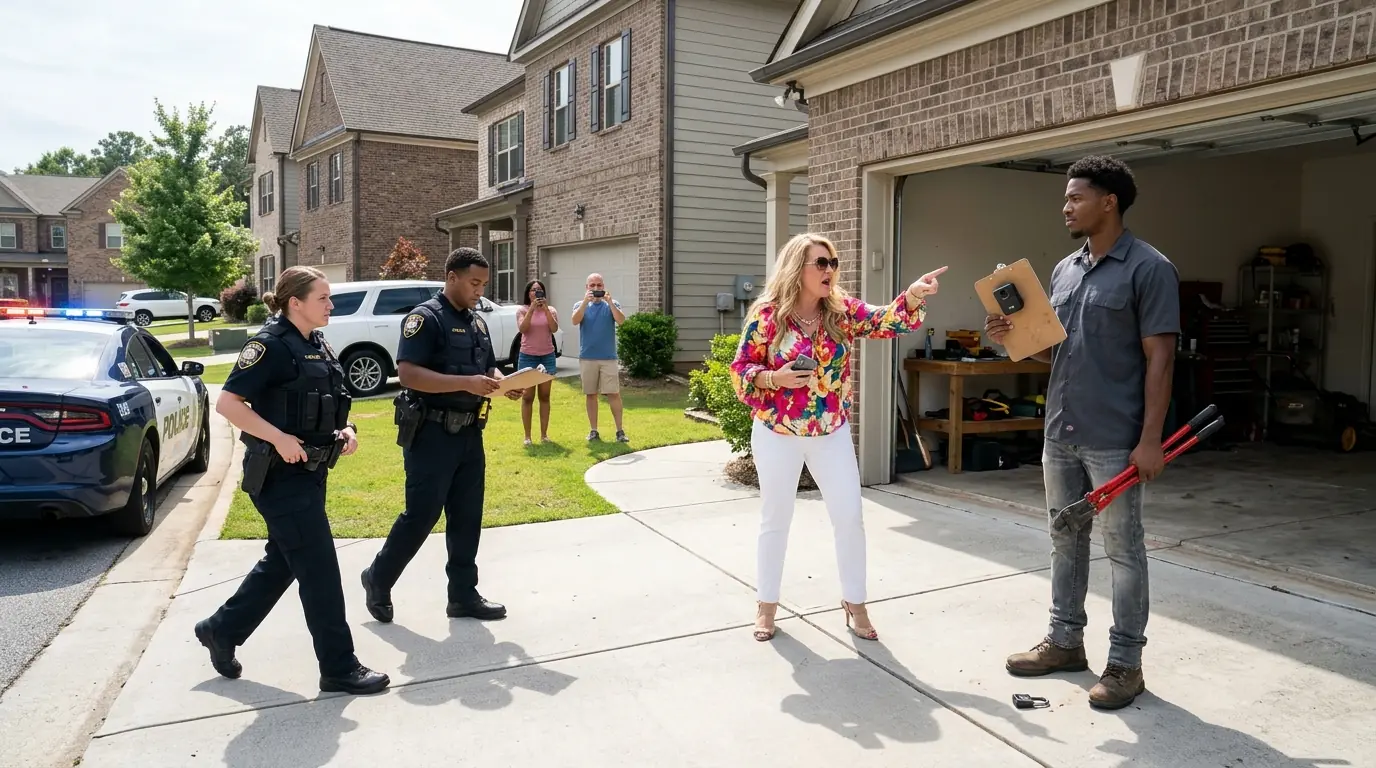
Jordan stepped out of the open garage without hurrying. He was twenty-three, athletic without trying to advertise it, dressed in a charcoal work shirt, faded jeans, and brown boots dusted with old sawdust and fresh concrete grit. In his left hand he held Valerie’s HOA clipboard. In his right, a pair of red bolt cutters.
A broken padlock lay on the driveway between them.
Valerie’s stride faltered for half a second.
Jordan saw it.
So did the nearest neighbor.
Then Valerie recovered.
“Officers!” she shouted toward the cruiser before it had fully stopped. “That man broke into this garage and threatened me when I caught him!”
The patrol car braked hard at the curb. Red and blue lights washed across the garage walls, the polished tools, the storage racks, and the bent metal around the damaged side-door lock.
Jordan did not answer her accusation.
He simply placed the bolt cutters down beside the broken padlock.
Valerie lunged toward him.
“Give me that!”
Jordan stepped back.
The clipboard stayed in his hand.
Her expression changed again.
That was when one of the officers noticed the tiny black shape fixed beneath the board.
Jordan turned the clipboard over.
A small security camera sat attached beneath it, no bigger than two stacked matchboxes. A green light blinked steadily near the lens.
The officer stopped walking.
His eyes moved from the camera to Valerie, then to the damaged garage lock, then to the red bolt cutters on the concrete.
Valerie’s face went pale.
“Ma’am,” the officer said, “is that camera still recording?”
Two hours earlier, nobody on Briar Glen Court would have believed the afternoon would end with Valerie Whitmore staring at her own clipboard as though it had turned into a live wire.
The neighborhood was built to discourage disorder.
Every lawn was trimmed within an inch of its patience. Mailboxes matched. Roof colors came from an approved palette. Garbage bins had to disappear behind side fences by eight in the morning after collection. The entrance monument used imported stone because the board once spent forty minutes arguing about whether the local stone looked “too rural.”
Valerie Whitmore had been HOA president for six years.
She treated those six years as if voters had not merely elected her to a volunteer board but installed her as hereditary governor of forty-two driveways, thirty-eight backyards, six cul-de-sacs, and every visible shrub.
Some people found her ridiculous.
Most found her exhausting.
A few found her useful when they wanted rules enforced against someone else.
That last group mattered most.