The first time Karen Whitmore damaged his fence, Marcus Reed carried the broken boards into the garage because he thought he might be able to save them.
By the next time, he knew better.
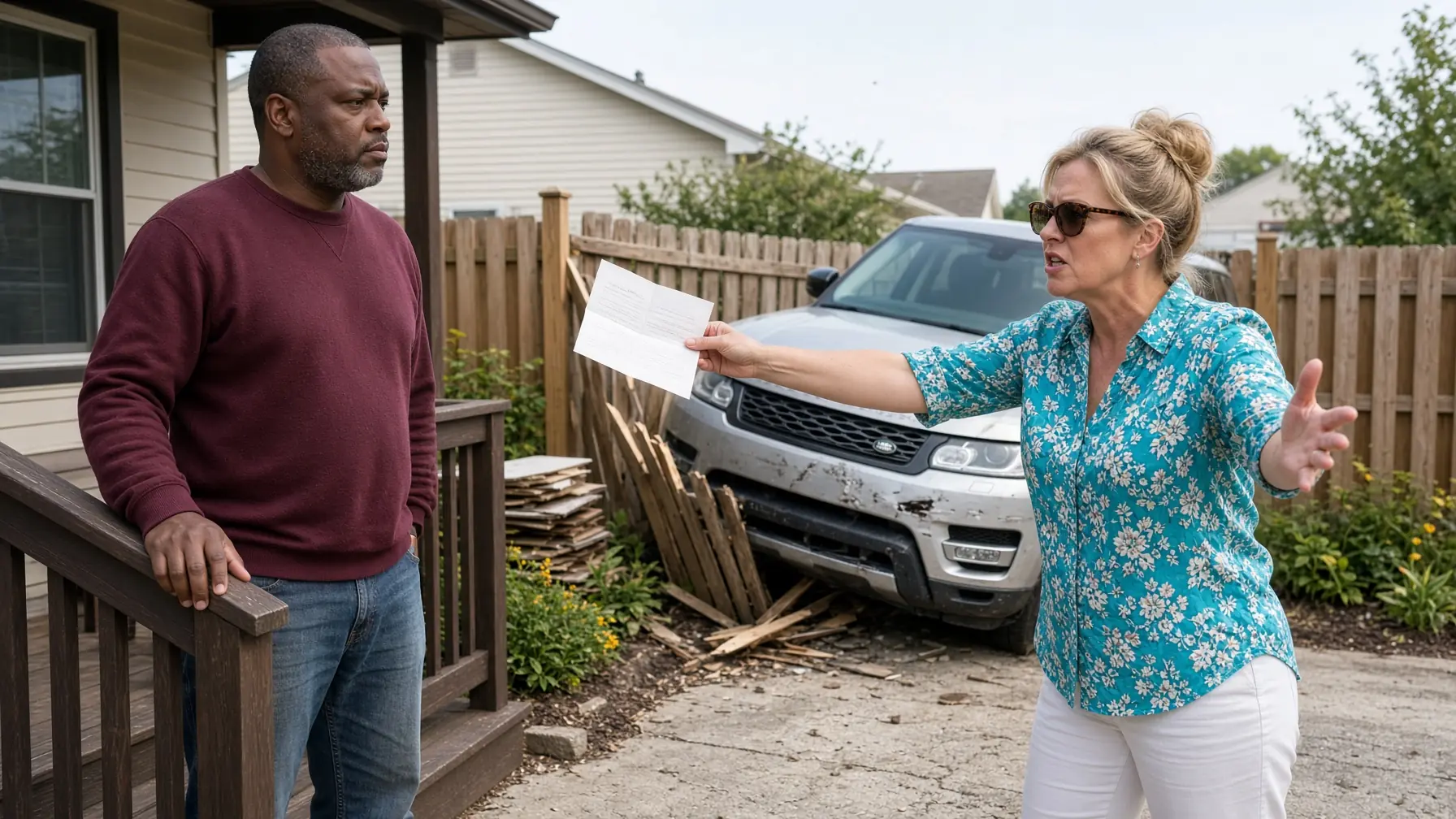
Wood split along the grain did not become sound again because the person who broke it called the damage minor. Nail holes did not close when a violation notice described the fence as poorly maintained.
And Karen did not become less certain simply because Marcus showed her what happened.
That morning, the boards from her previous visits were stacked beside his garden.
He had moved them there to clear space in the garage. The ends were uneven, some freshly pale where they had snapped, others darkened by the weather.
From the porch, he could see the pile, the repaired fence, and the street beyond it.
He was looking in that direction when the silver Range Rover turned toward his driveway.
Marcus set down his coffee.
He did not call out.
Karen had heard him before.
The first incident happened on an afternoon when Marcus was inside the house.
He heard a sharp crack through an open window, followed by the short, irritated sound of an engine. At first, he thought somebody had dropped something heavy near the curb.
Then he looked outside.
The silver Range Rover stood at an angle beside the fence.
A section of boards leaned inward toward the garden.
Karen sat behind the wheel, looking over her shoulder with the expression of someone offended by an object that failed to move out of her way.
Marcus came down the porch steps.
“Stop.”
She looked through the driver’s window.
He pointed toward the broken section.
“Don’t move yet.”
Karen lowered the window only partway.
“What?”
“Your bumper’s caught against the boards.”
She glanced toward the side mirror.
“It’s barely touching.”
Marcus looked at the fence.
A board had split almost the length of his forearm. Another hung crookedly from one remaining fastener.
“It wasn’t touching before you got here.”
Karen’s mouth tightened.
He had not meant the answer as a joke.
That was one of the things he remembered afterward.
He began the conversation expecting two adults to look at an ordinary problem and work out what needed to happen next.
One person damaged something.
The other person pointed it out.
Then they discussed repairs.
He was forty-four years old, with closely shaved hair and a short salt-and-pepper beard, and he had lived long enough to know not every disagreement would be reasonable.
Still, he did not expect a fence to become difficult.
Karen put the Range Rover in park.
She got out, examined the damage from a distance, and looked toward the garden.
“You’ve got this too close.”
Marcus stared at her.
“The fence?”
“To the access.”
“What access?”
She pointed vaguely along the side of the driveway.
“This area.”
Marcus looked where she pointed.
His driveway.
His garden.
His fence.
Nothing had appeared there that afternoon.
Karen had driven into something that was already present.
She spoke as though he had arranged the property around her moving vehicle.
“I came down here for an inspection,” she said.
“You drove into my fence.”
“I’m telling you why I was here.”
“That doesn’t change what happened.”
Karen looked at him with growing irritation.
At forty-seven, she had learned to make a pause feel like a reprimand. Marcus watched her use it, waiting for him to begin explaining himself.
He did not.
Eventually, she looked back at the Range Rover.
“There’s a mark on my bumper.”
Marcus almost laughed.
Not because the situation was funny.
Because the speed with which she reached the wrong conclusion left him briefly unable to find another response.
He kept his voice level.
“We should take pictures before you move it.”
Karen’s expression hardened.
“Of what?”
“Of this.”
He gestured toward the fence and vehicle together.
She stepped between him and the Range Rover.
“You’re not photographing my car.”
“It’s against my broken fence.”
“You need to calm down.”
Marcus had been calm.
He knew it.