“Arrest him. He’s loitering again.”
Brenda Miller stood at the edge of Jason Bennett’s driveway in a tailored pale-pink pantsuit, pointing toward him as though he had been caught climbing through a stranger’s window. Jason was sitting in a wooden rocking chair on the porch of the house he had purchased six months earlier, holding a coffee mug in one hand and a paperback thriller in the other. Two patrol cars idled at the curb, their flashing lights reflecting against his freshly painted blue front door.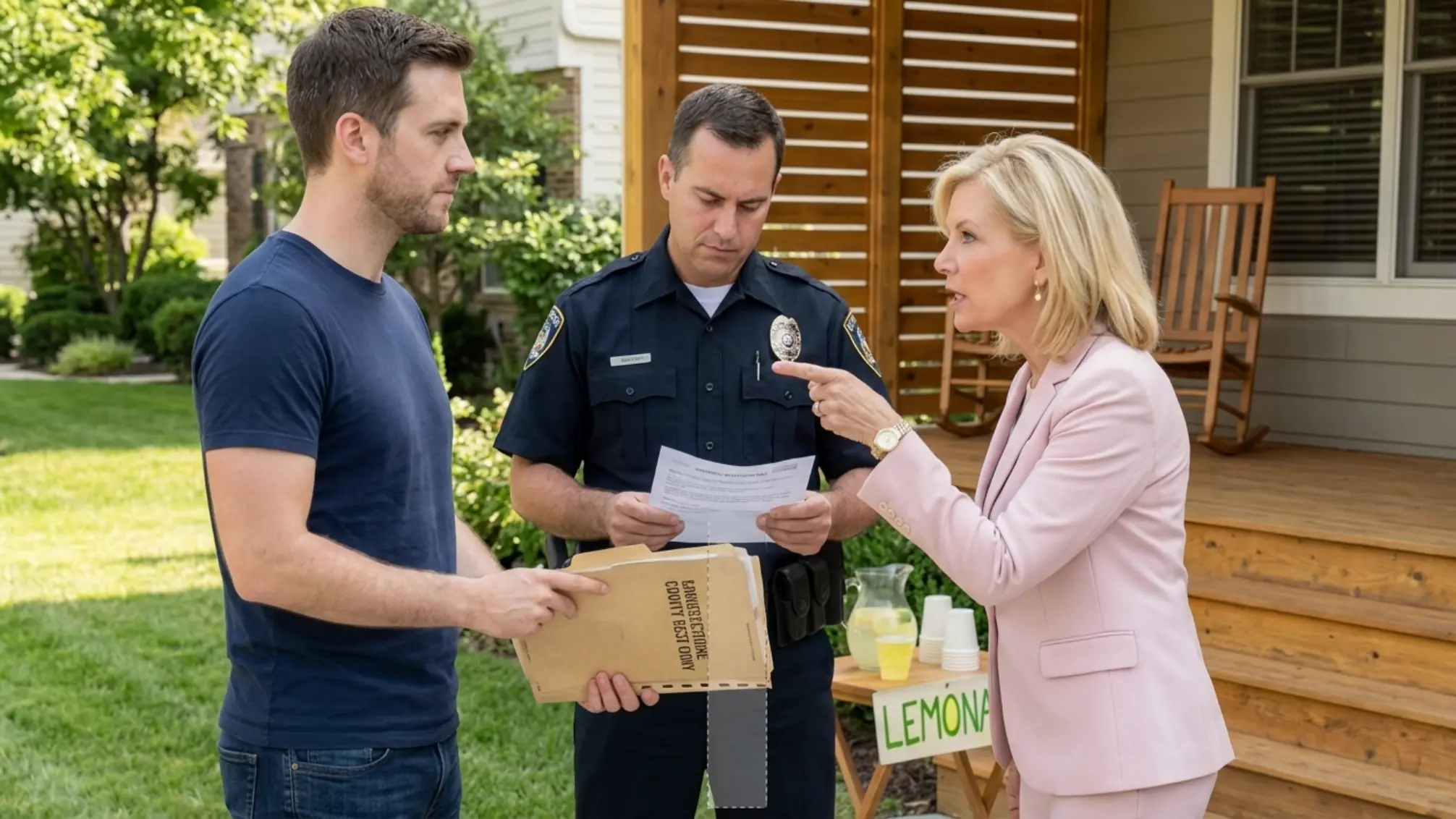
Officer Miller studied Jason, then the house, then Brenda. “Sir, do you live here?”
“I own it,” Jason replied. “I pay the mortgage, the taxes, and apparently the neighborhood entertainment budget.”
Brenda stepped forward, her nude heels stopping one inch from his grass. “He sits there for hours watching families. Normal people go to work.”
“I work from home.”
“That’s what suspicious people always say.”
Jason slowly closed his book. He was thirty years old, worked as a data analyst, and disliked confrontation so much that he occasionally apologized to furniture after bumping into it. Yet Brenda had already called the police twice that month—once because he received a delivery after nine at night and once because his recycling bin remained beside the garage until noon.
This call was different.
Brenda had reported an intoxicated vagrant “casing homes” from a porch. She had deliberately left out that the porch belonged to him.
Officer Miller’s younger partner returned from the cruiser holding Jason’s driver’s license. “Everything’s clean. Address matches the property.”
Brenda’s face tightened. “That proves nothing. People use false addresses all the time.”
“It’s the address printed on his license,” the younger officer said.
“He could have planned this.”
Jason stared at her. “Planned to live in the house I bought?”
Brenda lifted her phone and began recording. “Look at his aggression, Officer. He’s escalating.”
Jason was still seated.
Officer Miller rubbed his forehead. “Mr. Bennett, you aren’t violating any law.”
“Obviously,” Jason said.
“However, this situation is becoming disruptive. Could you go inside for a little while and let everyone calm down?”
Jason looked at the officer’s exhausted expression and almost agreed. Then he saw Brenda smiling behind the camera. It was a small, satisfied smile belonging to someone who believed she had proved the porch, sidewalk, and entire street operated under her permission.
If Jason went inside, she would not see compromise.
She would see surrender.
“No,” he said.
Officer Miller sighed. “Sir—”
“I’m on my own property. I’m reading quietly. If she keeps calling emergency services because she dislikes seeing me, that’s her misuse of police resources.”
Brenda gasped. “You don’t get to tell the police how to do their jobs.”
Jason reopened his book. “Am I under arrest?”
“No,” Officer Miller answered.
“Am I being detained?”
“No.”
“Then I’m finishing my chapter.”
The officers warned Brenda not to call again without an actual emergency. She protested that Jason’s presence disturbed the moral fabric of the neighborhood, but they returned to their cruisers anyway. Jason remained in the rocking chair until the police lights disappeared around the corner.
Brenda stood across the street filming him for another three minutes.
Jason lifted his coffee cup in a polite toast.
Her face twisted. She turned, crossed her manicured lawn, and slammed her front door hard enough to rattle the decorative wreath.
Jason stayed outside for an hour even though the coffee became undrinkable and mosquitoes began gathering around his ankles. He no longer wanted to read, but leaving immediately would have felt like allowing Brenda to determine when he could use his own porch. When he finally entered the house, his hands were shaking.
He opened the Oak Creek Community Watch page on Facebook.
Brenda had already posted the video.
The caption called him a “criminal element,” claimed police had questioned a vagrant at 402 Maple Drive, and warned families to lock their doors. The recording began after Jason stepped away from the rocking chair, creating the impression that officers had arrived to confront him over something serious.
The comments were worse.
Neighbors who had never introduced themselves speculated that Jason used drugs, watched children, or operated an illegal business. One woman wrote that property values would collapse if “people like that” were allowed to take over established streets.
Jason read every comment twice.
Then he looked through the kitchen window toward Brenda’s house.
She wanted to decide whether he could sit on his porch.
Jason decided he needed a larger porch.
The following morning, a lifted white pickup stopped outside his house at exactly seven. The truck belonged to Big Mike’s Decks and Renovations, a local contractor whose website promised structures “strong enough for hot tubs, storms, and difficult relatives.”
Big Mike climbed from the cab wearing a sleeveless neon work shirt. He was six feet four, shaped like a vending machine, and carried a crowbar as casually as most men carried umbrellas.
“You Jason?”
“That’s me.”
Mike examined the existing porch, pushed one boot against a loose board, and frowned. “This thing is one thunderstorm away from becoming firewood.”
“I want a cedar deck, a wraparound section, built-in seating, and a pergola.”
“How large?”
“The maximum legal size.”
Mike smiled. “Neighbor problem?”
Jason pointed across the street.
Brenda’s curtains moved.
“She called the police because I sat in that chair.”
Mike slowly turned toward her house. “For sitting?”
“For sitting.”
“I hate people like that.”
At seven sharp, the demolition began.
The first circular saw had been running for less than four minutes when Brenda stormed across the street wearing a pink robe and fuzzy slippers. Hair curlers framed her face like warning lights.
“Stop this immediately!”
Mike continued removing an old board.
“It is seven in the morning,” she screamed. “This is a residential community.”
Mike checked his watch. “Construction begins legally at seven. I’m right on time.”
“Do you have a permit?”
He pointed toward the front window, where the approved city permit was displayed.
“The HOA has not authorized this structure.”
“Structural repairs approved by the city don’t require your permission.”
Brenda stared at him. “I am the HOA president.”
Mike rested both hands on the crowbar. “Congratulations.”
She demanded measurements, design drawings, contractor credentials, proof of insurance, and a written explanation of how the project would preserve neighborhood harmony. Mike answered every legitimate question and ignored the imaginary ones. When she stepped onto the work area, he offered her a hard hat or the opportunity to leave.
Brenda returned home promising inspections, fines, and personal consequences.
The cedar deck rose across the next three days.
Mike installed a pergola, wide steps, built-in benches, and a slatted privacy screen facing Brenda’s house. From inside the porch, Jason could see the street through angled openings. From Brenda’s side, she saw only a beautiful wooden wall hiding everything she believed she had a right to monitor.
The HOA violation arrived Wednesday.
Jason was fined $500 for unauthorized exterior modification, excessive noise, and “persistent loitering.” The last violation had been handwritten beneath the official list.
Mike read the letter and shook his head. “She fined you for existing?”
“Apparently.”
“Pay it under protest, save the receipt, and appeal at the next meeting.”
“She can put a lien on the house.”
“Then we make sure she regrets every page she prints.”
Mike added discreet security cameras inside the porch lights. Each recorded high-resolution video, audio, and night footage, with automatic cloud backup. Jason wanted evidence if Brenda entered the property or damaged the new structure.
They did not wait long.
On Saturday afternoon, Jason and Mike sat behind the privacy screen drinking iced tea. Brenda emerged from her house after hearing them laugh and spent several minutes trying to see through the wooden slats. When she could not, she crossed the street and walked directly onto Jason’s lawn.
“What are you doing in there?”
“Drinking tea,” Jason answered. “Please leave my property.”
“This wall is aggressive.”
“It’s cedar.”
“I have the right to inspect HOA violations.”
“You have no right to enter my yard.”
Brenda kicked a planter beside the stairs. It overturned, scattering soil across the walkway.
Mike’s voice changed. “That was property damage.”
She froze, looked around for cameras, and found none. The lenses remained hidden inside the porch fixtures.
“I’ll have this monstrosity demolished by Monday,” she said before retreating.
Jason saved the footage in three locations.
That should have been enough leverage, but Brenda escalated again. She reported Mike’s work truck as an abandoned commercial vehicle even though it left every evening. A traffic officer issued him a citation based on her written claim and told him to contest it in court.
Mike folded the ticket and placed it inside his pocket.
“She lied easily,” he said.
“She always does.”
“No, I mean easily. No hesitation. No nervousness. That’s muscle memory.”
Jason looked toward Brenda’s house.
Mike lowered his voice. “People who police everyone else this hard are usually terrified somebody will inspect them.”
That evening, Jason searched for private investigators.
He found Sal Moretti operating from a small office beside a vape shop. Sal’s website contained one sentence: Need to know? I find out.
Jason called.
“Moretti.”
“I have a neighbor problem.”
“I don’t find lost cats.”
“She’s an HOA president who files false police reports.”
There was a pause.
“I hate people who weaponize cops. Come by in an hour.”
Sal’s office looked like the set of an old detective movie after budget cuts. Dusty blinds covered the windows, an overflowing ashtray sat beside a pickle jar, and stacks of folders leaned dangerously across the desk. Sal was broad, gray-haired, rumpled, and far more observant than his surroundings suggested.
Jason described the police calls, the Facebook accusations, the fines, the destroyed planter, and the false report against Mike.
Sal listened without interrupting.
When Jason finished, the investigator leaned back. “Control freaks usually control the present because they’re afraid of the past.”
“You think she’s hiding something?”
“I think I can find out.”
Sal requested Brenda’s full name, address, approximate age, known vehicles, and previous locations. Jason knew almost nothing beyond what he had observed, but Sal said property records, court databases, archived newspapers, and identity histories could fill the gaps.
The investigation would cost $2,000.
Jason paid half immediately.
“Go home,” Sal instructed. “Act normal. Let her think she’s winning.”
“That won’t be difficult. She believes that naturally.”
For the next week, Jason used his porch every day.
Brenda posted photographs, mailed additional notices, and circulated a petition accusing him of damaging Oak Creek’s character. The HOA board scheduled a hearing where she intended to demand removal of the deck.
Then Sal called.
“You sitting down?”
“Yes.”
“I didn’t find dirt. I found an archaeological site.”
Jason met him at a diner twenty minutes later. Sal occupied a rear booth with a slice of cherry pie and a thick manila folder. He waited until Jason sat before sliding the file across the table.
“Your neighbor’s real name is Brenda Kowalski.”
“Miller is her married name?”
“An ex-husband’s name. She began using it after moving here, but several legal records still identify her as Kowalski.”
Jason opened the folder.
A younger version of Brenda stared from a mugshot.
Sal explained that she had lived in Ohio before moving to Oak Creek. She left behind three unresolved criminal cases: illegal dumping, disorderly conduct after throwing coffee at a barista, and leaving the scene of a parking-lot accident.
She failed to appear in court for all three.
The resulting bench warrants remained active.
“She’s technically a fugitive?” Jason asked.
“A low-level one, but active warrants are active warrants.”
“Why hasn’t anyone arrested her?”
“Nobody here had reason to run her previous identity. The Ohio jurisdiction wasn’t going to send officers across state lines for minor offenses, but their records say they will confirm extradition within the authorized range.”
Jason stared at the court documents.
Brenda had spent months accusing others of violating rules while hiding from the consequences of her own actions.
“Call the police,” he said.
Sal shook his head. “You can, but an out-of-state warrant tip may sit in a queue. Better if officers are already there and have a reason to verify her identity.”
Jason thought about how quickly Brenda called police whenever she believed he had violated her authority.
A plan formed.
Two days later, Jason and Mike placed a folding table at the edge of his driveway. They covered it with a checkered cloth and added a glass pitcher of fresh lemonade, ice, mint, and free cups.
The sign read:
OAK CREEK COMPLIMENTARY REFRESHMENT STATION
FREE LEMONADE — COME ENJOY THE PORCH
Beneath that, in smaller print:
SERVICE REFUSED TO BRENDA DUE TO PENDING LITIGATION AND SEVERE BAD VIBES
They sat behind the privacy screen and waited.
Brenda emerged within five minutes.
She read the sign from across the street, dropped her watering can, and marched toward the driveway wearing a visor and pale-pink pantsuit. Her face darkened as she reached the final line.
“You cannot operate a business in a residential district.”
“It’s free,” Jason said.
“You need a food-service permit.”
“For lemonade?”
“You are harassing me through public signage.”
“The sign is on private property.”
Brenda pointed toward Mike. “And you’re running an illegal commercial enterprise with this hired thug.”
Mike lifted a lemonade cup. “I’m a licensed contractor enjoying citrus.”
She called the police.
Jason encouraged her to describe the situation as urgently as possible. Brenda reported an illegal storefront, harassment, intimidation, a dangerous gathering, and “loitering with intent to distribute.”
“Distribute what?” the dispatcher apparently asked.
“Unregulated beverages.”
Two cruisers arrived.
Officer Miller stepped out, recognized the house, and visibly reconsidered every career choice that had brought him back to Maple Drive. Brenda rushed toward him, demanding immediate arrests and seizure of the lemonade table.
He read the sign.
“A free drink excluding you isn’t a crime.”
“It’s a hate crime.”
“No, ma’am.”
“He is operating a business.”
“No money is changing hands.”
“He’s disturbing my peace.”
“Disliking something doesn’t make it illegal.”
Brenda folded her arms. “I have a clean record. I am the HOA president, a taxpayer, and the victim here.”
Jason stood.
The manila folder waited on the porch bench.
“Officer Miller, since she mentioned records, there’s something you should see.”
Brenda’s confident expression flickered.
Jason handed the folder to the officer.
“What is this?” Miller asked.
“Court records for Brenda Kowalski, the name she used in Ohio. Three active bench warrants.”
Brenda stepped backward. “That is not me.”
Jason opened the first page. “Same birth date. Same photograph. Same identifying information.”
“That was years ago.”
Officer Miller began reading.
The second officer leaned over his shoulder, then returned to the cruiser to check the national database. Brenda’s face lost color as the radio crackled from inside the car.
She attempted to retreat toward her house.
“Ma’am, stay here,” Miller ordered.
“I need medication.”
“You can receive it after we verify the information.”
“This is harassment. He hired someone to invade my privacy.”
“Court warrants are public records.”
The younger officer called from the cruiser. “All three confirmed. Ohio wants notification and transport processing.”
Brenda stared at Jason.
“You did this.”
“You called the police,” he replied. “I only gave them something to read.”
Officer Miller approached her. “Brenda Kowalski, place your hands behind your back.”
She slapped his hand away.
The officer immediately turned her toward the cruiser and secured both wrists. The sound of the cuffs closing carried across the silent street.
Brenda began shouting.
She threatened lawsuits, political connections, termination of police officers, seizure of Jason’s house, demolition of the porch, and the personal destruction of everyone who had embarrassed her. Neighbors appeared on lawns and behind windows, watching the woman who had monitored them for years finally confront rules she could not rewrite.
Officer Miller placed her inside the cruiser.
The door closed.
Her shouting became silent movement behind thick glass.
The officer returned the original folder to Jason after preserving copies of the documents. Then he looked toward the lemonade pitcher.
“Is that actually free?”
“Completely.”
“It’s hot, and we have paperwork.”
Jason poured two cups.
Mike raised his own drink. “To neighborhood safety.”
Officer Miller tasted the lemonade and smiled despite himself. “That is excellent.”
“The criminal beverage stand appreciates your review,” Jason said.
The cruisers departed with Brenda in the back seat.
Oak Creek remained quiet for almost a full minute.
Then Mrs. Higgins, an elderly neighbor who walked a poodle every morning, crossed the street and accepted a cup. She apologized for believing Brenda’s Facebook post without speaking to Jason.
Others followed.
Some apologized directly. Others pretended they had never doubted him. Jason did not demand confessions from everyone, but he remembered who had watched silently while his name was dragged through the neighborhood.
The HOA board convened an emergency meeting that evening.
Brenda was removed as president immediately. A financial review revealed she had issued fines without board approval, altered meeting minutes, and used association money to pursue personal complaints. Every violation against Jason was canceled, his $500 payment was returned, and the board formally acknowledged that the porch complied with city requirements.
Mike’s traffic citation was dismissed after Jason provided security footage proving the truck left each day.
Brenda eventually returned to Ohio to resolve the old cases. Her legal consequences were not severe enough to satisfy every neighbor who had endured her behavior, but her authority in Oak Creek was finished. She sold her house several months later.
Jason kept the porch.
The rocking chair remained behind the privacy screen, where he could read without becoming part of Brenda’s surveillance. The security cameras stayed active, though weeks began passing without capturing anything more serious than delivery drivers and squirrels.
One Saturday morning, Jason finally reopened the thriller interrupted by the first police visit.
Big Mike arrived carrying coffee.
“You finish that book yet?”
“Not even close.”
“You built an entire legal trap faster than you read one novel.”
Jason pointed toward the second chair. “Sit down. Try loitering.”
Mike lowered himself carefully into it. The cedar boards held without complaint.
Together, they sat behind the screen while morning light moved across the street. Nobody called the police. Nobody photographed them or demanded proof that they belonged.
Jason had spent months believing victory would feel dramatic.
Instead, it felt like quiet coffee on a porch no one else controlled.
Brenda had called him a criminal for sitting in his own rocking chair. She had weaponized police reports, HOA fines, neighborhood gossip, and fear because she believed rules existed to control other people.
In the end, those rules did not destroy Jason’s porch.
They exposed her.
And when the police finally returned to 402 Maple Drive, they did not remove the homeowner quietly reading beside his lemonade table.
They took away the HOA president who had summoned them herself.