The day Margaret Windham called the sheriff on me for illegally fishing on her lake was the day she signed her own eviction notice.
I was standing at the north bend of Pine Ridge Lake just after dawn, my boots planted in the soft gravel where the old boat launch met the water, casting my line into the same quiet pocket I had fished for twenty-three years.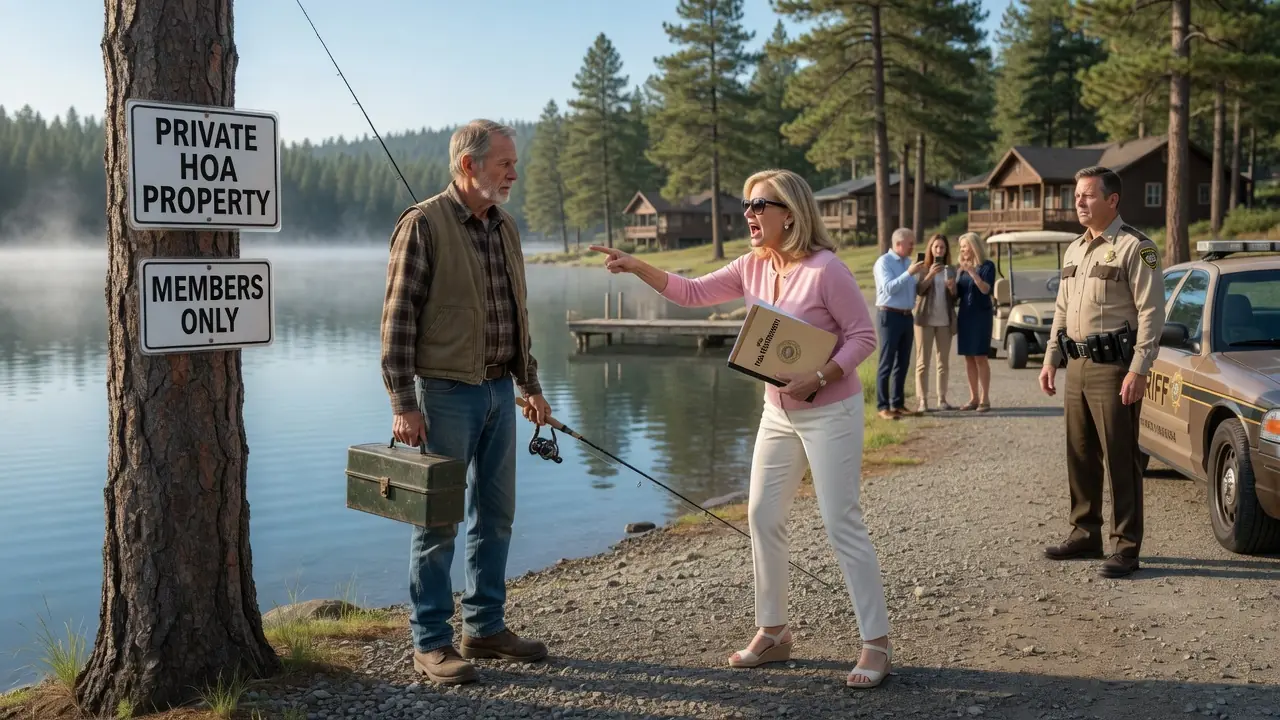
Mist rose from the surface in pale sheets, drifting low over the dark water like ghosts that had forgotten where they were going. The pines along the far bank stood still and black against the early light. Somewhere across the lake, a loon called once, then again, its voice carrying clean over the water.
That sound had kept me alive after Sarah died.
But that morning, it was cut clean in half by the shrillest voice in three counties.
“You are trespassing on HOA waters!”
I did not turn around right away.
At my age, a man learns not to give every loud person the satisfaction of immediate attention. I let my lure settle. Watched one perfect ring widen across the water. Then I reeled in slowly and looked back over my shoulder.
Margaret Windham stood at the top of the boat launch in a pastel pink cardigan, white slacks, pearl earrings, oversized sunglasses, and polished wedge sandals that had no business being anywhere near mud. Her hair, as always, was sprayed into a smooth blond helmet that could probably withstand a minor tornado.
In one hand she held a phone.
In the other, a laminated HOA folder.
Behind her, about fifteen yards up the gravel road, a sheriff’s cruiser sat idling with its lights off.
Deputy Charlie Morrison stepped out, looking like he would rather wrestle a drunk raccoon than walk down that boat launch toward me.
“Morning, Charlie,” I said.
Charlie removed his hat, ran a hand over his hair, and gave me the pained look of a man caught between law and nonsense.
“Morning, Theo.”
Margaret came down two more steps, stopping just far enough from the water to keep her shoes clean.
“Deputy Morrison is here to remove you from private association property.”
I looked from her to Charlie.
“Is that right?”
Charlie sighed.
“Sorry, Theo. She filed a formal complaint. Claims unauthorized fishing, trespassing, violation of posted lake restrictions.”
“Posted by who?”
Margaret smiled.
The kind of smile people wear when they believe paperwork has already won.
“By the Pine Ridge Lake Homeowners Association. Of which I am president.”
I glanced around at the lake, at the pines, at the old dock my grandfather helped build, at the little path worn into the earth by more than sixty years of boots, fishing chairs, tackle boxes, kids running toward summer water, old men walking slowly with coffee, and widows standing at sunrise because the world hurt less outdoors.
“Funny,” I said. “I don’t remember electing you queen of the lake.”
Margaret’s smile froze.
“Mockery won’t help you, Mr. Blackstone.”
“No, ma’am. But it does pass the time.”
Charlie cleared his throat.
“Theo, I know this is ridiculous, but I have a complaint in writing. Until we sort out the property issue, I need to ask you to pack up and leave for now.”
He looked miserable saying it.
I could have argued.
I could have told Margaret exactly where she could file her laminated signs and pastel authority. I could have pointed to the tax records, the old mining deed, the county maps, the stack of papers sitting in a metal box at my cabin that proved Margaret Windham had just called the sheriff on a man for fishing in water he legally owned.
But there are moments when the smartest thing a man can do is not speak too soon.
My father used to say, “Theo, never interrupt a fool while they’re laying the foundation for their own trouble.”
So I put my rod down.
I gathered my hooks.
I closed the lid of my tackle box.
The snap of that box closing echoed across Pine Ridge Lake like a gunshot.
Margaret’s smile widened.
She thought the sound meant surrender.
It did not.
It meant the beginning.
My name is Theodore Blackstone, though most people around Pine Ridge call me Theo. I am sixty-eight years old, widowed, half retired, and stubborn in the quiet way of men who have already lost the worst thing life could take from them.
Cancer took my wife Sarah when she was forty-eight.
I was forty-nine then.
Still young enough that people told me I had plenty of life left, which was true in the cruelest possible way. There was life left. Too much of it. Too many mornings with only one coffee cup. Too many evenings when I still turned my head to tell her something before remembering there was no one in the chair beside mine.
Sarah had been the kind of woman who made a house feel awake.
She sang while folding laundry. She named the birds that landed near the window. She burned biscuits every other Sunday and acted personally offended when I pointed out the smoke.
When the doctors said cancer, she squeezed my hand and said, “Well, we’ve always been good at inconvenient things.”
For a while, we believed we would beat it.
Then we believed we could slow it.
Then we believed we could keep her comfortable.
Then one October morning, after a night of rain, she was simply gone.
People brought casseroles.
They said gentle things.
They left.
I stayed in the house we had shared for sixteen years and discovered grief has a sound.
It is the refrigerator humming too loudly.
It is floorboards settling in rooms no one enters anymore.
It is a spoon clinking against one bowl instead of two.
I could not live in that house after Sarah. Everything in it looked like evidence.
That was when Pine Ridge Lake came back into my life.
My grandfather, Theodore “Bud” Blackstone Sr., had left me two acres on the north shore. Raw land mostly, with a stand of pines, a rocky slope down to the water, and an old fishing path cut through the weeds. The land had been in the family since the 1950s, but nobody had built on it.
Grandpa used to take me there when I was a boy.
He taught me to cast from that north bend, showed me how bass held close to submerged logs, taught me how to sit still without feeling useless.
“Fish don’t owe impatient men anything,” he would say.
After Sarah died, I drove out there with a thermos of coffee and no plan.
I sat by the water until noon.
Then I came back the next day.
Then the next.
Eventually, I sold the house in town and built my cabin at Pine Ridge.
Not hired it built.
Built it.
Board by board.
Nail by nail.
The first wall went up crooked, and I left it that way for three weeks because fixing it felt like admitting I had no idea what I was doing. Then Betty Kowalski wandered over from her cottage with a level, a sandwich, and the blunt kindness of a woman too old to pretend incompetence was charming.
“Theo,” she said, “your wall looks drunk.”
“I was calling it rustic.”
“Rustic is what people say when they don’t want to fix things.”
She helped me brace it straight.
Frank Martinez helped with the roof.
Old Harold Johnson loaned me a table saw and then refused to take it back for six months because, according to him, I still looked “like a man determined to cut something wrong.”
That was Pine Ridge back then.
A collection of old cabins, trailers, modest lake houses, and stubborn people who did not have much except time, tools, and the habit of showing up when someone needed help.
Nobody cared if your grass grew uneven.
Nobody measured mailbox height.
Nobody objected to Betty’s garden gnomes, and she had enough of them to form a small ceramic militia.
Pine Ridge was not fancy.
It was better than fancy.
It was home.
The lake became my therapy.
Every dawn, for twenty-three years, I walked the gravel path down to the water. In winter, frost glittered on the grass and my breath fogged in front of me. In spring, frogs sang from the reeds and the air smelled like damp leaves. In summer, the lake held the sunrise like melted copper. In fall, pine needles softened the trail beneath my boots.
I cast my line.
I waited.
I remembered Sarah.
Some mornings I talked to her.
Not out loud every time.
But often enough.
I told her about Betty’s latest gnome. About Frank’s tomatoes. About Harold’s bad hip. About the cabin roof, the water pump, the heron that kept stealing fish from the shallows like it owned the place.
In those quiet hours, grief became less like drowning and more like carrying a stone in my pocket.
Still there.
Always there.
But not enough to sink me.
Then came the development.
Around 2015, a company out of Atlanta bought the eastern ridge and cleared the old timber. We watched bulldozers push down trees that had stood since before I was born. Roads went in. Then sewer lines. Then model homes with front porches nobody sat on because the houses were designed for looking, not living.
They called it Pine Ridge Preserve.
There was nothing preserved about it except the name.
The first houses sold quickly.
Big ones.
Stone fronts.
Three-car garages.
Outdoor kitchens.
Smart irrigation systems.
Mailboxes that all matched like soldiers standing at attention.
At first, the newcomers were polite enough.
They waved sometimes.
Some asked about fishing.
Their kids liked the lake.
A few even came to the community fish fry Betty organized every July.
But money changes the weather around a place.
Little by little, people started saying things like “curb appeal” and “community standards” and “shared aesthetic vision.” Words that sound harmless until someone uses them to tell an old woman her flowerpots are a problem.
Then, six months before the sheriff call, Margaret Windham arrived.
She came in a white BMW with a vanity plate that read BLESSED, which is the sort of thing that tells you a lot about a person before you meet them.
Margaret bought the biggest house on the southeast shore, a glass-and-stone lakefront place with a floating dock, three decks, and landscaping so stiff it looked nervous.
She was forty-eight, recently divorced, and carried herself like a woman who had been told “no” too few times by people who mattered.
Former corporate compliance officer from Atlanta, she told everyone.
As if that explained something noble.
It did explain something.
Just not what she thought.
Margaret had the gift of making ordinary conversation feel like a disciplinary meeting. She could say “good morning” in a tone that made you wonder what policy you had violated overnight.
Within two weeks, she organized what she called a Concerned Homeowners Meeting.
I did not attend.
Betty did, because Betty enjoyed drama as long as she had knitting in her hands.
She came to my cabin the next morning carrying banana bread and a full report.
“The woman brought slides,” Betty said.
“Slides?”
“PowerPoint slides, Theo. At a lake meeting.”
“That is a cry for help.”
“She had charts about property values and recreational liability.”
“Did she serve coffee?”
“She served sparkling water.”
“Then the whole thing was doomed from the start.”
Margaret’s proposal was simple in the way bad ideas often are.
Pine Ridge needed a homeowners association.
Not just the new development.
The whole lake.
She claimed the water was a “community asset” requiring oversight. There would be dock standards, boat rules, approved landscaping, quiet hours, shoreline preservation guidelines, and a monthly “lake management contribution” of two hundred dollars per household.
She collected signatures from eight of twenty-three properties.
Mostly newcomers.
A few older residents signed because Margaret made the form sound like a petition for safety improvements rather than the birth certificate of a small dictatorship.
The rest of us received certified letters.
Mine began:
Dear Mr. Blackstone,
As a lakefront stakeholder, you are hereby notified of mandatory inclusion in the Pine Ridge Lake Homeowners Association...
I called Margaret that afternoon.
She answered on the second ring.
“Margaret Windham.”
“This is Theo Blackstone. I received your letter.”
“Excellent. Then you understand the compliance timeline.”
“I understand you mailed me a fantasy.”
A pause.
“Excuse me?”
“My property is not part of your association.”
“Mr. Blackstone, lake management affects everyone.”
“Fishing affects me. Rain affects everyone. Doesn’t mean you get to tax the clouds.”
Her voice chilled.
“This is not optional.”
“Ma’am, most things people say are not optional usually are.”
“You are making this harder than it needs to be.”
“No. I am making it accurate.”
Another pause.
Then, very softly, “People like you always resist progress.”
There it was.
People like you.
It does save time when folks tell you who they are.
“Margaret,” I said, “I don’t have investments. I have a home.”
She hung up.
Two weeks later, laminated signs appeared around the lake.
PRIVATE HOA PROPERTY.
MEMBERS ONLY.
AUTHORIZED LAKE ACCESS REQUIRED.
They were zip-tied to trees, nailed to posts, stuck near the boat launch, and placed along the old walking path like plastic weeds.
I tore down the one on my north bend and placed it neatly on Margaret’s porch.
She put it back the next day.
I left it there after that.
Not because she was right.
Because I had already decided the woman needed enough rope to knit herself a sweater.
Margaret began watching me from her deck with binoculars.
Every morning, I could feel her up there, standing behind glass in some expensive cardigan, documenting my crimes against her imagination.
I fished anyway.
Then came the morning she called Charlie.
After I packed up my tackle box and walked home under Margaret’s victorious gaze, I made coffee, sat at my kitchen table, and pulled out the old metal deed box from the bottom of the closet.
The box smelled like dust, paper, and my father’s pipe tobacco.
Inside were property tax receipts, my grandfather’s original deed, maps, old survey notes, Thompson Mining Company correspondence, and letters tied with string in my grandmother’s handwriting.
I had looked through that box before, but not closely.
Most people don’t read deeds like they are love letters.
They should.
Because land has memory, and memory often lives in the fine print.
The first thing I found was a 1958 deed referencing “mineral, surface, and subsurface resource rights conveyed in perpetuity.”
That phrase tugged at something.
I read it again.
Then I read the attached survey description.
Then I drove to the county courthouse.
The land records office was in the basement of a brick building that smelled like old paper, stale coffee, and government patience. Fluorescent lights buzzed overhead. Filing cabinets stood in rows like gray tombstones.
Joyce Miller worked behind the counter.
Joyce had been a county clerk since before half the commissioners knew how to spell zoning. She was small, sharp-eyed, and wore glasses thick enough to start controlled fires.
She looked up when I entered.
“Theo Blackstone,” she said. “You look like a man who found trouble.”
“Trouble found me first.”
“That woman with the helmet hair?”
“Yes, ma’am.”
Joyce leaned back.
“I knew she had the scent of paperwork violence.”
I placed Margaret’s HOA letter on the counter.
Joyce read it.
Her mouth tightened.
Then she pulled the incorporation filings.
Or tried to.
Because there were none.
“Interesting,” she said.
“That good interesting or court date interesting?”
“Depends who you are.”
Joyce kept searching.
Margaret had filed meeting minutes and a set of proposed bylaws with the county, but no formal state incorporation. No proper boundary description. No recorded declaration binding old properties. No signed consent from all affected landowners. No authority over my parcel, Betty’s cottage, Frank’s cabin, or any property outside the original Pine Ridge Preserve development.
In plain English, Margaret had built a castle out of letterhead.
“Son,” Joyce said, squinting at the documents, “this paperwork is messier than a soup sandwich.”
“That’s what I suspected.”
“Suspecting is nice. Proving is better.”
She pulled county survey maps from the 1960s.
Then old mining records.
Then lake parcel tax documents.
The more she pulled, the quieter she became.
Finally, she tapped one brittle map with her pen.
“Theo, this lake record is unusual.”
“How unusual?”
“Your grandfather may have owned more than shoreline.”
That was how I first heard the phrase that would eventually end Margaret Windham’s reign of terror.
Lake bottom ownership.
It sounded absurd at first.
A lake was water.
How could a person own the bottom?
But property law is a strange old creature. It remembers railroads, mines, mills, dams, timber rights, water access, mineral claims, and a hundred forgotten deals made by dead men in hats.
Joyce explained that Pine Ridge Lake had once been tied to Thompson Mining Company. In the 1940s, the company believed there might be copper deposits beneath the lakebed. They purchased broad rights: mineral, subsurface, surface water access, extraction privileges, lake bottom control.
The copper proved worthless.
The paperwork did not.
Those rights passed through corporate transfers, then into my grandfather’s hands when he bought out a share of an old holding company in the 1960s.
From my grandfather to my father.
From my father to me.
Joyce did not say I owned the lake that day.
She was too careful for that.
But she did say, “You need a lawyer.”
So I got one.
Samuel Bennett’s office sat in the county seat above an insurance agency. It smelled like leather chairs, old law books, and coffee strong enough to survive appeal.
Bennett was seventy-one, semi-retired, and known for two things: property law and not wasting words.
He reviewed my documents for twenty minutes without speaking.
I sat across from him, listening to the clock tick.
Finally, he removed his glasses.
“Mr. Blackstone,” he said, “this is extraordinary.”
“That good extraordinary or expensive extraordinary?”
“Both.”
He spread the papers across his desk.
“Your grandfather did not merely acquire mineral interests. He acquired lake bottom ownership and perpetual surface water usage rights connected to those mineral interests.”
“My grandfather owned the lake?”
“Legally speaking, yes. The bottom, the associated water rights, and use access. You have been paying taxes on those rights since 1999.”
“I have?”
He looked at me over the papers.
“You signed the checks.”
“I thought it was just parcel tax.”
“It included the lake rights.”
I sat back.
For a moment, all I could think about was Grandpa Bud teaching me to cast from the north bend.
Had he known?
Probably.
The old man never said half of what he knew.
Bennett continued.
“Mrs. Windham’s association is collecting fees to access private property she does not control. Her signs, restrictions, fines, and barriers may constitute interference with your property rights. Depending on the money collected, possibly fraud.”
The room went very still.
I thought of Betty trembling on my porch with a violation notice over ceramic gnomes.
Frank being blocked from his doctor-ordered morning walk.
The Johnsons being told their old dock needed HOA approval.
Margaret charging people two hundred dollars a month to use water she did not own.
My water.
My grandfather’s water.
Sarah’s dawn.
My peace.
“What do we do?” I asked.
Bennett’s eyes sharpened.
“What do you want to do?”
“I want her stopped.”
“That’s easy enough.”
“I want everyone to know why.”
His mouth twitched.
“That takes patience.”
“I fish,” I said. “Patience is practically the hobby.”
Over the next two weeks, Margaret escalated like a woman racing downhill without knowing the bridge was out.
She sent final violation notices.
She hired a private security guard to stand near the boat launch.
The poor kid was nineteen, maybe twenty, wearing a shirt that said Guardian Shield Security and an expression that said he had not expected his job to involve retirees with fishing rods.
I walked down Wednesday morning with my tackle box.
He stepped forward nervously.
“Sir, this is members-only lake access.”
“Morning. What’s your name?”
“Kevin.”
“Kevin, who told you that?”
“The HOA president.”
“Did she provide legal ownership documents?”
He blinked.
“I just started Monday.”
“That’s not your fault.”
He looked miserable.
“She told me to take pictures of anyone fishing.”
I smiled.
“Make sure you get my good side.”
Then I cast my line.
The lure hit the water with a clean plop.
Kevin lasted three days.
His resignation, according to Betty’s nephew who worked part-time for the security company, said:
Client expectations unclear and potentially illegal.
Smart boy.
Margaret then hired an attorney who sent me a cease and desist letter demanding five hundred dollars in administrative fees, immediate compliance with lake restrictions, and written acknowledgment of HOA authority.
Bennett laughed for almost a full minute when I showed it to him.
“That bad?” I asked.
“No. That useful.”
We added it to the file.
Betty began helping too.
People underestimate widows at their own peril.
A widow with free time, righteous anger, and a good filing system is more dangerous than any attorney.
Betty collected violation letters from residents.
Her garden gnome fine.
Frank’s walking path restriction.
The Martinez family’s unapproved fishing boat citation.
Harold Johnson’s dock notice.
A young couple fined for a backyard swing set visible from Margaret’s upper deck.
An elderly woman warned that her porch ramp created an “unapproved medicalized appearance.”
Betty placed every document in a binder with tabs.
Her tab labels were not polite.
GNOME NONSENSE.
DOCK LIES.
RAMP CRUELTY.
MARGARET THINKS SHE’S QUEEN.
Joyce quietly supplied public records.
Bennett prepared legal summaries.
I hired surveyor Jake Patterson, who confirmed the old maps and marked the boundaries.
“You know,” Jake said while packing up his equipment, “most people don’t realize lake rights can be split off like this.”
“Most people don’t have Margaret Windham trying to charge admission to their inheritance.”
“That’ll do it.”
Margaret, meanwhile, announced a Lake Beautification and Safety Initiative.
That meant fences.
Signs.
Cameras.
Fees.
And a public presentation before the county commissioners where she intended to ask for official recognition of Pine Ridge Lake HOA as the managing authority over the lake.
She invited the local newspaper.
Three neighboring HOA presidents.
A photographer.
She even reserved the community center for a “post-meeting reception celebrating the future of Pine Ridge Lake.”
Betty saw the invitation and snorted coffee through her nose.
“She planned herself a coronation.”
“She planned herself a lesson,” I said.
The morning of the county meeting, I went fishing.
Margaret called the sheriff again.
Charlie Morrison arrived looking even more uncomfortable than the first time.
“Theo,” he said, standing on the gravel while Margaret watched from her deck in a cream blazer and white pants. “I hate this.”
“I know.”
“She filed another complaint. Says tonight’s meeting will settle access authority, and until then—”
“You need me to leave.”
He rubbed the back of his neck.
“I’m sorry.”
I reeled in.
Packed up.
Closed the tackle box.
Margaret stood above us with her arms crossed, smiling like a woman who thought she had won twice.
I looked at Charlie.
“Will you be at the meeting tonight?”
He glanced at Margaret, then back at me.
“Sheriff asked me to attend.”
“Good.”
Margaret could not hear us from where she stood, but she saw me smile.
It bothered her.
Good.
The county commission room was packed that night.
Margaret arrived two hours early with binders, poster boards, a laptop, three HOA presidents in navy blazers, Dale Pemberton looking like a man reconsidering his entire life, and a photographer who kept adjusting his camera like he expected history to be flattering.
I arrived fifteen minutes before the meeting with my tackle box in one hand and a manila folder in the other.
Worn flannel.
Work boots.
No tie.
No performance.
Betty sat near the back.
Joyce sat along the aisle.
Bennett sat in the middle row with a leather briefcase on his lap.
Frank Martinez sat with his cane resting across his knees.
Harold Johnson wore his best suspenders, which meant one of them was only slightly frayed.
Margaret’s supporters took the front rows.
They looked polished.
We looked like the people who knew where the courthouse bathrooms were and how to fix a porch step.
Commissioner Williams called the meeting to order at seven.
Road maintenance.
Budget approvals.
A culvert replacement.
Then he cleared his throat.
“Next item. Public comment regarding Pine Ridge Lake access and homeowners association concerns. Mrs. Windham, you have the floor.”
Margaret rose like she had been waiting her whole life for theme music.
Her PowerPoint title appeared on the screen:
PINE RIDGE LAKE: COMMUNITY MANAGEMENT FOR SAFETY, VALUE, AND THE FUTURE
I nearly laughed.
To her credit, the presentation was polished.
Charts.
Photographs.
Petition signatures.
Quotes.
Liability concerns.
Property value projections.
Pictures of my fishing gear labeled Unauthorized Equipment.
One photo of me holding a bass, captioned:
Unregulated Wildlife Removal.
Betty leaned over and whispered, “That fish looked guilty.”
Margaret spoke for twenty minutes.
She used phrases like community asset, stakeholder responsibility, risk mitigation, neighborhood cohesion, and progress through structure.
She claimed Pine Ridge Lake had no clear private owner.
She claimed the HOA had stepped in responsibly where the county had failed.
She claimed enforcement was necessary because certain residents refused reasonable cooperation.
Certain residents.
Meaning me.
Her closing line was delivered with corporate precision.
“We must protect our community investment from those who refuse to respect progress.”
Her supporters applauded.
Dale did not.
Commissioner Williams thanked her and adjusted his glasses.
“Are there any responses?”
I raised my hand.
Margaret turned, smiling.
She thought I had come to surrender.
I carried my tackle box to the podium.
Set it down beside me.
Opened my folder.
Then I said the seven words that drained the color from her face.
“Commissioners, I’d like to clarify property ownership.”
The room shifted.
Margaret’s smile flickered.
I began politely.
“First, I want to thank Mrs. Windham for her presentation. She’s right about one thing. Lake management matters. Property rights matter. Responsibility matters.”
She relaxed a little.
That made the next part better.
“Which is why I’ve paid property taxes on Pine Ridge Lake every year since 1999.”
The room went quiet.
Margaret sat straighter.
I lifted the certified deed.
“This document, originally recorded in 1958 and transferred through inheritance to me, confirms that my grandfather acquired complete lake bottom ownership, mineral rights, and perpetual surface water usage rights connected to Pine Ridge Lake.”
Commissioner Rodriguez leaned forward.
“Mr. Blackstone, are you saying you own the lake?”
I placed the deed on the table.
“Yes, ma’am.”
Murmurs moved through the room.
Margaret stood.
“That is impossible.”
Commissioner Williams held up a hand.
“Mrs. Windham, please sit down.”
“But he can’t just claim—”
“He is presenting documentation. You had your time.”
She sat.
Barely.
Bennett rose.
“Commissioners, Samuel Bennett, counsel for Mr. Blackstone. I can clarify the chain of title.”
He walked them through it.
Thompson Mining Company.
The 1943 purchase.
The 1965 transfer.
The 1978 dissolution.
My grandfather.
My father.
Me.
He explained the water rights, lake bottom ownership, tax history, and the legal consequences of charging fees to access private property without authority.
Joyce stood next.
“I’m Joyce Miller from county land records. I can confirm Mr. Blackstone’s documents are recorded and valid. I can also confirm the Pine Ridge Lake HOA has not filed proper incorporation paperwork with the state, has no recorded authority over properties outside Pine Ridge Preserve, and has no deeded interest in the lake.”
The tax assessor stood from the back.
“I can confirm Mr. Blackstone has been assessed and has paid taxes on the lake rights annually. Mrs. Windham’s property stops at the high-water mark.”
That did it.
Dale Pemberton stood suddenly.
“I resign as treasurer.”
Margaret whipped around.
“Dale.”
“No,” he said, voice shaking. “No. You told me this was legal.”
“It is legal.”
“It very clearly is not.”
Betty raised her hand.
“Does this mean she can’t fine me for my gnomes?”
A ripple of laughter moved through the room.
Commissioner Williams tried to remain serious and failed.
“Mrs. Kowalski, based on what we have heard tonight, the HOA has no authority over your property.”
Betty sat back.
“My husband would have loved this.”
Margaret grabbed her folder and stood.
“This is a coordinated attack.”
I looked at her then.
“No, Margaret. This is a recorded deed.”
She stared at me with pure hatred.
I did not return it.
Hatred is heavy.
I had carried enough heavy things.
Commissioner Williams announced a short recess to review documentation. During those ten minutes, Margaret’s support collapsed in real time.
The neighboring HOA presidents stopped making eye contact with her.
The photographer packed up.
Two of her own members left.
Dale stood in the hallway calling his wife, saying, “I think we may need a lawyer.”
When the commissioners returned, Williams read the finding carefully.
“Based on the documentation presented, the commission recognizes that Pine Ridge Lake is privately held through lake bottom ownership and associated water rights belonging to Theodore Blackstone. The Pine Ridge Lake HOA has no authority to regulate access, collect fees, issue citations, or install structures on Mr. Blackstone’s property. Any existing unauthorized signs, fences, or barriers must be removed immediately.”
Charlie Morrison, who had been standing in the back, raised one hand.
“Commissioner, just so I’m clear, Mrs. Windham requested that I arrest Mr. Blackstone for trespassing on property he owns?”
The room erupted.
Even Commissioner Rodriguez laughed before catching herself.
Margaret stormed out so fast her heels clicked like hail on tile.
The reporter followed.
“Mrs. Windham, any comment?”
“No comment!”
Funny how quickly people stop giving speeches when truth arrives with paperwork.
The fallout was not instant.
Nothing involving lawyers ever is.
But it was thorough.
Within seventy-two hours, the signs came down.
The fence blocking the fishing path was removed.
The cameras disappeared.
Margaret’s HOA dissolved like sugar in hot coffee once residents understood it had less legal authority than Betty’s garden club.
Several families demanded refunds for monthly lake access fees.
Bennett filed a civil complaint seeking repayment for everyone charged.
Margaret’s attorney withdrew after reviewing the ownership documents and the fee records.
Dale cooperated fully, which I respected. He was dull as dishwater, but not evil. He had trusted the wrong woman and learned an expensive lesson.
Margaret listed her house for sale within two weeks.
The sign went up on a Tuesday.
She was gone by the following Monday.
No farewell.
No apology.
No final speech about community standards.
Her white BMW rolled out of Pine Ridge with the BLESSED plate shining in the sun, and not one person stopped to wave.
Her house sold below asking after forty-five days.
Turns out, “former HOA president who tried to charge neighbors to use a lake she did not own” is not a strong selling point.
The new owners were the Patterson family.
Two parents.
Three kids.
A golden retriever with the common sense of wet bread.
Their first weekend, the children showed up at my dock holding brand-new fishing rods still wearing price tags.
The youngest boy asked, “Mister, are we allowed to fish here?”
I looked across the lake.
At the pines.
At the water.
At the north bend where Sarah’s memory still waited for me every morning.
Then I said, “You respect the lake, clean up after yourself, and don’t scare the fish with all that yelling, you’re welcome here.”
He nodded gravely.
Then immediately yelled, “Dad! We can fish!”
Kids are terrible at legal agreements.
A month later, Joyce organized a property rights workshop at the library.
Seventy-three people showed up from three counties.
Bennett volunteered his time.
He explained deeds, water rights, HOA authority, boundary surveys, incorporation requirements, and why no one should pay a fine just because someone with a clipboard sounds confident.
Betty brought cookies.
Her gnomes came too, displayed proudly on a table near the entrance with a sign that read:
UNAUTHORIZED JOY
The newspaper ran a feature on Pine Ridge Lake.
The headline was:
LOCAL MAN DISCOVERS HOA CHARGED FEES TO USE HIS PRIVATE LAKE
I did not care for the word discovers.
I had not discovered the lake.
I had inherited it.
Defended it.
Loved it.
But I let it pass.
A man cannot fight every headline.
The real victory came quieter.
Frank Martinez returned to his morning walks.
Betty expanded the gnome population by three.
The Johnsons repaired their dock without asking anyone’s permission except common sense and gravity.
The new residents slowly learned the old ways of Pine Ridge.
Borrow tools.
Return them.
Wave.
Bring food when someone dies.
Do not measure your neighbor’s grass unless you plan to mow it for them.
I installed one wooden sign near the boat launch.
Not laminated.
Not plastic.
Cedar.
Hand-carved by Harold Johnson, who complained the whole time about his bad wrist and then refused payment.
The sign read:
BLACKSTONE FAMILY LAKE
Neighbors Welcome
Fish Responsibly
No fees.
No badges.
No pastel authority.
Just respect.
Every year after that, we held Pine Ridge Lake Day.
Kids fished in the morning.
Adults cleaned shoreline trash.
Betty judged a pie contest with suspicious favoritism toward anything containing peach.
Frank taught children how to tie knots.
The Patterson dog fell off the dock annually and acted surprised every time.
We created a small scholarship fund in my grandfather’s name for local students studying environmental science, conservation, or land management.
The first recipient was a girl named Elena Ruiz, who wrote an essay about how water belongs to memory before it belongs to maps.
I cried reading it.
Told everyone allergies were bad that day.
Nobody believed me.
Years passed.
I still fish at dawn.
My knees complain more now.
My hands are stiffer.
The tackle box is older, scratched along the corners, the latch still making that sharp snap when I close it.
Every time I hear that sound, I remember Margaret standing on her deck, thinking she had won.
I remember Charlie’s uncomfortable face.
I remember the county room going silent when I said I paid taxes on the lake.
I remember Sarah, because everything worth remembering at Pine Ridge eventually leads back to her.
One morning, Betty joined me at the north bend with two travel mugs of coffee.
She was eighty-two by then and still dangerous with a binder.
“You ever think about what would’ve happened if she hadn’t called the sheriff?” she asked.
I cast my line.
The lure landed soft on the water.
“I suppose she might still be charging folks.”
“Maybe.”
“Or someone else would’ve challenged her.”
Betty snorted.
“You know better.”
I did.
Most people do not challenge bullies right away.
Not because they are cowards.
Because bullies rarely begin with a punch.
They begin with a form.
A notice.
A policy.
A meeting.
A fee.
A sentence that sounds almost reasonable if you are tired enough.
Then, little by little, they make standing up feel more expensive than giving in.
Margaret Windham understood that.
But she misunderstood something else.
People can be pushed a long way.
Until they find the line that matters.
For me, that line was the north bend at dawn.
The place where I learned to live after Sarah died.
The place my grandfather left me without ever explaining exactly how much of it was mine.
The place Margaret tried to rename, regulate, monetize, and claim because she could not imagine that an old man in work boots might own something her money could not reach.
The lake was never just water.
It was healing.
History.
Inheritance.
A promise.
And some promises are worth defending all the way down to the bedrock.
So yes, Margaret called the sheriff on me for illegally fishing on her lake.
That part is true.
But it was not her lake.
It never was.
And by the time the paperwork finished speaking, everyone in Pine Ridge knew it.
Some fishing holes, as it turns out, do bite back.
They just do it slowly.
With deeds.
With tax receipts.
With old maps.
With neighbors brave enough to tell the truth.
And with one quiet fisherman who had been patient for twenty-three years before finally deciding that peace is not the same thing as surrender.