“Cut that cage off my Mercedes, or I’ll destroy this filthy ranch.”
Karen Whitmore stood outside the steel-fabrication workshop in an emerald-green pantsuit, one manicured finger aimed at Jack Turner’s chest. Her white Mercedes sat behind her, trapped inside a square enclosure of heavy steel tubing that blocked every door without touching the vehicle. Jack remained in front of the open workshop with his arms folded, his faded navy work shirt carrying the gray dust and burn marks of a man who had spent most of his life shaping metal.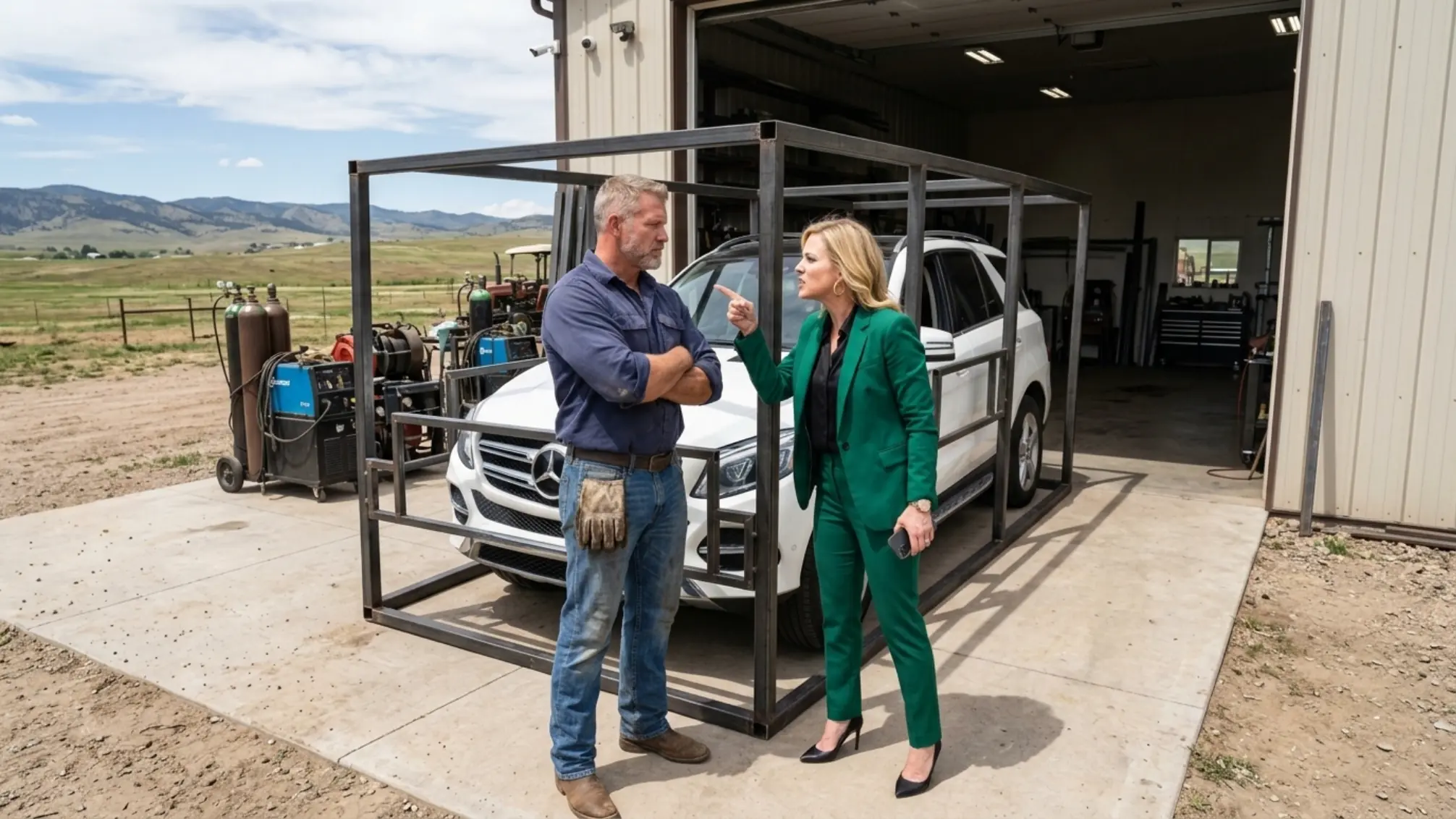
“Threaten my land again,” he said, “and you’ll leave without more than your car.”
Karen raised her phone as though preparing to summon an army. “I’ll bring contractors here and tear this workshop apart myself.”
Jack glanced through the Mercedes window toward the thick folder lying on its rear seat. “Bring them. The warrant team wants the file you left inside.”
The confidence vanished from her face.
Three days earlier, Karen had believed she controlled everything.
Jack Turner was fifty-two years old, a former Marine combat engineer, and the owner of Turner Steel and Ranch Fabrication outside Longmont, Colorado. For twenty years, he had built livestock gates, custom trailers, equipment racks, and machinery strong enough to survive cattle, winter storms, and careless operators. His hands were rough, his beard had turned mostly gray, and every shirt he owned smelled faintly of hot steel.
The workshop stood on land that had belonged to his family for decades. Eight open acres stretched behind the building toward a low eastern ridge, crossed by a gravel service road Jack and his late son had used while repairing fences. To anyone else, it might have looked like ordinary ranch property.
To Karen Whitmore, it looked like money.
She served as president of Silver Ridge Estates, a luxury HOA development west of Jack’s property. The neighborhood had large stone homes, decorative ponds, and expensive landscaping maintained by crews whose trucks arrived before sunrise. Karen ruled it through a mixture of polished charm, invented authority, and carefully targeted fear.
Her problem was that Silver Ridge could not expand east without crossing Jack’s land.
A development company wanted to build another seventy homes beyond the ridge. The shortest and most profitable access route ran directly through the workshop property and across the gravel road. Without Jack’s cooperation, the project required a longer road, additional utility work, and millions of dollars in added construction costs.
Karen first approached him four years earlier carrying blueberry muffins.
She stood on his porch wearing a cream blazer and a smile too bright to be trusted. After ten minutes of talk about responsible growth and community opportunity, she offered him $220,000 for a strip of land behind the workshop.
Jack declined.
The second offer was larger. The third included assurances that he could keep using part of the road. The fourth arrived with a developer’s representative and language about inevitable progress.
Jack gave the same answer every time.
“No.”
The land was where his son Ryan had learned to drive a tractor. It was where they repaired an old diesel engine together, argued over football teams, and welded a small scrap-metal tractor during the final winter before Ryan died in a highway accident. Selling the property would not merely transfer acreage.
It would erase the shape of a life Jack was still learning how to survive without.
Karen never understood that, or she understood and considered it exploitable.
After Jack rejected her final offer, the violation notices began. Silver Ridge accused his workshop of creating visual blight even though his land sat outside the HOA boundary. Then came complaints about noise, stored equipment, commercial activity, fencing, drainage, and truck traffic.
None had legal authority.
Jack saved every document.
By the end of the first year, one thin folder had become a binder. By the second, the binder contained customer statements describing how Karen warned them that Turner Steel was under investigation. One rancher ignored her. Another canceled an $8,000 trailer order because he did not want legal trouble.
Karen was no longer trying to purchase the property.
She was trying to make Jack desperate enough to sell it.
His seventeen-year-old daughter Emma noticed the growing pile of papers on the kitchen table one evening. She asked why he did not throw the false notices away.
Jack held up the first one. “This isn’t a fine.”
“What is it?”
“Evidence that she keeps making the same mistake.”
Emma understood after that. She helped label dates, save voicemails, and back up security footage. The workshop eventually received six cameras covering the bays, storage shelves, yard, office entrance, and gravel driveway.
Jack had installed them for thieves.
Karen turned them into witnesses.
Two weeks before she drove onto his property, a maintenance worker from Silver Ridge arrived at Jack’s gate in an old pickup. His name was Greg Lawson, and fear followed him out of the truck.
Greg carried a small USB drive.
“She left this open on the community-center computer,” he said. “I think it explains everything.”
Inside Jack’s office, the drive revealed maps, emails, financial projections, and internal plans labeled PHASE THREE. The expansion would almost double Silver Ridge’s size. Jack’s property appeared on every important map, marked in yellow as the required access corridor.
Then he found the email.
It was one sentence from Karen to a development consultant.
If he won’t sell, make the property unusable.
Jack read it three times.
The complaints, customer interference, and fake enforcement notices were not random acts of an entitled HOA president. They were part of an organized pressure campaign tied to a development worth millions.
Jack copied the files onto separate drives and contacted Pamela Whitcomb, an attorney known for noticing what other lawyers missed. She reviewed the documents and called the next morning.
“Do not confront her yet,” Pamela warned.
“Why?”
“Because she’s desperate. Desperate people create better evidence than careful people.”
Karen proved her right thirteen days later.
Jack was buying welding gas in town when Emma called from home. She had stayed home from school with a low fever, and her voice was far too controlled when Jack answered.
“Dad, Karen’s here.”
“At the house?”
“No. She drove into the workshop.”
Jack initially laughed because the sentence made no sense. Then his security application sent an alert.
Karen’s white Mercedes GLS was parked twenty feet inside the main fabrication bay.
She walked between welding tables in sunglasses and a white blazer, recording everything on her phone. Two contractors followed her, photographing steel racks and machinery while she described imaginary safety violations.
Jack set down the gas cylinder and ran for his truck.
During the drive home, he watched the camera feed on the dashboard. Karen opened storage cabinets, measured the rear wall, and pointed toward the eastern service road. Her behavior looked less like an inspection and more like preparation.
Then Emma spoke again.
“Dad, she knocked over Ryan’s tractor.”
Jack looked at the screen.
The small metal tractor lay on its side beneath the storage shelf. One wheel had snapped away and rolled across the concrete. The object had almost no financial value, but Ryan’s hands had shaped half its parts.
Jack’s anger did not explode.
It became cold.
“Are you safe?” he asked.
“I locked the house.”
“Stay there.”
When Jack reached the ranch, a sheriff’s cruiser was entering behind him. Emma stood on the porch holding her phone while Deputy Mark Reynolds walked toward the workshop.
Karen waited inside beside the Mercedes, visibly annoyed that Jack had returned with law enforcement instead of apologizing.
“You need to explain why your daughter is filming me,” she demanded.
Mark looked toward the fixed cameras. “Those belong to the property owner.”
Karen’s mouth tightened.
They reviewed the footage inside Jack’s office. One camera showed her driving through the gate. Another recorded her entering without permission. A third captured her directing the contractors to measure sections of the workshop.
Her own livestream supplied even stronger evidence.
Karen openly admitted she was not a county inspector, had no warrant, and had not spoken to Jack before entering. She called the visit an “independent HOA compliance investigation,” even though Jack’s property had never belonged to Silver Ridge.
Then the recording reached the moment when she backed into the shelf.
The small tractor fell.
Karen looked directly at it, saw the broken wheel, and continued filming without a word.
Emma lowered her eyes.
Jack said nothing.
Mark closed the laptop. “Ma’am, you need to leave.”
Karen laughed. “I’m not finished.”
“You are now.”
She picked up her purse and reached for the Mercedes keys.
Mark shook his head. “The vehicle stays until the scene is fully documented.”
Her expression changed. “You are not keeping my car.”
“It is inside a documented trespass scene and may contain relevant materials.”
“This is an HOA matter.”
“No,” Mark said. “It’s private property.”
For ten minutes, Karen threatened lawsuits, called attorneys, and claimed the deputy was interfering with official community business. None of it moved the Mercedes.
One of the contractors finally offered her a ride.
Before leaving, Karen looked directly at Jack. The expression carried no apology, only fury and calculation. She believed the car would be returned as soon as her lawyer made the correct call.
Jack watched the truck disappear down the gravel road.
Then he looked at Ryan’s broken tractor.
An idea formed.
Pamela’s reaction over the phone was immediate. “Do not damage the vehicle.”
“I won’t.”
“Do not weld anything to it.”
“I won’t.”
“What exactly are you planning?”
Jack explained.
The following morning, he began fabricating a removable steel frame around the Mercedes. Four upright posts stood outside the vehicle’s corners. Crossbars connected them overhead, while steel panels blocked the doors without touching the paint, windows, handles, or body.
Every connection used bolts and removable locking pins.
Emma recorded the entire construction process.
The purpose was preservation, not destruction. The Mercedes could be released without damage once investigators completed their documentation. Until then, no one could secretly remove the vehicle or anything inside it.
By noon, the luxury SUV looked like a museum exhibit for wealthy trespassers.
Jack attached a laminated sign:
EVIDENCE-PRESERVATION STRUCTURE. DO NOT TAMPER. CONTACT LEGAL REPRESENTATIVES BEFORE REMOVAL.
A friend of Karen’s drove past that afternoon.
Within hours, photographs were spreading through Silver Ridge. Residents who had feared Karen for years saw her Mercedes sitting behind steel bars inside the workshop she had illegally entered.
Karen returned the next morning wearing an emerald-green pantsuit and bringing an attorney.
She marched directly toward Jack.
“Cut that cage off my Mercedes, or I’ll destroy this filthy ranch.”
Jack stood in front of her with his arms crossed. “Threaten my land again, and you’ll leave without more than your car.”
“I’ll bring contractors here and tear this workshop apart myself.”
“Bring them.”
Karen stepped close enough for Jack to smell her perfume. “You think this little stunt makes you powerful?”
“No. The cameras make you accountable.”
Her attorney examined the enclosure carefully. Nothing touched the vehicle. Nothing had been welded to it. The warning notice referenced active documentation, and Pamela was already waiting for his call.
The attorney pulled Karen aside.
They argued quietly for several minutes before leaving.
At noon, she returned with a heavy tow truck.
The driver walked around the steel structure, read the notice twice, and asked Jack whether the vehicle was connected to an open investigation. Jack showed him Deputy Reynolds’s contact information.
The driver called.
Then he returned to Karen.
“I tow cars, ma’am. I don’t tow evidence.”
He climbed into his truck and left.
Karen remained beside the workshop, staring at the Mercedes as though Jack had imprisoned a member of her family. She pointed at him from across the yard.
“This is not over.”
Jack looked toward the cameras. “Keep talking.”
She left.
The discovery inside the Mercedes happened the next morning.
Jack was repairing Ryan’s broken tractor wheel when Emma stopped beside the steel enclosure. She stared through the passenger-side window and called him over.
A large folder lay partly open on the rear seat.
The label read PHASE THREE.
A rolled development map protruded from the side.
Jack immediately contacted Pamela and Deputy Reynolds. Mark arrived, photographed the visible documents through the glass, and called county investigators.
Nobody opened the vehicle.
They did not need to.
The folder, title, and map were visible from outside. Their existence matched the files Greg had copied from the community-center computer. What had previously looked like leaked information now had independent physical corroboration.
Karen had driven evidence of her hidden project directly into Jack’s workshop.
Pamela spread printed copies of the USB documents across a welding table. The maps showed identical access routes, lot designs, and development projections. The yellow corridor passed directly through Jack’s property.
“She brought this here herself?” Mark asked.
“Apparently,” Jack said.
Pamela shook her head. “People normally separate themselves from damaging evidence.”
“Karen isn’t used to anyone checking.”
That was the difference.
She had mistaken years of successful intimidation for intelligence. Nobody challenged her, so she assumed every action was clever. In reality, fear had protected her from scrutiny.
Now the scrutiny had begun.
Three days later, a judge signed the first search warrant.
County investigators entered the Silver Ridge HOA office, Karen’s home office, and the headquarters of Mountain View Development Services. The consulting company had appeared repeatedly throughout the Phase Three files but had never been disclosed to homeowners.
Its registered address led investigators toward Karen’s husband.
Payments traveled through a chain of accounts and consulting agreements. Contractors approved by the HOA had transferred money to businesses connected to the Whitmore family. Karen’s pressure campaign against Jack made more sense with every subpoena.
If his land could be forced into sale, Phase Three could proceed.
If Phase Three proceeded, Karen’s family stood to profit.
The first major change inside Silver Ridge was not legal.
It was social.
Residents stopped believing her.
People compared violation notices and discovered patterns. Those who had been fined for landscaping, fences, driveways, and parked vehicles began sharing documents. Contractors admitted Karen had pressured them to participate in enforcement actions.
Greg spoke openly for the first time.
A retired accountant named Richard Benson, once one of Karen’s most loyal supporters, called Jack and asked whether the allegations were real.
“Which allegations?” Jack asked.
“All of them.”
Jack did not celebrate.
A collapsing organization could still hurt people. He shared the public documents, encouraged residents to retain their own lawyers, and allowed investigators to work.
The emergency HOA meeting occurred the following Thursday.
Normally, fewer than twenty people attended. That evening, the community-center parking lot overflowed into the street. Homeowners arrived carrying binders, printed emails, and years of unanswered questions.
Jack sat near the back with Emma.
Karen entered exactly at seven, wearing a perfect suit and the expression of a woman determined to restore an old performance. She opened with a statement accusing unnamed individuals of spreading misinformation to damage Silver Ridge.
Several people laughed.
Karen struck the gavel.
Richard stood. “Is Phase Three real?”
“Certain planning discussions occurred—”
“That is not what I asked.”
The room became quiet.
Greg spoke from the rear wall. “Tell them about the access maps.”
Karen’s face changed.
Pamela walked forward and placed enlarged copies of public documents on display boards. One showed the proposed expansion. Another highlighted Jack’s property. A third listed projected HOA revenue after completion.
Questions erupted.
Why had homeowners never voted on the expansion? Why was Karen’s husband connected to the consulting company? Why had HOA enforcement focused so aggressively on Jack’s workshop? Why were approved contractors making payments to a private LLC?
Karen struck the gavel again.
Nobody stopped.
For years, she had controlled information. Now every person in the room possessed a piece of it.
Then Deputy Reynolds entered with two county investigators.
The room fell silent.
“Karen Whitmore,” Mark said.
She stared at him from behind the board table.
He repeated her name.
Karen slowly stood. Her eyes moved across the maps, the residents, Greg, Pamela, and finally Jack. There was no anger left in her expression.
Only fear.
The investigators escorted her from the room for questioning. The board suspended her authority that night, and Silver Ridge’s attorney advised every remaining member to preserve records.
The investigation lasted months.
Financial analysts examined accounts. Prosecutors authenticated emails. Civil attorneys reviewed years of fines and contracts. The evidence showed that Karen’s campaign against Jack had been connected to the planned development and the financial interests surrounding it.
The trespass into the workshop became one part of a much larger case.
Her livestream proved she entered without authority. Security footage showed property damage. The Mercedes contained project material linked to the hidden expansion. The USB files revealed intent.
The strongest sentence remained the simplest:
If he won’t sell, make the property unusable.
Silver Ridge removed Karen as president.
The board canceled unsupported fines, commissioned an independent audit, and reviewed every contractor relationship she had approved. Residents received refunds, and several suppliers were banned from future work.
The development project collapsed.
Without Jack’s access corridor and with its internal dealings exposed, Phase Three lost both financing and political support. The land beyond the ridge remained undeveloped.
Karen’s Mercedes eventually left the workshop under investigator supervision. Jack removed the steel enclosure piece by piece, leaving no mark on the vehicle.
He kept one short section of square tubing.
Not as a trophy.
As a reminder that patience often outlasted arrogance.
Life returned slowly.
Customers who had canceled projects came back. New ranchers arrived after hearing how Jack had handled the situation without destroying the Mercedes or physically confronting Karen. The workshop filled again with gate frames, trailer parts, and the clean blue flash of welding arcs.
One Saturday, Jack placed Ryan’s small tractor on the main workbench.
Emma brought two cups of coffee and sat beside him.
The broken wheel required a little welding, grinding, and paint. Jack worked slowly, preserving every crooked detail Ryan had left behind. By late afternoon, the tractor stood upright again.
Emma studied it. “You fixed it.”
Jack shook his head.
She frowned.
He touched the metal roof gently. “It was never the part that broke.”
Emma understood.
A few months later, Jack used part of the civil settlement to establish the Ryan Turner Trade Scholarship. It helped local students study welding, mechanics, fabrication, and other skilled trades.
The first recipient was a quiet eighteen-year-old boy who wanted to build agricultural equipment. During the ceremony, Jack noticed the boy’s mother crying in the back row.
Ryan would have liked that.
One evening, Jack and Emma stood outside the workshop watching sunlight fade across the same eastern pasture Karen had tried to seize. The gravel road remained rough, the cottonwoods still bent with the wind, and the steel building still offended anyone who believed ranch work should look decorative.
Emma leaned against the fence. “Do you ever think about her?”
“Not much.”
That answer surprised Jack only because it was true.
Karen had once consumed years of his attention. Her notices filled binders. Her threats reached customers. Her project nearly cost him his business and his land.
Now she was only the person who made one catastrophic mistake.
She drove her Mercedes onto property she did not own, entered a workshop where she had no authority, damaged the last object Jack had built with his son, and abandoned the documents that connected her to the scheme she had spent years hiding.
She thought the white SUV displayed power.
Instead, it became a container for evidence.
She thought Jack’s workshop was an obstacle.
Instead, it became the place where her entire operation was recorded, preserved, and exposed.
The steel cage had never been the real punishment.
Neither was the tow truck refusing her demand, the photographs spreading through the neighborhood, or the humiliation of seeing her Mercedes trapped inside a building she had invaded.
The real consequence arrived when residents stopped being afraid.
Once they began comparing stories, Karen’s authority disappeared. Once investigators began comparing documents, her explanations collapsed. Once Jack’s cameras showed what had actually happened, her confidence could no longer rewrite reality.
Months later, Ryan’s tractor sat safely on its shelf.
The workshop doors remained open to the evening air. Jack’s tools rested where they belonged, and no luxury vehicle occupied the center bay.
Outside, the land remained his.
Karen Whitmore had spent four years attempting to force him away from it.
In the end, she delivered the evidence that saved it directly to his workshop—and parked it exactly beneath the cameras.