Clare Phillips ignored the first PRIVATE PROPERTY sign because she believed rules were flexible whenever they inconvenienced her. She ignored the second sign because she was president of the Whispering Pines Homeowners Association, a position she treated like ownership of every road, fence, and field visible from her subdivision. By the time she drove around the third barrier, the white luxury SUV carrying the HOA emblem was already sinking into Brandon Rogers’s ranch road. The harder Clare pressed the accelerator, the deeper the tires buried themselves in the mud.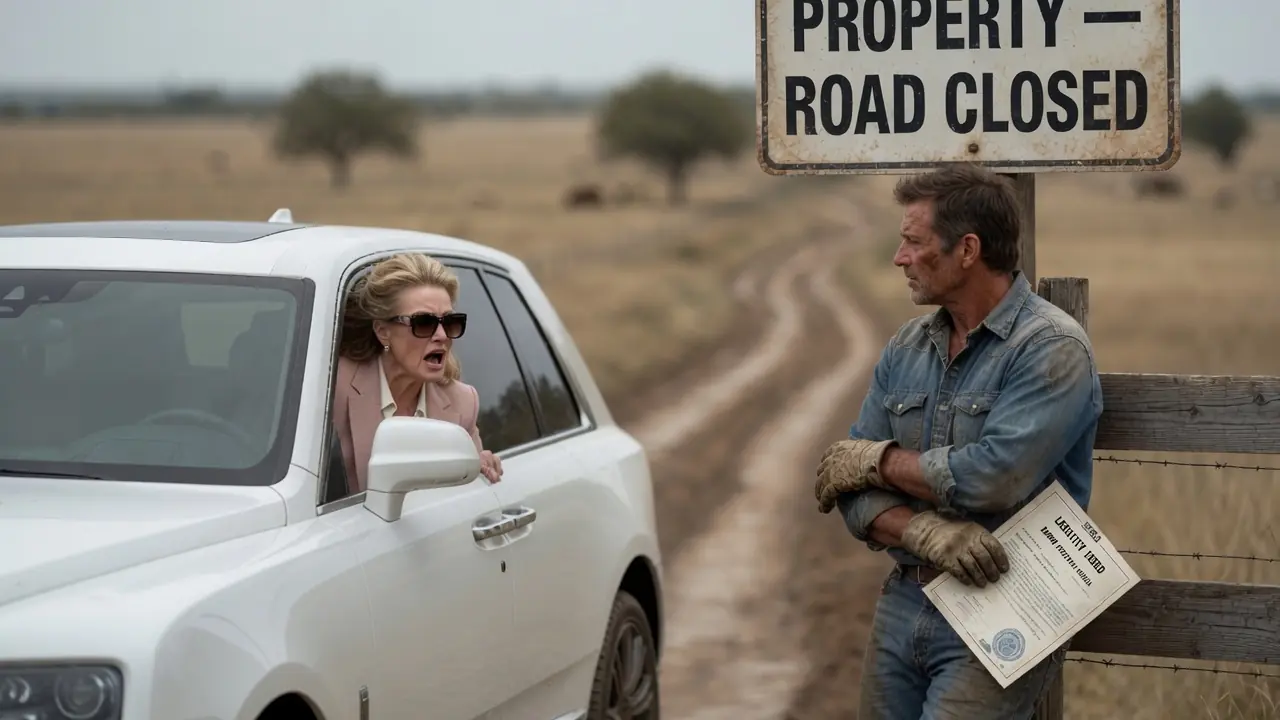
Brandon watched from beside his cattle fence, one gloved hand resting on the top rail. At forty-seven, he had weathered skin, short brown hair, and the steady patience of a man who had repaired the same land after droughts, floods, and winter storms. He wore a faded denim shirt, dusty jeans, and old leather boots that had crossed every acre of Rogers Ranch more times than he could count. Unlike Clare, he understood that dirt remembered how people treated it.
The rear wheels spun again.
Mud flew across Clare’s pink blazer, expensive trousers, and oversized designer sunglasses. The SUV rocked but did not move forward or backward. Its front bumper had settled low enough that wet earth pressed against the lower grille.
Clare slammed both hands against the steering wheel.
Then she opened the door and stepped directly into ankle-deep mud.
“You ruined this road just to trap me!” she shouted.
Brandon did not move from the fence. “You drove around three barriers.”
“You knew I use this route every morning.”
“That is why I closed it.”
Clare pointed toward the half-buried SUV. “Pull my car out now.”
Brandon removed a folded document from his shirt pocket. “You drove past three warnings because you thought my land belonged to your HOA.”
“I’ll fine you until this ranch is taken from you!”
Brandon looked toward the SUV as it settled another inch. “Call your board. The sheriff is already coming to explain why your car is buried on private property.”
Clare stared at him as though no one had ever answered her threat without fear.
Six months earlier, Whispering Pines had not existed.
The subdivision appeared almost overnight across the creek from Rogers Ranch, replacing eighty acres of scrubland with beige houses, decorative stone entrances, artificial ponds, and roads named after trees that had never grown there. Its developers advertised peaceful country living only twenty minutes from the city. Buyers received large homes, landscaped yards, and a view of Brandon’s open fields without being told those fields belonged to a working cattle operation.
Brandon did not object to the development.
He had no interest in controlling what others built beyond his property line. He only expected the new residents to respect the fences, leave his livestock alone, and use the paved road connecting their neighborhood to the highway. Most of them did.
Clare Phillips did not.
She became HOA president before the final house was sold. Her white SUV carried a removable magnetic sign reading WHISPERING PINES COMMUNITY LEADERSHIP, and she drove through the subdivision several times a day searching for violations. Trash cans remained outside too long, porch furniture failed to match approved colors, and children’s bicycles created what she called “visual disorder.”
The official neighborhood entrance added nearly eight minutes to Clare’s drive into town.
Brandon’s ranch road reduced that time to two.
The dirt lane began at the highway, crossed the western edge of Rogers Ranch, passed the cattle barn, and ended near a locked agricultural gate beside Whispering Pines. Years earlier, before the subdivision existed, Brandon had used the route to move feed trucks and equipment. The developers built their fence near the end of it but left a maintenance gate between the properties.
One morning, Brandon found the chain cut.
Fresh tire tracks crossed his road.
He followed them to the subdivision and saw Clare’s white SUV turning toward her house. At first, he assumed the cut chain had been the work of a contractor. He replaced it, installed a stronger lock, and placed a small private-road sign beside the gate.
The following morning, the lock disappeared.
Clare’s SUV crossed the ranch at seven thirty-two.
She raised two fingers in a cheerful wave as she passed Brandon feeding cattle.
He drove to her home that afternoon.
Clare answered the door wearing tennis clothes and an expression suggesting he had interrupted an important meeting. Brandon explained that the ranch road was private and asked her to stop using it.
She smiled.
“We’re all neighbors, Mr. Rogers.”
“Neighbors ask permission.”
“The gate connects our properties.”
“The gate was built for maintenance.”
“The HOA considers it an emergency-access point.”
“Your HOA has no authority on my ranch.”
Her smile faded slightly. “I’ll review the maps.”
“There’s nothing to review.”
Clare closed the door before the conversation had properly ended.
The next week, Brandon installed a larger sign at the highway entrance.
PRIVATE ROAD — NO TRESPASSING — WORKING RANCH
Two mornings later, he found it broken behind a stack of hay bales.
Security footage showed Clare’s SUV striking the wooden post, pausing briefly, then continuing across the road. She did not get out to inspect the damage. She simply drove over the fallen sign and disappeared toward town.
Brandon saved the video.
He replaced the sign with a metal one mounted between concrete posts.
Clare drove around it.
When he parked his truck across the road and waited for her, she finally stopped. She lowered her window only a few inches, keeping her sunglasses on despite the early hour.
“You’re blocking community access,” she said.
“This is not community access.”
“The HOA voted last night to recognize the road as a shared convenience route.”
Brandon thought she was joking.
“You voted on my land?”
“We voted on neighborhood mobility.”
“You cannot rename trespassing and make it legal.”
Clare sighed as though explaining something obvious to a stubborn child. “Mr. Rogers, refusing cooperation harms community harmony.”
“Driving through my cattle operation without permission harms my fence, my road, and possibly someone’s life.”
“I drive carefully.”
“You were doing forty yesterday.”
“I was late.”
“That does not change ownership.”
Clare lifted her chin. “The board will contact you.”
She reversed, turned across the grass, and left through the subdivision. Brandon believed the conversation had finally ended the shortcut.
The next morning, she drove across again.
Soon other vehicles followed.
A landscaper used the road to avoid the subdivision entrance. Then two residents crossed in golf carts. A delivery driver told Brandon that Clare had instructed service vehicles to use the “western community exit.”
The dirt lane began deteriorating under traffic it had never been designed to carry.
Deep ruts appeared after rain. Dust coated the nearby cattle troughs during dry days. One SUV frightened a young steer through a weak section of fence, forcing Brandon to spend hours recovering it from the creek.
He sent a certified letter to the HOA.
The board responded with a laminated notice claiming Rogers Ranch had become subject to “regional community-adjacency standards.” It ordered Brandon not to obstruct the lane and threatened daily fines for limiting neighborhood access.
The notice carried no county seal, no legal citation, and no signature except Clare’s.
Beside her name, she had drawn a smiley face.
Brandon placed the letter in a folder with the videos, photographs, and damaged signs.
Then he called county surveyor Helen Price.
Helen arrived the following afternoon with maps dating back more than fifty years. She confirmed what Brandon already knew: every inch of the dirt road lay within Rogers Ranch. No public easement existed, and the subdivision’s original development agreement specifically required Whispering Pines to use its own paved entrance.
“Can they vote themselves access?” Brandon asked.
Helen laughed. “I can vote to own your cattle. That doesn’t mean they follow me home.”
She marked the property corners again and provided Brandon with certified copies of the boundary survey. He sent one to Clare.
She returned it with a note written across the front.
DISPUTED BY HOA BOARD.
That was when Brandon stopped believing the situation could be solved through polite explanation.
Still, he did not plan a trap.
The mud existed because the western section of the road required drainage repairs. Summer storms had washed away part of the gravel base, and water collected near a natural dip after every heavy rain. Brandon scheduled the work with his friend Derek Miller, who owned a backhoe and grading equipment.
They closed the road legally.
Brandon installed a heavy chain at both entrances, placed reflective barriers across the lane, and added warning signs reading:
ROAD CLOSED — ACTIVE DRAINAGE REPAIR — SOFT GROUND
The county confirmed that no permit was needed for maintenance entirely within private agricultural property. Brandon also positioned trail cameras near the barriers because Clare had already destroyed two signs.
The night before the repair began, heavy rain fell for nearly seven hours.
By sunrise, the low section had turned into a deep mud basin. Derek recommended waiting one day before bringing in the backhoe. The saturated road could not support heavy equipment, much less a luxury SUV moving at speed.
Brandon locked both gates.
At seven thirty the next morning, a trail-camera alert appeared on his phone.
Clare’s SUV stopped at the highway barrier.
She got out wearing a pink blazer, white blouse, fitted trousers, and expensive brown boots. She read the warning sign, photographed it, then removed one of the lightweight side posts from the soft shoulder.
After widening the gap, she drove around the barrier.
Brandon watched the live camera feed from the barn.
He called the sheriff’s office immediately.
Then he walked toward the low section of road.
Clare never slowed down.
Her SUV rounded the bend, crossed the first muddy ruts, and began sliding. She pressed the accelerator instead of stopping. The heavy front wheels cut through the softened surface and dropped into the saturated section.
The vehicle sank almost to its axles.
Clare continued spinning the tires until the road beneath them became liquid mud.
That was where Brandon found her.
By the time Sheriff Cole Matthews arrived, Clare had called the HOA board, her insurance company, a tow service, and someone she described loudly as “regional counsel.” She paced beside the SUV, pointing at Brandon and demanding his immediate arrest.
Sheriff Matthews was a broad-shouldered man in his late fifties with tired eyes and the expression of someone who had already heard too much before finishing his first coffee.
He examined the barriers.
Then he examined the signs.
Finally, he looked at the deep tire marks showing where Clare had driven around them.
“Mrs. Phillips,” he said, “why did you enter a closed private road?”
“It is not private.”
Brandon handed him the certified survey.
Clare stepped between them. “That map is under HOA dispute.”
Matthews unfolded it. “The county recorder does not appear to care about your dispute.”
“Our board voted to recognize an access right.”
“A homeowners association cannot vote on property outside its boundary.”
“This road serves the community.”
“This road serves his ranch.”
Clare pointed toward the SUV. “He deliberately created hazardous conditions.”
Brandon gestured toward the repair signs. “The storm created the mud. I closed the road because it was unsafe.”
“You knew I would come through.”
“I knew you might ignore the barriers. That is why I called your office when the camera showed her entering.”
Matthews looked toward the nearest trail camera. “You have footage?”
“Every second.”
Clare removed her sunglasses. “This was entrapment.”
“No one invited you onto the road,” the sheriff replied.
“He has been hostile from the beginning.”
“He asked you not to trespass.”
“He refuses cooperation.”
Matthews sighed. “Ma’am, refusing to surrender private land is not hostility.”
The tow truck arrived twenty minutes later.
Its driver, Roy Jenkins, walked around the SUV twice before scratching his beard. The mud reached above the front wheel hubs, and the undercarriage rested against the softened ground.
“You kept spinning after it sank?” he asked.
“I was trying to get out.”
“That buried it deeper.”
“Can you pull it free?”
“Not with this truck.”
Clare stared at him. “What do you mean?”
“I mean I need a heavier recovery vehicle, ground anchors, and probably boards under the tires.”
“How long?”
“Several hours.”
“I have a meeting in town.”
Roy looked toward Brandon. “She serious?”
Brandon said nothing.
Clare ordered the tow operator to begin immediately. Roy explained that he could not position his truck safely on the unstable road. The vehicle would have to remain until the ground strengthened or additional equipment arrived.
Clare turned toward Sheriff Matthews. “Force him to repair this.”
“The road is already scheduled for repair.”
“Then force him to pull out my vehicle.”
“He is not required to use ranch equipment for a vehicle trespassing on his land.”
Mud shifted beneath the SUV.
The front end settled lower.
Clare’s face tightened. “Do something!”
Brandon looked at her calmly. “I did. I closed the road.”
Matthews wrote Clare a citation for criminal trespass and property damage involving the removed barrier. He also documented the destroyed signs from earlier incidents after reviewing Brandon’s video evidence.
Clare refused to sign the citation.
The sheriff explained that her signature acknowledged receipt rather than guilt.
She signed so aggressively that the pen tore the paper.
Before leaving, Matthews advised Brandon not to touch the SUV until the recovery company assumed responsibility. He also told Clare that any further entry onto Rogers Ranch could lead to arrest.
“You’re taking his side,” she said.
“I’m taking the property line’s side.”
The recovery crew returned that afternoon with two trucks and a compact crane.
Several Whispering Pines residents gathered behind the subdivision fence to watch. Some carried phones. Others stood silently, clearly afraid that Clare might notice them enjoying the scene.
Chains were attached to the SUV’s frame.
The first pull failed.
Mud held the tires with enough suction to strain the winch. The second attempt lifted the front end briefly before one recovery board snapped and disappeared beneath the vehicle.
Clare shouted instructions until Roy told her to step away.
“You’re making this worse,” she said.
“No, ma’am. The mud made it bad. You driving into it made it worse.”
The third attempt succeeded.
The SUV emerged slowly, coated from bumper to roofline with brown mud. Its front trim had loosened, one wheel sat at an unnatural angle, and the engine warning light remained illuminated.
Clare nearly cried when she saw it.
Then she turned toward Brandon.
“You will pay for every dollar.”
Brandon held up the certified map. “Send the invoice with your legal claim.”
She did.
Three days later, Brandon received a demand for forty-eight thousand dollars covering vehicle damage, towing expenses, emotional distress, missed appointments, and what Clare called “loss of leadership credibility.” The letter came from Douglas Phillips, her cousin, who described himself as HOA legal counsel.
A quick search revealed Douglas had never passed the state bar.
Brandon hired Mara Pritchard, a land-rights attorney known for dismantling fraudulent easement claims. She reviewed the evidence, watched the camera footage twice, and smiled at Clare’s letter.
“She drove around marked barriers?”
“Yes.”
“After receiving the survey?”
“Yes.”
“While knowing the road was closed?”
“The camera recorded her reading the sign.”
Mara closed the folder. “Then she has written us a very expensive apology without realizing it.”
They filed a civil claim for repeated trespass, destruction of signs, damage to the ranch road, interference with agricultural operations, and unauthorized attempts to claim an easement. Mara also requested an injunction permanently prohibiting Whispering Pines from using the road.
The HOA board began panicking.
Several members contacted Brandon privately and admitted Clare never showed them the certified survey. She had told them the ranch road was abandoned county property and that Brandon was illegally blocking a public connection.
Treasurer Harold Jennings provided copies of meeting minutes.
Clare had altered them.
The board had discussed requesting permission to use the road. The final record, edited after the meeting, claimed they had voted to establish access without Brandon’s consent.
When board members confronted her, Clare accused them of betrayal.
She called an emergency neighborhood meeting and displayed photographs of her mud-covered SUV as proof that Brandon endangered the community. She described the road as a necessary evacuation route and claimed he had created a hidden pit.
Brandon attended with Mara.
The community center filled quickly.
Clare stood beside a projector screen wearing an ivory suit and dark sunglasses, though the meeting was indoors. She described herself as a victim of rural aggression and demanded that the board finance her lawsuit.
Then Mara placed the trail-camera footage on the screen.
Everyone watched Clare stop at the barrier.
They watched her read the warning.
They watched her remove the post, drive around the closure, and accelerate toward the muddy section.
No hidden pit appeared.
No invitation appeared.
Only a woman choosing to ignore every visible warning.
The room remained silent after the video ended.
Harold turned toward Clare. “You told us the barrier had fallen.”
“It was improperly positioned.”
“You moved it.”
“For community access.”
“There was no community access.”
Clare pointed toward Brandon. “He manipulated the footage.”
Mara presented authenticated timestamps and the sheriff’s report. “The county has already preserved copies.”
Another board member asked about the altered meeting minutes.
Clare denied changing them.
Harold produced the original handwritten notes.
The difference was obvious.
By the end of the meeting, the board voted to remove Clare as president pending an audit. She protested, threatened lawsuits, and announced that Whispering Pines would collapse without her leadership.
No one changed their vote.
The court hearing occurred six weeks later.
Clare arrived with Douglas, who was allowed to sit beside her but not represent her legally. A licensed attorney hired through her insurance company handled the case and appeared increasingly frustrated by his own client.
Judge Eleanor Wade reviewed the property records first.
The original subdivision agreement required Whispering Pines to maintain a separate paved connection to the highway. It explicitly prohibited access through existing agricultural roads without written permission from the landowner.
No written permission existed.
The judge then watched the videos showing Clare’s repeated trespasses, the destroyed signs, and the morning her SUV entered the closed road.
Her attorney argued that Brandon knew the road was dangerous and should have installed stronger barriers.
Mara answered calmly. “The law requires reasonable warning, not a fortress designed to contain a determined trespasser.”
The judge agreed.
Clare insisted the mud had been engineered to damage her vehicle. Brandon explained the drainage project and submitted weather records showing more than four inches of rain fell the previous night.
Derek testified that work had been postponed because the ground was too soft for the backhoe.
Sheriff Matthews confirmed the site contained visible barriers, reflective warnings, and no concealed excavation.
Finally, Clare testified.
She said she believed the HOA vote gave her lawful access.
Mara handed her the certified survey notice she had received twelve days before the incident.
“Is this your signature acknowledging delivery?”
Clare hesitated. “Yes.”
“And this email states clearly that the HOA held no easement?”
“That was one interpretation.”
“It was written by the county recorder.”
“County offices make mistakes.”
“Did you obtain a court order granting access?”
“No.”
“A county permit?”
“No.”
“Written permission from Mr. Rogers?”
“He would never cooperate.”
“So you knew you lacked permission.”
Clare looked toward the judge. “The road should have belonged to the community.”
Judge Wade leaned forward. “Property ownership is not determined by what you believe should belong to you.”
The court ruled entirely in Brandon’s favor.
Whispering Pines and Clare were ordered to compensate him for road repairs, damaged signs, legal expenses, and interference with ranch operations. The HOA received a permanent injunction prohibiting residents, contractors, and board members from entering Rogers Ranch without written authorization.
Clare’s vehicle claim was dismissed.
The judge also forwarded the altered meeting records to state investigators.
Outside the courthouse, reporters asked Brandon whether he felt victorious.
He looked toward the cameras.
“I feel tired.”
“Do you regret allowing her vehicle to sink?”
“I did not allow it. I closed the road.”
“Would you help her if it happened again?”
“I would call professionals, just as I did the first time.”
“What lesson should homeowners associations learn?”
Brandon considered the question. “A vote does not erase a fence.”
Clare sold her Whispering Pines home three months later.
Before leaving, she sent Brandon one final letter accusing him of destroying her reputation. He placed it beside the earlier threats, surveys, photographs, and court orders.
Her reputation had not been destroyed by the mud.
It had been revealed by how far she drove after being told to stop.
The new HOA president visited Rogers Ranch personally. Harold Jennings carried no clipboard, no prepared notice, and no demands. He apologized for the board’s failure and explained that the neighborhood had approved construction of a proper secondary road within its own property.
“It should have been done from the beginning,” he said.
“Yes.”
“We want to repair the damaged section of your fence as part of the settlement.”
“Send me the plan first.”
Harold smiled. “That sounds reasonable.”
It was the first reasonable conversation Brandon had experienced with Whispering Pines.
The subdivision completed its new road before winter. It was paved, properly permitted, and connected directly to the highway. Residents discovered that using land legally was far less expensive than following Clare’s invented authority.
Brandon repaired the ranch lane.
He installed new drainage pipes, rebuilt the gravel base, and reinforced the shoulders. Near the section where Clare’s SUV had sunk, he placed another sign.
PRIVATE WORKING ROAD — PERMISSION REQUIRED
Beneath it, Derek attached a smaller handmade plaque.
MUD DOES NOT RECOGNIZE HOA AUTHORITY.
Brandon claimed he disliked the joke.
He never removed it.
A year later, wildflowers grew beside the repaired drainage ditch. Cattle moved calmly through the nearby pasture, and no unfamiliar vehicles crossed the ranch. The land had returned to the quiet rhythm it carried before Whispering Pines appeared.
Sometimes residents waved from the paved road beyond the fence.
Brandon waved back.
He had never wanted enemies.
He wanted boundaries.
Clare believed boundaries were insults because they limited her ability to control others. She broke signs, cut locks, altered records, and drove around barriers because each warning challenged the authority she had invented for herself.
That rainy morning, the ground finally gave her an answer she could not laminate, rewrite, or overrule.
Her luxury SUV sank into the mud.
The deeper she fought, the deeper it went.
And by the time the vehicle was pulled free, the entire county understood that the road had never belonged to her.