“You have seven days to leave this cabin.”
The woman standing at the foot of the porch raised a thick clipboard labeled HOA FORECLOSURE NOTICE as if the words alone gave her ownership of the land. She was a polished fifty-four-year-old white American HOA president with a sharp blonde bob, pearl earrings, a layered pearl necklace, and a dark-green double-breasted blazer fastened with gold buttons. Behind her, two moving trucks idled beside the gravel road while several neighbors watched from the tree line with their phones raised.
Thirty-seven-year-old Daniel Mercer remained beside the porch railing, holding a cup of coffee in one hand and the original deed to the cabin in the other. The handsome white American homeowner had lightly tanned skin, steady gray eyes, short dark-brown hair, and the strong build of someone who repaired his own roof instead of calling a contractor. He wore a charcoal henley shirt, faded jeans, and brown work boots stained with red Georgia clay.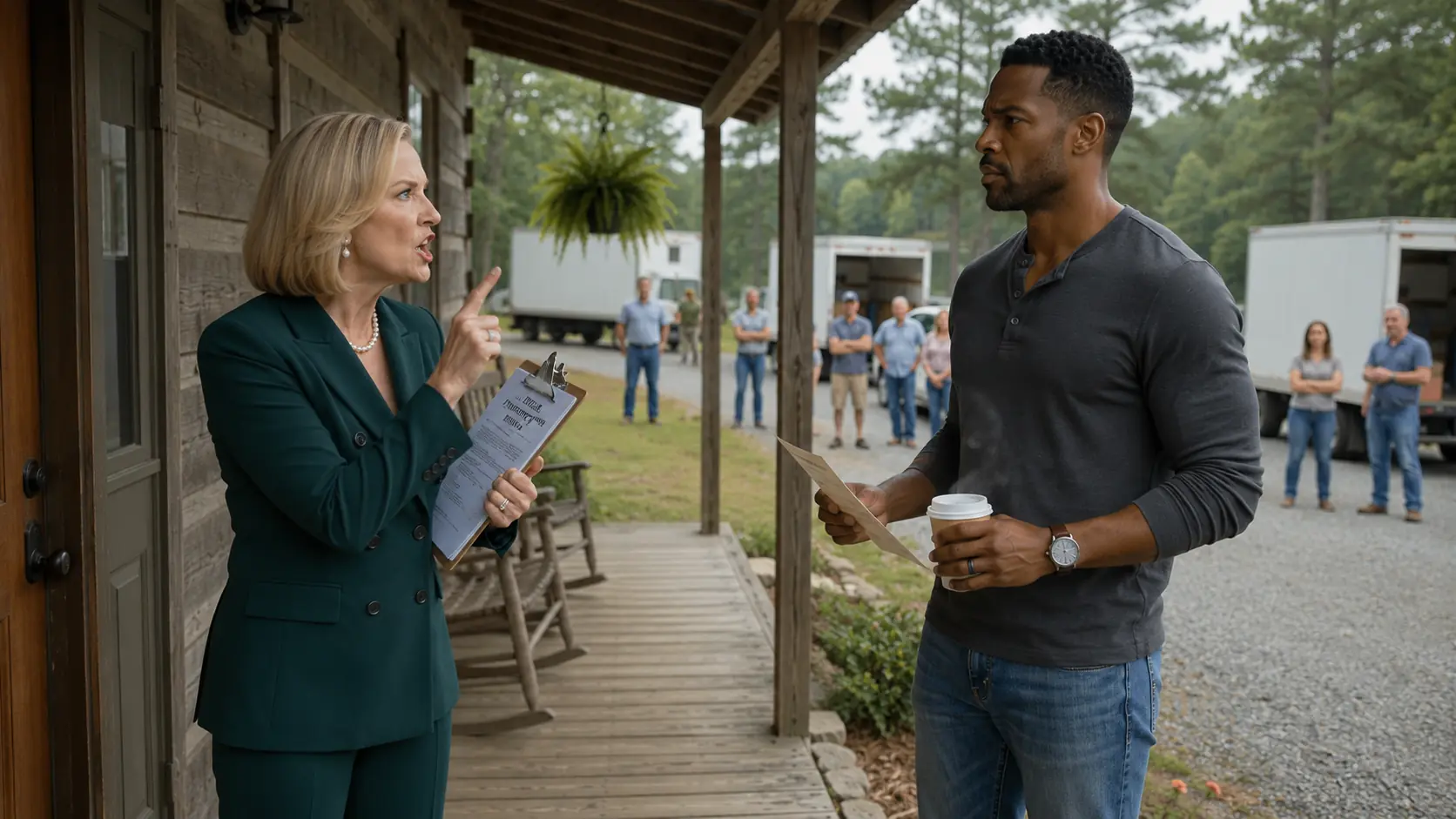
Daniel looked at the notice, then at the trucks.
“You brought movers before I agreed to leave?”
HOA President Vivian Cross gave him a thin smile.
“Your agreement is no longer necessary.”
The cabin stood beside a quiet lake in northern Georgia, surrounded by pine trees and a narrow strip of rocky shoreline. Its cedar siding had faded with age, the stone chimney leaned slightly to the left, and three porch boards creaked whenever anyone crossed them. It was not elegant, but Daniel’s father had built most of it by hand nearly forty years earlier.
Daniel had learned to fish from the old dock, split firewood behind the shed, and sleep through summer storms beneath the metal roof. After his father died, the cabin became more than property. It was the one place where grief felt less like an empty room and more like a voice carried gently across the water.
The Pine Crest Homeowners Association had been created long after the cabin was built. Its official boundary ended near Mile Marker Fourteen, where a line of expensive lake houses began behind stone entrance pillars. Daniel’s cabin sat three miles beyond that line on land recorded under a separate county parcel.
Vivian knew that.
At least, Daniel believed she did.
She stepped onto the porch without being invited and held the clipboard closer to his face. The printed pages carried the HOA logo, several highlighted paragraphs, and a red stamp reading FINAL ORDER. To someone unfamiliar with property law, it looked official enough to be frightening.
“This structure violates architectural standards, landscaping requirements, shoreline-access rules, and community-maintenance provisions,” Vivian said. “You have also failed to pay two years of association fees.”
“I’ve never been a member of your association.”
“Ownership carries automatic membership.”
“Not when the land sits outside your boundary.”
“The board voted to incorporate this parcel.”
Daniel almost laughed.
“You voted to take land that wasn’t yours?”
“We voted to correct an outdated mapping error.”
Vivian’s answer came too quickly. She had rehearsed it, probably in front of a mirror, along with the exact angle at which she would hold the notice. Everything about her—from the pressed white trousers to the black heels sinking slightly into the soft ground—suggested she expected the confrontation to end with Daniel surrendering.
He opened the deed and pointed to the parcel description.
“Lot Seventeen, Mercer Lake Tract. Recorded eleven years before Pine Crest existed.”
Vivian did not look at the page.
“That document is outdated.”
“The county renewed it when my father transferred the property to me.”
“The HOA’s attorney disagrees.”
“Then your attorney should learn to read a map.”
The neighbors near the road murmured. Vivian’s shoulders stiffened when she heard them. Public humiliation disturbed her far more than legal uncertainty.
She lowered her voice.
“You have mistaken patience for weakness, Mr. Mercer. I have removed difficult homeowners before.”
“I’m not one of your homeowners.”
“You will be after the annexation is finalized.”
“Annexation requires the owner’s consent.”
“The board has alternative options.”
Daniel looked toward the moving trucks.
“Is that what those are?”
Vivian turned and gestured toward the vehicles. Two men in black polo shirts stood beside the larger truck, trying to appear official while avoiding eye contact with Daniel. A stack of empty boxes and furniture pads was visible through the open rear door.
“They are here to help you relocate your belongings peacefully,” she said.
“From my own cabin?”
“From a property currently under association control.”
Daniel set his coffee on the railing.
“You need to leave.”
Vivian smiled again.
“No. You do.”
Inside the cabin, Daniel’s sixty-eight-year-old mother sat beside the front window with a cup of tea and a county plat map spread across the old oak dining table. Margaret Mercer had silver hair pulled neatly away from her face, intelligent gray eyes, and the quiet posture of someone who had spent twenty-three years presiding over courtrooms.
She had heard every word.
Daniel had invited her to the cabin for a week of rest, not to become part of another legal conflict. Margaret was a sitting state judge, but she had always separated her public role from her private life carefully. At the cabin, she wanted to be the woman who read mystery novels by the fire and complained that her son put too much salt in the soup.
Vivian’s arrival changed that.
Margaret studied the HOA notice through the window and recognized several problems before finishing the first page. The association cited county ordinances that did not govern Daniel’s parcel. The supposed foreclosure order contained no court name, no case number, no filing stamp, and no signature from an authorized official.
It was not a court order.
It was a scare tactic designed to look like one.
Outside, Vivian raised her voice so the neighbors could hear.
“If you obstruct the board’s lawful recovery of this property, the sheriff will be called.”
Daniel folded the deed.
“Please call him.”
Vivian hesitated.
“You think that will help you?”
“I think it will help everyone understand what you’re doing.”
“I have worked closely with county officials for years.”
“That isn’t the reassurance you think it is.”
A few neighbors laughed quietly. Vivian spun toward them, her face tightening beneath carefully applied makeup.
“This is official association business,” she announced. “Anyone interfering may be named in the enforcement action.”
The laughter stopped, but several phones remained raised.
One elderly neighbor stepped forward from the trees. He was a retired electrician named Walter Benton who had owned a nearby cottage before Pine Crest was established. Vivian had fined him repeatedly for parking his fishing boat beside his garage, even though the original community documents allowed it.
“Daniel’s cabin was here before any of us,” Walter said. “Everybody knows that.”
Vivian pointed her clipboard at him.
“Your own account contains unpaid penalties, Mr. Benton. I recommend you remain silent.”
Walter’s expression darkened, but he stepped back.
Daniel saw the familiar effect. Vivian did not win arguments by proving she was right. She reminded people how expensive resistance could become.
That was how she controlled the neighborhood.
A young mother standing beside Walter lowered her phone after Vivian looked in her direction. Another man whispered that he could not risk becoming her next target. They had watched her issue questionable fines, threaten liens, and demand expensive modifications that benefited contractors connected to members of the board.
Nobody wanted the trouble of challenging her.
Daniel understood why Vivian expected him to surrender.
She had spent years teaching everyone else to do exactly that.
Vivian removed a pen from the clipboard.
“Sign the acknowledgment. The movers will pack only personal items. The structure and attached fixtures will remain under association control.”
Daniel looked at the line marked OWNER’S VOLUNTARY SURRENDER.
“You want me to sign that I’m giving you the cabin voluntarily?”
“You are being given an opportunity to avoid further expense.”
“What happens to the cabin after I leave?”
“That is a board matter.”
“Who wants the land?”
For the first time, Vivian’s expression slipped.
Only slightly.
Daniel noticed.
The Mercer cabin occupied one of the best undeveloped lakefront points in the area. A developer had recently purchased neighboring acreage and announced plans for six luxury homes with private docks. Daniel’s property stood between the development and the widest stretch of shoreline.
Vivian recovered quickly.
“This has nothing to do with development.”
“I didn’t mention development.”
A longer silence followed.
Several neighbors lifted their phones higher.
Daniel stepped down from the porch until he stood directly across from Vivian. He did not shout or invade her space. His calmness seemed to irritate her more than anger would have.
“Who promised you something if I signed this?”
Vivian’s face reddened.
“I will not be interrogated by a trespasser.”
“You keep using that word while standing on my land.”
“I represent the lawful authority of Pine Crest.”
“No. You represent a private association whose boundary ends three miles away.”
“The updated map says otherwise.”
“Show it to me.”
Vivian held the clipboard against her chest.
“You’ll receive all supporting documentation during the enforcement process.”
“So there is no updated map.”
“I said the board has one.”
“Then take it out.”
Her hand tightened around the clipboard.
Daniel pointed toward the waiting trucks.
“You brought movers, issued a fake foreclosure notice, and expected me to leave before seeing the document that supposedly gives you authority.”
“It is not fake.”
“Which court issued it?”
Vivian stared at him.
“What?”
“The foreclosure order. Which court authorized it?”
“Our association counsel prepared it.”
“That wasn’t my question.”
“The board has enforcement powers.”
“Which judge signed the order?”
Vivian’s eyes flicked briefly toward the cabin.
The front door remained closed.
She turned back to Daniel and spoke through clenched teeth.
“You are delaying the inevitable.”
“No. I’m giving you time to leave before the sheriff arrives.”
Vivian pulled out her phone.
“Fine.”
She dialed the county dispatcher and reported that an aggressive trespasser was blocking HOA officials from accessing association property. Daniel listened without interrupting. When she ended the call, triumph returned to her face.
“You should have taken the quiet option.”
Daniel glanced toward the cabin door.
“So should you.”
Within twenty minutes, a sheriff’s cruiser appeared on the gravel road. The spectators stepped aside as it entered the clearing. Vivian straightened her blazer, smoothed her blonde hair, and walked forward before the deputy had fully exited.
Deputy Samuel Price was a broad-shouldered Black American man in his early forties who had patrolled the county for more than a decade. He recognized Vivian immediately and greeted her cautiously. Previous HOA disputes involving Pine Crest had consumed many hours of his department’s time.
“Deputy, thank goodness,” Vivian said. “This man is unlawfully occupying HOA property and refusing to comply with a foreclosure order.”
Price looked toward Daniel.
“Do you live here, sir?”
“I own it.”
Vivian thrust the clipboard toward the deputy.
“He claims ownership based on an obsolete deed.”
Daniel handed Price his copy.
“This was certified by the county recorder six months ago.”
Price compared the documents. He studied Vivian’s notice first, then the deed, then the parcel number written across the plat description.
“Ms. Cross, this is not a court-issued foreclosure order.”
“It is an HOA enforcement notice.”
“Then why does the title say foreclosure order?”
“Because foreclosure is the next stage.”
“You told dispatch you already had authority to remove him.”
“The authority is established in our bylaws.”
Price examined the address.
“This parcel isn’t listed inside Pine Crest.”
Vivian removed another sheet.
“The board approved an expanded jurisdiction map last month.”
Price unfolded the document. A thick red line had been drawn around Daniel’s land and several other older properties near the lake. Beneath it were signatures from Vivian and four board members.
“This is an HOA map,” Price said. “It isn’t a county record.”
“It reflects the board’s decision.”
“You can’t redraw property boundaries yourselves.”
Vivian’s confidence weakened.
“That is a legal interpretation.”
“Yes,” a woman’s voice said from behind Daniel. “And it is the correct one.”
The cabin door opened.
Margaret Mercer stepped onto the porch wearing a tailored navy blazer, a white blouse, dark trousers, and low black shoes. She carried a slim black folder in one hand and Vivian’s original notice in the other. Her silver hair was neatly arranged, and her face held none of the theatrical anger Vivian expected from a frightened relative.
Vivian looked her up and down.
“Who are you?”
Margaret descended the porch steps.
“I’m Daniel’s mother.”
“Then you are also occupying this property without authorization.”
Margaret stopped beside her son.
“No, Ms. Cross. I’m an invited guest on land owned by my family.”
“You don’t understand the legal situation.”
“I understand it quite well.”
Vivian gave a dismissive laugh.
“Everyone suddenly becomes a legal expert when an HOA enforces its rules.”
Margaret opened the black folder and removed a government identification card.
“I have served as a state judge in this district for twenty-three years.”
The clearing became completely silent.
Vivian’s smile disappeared.
Deputy Price straightened immediately.
“Judge Mercer.”
“Good morning, Deputy.”
Vivian stared at the identification.
“That doesn’t give you authority over an HOA decision.”
“No,” Margaret said. “The deed, county plat, state property statutes, and your own charter establish that.”
She placed the county boundary map across the hood of the sheriff’s cruiser. Daniel’s parcel was marked clearly beyond Pine Crest’s jurisdiction. The HOA’s recorded charter ended at Mile Marker Fourteen, exactly where Daniel had said it did.
Margaret then placed Vivian’s notice beside it.
“This document falsely presents itself as an official foreclosure order. It contains no case number, judicial signature, filing date, or court seal. It demands possession of land the association has never governed and requests a voluntary surrender under language designed to make the owner believe removal has already been authorized.”
Vivian’s hands began to tremble.
“Our attorney approved that form.”
“Then your attorney may need to explain why.”
“The board voted unanimously.”
“A board vote cannot transfer private property.”
“You are twisting this.”
Margaret looked directly into her eyes.
“No. I am reading it.”
The sentence landed harder than a shout.
Deputy Price took photographs of the notice, the HOA map, and the moving trucks. He asked the drivers who hired them. One man checked his work order and admitted the payment came from Cross Property Management, a company registered to Vivian’s husband.
Daniel glanced toward the neighbors.
More phones rose.
Margaret turned to Vivian.
“Who authorized your husband’s company to take possession of this cabin?”
Vivian’s face lost color.
“It was a standard relocation contract.”
“For property you do not own.”
“The developer was prepared to resolve the title issue after the transfer.”
Daniel stepped forward.
“What developer?”
Vivian said nothing.
Walter Benton spoke from the edge of the clearing.
“Briar Summit Homes.”
Several neighbors murmured in recognition. Briar Summit had been negotiating privately with the HOA for access to the lake road. Rumors suggested the developer wanted to purchase Daniel’s point and build an exclusive marina for the new luxury homes.
Margaret’s eyes remained fixed on Vivian.
“Did Briar Summit promise compensation to your family’s company?”
“That is none of your concern.”
“It becomes the homeowners’ concern if you used your office to fabricate authority for personal gain.”
Vivian looked toward her board members, but none had accompanied her that morning. She had arrived with contractors and expected the sheriff to complete the performance.
Now she stood alone.
“You cannot prove anything,” she said.
Margaret closed the folder.
“That is why records exist.”
Deputy Price informed Vivian that she and the movers needed to leave the property immediately. He explained that the notice would be forwarded to the county attorney and that any attempt to remove Daniel’s belongings without a valid order could lead to serious legal consequences.
Vivian looked at Daniel one final time.
“This is not over.”
Daniel picked up his coffee from the railing.
“It is for today.”
Margaret added quietly, “And before tomorrow, preserve every board email, payment record, map revision, and message involving Briar Summit Homes.”
Vivian’s expression changed.
It was the first moment she seemed genuinely afraid.
“Are you threatening me?”
“No,” Margaret replied. “I’m advising you not to make the situation worse by destroying evidence.”
The movers closed their truck and left first. Vivian remained near her SUV while the neighbors watched, perhaps waiting for someone to defend her. Nobody did.
She finally climbed inside and drove away without another word.
The confrontation spread through Pine Crest before sunset. Videos captured Vivian claiming the board could vote itself jurisdiction, Margaret presenting the county map, and the moving company admitting Vivian’s family business had arranged the job.
Homeowners began comparing their own notices.
Walter discovered that several fines attached to his property had been issued under rules never properly adopted. A retired teacher learned the association charged her for landscaping work performed by Cross Property Management at twice the local rate. Three families found unexplained legal fees on their accounts connected to the proposed development.
Within one week, homeowners demanded an emergency meeting.
Vivian entered the clubhouse wearing the same dark-green blazer, but the room no longer responded to her appearance with automatic silence. More than eighty residents filled every chair and stood along the walls.
Daniel attended with Margaret, though she remained in the back as a private citizen rather than taking control of the proceedings.
The association treasurer opened the financial records.
Payments to Cross Property Management exceeded two hundred thousand dollars over three years. Several contracts had never been competitively bid. An additional consulting payment from Briar Summit Homes had been routed through a company connected to Vivian’s husband shortly before the board approved the false boundary expansion.
Vivian attempted to call the information misleading.
Nobody accepted the explanation.
The homeowners removed her as president by an overwhelming vote and dismissed the remaining board members who approved the map without reviewing county records. An independent property attorney was hired to audit past enforcement actions and return improperly collected fines.
Briar Summit abandoned its effort to obtain Daniel’s cabin.
Months later, county investigators concluded that Vivian had not possessed legal authority to issue the foreclosure notice or order movers onto the property. Civil claims required her family company to repay money received through undisclosed association contracts.
The outcome was less theatrical than the confrontation on the porch.
There were no cheers, no dramatic courtroom speech, and no single gavel strike that solved everything. There were audits, meetings, canceled contracts, amended records, and stacks of documents reviewed line by line.
That was how real accountability usually arrived.
Quietly.
Slowly.
Completely.
The following spring, Daniel replaced the three creaking porch boards while Margaret sat nearby drinking tea. The lake reflected a bright blue sky, and the moving trucks had been replaced by Walter’s fishing boat parked beside the gravel road.
Daniel drove the final nail and looked toward his mother.
“You could have come outside earlier.”
“I could have.”
“You let me argue with her for almost an hour.”
Margaret smiled.
“You were doing fine.”
“She brought movers.”
“And you kept asking the correct questions.”
Daniel sat beside her.
“Were you worried?”
“About losing the cabin? No.”
“Why not?”
“Because your father recorded everything properly. He understood that memory protects a legacy emotionally, but documents protect it legally.”
Daniel looked across the water toward the dock his father had built.
Vivian had arrived believing power came from a title, a clipboard, and the confidence to say something untrue without hesitation. For years, that confidence had been enough because frightened homeowners assumed challenging her would cost more than surrendering.
At the cabin, she met something stronger.
A deed that had been preserved.
A son who refused to sign.
A mother who understood the difference between authority and performance.
The cabin remained exactly where Daniel’s father had built it, beyond the HOA boundary and beyond Vivian’s reach. Its cedar walls were still weathered, its stone chimney still leaned slightly, and the porch still creaked whenever Margaret crossed it with her tea.
Daniel never modernized it into the luxury property Briar Summit imagined.
He did not need a marina, approved landscaping, or a polished entrance sign.
He needed the lake, the old dock, and the quiet voice of his father’s work surviving in every board and stone.
Vivian had brought a foreclosure notice to erase that legacy.
Instead, she exposed her own empire.
And all it took to stop her was one homeowner holding the deed—and one judge opening the cabin door.