At 9:12 on a Thursday morning, Victoria Hale raised a twelve-pound sledgehammer above her shoulder and brought it down against Darius Cole’s mailbox.
The impact sounded louder than she expected.
Metal folded inward.
The dark-green mailbox twisted sideways on its post.
A small shower of paint chips scattered across the grass beside the curb.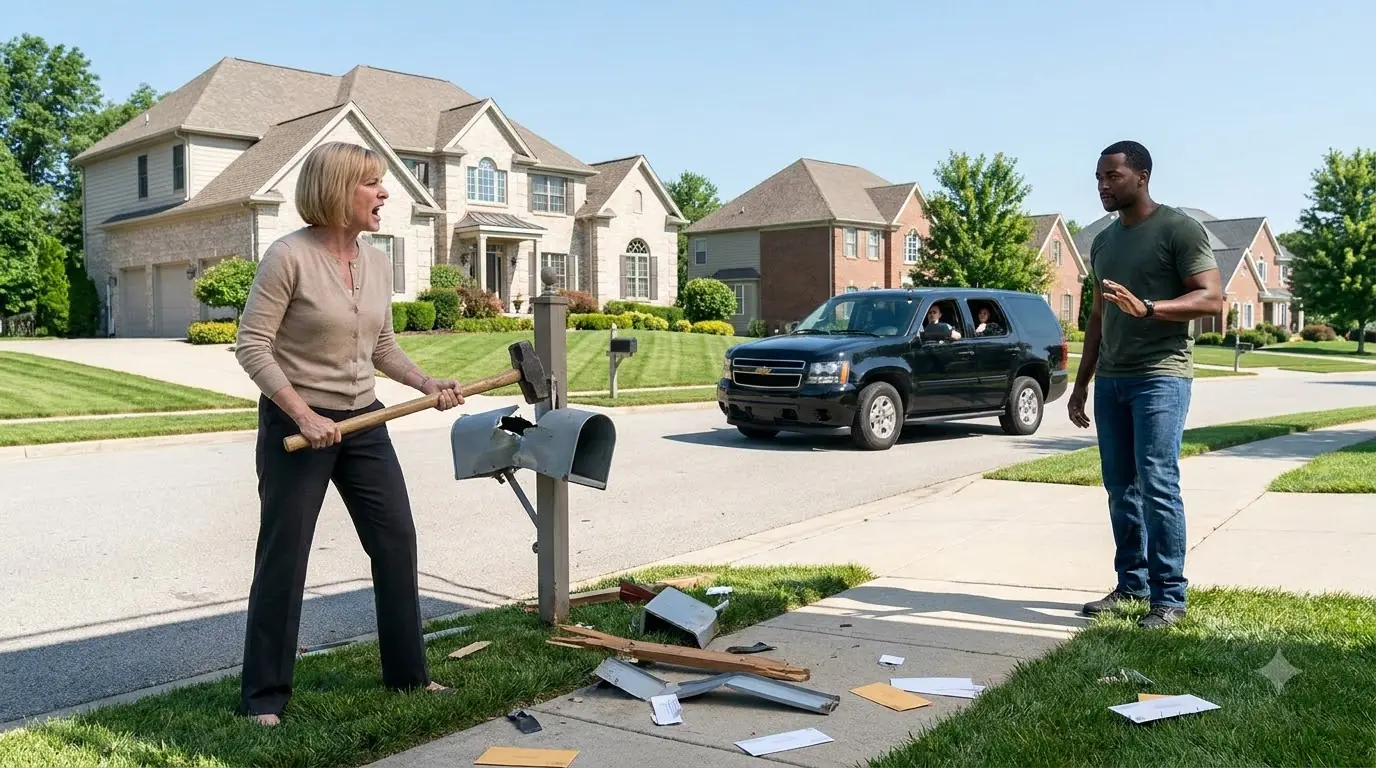
Victoria stepped back and stared at the damage.
For half a second, she looked almost surprised.
Then satisfaction returned.
She adjusted her grip on the wooden handle and swung again.
The second strike tore the mailbox partly away from its mounting bracket.
A bent door dropped open.
Several envelopes slid onto the grass.
Victoria breathed heavily through her nose.
Her blonde bob had shifted slightly from the effort, and a strand of hair stuck against her forehead.
She pushed it back with one hand.
Then she looked toward the two-story brick house behind her.
No movement.
Good.
Darius’s black pickup was not in the driveway.
His garage door was closed.
The front curtains were still.
Victoria had been watching the house for nearly twenty minutes before she began.
She had told herself she was confirming that nobody was home.
That sounded more reasonable than admitting she had been waiting for privacy.
She raised the hammer again.
This time she aimed lower.
The wooden post cracked.
The mailbox lurched toward the lawn.
Victoria smiled.
“There.”
She said it quietly.
Almost to herself.
“Now let’s see him argue with that.”
A woman across the street stopped walking her dog.
Victoria noticed.
The woman was elderly.
Gray sweatshirt.
Baseball cap.
Small terrier.
Victoria immediately straightened.
The HOA-president version of her expression returned.
Calm.
Official.
Slightly inconvenienced.
The elderly woman stared at the hammer.
Then the mailbox.
Then Victoria.
Victoria called across the street.
“Association compliance.”
The woman did not respond.
She simply pulled out her phone.
Victoria frowned.
People were always recording now.
Everything became drama.
Nobody respected process.
Nobody understood what it took to maintain standards in a neighborhood of four hundred and twelve homes.
Victoria had spent five years trying to explain that.
Crestwood Ridge had rules for a reason.
Mailboxes had approved dimensions.
Approved colors.
Approved setbacks.
Approved posts.
Approved decorative finishes.
If everyone ignored standards, property values declined.
Then neighborhoods changed.
Then people complained that leadership had failed.
Victoria had learned that the same residents who hated enforcement were usually the first to demand it when someone else violated something.
That contradiction exhausted her.
Darius Cole was worse than most.
He did not shout.
She almost wished he did.
Shouting was easy to dismiss.
Darius asked questions.
Specific questions.
Which covenant?
Which amendment?
Which inspection?
Which board vote?
Which photograph?
Which date?
Which authority?
Victoria hated the way he turned every notice into a hearing.
Most homeowners paid small fines just to make problems disappear.
Darius requested evidence.
When the evidence was weak, he appealed.
When the appeal failed, he requested meeting minutes.
When minutes contradicted enforcement notes, he pointed it out.
He was exhausting.
Worse, he had started teaching other homeowners to do the same thing.
Three months earlier, only two residents regularly appealed citations.
Now eleven did.
Victoria blamed Darius.
Not openly.
Officially, she described it as “increased procedural resistance.”
Privately, she called it what she believed it was.
Undermining authority.
The mailbox had become the latest fight.
It had stood at the edge of Darius’s property since before he bought the house six years earlier.
Dark green.
Simple.
Steel box mounted on a cedar post.
Nothing remarkable.
Then, four weeks ago, Victoria received a photograph showing a small black rectangular compartment attached beneath it.
She had never seen the compartment before.
It looked temporary.
Unapproved.
Possibly electronic.
The image came anonymously.
No sender.
No explanation.
Victoria inspected from the road the following morning.
The compartment was there.
About six inches wide.
Three inches tall.
Locked.
Attached beneath the mailbox with two dark brackets.
She sent Darius a notice.
UNAPPROVED EXTERIOR MAILBOX MODIFICATION.
He responded within twenty minutes.
Please identify the specific covenant provision allegedly violated and provide the inspection record supporting the notice.
Victoria sent section 8.4:
Exterior structures visible from common roadways must conform to approved community design standards.
Darius replied:
The mailbox and post predate my purchase and remain unchanged. Please identify the structure you believe is new.
She sent photograph.
Then Darius wrote something that irritated her immediately.
Thank you. Please do not touch, move, open, dismantle, photograph at close range, or otherwise interfere with the lower compartment. If the association believes further review is necessary, direct all communication through counsel.
Victoria read that twice.
Then three times.
He had not explained what it was.
He had issued instructions.
To her.
On neighborhood property.
That was how she interpreted it.
She called him.
He did not answer.
She called again.
Voicemail.
She sent email.
The association cannot be prohibited from inspecting exterior fixtures visible from common areas.
Darius responded:
You may visually inspect from lawful public or association-controlled areas. Do not physically interfere with it.
Victoria stared at the screen.
Do not physically interfere.
That phrase stayed with her for four weeks.
Then the board attorney complicated things.
Robert Sloan emailed Victoria privately after she forwarded correspondence.
Do not remove or manipulate the compartment. We do not currently have enough information to determine its purpose, and there is no urgent safety issue. If needed, request documentation through counsel.
Victoria hated that answer.
It rewarded Darius.
It made his warning sound important.
Then something stranger happened.
At the next board meeting, when Victoria raised the mailbox issue, Robert told her they should table it.
“Why?”
“Pending clarification.”
“From whom?”
“Relevant parties.”
“Which parties?”
Robert paused.
Then:
“I’m not at liberty to discuss that yet.”
Victoria immediately became suspicious.
She had served on the board for nine years.
President for five.
What could possibly involve her neighborhood that she was not entitled to know?
She asked property manager Elaine Porter.
Elaine said she had been told only to avoid direct contact with the fixture.
Treasurer Martin Pierce claimed ignorance.
Secretary Linda Carver claimed the same.
Victoria did not believe them.
Over the next ten days, she noticed two unfamiliar dark vehicles parked at different times near Hawthorne Lane.
One was a black Ford Explorer.
The other a gray Chevrolet Tahoe.
Neither had neighborhood permits.
Both disappeared after twenty or thirty minutes.
She photographed license plates.
One came back through an online search as a government fleet registration.
That changed the way Victoria thought about the mailbox.
Government.
Darius.
A locked compartment.
Attorney telling her not to touch it.
Why?
Darius worked in logistics.
Or at least that was what he told people.
Regional operations director for a freight company.
Nothing about him suggested law enforcement.
He traveled often.
Kept to himself.
Attended community meetings only when a dispute involved him.
But Victoria started wondering whether his job was something else.
Then another thought occurred.
Maybe the compartment was evidence.
Evidence of what?
That question kept her awake.
Three weeks before Thursday morning, Victoria attended lunch with Caleb Warren, a consultant for Northbridge Development Services.
That relationship was another thing she had convinced herself was normal.
Northbridge wanted to build a mixed-use development near Crestwood Ridge’s northern boundary.
The project included medical offices, townhomes, a grocery market, and a new access road.
Some residents opposed it.
Others supported it.
Victoria had met Caleb several times because the HOA needed information.
Traffic.
Drainage.
Noise barriers.
Landscaping buffers.
Ordinary community issues.
Over time, conversations became less formal.
Caleb was smart.
Polished.
Late forties.
Always wore dark blue suits without ties.
He understood politics.
He also understood Victoria.
He praised her leadership.
He told her most neighborhoods lacked someone willing to “make difficult decisions.”
Victoria enjoyed hearing that more than she admitted.
At lunch, she mentioned the strange compartment.
Caleb stopped eating.
“A compartment?”
“Under his mailbox.”
“What kind?”
“Black metal.”
“Locked?”
“Yes.”
“Who installed it?”
“He won’t say.”