Marcus Reed woke to the sound of metal striking metal.
The first blow was sharp enough to pull him out of sleep. The second made him sit upright in bed. By the third, he was already moving through the hallway of his two-story home in Hawthorne Glen, a carefully manicured subdivision outside Atlanta where every lawn seemed cut to the same height and every mailbox had been approved from the same glossy catalog.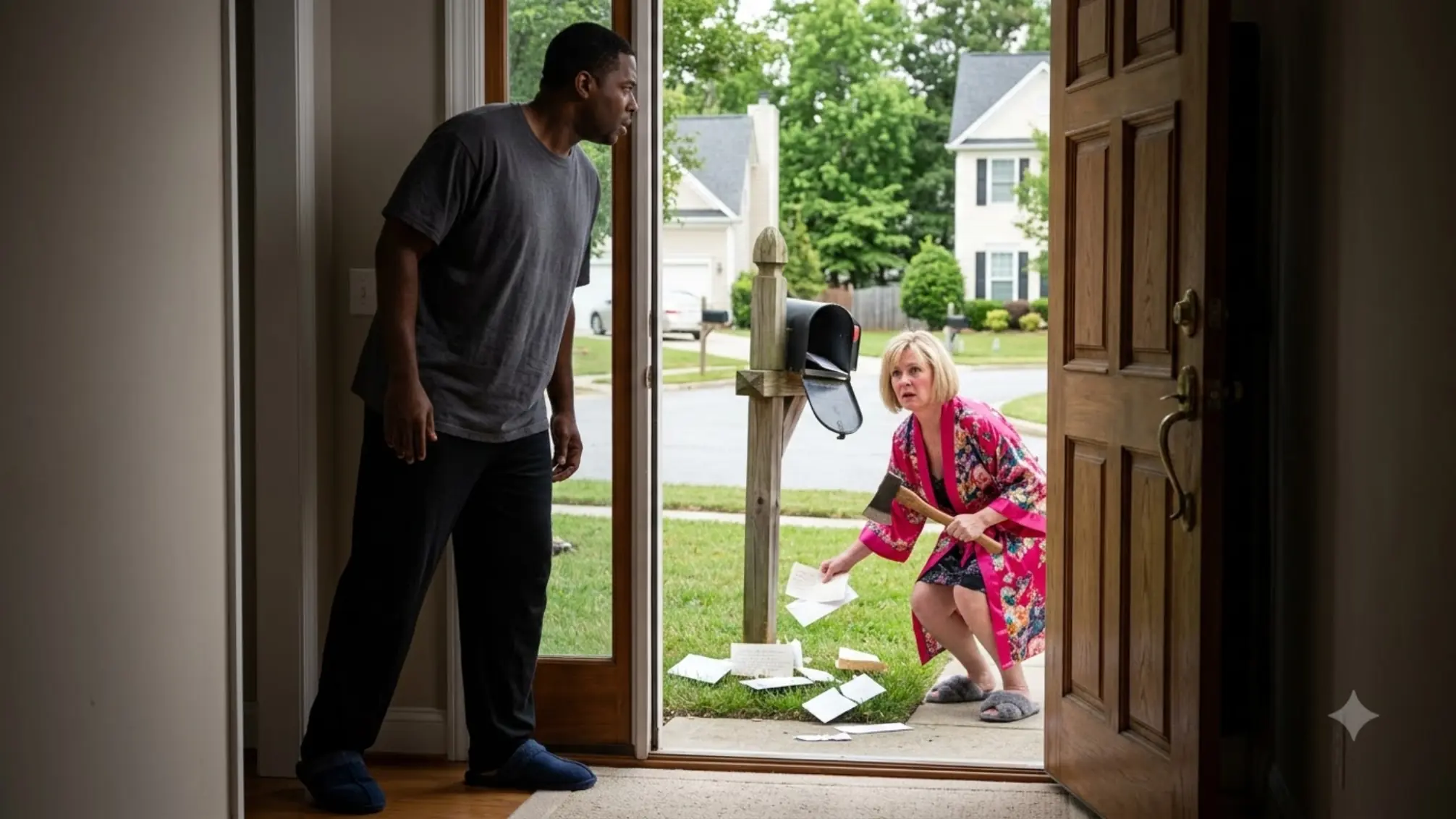
Marcus was thirty-nine, tall and broad-shouldered, with close-cropped black hair and the tired eyes of a man who had spent the last seven months sleeping badly. He wore a faded charcoal T-shirt, loose black pajama pants, and house slippers as he reached the front room. He expected to see a delivery driver, a fallen branch, maybe one of the neighborhood kids doing something stupid before breakfast.
Instead, he stopped cold.
Through the glass of his front door, Marcus saw Linda Carver crouched beside his mailbox.
The fifty-eight-year-old HOA president looked almost absurd against the perfect green lawns and expensive SUVs lining Hawthorne Glen Drive. Her short blonde bob was messy, her face flushed, and instead of the pastel blazer and pearls she normally wore to HOA meetings, Linda had come outside in a bright pink satin robe covered with oversized flowers. Gray fuzzy slippers covered her feet.
And in her right hand was a small axe.
Marcus watched as Linda raised it again.
“Are you out of your mind?”
His voice traveled through the closed door.
Linda froze.
For one strange second, neither of them moved.
Then Marcus saw what was scattered across the grass.
Envelopes.
Dozens of them.
Old envelopes, yellowed around the edges, some bent, some sealed, some apparently hidden inside the hollow post beneath the mailbox.
His stomach tightened.
One of them had his name written across the front.
Marcus Reed.
The handwriting stopped him harder than the axe had.
He knew that handwriting.
Seven months had passed, but he would have recognized it anywhere.
It belonged to his wife.
“Natalie.”
The name left his mouth almost silently.
Outside, Linda heard him anyway.
She dropped the axe.
Then she lunged for the letters.
Marcus threw open the front door.
“Stay inside,” Linda snapped, clutching one envelope against her chest. “This doesn’t concern you.”
Marcus stepped into the doorway.
“You’re standing on my property with my wife’s letters.”
Linda’s expression changed.
Not anger.
Fear.
She glanced toward the street before gripping the envelope tighter.
“You don’t understand what you’re looking at.”
“Then put it down.”
“Marcus.”
“Put my wife’s letter down.”
Linda backed toward the curb.
Seven months earlier, Natalie Reed had disappeared.
There had been no blood, no broken window, no overturned furniture, and no obvious sign that anyone had forced her from the house. Her car had been found at the Atlanta airport parking deck two days later, locked, empty, with her purse missing but her phone sitting underneath the driver’s seat.
For months, police had investigated every reasonable possibility.
Had Natalie left voluntarily?
Had she met someone?
Had she been running from something Marcus knew nothing about?
Had someone followed her?
Each possibility hurt in a different way.
Marcus had answered questions about his marriage until he began questioning memories that had once felt ordinary. He explained arguments about money, Natalie’s late nights at work, his own long hours running a commercial electrical contracting company, and the weekend before she vanished when they barely spoke because both were exhausted.
Nothing had produced an answer.
Eventually the neighborhood stopped bringing casseroles.
The police calls became less frequent.
Friends stopped asking whether there was news because they hated watching Marcus shake his head.
Linda Carver had been one of the few people who continued checking on him.
At least, that was what Marcus had believed.
She would appear with HOA paperwork and ask carefully worded questions.
Had detectives found anything?
Had Marcus searched Natalie’s computer?
Did Natalie ever mention wanting to leave Georgia?
Marcus had mistaken the questions for concern.
Standing on his lawn now, watching Linda try to gather his wife’s letters before he could touch them, he suddenly understood that she had never been concerned.
She had been checking what he knew.
Marcus walked slowly down the front path.
Linda lifted the axe again, though she held it differently now. She was not threatening him so much as warning him to stop approaching.
“Take one more step and you’ll regret opening them.”
Marcus stopped.
His eyes dropped to the envelope in her hand.
“You’ve known something for seven months.”
Linda’s jaw tightened.
“I know your wife caused problems.”
“What problems?”
“She asked questions that weren’t hers to ask.”
Marcus stared at her.
Natalie had worked as a senior compliance analyst for a regional insurance company. Details mattered to her. She noticed billing errors at restaurants, strange language in contracts, and county notices that everyone else threw away without reading.
She was also the person who had first noticed Hawthorne Glen’s HOA fees changing.
The neighborhood had approximately three hundred homes. For years, annual dues had risen in small increments, usually justified by landscaping costs, private security, pool maintenance, and road repairs.
Then two years earlier, the increases became aggressive.
New “infrastructure assessments” appeared.
Residents were charged for drainage improvements that no one remembered seeing.
A security contract nearly tripled in price despite fewer patrols.
The reserve fund somehow continued shrinking.
Natalie had complained about it at dinner more than once.
Marcus had barely listened.
He hated thinking about that now.
“Something’s wrong with those numbers,” she had told him one night.
He had been answering work emails at the kitchen island.
“It’s an HOA, Nat. Everything costs more than it should.”
“No. I mean actually wrong.”
He remembered looking up briefly.
“You planning to audit them?”
Natalie had smiled.
“Maybe somebody should.”
Marcus had smiled back.
That memory now felt like a warning he had missed.
Linda suddenly bent down and grabbed another envelope.
Marcus moved.
He did not charge at her. He simply stepped between Linda and the remaining letters, forcing her to retreat toward the sidewalk.
“Leave.”
“You need to give those to me.”
“They’re addressed to me.”
“You don’t know what she wrote.”
“That’s becoming pretty obvious.”
A garage door opened across the street.
Walter Jensen, a retired accountant who lived two houses down, stepped outside wearing shorts and an undershirt. He stared at Linda, the axe, the damaged mailbox, and the envelopes scattered across Marcus’s lawn.
Then another door opened.
Within minutes, phones were appearing behind windows.
Linda noticed.
Her confidence cracked.
“This is HOA business,” she announced loudly.
Walter looked at the axe.
“At seven in the morning?”
Linda ignored him.
Marcus pulled out his phone and called the police.
That was when Linda ran.
Not fast.
Not gracefully.
But she grabbed the envelope she had been holding and hurried toward a white Lexus parked fifty yards away.
Marcus did not chase her.
He simply raised his phone and recorded.
Walter recorded too.
Linda reached her vehicle, climbed inside, and drove away while wearing a floral satin robe and bedroom slippers.
Only after she disappeared around the corner did Marcus kneel beside the mailbox.
His hands began shaking.
There were twenty-one envelopes.
Every one was addressed to him.
Every one carried Natalie’s handwriting.
None had stamps.
They had never entered the postal system.
Someone had hidden them inside the mailbox post itself.
Marcus sat on the edge of the sidewalk and opened the first.
The date was eight months earlier.
One month before Natalie disappeared.
Marcus,
If you are reading this because I handed it to you myself, you’re probably going to tease me for being dramatic.
But if you found it without me, please take it seriously.
I think something is happening inside Hawthorne Glen.
Marcus stopped reading.
Walter stood several feet away, watching quietly.
“You okay?”
“No.”
Marcus looked toward the corner where Linda’s Lexus had vanished.
“But I think I finally know where to start.”
The police arrived fourteen minutes later.
Officer Elena Ruiz photographed the mailbox, the axe Linda had left behind, the scattered envelopes, and the damage to the metal housing. Marcus explained that Linda had taken one envelope with her.
Ruiz’s expression changed immediately.
“She removed one of these?”
“Yes.”
“Did you see which?”
“No.”
Walter stepped forward.
“I recorded most of it.”
That mattered.
So did the neighbor across the street who had a doorbell camera aimed partially toward Marcus’s property.
By 8:30 that morning, officers had video showing Linda striking the mailbox, collecting letters, confronting Marcus, and fleeing with one envelope.
But Marcus cared less about Linda’s vandalism than he did about Natalie’s words.
The letters told a story.
Not chronologically.
Natalie had apparently written them whenever she discovered something new, hiding each one inside the decorative hollow beneath their mailbox. Marcus suspected she had chosen the location because he almost never handled the mail; Natalie normally did.
The first letters focused on HOA finances.
Natalie had compared annual financial statements going back six years.
Three vendors appeared repeatedly.
Pine Ridge Landscaping.
Sentinel Neighborhood Services.
Carter Residential Consulting.
Together, the companies had received more than $1.8 million from Hawthorne Glen.
Natalie could find almost no evidence that two of them actually operated.
Pine Ridge had a website and phone number, but its registered address led to a small rented office that appeared empty.
Sentinel Neighborhood Services supposedly provided overnight security, yet residents regularly complained that patrol vehicles rarely appeared.
Carter Residential Consulting was worse.
The HOA had paid it more than $430,000 for “community compliance coordination.”
Natalie could not determine what that meant.
Letter five contained the first name Marcus recognized.
Linda Carver.
Natalie had discovered that the mailing address listed for Carter Residential Consulting had once been associated with Linda’s younger brother, Stephen Carver.
Marcus stood at the kitchen counter reading while Detective Samuel Hart, who had handled Natalie’s disappearance, listened.
Hart had arrived after Officer Ruiz called him.
“This changes the case,” he said.
Marcus looked up.
“You think Linda did something to Natalie?”
“I think your wife believed Linda was connected to financial activity she was investigating. That’s enough for us to reopen several questions.”
“Several?”
Hart remained careful.
“We follow evidence, Marcus.”
Marcus hated the answer, but he understood it.
They continued.
Letter nine described Natalie confronting the HOA treasurer, Frank Delaney.
Frank had become nervous.
He told Natalie that certain payments were approved directly by Linda and that board members rarely reviewed supporting invoices.
Two days later, Frank resigned unexpectedly and moved to Florida.
Letter eleven contained something more disturbing.
Natalie believed someone had entered the Reed house while she and Marcus were away at dinner.
Nothing had been stolen.
But a desk drawer upstairs had been opened.
Her printed HOA records had been moved.
Marcus remembered that night.
Natalie had asked whether he had touched her papers.
He had said no.
They had forgotten about it.
Now he felt sick.
Letter fourteen mentioned a dark blue SUV following Natalie from the county records office.
Letter fifteen included a license plate number.
Hart immediately photographed it.
By afternoon, detectives learned that the vehicle had once been registered to Sentinel Neighborhood Services.
The fake-looking security company.
The discovery spread through Hawthorne Glen by lunchtime.
Residents gathered in driveways.
Group chats exploded.
People who had complained privately about HOA fees began comparing statements.
Walter Jensen brought Marcus three years of his own assessment records.
A woman named Sheila Monroe discovered she had been charged twice for the same drainage project.
Another resident had paid a $1,200 “emergency road levy” for repairs that county records showed had actually been funded by the developer.
Linda stopped answering calls.
Her house remained closed.
By evening, her Lexus was gone.
That made Detective Hart nervous.
It made Marcus furious.
But the seventeenth letter changed everything again.
Marcus,
I confronted Linda today.
That opening line made his chest tighten.
Natalie wrote that she had asked Linda directly about Carter Residential Consulting.
Linda denied knowing anything.
Then Natalie showed her corporate registration documents connecting the company to Stephen Carver.
According to Natalie, Linda’s face changed.
She stopped denying.
Instead, she told Natalie to “think carefully about what kind of trouble you bring into your home.”
Marcus read that sentence three times.
The memory of Linda standing outside his mailbox with an axe suddenly felt different.
This had not begun that morning.
It had begun months before Natalie disappeared.
Letter nineteen revealed that Natalie had copied documents onto a flash drive.
She did not say where she put it.
Instead, she wrote a clue Marcus recognized immediately.
I left the truth somewhere you always complain is too cold.
Marcus stared at the sentence.
Then he ran toward the garage.
Detective Hart followed.
Marcus opened the old chest freezer near his workbench.
Frozen meat.
Ice packs.
A box of waffles.
Nothing.
He started pulling everything out.
Hart helped.
Underneath a removable plastic tray, Marcus found duct tape.
Something small had been attached beneath it.
A USB drive.
Hart told him not to touch anything further.
Within an hour, a forensic technician collected it.
The files were extensive.
Natalie had downloaded HOA invoices, corporate registration documents, emails, vendor payment schedules, meeting minutes, and scans of checks.
The numbers were staggering.
Over four years, hundreds of thousands of dollars appeared to have moved through companies connected indirectly to Linda Carver, her brother, and two board associates.
But one folder was different.
It was labeled ONLY IF NECESSARY.
Inside was an audio recording.
Natalie’s voice came first.
“Linda, I’m giving you one chance to explain this before I take it outside the board.”
Then Linda.
“You have no idea what you’re interfering with.”
Natalie remained calm.
“These invoices are false.”
“You don’t know that.”
“I know one company billed us for forty-seven security patrols during a month when their only vehicle was in a repair shop.”
Silence.
Then Linda said something that made Marcus grip the back of a chair.
“You have a nice home, Natalie. A husband who loves you. Stop digging before you lose something you can’t replace.”
The recording ended.
For the first time in seven months, Detective Hart stopped talking like a man trying to manage expectations.
“We’re getting a warrant.”
Linda was arrested the next morning.
Not for Natalie’s disappearance.
Not yet.
She was taken into custody for matters connected to the mailbox incident, alleged financial misconduct, evidence tampering, and violations investigators were still sorting through.
Her brother Stephen was located several hours later.
Then Frank Delaney, the former treasurer, contacted police voluntarily.
He had been watching the news from Florida.
Frank told investigators that Natalie had discovered the scheme almost by accident.
Linda had been approving inflated contracts through associated vendors, then portions of the money were routed back through consulting payments and shell businesses.
Frank had suspected it but had been frightened.
Natalie had not been frightened enough.
But Frank also told detectives something unexpected.
He had spoken to Natalie the night she disappeared.
She was alive.
And she was scared.
According to Frank, Natalie told him she believed someone had searched her office.
She planned to meet with a state investigator privately.
She did not trust local channels because she feared Linda had connections inside the county administration.
Marcus felt hope and terror at the same time.
“If she was going to meet an investigator, where did she go?”
Frank did not know.
But the answer came from the missing envelope.
The one Linda had taken.
Police found it inside her Lexus.
She had not destroyed it.
She had stuffed it beneath the passenger seat during her panicked drive away.
The letter was Natalie’s final message.
Marcus,
If this is the last letter, I finally found someone willing to listen.
I’m meeting a state investigator tomorrow morning.
I’m leaving my car at the airport because I believe someone is following me, and I don’t want them knowing where I’m going.
I’ll take another car from there.
Please don’t think I left you.
I love you.
If I’m gone longer than expected, find Agent Rebecca Sloan.
For seven months, everyone had interpreted Natalie’s airport car as evidence that she had boarded a flight or disappeared voluntarily.
She had done neither.
State records showed that Rebecca Sloan had worked in financial investigations at the time.
She had retired four months earlier after suffering a serious stroke.
Detectives contacted her family.
Sloan could no longer communicate easily, but her daughter searched through stored work materials with permission.
Inside an old case notebook was Natalie Reed’s name.
There was also an address.
A roadside motel sixty miles north of Atlanta.
Detectives reconstructed what had happened next.
Natalie had reached the motel.
She met Sloan.
She handed over partial evidence.
But before a formal statement could be scheduled, Natalie noticed the same dark blue SUV in the parking lot.
She panicked.
Rather than return home and potentially lead whoever was following her back to Marcus, Natalie left.
What happened after that had remained invisible for seven months.
The break came from a motel employee who remembered a frightened woman asking to use a phone.
Natalie had called her older cousin, Denise Carter, who lived in North Carolina.
Police contacted Denise.
Her silence lasted six seconds.
Then she began crying.
Natalie was alive.
Marcus could not speak.
Denise explained that Natalie had appeared at her house terrified and convinced the people following her might target Marcus if she returned home.
She had intended to stay only a few days.
Then she learned that someone had entered Denise’s detached garage during the night.
Natalie became convinced the danger was larger than she understood.
She moved again.
Denise had promised not to reveal her location until Natalie felt safe.
It was a terrible decision.
But it had been made by frightened people who did not trust the system around them.
Detectives eventually located Natalie in a small town in Virginia.
Marcus drove there with Hart.
He remembered almost nothing about the final hour of the trip.
When they arrived, Natalie stood behind the screen door of a modest rental house.
She looked thinner.
Her hair was shorter.
But she was alive.
Marcus stepped out of the car.
Natalie covered her mouth.
Neither of them moved for several seconds.
Then she ran.
Marcus met her halfway across the yard.
He wrapped both arms around her while seven months of anger, fear, confusion, sleepless nights, and unanswered questions finally broke apart.
“You should’ve called me,” he whispered.
“I know.”
“I thought you were dead.”
“I know.”
“You should’ve trusted me.”
Natalie pulled back enough to look at him.
“I thought staying away was protecting you.”
Marcus shook his head, tears running down his face.
“It nearly destroyed me.”
Natalie nodded.
“I’m sorry.”
There was no instant repair.
Real life was harder than that.
Natalie returned to Georgia under protection while investigators completed the financial case.
Marcus loved her, but he was angry.
Natalie loved him, but she carried months of fear and guilt.
They began counseling.
They talked about choices neither could undo.
Slowly, the house that had felt like a mausoleum became a home again.
The HOA case moved faster.
Bank records supported much of what Natalie had discovered.
Multiple board members resigned.
Linda Carver faced charges connected to financial fraud, evidence interference, property damage, and related conduct established during the investigation.
Her brother became part of the case as well.
Hawthorne Glen entered temporary outside management while residents elected a new board.
For the first time in years, the neighborhood finances were independently audited.
Residents learned exactly where their money had gone.
Some recovered funds.
Some did not.
But the system that had allowed one small group to operate without meaningful oversight was dismantled.
Months later, Marcus replaced the damaged mailbox.
He could have installed the same approved black metal model.
Instead, after the HOA restrictions were rewritten, he chose a heavy cedar post with a simple steel box.
Natalie stood beside him while he mounted it.
She smiled faintly.
“No secret compartment?”
Marcus tightened the final bolt.
“Absolutely not.”
She laughed.
It was the first time he had heard that particular laugh since she returned.
Then Natalie carried something from the house.
A small wooden box.
Inside were the twenty recovered letters.
Every one had been preserved.
Even the final letter Linda had tried to take.
Marcus looked at them for a long moment.
Those envelopes had nearly disappeared beneath an axe on an ordinary Monday morning.
Instead, they had reopened an investigation, exposed years of deception, and finally led him back to the woman he had spent seven months believing he might never see again.
Natalie touched his arm.
“What should we do with them?”
Marcus closed the box.
“Keep them.”
“All of them?”
“All of them.”
He looked down the quiet street.
Linda’s old house had been sold.
The HOA office had new leadership.
Neighbors who once avoided uncomfortable questions now attended board meetings and demanded receipts, contracts, and open records.
The neighborhood looked almost exactly as it had before.
Fresh lawns.
Clean sidewalks.
Identical roofs.
But Marcus knew appearances meant very little now.
Natalie slipped her hand into his.
Marcus glanced toward the new mailbox.
For seven months, he had searched airports, hospitals, phone records, parking garages, and memories for some trace of his wife.
The answer had been twenty feet from his front door.
Hidden inside a mailbox post.
Waiting for the wrong person to swing an axe.