“Sign now, farmer—your unpaid HOA debt makes this land mine.”
Vivian Hartwell slapped a thick foreclosure packet onto the hood of Ezra Blackstone’s old pickup. Her pale-pink blazer looked almost painfully bright against the weathered barn, muddy boots, and rows of corn stretching behind him. She stood with one hand wrapped around a black HOA binder and the other pointed at the farmhouse his great-grandfather had built in 1899. Behind her sunglasses, she wore the confident smile of someone who had never considered the possibility of losing.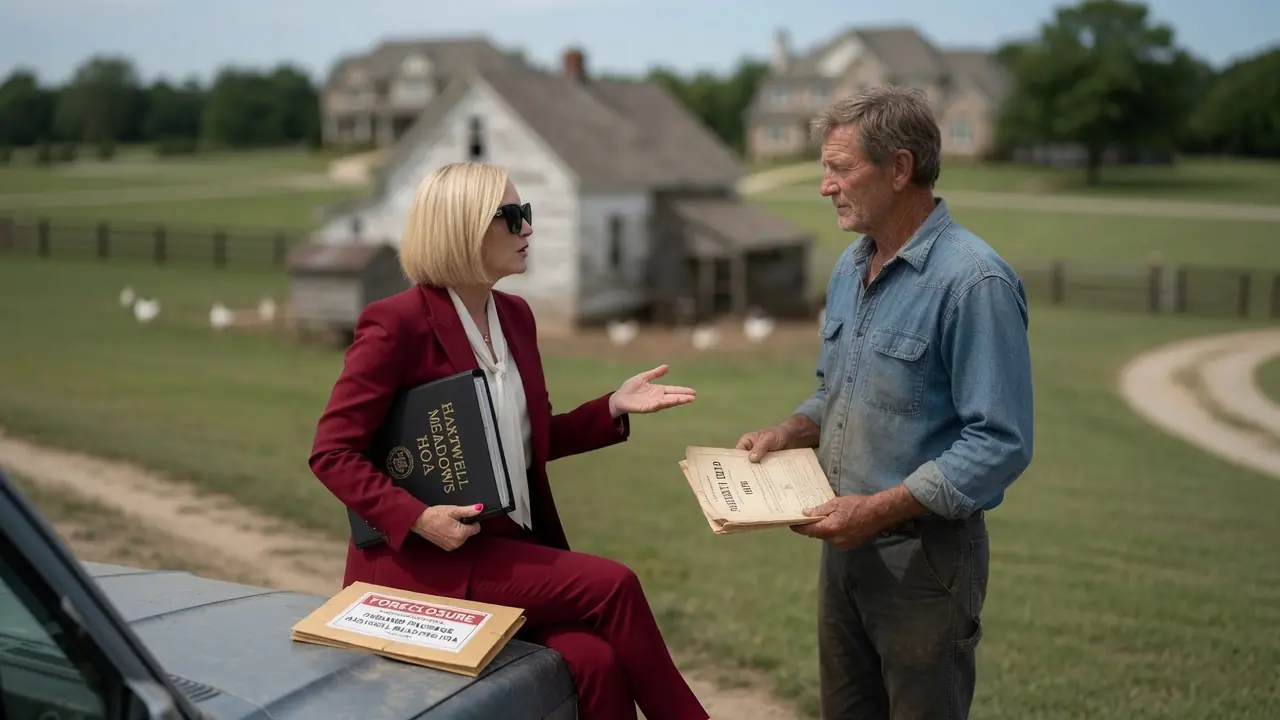
Ezra picked up the first page and studied it without changing expression. The document claimed he owed twelve thousand dollars in retroactive association fees, fifty thousand in penalties, and additional legal costs for refusing to follow Hartwell Meadows’ landscaping and livestock restrictions. According to Vivian, his forty-acre farm had been incorporated into the subdivision through a boundary revision fourteen years earlier. Every signature, seal, and official-looking stamp had been arranged to frighten someone who did not understand property law.
Ezra dropped the papers into the mud.
“Your fake lien is worth less than the dirt under my boots.”
Vivian’s jaw tightened. “Tomorrow, I bulldoze this dump and erase your family.”
Ezra lifted his phone. “Call your bank first. I own it, and your empire just lost its funding.”
For the first time since arriving, Vivian stopped smiling.
She recovered quickly, giving a hard laugh and adjusting the expensive sunglasses on her face. “You expect me to believe a man living beside a chicken coop owns Regional Trust Bank?”
“I don’t need you to believe it.”
“You’re a retired farmer with a rusted truck.”
“And you’re standing on property you have no legal authority over.”
Vivian snatched the foreclosure packet from the ground, leaving streaks of mud across its glossy cover. She told him bank officers had already approved enforcement and that deputies would arrive after the final deadline expired. Before leaving, she looked past Ezra toward the farmhouse as though mentally placing luxury homes across the fields. Her white Mercedes threw gravel behind it as she drove toward the mansion overlooking the subdivision.
Ezra remained beside the truck until the vehicle disappeared.
He had spent twenty years on Wall Street before returning to the family farm. During that career, he bought struggling community banks, repaired their lending systems, and quietly built a private investment company worth more than anyone in Hartwell Meadows suspected. Regional Trust had been his first major acquisition, and he still held seventy-two percent of its voting shares through a family trust.
Almost no one knew.
Ezra preferred it that way.
The neighbors knew him as the farmer who sold tomatoes at the Saturday market and helped repair fences after storms. They saw the chipped coffee mug, faded denim shirts, and hands permanently marked by soil. They did not see the quarterly reports delivered to his locked study or the private calls he held with bank directors before sunrise. Wealth had once controlled every hour of Ezra’s life, and he had no intention of allowing it to define his retirement.
Vivian Hartwell, however, had made secrecy dangerous.
The next morning, Ezra drove his pickup to Regional Trust’s main branch. The same marble floors he selected during a renovation two decades earlier still reflected the ceiling lights. Employees greeted him as a familiar local customer, unaware that the man walking past them approved the salaries of every senior executive in the building. He approached the lending desk holding Vivian’s muddy documents in a plain envelope.
Loan officer Janet Morrison recognized his name immediately.
“Mr. Blackstone, thank goodness you came. We need to discuss the serious delinquency attached to your property.”
“What delinquency?”
“The Hartwell Meadows association provided proof that your farm has been subject to its covenants since 2010.”
Ezra sat across from her. “Show me the original boundary agreement.”
Janet’s fingers paused above her keyboard.
“The HOA maintains the original.”
“Show me the county recording number.”
She looked toward the glass office of branch manager Thomas Williams. “I would need authorization.”
“You attempted to foreclose on my land without verifying whether the alleged agreement was recorded?”
“We relied on documentation supplied by Ms. Hartwell.”
Ezra leaned back. He had trained loan officers for years, and Janet’s answer revealed either astonishing negligence or deliberate cooperation. Federal and state lending rules required a bank to validate debts before enforcing them against real property. A private association could not create a mortgage default simply by submitting a packet filled with impressive language.
“Call Thomas,” Ezra said.
The branch manager arrived wearing a polished suit and the nervous smile of a man who had expected the farmer to beg. He repeated the same explanation, emphasizing Vivian’s reputation, legal team, and standing within the community. When Ezra requested independent verification, Thomas spoke about urgency and protecting the bank’s interests. He never produced a county record.
Ezra placed the documents back inside the envelope.
“You have until five this afternoon to suspend every action connected to this claim.”
Thomas laughed softly. “Mr. Blackstone, you are not in a position to issue deadlines.”
Ezra looked around the branch he owned.
“Everyone makes that mistake once.”
He returned to the farm and contacted Miriam Shaw, the bank’s general counsel. Within an hour, she confirmed the county recorder had no document placing Blackstone Farm inside Hartwell Meadows. The farm’s agricultural exemption predated the development, and its legal description remained entirely separate. Vivian’s boundary revision was not simply defective.
It was fabricated.
Miriam also found something more alarming. Regional Trust had approved forty-seven million dollars in loans tied to Vivian’s development company over four years. Several appraisals valued unfinished properties as completed luxury homes, while reserve accounts supposedly protecting the loans contained unexplained gaps. Most disturbing of all, Thomas Williams and Janet Morrison had personally handled nearly every suspicious approval.
Ezra ordered a confidential audit.
The first findings arrived two days later.
Vivian’s company had borrowed against community facilities that were never constructed. Landscaping reserves disappeared into consulting firms with no employees. HOA dues were transferred into accounts linked to Hartwell Development, then used to cover payments on Vivian’s mansion, cars, and private travel. Someone inside the bank had repeatedly overridden internal warnings.
The false foreclosure was not merely an attempt to remove an inconvenient farmer.
Vivian needed Ezra’s land.
Without the farm, Hartwell Meadows’ newest development phase could not connect to the highway. Her investors expected another sixty homes, and her loans assumed those properties would already be under construction. If Ezra refused to sell, the numbers supporting her entire empire collapsed.
She was not attacking him because of chickens.
She was financially drowning.
Vivian responded to the suspended foreclosure by calling an emergency HOA meeting. Nearly two hundred residents gathered inside the community center, where she stood beneath bright lights and described Ezra’s farm as a threat to every homeowner’s investment. She claimed livestock odors, outdated buildings, and agricultural equipment were reducing property values. Then she warned that Regional Trust could reconsider mortgages if the neighborhood failed to enforce uniform standards.
Fear moved through the audience.
Several families had invested their life savings in the subdivision. Retired couples depended on stable property values, while younger parents already struggled with rising payments. Vivian knew exactly which words would make them imagine losing everything. By the meeting’s end, residents who once bought vegetables from Ezra were signing petitions demanding removal of his farm.
Only one woman refused.
Seventy-eight-year-old Helen Kowalski appeared at Ezra’s kitchen door the following afternoon. She carried photographs, an unsigned statement, and an envelope containing two years of prepaid HOA dues. Vivian had offered to waive Helen’s fees if she swore that Ezra’s animals caused health problems and lowered neighborhood values.
“She wanted me to lie about you,” Helen said. “When I refused, she told me old women sometimes forget mortgage payments.”
Ezra’s expression hardened. “Did she threaten your home?”
“She smiled while she did it.”
That evening, Ezra’s auditors examined Helen’s mortgage file. She had never missed a payment. Nevertheless, someone had inserted three false delinquency notices and initiated an accelerated review only hours after she rejected Vivian’s offer. The action came from Thomas Williams’ account.
Vivian was now using Ezra’s bank to punish witnesses.
The next morning, Ezra summoned Regional Trust’s board to the farm. Several directors arrived in luxury vehicles and looked uncomfortable entering the same farmhouse Vivian called a shack. Ezra seated them around the oak table his great-grandfather built and distributed copies of the audit. Every page carried evidence of fraud, unauthorized overrides, and unverified liens.
Thomas Williams sat at the far end, his face losing color.
“You allowed a private developer to create debts against property outside her association,” Ezra said. “You also altered a widow’s mortgage after she refused to provide false testimony.”
Thomas denied everything.
Miriam played a recorded compliance call.
Vivian’s voice filled the kitchen, instructing Thomas to “make examples” of anyone protecting the farm. She promised future development accounts, consulting payments, and board appointments once Hartwell Development expanded. Thomas could be heard agreeing to accelerate pressure before Ezra found legal representation.
No one spoke when the recording ended.
Ezra removed Thomas and Janet immediately, froze every Hartwell Development account, and notified banking regulators. He ordered the foreclosure against Helen withdrawn and sent written confirmation that her loan remained current. Then he scheduled a meeting with federal investigators and turned over the audit without removing a single incriminating page.
Vivian learned about the account freeze before lunch.
She arrived at Ezra’s farm less than an hour later, still wearing the pink blazer but no longer carrying the confident smile. Her Mercedes stopped crookedly beside the barn. She marched across the driveway and demanded that Ezra restore her credit lines before construction companies abandoned the development.
“You had no right to interfere with my business.”
Ezra remained seated on the porch.
“You forged a claim against my farm.”
“That was a negotiation tactic.”
“You stole HOA money.”
“You don’t understand development finance.”
“You bribed bank officers.”
Her face changed.
Ezra held up a folder containing wire records, emails, and false appraisals. “I understand every dollar.”
Vivian lowered her voice. “What do you want?”
“For you to return what you stole.”
“We can make a private arrangement.”
“There is no private arrangement.”
“I can give you twenty million for the farm.”
“It isn’t for sale.”
“Everything is for sale.”
Ezra looked toward the fields his family had worked for five generations. His great-grandfather survived drought, his grandfather survived the Depression, and his father kept the land through years when agriculture barely paid its own costs. Vivian believed money created ownership because she had never understood inheritance as responsibility.
“This farm survived men richer than you,” Ezra said. “It will survive you too.”
Vivian stepped closer. “If you destroy my company, every property value around you collapses. Your precious neighbors will blame you when their homes become worthless.”
“No. They’ll blame the woman who stole their money.”
She left without another word.
That evening, residents received notices that the HOA’s reserve fund contained less than twelve percent of the amount Vivian reported. Roads scheduled for repair had no funding. Insurance premiums had not been paid, and several common areas carried undisclosed liens. Panic spread through Hartwell Meadows faster than any rumor about Ezra’s chickens.
Vivian attempted to regain control by blaming the bank.
She accused Regional Trust of freezing legitimate accounts and sabotaging the neighborhood because Ezra manipulated its executives. She filed a complaint with the county sheriff alleging that he used hidden ownership to intimidate residents. A detective arrived at the farmhouse expecting to question an aggressive financier exploiting vulnerable homeowners.
Ezra showed him the evidence.
Three hours later, the detective left carrying copies of bank records, forged documents, and Helen’s statement. The investigation that Vivian tried directing toward Ezra turned back toward her. County officials joined federal regulators, while prosecutors requested warrants for additional financial records.
Vivian began preparing to run.
Helen noticed moving trucks outside the mansion after midnight. Ezra drove there with the detective and found workers loading artwork, computers, filing cabinets, and boxes marked for international shipping. Through a damaged cardboard edge, he recognized folders containing homeowners’ private mortgage information.
Vivian stood near the garage directing the movers.
“Going somewhere?” Ezra asked.
She spun toward him. “Get off my property.”
“You’re loading evidence connected to a federal investigation.”
“These are business records.”
“They contain your neighbors’ financial information.”
“You cannot prove that.”
The first black government vehicles appeared at the end of the street.
Vivian’s expression collapsed.
Federal agents entered the driveway while residents emerged from surrounding homes. Camera crews arrived moments later after someone alerted local news. Under the bright exterior lights of her mansion, Vivian no longer looked like the ruler of Hartwell Meadows.
She looked cornered.
An agent ordered the movers to step away from the trucks. Another presented a warrant authorizing seizure of electronic devices, financial records, and property connected to fraud. Vivian attempted to retreat into the house, but investigators blocked the entrance.
Then she saw Ezra.
“This is your fault,” she shouted.
“You forged the first paper.”
“You could have sold the farm.”
“You could have left it alone.”
She pointed at the residents gathering along the sidewalk. “When this neighborhood collapses, remember he caused it!”
Helen stepped forward.
“No, Vivian. You threatened my home because I wouldn’t lie.”
Another resident accused Vivian of hiding repair costs. A young couple described unexplained increases in their dues, while a contractor admitted he had been ordered to conceal drainage defects. One voice became ten, then fifty.
Vivian had ruled by keeping everyone isolated.
Now they were speaking together.
Investigators arrested Thomas Williams that night. Janet Morrison agreed to cooperate and turned over emails proving Vivian directed the foreclosure scheme. Financial records showed more than a million dollars diverted from HOA accounts and tens of millions borrowed through false valuations.
Vivian was charged with fraud, conspiracy, bribery, identity theft, and attempted theft of property.
The bank immediately canceled the fraudulent liens against Ezra and Helen. Regional Trust also established an independent recovery fund to stabilize valid mortgages during the investigation. Because Vivian’s development loans were personally guaranteed, her mansion, vehicles, investment accounts, and ownership interests became available for restitution.
One week later, residents gathered for another emergency meeting.
This time, Vivian did not stand at the podium.
Ezra did.
He entered wearing a faded denim shirt and carrying the original deed to Blackstone Farm. Several people looked embarrassed, remembering the petition they signed against him. Ezra did not demand apologies.
He placed the deed on the table.
“My family held this land before Hartwell Meadows existed,” he said. “I will not surrender it to fraud, fear, or threats.”
He then revealed his ownership of Regional Trust.
The room became completely silent.
“You own the bank?” one resident whispered.
“Yes.”
“The bank holding our mortgages?”
“Yes.”
“Then why do you live in that old farmhouse?”
Ezra looked toward Helen, who smiled knowingly.
“Because a person’s home is not measured by how much it impresses strangers.”
He explained that every legitimate mortgage would remain protected. Interest penalties connected to Vivian’s misconduct would be reversed, and residents would receive access to independent financial reviews. He also promised that Regional Trust would not use the crisis to seize homes from families harmed by the fraud.
Relief moved through the room.
Then Ezra made one condition clear.
The neighborhood would never again be controlled by one person.
Residents elected Helen as interim HOA president. She established monthly public accounting, multiple-signature requirements for large expenses, and direct access to all financial statements. Committees were created for maintenance, budgeting, and community concerns.
The first new vote involved Blackstone Farm.
Instead of attempting to remove it, residents approved a permanent agricultural buffer protecting the farmhouse, barn, fields, and livestock from future development claims. Children began visiting on weekends to learn where food came from. Families rented garden plots along the southern fence, and Ezra supplied seeds without charging them.
Vivian’s mansion was eventually sold through restitution proceedings.
The new owners were not private residents. With support from Regional Trust and recovered HOA money, the community purchased the property and converted it into a library, meeting center, and financial-education space. The ballroom where Vivian once hosted exclusive parties became a classroom teaching homeowners how to recognize fraudulent liens and predatory contracts.
Her trial began nine months later.
The evidence was overwhelming. Forged signatures, bank bribes, stolen dues, false appraisals, retaliatory mortgage actions, and private messages describing residents as “assets to be controlled” filled the courtroom. Vivian attempted to claim she had protected property values through aggressive management.
Helen testified about the threat against her home.
Ezra testified last.
Vivian’s attorney asked whether he used his secret ownership of the bank to destroy her after a personal dispute.
“No,” Ezra replied. “I used my authority to stop fraud after she tried to steal property that was never hers.”
“Did you enjoy watching her business collapse?”
Ezra looked at Vivian.
“I enjoyed watching my neighbors discover they no longer had to fear her.”
The jury convicted her.
Years later, the old farmhouse remained exactly where it had always stood. The barn roof had been repaired, the chicken coops expanded, and children from Hartwell Meadows crossed the former boundary line every Saturday to help collect eggs. The curved roads Vivian once hated became shaded walking paths leading toward the community garden.
Ezra still drove the same pickup.
One afternoon, he parked near the porch and noticed a faded scrap of paper beneath the passenger seat. It was one page from Vivian’s original foreclosure packet, its official seal smeared with dried mud. He carried it inside and placed it in a frame beside his great-grandfather’s deed.
Visitors often asked why he preserved a fraudulent notice.
Ezra always gave the same answer.
“One document shows what my family built. The other shows what happens when arrogance mistakes quietness for weakness.”
Vivian Hartwell arrived believing an old farmer could be frightened off his land by expensive clothes, forged papers, and a powerful bank.
She was wrong about the farmer.
She was wrong about the land.
Most of all, she was wrong about who owned the bank.