A tractor worth nearly one hundred thousand dollars vanished in broad daylight, and the security footage showed exactly who took it.
The son of the homeowners association president climbed into the cab, started the engine, and drove it away as if it already belonged to him.
He did not sneak.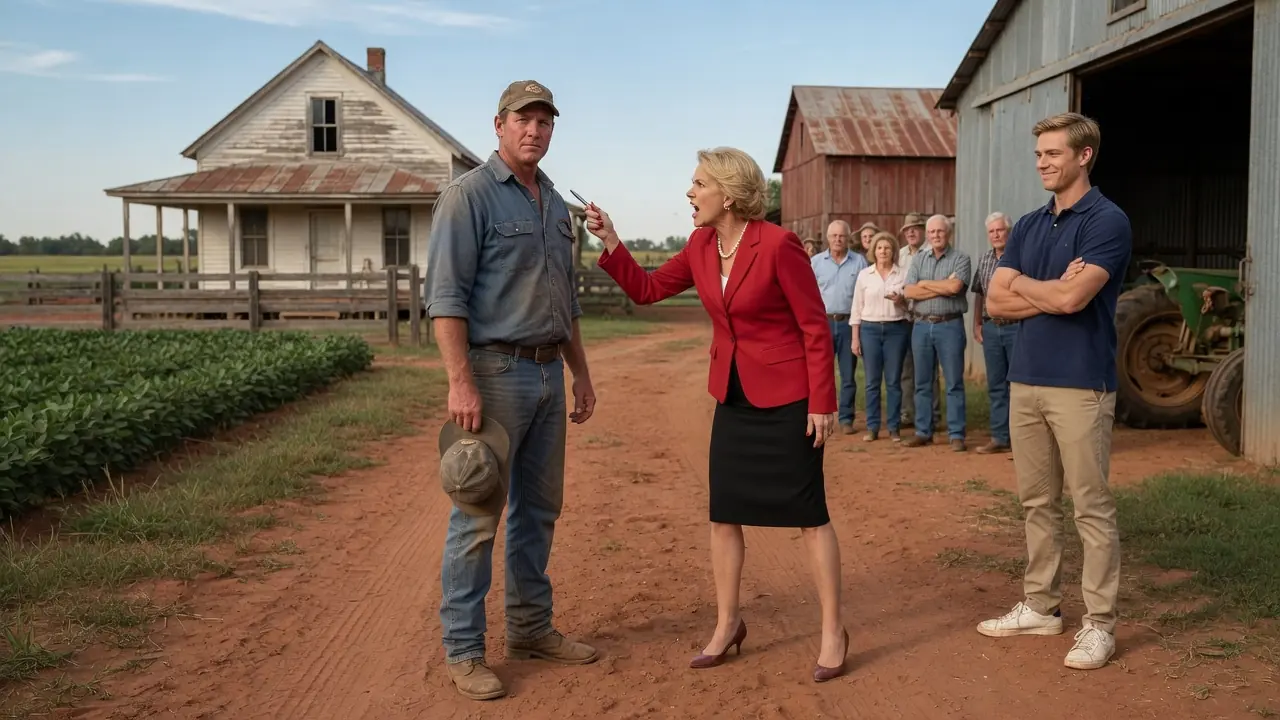
He did not cover his face.
He did not even look nervous.
That was the part people in town would talk about later.
Not only that Ethan Morrison stole the tractor, but that he did it with the lazy confidence of someone who had grown up believing consequences were things that happened to other people.
When the rightful owner came to demand it back, the woman in charge of the homeowners association sat behind her desk in a bright red blazer, pearls at her throat, red nails wrapped around a silver pen, and smiled as if he had brought her a paperwork error instead of evidence of a felony.
“The association has rules,” Linda Morrison said smoothly. “And around here, our rules matter.”
Jack Turner looked at her.
He was forty-two years old, sunburned from years in open fields, quiet in the way of men who had been taught that speaking less often made each word worth more. His boots were dusty. His jeans had red dirt at the cuffs. His shirt sleeves were rolled to the elbows, showing forearms browned by work, not leisure.
Nothing about him looked powerful.
Not to Linda.
Not to Ethan.
Not to the residents peering through the glass wall of the association office, eager to see whether the farmer at the edge of their neighborhood would finally be put in his place.
Linda leaned back in her chair.
“You should be careful, Mr. Turner,” she said. “Private property disputes can become very messy when people overreact.”
Jack placed both hands on the brim of the hat he held in front of him.
“My tractor was taken from my shed.”
Linda smiled wider.
“Moved.”
“Taken.”
“Relocated due to association concerns.”
“My land is not part of your association.”
Her smile thinned.
“That is your opinion.”
Jack looked toward Ethan, who stood against the office doorway with his arms crossed, trying and failing to hide a smirk.
Then Jack looked back at Linda.
“It is not an opinion. It is a deed.”
Linda’s expression hardened for only a second before she recovered.
The clipboard queen of Willow Creek Estates did not like hearing the word deed.
Deeds were old.
Deeds were stubborn.
Deeds were not impressed by matching mailboxes, architectural guidelines, or three-page letters about acceptable lawn ornaments.
Linda tapped her pen against the desk.
“You farm people always think being here first makes you untouchable.”
Jack said nothing.
That silence irritated her more than anger would have.
“If you want to call the sheriff,” she said lightly, “go ahead. But I promise you, Mr. Turner, the rules of this association are stronger than any badge you think you can carry into this office.”
A few residents outside the glass wall laughed softly.
Ethan’s smirk became a grin.
Jack put his hat back on.
Then he nodded once.
“All right.”
That was all he said.
He walked out of the association office, crossed the freshly edged lawn, got into his pickup, and drove back toward the farm that had been in his family since 1954.
No one in the office knew what would happen next.
No one understood that the quiet farmer they had spent two years trying to push off his own land was not just the last man holding the oldest deed in the county.
He was a sheriff’s deputy.
And he was patient enough to let the evidence speak for itself, one document at a time, until the truth became impossible to argue with.
The Turner farm sat at the edge of Briar County, forty acres of red dirt, soybean rows, pasture grass, and stubborn history.
Jack’s grandfather, Walter Turner, had bought the first twenty acres in 1954 after coming home from the Korean War with a bad knee, a used truck, and a belief that land meant a man could feed himself even when the rest of the world got complicated.
Walter built the farmhouse with help from neighbors who were paid in meals, borrowed tools, and promises returned over the next twenty years.
The porch leaned slightly east because Walter had misjudged the first set of posts.
No one ever fixed it.
Jack’s grandmother said the porch leaned toward the sunrise because the house knew what mattered.
Jack’s father, Raymond Turner, added the second twenty acres in 1978, a year before he married Jack’s mother. He planted soybeans, repaired fences, raised cattle for a while, then gave up on cattle after one bull decided fences were merely suggestions.
By the time Jack was ten, he knew every ditch, tree line, and drainage dip on the property.
He knew where the soil dried first after rain.
He knew which gate stuck in July.
He knew the creek sounded different before a storm.
And he knew the tractor.
The old green tractor had belonged to his father.
It was not technically worth one hundred thousand dollars on paper, not according to resale guides or insurance tables. The engine had been rebuilt twice. The paint was faded. The seat had been patched with black tape. It coughed smoke on cold mornings and groaned when turning hard around the south field.
But with the restoration work, equipment upgrades, specialty attachments, and the sentimental value of a machine that had worked Turner soil for three generations, the tractor was worth more than money to Jack.
It was the machine his father had taught him to drive.
The machine Jack had stalled in the lower field at twelve years old and cried because he thought he had broken it.
The machine Raymond Turner had used until his hands grew too stiff from arthritis to grip the wheel properly.
The machine Jack had driven behind his father’s casket the day they buried him beneath the oak tree near the back pasture.
That tractor was family memory with an engine.
Every Saturday Jack was not on duty, he worked the land.
Most people in town knew him as Deputy Turner, a calm presence in a county where calm was often needed. He handled domestic disputes, traffic stops, trespassing calls, noise complaints, and the occasional drunk argument outside Grady’s Bar on Friday nights.
He had a reputation for being fair.
Not soft.
Fair.
He listened before speaking. He wrote clean reports. He did not bluff. He did not threaten what he could not legally do. He did not bend rules for friends or punish people he disliked.
Sheriff David Cole once told a room full of new deputies, “If you want to know whether your report is strong enough, ask yourself if Turner would sign his name to it.”
Jack hated when Cole said things like that.
But he lived carefully enough that it remained true.
On his days off, though, Jack did not wear the badge.
He wore old boots, dusty jeans, work shirts faded by sun and detergent, and a cap with the feed store logo nearly washed away.
He liked being only Jack on the farm.
No radio.
No calls.
No one asking whether something was legal when what they really wanted to know was whether they could get away with it.
For most of his life, the land east of his fence had been pasture and scrub trees.
Then a developer bought it.
Then survey flags appeared.
Then came bulldozers.
Then came streets named after things the bulldozers had removed.
Willow Creek Drive.
Meadow View Lane.
Pasture Court.
By the time Willow Creek Estates opened its front gate, the place had ninety-six houses, three retention ponds, decorative stone entrances, and a homeowners association that acted like civilization had arrived fully formed and was now prepared to improve everything within sight.
Linda Morrison became HOA president before the first year ended.
She had not founded the association, but she took it over with the force of a woman who had found the role her whole personality had been waiting for.
She was fifty-five years old, polished, sharp-featured, and always dressed as if every mailbox check might become a courtroom appearance. Her favorite outfit for association business was a bright red blazer, white blouse, fitted black skirt, pearl necklace, red nails, designer sunglasses, and a leather folder tucked under one arm like a weapon.
Residents joked privately that Linda did not walk through Willow Creek.
She inspected it.
She measured mulch depth.
She photographed garbage cans left visible after 8 a.m.
She mailed violation notices for faded shutters, unauthorized wreaths, uneven hedges, flowerpots placed too close to sidewalks, and one inflatable snowman she described in official minutes as “visually destabilizing.”
At first, Jack found her ridiculous.
Then she became annoying.
Then she became a problem.
The first notice arrived six months after the development opened.
Violation: Tall grass visible from Willow Creek property line.
Jack read it twice, then called the number at the bottom.
Linda answered.
“Willow Creek Estates Association, Linda Morrison speaking.”
“This is Jack Turner. I received a violation notice.”
“Oh, good. Then we can get that corrected.”
“My property is not in Willow Creek Estates.”
Silence.
Then Linda gave a small laugh.
“Mr. Turner, your property borders our community and impacts our visual environment.”
“My property predates your community by sixty years.”
“Visual standards apply to any land visible from association-maintained streets.”
“No, ma’am. They don’t.”
Another silence.
This one colder.
“Well,” she said, “we’ll see.”
The notices kept coming.
Noise complaint: tractor operating before 8 a.m.
Visual nuisance: metal equipment shed visible from Meadow View Lane.
Fence violation: non-uniform post height along shared boundary.
Odor complaint: manure spreading, despite the fact that Jack had not kept livestock in years.
Architectural disharmony: barn roof color not consistent with community palette.
Jack answered every notice.
He attached copies of county maps, land surveys, deed records, zoning confirmations, and polite letters explaining that Willow Creek Estates had no authority over Turner Farm.
He did not insult.
He did not threaten.
He simply responded.
That made Linda furious.
She wanted a fight.
A rude email.
An angry voicemail.
A confrontation she could present to the board as proof that the farmer was unstable, hostile, unreasonable, and bad for property values.
Jack gave her nothing.
He kept farming.
He waved to children who stood along the fence watching the tractor.
He repaired the south gate.
He replaced the old mailbox.
He ignored the gossip.
Then Linda escalated.
She organized a neighborhood meeting titled External Property Impact Concerns.
Jack knew because someone slipped the agenda into his mailbox.
Item four was listed as:
Turner Agricultural Nuisance and Long-Term Community Vision.
Jack read that phrase three times.
Long-term community vision.
He knew what that meant.
Linda wanted his land.
Not personally, maybe.
But strategically.
Forty acres bordering Willow Creek Estates could become Phase Two.
More houses.
More dues.
More power.
The developer had approached Jack twice before construction began, offering numbers that looked large to people who did not understand what land meant when your grandfather’s handprints were in the porch rail.
Jack refused both times.
The developer gave up.
Linda had not.
One afternoon in late August, she met him at the fence line wearing a purple blazer, oversized sunglasses, red lipstick, and heels sinking slightly into the dirt.
She held a clipboard.
Jack was repairing a loose strand of wire.
“Mr. Turner,” she called.
He kept working.
“Afternoon, Mrs. Morrison.”
“You know, all of this could be easier.”
“I’ve always found fixing fences pretty straightforward.”
She smiled tightly.
“I mean the bigger picture. This farm is surrounded now. Development is coming whether you like it or not.”
Jack twisted the wire into place.
“Development can come right up to my fence and stop.”
“People like you never understand progress.”
He stood then and looked at her.
People like you.
There it was.
Not the first time.
Not the last.
But the phrase always told the truth about the person using it.
“And what kind of people am I?” he asked.
Linda adjusted her sunglasses.
“Stubborn people. Men who cling to old things because they have nothing new to offer.”
Jack glanced back at the farmhouse.
The leaning porch.
The barn.
The tractor shed.
The oak tree where his parents were buried.
“I’ve got plenty to offer,” he said. “I’m just not offering it to you.”
Linda’s smile vanished.
“Someday you won’t have a choice.”
Jack nodded.
Then he picked up his tools.
“Someday isn’t today.”
He walked away.
Linda watched him go.
On the other side of the fence, unnoticed by Jack, her son Ethan stood near the patio of the Morrison house, drinking from a bottle of beer and staring at the equipment shed.
Ethan Morrison was twenty-eight years old and unemployed in a way he described as “between opportunities.”
He had attended two colleges without graduating from either. He had worked briefly for a real estate office until the broker discovered Ethan had been using company listings to impress women at bars. He had tried selling high-end outdoor furniture online, failed, blamed shipping costs, and moved back into his mother’s house.
Linda adored him with the desperate blindness of a woman who had turned motherhood into excuse-making.
Ethan was not irresponsible.
He was misunderstood.
Ethan was not lazy.
He was selective.
Ethan was not entitled.
He had standards.
He had inherited Linda’s belief that rules existed for other people and her confidence that language could turn wrongdoing into policy.
Lately, he had become obsessed with Jack’s farm.
At parties, he called it “the problem land.”
He told friends it was only a matter of time before the association forced a sale.
He bragged that his mother had half the county in her pocket, which was not true, though she encouraged the impression.
The weekend before the tractor disappeared, Ethan threw a party at Linda’s house while she hosted a planning committee meeting inside.
String lights hung over the patio.
Music thumped softly.
Beer cans sweated in a cooler.
Ethan stood near the fence, entertaining a group of friends who enjoyed him most when he was bragging.
“All this will be ours eventually,” he said, gesturing toward Jack’s fields.
His friend Tyler laughed.
“You personally buying a farm now?”
“Don’t need to buy what the association can condemn.”
“That’s not how condemnation works.”
Ethan gave him a look.
“You a lawyer now?”
“No, but I’m not an idiot.”
The others laughed.
Ethan flushed.
He hated being laughed at unless he had caused it.
“That tractor’s already blocking the maintenance access half the time,” he said.
Tyler glanced toward the shed.
“That old thing?”
“Yeah. It’s technically on shared use land.”
“It’s behind his fence.”
“Fence lines can be disputed.”
“Can they?”
Ethan drank from his beer.
“My mother says he’s one violation away from serious action.”
Inside the kitchen, Linda heard enough to step onto the patio.
Her bright yellow blouse looked almost neon under the string lights. Her pearl earrings flashed when she turned her head.
“Ethan,” she said, “stop discussing association strategy at a party.”
Tyler grinned.
“We were just asking when your kingdom expands, Mrs. Morrison.”
Linda smiled at the flattery.
“Sooner than some people expect.”
Ethan pointed toward the shed.
“That tractor’s the problem. He parks it like he’s making a point.”
Linda’s expression sharpened.
“He makes everything a point.”
“Someone should move it.”
Linda should have stopped there.
A decent person would have.
A cautious person would have.
But Linda was neither when she felt watched.
She waved one red-nailed hand.
“Then move it for a few days if it bothers you that much. Maybe he’ll learn not to treat this community like his private junkyard.”
The words were careless.
Cruel.
Not meant as legal instruction.
But Ethan heard permission.
Tyler raised his eyebrows.
“You serious?”
Linda gave a light laugh.
“Of course not. Don’t be ridiculous.”
But she did not correct Ethan.
And later, when the party thinned and the patio lights buzzed over empty bottles, Ethan stood at the fence again, looking toward the shed with humiliation still hot in his chest.
He wanted his friends to stop laughing.
He wanted his mother to see him as useful.
He wanted Jack Turner to look helpless for once.
By midnight, he had a plan.
Two nights later, the moon was thin and the Turner farmhouse was dark.
Jack had gone to bed after finishing paperwork for a trespassing call from earlier that week. He slept lightly, as deputies often do, but not lightly enough to hear Ethan Morrison back a flatbed trailer down the dirt access road with his headlights dimmed.
Ethan moved quickly but not carefully.
The trail camera mounted to a fence post caught the truck turning.
Another camera near the equipment shed caught him stepping out.
A third camera, positioned high beneath the shed roof because Jack had dealt with fuel theft the previous year, caught Ethan’s face clearly when he lifted his phone flashlight.
The tractor was locked, but Ethan had found the spare key weeks earlier when he wandered into the shed during one of Linda’s “property line inspections.”
He climbed into the cab.
The engine coughed.
He froze.
The sound seemed impossibly loud in the night.
No light came on in the farmhouse.
Ethan smiled.
He drove the tractor up the trailer ramp badly, scraping the left fender against the rail. The sound made him wince, but only for a second.
Then he secured the tractor with two straps, though one was loose enough that any equipment hauler would have laughed, and pulled away.
At 1:17 a.m., the GPS tracker Jack had installed after a countywide equipment theft ring pinged from the access road.
At 1:31 a.m., it pinged near Willow Creek’s maintenance building.
At 1:36 a.m., it stopped moving.
Ethan parked the tractor inside the association maintenance building, removed the rear plate, tossed it onto a workbench, and locked the door behind him.
He stood there for a moment in the stale smell of fertilizer, gasoline, and bad decisions.
Then he took a picture of the tractor.
He sent it to Tyler.
Told you.
Tyler did not reply.
In the morning, Jack woke before sunrise.
He made coffee in the kitchen his mother had painted blue in 1989. He fed the barn cats. He checked the weather. Then he walked toward the equipment shed and stopped.
The shed door stood open.
The tractor was gone.
For a moment, Jack felt nothing.
No panic.
No rage.
Only a stillness so complete that even the birds seemed too loud.
Then he saw the tire marks.
Trailer tracks.
Boot prints.
A scrape of green paint on the ramp board.
He walked into the shed, checked the lock, checked the camera, checked the GPS app on his phone.
The dot was sitting inside Willow Creek Estates.
Jack stared at it.
Then he exhaled slowly.
“Lord,” he said quietly, “give me patience.”
He did not call dispatch.
Not yet.
He did not drive to the maintenance building.
He did not put on his uniform.
He did what his father would have done first.
He went to ask for it back.
The Willow Creek Estates association office was located near the front gate in a small brick building with white columns that made it look more official than it was.
Linda loved that building.
She had decorated her office with framed community awards, a large map of the subdivision, a shelf full of binders labeled by year, and a little brass sign on her desk that read:
President, Willow Creek Estates HOA
She was behind that desk when Jack arrived.
Bright red blazer.
White blouse.
Pearls.
Clipboard.
The full uniform of pretend authority.
Ethan stood in the doorway, trying not to look too pleased.
Jack removed his hat.
“My tractor was taken from my shed last night,” he said. “GPS shows it on association property.”
Linda blinked slowly.
“Good morning to you too.”
“Where is it?”
“I have no idea what you’re referring to.”
Jack took out his phone and showed her the GPS location.
She glanced at it.
Barely.
“That proves nothing.”
“It proves where the tractor is.”
“It proves where your phone thinks something is.”
“My trail camera also caught a flatbed entering my property.”
Ethan’s smirk flickered.
Linda folded her hands.
“Mr. Turner, perhaps you should consider that your equipment was obstructing association access.”
“My equipment was inside my locked shed.”
“Near disputed land.”
“There is no disputed land.”
Linda leaned back.
“You keep saying that.”
“Because it is true.”
“Truth is often more complicated than men like you understand.”
Jack looked at her red nails tapping the desk.
He gave her one more chance.
“If the tractor is returned today, undamaged, we can keep this simple.”
Ethan laughed.
“Simple? You threatening us now?”
“No.”
Linda smiled.
“He means he’ll call the sheriff.”
A few residents had gathered outside the glass wall, drawn by raised voices and the scent of gossip.
Linda noticed them.
Her posture changed.
Performance mode.
“Let me be very clear,” she said loudly. “This association will not be intimidated by an angry farmer who refuses to respect community standards.”
Jack remained still.
“My land is not in your association.”
“Your land affects our association.”
“My tractor was stolen.”
“Relocated.”
“Stolen.”
Linda stood.
“Go ahead and call the sheriff, Mr. Turner. I’m sure they have better things to do than chase after your rusty old farm toy.”
Jack put on his hat.
“All right.”
He turned.
Linda called after him.
“And do not think that carrying yourself like some kind of country hero makes you above our rules. Around here, our association is stronger than any badge you think you can wave.”
Jack paused at the door.
He looked back once.
Not angry.
Not smiling.
Just looking.
Then he left.
Twenty minutes later, Jack Turner stood in his bedroom buttoning his deputy uniform.
He moved slowly.
Carefully.
The way he did before court testimony.
The badge caught the light when he pinned it to his chest.
He looked at himself in the mirror, then looked past his reflection to the framed photo on the dresser.
His father sat on that tractor in the picture, one hand on the wheel, grinning at something outside the frame.
Jack picked up the photo for a moment.
“You always said don’t start a fight,” he murmured. “But finish the ones that come to the fence.”
Then he set it down.
At his father’s old desk, he laid out the evidence.
GPS logs.
Trail camera stills.
Shed camera footage.
Registration papers.
Insurance documents.
Maintenance records.
Photos of the empty shed.
Photos of the tracks.
He printed a copy of the deed too, not because he needed it for the theft case, but because he had learned long ago that people like Linda preferred confusion, and deeds were clear.
Then he called Sheriff David Cole directly.
“Sheriff,” Jack said. “I need to report stolen farm equipment. I am the victim, so I am requesting another deputy handle the investigation from start to finish.”
Cole was quiet for half a second.
“What happened?”
Jack told him.
Cole swore softly.
“You got evidence?”
“Yes, sir.”
“Bring it in. I’ll assign Alvarez and Pike. You stay out of the investigative chain unless they request victim statements.”
“Yes, sir.”
“And Jack?”
“Yes?”
“You did right calling me first.”
Jack looked out the window toward the fence line.
“I know.”
By late afternoon, Deputies Maria Alvarez and Owen Pike had the case.
Neither worked Jack’s shift.
That was intentional.
Cole wanted clean distance.
Alvarez was meticulous, sharp-eyed, and allergic to nonsense. Pike was younger but careful, the kind of deputy who photographed footprints before stepping near them.
They reviewed Jack’s footage, GPS data, and ownership documents.
Then they interviewed Sarah Bennett.
Sarah lived two houses down from the association office. She was thirty-eight, a nurse practitioner, recently divorced, and not fond of Linda Morrison, though she had kept that opinion private for neighborhood survival.
She had seen Ethan’s truck the night of the theft.
She had been awake with insomnia around 1:20 a.m., making tea in her kitchen when headlights moved strangely across her blinds.
Too low.
Too slow.
She looked out and saw Ethan’s truck pulling a flatbed trailer toward the maintenance building with the headlights dimmed.
At the time, she assumed it was association business.
Now she knew better.
“I should have said something sooner,” Sarah told Alvarez.
“You’re saying it now,” Alvarez replied.
At 6:12 p.m., a marked unit rolled through Willow Creek’s front gate.
People noticed immediately.
Curtains shifted.
Garage doors paused halfway.
A man walking a dog stopped so abruptly the dog kept going and yanked the leash.
Alvarez and Pike parked outside the association office.
Linda came out before they reached the door.
This time she wore a patterned black-and-white blazer, pearl earrings, and oversized sunglasses pushed onto her head. She carried a leather folder as if expecting to manage the situation through paperwork.
“Deputies,” she said brightly. “What can I help you with?”
Alvarez showed her badge.
“We’re investigating stolen farm equipment believed to be on association property.”
Linda’s face tightened.
“I’m afraid you’ve been misled.”
“Then you won’t mind opening the maintenance building.”
Linda smiled.
“That building contains association property and confidential maintenance records.”
Pike glanced at Alvarez.
Alvarez kept her eyes on Linda.
“We’re asking for consent to inspect.”
“Denied.”
“Are you refusing access?”
“I am protecting association assets from unlawful intrusion.”
Alvarez nodded once.
“Thank you. We’ll be back.”
Linda’s smile returned.
“I’m sure you will.”
Two hours later, they returned with a warrant.
Linda was still in the office when the patrol car pulled in again.
This time, Sheriff Cole came too.
Not because Jack asked.
Because the warrant involved a politically loud HOA president and a deputy’s stolen property, and Cole understood optics better than most people understood weather.
Linda stepped outside.
Her smile faltered when she saw the paper in Alvarez’s hand.
“You cannot be serious.”
Alvarez handed her a copy.
“Search warrant for the Willow Creek maintenance building.”
“This is harassment.”
“No, ma’am. This is a warrant.”
“You people are making a mistake.”
Cole spoke then.
“Mrs. Morrison, step aside.”
Linda looked at him as though she had never been told that by anyone wearing a badge.
She stepped aside.
The maintenance building stood behind the office, a wide metal structure used to store lawn equipment, seasonal decorations, bags of fertilizer, and the association’s small utility cart.
Alvarez unlocked it using keys surrendered under protest by Linda.
The doors opened.
The tractor sat inside.
Green paint scraped raw along the left fender.
Rear plate removed.
One strap still hanging from the axle.
Pike photographed everything before anyone entered.
Alvarez checked the serial number against Jack’s registration.
Match.
The tractor was officially recovered at 8:47 p.m.
Ethan Morrison was found at his mother’s house fifteen minutes later.
He had changed clothes and seemed to believe that would matter.
When Alvarez asked him where he had been the night before, he said, “Home.”
When she asked why his truck appeared on camera entering Turner property, he said, “Roads are public.”
When she asked why Jack Turner’s tractor was inside the association maintenance building, he said, “I don’t know. Ask my mom.”
When she showed him the still image of his face illuminated by his own phone flashlight inside Jack’s equipment shed, Ethan went pale.
“You have the right to remain silent,” Alvarez began.
Ethan looked toward Linda.
For the first time in years, his mother had no immediate answer ready.
By the next morning, Willow Creek Estates was divided.
Not morally.
Socially.
There were those who knew Ethan had stolen the tractor and wanted distance from Linda as quickly as possible.
There were those who still feared Linda enough to stay quiet.
And there were those who loved power more than facts and repeated her version because it allowed them to remain comfortable.
Linda hired an attorney named Grant Pritchard from two counties over.
Pritchard wore expensive suits, spoke in sharpened sentences, and specialized in suing local governments on behalf of people who believed any consequence was persecution.
Within a week, he filed a formal complaint against the sheriff’s office alleging abuse of power, conflict of interest, unlawful retaliation, and misuse of law enforcement resources by Deputy Jack Turner.
Linda gave a statement to the local paper outside the courthouse.
She wore a royal blue blazer, pearls, red lipstick, and the pained expression of a woman who wanted cameras to believe she had been personally wounded by injustice.
“This is what happens when a man with a badge cannot accept community oversight,” she said. “My son moved equipment that was obstructing access. That is all. Deputy Turner used his position to criminalize a neighborhood dispute.”
The headline ran the next morning.
HOA President Claims Deputy Used Badge in Property Dispute
Jack read it at his kitchen table.
Then he folded the paper and made coffee.
Sheriff Cole opened an internal review immediately.
Jack expected it.
He welcomed it.
Every dispatch log, phone record, warrant request, interview note, and chain-of-custody document was turned over.
The review found exactly what Jack already knew.
He had reported the theft as a victim, provided evidence, requested recusal from the investigation, and had no involvement in the search warrant, interrogation, arrest, or charging recommendation.
He had done everything correctly.
That should have ended Linda’s story.
Instead, her own camera ended it.
The second piece of footage came from a camera Ethan had installed months earlier above the association office side door after he claimed someone scratched his truck.
He had forgotten it recorded audio.
Sarah Bennett remembered it.
She told Deputy Alvarez.
The recovered footage showed Linda and Ethan standing in Linda’s kitchen the night before the theft, patio door open behind them, party lights glowing outside.
Ethan’s voice was clear.
“What if Turner sues?”
Linda laughed.
“For what? Moving equipment?”
“It’s his tractor.”
“It’s a nuisance.”
“It’s in his shed.”
A pause.
Then Linda’s voice, calm and unmistakable:
“Then go get it from the shed. Stop acting like he’s untouchable. The association protects this neighborhood. If he wants to live like a farmer, he can do it somewhere that doesn’t lower everyone else’s property value.”
Ethan said, “What if the sheriff gets involved?”
Linda replied, “Let him. That old deed won’t matter once we bury him in violations. People sell when staying becomes expensive enough.”
The room watching the footage at the sheriff’s office went silent.
Alvarez looked at Pike.
Pike looked at Sheriff Cole.
Cole said one word.
“Well.”
The camera had captured more than conspiracy to take the tractor.
It captured motive.
Pattern.
Intent.
And when investigators began looking at that pattern, Willow Creek opened like a rotten floorboard.
Residents came forward.
First quietly.
Then all at once.
A riding mower had vanished for two weeks after its owner refused to pay a hedge fine.
A wood chipper disappeared during a tree dispute.
Construction lumber went missing from a driveway after Linda objected to an unapproved garage addition.
A contractor said Linda had threatened to “make permits painful” unless he agreed to use her preferred vendors.
An elderly couple admitted they had paid nearly six thousand dollars in fines they did not understand because Linda told them failure to pay could lead to foreclosure.
A young family said fines stopped only after they agreed to serve on committees Linda controlled.
Then came the books.
The new interim board, pressured by residents and investigators, voted to open the association’s financial records.
What they found was worse than stolen equipment.
Vendor contracts paid to companies with no real offices.
Landscaping invoices four times higher than market rate.
Fine payments missing from official ledgers.
Maintenance funds transferred into accounts labeled as “consulting reserves.”
One vendor address traced to a mailbox rented by Ethan.
Another to a cousin of Linda’s late husband.
A forensic accountant reviewed the records and summarized the situation in plain language:
“This is not sloppy bookkeeping. This is organized theft disguised as community management.”
The community meeting that followed was the largest Willow Creek had ever seen.
The town community center filled before 6:30 p.m.
Residents stood along the walls.
Reporters sat near the back.
Sheriff Cole attended but did not speak.
Jack sat in the last row wearing jeans, boots, and a clean gray shirt.
Not his uniform.
He had refused to wear it.
Linda arrived ten minutes late.
Her outfit was armor: hot-pink blazer, white blouse, pearl necklace, oversized sunglasses, red nails, and a leather folder clutched tightly in one hand.
She walked to the front like she still owned the room.
“My neighbors,” she began.
A few people muttered.
She smiled through it.
“This association has been under attack by outside forces and by one disgruntled landowner who has never respected our standards.”
Jack looked down at his hands.
She continued for nearly eight minutes.
She spoke about property values.
Community harmony.
Rules.
Order.
The dangers of letting emotion override process.
Then the temporary board chair, a retired teacher named Elaine Porter, stood.
“Thank you, Linda. Mr. Turner has requested five minutes to address the room.”
Linda’s face flashed.
“He is not a resident.”
Elaine looked at her over her glasses.
“No. But he is the victim of a theft committed using association property, and every person in this room has a right to hear the evidence.”
For the first time, Linda looked unsure.
Jack stood.
He carried a small laptop and a folder.
No speech notes.
No anger.
No performance.
He connected the laptop to the projector.
The first image appeared.
His equipment shed at 1:04 a.m.
Ethan entering.
The room murmured.
The next image.
Ethan driving the tractor onto the flatbed.
A louder reaction.
The next.
The tractor inside the maintenance building.
Then the GPS map.
The registration.
The deed.
The internal review summary showing Jack had recused himself from the investigation.
Then the kitchen footage.
Linda’s own voice filled the room.
“Then go get it from the shed.”
Gasps.
A woman near the front covered her mouth.
Ethan, seated beside his attorney, looked at the floor.
Linda stood suddenly.
“That recording is taken out of context.”
Jack paused the video.
Then he looked at her.
“Then explain the context.”
Silence.
Not the silence of people waiting.
The silence of people understanding.
Jack clicked to the final slide.
It showed the Turner deed.
His grandfather’s signature.
Then he faced the room.
“My land is not part of this association,” he said. “It never was. It never will be unless I choose to sell it. Your rules do not cross my fence. Your fines do not cross my fence. Your president’s opinion does not cross my fence.”
He looked at the residents.
“I did not come here to embarrass anyone. I came here because a powerful person convinced some of you that rules are whatever she says they are. They are not. Rules have boundaries. So does authority.”
His voice remained calm.
“That tractor belonged to my father. Before that, this land belonged to my grandfather. I defended it the only way I know how. With records. With patience. With evidence.”
He closed the laptop.
“That is all.”
For a moment, nobody spoke.
Then Sarah Bennett stood.
“I saw Ethan’s truck that night,” she said. “I should have come forward sooner. I’m sorry I didn’t.”
Another resident stood.
“Linda fined us eight hundred dollars for a mailbox color that was approved before we moved in.”
Another.
“She threatened to block our deck permit unless we used her contractor.”
Another.
“She told us we’d lose our house over unpaid fines that weren’t even properly issued.”
Voices rose.
Not chaos.
Testimony.
The vote of no confidence passed eighty-nine to four.
Linda Morrison was removed as HOA president before the meeting ended.
Three weeks later, she was indicted for embezzlement, conspiracy, obstruction, and fraud.
Ethan pleaded guilty to theft, property damage, tampering, and conspiracy.
His attorney argued poor judgment.
The judge called it entitlement.
Linda’s criminal case took longer.
Financial crimes always did.
But the evidence was clean. Too clean. Years of control had made her careless. She had never expected anyone to look closely, because for years nobody had.
At sentencing, the courtroom was full.
Linda wore a black suit and no bright blazer.
Her pearls were gone.
So was the commanding posture.
Several residents gave impact statements.
An elderly man spoke about paying fines out of fear.
A young mother described crying in her car because Linda threatened legal action over a backyard baby swing.
Sarah Bennett spoke about the guilt of staying quiet too long.
Jack did not plan to speak.
But the prosecutor asked if he wanted to.
He stood.
Linda would not look at him.
Jack addressed the judge.
“My father taught me that land is not just something you own. It is something you answer for. You take care of it. You respect its boundaries. You do not take what is not yours simply because you want it.”
He looked briefly at Linda.
“Mrs. Morrison thought authority meant making people afraid. It doesn’t. Authority means knowing where your power ends.”
Then he sat down.
Linda was ordered to repay the stolen funds, serve prison time, and permanently resign from any fiduciary or board position in a residential association.
Ethan received probation with strict conditions, restitution, community service, and a felony record that would follow him longer than his mother’s protection ever could.
The tractor came home before the trials ended.
Jack restored the scraped fender himself.
He could have paid someone.
Insurance offered.
He declined.
Some repairs needed your own hands.
On a cool Saturday morning, Sarah Bennett arrived at the farm with a toolbox and two neighbors behind her.
“We’re here about the fence,” she said.
Jack looked at the group.
“What fence?”
“The one Ethan damaged backing that trailer in.”
“I can handle it.”
“I know,” Sarah said. “We’re asking if you’ll let us help anyway.”
More neighbors came.
Some from Willow Creek.
Some from town.
They brought post-hole diggers, hammers, wire cutters, coffee, biscuits, and the awkward humility of people trying to repair more than wood.
By noon, the fence stood straight.
Children from the subdivision fed apples to Jack’s old mule, who had contributed nothing to farm operations in eight years but remained emotionally convinced of his importance.
A boy named Mason asked if the tractor still worked.
Jack smiled.
“Runs better than some people I know.”
“Can I see it?”
Jack looked at the boy’s mother.
She nodded.
He lifted Mason into the cab and let him sit behind the wheel.
Mason touched it reverently.
“Is this the famous tractor?”
Jack laughed.
“I guess it is now.”
Sheriff Cole stopped by near the end of the day.
He stood beside Jack looking at the repaired fence.
“You handled it right,” Cole said.
“I was angry.”
“I know.”
“I wanted to kick the maintenance door down myself.”
“I know that too.”
Jack looked toward the field.
“But if I had, Linda would’ve made that the story.”
Cole nodded.
“Instead, you let evidence make the story.”
Jack was quiet for a moment.
“That’s what Dad would’ve done.”
“Sounds like a smart man.”
“He was.”
That fall, the new HOA board published its first transparent budget.
Every dollar listed.
Every fine reviewed.
Every previous violation audited.
Residents voted to create an independent dispute committee that included one non-resident county mediator for boundary issues involving neighboring properties.
The first letter Jack received from the new board was not a violation notice.
It was an apology.
He kept it in the same metal filing box as the old deed.
Not because he needed it.
Because his father had taught him to keep important papers.
Winter passed.
Spring came.
Soybeans went in on time.
The tractor rolled across Turner soil again, steady and stubborn, coughing smoke on the first start and then settling into the old rhythm Jack trusted.
One morning, as mist hung low over the field, Jack drove along the eastern fence line.
On the other side, residents of Willow Creek walked dogs, drank coffee on porches, waited with children for the school bus.
A few waved.
Jack lifted one hand from the wheel.
Sarah Bennett stood near the fence with a travel mug, watching the tractor move through the field.
She called out, “Looks good out there.”
Jack slowed.
“Fence or field?”
“Both.”
He smiled.
Then he kept driving.
The land looked different now, though nothing physical had changed.
Same rows.
Same red dirt.
Same leaning porch behind him.
Same oak tree in the distance.
But the line between the farm and the subdivision no longer felt like a wound.
It felt like a boundary.
And boundaries, Jack knew better than most, were not meant to keep people from being decent.
They were meant to remind everyone where respect began.
The whole town learned something from the theft of that tractor.
Not all at once.
Not cleanly.
But permanently.
A committee is not a court.
A title is not a law.
A clipboard is not a deed.
And no family name, no bright blazer, no association rule, no neighborhood rumor, and no carefully managed reputation can make stolen property belong to the person who took it.
Jack Turner did not win because he shouted louder.
He won because he stayed steady.
He gathered facts.
He respected the law even when anger gave him every excuse to bend it.
And when the truth finally came, it did not arrive like thunder.
It arrived like a tractor crossing a field at sunrise.
Slow.
Certain.
Impossible to stop.