“Move your car, pretty boy—Mom runs the HOA, and my Porsche parks here now.”
Dylan Mercer leaned against the silver Porsche as though the driveway beneath it belonged to his family. He was twenty-three, dressed in designer sneakers and an expensive jacket, with the bored expression of someone who had never been forced to respect the word no. Across from him stood thirty-one-year-old Ethan Blake, tall and athletic, with tousled blond hair, piercing blue eyes, and a strong clean-shaven jaw, wearing a tailored navy blazer over a crisp white shirt and dark trousers. Behind Ethan, the Porsche’s rear tire rested against the stone border of the flower bed his late father had planted by hand.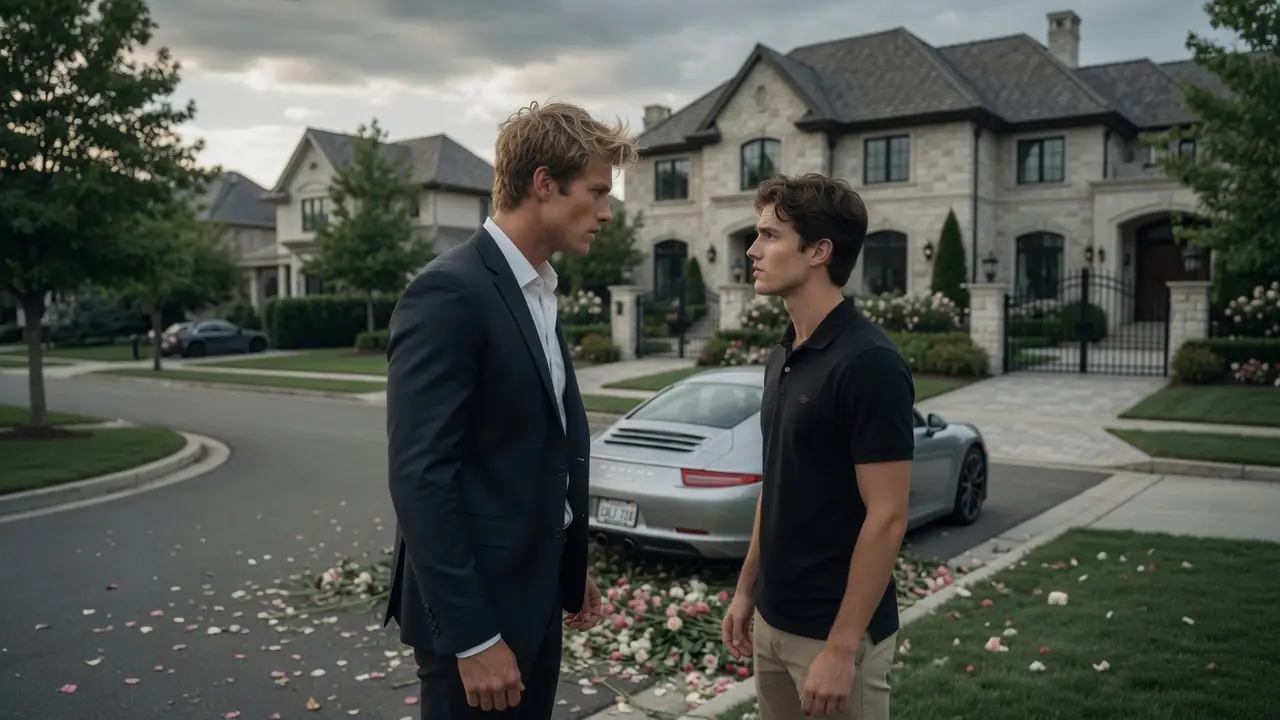
“Her title doesn’t turn my driveway into your private garage,” Ethan said.
Dylan laughed and slipped his phone into his pocket. “Touch it, and the HOA will bury you in fines.”
Ethan looked from the personalized license plate to the security camera mounted above his garage. “Park here tomorrow—then watch your own HOA tow it straight to the crusher.”
Dylan’s smile widened because he believed the threat was impossible. His mother, Karen Mercer, had been president of the Westbridge Hills Homeowners Association for nearly three years, and during that time she had transformed a quiet neighborhood board into her personal court. She issued warnings over flowerpot colors, fined families for basketball hoops, and once threatened an elderly widow because her visiting nurse’s car remained in the driveway overnight. Dylan had grown up watching residents surrender whenever Karen mentioned attorneys, violations, or liens.
Ethan Blake did not surrender easily.
He had purchased the gray stone house on Hawthorne Lane eighteen months earlier after returning to his hometown to manage the architecture firm his father had founded. The home had belonged to his parents for more than twenty years, and Ethan bought it from the estate after his father, William, died from a sudden illness. Most rooms had been renovated, but Ethan refused to change the front garden or driveway. William had designed both himself, shaping the drainage, laying the pale stone border, and planting white roses beside the walkway.
Every morning, Ethan left for work at seven thirty.
Every morning for the previous week, Dylan parked his Porsche across the lower half of Ethan’s driveway at seven fifteen and walked through the neighborhood’s private pedestrian gate toward a nearby luxury gym. The gym charged members for parking, while Hawthorne Lane offered a shorter walk without fees. Dylan chose Ethan’s driveway because it was closest to the gate and because the owner’s expensive clothes made him assume Ethan was too concerned with appearances to begin an ugly neighborhood conflict.
The first morning, Ethan left a polite note beneath the windshield wiper.
The second morning, he spoke to Dylan directly.
The third morning, Dylan tossed the note into the flower bed and told Ethan to reverse across the lawn if he needed to leave. His tire crushed two rose stems when he drove away. Ethan replaced the damaged plants that evening and installed a second security camera facing the street.
On the fourth morning, Karen Mercer appeared beside her son.
She was fifty-two, elegantly dressed, and carried a leather folder stamped with the Westbridge Hills emblem. Karen informed Ethan that the section of pavement beside the street fell within the association’s visual-control area. She claimed Dylan was not blocking the entire driveway and suggested Ethan modify his morning schedule to avoid unnecessary conflict.
“My schedule is not the problem,” Ethan said. “His car is.”
Karen smiled without warmth. “You are new here, Mr. Blake. Residents who cooperate with the board generally find life much easier.”
“My family owned this house before you moved into the neighborhood.”
“And now I manage the standards that protect its value.”
“You manage common property. You do not manage my driveway.”
Karen opened her folder and handed him a warning notice. It accused Ethan of creating a hostile confrontation with another resident and threatened a five-hundred-dollar conduct fine if he continued “harassing authorized neighborhood vehicles.” Dylan stood beside her grinning, apparently delighted that his mother had converted his misconduct into Ethan’s violation.
Ethan read the notice twice.
Then he folded it carefully and placed it inside his blazer.
“Thank you,” he said.
Karen appeared disappointed by his calm response. “Do you understand what happens if you ignore a board order?”
“Perfectly.”
That afternoon, Ethan requested the association’s complete governing documents, parking regulations, enforcement contracts, and meeting minutes. Karen delayed the request until Ethan’s attorney sent a formal demand citing the homeowner inspection provisions in state law. Two days later, the management company released more than six hundred pages of records.
Ethan read every one.
His profession required him to examine complicated building contracts, zoning codes, and engineering specifications. He approached the HOA documents with the same patience, marking contradictions, expired provisions, and procedures Karen had repeatedly ignored. The most interesting discovery appeared in a parking-enforcement amendment adopted six months earlier at Karen’s insistence.
The amendment established a strict policy against vehicles blocking driveways, sidewalks, fire access, or landscaped borders. Any vehicle documented committing the same obstruction three times within thirty days could be designated a recurring community nuisance. The board’s contracted towing company was authorized to remove the vehicle, assess escalating fees, and transfer it to long-term storage if the owner failed to claim it.
Karen had promoted the policy after a contractor’s truck briefly blocked her own driveway.
Meeting minutes recorded her exact words: “No resident’s status, family connection, or personal excuse should override uniform enforcement.”
Ethan printed the sentence and placed it beside the photographs of Dylan’s Porsche.
The enforcement contract contained another useful provision. When a board member, officer, or immediate relative was involved, the management company—not the board president—assumed authority to prevent conflicts of interest. Karen could threaten Ethan, but she could not legally stop the process once the documented complaint reached the independent property manager.
Ethan contacted Melissa Grant, the regional manager assigned to Westbridge Hills.
He sent time-stamped photographs from every morning, security footage of Dylan stepping on the flower border, copies of the discarded notes, and Karen’s warning accusing Ethan of harassment. He included measurements showing that the Porsche reduced the usable driveway opening below the minimum required for emergency access.
Melissa telephoned him within an hour.
“Mr. Blake, did you tell Ms. Mercer that her son was blocking your property?”
“Four times.”
“Did she see the vehicle herself?”
“She stood beside it yesterday.”
Melissa exhaled slowly. “The conduct notice she gave you was never submitted through our office.”
“Is that required?”
“Yes. The document number is invalid.”
“So she created it herself.”
“That appears to be the case.”
Melissa asked for two business days to investigate. Ethan agreed, but requested written confirmation that the evidence had been received before Dylan’s next visit. By evening, he had a formal case number.
The fifth morning was the confrontation Dylan treated as a joke.
After Ethan promised that the HOA would tow the Porsche, Dylan walked away laughing. He returned forty minutes later and discovered a bright orange violation sticker attached to the driver’s window. Melissa had sent a compliance officer to inspect the obstruction personally.
Dylan ripped off the sticker and marched to Ethan’s front door.
“You reported me?”
Ethan opened the door but remained inside. “I followed your mother’s parking policy.”
“She’s going to erase that violation.”
“She no longer controls the case.”
Dylan stared at him. “You think some management employee is going against my mother?”
“I think your mother wrote a rule that removes her from cases involving family.”
Dylan’s expression changed for the first time. His arrogance remained, but uncertainty had entered it. He drove away after spinning one rear tire across the stone border, scattering white pebbles over the lawn.
The camera captured everything.
Karen arrived at Ethan’s house before noon.
She carried no folder this time. Her face was red, and anger broke through the polished expression she presented at board meetings. She demanded that Ethan withdraw the complaint and accused him of using technicalities to target her family.
“You wrote the technicalities,” Ethan said.
“This neighborhood needs flexibility.”
“You told the board that no family connection should override enforcement.”
“That statement concerned commercial vehicles.”
“The amendment says any vehicle.”
Karen stepped closer. “I can make homeownership very unpleasant for you.”
Ethan held up his phone. “You are being recorded.”
She looked toward the camera above the door and immediately lowered her voice. “This should remain between neighbors.”
“It did until you fabricated a violation notice.”
“I was protecting my son from harassment.”
“I asked him to stop parking on my property.”
“He was there less than an hour.”
“Then paying for the gym garage should not be a serious burden.”
Karen’s eyes narrowed. “You have no idea who you are challenging.”
Ethan looked past her toward the damaged roses. “You have no idea what I am protecting.”
The independent review moved quickly.
Melissa discovered that Karen had issued twelve unauthorized notices during the previous year without submitting them to the management company. Several targeted residents who had disagreed with her at meetings. She also found that Karen had privately instructed the association’s security contractor to ignore Dylan’s parking violations while aggressively ticketing delivery workers and visitors.
The board scheduled an emergency executive session.
Karen attempted to cancel it, but four of the seven directors voted to proceed. Ethan was invited to present his evidence. He entered the clubhouse wearing a navy suit, white shirt, and dark striped tie, looking composed enough that Karen’s closest ally whispered that he appeared more like the association’s attorney than a complaining homeowner.
Dylan attended beside his mother.
He wore sunglasses indoors and kept his arms folded while the security footage played on a large screen. The video showed his Porsche blocking Ethan’s driveway on five separate mornings. It showed Dylan throwing a can into the garden, crushing the flowers, removing written warnings, and laughing during each confrontation.
Karen objected when the fabricated notice appeared.
“That document was an informal warning,” she said.
Melissa placed the official violation template beside it. “You copied the association seal and assigned a false case number.”
“I am the president.”
“You are not authorized to create enforcement records outside the management system.”
Karen looked toward the other directors. “This is a personal attack led by a homeowner who has lived here barely eighteen months.”
An elderly board member named Arthur Bell adjusted his glasses. “His family lived here before most of us.”
“That is irrelevant.”
“So is your son’s identity,” Arthur replied. “According to the rule you wrote.”
The board voted to void Ethan’s false conduct notice and issue Dylan a formal first-level obstruction violation. They ordered him not to park within fifteen feet of Ethan’s driveway entrance. Karen demanded the board close the case, but the independent manager reminded her that repeated violations would trigger automatic escalation.
Outside the clubhouse, Dylan confronted Ethan.
“You embarrassed my mother.”
“She embarrassed herself.”
“She can still make you pay.”
Ethan stopped beside his car. “Your Porsche has one official violation. Another doubles the fine. The third activates the nuisance clause.”
Dylan removed his sunglasses. “You really think they’ll tow me?”
“I think you’re arrogant enough to make them.”
The next morning, the Porsche returned.
Dylan parked more aggressively than before, angling the rear of the car across almost the entire driveway. He stepped out, looked directly into Ethan’s security camera, and raised both hands in a mocking gesture. Then he photographed himself beside the vehicle and uploaded the image to social media with the caption: HOA rules don’t scare people who own real lawyers.
The post reached Melissa before Dylan finished his workout.
A second orange notice waited on the car when he returned. His fine increased to five hundred dollars, and the document warned that one more verified obstruction would classify the vehicle as a recurring nuisance. Dylan tore the notice in half, left the pieces on Ethan’s driveway, and drove away.
Karen called an emergency board meeting that evening.
She proposed suspending the parking policy until the association could conduct a legal review. The remaining directors immediately recognized the attempt to protect her son. Three residents attended with photographs of Dylan blocking their driveways during previous months, revealing that Ethan was not the first person he had targeted.
One was a nurse named Priya Patel.
Dylan had once blocked her driveway while she was responding to an emergency shift. Karen dismissed Priya’s complaint after claiming the photographs did not prove who had parked the Porsche. Another resident, seventy-year-old Margaret Henderson, presented a notebook containing dates when Dylan used private driveways throughout the neighborhood.
The board refused Karen’s suspension request.
Instead, they voted to place her on temporary leave while reviewing misuse of association authority. Arthur Bell became acting president. Karen left the meeting before the vote total was announced.
Dylan blamed Ethan.
He sent angry messages through a false social-media account and drove slowly past Ethan’s house several times that night. Ethan did not respond. He forwarded everything to Melissa, the board, and local police for documentation.
At seven fifteen the following morning, the Porsche returned for the seventh time.
Dylan left it directly across the driveway, climbed onto the hood, and recorded a video. “This is for Ethan Blake, the neighborhood’s pretty little rule expert,” he announced. “My mother built this HOA, and nobody here is touching my car.”
Ethan watched from the garage.
He did not step outside or argue.
He sent one message containing the live camera image and the case number.
Melissa replied: Third verified violation. Towing authorized.
The association’s contracted tow truck arrived twelve minutes later. Its driver photographed the Porsche from every angle, recorded the obstruction, checked the prior notices, and attached the required authorization form. Arthur Bell and Melissa stood beside the truck as official witnesses.
Dylan returned while the front wheels were being lifted.
He ran toward the car, shouting that nobody had permission to touch it. The tow operator handed him the enforcement order. Dylan tried calling Karen, but she was already driving toward the scene.
“You can stop this,” Dylan told Arthur.
Arthur shook his head. “Your mother’s policy says enforcement must continue once towing begins.”
“That rule was for strangers.”
“It was for residents.”
“My family pays more dues than half this neighborhood.”
“Your dues do not purchase Ethan’s driveway.”
Karen arrived in her black SUV and parked in the middle of the street. She ordered the tow operator to release the Porsche, identifying herself as HOA president. Melissa informed her that she had been suspended and no longer possessed enforcement authority.
“This association will be sued into bankruptcy,” Karen said.
Ethan finally stepped outside.
He wore a fitted white shirt with the sleeves rolled neatly to his forearms, dark trousers, and a calm expression. He stopped near the damaged garden without approaching the Porsche.
Karen pointed at him. “You caused this.”
“No. Your son parked the car.”
“You manipulated our rules.”
“I followed the rule you demanded everyone else obey.”
Dylan looked between them. “Mom, make them put it down.”
Karen grabbed her phone and called the police.
Officer Samuel Rhodes arrived before the tow truck departed. He reviewed the complaint, the three violations, the association policy, and the private-property obstruction. After speaking with Melissa, he informed Karen that the tow appeared legally authorized.
“This is theft,” she insisted.
“It is a contracted HOA enforcement action,” Rhodes replied.
“Then I revoke authorization.”
“You are suspended.”
Karen’s face lost color.
The Porsche left Hawthorne Lane on the back of the tow truck while neighbors watched from porches and windows. Dylan stood beside his mother in silence, no longer looking like the untouchable young man who had mocked Ethan days earlier.
The towing facility charged six hundred dollars for the removal, administrative processing, and first day of storage. Because the Porsche had been classified as a recurring nuisance, the HOA policy also imposed a fifteen-hundred-dollar enforcement assessment. Karen refused to pay either amount.
She instructed Dylan to leave the car in storage while she challenged the board.
The decision proved disastrous.
Daily fees accumulated. The association refused to cancel its assessment unless Dylan signed a compliance agreement and paid for Ethan’s damaged landscaping. Karen rejected the condition because signing would acknowledge that her son had violated the rules.
A week passed.
Then two.
The Porsche remained behind the impound fence.
Dylan had received the vehicle as a graduation gift, but its title was registered to a family holding company controlled by Karen. That detail prevented him from retrieving it without her signature. Karen believed the threat of litigation would eventually frighten the board into releasing it.
Instead, the board hired independent counsel.
The attorney confirmed that enforcement had followed the association’s adopted procedure. He also found that Karen’s misuse of HOA stationery and false case numbers could expose her personally to liability. The board removed her permanently by a vote of six to zero.
Residents demanded a membership meeting.
During the meeting, Priya Patel read aloud the section of Karen’s parking amendment authorizing the contracted facility to classify an unclaimed nuisance vehicle as abandoned after the statutory notice period. Once declared abandoned, the towing company could seek a lien, sell the vehicle, or transfer it to a licensed salvage operator if sale proceeds were unlikely to cover accumulated fees and administrative costs.
Karen stood at the back of the room.
“You are threatening to destroy a hundred-thousand-dollar car over parking,” she said.
Arthur Bell looked toward her. “The car could have been recovered during the first day.”
“I refused to validate an illegal tow.”
“The court denied your emergency petition yesterday.”
The room became silent.
Karen had filed without informing most residents, using another five thousand dollars of association money before her removal became final. The judge ruled that she lacked authority to act for the HOA and that the documented violations supported the tow.
Dylan finally understood the danger.
He approached Ethan after the meeting. The arrogance in his face had been replaced by exhaustion. “Tell them to release it.”
“I don’t control the board.”
“This started because of you.”
“It started because you parked across my driveway.”
“I said I was sorry.”
“You called me a coward on video three days ago.”
Dylan lowered his eyes. “Fine. I’m sorry now.”
Ethan studied him. “Are you apologizing because you understand what you did, or because your car is about to disappear?”
Dylan did not answer.
The statutory abandonment notice arrived the next week. Karen had ten days to pay the towing lien, storage fees, HOA assessment, landscaping damages, and legal costs related to her failed emergency motion. The combined total exceeded fourteen thousand dollars.
Karen could have paid.
Her home was valuable, and she owned investment accounts. However, paying would require admitting defeat publicly and accepting that the board had authority over her family. She continued insisting the car would never be touched because its market value was too high.
Then the lender appeared.
The Porsche had not been purchased outright. Karen’s family company financed part of it through a luxury-vehicle loan and had recently missed two payments. When the lender learned the car had been impounded and declared abandoned, it reviewed the account and discovered that the insurance policy had lapsed during Karen’s legal dispute.
The lender refused to redeem the vehicle without proof of renewed coverage and payment of the towing lien. Karen blamed the HOA, the tow operator, Ethan, and eventually Dylan. Nobody accepted responsibility except the person who had repeatedly parked the car where he was told not to.
The deadline expired.
A salvage company purchased the lien interest after the lender declined to recover the Porsche. The vehicle had suffered minor damage during weeks of outdoor storage, and legal complications made a conventional auction unattractive. Its usable components were removed for resale, including the wheels, interior electronics, doors, engine parts, and body panels.
What remained was transported to a licensed recycling facility.
Arthur invited no residents to witness it.
Ethan did not attend.
Dylan followed the transport truck himself.
He stood behind a safety barrier as the stripped silver shell entered an industrial crusher. The machine lowered slowly, folding the roof, bending the frame, and reducing the car that once announced his importance into a flattened block of metal.
Karen arrived too late.
She remained inside her SUV, staring at the compressed remains while Dylan stood alone. For the first time, neither of them had an argument powerful enough to reverse what had already happened.
The story traveled through Westbridge Hills quickly.
Some residents celebrated, but Ethan refused to treat the destruction as entertainment. The Porsche had not been crushed because he wanted revenge. It had reached the crusher because Dylan ignored repeated warnings, Karen blocked every reasonable solution, and both believed rules should stop applying whenever consequences reached them.
The new HOA board revised its procedures.
No president could issue enforcement notices without management-company approval. Complaints involving board relatives required automatic independent review. Towing policies remained strict, but residents received clearer notices and a neutral appeal process.
The board also ordered Karen to reimburse association funds spent on her unauthorized legal action. When she refused, the HOA pursued repayment through the same enforcement mechanisms she had once used against other homeowners. She eventually signed a settlement requiring monthly payments and formally resigned from every neighborhood committee.
Dylan sold several expensive possessions to help cover family costs.
Without the Porsche, he began using an older sedan owned by his father. He parked it legally at the gym, paid the garage fee, and walked the additional distance without complaint. Neighbors noticed that he no longer threw trash, blocked driveways, or mentioned his mother’s authority.
One month later, he appeared at Ethan’s house carrying two replacement rose bushes.
Ethan opened the door but said nothing.
Dylan looked toward the damaged flower border. “These are the same variety, according to the nursery.”
“They are.”
“I know they don’t replace the original ones.”
“No.”
Dylan swallowed. “I treated your home like it didn’t matter because I thought money made my convenience more important.”
Ethan waited.
“My mother kept protecting me, so I never had to understand what I was doing to people.” Dylan looked down at the roses. “Then she couldn’t protect the car.”
“Your mother did not park it.”
“I know.”
That answer mattered more than the apology.
Ethan accepted the bushes but made Dylan help plant them. They worked for nearly an hour, removing damaged roots, adding fresh soil, and rebuilding the pale stone border. Dylan’s clothes became dirty, and his hands blistered because he had rarely performed physical work.
When they finished, Ethan brought two glasses of water.
Dylan sat on the front step. “Did you know they would crush it?”
“I knew abandonment could lead to salvage.”
“You could have warned me.”
“I warned you every morning.”
Dylan nodded slowly. “That’s fair.”
The new roses bloomed the following spring.
Ethan kept the security cameras, but no car blocked his driveway again. His relationship with the HOA improved, and Arthur asked him to join the architectural committee because someone who understood boundaries might help prevent future abuse.
Ethan declined the position.
He had no interest in controlling his neighbors.
Instead, he volunteered to review the board’s property maps and enforcement language so rules could not be twisted as easily again. He believed a good association should protect shared standards without treating private homes like territory waiting to be conquered.
Karen rarely spoke to Ethan after her removal.
One morning, she passed while he was trimming the roses Dylan had planted. She slowed beside the driveway and looked toward the empty space where the Porsche once stood.
“You destroyed my son’s future,” she said.
Ethan set down the shears. “A car was destroyed.”
“He loved that car.”
“My father loved this garden.”
Karen’s expression tightened.
Ethan continued, “The difference is that I never parked my grief across your property and demanded you accept it.”
She drove away without replying.
Years later, people in Westbridge Hills still told the story of the HOA president whose own policy sent her son’s Porsche to the crusher. Some exaggerated the details and claimed Ethan had personally ordered the car flattened. Others said he watched while smiling.
Neither version was true.
Ethan had simply refused to move his boundary for someone who mistook patience for weakness. He documented the violations, followed the procedures Karen created, and allowed her choices to meet their natural consequences.
The Porsche had been beautiful, fast, and expensive.
None of that gave it the right to block another man’s home.
Karen’s title had sounded powerful.
None of it gave her the right to protect her son from every rule she imposed on others.
And Ethan’s calmness had looked like weakness only until the moment everyone discovered it was discipline.
The final rose opened beside the driveway on the anniversary of William Blake’s death. Ethan stood in the morning light, adjusted one pale stone near its roots, and looked across the clear entrance to his home.
No engine roared.
No tire crossed the border.
No arrogant voice ordered him to surrender what belonged to him.
The driveway was open, the garden was alive, and Westbridge Hills had learned a lesson no board meeting could have taught as clearly:
Rules written to control everyone else have a dangerous habit of returning to their author.